Northwest Profiles
October 2022
Season 36 Episode 1 | 29m 7sVideo has Closed Captions
Magnificent Manito Park, Legendary Denny Yasuhara, Spirits of Colfax, Art of the Toad
Exploring Spokane's Manito Park from the ground up. Staff show us how they keep this crown jewel of parks popping with color and beauty. Denny Yasuhara's contributions to Spokane have been recognized with the naming of a school after the Japanese American teacher and civic leader. Has St. Ignacious Hospital in Colfax found new life - in Death? A B.C. artist loves her subjects, warts and all!
Problems playing video? | Closed Captioning Feedback
Problems playing video? | Closed Captioning Feedback
Northwest Profiles is a local public television program presented by KSPS PBS
Funding for Northwest Profiles is provided by Idaho Central Credit Union, with additional funding from the Friends of KSPS.
Support provided by:

Northwest Profiles
October 2022
Season 36 Episode 1 | 29m 7sVideo has Closed Captions
Exploring Spokane's Manito Park from the ground up. Staff show us how they keep this crown jewel of parks popping with color and beauty. Denny Yasuhara's contributions to Spokane have been recognized with the naming of a school after the Japanese American teacher and civic leader. Has St. Ignacious Hospital in Colfax found new life - in Death? A B.C. artist loves her subjects, warts and all!
Problems playing video? | Closed Captioning Feedback
How to Watch Northwest Profiles
Northwest Profiles is available to stream on pbs.org and the free PBS App, available on iPhone, Apple TV, Android TV, Android smartphones, Amazon Fire TV, Amazon Fire Tablet, Roku, Samsung Smart TV, and Vizio.
Providing Support for PBS.org
Learn Moreabout PBS online sponsorshipHello and welcome to the season premiere of Northwest Profiles.
I'm your host, Lynn Valerie.
And for me, the opening volley of a new season is always invigo And that is certainly the case t for two reasons.
Number one, it launches what remarkably will be our 36th And number two, it marks the debut of three brand new Nor Profile producers.
They are Neil Vanos, McKayla Fox and Todd Anderson.
No doubt their fresh perspective coupled with the well-traveled t of veteran producer Scott McKinn will help carry on the program's fine tradition of storytelling.
And of course, let's not forget the constant driving force behind the longevity of this pro Viewers like you throughout our vast vie covering parts of four states and two provinces of Canada, have supported the show over the both financially and with story The continued success of this sh would not be possible without yo Now let's raise the curtain on s For our free story, It's a short trip to Spokane, So an historic Manito Park, a park has been an icon of eastern Wash since it was established in 1904 We take you behind the scenes to some of the people who keep Manitoba looking its best.
My name is Jesse Jones.
I've been working for the city of Spokane Parks for 15 years.
I started out as a labor one, and now I'm the fore person up here at Manito Park.
My main responsibilities here at Manito Park are supporting all of the employees that work here.
I mean, I work on irrigation.
I lay sod, I do plumbing, a little bit of everything.
The work that has to go into Duncan Garden is quite extensive.
We have to bring in compost, we have to rototill all the beds.
We have to edge the beds, hedge trimming.
We're actually having 15 volunteers that are going to be here.
And then with our about 15 employees, we're going to start planting Duncan Garden, and then hopefully we'll be able to get that finished sometime a week.
Week and a half.
I'm not a gardener by any means, but I've definitely learned so much from the gardeners here at Manito Park.
My name is Mattie Whitney, and I'm the perennial gardener here at Manito Park in Spokane, Washington.
This is a four acre perennial garden.
There's something magical about the park.
If you drive in any direction and your in a busy streets, but yet here is this peaceful, beautiful place that people can come and enjoy.
And being the person that provides that for the community is something special.
Well, I started with the Parks Department, 20 years ago.
I was a botany student at Eastern Washington University.
And I didn't know anything about gardening.
But I knew about plants.
And so as I was identifying plants in the wild area that they had relatives that are perennials that grow in the perennial garden.
So just by knowing what plants needed, I knew how to take care of them.
And so that's kind of started my love of gardening and growing plants.
We're definitely a resource for the community because they can come and they can discover what they can actually grow in their own yards.
They can come here to the perennial garden and learn what they can put in their yard that will live for years.
And these are tried and true perennials that are known that they grow in this area.
So they can definitely learn from us here.
My name is Kevin Kilgore.
I've just taken over the Rose Hill Gardener position here at Manito Park.
We have old fashioned roses, miniatures, hybrid teas, grandifloras, floribundas, a little bit of everything.
We started around the 1st of April, weather permitting, and do a hard prune.
From that point on, it's about weeding and edging and making sure everything looks really clean.
Then we jump into fertilizing and amending the beds.
From that point on, you get to the deadheading, which we're kind of in the middle of right now.
I got out of the Air Force in the late nineties and was kind of figuring out what I wanted to do.
Ended up walking through the gardens one day with my wife and told the gentleman who just retired from the Rose Hill.
I was coming for his job and here I am.
Being outside, beautiful weather, it's therapeutic, to work with plants.
And then the people, the public, make it really worthwhile.
My name is Tara Newbury.
Right now I'm working in the Japanese gardens and I also designed Duncan Gardens.
I spend maybe a few weeks designing it and coming up with the layout and all the numbers for it.
My main responsibilities here, while I'm in the Japanese gardens is helping out the head gardener do all the pruning.
A lot of my passion came from when I was a little girl being around my grandmother's garden.
I just love each and every flower that I come across.
I've worked all over town.
I've worked in every single park in the city.
Coming up here to Manito Park, I mean, there are times where I walk around here and I'm just like, Wow, I get to work here.
This park has a little bit of everything for everyone.
I mean, my fellow employees are are great.
And it does.
I feel like I've finally made it home.
You really don't find anything else like this.
The diversity, the roses, the conservatory, the perennials, Duncan Gardens and yeah, the Japanese gardens.
I mean, there's really nothing else like it.
I get to share my knowledge and my love of flowers with the public.
The staff here is honored to be able to take care of this beautiful piece of property and share it with everyone.
And that's that's what's neat about Manito.
Manito Park can be enjoyed year round, including now when the park is awash in vibrant fall colors and durin the holidays, visitors can look to festive displays of Christmas So be sure to check it out.
Now, with Halloween just around the corner.
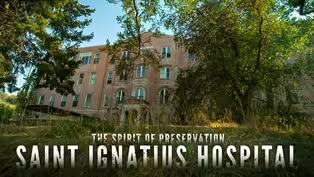
We thought it would be fun to ce this scary season with a visit to a 150 year old abandoned hospital in Colfax, Wa For over a century, Saint Ignatius Hospital was the only medical facility fo serving communities on the Palou Today, a couple is renovating th to give it a second life.
With a little help from a few ghostly friends.
[Wolf howling] [Valoree Gregory] Donald, if you're here, can you turn on the flashlight or any of these meters?
[Radio noises] [Valoree] Ghosts.
Did you hear him?
[Tour Guest] Mhmm.
Yeah.
[Valoree] He said ghosts.
They're ghosts.
I usually do ask them, Do you know that youve passed away?
because I dont know.
So, St. Ignatius Hospital was built in 1893 by the Sisters of Providence.
Mother Joseph built the building.
She also built Sacred Heart Medical Center.
In about 1968, the nuns decided to sell it because they were going to have to put in sprinkler systems.
And then it became a home for development, disabled and the mentally insane.
In 2003, they abandoned the building.
I am Valoree Gregory.
I am the director of the Whitman County Historical Society, and Im also the head tour guide for the ghost hunts.
Let's head into the kitchen.
Is there anyone else here with you?
[Radio noises] [Valoree] Did he say they all left?
[Ghost tour guest] Kinda of sounded like that.
[Valoree] I swear if that other group took them.
Eight years ago, we decided to use, like paranormal tourism as a way to get people to come to Colfax.
We used it as a vehicle to get people here and it worked.
So yeah, we had to use what we could and ghosts were - Sure, it's always been known as being haunted.
Like all the neighbors will say, Oh, I see someone standing in the window and I know you're not there because my car's not here.
[Radio noises] [Valoree] History.
Do you like when we tell the stories?
Oh, flashlight!
So, I didn't have to make up ghosts or anything like that.
It's always been known as a haunted facility.
[Austin Storm] Whenever you go into an abandoned building, you sense, okay, people lived a life here and now it's run down.
And there's a real powerful sense of hauntedness that you get just from that.
[Valoree] One time on the second floor, we saw something crawling down the floor, but it was see-through... My son always says, I can't believe you're known as the ghost lady.
Like that's what they call me.
They're like, Hey, ghost lady.
Im like, Hey, hows it going?
But by starting the ghost tours, I see how it changed Colfax.
I think in one year we opened up 17 new businesses in downtown Colfax, and it was because of this building.
And from the historical society side of things, our whole goal was always to have somebody buy it who actually cared and they definitely care.
So yeah, I'm okay with being the ghost lady.
[Music plays] [Austin] We first saw the building in 2014 and we were just struck by both the beauty of it and how rundown it was.
We were surprised that no one was taking care of it.
And then it took us a full seven years to actually buy the building from the previous owners.
[Laura Storm] And we feel definitely like caretakers.
Not like “owners, ” you know?
[Austin] Yeah, for a while we were like, oh, surely somebody is going to do something with this building.
And then as the years went on it became apparent that if we didn't do it, there was a good chance that nobody else would and it would actually fall down.
[Laura] I think how Austin and I most felt about it was, we're like, Well, worst case scenario, we try to fix it and it all just caves in, we go, that was going to happen anyway.
At least we tried, then not attempt it.
[Austin] Yeah, it's really that, that whole thing where regret runs one way, right?
Once you lose something like this, there's no getting it back.
We really feel that urgency when we're when we're looking at old buildings.
That if we don't save them, we'll lose something irreplaceable.
[Valoree] I love that they're going to repurpose it and still save the history.
Like I think the outside will still say St. Ignatius and I'll still say 1893 on it, and they'll still be able to tell the story of what this building was.
And I think that's probably the most important thing that we do on our ghost tours is that it's just not about finding the ghost or seeing something or hearing something that's fun.
But we like to tell the story of the people that lived here.
Now, whether those spirits are here or not, I don't know.
But it's fun to tell about Mother Joseph.
It's fun to tell about Sister Gabriella and we love to get the story out about the people who built the place and made the place what it was.
[Austin] So there are lots of times in history where people are kind of stymied by how to use a building.
Like there's no immediate adaptive reuse that suggests itself.
And that could be the case in a building like this.
Like Colfax is a smaller town.
So there's not a lot of call for one use that uses the whole building.
Fortunately, we can we can put a whole bunch of pieces in and really make it something special.
[Laura] We're working with a design group to figure out to be like, okay, could we do a coffee shop on the main level?
And then how many rooms can we fit on that above floors?
And then you have to figure out, well, if you're going to do X number of floors, like when you want to do it to code, you're like, Oh, this thing or that thing.
And I think we really want to do something when its finished, you still want to feel like you're going back in time a little bit.
You don't want it to be like, well, and everything is sleek and shiny.
[Austin] Yeah, it'll feel, it'll feel transportive not just because it's dilapidated, but because you feel that history in in the building.
[Laura] We always joke that it's going to be a lifelong project.
[Austin] Yeah.
You know, when you take on something like this that it's going to take time, but it's it's such an exciting vision to imagine being able to come here and stay in the building in a part that's finished and then go from that on your ghost tour through doors that then take you into the unfinished part of that building is something so wonderful about that.
[Laura] I live for that vision.
[Austin] Can't wait to realize that.
Can you imagine staying the night in Saint Ignatius when its renovation is complete?
Hmm.
I'm not sure I would.
Up next, we leave the spirits be and head back to Spokane to reveal the incredible life st of a former science teacher and rights activist who was recently for his contributions to the com by having a new Spokane middle school built with his nam 5, 4, 3, 2, 1.
Welcome to the inaugural class of 2022.
My husband's name is Denny Yasuhara He was born in Seattle on October 28, 1926.
Denny Yasuhara was adopted by family friends in Bonners Ferry, Idaho, after Denny's mother died when he was an infant.
When World War Two started, the family business was boycotted and Denny was ostracized and spit on by his high school classmates.
Soon after, the family moved to Spokane, which had a larger Japanese-American population.
After Denny graduated from Lewis and Clark High School in 1946, he served in the U.S. Army as a combat engineer in Japan.
After his time in the service, Denny attended Wa State University, where he joined the boxing team and graduated with a degree in pharmacy.
After six years, he found his pharmacist job boring, so he decided to get a teaching degree at Gonzaga University.
In 1961, Denny began his career at Logan Elementary, teaching math and science and coaching basketball.
It was from the basketball court that he spotted his future wife, Thelma.
She, too, was a teacher and basketball coach.
Denny and Thelma got married in 1964.
In the fall of 1970, Denny was picked for a new teaching opportunity.
We both were selected as teachers to open Gary in 1970, and that's when I first met Denny.
Yoshihara is how we pronounce it, but Mr. Yas is what we called hi Mr. Yas It was always Mr. Yas.
He made learning science fun.
He made that come alive in a way that had never happened for me and that stayed with me my whole life.
He was great with the kids.
He was slightly gruff, but the kids knew that he really cared about them.
Kind of a hard teacher.
He made us work, made us study.
I don't think he cut any corners or, you know, tried to make things easy so we would get it.
Then his tests, his tests were notorious.
They were so difficult.
He was very demanding.
He, he expected you to do your work.
And there was a price to pay if you didn't.
You know, he'd do anything for the kids.
He'd buy them clothes and shoes and supplies and everything.
In addition to teaching science, Denny taught other important lessons to his students.
My memory is that he spent lots of time talking to us about being good human beings, about how we treated each other, how we interacted in the classroom.
No insulting talk, no nasty talk.
In 1989, after 28 years, Denny retired from teaching and a hundred former students honored him with a retirement party.
On the other side of the coin.
He was really big into the Japanese society.
I think people were looking at ways to make things more equitable in Spokane, and I think that's where Denny's passion started with the JCL.
Along with teaching.
Denny committed his time to the community and specifically the Japanese-American community.
He joined the Japanese American Citizens League and served the JCL for 42 years at the local district and national levels.
He got the idea to develop a low income housing facility for ourl Isseis, which had lost so much during World War Two.
The Issei are First Generation Japanese-Americans.
In 1973, Denny successfully lobbied Congress for federal funds to build a low income senior housing project in east central Spokane called Hifumi En.
Denny also was instrumental with the Oriental food booth at the Spokane Interstate Fair.
He did a fantastic job of getting it organized.
We funded all our yearly activities with all those funds.
Most of his causes and his activity was geared towards educating the community, the Japanese-American community, Asian-American community, and the community at large.
And he wanted to make sure that everything and everyone had a fair and equal opportunity.
He was a leader, not just at the school and not just with the boys basketball team.
He was a leader for sort of all facets of the community.
Denny was a civil rights activist and advocated for social justice and equality all his life.
He took on his alma mater in 1977 and sued Washington State University for discrimination.
He knew the value of what it would mean to the Asian American community to have a recognized Asian-American program at your local Washington State University.
So he went down there and they said, well, they could be with the blacks and the Native Americans.
But that was not the answer my husband wanted.
He was a leader.
He was a role model.
But more he was a fearless advocate for social justice.
But he was always thinking ahead as to why, you know, why can't we make it better?
Like the redress.
He was considered the champion of redress.
After the Japanese attack on Pearl Harbor in 1941, President Roosevelt signed an executive order resulting in 120,000 Japanese-Americans from the West Coast being forcibly removed from their homes and confined to relocation centers.
Living in Eastern Washington, Denny and his family were spared from internment.
Denny spent years fighting for justice in the treatment of Japanese citizens during World War Two.
He became involved in the creation of the Federal Civil Liberties Act of 1988.
The act granted each survivor of the Japanese internment camps, redress or reparations, of $20,000 and an apology from the government.
More than 82,000 people received the money.
In 1994 Denny Yasuhara received the order of the Sacred Treasure from the Emperor of Japan for his contributions promoting ties between the U.S. and Japan and the welfare of the Japanese-American community.
He was elected president the same year, a post he served for two years.
My name is Denny Yasuhara and I'm the National president of the Japanese American Citizens League.
In another fight for justice, Denny successfully sued the Spokane Democratic Party after an official made a racist comment.
When the JCL National Convention was held in San Jose, President Bill Clinton happened to be staying at the same hotel.
Denny requested that he make an appearance during the convention, but instead the Secret Service arranged for Denny to meet privately with the president, where they spoke about anti-Asian violence and immigration bills.
Denny's legacy will go on forever.
Looking back, it's remarkable.
All that he gave us.
If he has to sacrifice for the many, then he had no no qualms about doing that.
He just did it.
He did whatever was right, you know, for justice and equality.
It should be noted that Denny Yasuhara middle school, is the first scho in Spokane's history to be named after an Asian Ameri Now for our final story we present for the first time since the COVID outbreak, a bran new profile from north of the bo More specifically, the community of Nakusp, B.C..
Located in the Scenic Arrow Lakes region of the province, it serves as the perfect backdrop for an a who has taken a shine to, of all things, the Western t When you look at good photography of toads and frogs, they are very, very colorful and very beautiful.
But generally, our eyes will only see a gray or green or brown.
But I definitely want to bring out the magic and the beauty of the creature.
So, I take some artistic license for sure.
I'm Deborah Rushfelt and I live in Nakusp BC.
And I've been an artist most of my life.
I was trained in Calgary at the Alberta College of Art and Design.
And then 20 years ago, we moved to Nakusp, my husband actually lived here in the 1960s, early seventies, and at one point we just decided we were done with the city and so we sold everything that we had in Calgary and moved out here.
It's like moving to another country.
When I moved to Nakusp I decided to teach myself to draw realistically.
So I spent a couple of years teaching myself how to work with charcoal and work with pencil, and then I did a whole series of artworks called Under Box Mountain that was all highlighted images from my neighborhood in Crescent Bay, I was looking for some new subject matter to start a new series and at one point I guess it was probably in 2016, the western toad kind of came into my sphere and I started doing, watercolors first.
And then I also did some drawings like this one, some little renderings to work out the composition I just decided that I really enjoyed the idea of doing the Western toad in its natural habitat and I just got really intrigued by the little creature.
I got very intrigued the more I read about the toad and about the symbology related to toads and frogs.
All about sort of healing and cleansing and the four stages of their life is about transformation.
Then I thought that it would be really cool to see a huge giant toad as a mural to see it really large.
And it would create some dialog with people, not only the people that live here, but the tourists that come to visit.
And so, I applied for a grant to do the mural and, so it took me five months to paint.
How I handled the whole thing was I decided to do three designs, and then I put it on a survey monkey for the town to vote on the one that they liked the best so, we ended up with the western toad on the forest floor.
They're painted on aluminum core cast panels.
So, I had five, five by ten-foot panels that I worked on over the winter.
People really love it.
Yeah.
When I did the design, I changed it a little bit from the original and took the slug out and put in the bunch berry flowers I added a little grasshopper in there for the kids to discover.
So, he's kind of hiding in the rocks there.
And the toad doesn't see him.
I think now that it wasn't artwork that was asking to be born and the idea somehow landed in my head in the future when we all remember what happened to us during COVID19, I always will be able to say that I gave birth to a huge toad, (laughter) And I don't think many people will be able to say that.
If you're interested in toads and frogs and in the western toad in particular, you can at this time of year at Summit Lake, there is a Toad Fest and it's where the breeding area in Summit Lake is one of the biggest ones in North America.
And it's quite primordial.
You see all the little, tiny toads are only this big and they're crawling all over each other and it's quite, quite strange but fascinating and I mean certainly the kids really love it and they really are quite intrigued with, with what's going on they are very special creatures and they're an amazing, special part of our ecology.
And I wanted to point that out to people and maybe, maybe get them excited to learn a little bit more about toads and frogs and just enjoy how magical they really are.
Deborah's artwork has been noticed by the Canadian herpetology society and the B.C.
Fish and Wildlife Service.
She says she is delighted and honored to have her toads included in their publications and notecards.
And on that note, I think it's safe to say season 36 is well on its way to being a terrific one.
And of course, there is more to next time on Northwest Profiles.
Until then, this is Lynn Veltrie saying so long.
And keep in mind there is always to see and explore here in the I Northwest and western Canada.
So don't hesitate.
Get out there.
And when you do, as always, take time to enjoy the view.
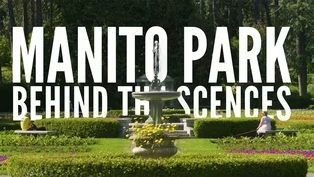
Behind the Scenes at Manito Park
Video has Closed Captions
Clip: S36 Ep1 | 5m 38s | A behind the scenes look at the people who keep Manito Park looking it’s best. (5m 38s)
Video has Closed Captions
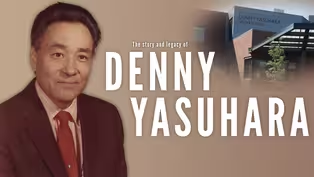
Clip: S36 Ep1 | 8m 40s | The amazing life of Spokane school teacher and civil rights activist Denny Yasuhara (8m 40s)
Video has Closed Captions
Preview: S36 Ep1 | 30s | Magnificent Manito, Denny Yasuhara, Colfax has Spirit(s), Finding the Beauty of Toads (30s)
Video has Closed Captions
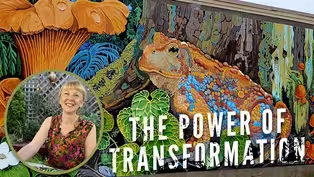
Clip: S36 Ep1 | 4m 55s | Nakusp, BC artist Debra Rushfeldt, has a fascination with toads! (4m 55s)
The Spirit of Preservation: St. Ignatius Hospital
Video has Closed Captions
Clip: S36 Ep1 | 6m 26s | A150-year-old abandoned hospital is getting a new life…with help from its past. (6m 26s)
Providing Support for PBS.org
Learn Moreabout PBS online sponsorship












Support for PBS provided by:
Northwest Profiles is a local public television program presented by KSPS PBS
Funding for Northwest Profiles is provided by Idaho Central Credit Union, with additional funding from the Friends of KSPS.