
October 2022
Season 7 Episode 1 | 26m 47sVideo has Closed Captions
The Season 7 premiere features local artists plus efforts to preserve local history.
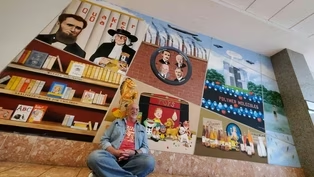
Find out how Progress Through Preservation of Greater Akron supports historically and architecturally significant areas and buildings, and learn about the Special Collections Division of Akron-Summit County Public Library. Visit with artist Michael Gearhart, who has been painting murals in Akron since the 1980s, and LOLO, an artist, skin care therapist and owner of the brand LOLO KNOWS.
Problems playing video? | Closed Captioning Feedback
Problems playing video? | Closed Captioning Feedback
Around Akron with Blue Green is a local public television program presented by WNEO
October 2022
Season 7 Episode 1 | 26m 47sVideo has Closed Captions
Find out how Progress Through Preservation of Greater Akron supports historically and architecturally significant areas and buildings, and learn about the Special Collections Division of Akron-Summit County Public Library. Visit with artist Michael Gearhart, who has been painting murals in Akron since the 1980s, and LOLO, an artist, skin care therapist and owner of the brand LOLO KNOWS.
Problems playing video? | Closed Captioning Feedback
How to Watch Around Akron with Blue Green
Around Akron with Blue Green is available to stream on pbs.org and the free PBS App, available on iPhone, Apple TV, Android TV, Android smartphones, Amazon Fire TV, Amazon Fire Tablet, Roku, Samsung Smart TV, and Vizio.
Providing Support for PBS.org
Learn Moreabout PBS online sponsorship(upbeat music) - Hey, out there, Akronites.
Welcome to year seven of "Around Akron with Blue Green."
On this episode, I'm gonna head downtown and check out the Special Collections Division.
Then it's over to Progress Through Preservation.
And then I'm gonna meet up with a muralist and learn a little bit of history about Akron.
Now, to kick this show off today, it's up to the Mustard Seed to meet up with Lolo Knows.
She's a DJ, she's an artist, and she's a wellness therapist.
Let's go see what Lolo Knows is all about.
(upbeat music) - I was a dancer for many years, and especially, you know, throughout my early childhood.
You know, both of my parents are Puerto Rican, all from Old San Juan, Puerto Rico.
And they migrated, and I was born in Brooklyn, New York.
And so there was a lot of entertainment in my family in regards to dancing and dress and etiquette and things in that nature.
But then there is a lot of, you know, other things too, darkness, that led me to dance.
So dancing was like my outlet of my pain.
So art also in its, you know, in that inception, I drew a lot and did all that stuff a lot, you know, to like, channel that energy.
You know, excitement, pain, whatever it was I was feeling.
Fantasy.
And I still do that today through my work.
(energetic music) Dancing was my first.
I was dancing for many, many years professionally.
You know, I was doing a lot of, you know, little shows.
You know, I was actively pursuing gigs and, you know, trying to be like a concert dancer and stuff.
So that was like my first real love.
When we first walked in here into the Mustard Seed, it was funny because as soon as I pulled up, Prince was playing.
And I always think like, he's like some like, musical angel of mine, even now after he's been gone.
But I've actually, you know, I got to dance for Prince.
He's actually a part of my work as well.
Everything that you see in my paintings is like a mirror of, you know, all of my desires and my fantasies.
And, you know, like, it's a mirror of just who I am and music, and, you know, the energies that I love and that I attract.
And you can see it all in my work.
(gentle guitar music) It really hurt my soul when my mother, some years ago, passed away from cancer.
But before she died, you know, her and I always shared some music together.
And when she didn't wanna like, listen to the music anymore, it really like, got me down a little bit.
You know what I mean?
It's just like, I don't know, I hope I never get to that point that I never ever wanna listen to it again because, you know, that was like her life joy.
She loved to dance.
You know, I kind of took that.
You know, she passed down a lot of her gifts.
You know, and it came through her daughters.
And so I'm just carrying on that gift.
(upbeat music) (upbeat music continues) I've always been in love with it.
I've always had a love for it.
I mean, probably since the first time I've ever like, carried a bunch of records in a crate for other DJs.
You know, going to the club and just the whole experience of, you know, the DJ and the dancers, and just having like that one night of let go.
It's like, beautiful.
I was a dancer for years in clubs.
I used to make it my business just to go to the clubs and just really like, dance.
We used to tear it up.
You know, I used to do battle dancing, the whole nine yards.
You know, it was like serious business.
But then when you left, you felt great.
You know, I kind of want that vibe again.
You know, I love just dancing, and I want people to be a part of that energy, you know?
That's why when I come here to the Mustard Seed, that's what it's all gonna be about when I DJ here.
It's gonna be that vibe, that energy.
I can't turn it off.
As soon as you turn me on, boom.
It's like I disappear and I'm with you, but I'm just, I'm in the music at that moment.
It's the best feeling in the world.
It's just, you're giving people freedom to release their inhibitions to the wind.
(upbeat music) Abstract expressionist.
I'm an abstract expressionist.
I need, you know.
And I love that for me because I express myself in so many ways.
You know, you look at all the art.
You know, I did a series with the factory, which is Warhol, Marilyn, and Basquiat.
And, you know, I did these black and white collages with these spiked frames that I made.
And it's just a wonderful like, testimony of just that life that I love.
I love going out.
I like being able to get into a nice outfit and have a nice, great night out on the town, you know?
I love to dance.
You know, I love having a glass of wine, you know, and just being social.
I love all that, you know?
There's an art to that as well.
There's an art to everything in my life.
From cooking to the way I dress, you know, I do it all.
And that's because I come from a family that had to do it all.
So I had to learn to do it all.
Therefore, Lolo Knows.
(laughs) (upbeat music) - Next up, it's Downtown Akron to the Special Collections Division of the Akron Summit County Public Library.
Let's go see what they're all about.
(gentle piano music) - I attribute it to my mother.
She worked in libraries when she was in college.
She was a housewife, but she was one of those people who you could ask her any question at any time and she always knew the answer.
It wouldn't matter if it was about Egypt or Akron or.
She always knew the answer.
So I also am probably one of the few people that I always knew I wanted to be a librarian.
I just always wanted to be like that.
I sought it out really early.
I worked in the library in high school.
I worked in the library at the Akron U when I went to college there.
And I just out of curiosity walked down here to the public library and just started asking around about jobs.
And I was fortunate enough to get every job I applied for here.
And I climbed the ladder from student to manager, and now I'm here.
(laughs) (relaxing music) Special Collections, we are a library within the library.
So I always say that we're actually four divisions.
We're actually genealogy, local history, archives, and digitization.
So we do everything here.
We have our own book collections.
So we have probably one of the top five genealogy book collections in Ohio.
We have our own periodical collection.
My librarians still order materials for the division.
We also do local history research.
So anybody who's looking for information on an old building or an old relative, this is the place you come to get started, and we can share those resources.
And we are also archives.
So that was actually how our division got started.
We didn't have a Special Collections Division until we reconstructed the building in 2004.
So my predecessor, Judy James, who I give all the credit for, she really was the impetus to get this division started.
And we got a grant.
And Shorty Fulton, the family named Shorty Fulton, wanted to donate the papers, the Fulton papers to us.
And that was how we got started as an archive.
And we knew that we had a lot of old books in the basement too.
And we had a librarian who started a genealogy collection a long time ago.
And in 2004, a lot of libraries were kind of starting those kind of departments where they were mixing local history and genealogy.
And it's a natural overlap.
So my predecessor, Judy, had the brilliant idea that we should do that too.
And when we reconstructed the building and came back in 2004, we had a Special Collections Division.
(upbeat music) Well, I think it's always interesting to us, to most of our library staff, how many people still don't know about how much the library has.
So I would say, you know, we have fantastic databases that you can use for free with a library card.
So I think the thing that people are surprised about when they call, you know, we're able to do pretty in depth property research, and we're able to do pretty in depth research on people, you know, undead people, (laughs) and finding ancestors.
And we have access to quite a few records.
One of the interesting collections we have is we do have like a roster of the early historical Ohio Penitentiary records.
It's pretty interesting.
But we also have other, probably what people should know too is that we have other large collections.
Like, we do hold the Summit County Historical Society's collections of photographs and historic documents.
So a lot of times people will, a lot of people don't realize that we have those.
So we do have Summit County Historical Society's large collection of materials.
We also have historic archive of Summit Metro Parks materials.
So we have lots of cool photographs and early oversized maps of all their early parks and planning materials and documents.
We have the Ohio Ballet Collection, which shut down a while ago, but we have their archive of photographs, films, audio.
And we also have soapbox derby collections.
We've also been collecting a lot of local church collections.
There are quite a few churches that have been closing down and consolidating, and they have been coming to us and giving us a lot of the archive of their photographs and some documents and things.
So we have quite a lot.
I always try to coordinate.
We coordinate with the university archives and with the Summit County Historical Society.
And usually whatever they don't want we get.
So I don't think people realize how much we are a resource worth checking when you run out of other options.
And, you know, if we don't have it, we can at least try to guide you to where it is.
(upbeat music) With genealogy research, there is a lot online, but there is definitely, not everything is online.
So we have to remind people that.
So we have local history records, we have maps, you know, we have genealogy books and resources that you're only gonna find here at the library and in our archival collections.
And I would say another testament to that, for our library in particular, is that many large metropolitan libraries in Ohio our size and probably across the country are weeding their collections.
They're getting rid of a lot of their old books because they are trying to stay relevant and newer.
But I will say that because we have such rich collections here, we have maintained a lot of our original collections that other libraries now in our library consortium of borrowing libraries in Ohio, all those libraries are now borrowing from our collections.
So that's just another testament that not everything is online, but especially as far as local records and, you know, important information that's still published in books.
We are still a good example of that.
It's just so much better to come to the library and see where resources are available.
(upbeat music) - Next up, it's Progress Through Preservation of Greater Akron.
Let's go see what they're all about.
(gentle enchanting music) - My mom always loved old houses, so whenever we went to any different city or visited a new place, we would, you know, drive through the oldest neighborhoods and look at all the big old houses.
So that's probably the genesis of my interest.
But another formative thing that happened was my historic school that was built in 1927 burned down when I was in eighth grade.
So that had been the high school in my community, and my dad went to school there.
That was really crushing for our community.
I think that loss helped me realize how important buildings are for a place's identity and to connect you to previous generations.
(gentle enchanting music) - It would have to go back to when I was a child.
I grew up in South Buffalo, and we lived in an old home, probably built teens or '20s.
That has influenced my taste in architecture and my interest in historic preservation.
(gentle enchanting music) Well, if you look back to the beginning of PTP, when the Civic Theater, years ago, there was talk of moving the theater to another location, taking pieces, parts and incorporating it into a new building.
Some of the early members of PTP did some extensive work studies, went to other theaters around the country, and convinced the city that that project was feasible to maintain and to renovate the theater.
And look what it's done to Akron.
That's an anchor in the city that wouldn't have been there had we not assisted in the effort.
(graceful string music) - It's been there for almost 100 years, and it's been a long time with many efforts to try to get it preserved and fixed up.
I think, at least in my opinion, now is a great time to do it.
There's a lot of development and revitalization going on in Downtown Akron.
They're trying to make it more walkable.
Lots of streetscapes.
They're downsizing the inner belt.
So now more than ever before is our chance to connect the Glendale Steps with Downtown Akron.
So I think the difference now is that things are changing in the city as well.
So I am helping get the Glendale Steps listed in the National Register of Historic Places.
That's something I do as a consultant pretty often.
So I'm very familiar with that process.
We're working on that, and that's gonna help us hopefully be in the running for some grant money and also just get some recognition, well-deserved recognition, for the Glendale Steps because they're amazing.
(graceful music) - We were instrumental in trying to save St. Paul's Church.
Back when the University of Akron had closed the Ballet Center, they essentially mothballed the building.
And we had community meetings just trying to find out a use for the building.
And we pushed very hard for a number of years, and then, unfortunately, there was a fire that destroyed a significant part of the building.
And even after that, we pursued our efforts to maintain that building.
And again, that's an example of a portion of Akron on the east side that needs that character to maintain that community.
You know, an example of planning that wasn't really wise in the community: The Werner Building was in that area.
And we were trying to work with and advocate for the preservation of that building, and it was torn down.
And it was unfortunate.
The Werner Building was a significant part of Akron's history.
Beautiful woodwork on the interior.
A beautiful mosaic floor that you couldn't reproduce in this day and age.
On a Saturday afternoon, it was gone.
And it's a loss to the community.
It was a landmark that people from Akron knew.
It's a landmark that could have drawn people to Akron.
(uplifting music) - So you can join Progress Through Preservation and be a member.
You can pay your dues and you can stop there, and that helps us.
The more members we have, the better.
You can take it up a notch and be on a committee.
You can be on just a small project or a huge project.
You can donate money to Friends of Keyser-Swain House or friends of any building that's going through preservation efforts.
And most cities have some sort of preservation organization that is interested in that geographical area.
We have Ohio.
Heritage Ohio is for the whole state.
So yeah, it can be as big or small as you want it to be.
(uplifting music) - So to wrap this show up today, I'm headed down to Main Place downtown to meet up with Michael Gearhart, a local muralist.
He's gonna teach us a little bit of history about Akron.
(upbeat music) - In 1986, I got a call to paint some signage at a place on East 55th and South Marginal in Cleveland.
And it was just signs to promote their business, Ohio School of Broadcast Technique.
And when they found out what else I could do, they asked me to paint six-foot-by-six-foot album cover reproductions for Billy Joel, Tina Turner, David Lee Roth, Journey.
And they had mounted them on the outside of the building 'cause from the outside, you couldn't tell that it was a place where you could buy music.
When they went out of business, I started back working in retail again.
And the retail part was just too much.
And I said, "I can't do this anymore."
I was working 60 to 80 hours a week, and this was just killing me.
So I quit on a Friday.
And in Sunday's paper, there was an ad for Canal Place for somebody to paint historic murals.
And I had some mural work already, so I went down there and spoke to the man.
He said, "You're hired."
That was on a Monday.
And I went back on Friday, and I primed two spots that they wanted me to paint.
It's a good thing I did because when I came in the following Monday to actually start work, they said, "Well, if you hadn't already done that, we were going to say, 'Forget it, we don't want to do this project.'
We decided we didn't want to do historic murals around the complex."
But it was the idea of Ken Roberts, who was the manager of the complex at the time.
He was from Los Angeles.
And a lot of murals are in LA.
And he knew how people responded to them.
Ken was always looking for a way to keep Canal Place in the news.
By having me paint murals, and then they would let, like the Channel 3 News came to interview me, and the Beacon Journal did stories.
And it wasn't long after that that I started getting calls from the city of Akron, and I painted for 2 Live Music.
And it just snowballed very fast.
I ended up doing over 60 murals at Canal Place from 1995 to 2007.
And I think there's only five or six still there, maybe seven.
(upbeat music) I had already done a couple murals for Dave Lieberth, for the city, painting on some boarded up storefronts at the time.
This would've been in the late '90s.
The city was going to be having its 175th birthday in the year 2000.
He had already arranged for something to be painted here at Main Place.
So we discussed it over a series of conversations about what I was going to do.
And then I did all the research for the images that I used.
And I had consulted with the library Special Collections department.
A lot of the images came from there, but most of them I was able to find online, just Google something, and 9 times out of 10, you're gonna find it.
But that was back in 2000.
This was 22 years later.
So I really had to do a lot of research to find the images that I used.
And I already knew a lot about Akron's history.
And that helped us decide which panels would be focused on which industries.
(upbeat music) The panel that's right behind me, the Quaker Oats one, I probably should've have put Ferdinand Schumacher's name on that because as I was painting it, I was asked why I was painting Abraham Lincoln and George Washington in a mural that featured Quaker Oats.
The rubber factories mural.
That's just Akron in the 1950s and '60s.
And, you know, it's in my memory bank.
I can still smell the sulfur burning the rubber.
I made sure that I featured the four major rubber factories at the time.
And I made sure the bricks were in there.
And of course I had to have the blimps, starting with the USS Akron, the dirigible.
For Pflueger Fishing, I don't fish.
I've only been once.
And so that was all pure research.
And all I had to do was look for a little bit about their history, find some images of their fishing lures, and just create something from that.
The one with the Polymer Building was fairly easy.
The toy mural features a lot of toys from the Rempel manufacturing company.
And I had a couple of those.
I had the froggy gremlin, and I also had the little hobo.
My brother had the lamb.
And they were very popular, and they were rather inexpensive Christmas gifts for parents to give kids in the 1950s.
I also included the toy marbles because I had met with Michael Cohill, who runs the Toy Marble Museum.
And I had no idea about Akron's history in all that.
It was fascinating how it was one of the first, if not the first, manufacturers of marbles.
They were clay to start with and eventually glass.
The mural panel for publishing.
At one time, Werner Publishing in Akron was the, they said they were the largest publisher in the world.
I did a lot of research on the beer products, Renner Brewery.
And I know they're still down on Forge Street, all their old buildings.
And I know that they're being used now.
I don't think they're being used as a brewery anymore.
And there are so many brew shops around here anymore.
You know, they make their own.
(upbeat music) I came in one day just to take pictures of it.
Part of the paper that covered the panels was coming down.
I'd spoke to someone here at the time, and they blamed it on the building next door.
That would've been probably in the early 2000s.
I'm kind of hoping that for the city's 200th anniversary that the city will hire me to reproduce those because that's been taken care of now.
The spot that's damaged has been covered up with the murals underneath it, I'm assuming.
They may be under there.
I don't know.
And I do have some photos of those panels.
They're not very good, but well enough for me to see.
(upbeat music) - Thank you once again for watching this episode of "Around Akron with Blue Green."
Thank you for your six years of support and the seven years going strong.
Thank you, and have an amazing day.
(upbeat music)
Preview: S7 Ep1 | 30s | The Season 7 premiere features local artists plus efforts to preserve local history. (30s)
Providing Support for PBS.org
Learn Moreabout PBS online sponsorship













Support for PBS provided by:
Around Akron with Blue Green is a local public television program presented by WNEO