
October 21, 2025 | Carolina Impact
Season 13 Episode 1307 | 28m 26sVideo has Closed Captions
Transit Tax; Historic Threads, Modern Destination; Nonprofits Losing Buildings; & The Longest Table
You’ll pay the tax. But will you get the tracks? Who’s left behind by Mecklenburg’s transit plan; See how a major project breathes new life into Rock Hill’s economy; Nonprofits Losing Buildings; & The United Way of Charlotte brings people together for "The Longest Table."
Problems playing video? | Closed Captioning Feedback
Problems playing video? | Closed Captioning Feedback
Carolina Impact is a local public television program presented by PBS Charlotte
October 21, 2025 | Carolina Impact
Season 13 Episode 1307 | 28m 26sVideo has Closed Captions
You’ll pay the tax. But will you get the tracks? Who’s left behind by Mecklenburg’s transit plan; See how a major project breathes new life into Rock Hill’s economy; Nonprofits Losing Buildings; & The United Way of Charlotte brings people together for "The Longest Table."
Problems playing video? | Closed Captioning Feedback
Where to Watch Carolina Impact
Carolina Impact is available to stream on pbs.org and the PBS app.
Introducing PBS Charlotte Passport
Now you can stream more of your favorite PBS shows including Masterpiece, NOVA, Nature, Great British Baking Show and many more — online and in the PBS Video app.Providing Support for PBS.org
Learn Moreabout PBS online sponsorship(upbeat music) - [Narrator] This is a production of PBS Charlotte.
(pleasant music) - Just ahead on ""Carolina Impact.""
- You'll pay the tax, but will you get the tracks?
I'm Jeff Sonier with a closer look at Charlotte Mecklenburg's 30-year transportation plant, including some of the neighborhoods that already feel like they're being left behind.
- Plus we head to South Carolina to see how the state's largest adaptive reuse project helps fuel a local economy.
And we hear how some local nonprofits who've always helped others are the ones needing help.
It's happening right now on ""Carolina Impact.""
(bright music) Good evening.
Thanks so much for joining us.
I'm Amy Burkett.
Supporters of Charlotte Mecklenburg's new sales tax for transportation call their plan Yes for Meck, but the plan still has a lot of maybes, like how much will the new projects cost, when will they be built and who benefits most or least from a tax we could all be paying.
Carolina Impact's Jeff Sonier and videographer Russ Hunsinger are on the Charlotte Transit Blue line with more.
- Yeah, Mecklenburg County's original transit tax back in 1998, will it help pay for these Blue Line tracks and trains that we ride today?
But it left lots of other transit projects unfunded like the Red Line in North Mecklenburg, which is still unbuilt and the Gold Line.
Those street cars are paid for by property taxes, not by the transit tax.
So what's different this time around?
Well let's start by taking a look at that Yes for Meck website.
- [Narrator] The Yes for Meck referendum allows voters to approve a 1 cent sales tax to fund improvements for our roads, ease traffic congestion, and improve safety for pedestrians.
- [Jeff] The new extra penny sales tax also promises billions more to expand light rail and streetcar service and the bus system.
There's even a map showing where the tax will build the tracks for the next three decades.
First priority is the new Red Line north of Charlotte, then a new Silver Line west on Wilkinson Boulevard to the airport with a possible Blue Line extension south to Pineville and six more miles of street car tracks for the Gold Line.
- [Narrator] And every penny stays right here in Mecklenburg County.
- [Jeff] But what you get in return for all those pennies?
Well that may depend on where you live.
- It's a good plan for the city of Charlotte.
It's a bad plan for East Charlotte.
- [Jeff] JD Mazuera Arias is the newly elected city council member from District 5.
- [JD] East Charlotte gave me everything.
That's why it breaks my heart to hear neighbors, friends and family say they feel forgotten.
- [Jeff] And he says most of the east siders who supported him don't support the new transit plan.
- Absolutely, I think East Charlotte has been overlooked and forgotten for so long right?
We do not get the investments necessary that will help our people.
Well, we're tired of waiting.
We're tired of saying, "Okay, maybe in the next 10 years, maybe in the next five years."
And this transportation plan kind of largely leaves out the constituents of District 5.
- [Jeff] Mazuera Arias says the plan's shorter Silver Line service that ends at Bojangles Coliseum does nothing to help these east side bus riders on Central Avenue, who depend on transit to get to work or to the grocery store or to a doctor's appointment.
What's the alternative if you don't take the bus?
- Get a bike, get a bike.
- Yeah.
Well I have no choice.
Ride the bus or I take special transportation.
- It completely left out the Silver Line extension from the plan.
They're not going to get that.
And what I heard from voters was they didn't trust the city.
I think that's really the crux of the issue right now is that there's a lack of transparency and a lack of trust from constituents on how the city will be able to manage so much taxpayer dollars.
- [Announcer] Please stand clear.
Doors are closing.
Train is about to move.
- [Jeff] Charlotte's newest council member adds that the transit plan's promise of extending the light rail Gold Line into East Charlotte is only that, only a promise.
Once again, leaving East Siders feeling more like outsiders.
- This hope that the Gold Line streetcar is going to go all the way to Eastland Yards, there's no guarantee of that.
And I think that's one of the biggest mishaps of this plan is that there's no guarantees.
(pleasant music) - It's not that we don't want improved bus service.
It's not that we don't need critical street road lighting, sidewalk improvements, all of those things are desperately needed- - [Jeff] But East Sider Greg Asciutto worries without new rail service, is it enough?
And how long will it take?
- This slice from Plaza Midwood to Eastland on Central, it's already log jammed.
- Asciutto is executive director of the Charlotte East Neighborhood Group.
He shows us these plans promised by the city 11 years ago to build a bike and pedestrian path here on Norland Avenue and a small park on this vacant lot.
Bond money for the project was approved by voters in 2014, but today still no park, still no bike path.
- Do we trust the same government body that has left us sitting here for 11 years waiting and scaling back by more than 50% 'cause money got shortened?
Do we trust that these projects are gonna be delivered in the way that they're gonna be delivered, that they're being said that they're gonna be delivered.
- [Jeff] It's a similar story here in Matthews, where leaders hope the new Silver Line would connect their town to uptown.
But after years of planning and millions of dollars spent on those plans, this transit tax doesn't include tracks to Matthews.
So if you're a transit rider in Matthews, you're still riding the bus, not the train.
(upbeat music) - So I'm absolutely against this.
It's a bad deal for Matthews.
- [Jeff] Matthews Mayor John Higdon speaks out against the transit plan and the tax to pay for it at this Matthews Candidate Forum back in September.
Now all of Mecklenburg's other towns support the transit plan partly because of the millions more they'll get for new streets and sidewalks.
But there's no mention here on the Yes for Meck website of the average 20 bucks a month that households will pay extra in sales tax, which will be the highest in North Carolina.
- If you don't wanna spend a dollar a day of your income to help some other cities, then you should club against this plan.
- We're seeing benefits to other communities, not to Matthews.
- Now, we'll never get the rail.
Anybody that thinks we're gonna get the rail is a delusionary.
It's not ever gonna happen.
- [Jeff] And while no light rail means no deal for many in Matthews... - I would be very interested to see light rail coming back.
- [Jeff] Others wonder how much growth is maybe too much growth.
- I would say no.
I feel like the town is small, the town is charming the way it is.
I think having light rail would probably make it too busy and sort of ruin the the feel.
(train whooshing) - The city should grow.
North Carolina should grow.
I mean it is good for the economy, it's good for the people.
- By the way, transportation tax or no transportation tax, all those future transit projects we're talking about, just like the Blue Line will need extra funding either from Raleigh or Washington or maybe both, which means more promises but no guarantees about how or when or even if those needed extra millions and billions will get here in the future.
Amy?
- Thank you Jeff.
If you wanna dive a little deeper into how local leaders want to spend your future tax dollars on roads and transit, check out our website at pbscharlotte.org.
We'll link you to the 30 year Charlotte Mecklenburg Transportation Plan with details on all projects, big and small, for every neighborhood.
Well just down the road in Rock Hill, another community weaves its past into a bold new future.
A massive redevelopment project is transforming a historic mill into a thriving destination and fueling the local economy.
Carolina Impact's Dara Khalid and videographer Marcellus Jones take us inside.
(transition whooshing) (birds chirping) (gentle music) - [Dara] Take a walk inside The Thread in Rock Hill, and this is what you'll find.
- The old free elevator doors leaving the chains on there, the dirt, the grime, the grease.
- [Dara] Pieces of the 400,000 square foot buildings passed frozen in time.
- One of our main focuses with this was preserving as much of the old, you know, character and history, integrity of what it once was, which is a textile mill.
- [Dara] Since the 1900s, this building, which is the size of nearly seven football fields, has stood tall on West White Street in Rock Hills Knowledge Park District.
It's lived many lives.
In 1946, it was the site for Baxter Mill, in 1986, Springs Industries, in 2008 Springs Creative.
- This was the main employment hub for the city of Rock Hill and really the region.
At its height in the seventies, this textile mill corridor employed over 6,000 hardworking Americans.
- [Dara] With the price tag of over $100 million dollars, it now stands as South Carolina's largest adaptive reuse project.
Inside you'll find two restaurants plus retail and office space.
- We were very intrigued by this great property with great bones.
And then we undertook the six year process, which brought us here today.
- [Dara] Ken Beuley, president of the Keith Corporation, the developer for The Thread, says there were several things that help with the cost, like the city and county creating a tax increment financing designation for the area, mill tax credits through state legislature and it being designated as an opportunity zone at the federal level.
- If any one of those factors wasn't present, this probably wouldn't have happened.
- [Dara] The project was also eligible for historic tax credits, but... - We knew it'd be a challenge to stay within the confines of how we'd have to design the building to qualify for those historic tax credits.
So we forwent those, which really opened up the creative toolkit for our architect and our design team, - [Dara] Which meant they had the freedom to add modern touches like this.
- What we have here is a 6,500 square foot, essentially donut hole cut into the middle of the building to create this courtyard.
And again, it gets all the natural light to all the office floors above.
And then on the retail on the bottom here.
- [Dara] The same way contemporary features like this sleek floating staircase are woven together with the old historic walls bearing crack paint and words from the past.
The threat as a whole is being woven into the city's Storyline project, which is still in the works.
It'll be a linear walking path that connects Fountain Park to Winthrop University and includes areas like Downtown and The Thread along the way.
It's similar to what's been done in big cities like New York with The High Line, an elevated park that's revamped an old railway line and in Atlanta with The Belt Line, a 22 mile trail also on an old railway corridor.
- And to see that storyline sort of meander through downtown, through our alleyways across a to-be built pedestrian bridge and then to land it and just really make sure that you know, we're staying grounded in our history.
- [Dara] The threat helps revive the city's textile corridor, which is key to honoring Rock Hill's roots.
One example, Riverstone Logistics recently relocated its headquarters here, a $16.4 million investment that according to the city will bring 159 new jobs.
- We're seeing a lot of growth in downtown Rock Hill, but what we don't have is this kind of growth, good professional, business space for corporate clients to come in and set up.
We have some, but this is really a game changer for downtown.
- [Dara] Then there are companies like Springs Creative that have been headquartered here since last year, but its history in the building runs much deeper.
- The Thread was actually a distribution center for Springs Creative since 2007.
And so we were doing, you know, housing our inventory and doing our distribution work out of this building.
- [Dara] Springs Creative president Claude Close says his family's textile company was founded in Fort Mill in 1887.
In 2007, his dad Derek acquired the building that's now home to the Thread.
In 2019, he partnered with the Keith Corporation to redevelop it.
Now equal partners with Capital Broadcasting, they all own the building.
Claude takes pride in knowing he is carrying on his family's legacy of sowing into the community.
- It's been great, you know, I love to have a story behind what we're doing and it's fun to be able to tell that story each and every day.
You know, other people seem to get as much joy and excitement out of it as I do.
- [Dara] When you're passing the Thread on West White Street and see the giant needle out front, let it be a symbol of how they're proudly stitching Rock Hill's past to its future.
For "Carolina Impact," I'm Dara Khalid.
- Thank you Dara.
The Thread leaders say recent economic projects have contributed to roughly $500 million of new commercial development throughout the area.
As Rock Hill breathes new life into its old mills, just up I77, a very different story is unfolding.
In Charlotte, the same wave of growth that's transforming neighborhoods is now threatening to push out the very nonprofits that helped those communities rise.
Carolina Impact's Chris Clark has that story.
(transition whooshing) - [Chris] It's 3:30 on a Wednesday afternoon just off North Tryon, two hours before Hearts United for Good even opens its doors, but already the line is forming.
Cars inch forward, trunks open, families wait.
- If you are a human being and you are hungry, we're going to feed you.
If you're an animal and you're hungry, we're gonna feed you.
- Hi, how are you?
- [Chris] As cars idle outside, inside the warehouse, it's a flurry of motion.
(metal clangs) Volunteers are busy sorting donations from pretzels, chips, tortillas to cereal and packing them into simple brown paper bags that are easy to carry and quick to hand out.
- They are a blessing to me.
When I'm cold, they make sure I'm warm, when I'm hungry, they make sure I'm fed.
- Yogurt.
- [Chris] For hundreds of people, like Mark, Hearts United for Good has become a lifeline built on consistency, compassion, and volume.
- Weekly we're putting out up to three tons of food.
- One regular bag and that one stack bag.
- And that is consistent.
It is every single week we're doing 10 to 12 pounds per bag.
- [Chris] And it's not just shelf staples.
- We're including produce protein.
There's meat, there's fresh fruits, there's vegetables when we can, when available.
- [Chris] They've also become one of the few pantries in Charlotte meeting other essential needs.
The things most people don't think about until they run out.
- We're one of the only pantries too that offers free diapers, free adult incontinence items, hygiene items.
- [Chris] Every item that leaves this warehouse carries more than food or supplies.
It carries connection.
Some of the volunteers here once stood in the same line now giving back to the next person who needs it.
- It's very satisfying, for two reasons 'cause I feel the same way when I get the box.
So I realize how they feel when they receive it, and it makes me feel good to be able to do that to someone else.
- [Chris] 12 minutes and six and a half miles down South Tryon another nonprofit is serving the same mission, not with food, but with tools.
(driller whirs) The Charlotte Tool Bank isn't your typical warehouse.
These shelves are stacked high with drills, rakes, tents, and tables all loaned out to nonprofits and neighborhood groups across the city.
- We provide tools and special event equipment.
We're located in a very philanthropic city that loves a good nonprofit fundraiser or a 5K that benefits an organization.
And those special event items come with a high cost.
And so having access to those allows our organizations to have larger scale events, but also to raise more money from their event because they're lowering their rental costs.
- [Chris] But while the tool bank helps other non-profits save money, they're now struggling to save themselves.
They moved into this warehouse because it was affordable.
Today, that same affordability has disappeared.
- We have a situation where there's so much demand for commercial real estate in Mecklenburg County that prices out the nonprofits.
- Our amazing South End location is prime for development and we are also out of space.
So the two things are coming hand in hand for us and require us to relocate.
- [Chris] And across town Hearts United for Good is staring at the same future.
Right across the street from their North Tryon pantry, construction crews are hard at work.
What started as an affordable no frill space is quickly becoming another corner too costly to stay.
- The landlords were amazing to work with us on our budget since we have none.
So it was affordable.
We didn't pay utilities.
We didn't have to worry about anything like that.
So our budgets and our expenses were next to nothing and that's what allowed us to grow.
- It might look like an empty lot now, but it won't be that way for very long.
Soon it could be shops, it could be restaurants, but more than likely what it's gonna be is a multi-family project.
You see, those are the type of things that could pay the most money for land like this.
For years, this stretch of Charlotte has been quietly transforming the empty lots filling in, the skyline inching north, but the real engine behind that change isn't always what you see going up.
Sometimes it's about what is running right beside it.
- The light rail running up North Davidson Street has been a blessing and a curse.
The blessing is it's caused property owners to be able to cash out of their property at a very good number.
It's taken away from the commercial real estate market.
- [Chris] After years of steady growth, the Tool Bank's next move won't be easy.
They need space close enough to serve their partners and affordable enough to keep saving them money.
- We have over 14,000 items.
We serve over 1300 organizations and so the sheer scale of our operation, we need to go somewhere and we need to stay there and plant roots there.
- [Chris] Luckily for Hearts United for Good, they found a new space just a few miles away at the corner of Hawthorne and Central.
It's big enough to keep the mission alive, but moving is gonna mean leaving some of the people they serve behind.
- It's gonna be a struggle for anyone.
People that aren't mobile, I don't know what they would do.
- [Chris] For Hearts United for Good, this move isn't the end of the story.
Just the next chapter and one they've lived before.
Each time they find a new home, the mission continues, but deep down they know this isn't permanent.
- This is just a temporary two year fix for our solution.
- [Chris] In a city growing skyward, these nonprofits keep their focus at ground level, meeting people where they are for as long as they can.
For Hearts United for Good and the Charlotte Tool Bank, every move means starting over.
It's just proof that even in a changing city, compassion still finds room to work.
- Got bunch of Bettys for ya.
- [Chris] For Caroline Impact, I'm Chris Clark.
- Thank you Chris.
As Charlotte's skyline rises, the question becomes who gets lifted with it?
For the Tool Bank and Hearts United for good, the answer may depend on how much the city values those who serve its most vulnerable.
Well our final story tonight, spotlights a non-profit tackling one of today's toughest challenges division in the digital age.
While social media has brought people together, sharing memories and celebrating life's moments, it's also become a battleground where keyboard crusaders spread negativity and fuel division.
Are we really as far apart as it seems online?
Carolina Impact's Jason Terzis joins us to share how one local organization is working to bring real connection beyond the comment section.
- When it comes to political and social issues people's opinions run the gamut from the super conservative right to the super progressive left and all points in between.
But if you get into a one-on-one conversation with someone, even if their opinions are on the opposite end of the spectrum from your own, more often than not, you'll find some sort of common ground and that was the focus of The Longest Table.
(transition whooshing) - Good morning everybody and welcome to Truist Field home of the Charlotte Knights.
- [Jason] A Saturday at Truist Field, in uptown Charlotte.
Fans going through security, having their tickets scanned while a live band played on the concourse.
(pleasant music) (singer vocalizing) Just outside the stadium, the start finish line of a 5K, but inside, there were no ball players on the field or even fans in the stands.
- So this is our first time doing this.
It's the first that we hope will be many annual events.
- [Jason] About 1500 people coming out on this day.
Not to support the Charlotte Knights, but to support, well Charlotte.
- They've come together for brunch, but more importantly, they've come together not just to share a meal, but to gauge in dialogue.
We want people to ask questions, get to know one another, and really begin to build a shared vision for the greater Charlotte region.
(pleasant music) - [Jason] Organized by the United Way of Charlotte, the event was dubbed at The Longest Table.
Dozens of tables lined up, creating one gigantic table, stretching the length of the entire concourse, attendees enjoying a full brunch of fruit waffles and quiche, but most importantly, conversation.
- What inspired it is really this is reflective of what United Way does every day.
We bring people together, we listen deeply to everyone's opinions because we value those opinions and then we ask everyone to dream together about what's possible for the greater Charlotte region, and then we mobilize the people and the resources to bring that vision to reality.
- I think it's a great idea.
I think in the environment we in today, we need to have the conversations and sometimes we need to have the hard conversations, but we need to respect each other in the process of doing so.
- [Jason] The premise of the longest table, bring people from all walks of life together and to get to know strangers from other parts of town talk and more importantly listen about various issues with the goal of not necessarily agreeing, but understanding.
- I really believe that when people sit down and get to know one another, when we take time to understand where each other is coming from, we'll find out that we have a lot more in common than we do that's dissimilar, right?
We all want the same things for our families.
We all want the same things for our community, - But it doesn't make a difference about differences.
If we were all the same, we'd be a very bland society.
So, what if we have differences?
As long as we respect each other while we're communicating the differences, that's the best thing.
- [Jason] To keep the conversation moving, United Way poses a series of questions which were put up on the stadium's video board, open-ended questions like how do you define community?
- So what I was saying is I define community as fellowship and I said it could be your work community.
I said I have different communities, I have my work community, I also have my friend community and then I have my family.
And so sometimes they interact and sometimes they may not.
But altogether we are there for each other and that's what I view community as.
- The ability to have tolerance, the ability to have patience and the ability to be humane towards others and leave everything else that you got in here over here, okay, work with this and you'll all get along.
- [Jason] Other questions asked, have you or someone you know seized an opportunity because of a connection or relationship?
In what ways can we work together to ensure all have access to opportunities?
Think five years ahead, what would make you proud to be part of the Greater Charlotte community and how can you take action to support a neighbor's journey toward an impactful opportunity?
- I think we're more alike than different.
And so I think that's what needs to be the focus is on the positive versus the negative and on how we're more alike than we are different.
- [Jason] Regardless of where thoughts and opinions stood on the questions, attendees all seem to agree on at least one thing.
Our phones and the social media apps on it are big reason for the deepening divides facing us.
- I think a lot of the division, you know, we can speculate about where it comes from, but we spend a lot of time on social media and on our phones and we consume information in an echo chamber.
And what we're doing here today pulls everybody out of their echo chambers and ask them to engage in honest dialogue.
- [Jason] Also affecting people's thoughts according to those in attendance, the carryover effect from the COVID-19 pandemic when pretty much the whole world went remote, got online and for the most part never really got off.
- When COVID hit, everything changed.
Everybody decided to jump into these and they forgot how to do this, because everybody got hibernated and they got siloed, all of a sudden, your opinion is the most important, your thinking is the most important.
Anything outside of your home is insignificant and that's not right.
- [Jason] At the end of the two hour event, most people left with a sense of it's okay to see things differently and it's okay to have different opinions.
It's all part of what makes us unique.
- I am confident that if we come together as a community, we can create a path to opportunity for everyone who lives in this region.
- We may not like each other, we may not care for each other, but sooner or later we all bleed red, and we may need each other.
And that's the whole thing.
- What an awesome story.
And as I understand, there's another Longest Table in the works.
- Yes, so they're already making the plans for next year and that was before this year's event even happened.
Organizers were already working on the details for next year's event, which is set for Saturday, September 26th.
So I think just the lead up to this and the number of people that expressed interest in coming to the event, they're like, "Okay, this is gonna be, we're gonna be able to pull this off and have a good event up to 1500 people.
So like let's get the plans going ready for next year."
- Which is fantastic.
I appreciate you sharing that information Jason.
Well before we leave you this evening, I'd like to thank iMeck Academy of Global Influencers who are visiting us in the studio tonight.
They were awesome and again, I never get tired of the great questions young people will ask.
Well, that's all the time we have this evening.
Thanks so much for joining us.
We always appreciate your time and I look forward to seeing you back here again next time on "Carolina Impact."
Good night, my friends.
(upbeat music) (pleasant music) - [Narrator] This is a production of PBS Charlotte.
(pleasant music fades)
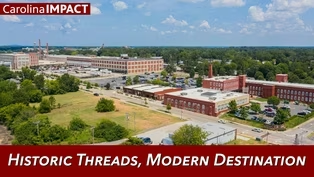
Historic Threads, Modern Destination | Carolina Impact
Video has Closed Captions
Clip: S13 Ep1307 | 5m 26s | See how a major project breathes new life into Rock Hill’s economy. (5m 26s)
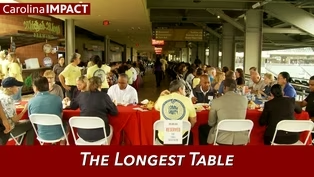
The Longest Table | Carolina Impact
Video has Closed Captions
Clip: S13 Ep1307 | 6m 38s | The United Way of Charlotte brings people together for "The Longest Table" (6m 38s)
October 21, 2025 Preview | Carolina Impact
Preview: S13 Ep1307 | 30s | Transit Tax; Historic Threads, Modern Destination; Nonprofits Losing Buildings; & The Longest Table (30s)
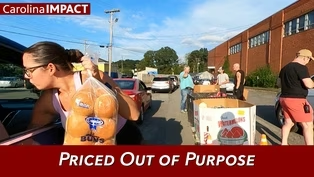
Priced Out of Purpose | Carolina Impact
Video has Closed Captions
Clip: S13 Ep1307 | 6m 13s | Hearts United for Good and Charlotte ToolBank face displacement due to rising local costs. (6m 13s)
Providing Support for PBS.org
Learn Moreabout PBS online sponsorship New Episode
- News and Public Affairs

Top journalists deliver compelling original analysis of the hour's headlines.
 New Episode
- News and Public Affairs

Today's top journalists discuss Washington's current political events and public affairs.



 New Episode
 New Episode
 New Episode

 New Episode
 New Episode
 New Episode
Support for PBS provided by:
Carolina Impact is a local public television program presented by PBS Charlotte