
October 22, 2025
Season 4 Episode 83 | 26m 29sVideo has Closed Captions
Lawmakers hear an update on the state’s medical cannabis program.
A primary challenger to Congressman Thomas Massie enters the race. Lawmakers hear an update on the state’s medical cannabis program. Could affordable housing projects in Lexington and northern Kentucky provide lessons for other communities? A less common form of breast cancer is on the rise. The first phase of Louisville’s Community Care Campus opens to homeless families.
Problems playing video? | Closed Captioning Feedback
Problems playing video? | Closed Captioning Feedback
Kentucky Edition is a local public television program presented by KET
October 22, 2025
Season 4 Episode 83 | 26m 29sVideo has Closed Captions
A primary challenger to Congressman Thomas Massie enters the race. Lawmakers hear an update on the state’s medical cannabis program. Could affordable housing projects in Lexington and northern Kentucky provide lessons for other communities? A less common form of breast cancer is on the rise. The first phase of Louisville’s Community Care Campus opens to homeless families.
Problems playing video? | Closed Captioning Feedback
How to Watch Kentucky Edition
Kentucky Edition is available to stream on pbs.org and the free PBS App, available on iPhone, Apple TV, Android TV, Android smartphones, Amazon Fire TV, Amazon Fire Tablet, Roku, Samsung Smart TV, and Vizio.
Providing Support for PBS.org
Learn Moreabout PBS online sponsorshipThe president wanted this man to run for one of Kentucky's congressional seats, and now he's in the race.
>> Our median home prices have increased over 100% over the last ten years.
Whereas the wages that people are making in the community have only increased 30%.
>> And why does Kentucky have a housing shortage?
We'll crunch the numbers.
>> This is an opportunity for people to live and work in the same space together and be able to to receive services in a very unique way.
>> Plus, what's different about a new community care center in Louisville?
>> Production of Kentucky Edition is made possible in part by the KET Millennium Fund.
>> Good evening and welcome to Kentucky Edition for this Wednesday, October the 22nd, I'm Renee Shaw, and we thank you for winding down your Wednesday with us.
President Donald Trump gets his man in Kentucky's fourth congressional district.
Last Friday, the president endorsed former Navy Seal Ed Galvin to run in the 2026 Republican primary against incumbent Thomas Massie.
But at the time, Galvin wasn't a candidate.
Now he is.
Yesterday, he announced he will run as an ally of President Trump.
Galvin ran for the Kentucky State Senate unsuccessfully last year.
President Trump wanted someone to challenge Massie, a Republican who backs President Trump on many issues but opposes him on the budget and on the Jeffrey Epstein files.
As he announced his candidacy, Galvin put out this statement, quote, the district, this district is Trump country.
The president doesn't need obstacles in Congress.
He needs backup.
I'll defeat Thomas Massie, stand shoulder to shoulder with President Trump and deliver the America First results Kentuckians voted for.
End quote.
Massie put out a statement of his own, says, quote, fourth district voters appreciate having an independent conservative voice who works for them, end quote.
And he described Galvin as, quote, someone willing to be a rubber stamp for globalist billionaires, endless debt, foreign aid, and forever wars.
End quote.
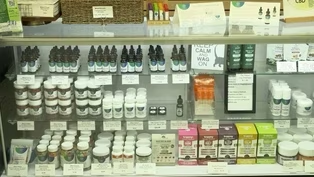
State officials say Kentucky's medical marijuana program is slowly but surely coming online.
Seeds are in the ground and dispensaries have secured locations.
The Office of Medical Cannabis testified to state lawmakers today.
An hour June Leffler has more.
As we kick off our legislative update.
>> One medical marijuana dispensary has gained final state approval.
That's the post in Beaverdam, Kentucky.
The dispensary is not open yet, but its website says it should be open this fall.
>> Currently, we have three cultivators in the state who are actually growing medical cannabis.
We'll have one processor by the end of next week that will be coming online.
Two safety compliance facilities, which are tasked with testing the actual medical cannabis.
And then we have one dispensary, which I know is the focus of this discussion today that is approved to operate.
The expectation is within the next month, we'll have more than one dispensary that will be ready to operate.
46 of our 48 dispensaries are in their forever homes.
They found their permanent locations.
We have two more that are still needing to be settled, but we're working on that and should have those done before the end of the year.
Here is our dispensary location spread on a map, but we have a good spread throughout the state that's going to make travel to these dispensaries within an hour.
Definitely with under under two hours for anyone who is a cardholder.
>> This Democrat from Lexington commends how the state has ran the program so far.
>> The thing that really sticks out to me is the feedback I've gotten from those distributors, growers and dispensary owners is that the program we put together, they tell me, is one of the best that they've seen across the country.
The thoughtfulness of the regulations, the way that this has been structured, makes them feel confident that they are able to do business in a way that is safe, it's well regulated, and they feel confident that they're going to be able to help Kentucky patients without exposing children.
And I think that's important to everyone in this room.
>> A Western Kentucky Republican worries kids will be more susceptible to finding marijuana in their homes and ingesting it.
>> And we're headed down the path of legalizing marijuana in this state.
And I think we're going to get to epidemic proportions once that happens.
So we are going to hear about that in committee.
That's that's how much it's growing and something we need to be concerned about.
>> And the 2023 state fiscal year, 18 children ingested and overdosed on THC.
>> These gummies you see, they're identical to buying like a thing of Skittles.
They look identical.
It can't it has to look like medicine because we're treating it as medicine.
And if it looks like candy and it tastes like candy, children are going to eat it.
>> State law approved by the General Assembly says medical cannabis cannot resemble major brand food products or otherwise appealed to minors.
The law does not say edibles cannot come in the form of gummies.
For Kentucky edition.
I'm June Leffler.
>> Thank you.
June.
In April, State Auditor Alison Ball announced an investigation into the medical marijuana program, specifically the application and lottery process.
The auditor's office told KET today that, quote, the Office of Medical Cannabis finally provided us on October 17th with additional documentation we need for our examination.
This brings the total amount of documents our office has obtained at 1.7 million.
We are actively analyzing all the data we have and hope to start putting the pieces of the puzzle together soon.
End quote.
Another member of the Kentucky General Assembly will step down at the end of his next term.
Representative David Hale is a Republican from Wellington who has served the 74th district since 2014.
He says he will not seek reelection in 2026.
Hale chairs the House state government committee.
Yesterday, the housing task Force in Frankfort heard an update on the affordable housing project being built in Lexington.
Today, our Mackenzie Spink tells us more about how this unique project came about and if it could be replicated statewide.
>> In Fayette County alone, over 22,000 housing units need to be built in order to close the housing gap.
>> What we found is that the lack of available land, the high purchase to buy land in Lexington and then for affordable housing developers having the capital to access that land was a key challenge.
And then, of course, just the affordability challenge for Fayette County overall.
And something that we've talked about is just the fact that our median home prices have increased over 100% over the last ten years, whereas the wages that people are making in the community have only increased 30%.
>> The affordable housing being built on Transylvania University's former baseball field is the result of a unique partnership between five local banks and local affordable housing developers.
The banks bought the land from the university and held on to it for the developers with a no interest loan, allowing time for the 242 unit project to be developed.
The president of central Bank says he's hopeful this kind of partnership can be replicated around the state.
>> It's going to be unbelievable and it's going to work, and I hope and pray that we can take this throughout the state.
Truthfully, I'm meeting with other people in our region to see how to explain how we've done it here, and how do we take this to other parts of the region and and the state being where I'm from, up in Breathitt County, it's hard to find a house in the rural areas.
>> One of the policy recommendations from the affordable housing developers was a housing fund that could kickstart similar projects.
>> So we're fully in support of a statewide housing fund of $20 million, kind of proposed by the Kentucky Bankers Association and championed by this group to provide similar type of financing across the state to do transformational projects like this, involving a revolving loan fund, potentially state housing tax credits, which all of our neighbors have, that we do not have.
>> More policy recommendations came from the Kentucky chapter of Americans for prosperity, a national grassroots advocacy organization.
One of their recommendations is for the state to establish permitting shot clocks, which would require local governments to speed up the permitting process for housing developments.
>> Right now, developers and builders often face long, unpredictable delays that drive up costs and discourage investment.
Some studies have shown that for each month of delay for permitting, the price of a home can increase as much as $4,400.
By requiring local governments to act within a specific time frame, say 60 or 90 days, we can bring greater certainty and efficiency to the process.
This doesn't mean cutting corners.
It means setting clear expectations and holding agencies accountable.
>> This was the last meeting for the 2025 Housing Task Force to receive input and hear from other agencies.
The next meeting in November will be a discussion of its findings for Kentucky edition.
I'm Mackenzie Spink.
>> Thank you.
Mackenzie.
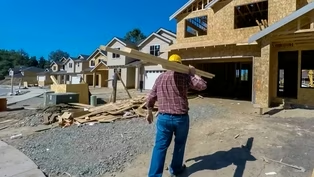
Northern Kentucky leaders also paid a visit to Frankfort yesterday to present their housing blueprint to the Kentucky Housing Task Force.
Our Emily Sisk has more on their ideas to bolster the region's housing supply and the workforce.
>> When we invest in housing and workforce initiatives in Northern Kentucky, the results ripple far beyond our three largest counties.
>> As part of the Northern Kentucky Housing Blueprint, a Chamber of Commerce representative presented four main ideas.
One of those was to get investments from employers, which could help workers live closer to their job.
>> A one time $5 million investment from a large employer or a cluster of employers could help provide homes for roughly 125 families.
>> And to support those families.
The region also wants to build back what they called middle housing properties that are smaller and more affordable.
>> Add variety to neighborhoods, and provide more attainable options for young families, seniors and essential workers like our teachers and public safety officers.
>> For Northern Kentucky and most of the state, the elephant in the room is the lack of workers.
>> None of this happens without people to build it.
>> Without enough trained workers, we simply cannot build housing at the pace required to meet demand.
>> A building and construction institute in Northern Kentucky is currently training around 100 high schoolers and 350 adults through afternoon and night classes.
But the institute wants more support and dual credit opportunities from the Department of Education.
>> State legislators can play a pivotal role in expanding the construction talent pipeline through funding, education policy reform and regulatory improvements.
>> The Building Institute's goal is to produce 2200 new construction workers every year.
A lawmaker questioned how Kentucky can retain those workers once their training is complete.
>> Sometimes the draw is more towards Cincinnati or toward Evansville than it is.
You know, you get an education and they got more work there.
>> If we're able to create a healthy housing environment that is more that is less regulated and more affordable, we're going to naturally see more job growth.
And those jobs will have a tendency to stay here.
>> Another legislator said increasing the workforce is a constant challenge.
So they'll take the Northern Kentucky suggestions into consideration for Kentucky Edition.
I'm Emily Sisk.
>> Thank you.
Emily, the final idea in the Northern Kentucky housing Blueprint is to create a regional housing fund.
The leaders want to pull $25 million over five years to help build 1000 new homes and provide down payment assistance to first time home buyers.
Pike County is making a comeback after devastating floods in February, governor Andy Beshear says Weddington Plaza Partners will invest about $6 million to restore and renovate its shopping center, saving 300 jobs.
The money will be used to replace flooring, roofing and electronics, to rebuild a flood wall and to pay for security.
The group hopes to have the work half complete in a year, with all renovations done in three years.
Pike County was one of the hardest hit areas during a deadly flood event back in February.
LG and Ku customers.
You could end up paying more for electricity and gas, but Kentucky Attorney General Russell Coleman says the increase is smaller than it could have been.
Coleman says he's negotiated a deal to keep the increase less than $10 a month per family.
The Kentucky Public Service Commission still has to sign off on the agreement.
Kentucky is the 20th safest state in the union, according to WalletHub.
The company looked at 52 key indicators, including crime rates, road safety, occupational safety, economic security and more.
Vermont was the safest state in Louisiana was the least safe.
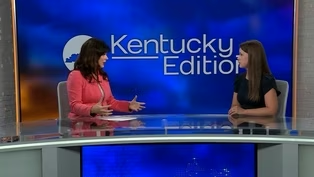
A less common form of breast cancer is on the rise, according to a special report from the American Cancer Society, lobular breast cancer rates are increasing three times faster than all other breast cancers combined.
Our Kristy Dutton continues the conversation about breast cancer awareness and finds out what makes lobular breast cancer different and what might be causing this increase that in tonight's medical news.
>> Here to talk with us about the rise in lobular breast cancer diagnoses.
We have Doctor Alyssa Dahl from Norton Health Care.
So Doctor Dahl, explain to us exactly what is lobular breast cancer and how does that compare with other types of breast cancer.
>> Yes.
So there's two types of breast cancer lobular breast cancer and ductal breast cancer.
And they originate from the two different structures of tissue within the breast.
So there's lobular breast tissue and ductal breast tissue.
The purpose of the lobules is to make milk for breastfeeding.
And the purpose of the ducts is for transport of that milk from where it's made to the nipple.
So we can see cancers form in either one of those tissue types.
>> So in recent news we've seen that lobular breast cancer diagnoses are on the rise.
Why might that be.
>> Yeah I think that that's a good question.
In reality I don't know that we know the answer.
I think we know that the incidence of lobular cancer is increasing compared to, say, in 2015 or earlier.
We know that there are a higher proportion of breast cancers that are being diagnosed that are lobular.
The question that I have is whether or not it's truly that they're more common, or just whether we're better at picking up on them.
So lobular cancers can be more difficult to see on conventional types of breast imaging like mammogram and ultrasound.
But as our imaging has gotten better, that is potentially one reason why we're seeing more of them.
>> Okay, why are they more difficult to see what's different about them?
>> So ductal cancers tend to form a mass, and we can see that pretty easily on mammogram and ultrasound.
When lobular cancers form, they don't necessarily form a mass.
And sometimes they can travel in little linear lines along the tissue.
It just makes them a little bit more difficult to see on those modalities.
So we have other ways to image the breast if necessary.
>> Okay.
So lobular I think lobular.
And I do think of a glob.
But it's it's more like a line or it's harder to detect.
So can it be detected in like a self-breast exam.
>> Some sometimes it can.
But most commonly we see lobular cancers on screenings.
>> On mammograms.
Or is it detected some other way?
>> Usually mammograms.
>> Okay.
So you find it on a mammogram and then you can do an ultrasound or some other.
What are some of the other diagnostic tools that you then can use to your advantage.
>> So we always start with mammogram usually with screening mammogram.
And that serves as our gateway into all of the other options.
And so if there's ever anything abnormal on mammogram then we would usually get a different type of mammogram.
Something that takes a little bit more pictures maybe an ultrasound.
There's also a breast MRI that is useful in some patients, not all patients, but some.
And then physical exam by a medical professional who specializes in breast cancer.
Those are the places that we start.
>> Okay.
So we've talked about ductal breast cancer.
That's the most common in lobular that we're talking about.
Now.
Do men get both types.
>> Yes.
Men can actually get breast cancer and they can get both types of breast cancer.
Just like in women.
Ductal cancers are more common in men as well.
So men actually have a little bit of breast tissue.
It doesn't mature in the same way that a woman's breast does, because of the estrogen that a woman has in her body during her life.
But men do have small amounts of estrogen, and they do have a small amount of breast tissue.
So men can actually get breast cancer as well.
>> Okay.
How does lobular cancer differ from ductal cancer?
Breast cancer in in a prognosis.
Is it just as good.
Is it different.
>> It's just as good.
So when we compare stage of ductal to the same stage of lobular cancer, there's very similar long term outcomes.
We look at survival disease free survival.
Those things are very comparable between the two subtypes okay.
>> And just for prevention what are some of the risks and how can we lower our risk of not just lobular breast cancer but ductal breast cancer.
>> In terms of reducing risk?
I think one of the most important things for reducing risk of breast cancer falls in line with just improving your overall health, which is regular exercise.
Eating a healthy, balanced diet, low in inflammatory foods, and maintaining a healthy weight.
That's the best way to prevent breast cancer from happening.
Other ways to detect it early is are really screenings.
And so when we think really those two go hand in hand, one is prevention and the other is early detection.
But those are the ways to ensure that you're optimizing just your overall health as well as your breast cancer risk.
>> Okay.
Wonderful.
Well this is great advice.
Thank you so much for your expertise and for taking the time to share this with us.
Thank you.
>> Thank you for having me.
>> And thank you.
Christie Dutton.
Lobular breast cancer now accounts for about 10% of all new breast cancer diagnoses.
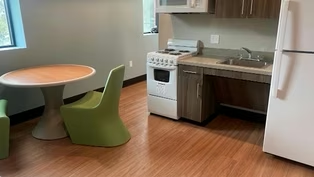
13 Louisville families are now living in the first phase of Louisville's Community Care campus.
When it's complete, it's expected to be a one stop shop where the homeless can access shelter, medical services, and other resources.
The full campus is scheduled to open in 2027.
It's a partnership between Louisville Metro and Volunteers of America Mid-states, with support from the Kentucky General Assembly.
Our Kelsey starts brings us up to date on this project.
>> Tamara Rife is the senior director of Housing Services for VOA.
Mid-states.
Thanks so much for being.
>> Thanks for having us.
>> So tell us about VOA and your involvement in this type of transformative project for Louisville's homeless community.
>> Yeah, sure.
It's really an exciting time for us.
I think at Volunteers of America, we have been in business for over 125 years.
We do lots of things, but this community care campus is really focused on our homeless and housing work that we do.
We have been operating a family emergency shelter for over 40 years now, serving 200 families or so a year in our family emergency shelter.
And the community care campus is going to allow us to expand those services, as well as a lot of other ones.
>> Yeah, a lot of people have said this, this, this is going to fill a gap.
And we have been in need for a long time of a 24 hour shelter and other things.
What type of resources are going to be a part of this campus that's going to fill some of those gaps that have been so long in the Louisville community?
>> Yeah.
So we recognize when they first put out that there was a need for somebody to manage the campus and to offer ideas for what might happen on the campus.
We knew right away that the biggest area that we could serve is for families who are experiencing homelessness.
Homelessness and housing crisis.
We do that really well.
So we said we absolutely need more.
There are always families on the waiting list waiting for a shelter spot to become available to them.
So we said, let's do another, another unity House.
So we've got unity House two coming online.
We'll be able to serve 29 additional families.
So not only the 24 we serve now, but another 29.
And the goal really is that at some point there is not a waiting list.
And when a family is experiencing a crisis, they call and they're told, yes, VOA has a bed for you tonight we're going to have a medical respite, which is its own very unique space for people who are in the hospital.
And instead of having to leave the hospital and go back to a place that is not clean, maybe not meant for habitation, really, or a homeless camp, they can go to respite where they can heal and have professionals take care of them.
We get to partner with Family Health Centers, UofL, Norton to do that work, and then also we're going to have transitional housing for youth experiencing homelessness.
Those 18 to 24, we get to partner with YMCA Safe Place, who is already doing amazing work, and they get to come on and have a have a building where they get to serve their their individuals in the way that they do really well.
So we're excited to do that too.
>> So this is designed to sort of be a one stop shop, right where everything is included in this one campus.
>> Yes, because the other building will be a partner space as well as VOA headquarters.
In that partner space, there are lots of folks who will provide services, whether that's monthly or weekly, or they'll have a permanent space.
This is an opportunity for people to live and work in the same space together and be able to to receive services in a very unique way.
>> Another part of this is permanent affordable housing.
Right?
And so how does that play into this campus?
>> So we also have plans to build 80 units of affordable housing with an emphasis on permanent supportive housing.
We are short in this city of about 1200 permanent supportive housing units.
They are for the most vulnerable and the hardest to house.
So we there's almost 300 coming online in the next couple of years that will help with that gap.
But we want to be a part of creating even more space.
We know that folks need housing, but also the support that goes along with it to help keep them housed.
And so that's always our goal, is to get them housed and keep them housed.
>> Yeah.
Overall, this is a $58 million project supported by metro government and funds bipartisan support from the Kentucky General Assembly as well.
Explain why this is important not only to Louisville but the rest of the state as well.
How does it affect everybody?
>> Well, I think that one of the things it can do is really show what's possible.
Right?
So, you know, this is a very unique opportunity for us to do this campus the way that it is.
And maybe there's opportunities across the state for smaller versions.
People are very eager to provide housing, homeless work in their communities.
And we know that Volunteers of America does it well.
But we also know that folks on our campus do their parts really well.
So it would be amazing if we could replicate this service in other areas, maybe not on the same scale, but certainly with the with the intention of wraparound services and what a community campus can really be.
>> Yeah, it could be a model for the state and maybe the country too, because there are so many areas experiencing this rising number of homeless right now.
Thank you so much for your time and all you all are doing for the community.
Phase one of the Community Care campus is on track, as we mentioned, open next spring, and that includes the unity House.
That's an emergency shelter for families who will have access to case management and housing placement as well.
Back to you.
>> Thank you so much, Kelsey.
According to the coalition for the homeless, nearly 2000 people are currently homeless in Louisville.
Well, that will do it for us tonight.
But coming up tomorrow, lawmakers will talk about Kentucky's food stamps or Snap program, and we'll hear from Kentucky Governor Andy Beshear during his weekly news conference.
So we hope to see you again tomorrow night at 630 eastern, 530 Central on Kentucky Edition, where we inform, connect and inspire.
And we hope that you'll connect with us all the way as you see on your screen.
Facebook, Instagram and X to stay in the loop on all the social media channels, send us a story idea by email to Public Affairs at ket.org and look for us on the PBS and the KET app.
Or you can download some great content at your convenience, on demand, and watch our programs in their full length or either special extras online at ket.org.
I'm Renee Shaw, thank you so much for joining us tonight, and we look forward to seeing you right back here again tomorrow night.
Take really good care.
So long.
Families Move into Louisville's Community Care Campus
Video has Closed Captions
Clip: S4 Ep83 | 5m 42s | Community Care Campus expected to be one-stop shop for those experiencing homelessness. (5m 42s)
A Look at Lobular Breast Cancer
Video has Closed Captions
Clip: S4 Ep83 | 5m 26s | Less common form of breast cancer is on the rise. (5m 26s)
Medical Marijuana Program Growing in Kentucky
Video has Closed Captions
Clip: S4 Ep83 | 3m 49s | Lawmakers updated on the growth of Kentucky's medical marijuana program. (3m 49s)
Northern Kentucky Leaders Present 'Housing Blueprint'
Video has Closed Captions
Clip: S4 Ep83 | 2m 43s | Lawmakers hear ideas from Northern Kentucky leaders on boosting housing supply. (2m 43s)
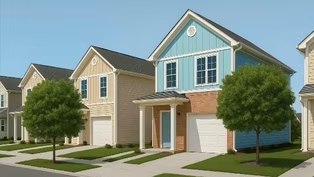
Project Could Help with State's Housing Crisis
Video has Closed Captions
Clip: S4 Ep83 | 3m 27s | New affordable housing project could be replicated statewide. (3m 27s)
Providing Support for PBS.org
Learn Moreabout PBS online sponsorship
- News and Public Affairs

Top journalists deliver compelling original analysis of the hour's headlines.

- News and Public Affairs

FRONTLINE is investigative journalism that questions, explains and changes our world.












Support for PBS provided by:
Kentucky Edition is a local public television program presented by KET