
October 23, 2025
Season 4 Episode 84 | 26m 29sVideo has Closed Captions
Changes to public assistance programs are impacting thousands of Kentuckians.
Changes to public assistance programs are impacting thousands of Kentuckians, Auditor Ball is again calling on the governor to fund SB 151, a Kentuckian is confirmed as a federal judge, Congressman Massie has a beef with President Trump's comment about beef, and meet a group working to save lives across Louisville.
Problems playing video? | Closed Captioning Feedback
Problems playing video? | Closed Captioning Feedback
Kentucky Edition is a local public television program presented by KET
October 23, 2025
Season 4 Episode 84 | 26m 29sVideo has Closed Captions
Changes to public assistance programs are impacting thousands of Kentuckians, Auditor Ball is again calling on the governor to fund SB 151, a Kentuckian is confirmed as a federal judge, Congressman Massie has a beef with President Trump's comment about beef, and meet a group working to save lives across Louisville.
Problems playing video? | Closed Captioning Feedback
How to Watch Kentucky Edition
Kentucky Edition is available to stream on pbs.org and the free PBS App, available on iPhone, Apple TV, Android TV, Android smartphones, Amazon Fire TV, Amazon Fire Tablet, Roku, Samsung Smart TV, and Vizio.
Providing Support for PBS.org
Learn Moreabout PBS online sponsorship>> There is no one common face of hunger.
One unfortunate circumstance.
Loss of a loved one, loss of a job, unexpected health crisis.
>> And how hungry Kentuckians face another problem.
The federal government shutdown.
New.
The president's call for more foreign beef has one Kentucky congressman saying bull.
>> This is not hard work.
This is hard work.
>> And why 12 community violence interrupters decided to share their stories in a new book.
>> Production of Kentucky Edition is made possible in part by the KET Millennium Fund.
>> Good evening and welcome to Kentucky Edition for this Thursday, October 23rd, I'm Renee Shaw, and we thank you for joining us this evening.
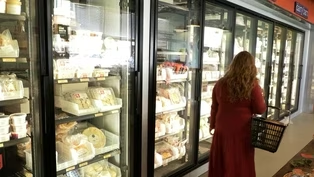
Federal changes to public assistance programs are impacting thousands of Kentuckians.
That's because of President Donald Trump's big, beautiful bill.
And more changes are to come.
In tonight's legislative update, our Mackenzie Spink tells us who is no longer exempt from reporting work requirements and who may need to start paying more out of pocket for groceries.
>> Able bodied adults without dependents are SNAP participants who are subject to more stringent work requirements and time limits on receiving support.
Congress, through the so-called Big Beautiful Bill, expanded the eligibility for that type of public assistance.
Here are the changes.
Previously, if you were over 54 years old, you did not fit into the category of able bodied adults without dependents and were exempt.
But the age limit has been extended to 64.
If you had a child under 18, they were considered a dependent and you were also exempt.
Now, a child is only considered a dependent if they are under 14.
Exemptions for veterans, homeless individuals and former foster youth have also been removed.
Another change expected to affect over 10,000 Kentuckians involves households receiving energy assistance before congressional changes through House resolution one or the Big Beautiful Bill.
If a family received energy assistance through the program LIHEAP that automatically contributed to their Snap eligibility.
>> It used to be that anybody who signed up for energy assistance could get the standard utility allowance.
HR one changes it so that it's only going to apply to households that have an elderly member or a disabled member in their household.
We're looking at a about 13,000 households that will receive a small decrease in their in their SNAP, and I shouldn't say small, because some of them will receive about 24%, will actually receive 110 to $120 less SNAP per month.
Because of this change in HR one.
>> It used to be that entire counties could be exempt from work requirements if the unemployment rate was too high, or if an area didn't have enough job openings.
117 counties out of 120 were previously exempt, but that criteria has now changed.
>> So currently today, we do not have any counties that will meet that exemption requirement.
Starting November 1st, no county will be exempt.
The USDA notified us that that exemption would terminate.
And and all of our all of our counties will have to do work requirements.
So we we went from 3 to 120 of of doing the work reporting requirements.
>> Kentuckians who use the Kentucky Works program or who receive cash assistance from the Kentucky Transitional Assistance Program or Ctap, are also seeing reductions in support.
But these changes aren't a result of federal cuts.
The state's Department for Community Based Services has had to rebudget because of unexpected growth in 2023, CBS expanded its eligibility for Kentuckians to access programs funded by the Temporary Assistance for Needy Families federal Fund.
These dollars funds Ctap Kentucky Works Program, and child welfare programs like Foster Care.
>> When we made these changes, we projected growth in the program of about 10 to 15%, which was within the TANF budget.
The templates could support because prior to that, we had decreasing caseloads year over year.
And we had we had TANF carry forward funds.
>> However, the actual growth ended up being over 50% and those carry forward funds will be gone by fiscal year 2026.
Dcbs attributes the unexpected growth to the rising cost of foster care, especially for high acuity children who need special accommodations.
>> In 2023.
We were just beginning to see youth with complex needs or high acuity youth, in which we could not find placement or treatment for.
This was a new issue for Dcbs.
We had never been unable to find a placement or treatment for a kid in foster care.
>> As a result, families who receive Ctap cash assistance can expect to receive 35% less in support and the transportation supports in the Kentucky Works program are being reduced by 50%.
Lawmakers are concerned about the effect this will have on Kentucky families.
>> In East Kentucky.
We don't have public transportation.
We don't have access to transportation is the number one issue for families, whether it's from domestic violence to health care to getting to school.
So, I mean, I think long and hard before you prejudice areas with service deserts.
>> We do have problems when food is not in the in the cab, you know, in the cupboards and the lights are getting cut off in the water.
And I've had kids in my home who've come from those types of homes.
My concern is, is are we are you all anticipating potentially even more growth in kids coming into care because of these cuts?
>> Dcbs says it's working with families to find them alternative supports.
>> Whenever possible.
We want to make sure that we are, you know, getting services, supports, funding and benefits to those who need that, who need them.
And when we when we have the availability to do so, we do.
But we also have budgetary responsibilities as well.
>> Dcbs says.
To make the programs whole again, it would need $32 million from the state for Kentucky edition.
I'm Makenzie Spink.
>> Thank you.
McKenzie SNAP reporting.
Exemptions weren't downsized wholesale.
New exceptions were actually added for Native Americans, Alaska Natives and other indigenous people.
If the congressional deadlock on the federal government shutdown continues.
1 in 8 Kentuckians who rely on government food assistance may not be able to keep food on the table, and that could put more strain on food banks.
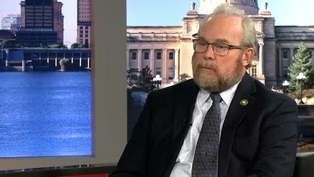
God's pantry CEO Michael Halligan stopped by our studios earlier today to talk about the impacts the shutdown is already having.
Well, welcome, Michael Halligan, it's good to have you.
>> Thank you so much for having me today, I appreciate it.
>> I know that you've been talking a lot about this issue, and I've seen it said or you quoted that says food insecurity in central and eastern Kentucky is already at historic heights, and a government shutdown is making it worse.
How bad is it?
>> Well, so let me give you one illustrative example.
Federal workers and contractors in central and eastern Kentucky number about 17,000.
Food insecurity across central and eastern Kentucky is 280,000.
So that could be another 7.5% increase to what we're already seeing, simply based on folks who all of a sudden are not receiving pay for the work they do or for the layoff that they're facing.
>> Yeah, we are at the time that we talked, and this will be on this evening, 23 days into this federal government shutdown.
I mean, what are you hearing from folks?
And are they coming not volitionally, but are they coming reluctantly or do they feel embarrassed or what?
What are you hearing from people?
Reach out to you, perhaps for the first time.
>> You know, the range of emotions that we see is is very broad.
There are some who maybe have experienced hunger in the past who understand what to do, who, who understand that there's no shame in asking for help.
There's no shame in getting support to be resilient.
We've got others who are experiencing this for the first time in their lives, and they don't know where to turn.
They don't know how to proceed.
And our role is to help provide comfort, to help people understand.
The process is here for you.
And this is a hand up.
And it's so important for people to recognize that a circumstance like this does not, does not define a person.
Right?
The circumstance is what we're trying to address so that people can have a healthy, active lifestyle for a short period of time while the government is shut down.
>> Right.
Is this where it works for they get a week supply of food, or how?
What is the duration of the help that you're providing?
>> So it depends on the circumstances.
The data that we have for food insecurity suggests, right, that an individual who needs access from God's Pantry food bank through one of our 500 food pantries and meal programs, it's about a week's supply.
But part of that is based on the fact that Snap benefits, right, are part of the solution.
>> Which we often refer to as food stamps.
>> As food stamps.
Right.
And we know that if the government remains shut down for the next week and a half, there is a significant risk that Snap benefits will not be funded in November.
So now, individuals who may already rely on Snap now, they don't have that benefit, and they need to rely on a food pantry or meal program.
It's a compounding effect.
Our job is to make sure that people get the food they need to thrive, right.
>> And this is always been an issue.
But do you think there is more attention to food insecurity now because of the federal government inaction and the shutdown?
>> Well, you know, so I think there's a couple of things.
The inflationary pressures that we've seen over the last couple of years have definitely raised awareness, right.
The circumstances on people that are on fixed incomes or who are in part time jobs are more dramatic than they used to be because their budgets are stretched thinner.
So we've already seen an increase in awareness.
And when a circumstance like the shutdown or other economic situations emerge, that always increases the awareness a little bit more.
>> And for those, perhaps, who are relying on your assistance, you also have to have a supply to meet the demand.
Tell us about that.
>> So we've been doing a lot of analysis.
Typically, you know, we carry between 3 and 4 weeks of food supplies at the food bank, right.
If we see an increase in demand and our food supplies remain flat, that availability of inventory starts to go down.
And so we're reaching out right now to food donors and to a lot of different organizations, and quite frankly, the general public, to help us secure additional resources so that we can maintain the services that people need to get the food on their table so they can be well nourished.
>> Guidelines for what should and can be donated and accepted.
>> So from a food perspective, we can handle all, all types of food, basically anything that's sold in a grocery store we can secure, we can properly store, we can properly distribute canned goods, peanut butter, meat, proteins, fresh produce, the entire spectrum.
From a financial standpoint, the research that we've done over the last couple of days says that for every month the government is shut down, we need an incremental $250,000 of financial support to be able to continue to provide the services that folks need to get food on their table throughout whatever the shutdown may be.
>> There are nearly 17,000 federal workers who live in the 50 counties served by God's Pantry Food Bank.
In a related item earlier this week, Governor Andy Beshear announced that his administration has reallocated $9.1 million for the Senior Mills program, following news that area development districts have exhausted all previously budgeted funding for the program.
Kentucky auditor Allison Ball is once again calling on Governor Beshear to fund a new state law.
According to the Kentucky Lantern.
The push came a day after the governor said he was reallocating that money to the state's general fund to pay for the Kentucky Senior Meal Program, which ran out of money last month.
Now, Auditor Ball says the governor should use the remaining $16 million in the general fund to pay for Senate Bill 151, the so-called kinship care bill that became law in July and is meant to help people who care for a relative's child by allowing them access to financial aid.
Governor Beshear signed the bill into law, but argued the Kentucky General Assembly failed to appropriate money for the new law.
The US Senate today has confirmed Kentucky and Chad Meredith as a federal judge for the Eastern District of Kentucky.
President Trump nominated Meredith on June 18th.
Meredith served as solicitor general in the administration of Republican Governor Matt Bevin.
He was also a guest on Ket's Kentucky Tonight.
Just last year, the U.S.
military struck another suspected drug boat yesterday, killing both people on board.
This one was in the Pacific Ocean.
This is believed to be the eighth strike in recent weeks, with most near Venezuela.
U.S.
Senator Rand Paul of Kentucky has criticized the Trump administration's policy on this.
Rand Paul says the policy doesn't make sense.
>> Number one, there is no fentanyl made in Venezuela.
Not just a little bit.
There's none being made in Venezuela.
These are outboard boats that, in order for them to get to Miami, would have to stop and refuel 20 times.
There an all likely going to Trinidad and Tobago, which is an island right off of the coast of Venezuela.
So there's a lot of reasons to be worried about this.
But number one is the broader principle of when can you kill people indiscriminately when you are at war?
That's why when we declare war, it's supposed to be done by Congress.
It's supposed to be thoughtful.
It's supposed to be debated.
We're not supposed to do it willy nilly.
And then when you have war, you just kill people in the war zone.
And even then there are rules of engagement.
But interdicting drugs has always been a criminal activity and a criminal anti-crime sort of activity where we don't just summarily execute people, we actually present evidence and convict them.
>> Senator Paul is part of a bipartisan group in the Senate, planning to force a vote on legislation that would stop the U.S.
from engaging in hostilities inside Venezuela without approval by Congress.
Congressman Thomas Massie of Kentucky's fourth district is also criticizing President Donald Trump this over the statement that America should import more beef from Argentina.
Massie says we shouldn't be buying more foreign beef when American farmers are struggling.
Here's what President Trump said on Air Force One.
>> To get beef prices down.
The only price we have that's high is beef, and we'll get that down.
And one of the things we're thinking about doing is beef from Argentina.
>> But my question is, what do you have to say to us farmers who feel that the deal is benefiting Argentina more than it is them, as they are?
>> Argentina is fighting for its life.
Young lady, you don't know anything about it.
They're fighting for their life.
Nothing's benefiting Argentina.
They're fighting for their life.
Do you understand what that means?
They have no money.
They have no anything.
They're fighting so hard to survive.
If I can help them survive in a free world, I happen to like the president of Argentina.
I think he's trying to do the best he can.
But don't make it sound like they're doing great.
They are dying, all right?
They're dying.
>> Here's how Congressman Massie responded to this on the social media channel X quote, this is not America First.
We don't need the U.S.
flooded with beef from Argentina after our cattle ranchers have taken a beating over the last several years, bring back country of origin labels, end quote.
Construction work will bring a temporary halt to a Frankfort tradition, Governor Andy Beshear announced during his news conference today.
No trick or treating at the governor's mansion.
And that's because of the construction work that's underway around the state capitol and concerns about safety.
The governor hopes something can be worked out for next Halloween.
London's mayor is still on the job after the latest twist in his impeachment saga.
Our Toby Gibbs explains that and more in this look at headlines across Kentucky.
>> The London City Council impeached Mayor Randall Weddle September 5th.
A circuit judge reinstated him and the council appealed that decision, saying Waddell's presence in office is causing irreparable harm.
But according to the Sentinel Echo, the Kentucky Court of Appeals says the council failed to show any irreparable harm, so it sided with Weddle, who remains as mayor.
If the federal government shutdown lasts into November, it could mean furloughs and temporary layoffs at the Department of Energy Paducah site.
The Paducah Sun says funding shortages will start November 1st, potentially affecting thousands of workers and their families.
McCracken County Judge Executive Craig Clymer blasted politicians in Washington, D.C.
for putting party politics above workers.
Fort Knox is concerned about plans to rezone 26 acres in the Radcliffe Vine Grove area, according to the News Enterprise.
The plan calls for the area to be rezoned from commercial to residential, allowing the building of single and duplex housing developments.
Fort Knox is worried that the developments will be too close to a cadet training area.
Earlier this month, Toyota unveiled a 30 acre solar field on Lexus Way in Georgetown.
The news graphic says it will produce about 15,000,000 kilowatt hours of energy each year.
Toyota says it will provide about 4% of the Toyota plant's energy consumption.
The Murray Fire Department has a new firefighting tool.
The Murray Ledger says the department now has a truck with a 100 foot tower ladder.
Murray leaders say it will enhance public safety and bring peace of mind to people in Murray, as well as students at Murray State University.
It cost about $2 million and can pump up to 2000 gallons of water per minute.
With headlines around Kentucky, I'm Toby Gibbs.
>> You're about to hear the story of 12 peacekeepers, a group working to improve communities and save lives all across Louisville.
It's from the Louisville Story Program, a group focused on highlighting untold stories, and Cities United, a national group dedicated to public safety and violence prevention among African American men and boys.
>> What we think is that it is too frequently the case that our neighbors and our communities in Louisville have their stories told for them, or about them or at them.
We believe that those those experiences, when we're able to inhabit or spend time with our neighbors in a really robust way, the the sort of empathetic understanding is greatly increased and that people are the experts of their own experience, really, and can can tell their stories better than anyone.
>> I think.
I think one of the biggest drawbacks to the whole CBI or Community Violence intervention initiative and ecosystem is that folks don't understand the work.
They don't understand the magnitude of the work or what goes into it.
Community awareness is what I'm hopeful will come out of the book, and folks paying attention to the fact that there are some people whose whose whole life is involved in doing the work and keeping people alive.
My chapter is basically about work, programing or working with kids in all different areas of the city.
I've worked Metro Parks and Recreation, the Boys and Girls Clubs, private industry, churches.
So I was more or less interviewed about how I get kids to respond and work in a peaceful way, and how did I get to bring kids together from all areas of the city.
>> We put our life on the line doing this work.
I mean, you know, my life has been threatened and it's been all kind of craziness, but you can't be fearful and be effective at the same time.
Everybody who does this work has their own story of pain and purpose.
And so this work is for people like me who have had a painful journey, who wanted to turn around and turn it into purpose.
And so my purpose is I wanted to be for other young kids what people were for my kids in the 90s.
>> If I had to pick a couple of themes or concerns that come up in the book across all of the 12 chapters that I think are most resonant, most important, it's really that relationships are the site of the answer to these problems that people who come from the communities most impacted by community violence have the solutions in ways that are largely underreported, that community violence is that the solutions to community violence are really a new understanding of what public health looks like, and one that's not dictated by or dominated by, you know, emergency services or policing, one that understands that community health is really needs to be community led.
>> My takeaway for this book is that people really know how dangerous this work really, really is, and then they know how invested we really, really are.
And we're not invested from a financial standpoint.
We're invested from a heart standpoint.
So I tell people this is not hard work.
This is hard work.
And I believe everybody in that book, their heart is in this work.
>> Folks are always concerned with, with the number of homicides and up and down on those numbers.
And all of those numbers are people, people we dealt with over the years.
And the numbers don't even come close to the people who aren't part of the numbers.
So that's the story we wanted to try to help to tell.
>> That's why this book is so important, is because it's really difficult to tell the story of a murder that didn't happen.
And that's what these folks are out here doing every, every day.
And I really mean that they're keeping people from being killed.
>> You know, that's the hugest part, is to save a life.
You know, everybody knows somebody that they wish somebody would intervene with.
And we just happen to be those folks.
When people read this and see this and there's hope, even the ones that think that they're dumb fell so far back, that ain't.
But somebody out there cares about you.
There's somebody willing to work with you, and somebody's going to be in your corner no matter what.
>> The book you Got to be of the people was released today.
Kentucky edition will be there tomorrow for the official Proclamation of Pork Month in Kentucky.
It's an event that promises to involve more than just politicians at a podium.
That story and more.
We won't be picking around on Kentucky Edition.
And that comes at you, of course, at 630 eastern, 530 central, where we inform, connect, inspire and maybe make you laugh.
We hope that you'll subscribe to Kentucky Edition email newsletters and watch full episodes and clips at ket.org.
You can also find us on the PBS video app and the KET app that you can download on your mobile device and smart TV.
We encourage you to send us a story idea by email to Public Affairs at ket.org and follow us on Facebook, Instagram and X to stay in the loop of all the great programing on Kentucky Edition, Public Affairs and across the board here at KET.
Thanks so very much for watching.
I'm Renee Shaw, have a great night and I will see you right back here again tomorrow.
So long.

Book Highlights Work of 'Peacekeepers'
Video has Closed Captions
Clip: S4 Ep84 | 4m 43s | Louisville 'Peacekeepers' tell their stories about working to prevent violence in a new book. (4m 43s)
Government Shutdown Could Strain Food Banks
Video has Closed Captions
Clip: S4 Ep84 | 6m 12s | Food banks expecting to see more Kentuckians because of federal shutdown. (6m 12s)
Public Assistance Changes Impacting Kentuckians
Video has Closed Captions
Clip: S4 Ep84 | 6m | Federal changes impacting Kentuckians on public assistance. (6m)
Providing Support for PBS.org
Learn Moreabout PBS online sponsorship
- News and Public Affairs

Top journalists deliver compelling original analysis of the hour's headlines.

- News and Public Affairs

FRONTLINE is investigative journalism that questions, explains and changes our world.












Support for PBS provided by:
Kentucky Edition is a local public television program presented by KET