Vermont This Week
October 25, 2024
10/25/2024 | 26m 45sVideo has Closed Captions
Funding Vermont’s education system | Voters want answers after property taxes spike
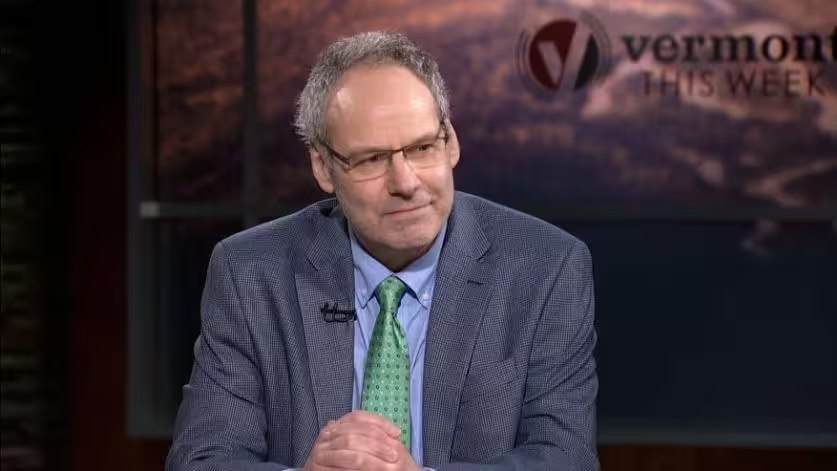
Funding Vermont’s education system | Voters want answers after property taxes spike | Health care reform | Panel: Mitch Wertlieb - Moderator, Vermont Public; Lola Duffort - Vermont Public; Mark Johnson - WCAX; Howard Weiss-Tisman - Vermont Public.
Problems playing video? | Closed Captioning Feedback
Problems playing video? | Closed Captioning Feedback
Vermont This Week is a local public television program presented by Vermont Public
Sponsored in part by Lintilhac Foundation and Milne Travel.
Support provided by:


Vermont This Week
October 25, 2024
10/25/2024 | 26m 45sVideo has Closed Captions
Funding Vermont’s education system | Voters want answers after property taxes spike | Health care reform | Panel: Mitch Wertlieb - Moderator, Vermont Public; Lola Duffort - Vermont Public; Mark Johnson - WCAX; Howard Weiss-Tisman - Vermont Public.
Problems playing video? | Closed Captioning Feedback
How to Watch Vermont This Week
Vermont This Week is available to stream on pbs.org and the free PBS App, available on iPhone, Apple TV, Android TV, Android smartphones, Amazon Fire TV, Amazon Fire Tablet, Roku, Samsung Smart TV, and Vizio.
Support the crew
Help Mitch keep the conversations going as a member of Vermont Public. Join us today and support independent journalism.Providing Support for PBS.org
Learn Moreabout PBS online sponsorshipThe cost of the state's education system is a leading issue for Vermonters this election.
It's also notoriously complicated.
As Senate Minority Leader Randy Brock pointed out during a spirited debate back in February.
Right now, we have a tax system.
As far as education funding, I defy you.
Any one of these actually explain it to voters?
No child.
Really.
Reader with educatio funding top of mind for voters.
Vermont public smaller due for breaks down how it all works.
Plus the author of a landmark Vermont hospital report admits errors in the report but stands by the report's conclusions that the state's health care system needs a major overhaul as hospitals and state regulators grapple with how to rein in costs while also providing quality care.
That, and more ahead on Vermont this week.
From the Vermont public studio in Winooski.
This is Vermont this week, made possible in part by the Lintilhac Foundation and Milne Travel.
Here's moderator Mitch Wertlieb.
Thanks for being with us.
I'm Mitch Wertlieb.
It's Friday, October 25th, and joining us on the panel today we have Mark Johnson from Wcax.
Lola Duffort from Vermont Public.
And joining us remotely today, Howard Weiss-Tisman from Vermont Public.
Thank you all so much for being here today.
We're going to start wit something very different today.
You heard me talk at the top about how complicated our education funding system is here in Vermont.
Well, we've got a very special video to show you.
And it's going to do it in a way that you may not be used to, but it's going to explai some things about the education system, and I think you'll find it fascinating.
Here it is.
Have you ever wondere how Vermont schools get funded and how your property taxes get calculated?
You're not alone.
It's pretty confusing.
So we're here to break it down.
First, local school boards create a budget for their district.
And on town meeting day, residents either vote to approve or reject this budget.
Once a voter approved spending plan is in place, the school board sends the state a bill for basically the full amount.
Now, the state must pay for all of these budgets, plus a few related expenses.
And so in total this year, Vermont will spend $2.3 billion on education.
But Vermont doesn't just use property taxes to pay for schools.
We also have sales taxes, the lottery, and other sources feeding into the statewide education fund.
In Montpelier, state lawmakers chec how well these sources are doing and then figure out how much they'll need to raise from property taxes to make up the difference.
There are two types of school taxes.
Homestead property taxes, which are applied to primary residences, and non homestead property taxes, which are applied to basically all other types of property, including commercial buildings, rental properties and second homes.
Now the non homestead rate is fairly simple.
Technically the legislature sets one statewide non homestead rate.
But to ensure fairness we use a common level of appraisal or CLA to adjust the tax rate in each town, so each town's taxes reflec current and fair market values.
Every town appraises its properties a little differently and on different timelines.
So this helps make sure that towns with outdated appraisals aren't inadvertently getting their residents an unfair discount.
So the tax department takes that one homestead rate that the legislature sets, and then uses the CLA to adjust the rate from town to town.
Homestead taxes, unfortunately, are trickier.
Each school district gets a rate depending on their spending per student.
Districts with lower spending per pupil have proportionally lower tax rates.
Each district's homestead rate, which is pegged to that spending per pupil, is then adjusted again using each town CLA.
That is why homestead rates look different from town to town, even when those town are in the same school district.
The difference between tax rates before and after the CLA is applied can be jarring.
So updates which will be in effect in 2025.
Aim to bake in some of this adjustment earlier in the process, so that people are less surprised when final rates come out.
Now, we should note that this per pupil calculation that I mentione earlier isn't straightforward.
Some kids should cos more to educate, like students in rural settings or those living in poverty, so they're weighted differentl when the state is figuring out how much a district is spending per pupil.
Act 127.
That new la you may have been hearing about adjusted these weights plus Vermont income sensitize is property taxes.
Meaning if your household earns below a certain amount, you get a tax credit and roughly two thirds of Vermonters receive such a credit.
So how does this usuall all come together in Montpelier?
Well, unless lawmakers want to change the basic structure of the system, they typically have really two choices to make.
First, they have to decide how much of the burden to put on the homestead tax versus non homestead.
And then if they're lucky and the education fund has a surplus, they have to decid what to do with that extra cash.
A surplus however can be a double edged sword.
One time money is best spent on one time expenses.
But it's pretty tempting politically to use a surplus to take the pressure off property taxes.
The problem with that, of course, is that educatio spending is an ongoing expense.
And so when a surplus or any other type of one time money is used to artificially buy down rates in one year, that means ta rates will have to play catch up the following year.
You risk a spike.
Yes, it's super complicated.
So why do we have a system that is so mind numbingly complex?
Why can't we make it simpler?
Well, that's because fundamentally, it's designed to be fai while preserving local control.
30 years ago we had a very different system.
While the state did provide some funding, school budget were generally a local affair.
School boards and local voters decided how much they wanted to spend, and then they set tax rates based on their local grand list to raise that money.
There was one big problem with that system property rich towns could spend lavishly on their schools, even with low tax rates, while property poor town struggled to pay for the basics.
Even with high tax rates, it wasn't fair.
There was a lawsuit about it and in 1997, the Vermont Supreme Court decided that the status quo was unconstitutional.
In response the legislature passed act 60.
And that is why we rely on a statewide education fund and not local grand lists to pay for schools.
The basic notion of the law is thi whether you live in Bennington or Barre, if your school is spending the same per pupil your tax rate will be the same.
Our education system is often hailed as one of the most progressive in the country, bu it's not without its problems.
One, it's incredibly complex which means that it's difficult for voters to understan the implications of their vote when they're asked to weigh in on school budgets.
Two it's not cheap, and in an era of declining enrollment, some want to see more cost containment, although others argu that tax reform is the answer.
And three well, it uses a lot of incentives to try and encourage the highest need districts to spend more and more privileged districts to spend a little less.
Local voters and school boards still get the final say on spending, and sometimes more privileged communities still choose to spend more, while poorer communities still choose to spend less.
For the challenge before us.
Is this.
Can we make this system more affordable?
Can we make things more fair?
Can we make things more legible to people on the ground?
And can we do all of this while preserving local control?
Well, Lola, can we.
This is the real life Lola do for.
That was the animated version of Lola giving us that explainer video.
Fascinating.
And what I very quickly say this took a lot to put together.
That seven minutes that you saw might have looked simple, but Lola De Ford did a ton of work on this.
April MacCallum, Mike Dunn, Kyle Ambrose, Kelly Mumford and Brian Stevenson all helped put that video together.
And thank you for doing that.
you know, it does explain a lot.
It's the kind of thing you have to go back, maybe and watch a few times, though, again, because this is incredibly complex.
but what I foun fascinating about it was that, you know this was not the way it was done originally back in the late 90s.
This changed and is the change.
Can we say this is the change a little bit for the better as far as fairness goes?
I'd say yes.
I mean, I think, you know, and if you talk to folks in Montpelier, as much as people want to, change the status quo, most people agree, you know, on all sides of the aisle that we should not go back to you know, a pre 60 world, a pre Brigham world where it wa basically every town for itself.
and so there is, you know, a least that common common ground.
But one of the things I found interesting about this is the property taxes are still, you know, an issue for so many Vermonters.
And so many folks saw sticker shock this year.
it got brought down a little bit.
I guess it could have been about an 18% increase this year, brought down to about 14%.
Is that right?
That's that's right.
Yes.
And that was a political calculation.
I mean, was it was that money paid down because there was just no way you could pass that on to Vermonters and say, this is what you got to pay.
Yeah.
I mean, this is one of the things I kind of talk about in the video.
I don't reference specifically what just happened, but, you know, the reason that tax rates went from, you know, projected 20 ish percent to about 14% is in part because lawmakers, brought them down again.
You know, they used about $70 million to bring that down, which was, you know, something that their constituents were, saying very loudly that they needed them to do.
but that decision is going to be one that we contend with, this upcoming year.
And, you know, school officials, and lawmakers themselves have, like, admitted that this was kind of a Faustian bargain that they had to make.
you know, the governor who had proposed an alternative also wanted to use one time money.
but he wanted to use one time money that was in reserves, which would have needed to be paid back.
Right.
and so very likely would have made things worse.
at least, you know, this next year.
Mark Johnson, you've been looking at this issue, too.
Yeah.
There's no question that this is fairer and better than pre Brigham.
I mean, as you said, you know, really was every time for themselves.
And you had very wealthy communities that had a relatively small number of kids.
And people's property taxes were pretty low.
I mean, we talked about gold towns in the past.
I think one of the issues that people have with the current system, though, is that what you spend in your community is not directly connected with what you pay in taxes.
It all kind of goes into this large pool and then it's divvied back.
So, you know, we saw communities what a third of the communities out there turning down their school budgets.
And even if they turned them down there, just there wasn't that connectio between what you were voting on and what your taxes were going to be.
So there's got to be somewhere in between there.
And a lot of those school budgets voted down multiple times.
Howard West has been you've been seeing thi in southern Vermont, too, right?
I mean, you got some, a lot of questions from folks in Putney, I believe, about their property taxes.
Right.
So the Putney tax bills, shot up, you know, astronomically this year and, somethin that we haven't touched on there just so many things that go into this.
insurance premiums are huge.
a lot of the, the past, year we're coming out of Covid where there was a lot of Covid money that schools had to spend.
So it was just a really toug year in towns all over Vermont.
As you said, the tax rate this year was just very high.
And I don't see too much on the rise in that, that we're not going be back here talking about this again you know, in a couple of months.
Well, this study came out recently and Loyola, I know that you took a look at this, arguing that Vermont could cut or save some $400 million in school spending if they change the system, change the way everything works.
And I remember, the story that you wrote about this, there was a reaction from Don Tenney, the head of Vermont's, NEA, the Education Association, and he had one word for it absurd.
Yeah.
that was a pretty strong reaction.
and, you know, to be, you know, the the study that came out, which was commissioned by lawmakers was very much a theoretical exercise.
Right?
There is no, there is no world in which, lawmakers can flip a switc and save $400 million next year.
and while there are, say, a lot of parallels between the conversation going on between, you know, in health care and in education, right, in health care.
We recently got a report that was like, you need to do this x, y, z. that road map does not yet exist for our schools, right?
so what was this report saying?
That it did the theoretical part of it, I guess.
Yeah.
I mean, the theoretical part of it was like you have X number of students, based on, like, based on best practices, like you could spend, you know, based on this body of literature, you could spend this amount of money and be reasonably certain that you would be delivering, an education that was, just as good, if not better than what you are doing now.
but, you know, and this is big, but you would have a larger classes and you would have larger schools, right?
this study did not go into like, this is, you know, you could do it this way.
And, you know no kid would have a bus ride of, you know, it didn't deal with the particulars.
Short on details, it sounds like.
Yeah.
Which it was never sort of the, the intent of this.
Right.
The intent of it was just to try and figure out, like, okay what is actually like a sort of theoretical, reasonable amount of money to spend on schools.
it's sort of like a first data point.
because, a whole bunch of stakeholders are meeting and trying to figure out what that roadmap should look like, right?
Yeah.
and so a, you know, it's.
Yeah.
No, it's a it's a really interesting report.
I think as Phil Scott has said, you know, like we have commissione a lot of studies over the years and they all sort of boil down to the same conclusion, which is that, you know, the current way we deliver education in Vermont, is expensive in large part because we have really small schools, really, really small classes and the smallest staff t student ratios in the country.
Yeah.
And that's so I think you're exactly right in the parallel between this discussio and the health care discussion.
I mean, we've got 250 schools.
We have 14 hospitals, but we're a very rural state.
And I think that the, the, the same theme that's running through these is that people don't want to be too far from a hospital, and they don't want to be too far from a school.
And at the same time, you know we're trying to attract younger people to come to Vermont.
And I think both of those situations are a negative for people to want to live out in the boonies, so to speak.
So, you know, it sounds good on paper, but when you really boil it down, unless you're living in Chittenden County or down near Dartmouth and the health care discussion, you're pretty going to be pretty far away from a major facility.
Well, Mark, you've been digging into this health care report.
outside consultant, came in to talk about this one thing.
I want to get out of the way.
firs is that the author of the report actually said he made some errors, in the report.
But the overall conclusions of the report does not do not change.
Yeah.
And I think that's fair.
I mean, yes there were some miscalculations, but but I think the bottom line and the most alarming part of this repor is that out of the 14 hospitals we have, if we go with the content, the rate we're continuing to go right now, by 2028, 13 of the 1 hospitals are going to be losing major money and the accumulated deficit between now and then.
He pegs between 2 and $3 billion.
So I think the point of that report was that we better make some adjustments now before hospitals are closing.
And let's figure ou in a appropriate role for them, and what's the appropriate number to hav major medical care facilities.
And what do we do with the rest of them?
For example, have some of them focus on primary care, maybe have one specialize in orthopedic surgery, and not have all hospitals trying to do all things at the same time, where those are the specific or some of the specific recommendations they made in that report.
Well, the report kind of just gave a roadmap.
And then, you know, it's going to be up to the Greenmount Care Board and really the Agency of Human Services to then take that digest.
And I think that's wher the report was leading them to.
There's some specific examples, Howard, that you've been looking at in southern Vermont.
you mentioned that there's a Bellows Falls clinic that I believe that's going to close because it's unsustainable financially.
What can you tell us about that?
Right.
So the Bellows Fall Clinic is a little bit separate.
this report specifically looked at hospitals and our hospital system.
The clinic is part of a larger health care grou that works out of Springfield.
So it's kind of, it's kind of the same thing, but a little bit different.
But there's there's so much to talk about here.
And Mark touched on the similarities with the school, discussion.
The hospitals acros the state have been pushing back really hard on this report.
I was at a community meeting last night in towns in, for the Grace cottage Group.
And what strikes me with the school discussion, it's like in the big talk, everyone is upset about their property tax bills going up.
Everyone is upset abou their insurance rates going up.
But when it gets down to closing your hospital or your school, that's where no one wants to make the tough choices.
And that's what Grace Cottage Hospital is, is the smallest hospital in the state.
And when you're at this public meeting and a woman stands up and says she broke 27 bone in a bicycle accident and Grace cottage helped her nurse herself back to health, you know, it's really strong arguments.
It's the same thing i the school all across the state.
We can say we want to close small schools, but then families stand up and they say, we'r losing the soul of our community and we can attract more families.
So, it's a really tough, conversation.
It's a really tough challenge.
What the hospital report is pointing out and what the school, the report Loyola talked about is that we just have to make some really tough decisions.
It's not going to be easy.
There's no silver bullet.
There are not too many ways to make education or health care, cheaper.
And, there are some really tough choices.
I'll just say very quickly, what we're seeing here is it feels like this is all coming to a head.
The tax rate last year was was so, eye popping, our insurance rates low.
Did some reporting this week.
health care rate are going up again for schools.
So, you know, if last year was tough, next year is going to be even harder.
And it's just going to take some really tough decisions, to try to move this conversation forward.
And, you know, another thing I'll say is I've been really struck as I've been covering these school closure discussions where, often.
Right.
You do get those parents standing up saying, please don't close my school.
I love this school.
You know, I love this small atmosphere, but I'm also meeting a lot of parents who are saying, actually, I want more for my kid.
And I believe that a larger, facility could deliver that.
And I think that, what I'm saying is that for a lot of people, like whether or not you can save money doesn't really feel, like a convincing argument to get rid of these institutions or to change them.
But the only one that does is when you actually can say, like, here are the things we can do better, right?
For you in terms of like, can we deliver you better medical care?
Can we offer your child more programing?
and, and I and I have found that really interesting.
Right.
Is that for so many people, the actual decision of whether or not to change or to close, does not seem to be really a financial calculation.
But about that thing that you get from this institution, right.
What can you get from there?
Because, you know when these class sizes are ten, 12 kids, there's a much richer experience.
Many people feel if they can be in a larger classroom and have more interaction with other kids.
And I think when it really comes down to, in some cases, how long a bus ride you're willing to let your kid and you put up with it, has that been Governor Phil Scott's argument to that?
You know, we have to consolidate.
We have to get rid of these very small classroom sizes.
That's been his argument.
And let me just jump in here.
You know, this also, there's a parallel with the health care in tha the report says the same thing is that we're trying to save money, but we're also trying to improve health care for everybody.
Because if you're going to a hospital that's only doing 6 or or a dozen operations in a year, studies have shown outcomes are better when doctors are doing more of these procedures and the health care will improve if we can get over this mountain.
That's, ahead of us.
Yeah.
But, you know, the numbers d keep getting in the way, Loyola.
I mean, you know, you said the health insurance premiums for schools are se to rise nearly 12%, nearly 12%.
And it was funny I when I was talking to, folks that we had the Vermont Education Health Innovation Initiative they manage the the tax rates.
They were joking when they said this, but they were like, you know, we actually receive quite a few people saying, oh, we thought it'd be worse.
okay.
and to be clear, they weren't like proud, like the 12%.
They fully understand that that's that is too high.
But like, you know, the point is we we now expect the trend lines to, to get just they're so bad, that, you know you get you get hit with a 12%, you're like, well, it could have been worse.
and that's sort of where we are right now.
and it yeah, i kind of feels like we're at the really the toughest part the last couple of minutes here.
We can get off schools and, and hospitals.
For a moment, I want to mention a political story that, maybe caught the panel here by surprise.
Caught me by surprise.
House Speaker Jill Krinsky, no facing a challenge from Dover, independent Laura Sibylla, who wrote to her colleague and said she wants the position.
And she said, this is not a stunt.
Were you all all surprised by that?
I was somewhat be given how strong the Democratic majority is right now.
You would think Joel Kruczynski was, you know, was going to bother to challenge or I think, really, Laura Sibley has got quite a task ahead of her here.
I mean, she would literally have to get every Republican in and get a big chunk of the Democrats, to go along with her.
I mean, one thing that that, I thin the news stories to talk about, they should point out it is a secret ballot.
So, if you were going to be doing it publicly, there's no chance.
But, you know, unless there's and I know there's been some pushback on on Joe for his leadership.
But, you know, to the extent to which she's going to get ousted from this, I'd say longshot.
Longshot?
You think?
Yeah I think definitely a long shot.
But I do think it speaks to some pretty interesting dynamics in the House.
the strength of the rural caucus.
Right.
Which Laura Sebelius, a really key member of and which is a bipartisan caucus, and fractures in particular, around housing.
Right.
And the role that housing and conservation are playing.
and so, you know, do I, I don't think she'll win, but I do think it speaks to real fissures.
We'll see if that happens and we'll check it out next week as well.
I it's really we want to thank our panelists, Mark Johnson W-c-i-a do four from Vermont public and Howar Weiss to me from Vermont Public.
Hope you can join us agai next week on Vermont this week.

- News and Public Affairs

Top journalists deliver compelling original analysis of the hour's headlines.

- News and Public Affairs

FRONTLINE is investigative journalism that questions, explains and changes our world.












Support for PBS provided by:
Vermont This Week is a local public television program presented by Vermont Public
Sponsored in part by Lintilhac Foundation and Milne Travel.