
October 27, 2025
Season 4 Episode 86 | 26m 29sVideo has Closed Captions
Kentucky food banks are seeing increased demand.
How the government shutdown could impact Kentucky food banks, Governor Beshear makes another appearance on a late-night talk show, and the Hardin County Republican Party faces backlash for sharing a video depicting the Obama's as apes.
Problems playing video? | Closed Captioning Feedback
Problems playing video? | Closed Captioning Feedback
Kentucky Edition is a local public television program presented by KET
October 27, 2025
Season 4 Episode 86 | 26m 29sVideo has Closed Captions
How the government shutdown could impact Kentucky food banks, Governor Beshear makes another appearance on a late-night talk show, and the Hardin County Republican Party faces backlash for sharing a video depicting the Obama's as apes.
Problems playing video? | Closed Captioning Feedback
How to Watch Kentucky Edition
Kentucky Edition is available to stream on pbs.org and the free PBS App, available on iPhone, Apple TV, Android TV, Android smartphones, Amazon Fire TV, Amazon Fire Tablet, Roku, Samsung Smart TV, and Vizio.
Providing Support for PBS.org
Learn Moreabout PBS online sponsorshipKentucky, my home state off Medicaid that are able bodied and into private health care.
>> Kentuckians in Congress talk about the government shutdown, health care and how to fix both.
>> You know, some of those families now are struggling.
They used to donate, and now they're standing in the line that they used to donate to.
>> It's the worst of both worlds.
More people need food and fewer people can afford to donate.
>> Sometimes just the right connectors being in the room, you know, can make a big difference.
>> The Violence Reduction Summit in Louisville is working to create a network of organizations fighting to prevent gun violence.
>> I remember falling in love with the 1990 Corvette ZR1.
The King of the Hill.
It was the car.
>> And a love story that's still going strong as the next chapter unfolds for America's sports car.
>> Production of Kentucky edition is made possible in part by the KET Millennium Fund.
>> Good evening and welcome to Kentucky Edition for this brand new week.
It is Monday, October the 27th.
I'm Renee Shaw and we thank you for spending some of your evening with us.
It's day 27 of the federal government shutdown, and it's unclear when or how the government will reopen.
Democrats in Washington, D.C.
want tax credits that lower the cost of health care to be extended.
Republicans say they won't negotiate until the shutdown ends.
Congressman James Comber of Kentucky's first congressional district, is chair of the U.S.
House Oversight Committee, appearing on CNN.
He said the current health care system is broken.
>> When you talk about the people that have received the Obamacare subsidies, their premiums are going to skyrocket.
Will the people that have been paying full price, their premiums have skyrocketed for the last decade?
So this is this is specific to this.
We've been trying to have this conversation for a long time, and I think the Democrats have intentionally waited until the subsidies expire.
We need to have a health care plan for every American, for the small business owners, because we've got to get people in Kentucky, my home state off Medicaid that are able bodied and into private health care.
But private health care goes up twice as much as as people on the Obamacare subsidies, because somebody's got to pay for those subsidies.
So it's a terrible situation.
I think we've got to reopen the government and then have public hearings on how to fix a broken health care system.
>> Nearly 100,000 Kentuckians get their insurance through the Affordable Care Act.
Open enrollment begins Saturday.
U.S.
Senator Rand Paul of Kentucky says President Donald Trump should appoint a bipartisan group of senators to a commission to look at ways to end the shutdown.
On Fox News Sunday, Paul said the government should reopen for a month, and during that month, the commission could discuss ways to address the Affordable Care Act tax credits that expire at the end of the year.
That's been one of the sticking points.
Of course, preventing Democrats from supporting the Republican budget plan.
Today, U.S.
Senator Mitch McConnell welcomed a Senate colleague, Senator Shelley Moore Capito of West Virginia, to the McConnell center at the University of Louisville.
Capito talked about the continuing impact of the federal government shutdown.
While McConnell talked about the need to compromise in order to make the Senate function.
>> We are now at a point where our SNAP benefits.
And I know Kentucky has a lot of Snap benefit beneficiaries.
This is the health.
This is the feeding food for many families.
Imagine my state of West Virginia is very impactful to my state.
This expires November the 1st.
Some Head Start programs TSA people have lost.
Last time I went through TSA, I was like, hey, how are we doing?
You know, I was I was rushing through there because, you know, small town, five gates, everybody knows you.
And and so I, you know, I we've got to do.
I hope we talked about this just briefly.
And we honestly don't know what's going to happen this week.
There's going to be a point at which it can't it the bubble's going to burst.
I would have thought it would burst.
My original prediction was it would last a week, but.
So I'm out of the prediction business.
It's gone on a lot longer and it's hurting a lot more people.
>> Compromise is imperative.
Might say there are a lot of people running around these days saying don't ever compromise.
That's absolutely nuts.
You have to compromise.
>> And as Senator Capito just mentioned, if the shutdown continues past November 1st, nearly 600,000 Kentuckians who rely on Snap benefits will lose access.
More people are now headed to Kentucky's food banks for help.
Our Kelsey Stark sat down with the CEO of Louisville's Dare to Care food bank to find out how they're adjusting to the increasing need.
>> Vincent James is the CEO of Dare to Care Food Bank here in Louisville.
Thanks for being here.
And I know the effects of this federal government shutdown are having an effect on everyone, but specifically for the position that you all are in serving the community as a food bank.
How so?
>> Yeah, it's been really challenging in terms of when we've been talking with our partners, really trying to understand how the government shutdown is impacting.
We received some data yesterday that 48%, 47% of our partners are talking with neighbors that have been impacted by this government shutdown.
So we were thinking, because we're not we're not heavily we don't have a lot of government workers in terms of other states do and other regions that it was not going to be as impactful.
But we're seeing on multiple levels, we're thinking about various tiers of impact that it's happening, and we hadn't thought about it that way before.
And so that's what we're seeing.
And that's what our partners are expressing, that that need is increasing.
And we haven't gone into the first paycheck.
Or we might be just at that point where they're not receiving their first paycheck.
And so we're only anticipating for it to grow.
>> Yeah.
And now we're hearing a lot about the Snap benefits that the money is going to expire if this continues.
Yes.
And an estimated 595,000 Kentuckians receive Snap benefits.
What's the impact of that if it happens?
>> If that happens November 1st, it's funded through November the 1st if the government is still shut down November 1st, all of those families that you just described will no longer have access to Snap benefits.
That provides them.
A lot of people will know Snap benefits from the old food stamps.
That's what people remember as they were growing up where they actually had this, the paper that looked like a money, and they gave it to the grocery retailer Snap Benefits.
They receive a card and they're able to purchase, you know, our neighbors are able to purchase food that's provided resources through the government.
But what that does is for every dollar that Snap benefits is providing, it's nine meals for that family.
And so they have opportunities to be able to take care of their families in times where they normally could not do it on their own.
>> And so the government shutdown is one part of what's happening with you all, but you all are already seeing a dramatic increase in need right now.
>> We're already seeing it.
Just the past two years, we've seen a 48% increase.
That's before anything we're talking about government related has impacted the community.
And so with that, we are also now anticipating even a greater need than the 48% in the past two years.
And we haven't seen these kinds of numbers since 2008, the Great Recession.
>> So why, why, why are we seeing this dramatic increase right now?
>> Well, I think it's because it's what I would call this perfect storm, if you will.
We had post pandemic benefits that were no longer in existence, and then you had inflation taking place at the same time.
So you had gas prices increasing, food prices increasing.
And so and now that rising prices on other things as well.
And so when you have a family that is already struggling and now they don't have the additional safety nets and supports, and they're experiencing the same increase that everyone else is experiencing all of a sudden now you have a family of two that that are working every day.
They can't afford to buy groceries.
And that's the kind of situation we're hearing, unfortunately, more frequent than not.
>> Yeah, and Dare to Care was born out of a community coming together to to address the need.
And I know a lot of the community right now they're struggling with their their own increase in grocery prices right now.
So are you all seeing a decrease in donations and community support?
>> We have we've seen a decrease in smaller donations.
And that's been the challenge because one of the things anyone can support dare to care.
I mean, we have kids that will host food drives that are on the corner.
Instead of having to eliminate stand, they'll have a food drive.
And we you know, we've seen all kinds of ways that people can help and support.
But when your budget is tight and you don't have the resources that you had in your discretionary income is dwindled to nothing, it's hard for you to donate and give.
And so we've been seeing a lot of the smaller gifts as we're seeing inflation in the grocery prices.
We're seeing everything else taking place.
You know, some of those families now are struggling.
They used to donate, and now they're standing in the line that they used to donate to.
>> Yeah.
How is your organization adjusting to navigate this time?
>> We're doing a couple of things in terms of what we're doing.
We're always thinking, you know what I always identify as I say, this thing with my staff is that we got to look around the corner and we got to see what's happening around the corner before it happens so that we can prepare.
And so we've been preparing for what we're seeing now and what we're experiencing, realizing that, you know, we can't do it by ourselves.
And we've never prepared to do it by ourselves.
Our preparation has been how do we work better in partnership with other organizations in the community that are providing resources to families that are in need and collectively working together?
We can create opportunities for families that don't have access to food, as well as other resources that may be needed.
>> How can those community members help at this time?
>> Well, one of the ways that they can help is simply go to Dairy care.org, and they can sign up to volunteer, volunteer at one of our food drives, or volunteer at one of our food pantries, mobile pantries.
Or they can volunteer at our warehouse and where they can help to prepare the food that's actually going to be distributed to our neighbors in need.
They can also go to Dare to Care org and donate finances or financial resources.
One of the things we like to talk to people about is our Apple Corps program, where you can sign up one time and have IT resources taken out of your account monthly, and then you don't have to think about it.
You know you're always going to be supporting dare to Care with the work that you're doing.
Or you can give a one time donation.
We have multiple ways in which you can contribute and support the work of Dare to Care.
>> What do you see as what do you see around the corner right now?
What do you think is happening in the future, and how is that going to impact you all?
>> Well, the challenge in terms of looking around the corner and what I see, I wish I could say I could see a much more rosier picture.
Unfortunately not because there are some cuts and decisions that have been made and policies that have been made that are going to even make it more challenging in the coming year for families.
And so what we're going to have to do is work not only with legislators, working with our partners, working with our business community to say this is a collective problem that we have and a collective challenge.
And so how can we solve this together?
And that's what we really have been thinking about, is we've been thinking around, looking around the corner, realizing that it's going to be a multi-sector approach to really addressing food insecurity and some of the other challenges that we face in our community.
And so that's what we're building out the infrastructure for that.
>> Right now.
All right.
Thanks so much for being here.
We appreciate it.
>> Thank you Kelsey.
It was my honor.
>> And there are some new numbers out to that show.
1 in 5 children in Kentucky deal with some type of food insecurity.
1 in 7 adults.
Back to you.
Yes.
>> Well, thank you, Vincent James.
And thank you, Kelsey.
Dare to care.
Serves 150,000 people across 13 counties every year.
Last year alone, they supplied meals to 22 million people.
Kentucky's only congressional Democrat, Morgan McGarvey, signed a letter to the Secretary of Agriculture urging the department to find a way to fund SNAP past Friday, and he said this on X, quote, food shouldn't be used as a weapon, but that's what the Trump administration is doing.
They're deliberately creating this crisis.
We're calling on the USDA to use contingency reserve dollars and all legal authority to fund SNAP during this GOP shutdown, end quote.
And a programing note about a different federal program, Medicare, that is a health care program that enrolls those 65 and over.
Well, tonight I will be joined by a panel of experts to discuss the open enrollment period of Medicare that goes through the 1st of December.
We'll answer your questions about how the program works, the coverage options, supplemental plans, and so much more.
It is our Medicare call in that is viewer driven.
So the content depends on what questions you ask.
That comes on tonight at eight eastern, seven central right here on KET.
Kentucky Governor Andy Beshear continues to make appearances on late night talk shows.
He was a guest on HBO's Real Time with Bill Maher on Friday, where he was asked how President Trump so-called big beautiful bill will impact rural Kentucky.
>> It's basically punishing rural America in the face.
It just is.
It's going to devastate rural economies because it's going to close or significantly impact rural hospitals.
Every one of my rural hospitals is the number one payroll in their community.
And so if you eliminate a large part of that payroll, you don't just close the hospital, you close the local restaurant, you close local coffee shop, and you close the local bank.
You can't take $1 trillion that's flowing through rural America out of it and not expect people to be impacted.
But then there's the workforce.
So right now, if you've got a clinic, you can miss a couple hours of work and see a doctor.
But if you have to drive 2 to 3 hours, you're missing a day.
And then you take your kids and then you take your parents.
It's going to profoundly impact America in really negative ways.
>> Governor Beshear has been mentioned as a possible Democratic presidential candidate in 2028.
He said he's running.
He said running for the white House is a job he would consider.
The Hardin County Republican Party chair is apologizing for a video showing former President Barack Obama and former first lady Michelle Obama as apes.
The Courier-Journal reports the video was posted to then deleted from the county party's Facebook account.
Chair Bobby Coleman says she did not initially see the video as racist.
She says she saw it as a video portraying President Donald Trump as a Lion King, triumphing over liberal Democrats.
She said, quote, as someone who does not engage with racist tropes, I did not consider the underlying meaning that this video may have had.
I am not racist, and any suggestion to the contrary does not reflect my values or character.
End of her quote.
Robert Benvenuti, who is chair of the Republican Party of Kentucky, put out this statement saying, quote, The Republican Party of Kentucky condemns hate in all its forms.
This post is vile and reprehensible, and is directly adverse to all that we stand for as a party and a nation.
End quote.
Benvenuti says the party is investigating.
Kentucky's attorney general, Russell Coleman, is joining a Republican effort against birthright citizenship.
The idea that the U.S.
Constitution guarantees citizenship to anyone born in the U.S.
according to the Lexington Herald leader, Coleman has signed on to a brief filed Friday by the Tennessee attorney general, who is also a Republican.
The brief backs President Donald Trump's executive order ending birthright citizenship, which is now the subject of a court case.
Critics of birthright citizenship say the courts are misinterpreting the meaning of the 14th Amendment, passed in 1868, three years after the end of the Civil War.
That amendment reads, quote, all persons born or naturalized in the United States and subject to the jurisdiction thereof, are citizens of the United States and of the state wherein they reside.
End quote.
Kentucky's largest city is seeing less violent crime, and city leaders are working to build on that momentum.
Louisville's Office of Violence Prevention just hosted its annual Violence Reduction Summit.
Organizers say this year's event was the biggest yet, with more hands on learning opportunities.
>> This is our third annual citywide Gun Violence Reduction Summit, designed to be an opportunity for people across all aspects of this work to reconnect as well as level up their skills through a variety of breakout rooms.
We have, you know, a diverse group because that's the kind that's what's needed when it comes to violence prevention, right?
So we have nonprofits, city agencies, elected officials, even some businesses, and maybe most importantly, concerned citizens here in the building.
We've tried to have sessions that reflect all the aspects of this type of work.
We have 32 breakout sessions, which is more breakout sessions than we've ever had before.
For people just getting involved in this type of work, maybe they're just passionate about this issue.
A great way for them to get started would be learning about the public health approach to violence, maybe learning how adverse childhood experiences work if they're looking for more practical skills.
We have conflict resolution and de-escalation trainings.
We have domestic violence awareness.
We even have some simulations that are happening, such as reentry simulation, or how difficult it is to escape a domestic violence situation, even stop the bleed.
How to intervene as a bystander?
When we first started out, it was just about like who all was in the room?
It was like finding those gaps in service.
What are you doing?
What is your referral process like?
We're able to map that out.
And on year two, we brought those same organizations back together with a much better understanding of how our work impacted others.
And then this year, it's all about, okay, so we know who's in the room.
We know how to make this how this work connects.
Now, let's just make sure that you have the tools to move your work forward.
Whatever will help you move the needle.
One thing that we're offering this year that's evolved is, you know, a lot of people in this work, they didn't ask to be involved in this.
They're just passionate about this issue.
So maybe they've never learned budgeting.
Maybe they've never learned grant writing, maybe they've never learned mission and vision statements.
We have a room of dedicated professionals to help people with that.
One of the real fruits that we see from things like this is the networking and the collaboration.
People involved in violence prevention already know they have to do a lot with a little.
And so sometimes just the right connectors being in the room, you know, can make a big difference.
>> Participants at the summit helped to create a community mural, which will debut at the Office of Prevention's Night of Remembrance in January.
The National Corvette Museum is expanding.
Construction is underway on a new facility to house its growing collection of corvettes and other historic items.
Our Laura Rogers has more from Bowling Green.
>> I love cars, I'm a car guy for sure.
>> Michael especially loves corvettes.
He has five of them.
>> There have been times where I've come here and driven home, you know, of course, in a new Corvette.
>> No small feat considering LaRocca lives in New York City.
>> As a native New Yorker.
There's something different and refreshing coming to Bowling Green, coming to see the museum.
>> The Corvette enthusiast and incoming board chair has pledged $500,000 for a new collections facility that will help the museum showcase twice as many cars as they do now.
>> It's gonna be a world class collections facility.
Very few places in the world have a facility of this level.
>> The museum's collection of cars and artifacts is growing, and the standards for preservation are high.
>> When someone gives you the car, you're doing all the things you can to make sure that car is going to be around for generations to come.
>> That includes protecting that car from extreme and changing temperatures.
>> It's bad.
It's bad for leather.
It's bad for dashboards.
We're going to make sure these cars are in an environment where that doesn't happen.
>> The new 66,000.
>> Square foot facility will house 120 cars on day one.
This historic Corvette will be one of the first in the new space.
>> We have some amazing cars in our collection.
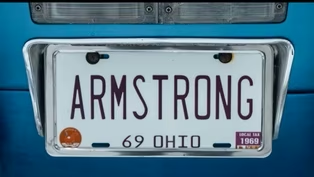
One that was just donated to us is a 1967 Corvette Stingray that was driven by Neil Armstrong.
>> Yes, that Neil Armstrong.
Years before he walked on the moon, Armstrong was driving to NASA and style.
>> So there's a program where astronauts back in the Apollo era got to drive a Corvette for a dollar.
>> It is.
>> Stories like this one that serve as the drive to preserve and conserve these cars and artifacts.
>> We want to tell more stories.
So everything that we try and do is educate people on the history and legacy of Corvette.
>> And to share that history and legacy with future generations.
>> When someone walks in the building in 60 years and they see a car that was already 60 years old, it's going to look just like it did when it came down the line.
>> This museum is a special place.
It's sort of, to me, the nucleus of a wonderful community.
>> A community that's given more than $2 million to the capital campaign supporting the expansion on the Corvette campus.
>> So many friendships come through our passion for this car.
A car that we all love also becomes this magnet that draws us all together.
>> Museum says the new collections facility will become home to 240 cars over the next 30 years.
>> So we can tell more stories, talk about more engineering, and educate people on Corvette.
>> It's expected to be open to guests in early 2027.
For Kentucky edition, I'm Laura Rogers.
>> Thank you Laura.
Aside from preservation and storage, the museum will also offer behind the scenes tours of the new building for guests wanting to see even more of the Corvette collection.
And finally, tonight, the first steamboat to arrive in Kentucky.
The first meeting of the Kentucky General Assembly in Frankfort, and the Kentucky College involved in one of football's biggest upsets.
Our Toby Gibbs has those three stories and much more in this look back at This Week in Kentucky history.
>> Explorer and frontiersman Daniel Boone was born November 2nd, 1734, according to the Gregorian calendar now in use.
Although he's synonymous with Kentucky, Boone was born in Pennsylvania.
Virginia divided the Kentucky territory into three counties on November 1st, 1780.
Jefferson County named for Thomas Jefferson Fayette County, named for the Marquis de La Fayette and Lincoln County, named after General Benjamin Lincoln.
The Kentucky General Assembly met in Frankfort for the first time on November 1st, 1793, as 47 lawmakers met in Major James Law's farmhouse.
A steamboat arrived in Louisville for the first time on October 28th, 1811.
Locals were skeptical that the boat, called the New Orleans, would be able to travel upstream against the Ohio River current, but it did, leading many Louisvillians to invest in the Fulton Steam Company.
Senator College beat Harvard in football six to nothing on October 29th, 1921, in one of the biggest upsets in the history of college football.
Louisville native Muhammad Ali beat George Foreman in the Rumble in the jungle, a heavyweight championship fight in Zaire on November 30th, 1974.
Ali won it in eight rounds, and those are a few of the big events this week in Kentucky history.
I'm Toby Gibbs.
>> Thank you, Toby Gibbs.
People who navigate through the criminal justice and court systems don't always know about the resources available to them.
Someone's there to help.
>> If we don't assist these individuals, who's going to?
>> We'll hear more about behavioral health liaisons and what they do.
That story and much more tomorrow night on Kentucky Edition at 630 eastern, 530 central.
We'll be inform, connect and inspire.
We hope that you will connect with us all the ways you see on your screen by the social media channels Facebook, Instagram and X. We encourage you to send us a story idea by email to Public Affairs at ket.org, and look for us on the PBS app that you can download on your phone and other smart devices.
And of course, our programing is streaming online on demand at ket.org.
I'll see you in a little bit on our Medicare call
Hardin Co. GOP Official's Post Sparks Backlash
Video has Closed Captions
Clip: S4 Ep86 | 1m 4s | A video shared online showed former President Obama and his wife as apes. (1m 4s)
Kentucky Food Banks Adjusting to Increased Need
Video has Closed Captions
Clip: S4 Ep86 | 8m 8s | More people are headed to Kentucky's food banks for help amid the government shutdown. (8m 8s)
Louisville Continuing Work to Reduce Violence
Video has Closed Captions
Clip: S4 Ep86 | 2m 42s | Louisville's Office of Violence Prevention hosted its annual Violence Reduction Summit. (2m 42s)
National Corvette Museum Expanding
Video has Closed Captions
Clip: S4 Ep86 | 3m 3s | A new facility will house a growing collection of Corvettes and other historic items. (3m 3s)
Providing Support for PBS.org
Learn Moreabout PBS online sponsorship
- News and Public Affairs

Top journalists deliver compelling original analysis of the hour's headlines.

- News and Public Affairs

FRONTLINE is investigative journalism that questions, explains and changes our world.












Support for PBS provided by:
Kentucky Edition is a local public television program presented by KET