
October 29, 2025
Season 4 Episode 88 | 26m 30sVideo has Closed Captions
Congressman Guthrie discusses the impact of the government’s shutdown on Fort Knox.
Congressman Brett Guthrie talks with community leaders in Radcliff about the impact of the government shutdown. Christian County plans a resource fair to help civilian workers at Fort Campbell. A new law banning drones for fishing and hunting in the state takes effect.
Problems playing video? | Closed Captioning Feedback
Problems playing video? | Closed Captioning Feedback
Kentucky Edition is a local public television program presented by KET
October 29, 2025
Season 4 Episode 88 | 26m 30sVideo has Closed Captions
Congressman Brett Guthrie talks with community leaders in Radcliff about the impact of the government shutdown. Christian County plans a resource fair to help civilian workers at Fort Campbell. A new law banning drones for fishing and hunting in the state takes effect.
Problems playing video? | Closed Captioning Feedback
How to Watch Kentucky Edition
Kentucky Edition is available to stream on pbs.org and the free PBS App, available on iPhone, Apple TV, Android TV, Android smartphones, Amazon Fire TV, Amazon Fire Tablet, Roku, Samsung Smart TV, and Vizio.
Providing Support for PBS.org
Learn Moreabout PBS online sponsorship>> Do you expect us to tell the men and women in uniform to wait for the next 2 or 3 weeks, not get paid so we can negotiate ACA tax credits.
>> Here from Congressman Brett Guthrie about the federal government shutdowns, impact on Fort Knox.
>> Allowing taxes to be levied, doubled, tripled.
And then one day, perhaps forgiven is a recipe for chaos.
>> Kentucky's U.S.
senators vote to reverse tariffs on Brazil.
But does that vote matter?
>> Time saved is brain saved.
So if you or anyone else is experiencing new signs of a stroke, call 911 and get to the E.R.
immediately.
>> And what are the red flags before stroke?
>> Production of Kentucky edition is made possible in part by the KET Millennium Fund.
>> Good evening and welcome to Kentucky edition for Wednesday, October the 29th.
I'm Renee Shaw, and we thank you for winding down your Wednesday with us.
Congressman Brett Guthrie met with community leaders and Radcliffe today as the government shutdown is now in its fourth week.
The lapse in funding is causing stress for many families, including civilian personnel at Fort Knox, who've been furloughed.
Senate Democrats are demanding an extension of health care tax credits tied to the Affordable Care Act, set to expire at the end of the year.
>> And we need to deal with the high cost of health care.
We absolutely have to deal with the high cost of health care, but they need to make sure we don't.
They keep saying leverage we have.
This is our only leverage is shutting down the government.
It was tried, I tell you, it was tried 12 years ago.
It's leverage when they say this is the only leverage they have, the leverage that they're claiming to have has the effect that you guys just heard in the room next door.
And it's just sad.
It's unfortunate.
And it needs to stop.
>> Today's roundtable discussion included concerns over the shutdown's economic impact.
Active duty military are getting paid, but there's still uncertainty.
And area food banks and other resources say they're receiving more requests for help.
There's also the issue of Snap funding or food stamps, set to end later this week.
Guthrie says Senate Minority Leader Chuck Schumer should learn from the example of former leader, Republican Senator Mitch McConnell.
>> But in the Senate, you can't just be against everything.
You have to be for things, because as long as you I mean, Chuck Schumer, I assume in the Senate rules could just not filibuster, let 52 Republicans pass it.
But he's choosing to filibuster, which means it takes 60 votes, which will take at least 7 or 8 Democrats to vote for it.
And that's a tough decision to make.
Kevin McCarthy lost his speakership because he made that decision.
Mitch McConnell, you've seen the ads.
You see how people go.
You have to spend political capital because the most hardcore of believers in your party won't you can't give in to anything.
Well, Mitch McConnell made the decision to be a statesman.
And you've seen you've just seen the political capital he spent.
And people forget how much he's done for the Republican Party, the Supreme Court and everything else.
But he spent political capital doing that.
And I'll just call on Chuck Schumer to follow the example of Mitch McConnell and be a statesman and not a politician.
And let's get to discuss let's let's pay these men and women in the military.
Let's pay these families serving the men and women in the military.
And let's absolutely sit down and negotiate to get a handle on the rising cost of health care in this country.
That's absolutely needs to be done.
>> Guthrie says.
Congress appropriates money for SNAP, otherwise known as food stamps.
And through some, and though some are calling for contingency funds to cover benefits during the shutdown, he says those are for emergencies like natural disasters.
Now, it's not just Fort Knox.
Civilian workers at Fort Campbell in Christian County, along the Tennessee line, are going without pay.
County leaders are rallying around the workers and plan to host a resource fair to help folks make ends meet.
Our Emily Sisk has more.
>> We are joined now by the judge executive of Christian County, Jerry Gilliam.
Thank you so much for being with us.
And we want to ask you about this resource fair that Christian County is going to hold.
Tell us about it.
What is the need for this resource fair?
>> Well, we've been pretty engaged with Fort Campbell since the beginning of the shutdown, and we discovered that there are some voids with the civilian workforce.
And we wanted to certainly be able to provide some kind of assistance to those folks, or at least awareness, so they can know and be able to plan.
Is there said not to receive a paycheck in this next week?
>> And for folks who maybe don't know, when we talk about the civilian workforce, what does that mean and how many people does that include?
>> It's a great question, Emily.
So we have a civilian workforce that actually participate and work alongside our active duty soldiers at Fort Campbell.
So the garrison, which is kind of the city at home within Fort Campbell, has, along with the the bark or the Blanchfield Army Community Hospital, each together have about 2000 employees that are not military or civilian workforce.
So and then when you take all the other contractors and other civilians, that totals around 4000 people.
So it's a larger impact.
And of course, our active duty did receive pay.
You know, the 15th, they're assuming that we're going to see them get paid again this week.
But we know the civilian workforce probably will not get paid.
The ones that are furloughed.
>> Okay.
And so for this resource fair, what kind of resources would that include.
>> We're going to have a list of food banks that are available.
We've worked with our shelters and hopefully be able to actually work with property management companies.
So any rent that may be due, we're looking at opportunities that that they can be able to inform these management companies the their situation and hopefully be able to work something out along with our utility partners, be able to identify the reasons that they're being furloughed and even psychological opportunity.
The Penarol center is going to be there and hopefully we'll get get some help they need.
So basically just if nothing else, for them to feel like they are, they're thought about and we care about them and they're part of our community.
And we certainly want to do what we can and do our part to help them through this tough times.
We all indications say that when the shutdown is gone, they will receive back pay.
But until that they're they're going without pay.
So they are part of our community.
And and like any good community, you got to support each other.
And that's certainly what we want to do here.
>> Yes.
Well this is great information to know.
So Judge-executive Gilliam, we appreciate your time and thank you for telling us about this.
>> Thank you Emily.
>> Thanks, Emily.
The resource fair is next Tuesday and Wednesday at Valor Hall in Oak Grove.
Now going back to Washington politics.
The U.S.
House Oversight Committee is out with a new report alleging a cover up of former President Joe Biden's mental status.
The report suggests Biden's aides were allowed to enact executive actions without his knowledge.
And it says Biden's use of the Autopen, which is a machine that can duplicate someone's signature, should be considered invalid unless it can be proven that Biden approved of the signed decisions.
Congressman James Comer of Kentucky's first congressional district is chair of that powerful oversight committee.
He discussed the new report on CNN.
>> Anyone that reads this report, anyone that watches the hours.
>> And hours of depositions, would would conclude that Joe Biden wasn't the one making those decisions.
They had opportunity after opportunity to demonstrate a consistent pattern of how pardons were authorized.
And they failed to do that.
And look, everyone in America saw with their own eyes a declining president of the United States and the fact that there was so much activity during the lame duck period, it seemed like from the time of the debate until the transition of power, that's when the use of the autopen greatly accelerated.
And again, 75% of the time that Autopen was used, they claim Joe Biden, according to the records, was in the white House.
Why wouldn't he, you know, be more involved?
Why wouldn't there be notes from from meetings that Joe Biden said this?
There's no documentation that would suggest Joe Biden was involved in the pardon.
>> I guess the.
>> Biden has denied being unaware of his administration's actions.
Democrats on the House Oversight Committee called this report a distraction.
The committee is now asking U.S.
Attorney General Pam Bondi to review all executive actions from the Biden administration.
Five Republican U.S.
senators, including both from Kentucky, joined Democrats to vote against President Donald Trump's 50% tariff on Brazil, a tariff causing increased costs for coffee, oil and orange juice.
The vote was 52 to 48.
To end the tariff, Senator McConnell said this about the president's overall tariff policy and its effect on the Kentucky economy.
He says, quote, retaliatory tariffs on American products have turned agricultural income upside down for many of Kentucky's nearly 70,000 family farms.
Bourbon has been caught in the crossfire from day one, and consumers are paying higher prices across the board as the true cost of trade barriers fall inevitably on them.
End quote.
Senator Rand Paul of Kentucky says a tariff is nothing more than a tax.
And in this case, he says it's a tax levied by one man, the president, without the consent of Congress or the people.
Paul says that's exactly the kind of thinking that led to the American Revolution.
>> In 1765, the American patriot who helped formulate the grievances against the British crown, James Otis, called for a defense of this principle by popularizing the phrase taxation without representation is tyranny.
This principle was said by many to be the principle, the spark that sparked our revolution.
Yet today, the Senate is compelled to act because one person in our country wishes to raise taxes without the approval of the Senate, without the approval of the House, without the approval of the Constitution, allowing taxes to be levied, doubled, tripled, and then one day, perhaps forgiven is a recipe for chaos.
The tariffs are implemented, the tariffs are canceled, the tariffs are delayed.
The tariff rate changes daily.
Just this week, the president added a special 10% import tax on Canada because he was mad about the nations.
Ronald Reagan had an ad, by the way, which was showing Ronald Reagan verbatim.
Speaking newsflash to the administration.
Reagan was a free trader.
Subject or target.
>> The vote is considered largely symbolic.
The political website The Hill reports that House speaker Mike Johnson is unlikely to bring the resolution up for a House vote, and even if it passed the House, it would be vetoed by President Trump.
If you're mid 60s and above, you're likely being inundated with snail mail and phone calls about Medicare coverage plans.
Now, is the Medicare open enrollment period that started October the 15th and goes until December 7th.
This is the time enrollees review all their options and decide whether they want to keep the health care coverage they have or make a change.
And to say it's complicated is an understatement.
Medicare.gov is an online resource to help you compare your options, and you can reach out also to state health insurance assistance counselors to help you make sense of it all.
Last week, I spoke with Tricia Neuman at the KFF, formerly known as the Kaiser Family Foundation, to help us sort out traditional Medicare versus advantage or Medicare Advantage options.
>> There are many tradeoffs in Medicare Advantage plans.
On the upside, they can offer extra benefits like vision, hearing, and dental.
That's very appealing to people, and they offer reductions in some cost sharing for people living on fixed incomes.
That is particularly attractive.
But a downside or tradeoff for people is a more limited network of health care providers, because that's the way Medicare Advantage plans work.
They also have cost, cost, and utilization management tools like prior authorization.
But so for people who want to see a certain health care provider have an attachment to a primary care doc, a specialist, a mental health care provider, an important consideration is whether that provider is in the network of the plan, because if that provider is not in the network, then the individual may have to pay a lot more to go.
Continue to see a given doctor or professional, or may pay the whole fee out of pocket, or might just have to discontinue a long standing relationship with a provider.
So for people with close relationships with mental health providers or someone who's seeing a cancer specialist, or someone who has a rare condition and wants to be able to travel to see a certain, you know, expert in their field, this could be a very important consideration.
The other consideration I want to highlight is for people who choose Medicare Advantage, maybe because they are attracted by the extra benefits and the vision, hearing and dental, and they're the ways that they can save money relative to traditional Medicare.
Some people tell us that they're going to sign up for Medicare Advantage for 3 or 4 years and see how it goes, because they're relatively healthy and they want the extra benefits, and they're not so worried about provider network restrictions.
What can happen, though, is when people after a few years when people get sick, they might say, well, I want to go back to traditional Medicare so I can see any specialist, any hospital virtually across the country.
They can they can go back to traditional Medicare during the open enrollment period, but they might not be able to buy a medigap, a Medicare supplement, which many people on Medicare like to buy, because that helps fill in the cost sharing.
The Medigap market is perhaps the only health insurance product out there that can still deny people coverage because of preexisting conditions, unless they sign up for Medicare.
Medigap policy when they first go on Medicare.
So that's a consideration that people just don't know about, and it can really trip people up later in their years when they know they can go back to regular Medicare, but they may not be able to buy Medigap policy.
And I've had friends who have been affected by this.
>> Yeah.
Thank you for sharing that.
That's that's really crucial.
I know a lot of people are wondering, because of the federal government shutdown, that at the time we talked was in its 23rd day.
They may be curious if this is going to impact the Medicare enrollment timeline.
That goes until the December the 7th.
Could that deadline be extended if the federal government continues to be shuttered, or does it have any impact at all on this process?
>> Well, I think we have to wait and see.
Right now.
People can go on the Medicare Plan Finder, which is on Medicare.gov.
People can sign up for plans, people can switch plans.
But if there are glitches because of staffing issues or technology issues, or there's not enough support and there may not be enough consumer education, then there may be a demand to extend the open enrollment period.
I'm, you know, that will have to wait and see.
I'm not hearing any about any problems yet, but we're not done with the shutdown.
And so this could be an issue separately for people who are turning 65 and going on Medicare that you do throughout the whole year.
That's not limited to the open enrollment period.
And that process happens through the Social Security office.
So to the extent Social Security is staffed up, that should not be a problem.
But if staffing issues should arise there, then I can imagine there being delays and concerns, but I've not heard of that yet.
>> Earlier this week, we broadcast a viewer call in about Medicare enrollment, where we took dozens of calls you had about your coverage options and the costs, so feel free to check that out online and on demand at ket.org.
Leaders at the University of Kentucky have reason to celebrate UK health care.
Just received a $50 million donation, its largest in history.
The money comes from entrepreneur and philanthropist Tom Golisano.
The New York native is the founder of Paychex, one of the nation's largest human resource companies for business.
UK President Eli Capilouto says the money will help transform pediatric health care in Kentucky.
>> Mr.
Golisano just doesn't hand money out.
He looks carefully at the recipients and I think he has trust in us.
He has confidence in us that we're going to do what he's done in life.
And that is if you find something, a challenge, you need to meet, that challenge.
You need to make things better for the community.
>> UK's Board of Trustees also approved Kentucky Children's Hospital to be renamed.
It's now Golisano Children's at UK.
Two other clinics in UK's network will also bear his name.
Kentucky Governor Andy Beshear has declared today as Buckle Up, Phone Down day in Kentucky.
It's a day to promote wearing a seatbelt and avoiding distracted driving, the state says.
Every year in Kentucky, distracted driving results in about 40,000 crashes, with 11,000 injuries and about 150 deaths.
Today is World Stroke Day, a day to raise awareness about the signs of stroke, how to lower your risk, and the importance of a fast response.
Our Christie Dutton spoke with the Stroke Certified Registered Nurse about the most important things everyone should know about strokes.
More about that in today's medical news.
>> Here to talk to us about stroke care.
Stroke prevention is Rosa Hart.
You are a stroke nurse navigator at Norton Health Care and the host of world renowned podcast Stronger After Stroke.
How many countries?
91 countries.
>> That's right.
It's heard in 91 countries and prescribed all over the place.
When someone goes home after having a stroke for answers to frequently asked questions, as well as encouragement of stroke survivors and caregivers about how to have the best quality of life after stroke.
>> Okay, so you're the one we need to talk to.
Tell us exactly what is happening when what is happening, when somebody is having a stroke and are there different types?
>> So there's two main types of stroke that we talk about.
The most common is ischemic strokes.
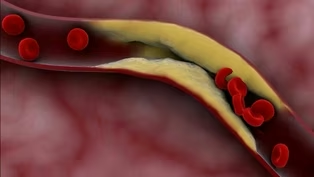
And that's caused by a clot or some other obstruction that stops blood flow to the brain.
And it can be called a brain attack.
Like you would have a heart attack, but in the brain.
And the other kind is hemorrhagic, which is a brain bleed, but not due to an injury, more like a spontaneous.
>> Okay from a blood vessel bursting.
Okay, so those are the two types.
Do they have different signs or is it the same sign to kind of detect if somebody's having a stroke?
>> We use the same signs of stroke to identify whether or not you should call 911.
And that is be fast where B is for balance.
So a sudden change in balance E is for eyes, a sudden change in vision.
F is for face where one side may have a droop, a facial droop, a is for arms where one arm may be weaker than the other.
S is for speech like slurred speech, and T is for time where time saved is brain saved.
So if you or anyone else is experiencing new signs of a stroke, call 911 and get to the E.R.
immediately.
>> Time saved is brain saved.
So you call 911.
When you see any of these signs, you get to the hospital.
What happens then?
How is it diagnosed?
>> So typically they go to get a CT of the head to see if there is that bleeding we talked about.
And if there's not a sign of bleeding then they may be eligible.
Depending on a set of questions they will be asked for a clot busting medication that can open up the blood flow and restore their function and reverse their symptoms.
>> Okay.
Which type of stroke is more common?
The brain bleed or the clot?
>> The clot, which is called ischemic and 80% of strokes are preventable.
>> Okay.
So there are preventable.
So how do we prevent it then.
>> The number one thing we can do to prevent strokes is control blood pressure.
And that goes in both cases blood pressure when it's too high strains those blood vessels.
And if that's chronic damage, that irritation to the blood vessels can lead to the obstructions forming or cause a rupture.
>> Okay.
So lower blood pressure.
Are there any risk factors that are genetic besides high blood, which I guess can be genetic?
>> Well, it could be genetic, but it's one of the things we can control.
So there are genetic risk factors.
But most like I said, 80% are preventable, which means there are things we can do to stop them.
That includes controlling blood sugar.
If you're diabetic, you're twice as likely to have a stroke as anyone who is not diabetic because of the strain that puts on your entire body.
Also, cholesterol.
If your cholesterol is high, that increases your stroke risk.
Any kind of nicotine use, whether it's smoking, vaping or taking nicotine another way, it has a reaction on your blood vessels and it increases your blood pressure.
And so nicotine is not a safe thing to be stressing your body with.
>> What about men versus women?
>> So women actually are more likely than men to have a stroke.
And it may not be picked up on because they may have signs that are different, such as fatigue, confusion, generalized weakness, things like that.
And but generally those are things we can recognize are in the be fast.
And that is the same for both.
>> Okay.
Tell me one myth that you would like to get out of the way about strokes or stroke survivors or stroke prevention.
>> Oh.
Just one.
Okay.
Can I tell you two?
>> Yes, you can.
>> Tell me.
Okay.
Kids can have strokes too.
Stroke is the in the top ten leading killers of children.
And so it's important to know the signs of stroke at any age.
Other stroke myth I really want to bust is that your recovery is over after about six months to a year.
Neuroplasticity shows us that recovery is possible years into the future.
And there are exciting innovations being developed with technologies and physical, occupational and speech therapy.
There's pelvic floor therapy and vision rehab.
So there are so many options to help direct that neuroplasticity to have a better recovery.
So giving people hope is the most important thing that I would want to put out there.
>> Yeah, I like that.
Well Rosa Hart from Norton Health Care, thank you so much.
This has been so informative.
So thank you so much for being here.
>> You're so welcome.
>> We are just days away from the Kentucky Book Festival, so it's an appropriate time to ask our children reading enough.
And is one particular generation of parents doing enough to encourage reading in their kids?
We'll talk about the importance of books and helping children learn that story, and much more tomorrow night on Kentucky Edition, which you know to join us for at 630 eastern, 530 central, where we inform, connect and inspire.
We hope you'll connect with us all the ways you see on your screen by the social media channels Facebook, Instagram and X, formerly known as Twitter.
And we always encourage you to send us a story idea by email to Public Affairs at ket.org, or look for us on the PBS app that you can download on your smart devices, and check us out to watch programs online on demand at ket.org.
I'm Renee Shaw, take
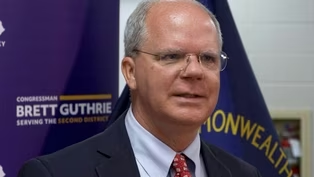
Congressman Brett Guthrie Speaking Out on Government’s Shutdown
Video has Closed Captions
Clip: S4 Ep88 | 2m 50s | Congressman Brett Guthrie on the impact of the federal government’s shutdown on Fort Knox. (2m 50s)
Video has Closed Captions
Clip: S4 Ep88 | 6m 8s | Health expert talks about the warning signs of a stroke. (6m 8s)

Resource Fair Planned for Fort Campbell Workers
Video has Closed Captions
Clip: S4 Ep88 | 3m 31s | Leaders in Christian County plan a resource fair for civilian workers at Fort Campbell. (3m 31s)
Providing Support for PBS.org
Learn Moreabout PBS online sponsorship
- News and Public Affairs

Top journalists deliver compelling original analysis of the hour's headlines.

- News and Public Affairs

FRONTLINE is investigative journalism that questions, explains and changes our world.












Support for PBS provided by:
Kentucky Edition is a local public television program presented by KET