
October 5, 2024 - PBS News Weekend full episode
10/5/2024 | 26m 46sVideo has Closed Captions
October 5, 2024 - PBS News Weekend full episode
Saturday on PBS News Weekend, how hundreds of California police officers are able to keep past misconduct confidential. Then, following allegations of discrimination inside the WNBA, a look at the state of protections for pregnant people in the workplace. Plus, why typewriters are seeing a renaissance in this age of digital technology.
Problems playing video? | Closed Captioning Feedback
Problems playing video? | Closed Captioning Feedback
Major corporate funding for the PBS News Hour is provided by BDO, BNSF, Consumer Cellular, American Cruise Lines, and Raymond James. Funding for the PBS NewsHour Weekend is provided by...
Support provided by:

October 5, 2024 - PBS News Weekend full episode
10/5/2024 | 26m 46sVideo has Closed Captions
Saturday on PBS News Weekend, how hundreds of California police officers are able to keep past misconduct confidential. Then, following allegations of discrimination inside the WNBA, a look at the state of protections for pregnant people in the workplace. Plus, why typewriters are seeing a renaissance in this age of digital technology.
Problems playing video? | Closed Captioning Feedback
How to Watch PBS News Hour
PBS News Hour is available to stream on pbs.org and the free PBS App, available on iPhone, Apple TV, Android TV, Android smartphones, Amazon Fire TV, Amazon Fire Tablet, Roku, Samsung Smart TV, and Vizio.
Providing Support for PBS.org
Learn Moreabout PBS online sponsorshipJOHN YANG: Tonight on PBS News Weekend, how hundreds of California police officers are able to keep past misconduct confidential.
Then, following allegations of discrimination inside the WNBA, we look at the state of workplace protections for pregnant people and why typewriters are seeing a renaissance in this age of technology.
WOMAN: I love the hands on process of things and kind of the idea of slowing down in a world that's moving so fast.
(BREAK) JOHN YANG: Good evening.
I'm John Yang.
Israel's targeted bombardment of Hezbollah and Hamas leaders in Lebanon reached farther north today.
A strike on a Palestinian refugee camp near the Syrian border killed a Hamas leader and his family.
And there were more airstrikes on Hezbollah's stronghold in Beirut's southern suburbs.
At least six people were killed.
Hezbollah responded by firing about 90 rockets into Israel.
Most were intercepted, but several fell on the Arab town of Deir al Asad.
Police there said three people were slightly injured.
In Lebanon, hundreds of thousands of people are headed to Syria to escape the fighting.
MARIAM MOUSSA, Displaced Palestinian (through translator): This is what were scared of.
We saw the scenes in Gaza.
We saw what was happening there, destruction, children, families.
That's why we were insisting on leaving our homes.
JOHN YANG: The Israeli military says 11 soldiers have been killed since Tuesday, when limited ground operations began in southern Lebanon.
In Gaza, nine people, including two children, were killed in Israeli strikes.
The bombing began less than an hour after residents of refugee camps were told to evacuate.
Israel has long accused Hamas of operating in civilian areas.
The massive cleanup from Hurricane Helene is entering its second week.
At least 220 people are dead and 75 are still missing amid the destruction the storm caused across the southeast.
The Pentagon has deployed 1,000 troops to join FEMA's aid distribution efforts.
But hundreds of thousands of residents remain without power and water and may not get it back for several weeks.
KATHLEEN MCCARTHY, Asheville Resident: I'm draining my water heater tank, which holds 38 gallons, so that I can use it for toilet flushing.
But that's my plan for the next couple of weeks.
JOHN YANG: The North Carolina Health Department is distributing epipens and antihistamines to people stung by swarming bees in yellowjackets whose underground nests were inundated by the floodwaters.
Meanwhile, Tropical Storm Milton has formed in the Gulf of Mexico.
It's expected to strengthen and could threaten Florida next week.
On the campaign trail today, Vice President Kamala Harris visited the storm zone.
She's in Charlotte, North Carolina, where she's to be briefed on recovery efforts and visit an aid distribution site.
And former president Donald Trump is holding a rally at the Butler, Pennsylvania, site of July's assassination attempt.
Russia is claiming new gains in Ukraine's east after taking control of a small village in the partially occupied Donetsk region.
Ukrainian forces say they shot down a Russian fighter plane just to the north.
Troops inspected the charred remains of the aircraft, which landed on a house that caught fire.
No Ukrainian casualties were reported.
And a colorful scene in the skies over Albuquerque, New Mexico, today as the city's famed balloon fiesta began.
Hundreds of giant balloons were inflated and then ascended early this morning, dotting the high desert skies.
More than 500 balloons are expected for this year's festival.
The event began in 1972 with just 13 balloons.
Still to come on PBS News Weekend, the state of anti-discrimination laws for pregnant workers in America and the growing appeal of typewriters among younger generations.
(BREAK) JOHN YANG: For decades, California police departments that want to sever ties with officers for misconduct have agreed to let them resign and to keep the bad behavior confidential.
That's in order to avoid potentially costly and time consuming lawsuits.
But as a result, officers with bad records have landed new jobs in law enforcement, and their new employers have no idea of their past.
That's the finding of a five-year long investigation by the San Francisco Chronicle and the University of California, Berkeley's investigative reporting program.
Katey Rusch of the investigative reporting program was the lead author of the articles that appeared in the Chronicle.
Katey, you say that these are called clean record agreements.
How many of them were able to find in your investigation?
KATEY RUSCH, UC Berkeley Investigative Reporting Program: We were able to find over 300 involving nearly 300 officers.
So some of the officers had multiple.
But I think really what the major finding is that we found them in so many different agencies across the state, 167 agencies across the state of California, and it didn't matter the size or the region.
We were finding these agreements.
JOHN YANG: And what sort of misconduct are we talking about?
Did you find in these records?
KATEY RUSCH: You know, that was a big question when we started the investigation was, were wondering, is this just minor mistakes that police are making and then getting these agreements to clean their records.
And what we found was, no, this is serious misconduct, everything from dishonesty to sexual assault to excessive force.
JOHN YANG: And there's also a wrinkle.
There were some cases you found in which they sort of short circuited the investigations into their behavior by claiming a disability.
And talk about what would happen to those officers.
KATEY RUSCH: Yeah, those were really interesting cases.
So in some situations, an officer would be accused of misconduct, and during the misconduct disciplinary proceedings, they would claim that they were injured, they had a back injury, they had PTSD, and then they would end up with these agreements that not only whitewashed their misconduct records, but then also guaranteed them a disability pension.
So a pension that's meant for an officer who can no longer work, who is so incapacitated that they can no longer do their job.
Now these officers are also getting that benefit as well, which is a huge benefit, a yearly salary for the rest of their lives with huge tax benefits.
JOHN YANG: And paid for by the taxpayers.
KATEY RUSCH: Absolutely.
Paid for by the taxpayers.
JOHN YANG: Is this just a California thing, or is this happening in other states as well?
KATEY RUSCH: Well, our investigation focused on California.
California employs the most peace officers in any state in the country.
But what we found when were looking at this, and we couldn't ignore, was that there are agreements like this in almost every state, from Texas to New York to Illinois to Idaho.
We found these types of agreements.
JOHN YANG: You talked to the police chiefs of not only the departments that these people left, but also the departments that they went to.
What did they tell you?
What was their reaction to this?
KATEY RUSCH: It was some of shock and disbelief.
I had multiple conversations with some police chiefs and sheriffs who couldn't believe that they didn't know about the misconduct at a previous department.
And on the other side, I talked to many police chiefs and sheriffs, just sit awake at night worrying about these agreements that they made that allowed officers who they don't think should be working in the profession to continue to carry a badge and a gun.
JOHN YANG: And you also wrote that some of these police chiefs who worry about this, it wasn't their call.
The decision was taken out of their hands.
KATEY RUSCH: Absolutely.
And I think that was a really interesting part of this, was the involvement of the insurance companies.
So when it gets to a certain step in the discipline process, sometimes the city's municipal insurance gets involved, and then they have ultimate settlement authority.
So even though the police chief, the sheriff, the city wants to fire that officer and make sure that their record is not whitewashed, the insurance company comes in and says, nope, you don't get a say.
JOHN YANG: And you wrote that in California, there's an organization that actually advocates the use of these agreements.
Who's behind that organization?
KATEY RUSCH: So, in California, most peace officers belong to a union, and as part of that union, they pay dues to a legal defense fund.
And so they have this group of lawyers who they have access to.
And the one that we found that was primarily working in the state of California was an organization called the Peace Officers Research association of California, PORAC, and their legal defense fund they have a group of attorneys, and that legal defense fund was involved in almost every agreement that were seeing in California.
JOHN YANG: There's a relatively new law in California that requires the disclosure of police misconduct and gives a commission the power to ban officers from being police officers.
How does that law mesh with what's going on?
KATEY RUSCH: I think that's really interesting.
That law took effect last year, and so we're still seeing how attorneys and police officers are navigating that with these agreements.
But what we found from our investigation is that law wasn't aware of these agreements, doesn't specifically address these agreements, and also only addresses a specific type of misconduct.
So there are only certain types of misconduct that are reportable to the state that are required to be reported to the state.
And so that still leaves this loophole for officers to kind of get around this law.
JOHN YANG: Is anything being done to close that loophole in California?
KATEY RUSCH: Right now the legislature in California is not in session.
They reconvene in December.
But there are a lot of conversations that I'm having, obviously because of our investigation with lawmakers about what could possibly be done.
Would they model a state like Kansas or Colorado who have passed laws to specifically address these agreements?
I think time will tell what California is going to do to address this, but I can tell you that they are having those conversations right now.
JOHN YANG: Katey Rusch, thank you very much, and thank you very much for this reporting.
KATEY RUSCH: Thank you.
JOHN YANG: Los Angeles Sparks forward Dearica Hamby isn't on the court for the WNBA playoffs now underway, but she's in court with a workplace discrimination and retaliation suit.
Hamby claims that after she announced in 2022 that she was pregnant, her team at the time, the Las Vegas Aces, took away benefits like team provided housing and then traded her.
Aces head coach Becky Hammond, has denied the allegations, and both the team and the WNBA are asking a federal judge to dismiss the case.
Her suit highlights the issue of how pregnant people are treated in the workplace.
Federal protections for pregnant workers have been the law since 1978, but a 2022 survey found one in five mothers reported experiencing pregnancy discrimination at work.
Gillian Thomas is the senior staff attorney for the ACLU's Women's Rights Project.
Gillian, how illustrative are these allegations that Dearica Hamby is making?
How illustrative are they about workplace discrimination against pregnant people?
GILLIAN THOMAS, Senior Staff Attorney, ACLU Women's Rights Project: Unfortunately, they're extremely common.
The allegations that she makes about insinuations that she isn't going to be as committed to the team or that she may have one child already, and now that she's going to be having a second one, that's really going to push her over the edge in terms of having her mind elsewhere, not really having her mind on the game, assumptions that she physically is not going to be capable of performing at the high level that she had up until that time, all of those stereotypes are, unfortunately, very alive and well in the workplace today.
JOHN YANG: I know there have been some recent developments on this front.
What is the current state of anti-discrimination law regarding pregnant workers?
GILILAN THOMAS: Well, as you noted in your introduction, it has been illegal to discriminate against pregnant workers and workers affected by pregnancy since 1978.
That means that it's illegal to deny someone a job or fire them or deny them a promotion or pay them less or harass them.
But there also is a prohibition that's been in place for 45 years on treating pregnant workers worse when it comes to workplace benefits.
So, for instance, if an employer has a policy of paying some income replacement when you're out on disability for a period of time, an employer can't pay that benefit to people who are out because of cancer or a bad back or some other health related issue and exclude pregnancy.
We advocates are very excited about some new protections that just went into effect last year under a law called the Pregnant Workers Fairness Act.
JOHN YANG: And what are some of those changes?
And were they sort of plugging gaps in the old law?
GILIAN THOMAS: That's a great way to put it.
The Pregnancy Discrimination Act that I was just describing and the prohibition on excluding pregnant workers from benefits given to other people.
One such benefit is the right to accommodation, meaning some sort of temporary modification in how the job is done, whether that means being able to sit down a little more often or take some more breaks, maybe adjust your schedule because you have terrible morning sickness or take some time off to go to just regular prenatal visits.
The Pregnancy Discrimination Act was imperfect and incomplete in its protections.
Only if a pregnant worker could point to somebody else in the workplace who had been given that benefit were they going to be entitled to the same benefit.
And so what the new law does is say if it would be a reasonable accommodation that doesn't impose an undue hardship on the employer, then the employer has to provide the accommodation full stop.
JOHN YANG: Are there types of workers or types of jobs in which workers are more likely to face these things than others?
GILLIAN THOMAS: Absolutely.
And there's really a plethora of low wage work that is extremely physically demanding and is also disproportionately held by women, and especially black and brown women.
So think of retail workers.
You go to your local Walmart or Costco, and you see workers who are on their feet for eight and 10-hour shifts.
Same thing for cashiers, also healthcare workers, and then also in male dominated professions that may be exceptionally physically demanding or even dangerous.
So think of law enforcement or firefighters or construction workers.
JOHN YANG: And even with this new law, are there still areas you think can be improved in the law?
Any gaps that still remain?
GILLIAN THOMAS: There's always room for improvement.
I think we're going to see how the PWFA plays out.
It only is in its has just passed its first anniversary as a law, and then this year, the EEOC, the Equal Employment Opportunity Commission, put out regulations implementing the statute.
So, I will say that there have certainly been a - - there's been a learning curve among employers, just that this new law even exists.
Something that we've heard in the first year that the PWFA has been in effect is that employers are imposing really onerous paperwork requirements, meaning that they're demanding really onerous certifications from medical providers about the need for accommodation, even when it's really a pretty simple change.
JOHN YANG: What advice do you have for someone who thinks they are subject to discrimination because of their pregnancy?
GILLIAN THOMAS: Well, I mean, if it's the accommodation issue, a big thing to do is to inform the employer about this new law.
There are a lot of resources available from the EEOC, the federal agency that enforces the statute, a lot of very user friendly, plain English kinds of resources.
So having a conversation with the employer just to gently alert them to this new statute, and also the fact that the law imposed a requirement that there be a conversation between employer and worker.
And I would urge folks to consult with HR and discover what kinds of processes there are to lodge complaints.
But that, unfortunately, also may be the time that it's necessary to approach either the EEOC or a local, state or local agency to find out about options.
You don't have to have an attorney to file a charge of discrimination with one of those entities, though, that is, you know, a scary prospect understandably for workers.
And they need to understand they're protected from retaliation if they do choose to alert their employer that they believe the law is being violated.
JOHN YANG: Gillian Thomas of the ACLU, thank you very much.
GILLIAN THOMAS: Thank you for having me.
JOHN YANG: When singer songwriter John Mayer talks about keys, it's not always about music.
Sometimes it's about the typewriter he uses.
Tom Hanks not only uses one, he's collected about 100 of them.
Mayer and Hanks are among the growing number of people in a world dominated by digital technology who are embracing this decidedly analog device.
JOHN YANG (voice-over): Take a look inside this South Philadelphia shop called Philly Typewriter and you'll see the renaissance of something many consider a relic of the past.
And now it's gotten a boost from a 21st century icon.
Singer Taylor Swift using a vintage Royal 10 typewriter in the video Fortnight, the chart topping single off her latest album, the Tortured Poets Department.
BILL RHODA, Co-owner, Philly Typewriter: I made a sign that said, join the tortured poets department and then come in and find out who uses typewriters anyway.
JOHN YANG (voice-over): Philly typewriter co-owner Bill Rhoda.
BILL RHODA: Any news about typewriters is good news about typewriters.
JOHN YANG (voice-over): He says Swift has sparked a typewriter bull market.
BILL RHODA: Private market prices on specifically Royal KHM and Royal 10 typewriters went through the roof.
Everybody who had one that didn't know it had value now all of a sudden knew it had value.
It was amazing.
That first weekend we had Swifties in here and in and out, all day, Saturday.
JOHN YANG (voice-over): Browsing the shop, I spotted an old familiar friend.
JOHN YANG: Everything old is new again.
When I was starting out as a reporter in the 1980s, an Olivetti portable like this one was the laptop of its time, balanced on my knees while I wrote stories from the road.
JOHN YANG (voice-over): The 1870s invention of the typewriter as we know it today revolutionized the workplace.
The demand for typists paved the way for women to enter male dominated offices, the first in a series of advances that eventually led to granting women the right to vote.
Novelists and artists were drawn to these new fangled contraptions.
Mark Twain was an early adopter, though he called his a curiosity breeding little joker.
MAN: Typewriter carriages are going the way of the one horse shave.
JOHN YANG (voice-over): The 1961 introduction of the IBM Selectric may have marked the apex of typewriter technology, the most successful electric typewriter in history and by some, the most coveted.
The beginning of the end of widespread typewriter use came in the 1980s with the rise of the personal computer.
MAN: Show you how simple it is to get started.
JOHN YANG (voice-over): But today, some are eager for analog experience, even if they came of age in the computer era, like 26 year old Tristin Guanzon.
TRISTIN GUANZON: I love the hands on process of things and kind of the idea of slowing down in a world that's moving so fast, you're more connected to the writing process instead of the computer trying to edit what you're writing or automatically giving you suggestions instead of just letting you be the part of the process.
JOHN YANG (voice-over): Rhoda says hears that a lot.
BILL RHODA: We have people that are wanting to unplug.
They want to disconnect.
They want to have something patient and thoughtful for themselves that isn't, you know, flashing notifications and, you know, all of a sudden you're doom scrolling or you're checking your email or checking your Facebook.
But with the machine, when you're writing on a typewriter, you're just writing on a typewriter.
It does one thing really, really well.
I tell people all the time, typewriter is a machine that writes.
A computer is a machine that happens to write.
JOHN YANG (voice-over): Philly Typewriter is considered the world's largest typewriter company.
They not only sell vintage machines, they repair and rebuild them.
The waitlist for repairs is 50 names deep.
Ryan Anderson is a recent graduate of the shop's apprentice program.
RYAN ANDERSON, Philly Typewriter: The difference between something like this and a computer is you can't really see what's physically happening, its electrical pulses traveling through the circuit boards.
This I can follow from pressing the key to it, typing on the page, and follow every single linkage, see what's actually happening.
BRYAN KRAVITZ, Founder, Philly Typewriter: In 25 years, they made 13 million of them, and it ate up 75 percent of the typewriter world.
JOHN YANG (voice-over): Wow.
Co-owner Bryan Kravitz knows the IBM's Selectric inside and out.
He's worked on them since 1975.
BRYAN KRAVITZ: I love it.
I just love it.
But there's, like, all these different sections of the machine that have to work together.
And here's a gear train on the side.
There's three different shafts that have to be timed perfectly or it won't work.
JOHN YANG (voice-over): The shop's basement is chock full of typewriters in need of repair.
Most were donated, unearthed from attics and garages.
BILL RHODA: These are all olivettis mixed with underwoods.
There was a big merger there, but -- and then these are a lot of the big standard office machines, and you know, they're huge and they take up a lot of space, but they're workhorses.
But people don't have a lot of space for these big guys anymore.
So these machines we reserve for our repair classes.
JOHN YANG (voice-over): Back upstairs, Rhoda shows off two favorites.
BILL RHODA: This one is a Corona flat top, also known as the Corona standard.
So Corona is from the 1930s.
And this absolutely, in my opinion, exquisite design of this machine.
This is the flat top design is known as the grand piano of typewriters.
This is a decade before.
This is the Corona folding typewriter.
This machine was able to be lifted up, fold it down, and once the machine was set like this, you could close it.
In its case, much more portable design.
And this was a big military typewriter as well.
JOHN YANG (voice-over): Vintage typewriters have become a hot collectible.
Tristin Guanzon is just beginning.
TRISTIN GUANZON: I currently have two typewriters.
It's a small collection.
If I had a bigger apartment, it would be a bigger collection.
I'm actually working on buying a house.
So the main point of that is so I have more room for the typewriters.
JOHN YANG: You're getting the house around the typewriters?
TRISTIN GUANZON: Yes.
Yeah.
JOHN YANG (voice-over): Some more experienced collectors seek out unusual designs, typefaces and keyboards.
JULIAN PLISS: This is a Ukrainian typewriter.
And I got this, like, off of eBay, but just like a couple of weeks before the Russian invasion of Ukraine.
JOHN YANG (voice-over): Julian Plys of nearby Haddonfield, New Jersey, who works in IT, has a special reason for seeking out this machine.
JULIAN PLYS: My parents are immigrants, Ukrainian immigrants.
I grew up speaking Ukrainian.
The typewriters I collect have to do with language.
There are certain keys and letters that are only in Ukrainian and not in Russian, like this G character And then there are characters that are not here that are in Russia.
JOHN YANG: I've got to ask.
You collect typewriters.
You have typewriters, but you're an IT guy.
JULIAN PLYS: I am.
I am an IT guy.
Yes.
JOHN YANG: There's some of that you were attracted to typewriters because you deal with digital all day long.
JULIAN PLYS: It is about attention and concentration and writing.
So to me, these are instruments that they're beautiful.
They do one thing.
They write words.
Words are beautiful.
Literature is beautiful.
And so the machines that are for that purpose, they are beautiful.
JOHN YANG: And that is PBS News Weekend for Saturday.
I'm John Yang.
See you tomorrow.
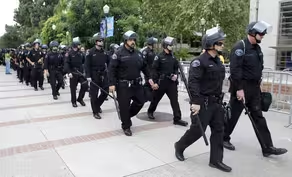
How California police officers have hid past misconduct
Video has Closed Captions
How hundreds of California police officers have kept past misconduct confidential (6m 1s)
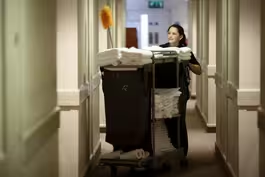
The state of U.S. workplace protections for pregnant people
Video has Closed Captions
The state of anti-discrimination laws for pregnant workers in America (7m 6s)
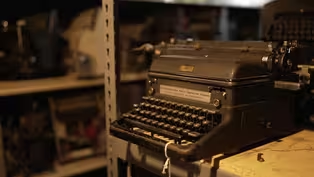
Why typewriters are having a renaissance in the digital age
Video has Closed Captions
Why typewriters are having a renaissance in the digital age (7m 25s)
Providing Support for PBS.org
Learn Moreabout PBS online sponsorship
- News and Public Affairs

FRONTLINE is investigative journalism that questions, explains and changes our world.

- News and Public Affairs

Amanpour and Company features conversations with leaders and decision makers.












Support for PBS provided by:
Major corporate funding for the PBS News Hour is provided by BDO, BNSF, Consumer Cellular, American Cruise Lines, and Raymond James. Funding for the PBS NewsHour Weekend is provided by...