
October 7, 2024 - PBS News Hour full episode
10/7/2024 | 57m 46sVideo has Closed Captions
October 7, 2024 - PBS News Hour full episode
October 7, 2024 - PBS News Hour full episode
Problems playing video? | Closed Captioning Feedback
Problems playing video? | Closed Captioning Feedback
Major corporate funding for the PBS News Hour is provided by BDO, BNSF, Consumer Cellular, American Cruise Lines, and Raymond James. Funding for the PBS NewsHour Weekend is provided by...
October 7, 2024 - PBS News Hour full episode
10/7/2024 | 57m 46sVideo has Closed Captions
October 7, 2024 - PBS News Hour full episode
Problems playing video? | Closed Captioning Feedback
How to Watch PBS News Hour
PBS News Hour is available to stream on pbs.org and the free PBS App, available on iPhone, Apple TV, Android TV, Android smartphones, Amazon Fire TV, Amazon Fire Tablet, Roku, Samsung Smart TV, LG TV, and Vizio.
Providing Support for PBS.org
Learn Moreabout PBS online sponsorshipGEOFF BENNETT: Good evening.
I'm Geoff Bennett.
Amna Nawaz is away.
On the "NewsHour" tonight: Israel marks one year since Hamas' deadly attack, as war rages on multiple fronts.
NILI BAR SINAI, Kibbutz Be'eri, Israel, Resident: Still, I'm here.
So they will have to understand this nobody is going because they kill us.
Nobody is going.
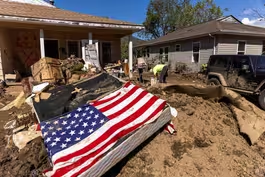
GEOFF BENNETT: The recovery from Hurricane Helene is complicated by lies, hoaxes and conspiracy theories spread by former President Donald Trump and others.
And residents of a Ukrainian town face an agonizing choice as Russian forces advance within a mile of their homes.
(BREAK) GEOFF BENNETT: Welcome to the "News Hour."
It was one year ago today that Hamas gunman launched a surprise terror attack on Israel, killing and wounding thousands and abducting hundreds more.
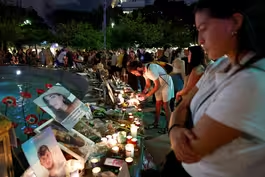
In Israel and around the world, memorials marked a year of loss, a year of trauma, and a year of war that is still unfolding.
It was not yet dawn.
Still, families of Israel's victims had already gathered to remember, lighting candles and choking back tears for the more than 360 people who were killed at the site of a music festival one year ago.
When the sun finally rose, club music echoed.
It was the last song that festivalgoers heard on October 7, 2023, before the shooting started, and in pain laid bare the solemn ceremony pierced by the anguished wail of a victim's relative.
Families spoke of the moment that everything changed.
SHIMON BUSKILA, Father of Victim: It seems to be like yesterday was the last day we saw him.
For us, yesterday was the last day of the old life.
GEOFF BENNETT: In Jerusalem, sirens blared at 6:29 a.m., believed to be the precise moment Hamas-led militants began their attack, massacring more than 1,200 people and taking over 200 hostages.
Israeli Prime Minister Benjamin Netanyahu today visited a memorial, the names of the victims etched forever in iron, and surrounded by his Cabinet held a minute of silence before insisting on strength in the resulting war.
BENJAMIN NETANYAHU, Israeli Prime Minister (through translator): Since that black day, we have been fighting.
This is the war of our existence, the war of resurrection.
This is how I would like to officially call the war.
We will end the war when we complete all the goals we have set.
GEOFF BENNETT: And, indeed, across the world, others paid tribute.
President Biden and the first lady honored those lost with a prayer, "God full of mercy," and the lighting of a single candle.
The solemn anniversary was also front of mind on the campaign trail.
Former President Donald Trump comforted Jewish leaders and visited a memorial grave site in Queens.
His running mate, J.D.
Vance, in a separate event in Washington, D.C., said he and so many others share in Israel's pain.
SEN. J.D.
VANCE (R-OH), Vice Presidential Candidate: We can't ever let our fellow citizens forget that October the 7th was not just an attack on Israel and it was not just an attack on Jews.
It was an attack on Americans.
GEOFF BENNETT: Vice President Kamala Harris planted a pomegranate tree, which represents hope and righteousness in Judaism, on the grounds of her residence and offered words of support and comfort to Israel.
KAMALA HARRIS, Vice President of the United States (D) and U.S. Presidential Candidate: Doug and I pray for the family and loved ones of all of those who were lost.
And may their memories be a blessing.
GEOFF BENNETT: And in an interview airing tonight on CBS' "60 Minutes," Harris said this when pressed on the U.S. relationship with Netanyahu.
BILL WHITAKER, CBS News Correspondent: Do we have a real close ally in Prime Minister Netanyahu?
KAMALA HARRIS: I think, with all due respect, the better question is, do we have an important alliance between the American people and the Israeli people?
And the answer to that question is yes.
GEOFF BENNETT: For many Palestinians, there was grief for the 42,000 Gazans that local health officials say have been killed since the war began.
And there was anger for what many Palestinians are calling a genocide at the hands of the Israelis.
NASRAH AL-QABALANI, Ramallah Resident (through translator): A year has passed and Israel is stumbling.
It is committing massacres against our people, our children and our houses.
GEOFF BENNETT: In Gaza, this day was not so much an anniversary, but a day like all the others.
Many were still reeling from Israeli airstrikes that tore through a mosque and a shelter for displaced people early Sunday that killed at least 26 and wounded nearly 100 others.
And as the war rages on multiple fronts, Israel continued its relentless aerial assault on neighboring Lebanon in its pursuit of Hezbollah militants.
What were entire blocks in Beirut's southern suburbs are now craters.
ALI ASILI, Beirut Resident (through translator): Nothing is left.
Our whole lives have changed.
We have been displaced to the streets, all of us together.
GEOFF BENNETT: Hezbollah launched some 175 rockets into Northern Israel in return, a tit-for-tat on a tense day in which Israel promised to launch more operations in Lebanon along the southern coast and as the Israeli military told Gazans across the north to flee south, and told the displaced in Khan Yunis already to the south to flee anywhere else.
SHAIMA ABU LUDBA, Displaced From Khan Yunis (through translator): They said, evacuate, and we evacuated.
And every time we're evacuated to the streets, I wish they would eliminate us and end our suffering.
GEOFF BENNETT: For some, today marks a grim milestone, for others, another day in a life upended by a war with no end in sight.
The day's other headlines start with Hurricane Milton, which has rapidly intensified to a Category 5 storm.
Milton is on track to make landfall in the Tampa Bay area this week, bringing a life-threatening storm surge of up to 12 feet, a torrent of rain and high winds.
Authorities and residents there are racing to prepare.
For many today, that meant filling sandbags.
Others have already heeded evacuation orders.
All this comes less than two weeks after Hurricane Helene battered the same area.
GOV.
RON DESANTIS (R-FL): We had a lot of debris left from Hurricane Helene on Florida's Gulf Coast.
That creates a huge hazard if you have a major hurricane hit in that area this week.
GEOFF BENNETT: Helene caused at least 230 deaths.
About half of those fatalities were in North Carolina, where apocalyptic scenes still cover the western part of the state.
Today, the FEMA administrator once again responded to unsubstantiated claims that her agency isn't doing enough to help the storm's victims.
DEANNE CRISWELL, FEMA Administrator: Absolutely false.
We have thousands of people on the ground, not just federal, but also our volunteers in the private sector.
And, frankly, that type of rhetoric is demoralizing to our staff that have left their families to come here and help the people of North Carolina.
And we will be here as long as they're needed.
GEOFF BENNETT: Shortly after that press conference, Criswell traveled to Florida, where she met with state and local officials ahead of Hurricane Milton.
The U.S. Supreme Court kicked off its new term today.
In the months ahead, the justices will hear cases about ghost guns and transgender rights, among others.
Today, the court declined to hear a Biden administration appeal over emergency abortions in Texas.
In doing so, the justices left in place a lower court ruling saying hospitals can't be required to perform abortions that go against Texas law.
The court also turned away an Alabama fertility clinic's bid to avoid a wrongful death claim over the destruction of a couple's frozen embryo.
The case raised broader concerns about legal protections for in vitro fertilization nationwide.
The justices also declined to hear appeals by singer R. Kelly on his child's sex crime conviction and the social media platform X over a search warrant in an election interference case.
A Russian court sentenced a 72-year-old American man today to nearly seven years in prison charges of fighting for the Ukrainian military.
Prosecutors say Stephen Hubbard signed a contract as a mercenary and fought for two months back in 2022 before being captured.
He's the first American to be convicted on such charges.
Hubbard is originally from Michigan, but had reportedly been living in Ukraine since 2014.
Russian arrests of Americans have become increasingly common amid concerns that authorities are targeting U.S. citizens for future prisoner swaps.
Georgia's Supreme Court has temporarily put back in place a ban on nearly all abortions after about six weeks of pregnancy.
The order is meant to give the justices time to consider an appeal of last week's ruling by a lower court judge that found the ban violates the state's constitution.
Georgia law was passed in 2019, but didn't take effect until the fall of Roe v. Wade in 2022.
It prohibits most abortions once a detectable human heartbeat is present, usually around six weeks, which is before many women know they are pregnant.
And 2023 was the driest year for the world's rivers in more than three decades.
That's according to a new report by the U.N.'s weather agency.
Prolonged droughts have drained water levels in some areas to all-time lows, like here in the Amazon.
The report also noted that glaciers, which feed many of the world's rivers, suffered the largest loss of mass in half-a-century last year.
The agency's director said that rising global temperatures are partly to blame and called the state of water -- quote -- "the canary in the coal mine of climate change."
And a pair of Americans have won the Nobel Prize for Medicine.
The Massachusetts-based duo of Victor Ambros and Gary Ruvkun were recognized for the discovery of tiny bits of genetic material known as microRNA.
A panel in Stockholm said their findings, initially studied in worms, are fundamentally important for how organisms develop and function, including humans.
After hearing the news, Ruvkun said a Nobel Prize amounts to a quantum leap in terms of recognition for their work.
And Ambros explained the potential real-world health implications of microRNA.
VICTOR AMBROS, 2024 Nobel Laureate: The deeper we understand living systems, the better equipped we are to figure out what's wrong when these systems go awry in the context of disease.
GEOFF BENNETT: Experts say learning how to manipulate microRNA could one day lead to powerful treatments for diseases like cancer.
Tomorrow, the Nobel for Physics will be announced.
On Wall Street today, stocks struggled to start the week.
The Dow Jones industrial average dropped about 400 points, or nearly 1 percent.
The Nasdaq gave back more than 200 points.
The S&P 500 also ended lower on the day.
And a passing of note.
Cissy Houston, the mother of the late Whitney Houston and a successful singer in her own right, has died.
The two-time Grammy winner performed alongside the likes of Elvis Presley and Aretha Franklin.
She saw early success as part of the vocal group The Sweet Inspirations, who sang backup for several soul acts and featured on Van Morrison's "Brown Eyed Girl."
Branching out on her own, Houston was an in-demand session singer.
Her vocals can be heard on tracks by Jimi Hendrix, Luther Vandross, and Beyonce, among others.
Cissy Houston was 91 years old.
And still to come on the "News Hour": Tamara Keith and Amy Walter break down the latest political headlines; Russian forces advance on a Ukrainian town, leaving residents with the painful choice of whether to stay or go; and a college trains students to become automotive technicians and works to increase diversity in the field.
Among the first targets on the morning of October 7 were communities across Southern Israel, hit first by rockets, then infiltrated by gunmen, who went house to house, killing and kidnapping civilians.
Among those communities, Kibbutz Be'eri, where Nick Schifrin looks back on a day that has changed the country and the region and upended the lives of its 1,000 residents.
A warning: Some images in this story may be disturbing.
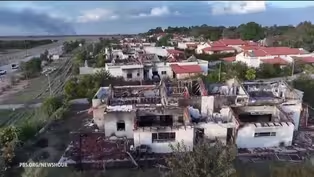
NICK SCHIFRIN: One year later, the Bachar home in Kibbutz Be'eri three miles from the Gaza Strip is frozen in horror, evidence of a community that will never be the same, a family that will never be whole, and a safe room that couldn't keep them safe.
AVIDA BACHAR, Kibbutz Be'eri, Israeli, Resident: They get into the house.
You hear the steps on the floor.
And they know that people still alive, they are in the safe room.
So they go straight to the safe room.
They try to open and you close, and they try to open.
And you close and they told me, "Open the door."
NICK SCHIFRIN: Avida Bachar lived here with Dana, his wife of 32 years, their son, Carmel, and daughter Hadar.
The home stands as it was 365 days ago, a clock frozen to the time of the attack on this house and a safe room where Hadar Bachar recorded these messages for a local chat group.
HADAR BACHAR, Victim (through translator): They are burning us.
We can't -- they burn us.
Come now, now, now.
We're being shot.
They shot us.
Come now.
AVIDA BACHAR: They shot me through the door.
So, I saw one bullet took my arm here in the side, and a few seconds later, I collapsed and fell out of the safe room.
Carmel, both hands go, because he holding like that, and the bullets hit his arm.
NICK SCHIFRIN: The bullet holes and his or his son's blood still stay in the door.
HADAR BACHAR (through translator): Help us please.
They threw three grenades at us, please help us We're dying here.
My whole leg is injured.
My whole leg is punctured, dad, all his legs, Carmel too.
Mom is going to die, I'm telling you.
Help us, anyone who can help us, please.
I love you.
We love you.
We all love you.
Carmel, stay with us.
Don't close your eyes.
Mom, stay with us, don't die.
AVIDA BACHAR: Dana, she told me: "I -- I can't breathe."
Hadar, she tried to clean her a little bit, and she told Hadar: "Hadar, it's done.
I don't have nothing in this world," and she died.
Carmel told me: "Dad, when you bury me, please do it with my surfboard."
A few seconds later, he got his short breath, and he died.
NICK SCHIFRIN: A few weeks later, he and Avida led the funeral, a family split in half, a country in mourning and shock, and a son's final wish granted, Carmel buried with his surfboard.
Bachar's leg was amputated, and he spent five months in the hospital.
How does your leg feel today?
AVIDA BACHAR: Good.
Practicing.
NICK SCHIFRIN: Today, he's increasingly sure of his step and of a lesson taught by tragedy.
AVIDA BACHAR: When you say thank you for something, I'm not believe in God, but I can say thank you to Dana about 32 years with me.
I met her, she was 17.
And you got your wife for 32 years.
Why you cry?
You got everything.
You got more than rich people on a boat.
You got everything.
So I can thank you for her about this time.
And I can thank you also to Carmel, about 15 years, because I got a great son.
NICK SCHIFRIN: Be'eri's 1,000 residents lived in about three square miles, invaded by more than 340 gunmen, some wearing Israeli uniforms, civilians killed point blank, dead bodies discarded or denied any dignity and taken back to Gaza, a couple embracing each other burned alive.
In total, 101 civilians, more than one-tenth of Be'eri's population and more than 30 security personnel, were killed, including a friend who fought alongside Yonatan Alfia.
YONATAN ALFIA, Former Israeli Paratrooper (through translator): The chaos was so high, none of us understood what's going on.
NICK SCHIFRIN: Alfia is a reservist and former paratrooper.
He and others came from all over to join a handful of Israeli special forces to fight back.
It took them nearly two days to declare a Be'eri liberated and bring shocked survivors out of their safe rooms.
YONATAN ALFIA (through translator): The main feeling of us fighters in this area was that we came to the battle unprepared.
I, for example, came only with my personal handgun, when the other side, Hamas terrorists, fight us with RPGs, rockets, suicide drones, automatic weapons, mortar bombs and well-prepared command.
NICK SCHIFRIN: The IDF's own investigation into actions here in Be'eri admitted that it failed the residents here, that the early response was characterized by a lack of coordination and command-and-control, and that the residents of Be'eri were largely left on their own for the first seven hours.
Be'eri's founders came here in 1946, when it was nothing but Negev Desert.
They were pioneers, hoping to help create a country and build an agricultural settlement with residents who live communally.
NILI BAR SINAI, Kibbutz Be'eri, Israel, Resident: This kibbutz, there was nothing here because there was no water.
Everything that you see here is planted.
Everything is manmade.
NICK SCHIFRIN: Nili Bar Sinai has lived here for a half-century, lured by Yoram Bar Sinai, one of the kibbutz's original architects.
They started a family and advocated for the kibbutz's founding principle, cooperation.
NILI BAR SINAI: He's cooperative and not competitive, but he wants to live together.
And it's the saddest irony of all that we think in such cooperative terms, and this is what they do to us.
NICK SCHIFRIN: You live on the opposite side of the kibbutz.
NILI BAR SINAI: Yes.
Yes.
NICK SCHIFRIN: And your husband came here on the morning of the 7th.
(CROSSTALK) NILI BAR SINAI: Yes.
NICK SCHIFRIN: One year ago, Yoram Bar Sinai rushed to this house, their daughters, to help defend her and the grandkids.
NILI BAR SINAI: They stopped the car and went up, seven of them, and he shot and they shot.
And that was it.
My daughter was there with three kids and she heard the sound.
And then she heard steps coming and she hoped it was him.
But it wasn't.
Somebody opened this thing, and she slammed the door on him, and she stayed there holding the handle for 20 hours, I think.
He was a cooperative guy.
He could handle anyone, including me.
He could take me for 50 years, so you can imagine.
He was a good father.
He was like a local kibbutznik.
He was an army officer, and he was playing guitar.
He was drawing.
He was just the best you could get.
NICK SCHIFRIN: Twenty-five miles to the east, another kibbutz, Hatzerim, has opened its doors to Be'eri's displaced and built them new prefab houses, including for Ayelet Hakim.
AYELET HAKIM, Displaced Resident of Kibbutz Be'eri, Israel: What was done to us on the 7th of October is unimaginable, and I don't think anybody invented a word for it.
And my life since, it's just the same.
I have a house, but not a home.
NICK SCHIFRIN: Hakim knows how lucky she is to be here and have her family whole.
That's her sister, Raz Ben Ami, abducted to Gaza one year ago today, alongside her brother-in-law, Ohad Ben Ami, two of 30 hostages taken from Be'eri.
Raz was released during last November's cease-fire, but Ohad remains a hostage.
AYELET HAKIM: I try to tell myself, convince myself he's still alive, because we know about dead hostages.
So, if we know about the dead hostages, the other ones that we don't know about are still alive, as far as we know.
And hopefully they will do something about it and bring him back.
NICK SCHIFRIN: Back in Be'eri today, at the epicenter of their loss, residents rallied for the hostages and hoped they heard a message.
"You are not alone," they chant.
That's also a reminder for themselves.
AVIDA BACHAR: We're back to Be'eri because this is our place.
I'm born here.
I'm going to die here.
We're going to rebuild Be'eri again.
NILI BAR SINAI: My mother was killed 50 years ago at the Lod Airport, and now my husband.
And still I'm here.
So they will have to understand this.
Nobody is going because they kill us.
Nobody is going.
NICK SCHIFRIN: Determination despite devastation.
But this community and country are still traumatized.
And one year later, Be'eri and October the 7th remains an open wound.
For the "PBS News Hour," I'm Nick Schifrin in Kibbutz Be'eri, Israel.
GEOFF BENNETT: Former President Donald Trump has for several days now spread lies and spouted conspiracy theories about the federal government's response to Hurricane Helene, disinformation that's causing real-time confusion among some of those most desperate for help and answers.
We're joined now by Juliette Kayyem, former assistant secretary at the Department of Homeland Security.
Her latest piece in "The Atlantic" is titled "The Fog Of Disaster Is Getting Worse."
Thank you for being with us.
JULIETTE KAYYEM, Former U.S. Department of Homeland Security Assistant Secretary: Thanks for having me.
GEOFF BENNETT: As you note in the piece, the spread of rumors and misinformation has always been a problem during major disasters, especially when the usual channels of communication break down.
But what's the real-world harm inflicted by lies and conspiracy theories about the hurricane relief effort?
JULIETTE KAYYEM: Well, there's a couple of direct impacts.
The first is how the government works and functions.
It needs the support of communities and populations.
If there's distrust, rumors, all sorts of rampant lies being spread, in particular by the former President Trump, it makes the work of government more difficult.
The second is sort of the driving of resources.
In normal disaster management,a lot of what the government finds out comes from local sources, a mayor, a local newspaper, a citizen saying, look, this is here, or we have a problem there.
And they drive resources that way.
If there's a lot of noise in the system, not just sort of disinformation, someone gets something wrong, but actual misinformation, it actually impedes the ability to move resources.
Finally, I have talked to people in FEMA.
The concern or the animus towards the government that's being bred and spun up by so many right now is causing some of them to have to be deployed in pairs.
So that just basically means that you're wasting resources on safety and security issues that don't normally exist in a crisis, when people generally do come together.
GEOFF BENNETT: Donald Trump's claims have focused on undermining confidence in the federal response and trying to tie that to his political opponent, Kamala Harris.
So here's a sampling of some of the false things that he said in recent days.
DONALD TRUMP, Former President of the United States (R) and Current U.S. Presidential Candidate: Kamala spent all her FEMA money, billions of dollars, on housing for illegal migrants, many of whom should not be in our country.
(BOOING) DONALD TRUMP: They're offering them $750 to people whose homes have been washed away.
(BOOING) DONALD TRUMP: And yet we send tens of billions of dollars to foreign countries that most people have never heard of.
GEOFF BENNETT: So here's the fact-check.
There is zero basis for claiming that FEMA disaster money is being diverted to undocumented immigrants.
And the $750 he mentioned is merely the immediate up-front aid that survivors can get to cover basic supplies in the days after disaster hits.
You mentioned that you know a lot of people at FEMA.
There's this other false notion, this conspiracy theory that the federal government is trying to swoop in and buy up land from people?
Tell me more about that and how it's resonating.
JULIETTE KAYYEM: That's exactly right.
So there's there's all of these rumors that basically undermine trust.
And that is so essential in a crisis,trust not just in your government, but trust in your other citizens, that people will come together.
And so all of these lies breed distrust amongst ethnic groups or racial groups or red states and blue states.
That's been a rumor that -- or that's been a lie that Trump has been pushing that resources aren't going to red states.
One very harmful lie that is being spread is that the government -- this is the opportunity for the government to take your house.
Well, that is actually not true.
FEMA cannot take your house.
They can pay you and urge you to be bought out, so that you don't build your home in the same place.
It's a long process.
It doesn't happen overnight.
But you can imagine people worrying about, well, my home is going to be taken away.
They believe these lies.
And then what do they do?
They don't evacuate, as we have a new hurricane, a deadly hurricane coming to Florida right now.
The idea that people are going to stay put because of a lie that the government is going to take their home if they leave it is going to cost lives.
And this is why it's not just, oh, these are lies being spread around.
They have direct impact on the life and health and safety of millions of people either impacted by Helene or all of these hurricanes that are coming through now.
GEOFF BENNETT: And as a sign of the times, FEMA now has part of its Web site devoted to dispelling rumors.
What do you make of the federal government's efforts to combat misinformation and disinformation?
JULIETTE KAYYEM: I mean, it's much better than it has been before.
I think there used to be a belief, well, no one's going to, no one's going to actually believe this.
We now know that these lies, they fill the vacuum that has been created by platforms like X that sort of contribute to the misinformation, political leadership like Donald Trump that then amplify it.
And then remember a communications network in particular in Helene that's essentially down.
It is hard for people to get online.
It is hard for them to get those media resources that they used to have.
So there's just all sorts of rumors at this stage.
So FEMA has taken a step.
I commend Republican governors and mayors that are pushing back against a narrative that is being asserted by Donald Trump as part of his election campaign.
It's obscene at this stage, but we're just going to see more of it.
GEOFF BENNETT: And lastly, Juliette, you write in your piece that emergency managers regularly urge people to stockpile 72 hours' worth of food and water, but Americans should also be planning their disaster media diet with similar care.
What does that look like, a disaster media diet?
JULIETTE KAYYEM: This is where, no offense to us, national media matters less, that you want to talk -- you want to follow local emergency managers, local media, radio, whether people who are in the community and are telling you what to do, and then, of course, to take -- to listen to what is being asked of you.
So, the evacuations are not done casually.
The kinds of evacuations we're seeing in Florida right now are serious.
There's a lot of weighting going into them.
But this is where people before the disaster, much like that they would retain 72 hours of water or food, really think about, well, how am I going to get my resources and my information in real time?
And you can build for that now, even before the disaster.
GEOFF BENNETT: Juliette Kayyem, thanks so much for sharing your insights with us.
We appreciate it.
JULIETTE KAYYEM: Thank you.
GEOFF BENNETT: With just under a month to go before Election Day, all eyes are on the key battleground states set to decide the presidential race.
Our Politics Monday duo is following it all.
That is Amy Walter of The Cook Political Report With Amy Walter and Tamara Keith of NPR, who joins us from one of those key states, North Carolina.
So, Tam, you are in Raleigh, this evening.
You know, J.D.
Vance has said that it would be very hard for the Trump campaign to win this election if they don't hold on to North Carolina.
So, how are things looking there?
TAMARA KEITH, National Public Radio: Yes, he's absolutely right about that.
It is one of these key states.
It's been very close at the presidential level, going back several cycles.
Republicans here still feel very confident about this state.
However, we know that the Trump campaign realizes that they could lose.
That's why Trump and Vance keep traveling here.
And what I have been learning about today as I have been here and I will be looking into more in particular, the state is working on figuring out how to respond to the hurricane, and the state election board -- elections board met today to talk about making sure that people can actually vote when early voting begins later this month.
And, certainly, the campaigns are also working on figuring out how to mobilize voters in areas that have been affected by the storm, where getting to a polling place just isn't a top priority or the easiest thing right now.
GEOFF BENNETT: Amy, this race is still exceedingly close with less than 30 days to go.
What stands out for you in terms of polling and the early voting so far?
AMY WALTER, The Cook Political Report: To me, what stands out is the fact that we have had a lot happen over the course of a few months.
GEOFF BENNETT: Fact-check, true.
AMY WALTER: Very true.
(LAUGHTER) GEOFF BENNETT: This is true.
AMY WALTER: A lot of things.
It seems every week we have one of these events that is really quite remarkable.
And yet the numbers just really don't move that much.
What you saw -- the most movement in this race was from the time that Biden drops out.
Harris is on the ticket.
She consolidates much of the Democratic base.
And now we just haven't seen much movement one way or the other.
It's just like continuing and continually on this very marginal -- it's the knife's edge of polling.
So what we're looking at for every single one of these states, this is why, to Tam's point in North Carolina, literally, every single one of those voters out in a place that's been destroyed by a hurricane, making sure that they are able to cast a ballot.
I mean, these are, what, I think 13 counties that have been impacted.
It's obviously not as many people as, say, a big urban area, but that's still -- in a state that was decided by 70,000 voters, that's important.
The other thing that really matters, and it's mattered all along, but it's even in sharper focus now, is the state of Pennsylvania.
It's the one place where both campaigns are basically spending equal amounts of money and time and energy.
It is -- both candidates have a path to win without Pennsylvania, but it is very difficult.
And so when we think about where is the place where this election will be decided, you look at the kinds of voters in Pennsylvania that are the most important, and we will be talking about them, I'm sure, going into the next election, but in between suburban voters, the gender gap and these working-class voters, all seeming to move in different directions.
And at what pace they move is going to tell us who wins.
GEOFF BENNETT: Let's talk in more detail about the candidates, because Vice President Harris is spending the rest of the week hitting the airwaves with a series of major media interviews.
She's going to sit down with Howard Stern, Stephen Colbert, the hosts of "The View."
And she also sat for an interview with the very popular, I'm told, "Call Me Daddy" podcast -- I'm sorry -- "Call Her Daddy" podcast.
We said we were going to get the name of this podcast wrong.
AMY WALTER: Oh, I know.
We did.
(LAUGHTER) GEOFF BENNETT: The "Call Her Daddy" podcast.
And she was asked about Arkansas Governor Sarah Huckabee Sanders' criticism that somehow Kamala Harris didn't have anyone to keep her humble because she doesn't have biological children.
Here's how she responded.
KAMALA HARRIS, Vice President of the United States (D) and U.S. Presidential Candidate: I don't think she understands that there are a whole lot of women out here who, one, are not aspiring to be humble.
Family comes in many forms, and I think that increasingly all of us understand that this is not the 1950s anymore.
GEOFF BENNETT: So, this appearance was aimed at reaching younger women.
Tam, walk us through the campaign strategy of having Vice President Harris speak to different media figures and different media platforms.
TAMARA KEITH: So that podcast is, I think, the number two Spotify podcast.
It is a hugely popular podcast with young people, in particular young women.
And the struggle that the Harris campaign has had - - and there's a corollary to the Trump campaign, but the struggle the Harris campaign has had is reaching voters who do not want to be reached.
These are people who are actively avoiding politics.
Well, that is a podcast where people go to talk about sex and other things.
And politics came to them in the form of this interview with Vice President Harris.
If you look at the swathe of interviews that she is doing this week, she is hitting a lot of demographics.
Men, younger men, listen to Howard Stern.
"The View" is another audience.
"60 Minutes" has the largest news audience out there.
So, for a large part of the Harris campaign, she had a lot of earned media.
She was just getting -- she was getting a lot of attention just for being new, then for her convention, the debate.
And now it's a phase of the campaign where their campaign is now going out there and trying harder to get to voters, like, everywhere.
And it -- especially also this Univision town hall is another area, another key demographic of voters.
GEOFF BENNETT: Amy, Donald Trump returned to Butler, Pennsylvania, the site of the first assassination attempt.
And he and some members of his family suggested that Democrats are somehow behind these attempts on his life.
Take a listen to this.
DONALD TRUMP, Former President of the United States (R) and Current U.S. Presidential Candidate: Over the past eight years, those who want to stop us from achieving this future have slandered me, impeached me, indicted me, tried to throw me off the ballot, and, who knows, maybe even tried to kill me.
SEN. J.D.
VANCE (R-OH), Vice Presidential Candidate: With all the hatred they have spewed at President Trump, it was only a matter of time before somebody tried to kill him.
ERIC TRUMP, Executive Vice President, Trump Organization: And then, guys, they tried to kill him.
They tried to kill him.
And it's because the Democratic Party, they can't do anything right.
GEOFF BENNETT: So claims without regard for evidence or propriety.
I mean, what are your -- what are your takeaways?
AMY WALTER: Right.
Geoff, remember when we were at the RNC,and it was just days after that assassination attempt, and we had Republican official after Republican official say, this event has changed Donald Trump, this is going to be a new Donald Trump,this is going to be a more unifying, a more somber Donald Trump?
And I think, as we saw in his final speech at the RNC, that is not -- that Donald Trump showed up for about half of it, and then the sort of regular Donald Trump showed up.
But this was also a Donald Trump who was feeling incredibly confident.
And the party was feeling very confident that they were going to win.
The Donald Trump that returned to Butler is a candidate that feels like they are not winning, or at least it's too close for comfort.
And so going back into, how am I going to be able to get my team, my side fired up, where he traditionally goes back to is not a unifying message, not how we're going to go together to bring the country back from a really traumatic place.
It's -- it has to be us versus them.
And I think we're going to see this just continue for the next 30 days.
GEOFF BENNETT: Yes.
And, Tam, there's one last topic I want to get to.
It's The New York Times putting a focus on Donald Trump's age and mental cognition.
Our friend Peter Baker and his colleagues over there write that: "Donald Trump's speeches have grown darker, harsher, longer, angrier, less focused, more profane, and increasingly fixated on the past."
There is this question of, where's the outrage and the criticism that Joe Biden saw when the question was focused on his age and mental capacity?
TAMARA KEITH: Certainly, that debate performance that former - - that President Biden had really opened the floodgates of conversations about his health, conversations that voters had been having already.
I think that former President Trump, his health, his age are fair game.
He is now the oldest candidate in the race, and he has never released a fulsome health report.
He has said he's aced his cognitive exams, but he hasn't ever released non-superlative medical reports.
GEOFF BENNETT: Tamara Keith and Amy Walter, we covered a lot of ground today.
Thank you both.
AMY WALTER: You're welcome.
GEOFF BENNETT: Appreciate it.
The front lines in Ukraine's east are long and deadly, but all along them, as Russian and Ukrainian forces hammer each other day in and day out, civilians are caught in between.
And as we now too often see in war, it's the civilians who sometimes suffer the most, in this case, one of the most agonizing choices, to stay and face the unknown or flee.
Special correspondent Jack Hewson reports from Eastern Ukraine.
JACK HEWSON: The wind is blowing against Ukraine in the deserted streets of Myrnohrad, a name which means Peace Town.
The familiar signs of Russia's destructive advance are everywhere, ruins, rubble, and the distant sound of shellfire.
Russia is on the brink of taking this town two miles east of the vital strategic hub of Pokrovsk, but there is little left to occupy; 28,000 people have been evacuated from here in the last two weeks alone, and that's because the Russians have been making gains towards here at 300 meters to a kilometer a day, the fastest gains they have made since the original invasion in 2022.
As so often in this war, it is civilians that suffer most.
At the daily evacuation bus are some of the last to leave.
Among them is Inna.
She already escaped bombardment in Avdiivka, a city 25 miles southeast that fell in February.
INNA, Displaced From Avdiivka, Ukraine (through translator): After I survived all those horrible things, when I was woken up by the glass that was shattering and falling on me, I'm not ready to feel that fear again.
When I heard the shots here, my body jerked each time uncontrollably.
My nervous system can't stand that.
I'm scared.
I just want to wake up and see the sunshine and hear birds twittering, you know?
I want silence.
JACK HEWSON: JACK HEWSON: It's scenes like these that Inna is fleeing.
In the Pokrovsk area, shelling has terrorized civilians in recent weeks, prompting a government evacuation.
But some residents are determined to stay.
We drive to the town's southern limits to find them.
Past these tank defenses, it's open road until the front.
Russians guns are just a few miles from here, and drones may be watching, so we seek cover in the back streets.
Searching for water and basic supplies, we find Valentina and Oleksandr.
VALENTINA, Myrnohrad, Ukraine, Resident (through translator): Oh, God, this shelling.
I just don't know what to say.
JACK HEWSON: We ask them, for the all the dangers and their obvious distress, why do they choose to stay?
OLEKSANDR, Myrnohrad, Ukraine, Resident (through translator): Let it be what it will be.
We don't have anywhere to go.
VALENTINA (through translator): We're old and we are afraid to lose our house.
OLEKSANDR (through translator): Also, money is needed to leave.
To rent an apartment somewhere else is too expensive, and we don't have money for that.
VALENTINA (through translator): It's scary in here and we are very afraid.
OLEKSANDR (through translator): So, let it just be what it comes.
JACK HEWSON: But while some are unable to leave, others are not inclined.
The people who wait, or zhduny, a term meaning Russian sympathizer.
Many don't want to show their faces.
They have turned their backs on Kyiv.
Fearing judgment, they refuse to talk.
But even for those that hate the Russians, bitterness and paranoia are growing in Donbass.
And back at the evac bus, there is anger at how the area's defenses have crumbled.
MAN (through translator): Why weren't the Russians stopped?
Why weren't those bastards stopped in Avdiivka?
People here are afraid and suffering.
JACK HEWSON: We try to interview this man further.
MAN (through translator): And then rumors spread that Donbass was given up to the Russians.
but that's not the point.
The point is that it was necessary to defend it in advance.
JACK HEWSON: As we put a microphone on him, he is pulled away by his wife.
Even in their anger, some fear being judged pro-Russian if they are critical of the war effort.
Ukraine's surprise incursion into Kursk in August has exacerbated disquiet in Donbass.
Images of Ukrainian soldiers occupying Russian towns and villages has provided the country a much-needed morale boost and challenged the narrative that Kyiv is losing.
VOLODYMYR ZELENSKYY, Ukrainian President (through translator): Commander in Chief Syrskyi has already reported several times on the front-line situation and on our actions to push the war out into the aggressor's territory.
JACK HEWSON: But military analysts have questioned the wisdom of this move.
While Ukraine has gained in Kursk, losses have accelerated across Donbass, notably in Vuhledar, Toretsk,Chasiv Yar, and here in the Pokrovsk area.
If Russia takes Pokrovsk, it cuts off the region's most strategic supply route and threatens to split the eastern front in two.
For now, the evacuation continues, but with Pokrovsk train station in artillery range, evacuees instead are bused 60 miles northwest.
We're at Pavlohrad train station, where a large number of evacuees from nearby Pokrovsk and other areas under threat from the Russians have come to get out of here.
There's a general sense obviously of resentment against the invading Russian forces, but some are also angry with how the handling of the defense has gone in recent months.
As troops have been pushed to Kursk, they wonder, has it come at the expense of defending places like Pokrovsk?
We asked Mariia, who recently fled the town of Ukrainsk 75 miles southeast of here, if she supported the Kursk offensive.
MARIIA, Displaced From Mariia, Ukraine (through translator): I have some thoughts about that, but I don't want to share and say them out loud.
But they shouldn't have done that.
JACK HEWSON: Outmanned and outgunned, there are only hard choices for Ukraine's leadership.
But, for Mariia, losing her home has been harder.
MARIIA (through translator): I never cried so hard.
Even at my husband's funeral, I wasn't crying as hard as I was crying while leaving my city.
Pardon my tears.
JACK HEWSON: Mariia and many others journey into an uncertain future.
Waving goodbye to homes they may never see again.
For the "PBS News Hour," I'm Jack Hewson in Donbass, Ukraine.
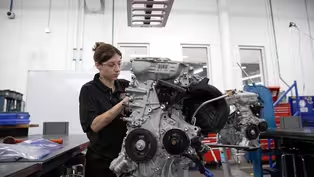
GEOFF BENNETT: From self-driving cars to electric vehicles, automobiles are becoming more technologically advanced, and there's a shortage of workers who have the diverse skills needed to keep them on the road.
Ali Rogin visited one college focused on training the next generation of the automotive industry, including many people who may have once thought there wasn't a place for them there.
It's part of our series, Rethinking College.
CAID KROEGER, Instructor, Department of Automotive Technology, Weber State University: Hey, guys, for this assignment, we're going to be tearing down the engines, much like you guys are.
ALI ROGIN: At Weber State University in Layton, Utah, it's no coincidence that the automotive program shares a building with computer science.
CAID KROEGER: We have autonomous vehicles now.
We have adaptive cruise control.
We have a full-on hybrid and full-on electric vehicles now.
So, the old days of just being able to pick up a wrench and work on your car are falling farther and farther behind.
ALI ROGIN: Weber State instructor Caid Kroeger trains his students for the cars and the jobs of the future.
CAID KROEGER: You are no longer just your average mechanic that's diagnosing base engine concerns.
You are I.T., you are an engineer, you are a tech expert at this point.
ALI ROGIN: Weber has been keeping students on the cutting edge of the auto industry since 1922, not long after Henry Ford launched the Model T. The university works with companies like Toyota, GM, and Chrysler to make sure students are learning the most in-demand skills.
Many students already work in the field and can translate their professional certifications into credits towards an associates degree.
They can stop there, or keep going, or come back later for their bachelor of science in automotive technology.
BRIAN RAGUE, Associate Dean of College of Engineering, Applied Science, and Technology at Weber State University: Fundamental knowledge about their particular field is important to us and we build that up.
But we build it up in a kind of a gradated or stackable way, so that students can earn degrees and credentials as they move along.
ALI ROGIN: Brian Rague is the associate dean of the college of engineering, applied science and technology.
It seems like this hybrid approach to higher education is really well-geared to this national moment that we're in.
BRIAN RAGUE: It requires of the university to be attuned to what the needs are out there.
And you get that information from the industry partners, and then you make the curriculum kind of fit those needs.
And that is not an easy thing to do at a university.
ALI ROGIN: One of the biggest needs is the work force.
According to one study, the U.S. auto industry will need more than 300,000 new auto techs over the next four years to keep up with demand.
Many of those jobs will need to be more technical than mechanical, making it an opportune time for the horsepower industry to rethink manpower.
Women make up about half the American work force, but only about a quarter of the automotive industry.
Experts say that's a missed opportunity.
JESSICA SLATER, Department Chair, Department of Automotive Technology, Weber State University: I think there are a lot of fantastic women and there are a lot of brilliant women that are in other industries that we are missing.
ALI ROGIN: Jessica Slater is the department chair of Weber's automotive program.
JESSICA SLATER: Where would the automotive industry be now if those women had been a part of it?
If maybe they had entertained a STEM or an engineering field, where would we be now?
It's a curious thought.
I think we would be somewhere else entirely.
ALI ROGIN: Today, women are a little over 10 percent of the undergrad auto program at Weber, and the college hopes to boost those numbers in part by offering college-level courses to students at 16 local high schools.
JESSICA SLATER: We want to get in front of these young women, again, before any preconceptions are developed on this is what I'm capable of doing because I'm a woman.
We want to get to them when they're 12 years old and they think they can do whatever a boy can do, because they can.
ALI ROGIN: It can be easy for young girls to lose that attitude.
Luckily, 20-year-old Delanie Long held on to it.
DELANIE LONG, Student: Since I was young, my dad always worked on cars and stuff like that.
And he would actually try and show my brother everything and get him into it.
So, I just tagged along and I enjoyed it more than my brother.
ALI ROGIN: You're a woman going into potentially a very right now male-dominated industry.
How do you feel about that?
DELANIE LONG: At first, it was really intimidating, to be honest.
But I do feel welcome here.
It's fun to show, like, the boys what's up kind of thing.
ALI ROGIN: Not just the boys.
Her father too.
DELANIE LONG: It's also fun, like teaching him some things I have learned here that he didn't know.
He's shocked, but proud of me, for sure.
ALI ROGIN: But attitudes take longer to change than tires.
A 2020 survey of the auto industry found that 91 percent of female respondents believed there was a bias towards men for leadership positions.
Only 47 percent of men felt that way.
But Weber alum Beth Miya, who now works for the Cummins engine and generator company, says the industry has improved since she started out over two decades ago.
BETH MIYA, Weber State University Graduate: I couldn't get a job turning wrenches when I first started out in the automotive industry, even though I had more experience than some of my male counterparts.
It's obviously a very, very different world.
I mean, I graduated from Weber State in like '04.
I think that just the assumptions that females shouldn't be there is gone.
ALI ROGIN: But Miya says she still deals with sexism in the industry.
BETH MIYA: Everywhere I go, they usually assume I am the marketing girl or the secretary that's helping.
And then I get up and I'm presenting the technical information.
I always feel that I have to prove myself, when my male counterparts can walk up and they just listen.
I have to kind of show them why I'm there.
ALI ROGIN: So, Miya is paying it forward, speaking when she can to younger students who are curious about the automotive field.
BETH MIYA: It would have been nice for me to see a female instructor.
You know, that would have been encouraging for sure.
As cheesy as it sounds, anywhere I can actually appear and be a female is a good thing.
ALI ROGIN: Caid Kroeger says the industry would benefit from more women joining.
CAID KROEGER: I have found that our female students, the women in the industry, approach diagnostic in a very unique way and they end up being great at solving problems.
ALI ROGIN: Plus, these days, the auto industry isn't just looking for gearheads.
CAID KROEGER: Much like the days of old, we still get the students that love automotive for the horsepower, the loud noises, the -- like, what people, what some students end up coming to the automotive industry in the first place.
But the other side of that, though, too, is now I have a lot of students that are interested in I.T.
that are still interested in cars or interested in battery design.
ALI ROGIN: Jessica Slater says there's more opportunity in automotive than outsiders realize.
JESSICA SLATER: There's a misconception, if you go into automotive, you're just going to be a grease monkey, that's all you're good for.
And that is entirely inaccurate.
There are so many channels and avenues for this industry that people just don't know about.
ALI ROGIN: That's why Weber State is working to change stereotypes about the industry and the people who work in it.
For the "PBS News Hour," I'm Ali Rogin in Layton, Utah.
GEOFF BENNETT: And join us again here tomorrow night for the latest, as Hurricane Milton charts a path towards Florida's already storm-battered Gulf Coast.
And that's the "News Hour" for tonight.
I'm Geoff Bennett.
For all of us here at the "PBS News Hour," thanks for spending part of your evening with us.
Helene recovery complicated by lies and conspiracy theories
Video has Closed Captions
Helene recovery complicated by lies, hoaxes and conspiracy theories (6m 55s)
Israel marks one year since Hamas' Oct. 7 attack as war rages on multiple fronts
Video has Closed Captions
Israel marks year since Hamas' Oct. 7 attack as war rages (5m 26s)
Kibbutz Be’eri frozen in horror a year after Hamas attack
Video has Closed Captions
Kibbutz Be’eri remains frozen in horror a year after Hamas attack (9m 51s)
Next generation of auto techs preparing for EV transition
Video has Closed Captions
How the next generation of auto techs is preparing for the electric vehicle transition (6m 57s)
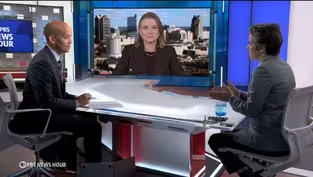
Tamara Keith and Amy Walter on key voters and states
Video has Closed Captions
Tamara Keith and Amy Walter on the voters and states that will decide the election (9m 30s)

Ukrainians face painful choice as Russians advance on town
Video has Closed Captions
Ukrainians face painful choice of leaving or staying as Russian forces advance on town (6m 55s)
Providing Support for PBS.org
Learn Moreabout PBS online sponsorship
- News and Public Affairs

Today's top journalists discuss Washington's current political events and public affairs.

- News and Public Affairs

FRONTLINE is investigative journalism that questions, explains and changes our world.












Support for PBS provided by:
Major corporate funding for the PBS News Hour is provided by BDO, BNSF, Consumer Cellular, American Cruise Lines, and Raymond James. Funding for the PBS NewsHour Weekend is provided by...