
October 8, 2023 - PBS News Weekend full episode
10/8/2023 | 26m 44sVideo has Closed Captions
October 8, 2023 - PBS News Weekend full episode
October 8, 2023 - PBS News Weekend full episode
Problems playing video? | Closed Captioning Feedback
Problems playing video? | Closed Captioning Feedback
Major corporate funding for the PBS News Hour is provided by BDO, BNSF, Consumer Cellular, American Cruise Lines, and Raymond James. Funding for the PBS NewsHour Weekend is provided by...
October 8, 2023 - PBS News Weekend full episode
10/8/2023 | 26m 44sVideo has Closed Captions
October 8, 2023 - PBS News Weekend full episode
Problems playing video? | Closed Captioning Feedback
How to Watch PBS News Hour
PBS News Hour is available to stream on pbs.org and the free PBS App, available on iPhone, Apple TV, Android TV, Android smartphones, Amazon Fire TV, Amazon Fire Tablet, Roku, Samsung Smart TV, and Vizio.
Providing Support for PBS.org
Learn Moreabout PBS online sponsorshipJOHN YANG: Tonight on PBS News Weekend, Israel declares war on Hamas as it follows Gaza in retaliation and the death toll mounts on both sides.
ANTONY BLINKEN, U.S. Secretary of State: Everything that Hamas does makes their situation their plight even worse.
They bring nothing but death and destruction, not only to Israelis, but to Palestinians.
JOHN YANG: And we get two perspectives on this weekend's violence and what it means for the Middle East.
Then the global fentanyl trade and the recent U.S. crackdown on Chinese companies producing and trafficking the illicit drug.
(BREAK) JOHN YANG: Good evening, I'm John Yang.
Tonight, Israel is a nation at war.
Prime Minister Benjamin Netanyahu has vowed to destroy the ability of Hamas and Islamic Jihad to govern and carry out military attacks and ever he warns will be long and difficult.
The death toll continues to climb.
At this hour there are more than 700 Israelis dead.
On the Palestinian side.
More than 400 are reported dead, and each side reports more than 2,000 wounded.
Late today, U.S. Defense Secretary Lloyd Austin ordered the aircraft carrier USS Gerald Ford to the eastern Mediterranean as a show of force in support of Israel.
The skyline of Gaza shrouded in smoke as Israeli strikes pummeled residential building.
Mosques of the Israeli military said how's Hamas command centers and tunnels long suspected to be smuggling routes for weapons.
Israeli officials say they also hit the National Bank of Gaza.
NewsHour producer Shames Ouda.
SHAMES OUDA: If you look behind me, this is the Islamic investment bank as the Israeli playing that this bank belong to Hamas, the Israeli Air Force Attack this bank just 10 minutes ago.
We are in the main street of Gaza.
Omar Mukhtar Street.
Omar Mukhtar Street, the famous street in Gaza is full of shops, full of tanks, a lot of offices belong to journalist banks.
And this if you see it's empty, no problem state everything is closed.
JOHN YANG: Just across the Gaza border in southern Israel, battles continued between Israeli forces and Hamas gunmen.
Israel is called reservists back to duty some volunteering to join the fight.
The military says it's masking tens of thousands of troops in southern Israel.
AVIEL HAIM, Reservist (through translator): What happened yesterday hasn't happened for a long time.
We need to know how to deal with it and what to do and act correctly.
We are on our way to the south.
We'll see what will happen.
I don't know yet what we'll do there.
ORI GAT, Reservist: We're doing what's needed, we will win slowly, slowly, it will be okay.
JOHN YANG: On Israel's northern border and exchange of rockets and artillery between the Iranian backed Hezbollah militia and Israeli forces stoked fears of a larger regional conflict.
And there was word today that American citizens may have been killed or captured in the attack.
Secretary of State Antony Blinken on CBS Face the Nation.
ANTONY BLINKEN: We've got reports that several Americans are among the dead.
We're working very actively to verify those reports.
At the same time that reports of Americans being taken hostage there too.
We're working to get the facts and to find out if those reports are accurate.
JOHN YANG: Around the World gestures of support for both sides.
In Tehran, in Istanbul, and elsewhere shows of support for Palestinians.
But far greater were gestures of sympathy and solidarity for Israel.
In Berlin supporters gathered at the Brandenburg Gate, in New York City, the Empire State Building bathed in Israeli blue and white.
Tragedy as well in Afghanistan.
The death toll from yesterday's earthquakes in the country's West climbed to nearly 2,500 people.
At least five strong tremors and aftershocks leveled about six villages, burying hundreds of people under rubble.
Some villagers used their bare hands to look for survivors and dig out the dead.
One man spoke of his loss.
MAN (through translator): This earthquake has affected us a lot and personally lost two family members in this incident.
One was my sister, and the other was my son.
JOHN YANG: This is the deadliest seismic event in Afghanistan in two decades.
It surpasses last year's quake that claim more than 1,000 lives.
And now some brighter news gymnasts, Simone Biles has once again made gymnastics history.
On the final day of competition at the World Gymnastics Championships, Biles won two gold medals, one for floor exercise and one for balance beam.
She now holds a record 37 medals and World Championship and Olympic competition.
Two days ago, she won a record six all-around title.
Still to come on PBS News Weekend, two perspectives on the war in Israel and the U.S. crackdown on the global fentanyl trade and China's role in it.
(BREAK) JOHN YANG: It is impossible to understate the devastating effect yesterday's attack had on Israel, Israeli citizens and their leaders.
Michael Herzog is the Israeli ambassador to the United States.
Mr.
Ambassador, thanks for joining us.
And first let me begin by offering our condolences on the loss of life in Israel yesterday.
And I wonder I'll see if we could put it into perspective a little bit because I found that when things happen in Israel, it's such a relatively small country.
Everyone knows someone or know someone who knows someone who's affected by this.
MICHAEL HERZOG, Israeli's Ambassador to the U.S.: Thank you very much for your condolences.
And yes, this is a serious blow to the State of Israel.
Hamas wage war in Israel yesterday an unprovoked attack on civilians.
They fired thousands of rockets at Israeli populated centers, and then they breach the border fence and sent in hundreds of armed terrorist infiltrated almost all the border towns and Kibbutzim and basically murdered hundreds of people.
Right now the official count is at least 700.
But the number we're still counting and numbers will probably go up.
There was a beach party not far away from the border in Gaza, we just counted 260 bodies.
This is unimaginable.
This is someone said our 911.
This is war.
And we have to consider it as a war.
JOHN YANG: The question and much like the question that was asked in America after 911 is how could this happen?
How could Israeli intelligence miss the planning for this?
Underestimate the capabilities of Hamas to do this?
And also how are so many militants able to breach that barrier?
MICHAEL HERZOG: Well, obviously, there was a serious element of surprise, but I believe the time will come where we will deeply investigate that.
Right now we are at war.
And we have to fight this war and win that war.
The way they entered our territory was breaching the border fence with explosive charges.
Using target power glades, and also through the sea.
We encountered and killed the huge number of terrorists inside our territory.
And yes, the time will come to look into what exactly happened but right now we are at war.
JOHN YANG: The time will come but how can Israelis trust the government after such a failure, failure and intelligence and preparation?
MICHAEL HERZOG: It's not a matter about trusting or not trusting the government.
It's a professional question of how come people were surprised by this assault probably some misconceptions but again, the time will come to discuss this.
Right now we have to fight the war.
JOHN YANG: And as I understand there's still some fighting in some cities in southern Israel right now.
And Hamas says that they're able to send in fresh fighters and bring out tired ones.
Is this raises the question does Israel really have control of southern Israel right now?
MICHAEL HERZOG: We are nearly in complete control.
We eliminated most of their cells inside our territory.
That still one two flashpoints.
And, but I expect that sooner perhaps by the end of the day, we will control all of our territory and nobody will be able to penetrate.
The IDF is right now sealing the border once again.
JOHN YANG: And the Prime Minister and other military leaders in the IDF have promised vengeance on Gaza for this.
How good, you know, the last time there was a major ground operation in Gaza.
The United Nations estimated that more than 1,400 Palestinian civilians were killed, including more than 500 children.
How can you protect or minimize the loss of Palestinian civilian life?
MICHAEL HERZOG: First of all, I would be very careful about these numbers.
These numbers are usually conflated, and usually the Palestinians they base themselves on Palestinian sources in Gaza.
They include hundreds of terrorist who are killed while trying to kill our citizens.
So let's be very careful about these numbers.
I would -- I think we should give it time to understand what's happening.
The fact of the matter is Hamas hides its military capabilities behind civilian population.
They are using civilian population as human shields.
What we are doing, we do not target civilians when we have -- we target militants terrorist.
And when we do that, and when they nest in civilian populated areas, we send warning to the population to evacuate the area because this is a war zone.
And that's with all the way we've always operated.
We are very different than there.
JOHN YANG: The former U.S. ambassador to Israel, Martin Indyk pointed out that he, in his opinion, the Netanyahu government was more interested in protecting settlers on the West Bank than they were in protecting the kibbutz near Gaza.
What do you say to that?
MICHAEL HERZOG: I don't bite the tone.
I think the issue in the border of Gaza was not the number of troops but it was the element of surprise.
I think my advice to everybody.
This is not the time to politicize the discussion for.
JOHN YANG: Mr.
Ambassador, thank you very much.
MICHAEL HERZOG: Thank you very much.
JOHN YANG: For more analysis on the war in Israel, we're joined by Shibley Telhami.
He's a senior fellow with the Brookings Institution's Center for Middle East Policy, and the Anwar Sadat professor for Peace and Development at the University of Maryland.
Shibley, thanks so much for joining us.
And we begin with the wish and hope that your loved ones and family in the Middle East are safe and well after yesterday.
SHIBLEY TELHAMI.
University of Maryland: Thank you.
JOHN YANG: You and I have talked a lot in the past few years about how the Palestinian-Israeli conflict was a tinderbox.
But this seemed to come out of nowhere.
why now, why did this did Hamas Act now?
SHIBLEY TELHAMI: This is a really good question.
The surprise, honestly, is not why they acted.
Now, the surprise is that they had such a capability to do what they did.
Frankly, that is the big surprise.
And that's the shocker.
And then the Israeli military inability to stop them that that's the shocker.
Now, the timing, when you look at it, there are a number of things that are going on at the same time.
The first is that there is a lot of despair in the West Bank, particularly but also in Gaza, because nothing has changed 56 years of occupation, they exploit that to their benefit politically.
Palestinians feel there's no one paying attention to them, the international community's ignore them, ignoring them, might be peace between Israel and Saudi Arabia that ignores them further.
So they exploit that they get attention and credit, as well as marginalized their opponent, the Palestinian Authority.
So they have the timing really is not particularly surprising.
There's also been talk of possibly Israel, and many of the far right ministers in Israel have been calling for a large attack on Gaza.
In fact, Hamas itself claimed that they had information the Israelis were going to do it anyway, after the holidays, whether they're using that as an excuse or not, it's hard to know.
But nonetheless, there was some expectation that.
JOHN YANG: You say the capability was surprising.
Do you think they got help from their backers in Iran?
SHIBLEY TELHAMI: Well, obviously Iran supports them.
Iran is clearly a menace to America's interest and have supported Hamas but I sincerely doubt that this is being done for Iran.
In fact, I you know, the U.S. has already said there's no intelligence that says that and they, you know, it's improbable the relationship between Hamas and Iran is very close and cooperative but it's not like Hezbollah and Iran where Hezbollah can get instruction from Iran.
I'm not even sure this is a perfect time for Iran, honestly, because they want to perhaps use their allies in case they go to war with Israel and the U.S. down the road.
I think, you know, Hezbollah isn't eager, for example, to enter into this fight right now, although they might be drawn into it.
Nonetheless.
JOHN YANG: You mentioned the talks about normalizing relations between Israel and Saudi Arabia.
What does this do to that?
SHIBLEY TELHAMI: Well, it we shuffled the deck, there's no question that the Arab governments have had their own strategic interest and that have not been necessarily in harmony with the interests of the Palestinians, that has been taking place and the Saudis obviously have their own strategic interests that they were intent on moving forward.
But what they didn't expect is that this issue would rise to the top of the agenda in the Middle East reshuffling of the deck in ways that were anticipated and they're public, even if the government's don't care about policy.
Aciar (ph) public cares in the Saudi public particularly cares a lot about the Palestinian issue.
And this obviously puts it right at center stage.
So it limits the possibilities and freedom that governments have with regard to making a deal with Israel, especially knowing now that as Israel has declared war, we're likely to be at this for, unfortunately, many, many, many weeks.
JOHN YANG: Why do you think Israel missed this?
The intelligence didn't pick up the planning?
They seemed unprepared.
The Hamas seem to get a peep their men into Israel very easily.
Why do you think that is?
SHIBLEY TELHAMI: Well, you know, I think this is something that everybody's going to be asking.
And frankly, I think part of the finger pointing, you know, Iran or something like that, in this particular case, is intended to, you know, divert attention from the failure.
I mean, there's been an incredible failure that have taken place.
And it's hard to do understand.
I mean, I've been watching Israeli television very closely the last two days.
And I think this is not a question they want to get into now, because they have business to do.
It's fully understandable.
There's a lot of innocent civilians that have been hurt that have a major, you know, challenge that the likes of which you haven't seen in years.
So they need to deal with this now.
And they're putting off the question of trying to investigate what went wrong, but I think there is, you know, I've investigated the '73 war, just as you know, this happened the day after the 50th anniversary of the 73 Arab-Israeli war, where in fact, Israel was shocked by the Egyptian and the Syrian attacks, to try to liberate their territories.
And that attack was happened, in part because Israel felt secure.
These countries had been thoroughly defeated by Israel just six years before, and Israel was seemed to be strong and in command, and yet, obviously, it happened and this particular case is a conference that Israelis have, perhaps not taken seriously, the capabilities of their opponents may have played a role in this.
JOHN YANG: Shibley Telhami, Thank you very much.
SHIBLEY TELHAMI: My pleasure.
JOHN YANG: This past week, the Biden administration moved against China based firms and executives blamed for importing chemicals used to make the synthetic opioid fentanyl which is up to 50 times stronger than heroin.
It's part of the government's effort to disrupt the global illegal drug trade and stem the opioid epidemic.
Ali Rogin spoke with Vanda Felbab-Brown of the Brookings Institution.
ALI ROGIN: Vanda Felbab-Brown, thank you so much for joining us.
Tell us about how Chinese entities are working with Mexican drug cartels to produce and distribute fentanyl.
VANDA FELBAB-BROWN, The Brookings Institute: Well, thank you for having me.
China is the principal source of precursor chemicals from which Mexican cartels synthetize fentanyl.
So various Chinese brokers individuals, sometimes larger family based networks and companies produce and sell these precursors to Mexico often very knowingly enabling the cartels in synthesizing fentanyl.
They even provide recipes to the cartels how to make fentanyl out of them.
JOHN YANG: The Biden administration has made very clear that the actions that they've been taking over the past few months are part of a very deliberate effort to stop the global fentanyl trade.
Why is the U.S. stepping up these actions now?
VANDA FELBAB-BROWN: Well for well over a year we have had no meaningful cooperation from the government of China and frankly we have had minimal and in adequate cooperation from the government of Mexico as well.
In 2018, 2019, we had the height of China's cooperation in trying to stop the flows of precursors and fentanyl out of China.
At the time China scheduled the entire class of fentanyl type drugs as a scheduled substance, requiring that permits are obtained for the production of fentanyl, class drugs and their exports.
And that's changed the patterns of the illegal trade.
Instead of fentanyl being shipped directly to the United States, these precursor chemicals would now be shipped to Mexican cartels that sanitize fentanyl from it.
But after that China has significantly scaled back cooperation.
Why?
Because it had expected that the Trump administration would lessen the economic tariffs on Chinese goods.
And then it expected that the Biden administration will take a softer geostrategic approach to China neither happened.
In fact, we have seen significant increase in tensions between the two countries, China in general subordinates its law enforcement cooperation with other countries to its other objectives.
And with countries where the economic or geostrategic relationship is not what it wants, it weakens or altogether suspense cooperation.
The Biden administration has attempted to redress this lack of cooperation in several ways.
One is the set of prosecutions that we are seeing.
They found an important way to get around the fact that many of the precursors being sold and legal nonscheduled chemicals.
It has also engaged the Chinese government when Secretary Blinken was in China in the spring, the issue of fentanyl and counter narcotics came up.
And that seemed to be a hopeful moment when Chinese officials, Chinese interlocutors started looking back and reviving the possibility of a joint fentanyl working group.
Certainly seeing that move ahead would be important in July organizing the first summit of a global coalition against the threat of synthetic drugs.
And hopefully this joint international effort to put pressure on China will pay off.
ALI ROGIN: This is also affecting the U.S. relationship with Mexico.
Attorney General Garland and other senior U.S. officials were in Mexico this week talking about this issue.
What is the role of the Mexican government then?
VANDA FELBAB-BROWN: Well, unfortunately, just as with China, we also have had really inadequate cooperation from the government of Mexico ever since President Andres Manuel Lopez Obrador came to office in Mexico, so much so that even earlier this year, in the spring, we have had President Lopez Obrador making claims that there is no fentanyl produced in Mexico, even though we know that Mexico is the predominant place that fentanyl sympathized (ph).
In recent weeks, there has been more effort on the part of the Mexican government to restart at least some cooperation.
And the meeting that you mentioned between Mexican officials and high level U.S. officials is part of that spirit to see whether we could get toward some more meaningful corporations that have been some progress.
And most importantly, the Mexican government extradited Ovidio Guzman, one of the leaders of the Sinaloa Cartel to the United States, just in recent days.
But we really need to get to a space where U.S. law enforcement agents can in the field operate with Mexican counterparts.
We don't have that right now.
We need to also get to a state where the Mexican government is far more willing to confront the cartels than assaults.
ALI ROGIN: What impact do these announcements actually have on the global fentanyl trade?
VANDA FELBAB-BROWN: I do hope that at minimum, they will help shrink the pool of actors in China who are willing to violate laws, at least U.S. laws and international laws.
If instead of having thousands of potential suppliers, we shrink through these indictments through deterrence, those who are willing to supply to hundreds or tens.
That's an important accomplishment.
Your question touches at the core of what comes in narcotics efforts have been grappling with over the past decades the so called balloon effect, that as long as demand persists, as someone will step in even if production is suppressed in one place, or precursor chemicals are suppressed in one place, they will move to another place.
That will be the reality with us.
But the answer is not to simply give up and allow unmitigated supply to come.
The lesser the supply, the more the supply is in places where we have good cooperation when network networks can be dismantled, the better off we are.
ALI ROGIN: Vanda Felbab-Brown with the Brookings Institution.
Thank you so much for your time.
VANDA FELBAB-BROWN: Thank you for having me.
JOHN YANG: Online right now head to our Instagram account to see the results of a PBS News/NPR Marist poll on the house impeachment inquiry into President Biden.
And for more, visit our website pbs.org/newshour.
And that is PBS News Weekend for this very eventful weekend.
On Monday with Israel at war after suffering one of its bloodiest days ever the latest from the region.
I'm John Yang.
For all of my colleagues, thanks for joining us and have a good week.

China’s role in the U.S. crackdown on global fentanyl trade
Video has Closed Captions
Why the U.S. is pressuring China amid a crackdown on the global fentanyl trade (6m 38s)
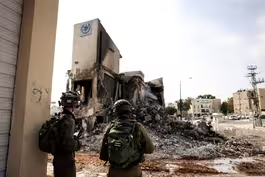
Deaths mount as Israeli military retaliates against Hamas
Video has Closed Captions
Deaths mount as Israel launches large-scale retaliation against Hamas in Gaza (3m 16s)
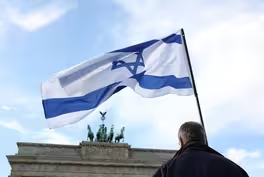
Israeli ambassador to U.S. shares reaction to Hamas attack
Video has Closed Captions
‘Our 9/11’: Israeli ambassador to the U.S. discusses reaction to Hamas attack (5m 51s)
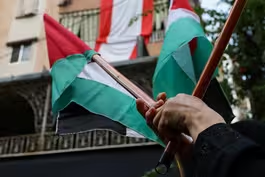
What the Palestine-Israel crisis means for the Middle East
Video has Closed Captions
What the escalating Palestinian-Israeli crisis means for Middle East relations (5m 47s)
Providing Support for PBS.org
Learn Moreabout PBS online sponsorship
- News and Public Affairs

FRONTLINE is investigative journalism that questions, explains and changes our world.

- News and Public Affairs

Today's top journalists discuss Washington's current political events and public affairs.












Support for PBS provided by:
Major corporate funding for the PBS News Hour is provided by BDO, BNSF, Consumer Cellular, American Cruise Lines, and Raymond James. Funding for the PBS NewsHour Weekend is provided by...