
October 9, 2024 - PBS News Hour full episode
10/9/2024 | 56m 41sVideo has Closed Captions
October 9, 2024 - PBS News Hour full episode
October 9, 2024 - PBS News Hour full episode
Problems playing video? | Closed Captioning Feedback
Problems playing video? | Closed Captioning Feedback
Major corporate funding for the PBS News Hour is provided by BDO, BNSF, Consumer Cellular, American Cruise Lines, and Raymond James. Funding for the PBS NewsHour Weekend is provided by...
October 9, 2024 - PBS News Hour full episode
10/9/2024 | 56m 41sVideo has Closed Captions
October 9, 2024 - PBS News Hour full episode
Problems playing video? | Closed Captioning Feedback
How to Watch PBS News Hour
PBS News Hour is available to stream on pbs.org and the free PBS App, available on iPhone, Apple TV, Android TV, Android smartphones, Amazon Fire TV, Amazon Fire Tablet, Roku, Samsung Smart TV, LG TV, and Vizio.
Providing Support for PBS.org
Learn Moreabout PBS online sponsorshipGEOFF BENNETT: Good evening.
I'm Geoff Bennett.
AMNA NAWAZ: And I'm Amna Nawaz.
On the "News Hour" tonight: Hurricane Milton hits Florida's west coast with life-threatening storm surge and potentially catastrophic winds.
KEN WELCH, Mayor of St. Petersburg, Florida: The impacts of the wind is inevitable, and we have to rebuild from that, but saving lives is the most important thing right now.
GEOFF BENNETT: With 26 days until the election, former President Donald Trump tries to win over voters in President Biden's hometown.
AMNA NAWAZ: And a growing number of civilians in Lebanon are displaced and in dire need of aid amid Israel's ongoing offensive against Hezbollah.
(BREAK) AMNA NAWAZ: Welcome to the "News Hour."
Hurricane Milton will make landfall in Florida overnight, potentially as a Category 3 storm, and poses a major threat to Tampa and other coastal cities like Fort Myers, Sarasota and St. Petersburg.
GEOFF BENNETT: Milton's outer bands have already hit the state with heavy winds, rain and triggered a few tornadoes.
William Brangham is in West Central Florida and starts our coverage.
WILLIAM BRANGHAM: Even from miles offshore, Hurricane Milton warned Floridians of what's to come.
The immense storm blew fierce winds across the state and dropped heavy amounts of rain.
Earlier today, residents braced for a brutal impact, boarding up buildings and stocking up on supplies and gas.
JELISSE CARABALLO, Florida Resident: I'm scared, but trying to prepare the best that I can at the moment.
WILLIAM BRANGHAM: And have you ever been through a hurricane before?
JELISSE CARABALLO: Never in my life.
I'm from Upstate New York, so never experienced a hurricane, and especially to see it being at this level.
WILLIAM BRANGHAM: As it churned across the Gulf of Mexico today, Milton fluctuated between Category 3, 4 and 5.
Regardless, forecasters say it could be one of the most destructive storms on record.
During a virtual briefing, President Biden and Vice President Harris pledged they would provide whatever federal support the state needs.
JOE BIDEN, President of the United States: In moments like this, there are no red or blue states.
There's one United States of America, where neighbors are helping neighbors.
Volunteers and first responders are risking everything, including their own lives, to help their fellow Americans.
WILLIAM BRANGHAM: Milton is expected to push a life-threatening surge of ocean water up onto shore, up to 12 to 15 feet high in some areas, and trigger flash flooding across a wide band of the middle of the state, including many areas still recovering from Hurricane Helene just two weeks ago.
GOV.
RON DESANTIS (R-FL): The major effects for surge will be on the West, but there is going to be impacts far inland and on the other coast in the state of Florida.
WILLIAM BRANGHAM: This afternoon, Governor Ron DeSantis urged residents in the worst parts of the storm's path to leave.
GOV.
RON DESANTIS: The conditions are starting to get bad.
You listen to your local emergency managers about when it's too dangerous to go out.
In many parts of Florida, you probably could still go to a shelter.
You don't even need to get on the interstate or doing that.
And we still have a lot of space in our shelters.
WILLIAM BRANGHAM: Many have taken the warnings to heart, leading to one of the largest evacuations in the state's history.
In Polk County, about 60 miles inland, Juan Mangual evacuated with his dog, Blue, heading to one of the county's shelters that allows pets.
You were not going to evacuate and leave your dog behind?
JUAN MANGUAL, Florida Resident: Never, ever.
That's my son.
I said, better safe than sorry, and just -- I don't want to make a mistake on this one.
This is a once-in-a-lifetime hurricane, and it's actually huge.
WILLIAM BRANGHAM: Michelle Schmeink and her friends are here on vacation from Iowa, but will ride out the storm in a local shelter, instead of their mobile home park.
MICHELLE SCHMEINK, Tourist: And it's all weathered up.
I mean, they put metal panels on the windows and everything.
And just with the storm surge that they're predicting, we're going to feel much more safe here.
WILLIAM BRANGHAM: Milton's powerful outer bands triggered multiple small tornadoes across the state, including one that tore across a highway near Fort Lauderdale.
Today, FEMA Chief Deanne Criswell said she would travel to Florida to help with recovery efforts.
DEANNE CRISWELL, FEMA Administrator: You need to prepare for catastrophic impacts.
This is going to be a serious storm, one that could forever change communities that are still recovering from Helene.
WILLIAM BRANGHAM: Millions of Floridians are now hunkering down, hoping for the best.
TOM PERSSON, Florida Resident: Everybody's worried about the same thing.
Do you have a home to come back to or damage?
WILLIAM BRANGHAM: There are 25 counties across Florida right now that are under mandatory or voluntary evacuation orders, but time is running out for people to leave safely.
Meanwhile, millions of Floridians are bracing for what could be the worst storm they have ever seen in this region.
And landfall is only a few hours away -- Geoff.
GEOFF BENNETT: William Brangham reporting tonight again from Orlando, Florida.
William, thank you.
Now let's hear the latest about what we can expect from this storm and bring in Michael Brennan, the director of the National Hurricane Center.
So we have seen conditions deteriorate as Milton bears down on Florida.
What's the expectation for tonight and tomorrow morning?
MICHAEL BRENNAN, Director, National Hurricane Center: It's going to be a very dangerous night and much of Thursday across much of the Florida peninsula.
We're expecting the center of Milton to make landfall this evening or tonight along the west central coast from, say, the Tampa Bay area down to near the Sarasota area and then move quickly across the peninsula.
We have already got very heavy rainfall.
We have got tropical-storm-force winds moving on shore now.
Storm surge is starting to occur.
We have had numerous tornadoes across portions of the central and southern portion of the peninsula today.
And all those hazards are going to get worse as we go through the overnight hours tonight.
GEOFF BENNETT: Well, tell us more about that destructive tornado outbreak across parts of this state.
Are we expecting to see more?
MICHAEL BRENNAN: Yes.
What we're looking at here, everywhere you see in this sort of bright pink color is under a tornado watch, which means conditions are favorable for tornadoes to form.
This watch goes until mid-evening, likely will be extended overnight.
But we have had the wind field associated with Milton and some of the daytime heating that occurred across the peninsula where the skies were clear allowed thunderstorms to develop, quickly rotate.
And we still have a few tornado warnings in effect now in parts of the Treasure Coast and up near the metro Orlando area.
And tornadoes can be especially dangerous at night because they're difficult to see.
And tornadoes associated with hurricanes can often form very quickly without a lot of lead time.
So we want people in these areas to make sure they have multiple ways to get weather alerts overnight through a NOAA weather radio, wireless emergency alerts turned on in your phones so that you can be alerted if a warning is issued for your area.
GEOFF BENNETT: That wind field you mentioned has more than doubled since yesterday, which suggests that the impact of Milton will be felt across a wider area.
Is that right?
MICHAEL BRENNAN: Yes, that's right.
We're expecting a really big wind field here.
If you look at the hurricane-force winds and the hurricane warning, everywhere you see in red here, much of the central portions of the Florida peninsula and from Tampa to Orlando to Melbourne up to st. Augustine down to the Treasure Coast, Sarasota, we're expecting to see hurricane conditions in that region tonight, moving from west to east across the peninsula and onto the east coast on Thursday.
So, in this region, we're expecting to see widespread wind damage, power outages, structural damage.
So it's going to be a very dangerous night.
People are wanting to be sheltering in place by now and be prepared to stay in a safe place through much of Thursday.
GEOFF BENNETT: And last night, you told us that we should expect storm surge as high as 12 feet.
Is that still the case?
MICHAEL BRENNAN: Yes, we're still expecting to see a very significant storm surge from the Tampa Bay region southward to Charlotte Harbor to the Fort Myers area.
We're really concerned about this area from Anna Maria Island to Boca Grande.
We're expecting to see nine to 13 feet of inundation near and just to the right of where the center of Milton makes landfall tonight.
That's going to be, again, nine to 13 feet of Gulf of Mexico water being violently pushed up onto normally dry land with dangerous waves on top.
But you can see we have already seen storm surge flooding all the way down to Fort Myers down to Naples, along much of the Florida west coast, given the sensitivity there.
And those water levels are going to continue to rise through the next several hours as Milton approaches the coastline.
GEOFF BENNETT: Michael Brennan, director of the National Hurricane Center in Miami, thanks again for joining us.
AMNA NAWAZ: Let's turn now to St. Petersburg, Florida, another major city in the path of the storm.
Mayor Ken Welch joins us now.
Mr. Mayor, thank you for being with us.
KEN WELCH, Mayor of St. Petersburg, Florida: Glad to be with you tonight.
AMNA NAWAZ: So you're there in St. Petersburg now.
I understand you're at your city's emergency operations center.
Just tell us where you are right now and what's ahead.
KEN WELCH: Well, now we're playing a waiting game.
We're tracking the storm as it comes toward us.
We have locked down the city, evacuated folks.
We have got thousands of folks in our emergency shelters and many more have left the city or the county, which is exactly what we asked them to do to move out of the threat of the storm surge.
And so now we're waiting to see which way the storm actually tracks.
As you know, a storm of this size, 20 or 30 miles' difference can make all the difference in the world in terms of the impact of storm surge.
But we know we're going to be impacted by the broad wind field from this hurricane.
And we're bracing for that and ready to get into recovery tomorrow.
AMNA NAWAZ: There's some predictions that say the storm surge, if it comes on a certain path, could be as high as 15 feet, which is just really impossible to imagine.
In a city like St. Petersburg, what would that do?
What does that look like?
KEN WELCH: Well, there are areas where it would not be survivable.
We saw from Hurricane Helene just two weeks ago what that impact would be.
That was a record-breaking storm for us in terms of storm surge at six to seven feet.
We have never seen it that high.
And, as you said, Hurricane Milton has a potential to more than double that.
And so I think that really got the attention of folks that live in those low-lying areas, and we evacuated areas A, B and C, and those folks have, again, moved out of harm's way, which is a good thing.
So, as long as folks are responsive to what we asked them to do in terms of moving away from that storm surge, not one life has to be lost from that.
And that's the most important thing.
The impacts of the wind is inevitable, and we have to rebuild from that.
But saving lives is the most important thing right now.
AMNA NAWAZ: Do you think Hurricane Helene having come through in some ways made it more real for people, made more people heed the mandatory evacuation who might not have otherwise?
KEN WELCH: No doubt in my mind.
I have talked to folks who said they have never seen water in their neighborhoods before.
And that really convinced them that they needed to move this time.
And we have seen entire neighborhoods that are in those low-lying areas where no one is there now.
They have actually heeded the call.
No, I know it made a big difference.
AMNA NAWAZ: We know there are always people who still don't want to evacuate, other people who simply cannot evacuate.
do you know how many people are left in St. Petersburg and what's your message to them now?
KEN WELCH: Well, we started very early in this process, and this is a routine for us.
We have special needs.
We have transportation, door-to-door transportation for folks who need it who sign up on a special needs registry, that we were still taking names as late as yesterday for that.
And so our message is, there's no reason to stay in an unsafe place.
We have got shelter space.
We have transportation to get you there.
And folks have been very responsive to that, really good utilization of our shelters at this point.
AMNA NAWAZ: But, Mr. Mayor, if I may, do you have any idea how many people may have stayed, how many people are still there?
KEN WELCH: I do not.
The estimate for our county was half-a-million people.
About half of the population were in the evac zone and asked to leave.
Our city, we think it's roughly the same thing, so, 135,000, 140,000 people asked to leave.
And from what we have seen, what we have heard from our folks who've been out in those neighborhoods, they have been responsive.
For the ones who are left, our message is at a certain point, when we get 50-mile-an-hour sustained winds, there will not be emergency response.
We will not be putting our first responders in danger at that point and help will not be available.
AMNA NAWAZ: There's also been a number of reports about construction cranes in downtown St. Petersburg, some as high as 600-feet-tall, that weren't dismantled before the storm.
I think a lot of folks are wondering why not.
And also, if people are in the vicinity of those cranes, are they at risk?
KEN WELCH: So, we have done active outreach to make sure folks are aware of that issue.
And, again, this is a matter of the storm developing so quickly.
It was a tropical storm just a few days ago, became a powerful Cat 5 in 24 hours.
It takes seven days to take these cranes down.
So it's just not possible within the time span of the development of this hurricane to take those down.
And so it's a lesson learned about how we go forward what we require in terms of the strength of those cranes, if they can't be taken down quickly enough to deal with a storm like this.
AMNA NAWAZ: Mr. Mayor, are storms like this the new normal for St. Petersburg and other areas around there?
KEN WELCH: Look, we believe in sea level rising, extreme weather and those changes.
We have developed a Tampa Bay compact of local governments who have changed our investments, our infrastructure approach for years to come.
But the pace of the change is much quicker than even we thought would happen.
And so we need to readdress the pace of our infrastructure improvements and how we deal with adapting to this new normal.
It certainly is a new normal.
These two record-breaking storms within two weeks of each other is evidence of that.
AMNA NAWAZ: That is Mayor Ken Welch of St. Petersburg, Florida.
Mr. Mayor, please stay safe.
We're thinking about you and everyone there.
Hope you stay well.
KEN WELCH: Thank you.
AMNA NAWAZ: We begin the day's other headlines in Gaza, where Israeli strikes on the center and north of the territory have killed dozens of people.
One of the attacks struck a hospital in Gaza's Jabalia refugee camp, where Palestinian officials say at least nine people were killed, including women and children.
Today, President Biden and Israeli Prime Minister Benjamin Netanyahu spoke by phone for the first time in seven weeks.
Vice President Harris also took part.
The White House called that 30-minute call productive and direct, and said the U.S. remains supportive of Israel as it weighs how to respond to a recent missile attack from Iran.
KARINE JEAN-PIERRE, White House Press Secretary: I think what you have seen from this administration is the continued support for Israel's security.
You saw that over the past couple of days, obviously, since the past couple of weeks, when Iran attacked Israel.The president directed his military to protect Israel.
He was very proud to be able to do that, and that support continues.
AMNA NAWAZ: On that Iran attack, Israeli Defense Minister Yoav Gallant said today that the country's retaliation against Iran would be -- quote -- "lethal, precise, and, above all, surprising."
Iran launched nearly 200 projectiles at Israel last week, increasing tensions between the two nations.
Here in the U.S., talks between Boeing and striking workers have stalled after the plane maker withdrew its latest contract offer.
It reportedly included a 30 percent raise over four years, along with other benefits.
The union says it's surveyed its members, who overwhelmingly rejected the proposal.
Boeing said the union's demands are -- quote -- "far in excess of what can be accepted if we are to remain competitive as a business."
The strike by some 33,000 factory workers is nearing its fourth week.
No new negotiations are planned.
The Nobel Prize in chemistry went to three scientists whose work ushered in a better understanding of proteins, the building blocks of life.
A committee in Sweden recognized David Baker of the University of Washington in Seattle.
He created a computer program to design proteins that don't exist in nature.
The award is also shared by Demis Hassabis and John Jumper of Google DeepMind.
Their artificial intelligence model can predict the structure of previously discovered proteins, all 200 million of them.
At Google's A.I.
Lab in London, where the pair is based, Jumper explained just how powerful the technology can be.
JOHN JUMPER, Director, Google DeepMind: This is something done all the time by research biologists, and it takes them a year or more to get a single answer.
And we have a program that gives an answer that's reasonably close in quality and does it in five or 10 minutes.
AMNA NAWAZ: Their work holds the potential to transform how medicine and vaccines are made.
It's also the second Nobel this week honoring advancements in A.I.
Tomorrow, the Nobel Prize in literature will be announced.
Las Vegas said goodbye to the legendary Tropicana today in an early morning extravaganza.
The hotel and casino went out with a boom in a controlled implosion.
Its towers tumbled to the ground as drones lit up the sky.
The farewell was just as flashy as the Tropicana's early days.
It opened in 1957 and was the most expensive hotel built in Las Vegas at the time.
The Tropicana was once known as the Tiffany of the strip for its opulence and was a regular hangout for the legendary Rat Pack.
It was also known for its mob ties.
The Tropicana closed in April to make way for a new baseball stadium for the relocating Oakland Athletics.
On Wall Street today, the major markets bounded higher thanks largely to gains in tech stocks.
The Dow Jones industrial average jumped more than 400 points, or about 1 percent.
The Nasdaq added about 100 points and the S&P 500 closed at a new all-time high.
And, finally, we have a passing of notes.
Lily Ebert, a Holocaust survivor, author, and later in life a prolific educator through social media, has died.
Ebert's mother and two siblings were killed at the Auschwitz Nazi concentration camp and she vowed to make her tale of survival a lesson for millions.
Her memoir, "Lily's Promise," was a New York Times bestseller.
And she took her message online through a TikTok account, she shared with her great-grandson reaching two million followers.
For her contributions to Holocaust awareness, she was honored by Britain's then-Prince Charles and last year was made a member of the Order of the British Empire.
Lily Ebert was 100 years old.
Still to come on the "News Hour": the Supreme Court hears a death penalty appeal; a look at the only county that's voted for the winning presidential candidate in every election since 1980; from underdog to undefeated, the inspirational story of a deaf school's football team; plus much more.
GEOFF BENNETT: Early voting started in Arizona today and both campaigns held events to persuade voters there.
Laura Barron-Lopez has this report.
LAURA BARRON-LOPEZ: As another hurricane barrels towards Florida, Vice President Kamala Harris criticized Donald Trump for spreading disinformation about Hurricane Helene during a phone interview on CNN.
KAMALA HARRIS, Vice President of the United States (D) and U.S. Presidential Candidate: It is dangerous.
It is unconscionable, frankly, that anyone who would consider themselves a leader would mislead desperate people to the point that those desperate people would not receive the aid to which they are entitled.
LAURA BARRON-LOPEZ: But in Pennsylvania, former President Trump continued to spread false information about the federal response to Hurricane Helene.
DONALD TRUMP, Former President of the United States (R) and Current U.S. Presidential Candidate: And we have another big one coming in, but the worst, the one in North Carolina, Georgia, Alabama, Virginia.
That was -- pieces of Florida got hit.
It was incredible, the worst ever, they say.
They had no money.
You know where they gave the money?
To illegal immigrants coming in, many of whom are killers.
(BOOING) LAURA BARRON-LOPEZ: Harris left New York today to campaign in Las Vegas after a series of media appearances.
On "The Late Show With Stephen Colbert" last night, Harris took aim at Trump's relationship with Russian President Vladimir Putin.
KAMALA HARRIS: He gets played by these guys.
He admires so-called strongmen, and he gets played because they flatter him or offer him favor.
LAURA BARRON-LOPEZ: In an upcoming book, Washington Post journalist Bob Woodward reports that Trump sent COVID-19 test machines to Putin during a shortage in the U.S. and has had up to seven private phone calls with Putin since leaving the White House.
KAMALA HARRIS: He thinks Vladimir Putin is his friend.
What about the American people?
They should be your first friends.
(CHEERING) LAURA BARRON-LOPEZ: The Kremlin confirmed that Trump sent them COVID-19 tests, but denied that multiple calls between Trump and Putin had taken place.
On the other side of the country, the vice presidential candidates made their cases in Arizona.
Trump's running mate, Senator J.D.
Vance, held a rally in Tucson.
SEN. J.D.
VANCE (R-OH), Vice Presidential Candidate: If you want a government that puts the interests of American citizens first, the only person to vote for is Donald J. Trump.
LAURA BARRON-LOPEZ: Just two hours north in Phoenix, his opponent, Governor Tim Walz, campaigned with Jim McCain, son of the late Republican senator John McCain.
GOV.
TIM WALZ (D-MN), Vice Presidential Candidate: It's not about politics.
It's about basic human decency.
It's about leadership and character.
LAURA BARRON-LOPEZ: Yesterday, in Arizona's most populous county, election officials ran accuracy tests on voting equipment.
JENNIFER LIEWER, Deputy Elections Director, Maricopa County, Arizona: There is so much attention to elections these days, and Maricopa County has really sort of been the center of a lot of exposure.
LAURA BARRON-LOPEZ: Early voting in Arizona started today, and all eyes will be on bellwether Maricopa County.
For the "PBS News Hour," I'm Laura Barron-Lopez.
AMNA NAWAZ: Thousands upon thousands of Lebanese are fleeing Israeli bombing across Southern and Central Lebanon, as Hezbollah continues its rocket and missile fire into northern Israel.
As fears of an all-out regional war mount, special correspondent Leila Molana-Allen sits down with the Lebanese official managing the humanitarian response in a country that was already on its knees before this latest conflict.
LEILA MOLANA-ALLEN: Earlier today, 90 Hezbollah missiles were launched across Lebanon's border into Israel after what many here saw as a bold provocation yesterday, IDF soldiers planting an Israeli flag in Lebanese territory on the southern border.
And Israeli Prime Minister Benjamin Netanyahu issued a warning to the Lebanese people.
BENJAMIN NETANYAHU, Israeli Prime Minister: You have an opportunity to save Lebanon before it falls into the abyss of a long war that will lead to destruction and suffering like we see in Gaza.
LEILA MOLANA-ALLEN: In the south, the IDF continued its campaign by air, land and sea, laying waste to Lebanese farming villages and hundreds of homes, and as the sun sets in the capital, Beirut, fresh waves of airstrikes.
This has become the new normal for Beirut's skyline at night.
A large strike has just come in behind us in the southern suburbs, a ball of red fire and then black smoke spreading across the sky.
These strikes come in now every hour overnight, bringing down huge high-rise buildings and decimating this part of the city.
As the death toll in Lebanon passes 2,100, with more than 10,000 wounded, the "News Hour" sat down with the man heading the crisis response, Lebanese Health Minister Dr. Firass Abiad one of the few politicians in the country respected almost universally for his clean record and bipartisan attitude, who accused Israel's military of targeting civilians.
DR. FIRASS ABIAD, Lebanese Public Health Minister: It's the definition of carnage.
We have been in previous wars, but we have never seen this level of indiscriminate attacks on civilians, the whole residential buildings collapsing, completely killing everyone who is in that building.
How can we have excellent intelligence, knowing exactly who we're targeting, but at the same time claim that we don't know that there are civilians and that these were unfortunate collateral damage?
The only logical explanation is that we know exactly what we're doing, but we don't care.
LEILA MOLANA-ALLEN: Israel says that it is targeting Hezbollah operatives and leadership, and they have been able to eliminate a large number of Hezbollah commanders and weapons depots in these strikes.
So does Hezbollah not have a responsibility to remove civilians from those areas or remove themselves and their weapons from areas where civilians are living?
DR. FIRASS ABIAD: Look, if you go back to the international humanitarian law, proportionality means that if, for example, you have a high-level target, let's say a terrorist on an airplane, you cannot say that I'm going to blow up the whole airplane to be able to reach that terrorist.
And even if you want to consider that it's extremely irresponsible of that terrorist to be on that plane, it doesn't absolve you from the responsibility.
And that's why whether it considers that everyone in Lebanon is Hezbollah, which is not true.
The Lebanese, there are a lot of people in Lebanon who are not Hezbollah or who are actually opposed to Hezbollah.
LEILA MOLANA-ALLEN: The United States has just pledged another $8.7 billion to Israeli military aid, and the United States is also one of the main funders of aid in Lebanon.
So we could end up in a situation where U.S.-funded bombs are destroying infrastructure in Lebanon that is then being paid for by U.S. aid to be rebuilt in the country.
What do you want the international community to do now to help Lebanon?
DR. FIRASS ABIAD: A country like the U.S., which is a major backer of Israel, whether it is with unconditional financial support, diplomatic support, weapons, of course, has sway.
The question is whether it wants to exert that pressure.
And up until now, we haven't seen anything to suggest that the United States is willing to exert the required pressure on Israel.
The international community, more than sending aid, if they could just stop dropping the bombs, I think that will be helpful.
LEILA MOLANA-ALLEN: What do you fear could be coming next in this conflict?
DR. FIRASS ABIAD: Lebanon, in my opinion, is really at an existential juncture in its history.
I think that, for me as Lebanese who have lived through all of the past crisis, including the civil war, the '82 invasion, to me, this is the moment in time where I really fear for the future of Lebanon, or at least for the future of the Lebanon that I know and I love.
Will Lebanon truly embody what people say about them, as the phoenix that rises among the ashes?
I don't know.
I know that we have the fire.
We have the ashes.
But whether we will be able to rise from this or whether this will prove to be really a bridge too far for us, oh, it's to be seen.
LEILA MOLANA-ALLEN: Across Lebanon tonight, more fire and more ashes.
For the "PBS News Hour," I'm Leila Molana-Allen in Beirut.
AMNA NAWAZ: The Supreme Court heard arguments today in a death row case from Oklahoma that's garnered national attention.
Justices looked at whether the due process rights of a death row inmate named Richard Glossip were violated when the state suppressed information about its star witness who committed the murder.
An Oklahoma court of criminal appeals has denied Glossip's appeal for a retrial.
Our Oklahoma communities correspondent, Adam Kemp, has been following this case and joins us now.
Adam, good to see you here.
ADAM KEMP: Nice to see you.
AMNA NAWAZ: So, remind us now, who exactly is Richard Glossip and why is this case significant?
ADAM KEMP: Yes, Richard Glossip was convicted and sentenced to death in 1998 for the murder of Barry Van Treese.
His case has been has had many ongoing developments over the years.
In 26 years, he's faced nine different execution dates, he's eaten three last meals.
And, today, he gets to go before the Supreme Court to have his case heard.
It's also unique, because Oklahoma's attorney general, Gentner Drummond, a Republican, is really leading the effort here to have Glossip get a new trial.
He has been a pretty staunch advocate that Glossip's due process was denied and that it should go to retrial.
It's also unique that the Supreme Court is hearing a death row case at all.
It's been a couple of years since they have actually taken on any arguments in that regard.
AMNA NAWAZ: That is really unique.
And you had a chance to be in there today in the court as oral arguments were unfolding.
So tell us a little bit about what exactly Supreme Court justices are weighing here, what they're considering.
ADAM KEMP: Yes.
Yes, the Supreme Court's considering two things, one, whether Glossip's due process was denied.
There's a lot of evidence that shows that Sneed, the state's star witness and the person who actually committed the murder of Barry Van Treese, lied under oath about his treatment for mental health issues.
He's also the one that pointed the finger at Glossip, saying that he orchestrated the whole entire thing.
There was also a second question about whether the Supreme Court has jurisdiction to overturn a state Supreme Court ruling.
In this case, it's more about whether the attorney general, Drummond, has the right to get a retrial when he asks for it from the state court.
AMNA NAWAZ: Yes, I mean, that's so interesting.
How did the justices seem to be grappling with that issue when you heard them?
ADAM KEMP: Yes, it seemed pretty split up along party lines.
The conservative justices, Alito and Thomas, really hammered home and questioned whether there would be a big impact from a jury knowing this lie in a trial, whereas the liberal bench questioned, why would the Supreme Court not have jurisdiction over the state court?
And then worth pointing out as well that Justice Gorsuch was recused from this hearing because he had previously served on the 10th Circuit for a Glossip hearing.
It kind of seems like it might come down to Justices Kavanaugh and Justices Barrett to maybe make the -- ultimately the deciding decision here.
AMNA NAWAZ: So does the impact of a decision here go beyond Richard Glossip?
I mean, could it impact other death row cases?
ADAM KEMP: Yes, we will get that decision in June.
Right now, it's kind of up in the air.
We don't really know what the impact could be.
I did talk to some death penalty experts just about death penalty as a whole in the U.S. right now.
And they believe that you're going to see more cases like this, that more people are going to challenge not the - - whether a death penalty is right or wrong, but whether or not people are getting the due process when they go through this.
AMNA NAWAZ: Fascinating, fascinating story.
Great reporting by our Oklahoma communities correspondent, Adam Kemp.
Adam, great to have you here.
Thank you.
ADAM KEMP: Thank you.
GEOFF BENNETT: As Donald Trump and Kamala Harris make their case to voters, they're spending most of their time in a handful of battleground states.
But hundreds of miles from any swing state campaign stop, the Pacific Northwest is still make their case to voters, they're spending most of their time in a handful of battleground states.
But hundreds of miles from any swing state campaign stop, the Pacific Northwest is where you will find the only truly swing county left in the U.S. Videographer Tela Moss and radio reporter Lauren Gallup from Northwest Public Broadcasting have more.
I'm going to do a little yelling.
BILLY FORTINI, Sawtooth Ranch: Come on sheep.
TELA MOSS: In a far northwestern corner of Washington state, Billy Fortini is taking his flock of sheep out to pasture.
Delphine (ph) is the first to get moving.
BILLY FORTINI: One of them will act like the bellwether and be the leader, and the rest will kind of follow along.
TELA MOSS: In sheep herding, a bellwether is the lead sheep.
Shepherds put a bell around its neck to keep track of the flock.
But in politics, it's a place to watch that usually reflects a bigger trend.
And in presidential politics, bellwethers are nearly extinct.
Of the more than 3,000 counties across the country, only one, Clallam County, Washington, has a 40-year-long perfect record.
The residents have voted for the national winner in every presidential election since 1980.
In the city of Port Angeles, people say there's a reason this county of 77,000 has bucked the national trend toward political polarization.
NORMA TURNER, Resident of Port Angeles, Washington: People out here are really independent.
I describe Port Angeles as the end of the road.
JOHN O'DOWD, Resident of Port Angeles, Washington: I think there's a certain friendliness here as well.
My neighbor is a person, not an opposite -- no an enemy.
TELA MOSS: Every Thursday morning at the local senior and community center, residents of Port Angeles gather around a big table to talk politics.
WOMAN: White Christian nationalists.
MAN: Immigration, fiscal responsibility.
MAN: The border.
WOMAN: Trump.
TELA MOSS: The discussions can be lively.
People aren't afraid to express disagreement on hot-button topics like immigration.
SANDRA LYTLE, Resident of Port Angeles, Washington: Why do we have drugs?
They're coming across the southern border.
PAM BLAKEMAN, Resident of Port Angeles, Washington: I'm totally in favor of legal immigration, but they do need to be vetted.
DAVID FOX, Resident of Port Angeles, Washington: People who are different can get along.
TELA MOSS: Though the political divides can be sharp, the participants are glad to have a place to sit down to politely debate and hear viewpoints that differ from their own.
They agree that's what makes this place special.
KATHERINE OCCHIOGROSSO, Resident of Port Angeles, Washington: One thing about in this community that I feel is, when it comes down to brass tax, I can rely on any of my neighbors, regardless of their political affiliation.
DAVID BROWNELL, North Olympic History Center: These old newspapers, our rare books library, this is all reference photos.
We have got hundreds of thousands of those.
TELA MOSS: At the North Olympic History Center, historian David Brownell says the county's independence streak goes all the way back to its founding.
DAVID BROWNELL: So there were all of these sort of different political influences as soon as Clallam County became a county.
TELA MOSS: How do you think that has influenced the political landscape in this community?
DAVID BROWNELL: That's like a 30-minute answer.
TELA MOSS: Vast forestland and 200 miles of coastline attracted early settlers and helped fuel the timber, fishing, and service industries.
DAVID BROWNELL: Instead of sort of conservative and liberal, you could think of it as more as pro- and anti-regulation.
Between those factors, I think that's kind of how we ended up as being like the fulcrum in the political seesaw.
TELA MOSS: People will find out whether Clallam County remains the last bellwether when votes are counted in November.
For the "PBS News Hour," I'm Tela Moss in Port Angeles, Washington.
AMNA NAWAZ: And stay with us.
Coming up on the "News Hour": a former NASCAR driver coordinates flyovers and rescues in the aftermath of Hurricane Helene.
But first to a team that defied expectations.
In 2021, the football team at the California School for the Deaf made it to the state championships, but suffered a disappointing loss.
In 2022 and 2023, they made it back and won.
Now a new book chronicles that historic run and the abilities that make these players particularly formidable on the field.
Stephanie Sy has a look for our ongoing coverage of the intersection of health and arts, part of our Canvas coverage.
STEPHANIE SY: At the California School for the Deaf-Riverside, the Cubs are gearing up for a three-peat.
Coach Keith Adams, here using sign language to call plays, has led the team to two state championships in their eight-man football division.
But it wasn't always this way.
The decades-old scoreboard hearkens to a time when the Cubs rarely had winning seasons.
That ended in 2021, when they entered the championship undefeated.
THOMAS FULLER, Author, "The Boys of Riverside: A Deaf Football Team and a Quest for Glory": You had all of these deaf players who when they were younger had played on hearing teams, and it was very frustrating.
So all of these players came together here and they felt this brotherhood, they felt this camaraderie, and I think that was part of the winning formula.
STEPHANIE SY: Journalist and author Thomas Fuller started following the Cubs in the fall of 2021.
His New York Times article described the rise of the all-deaf team, which beat hearing teams time and again that year.
WOMAN: Underneath these Friday night lights, there is something special happening.
STEPHANIE SY: The article attracted national media attention by the likes of "The Kelly Clarkson Show" and World News Tonight with David Muir.
DAVID MUIR, "World News Tonight" Anchor and Managing Editor: Running back Enos Zornoza, number 2, signing this: "Deaf people can do anything.
We're not the stereotype that's out there."
STEPHANIE SY: Soon after came a pledge from California's governor to fund a $43 million athletic complex at the school.
THOMAS FULLER: I just wanted to have a camera shine on the feelings that these players had being together and the bond that deafness gave them.
STEPHANIE SY: Now Fuller has published a book about the Cubs, "The Boys of Riverside."
It's more than an American underdog to undefeated story.
It looks at deaf culture, a term he writes encompasses an entire class of people and their way of life.
At a book event at the school, the intergenerational bonds of deaf families was on full display and fervent applause greeted the journalist.
THOMAS FULLER: And I came in and I said, I love this team.
I love your story.
STEPHANIE SY: After the 2021 season, Fuller took a leave of absence from his job at The New York Times to write the book, following the Cubs throughout the next season.
Game after game, he noticed something.
THOMAS FULLER: The question of, what's a disability?
And here's a team where everyone is deaf, all the players, all the coaches.
And yet they are using deafness as an advantage, as an edge.
STEPHANIE SY: His reporting included interviews with experts outside football, including David Corina, a cognitive neuroscientist, who explains why deaf people may have what he calls hyper-abilities, starting with the way they take in what they see.
DAVID CORINA, Center for Mind and Brain, U.C.
Davis: Well, for a deaf person, that span of attention is spread further out into the periphery.
OK, so it's like that flashlight is a much broader beam.
STEPHANIE SY: More like a floodlight?
DAVID CORINA: Yes, yes, that's great.
It's more like a floodlight than a flashlight.
Right.
That's good, with the caveat that I don't mean it to be necessarily brighter, but it's just covering greater area.
STEPHANIE SY: Vision essentially steps up to fill in blanks left by the lack of auditory cues.
Quarterback Kaden Adams is a senior this year.
He explained what it's like through interpreter Julie Hurtis (ph).
KADEN ADAMS, High School Football Player (through interpreter): We rely on our eyes, so we see the movement a little bit ahead of time.
So we kind of think two steps ahead more so than a hearing team.
We're much more alert.
STEPHANIE SY: Corina says the science also suggests that deaf people are more attuned to movement around them.
That could be an advantage, for example, to a wide receiver.
Watch Jory Valencia intercept this pass in a 2021 game, which the Cubs won by 11 points.
DAVID CORINA: If you are able to detect that, hey, that ball is going to be headed in my direction, you might be able to pivot earlier and actually catch the ball than a hearing person, who doesn't have those initial milliseconds of extra processing time.
STEPHANIE SY: And there's another hidden advantage, the team's use of sign language, in this case ASL, or American Sign Language.
It's not only more efficient than jogging back and forth from field to huddle.It's unifying.
Junior wide receiver Gio Visco recalled how it felt to play on a hearing team when he was younger through interpreter Mark Bajarski (ph).
GIO VISCO, High School Football Player (through interpreter): But like AAU, I do like playing on the hearing team, but communication is always an issue, frustration when trying to deal with a coach and trying to communicate with the coach.
Now, if you have a deaf coach, then that is better.
STEPHANIE SY: Coach Keith Adams, who himself played on deaf and hearing football teams growing up, says the team's success comes from the support's unique to being at a school for the deaf.
KEITH ADAMS, Head Football Coach, California School for the Deaf-Riverside (through interpreter): They come from various backgrounds, different skin color, different status, family status.
The commonality is, they're deaf.
And I think that helps.
I think the -- those who experienced maybe mainstream education, it was a lonely time.
They just have so much more opportunity as a deaf student going to a school for the deaf.
STEPHANIE SY: Multiple generations of families have attended the school and come back to teach or coach.
Students range in age from 18 months to 22 years, and all receive a bilingual education, meaning English and American Sign Language.
By high school, well, the cafeteria is a hive of teen expression, like you would see at any other high school.
April McArthur is the school's superintendent.
APRIL MCARTHUR, Superintendent, California School for the Deaf-Riverside: I think one of the biggest challenges that deaf children face is language access.
There is a stigma related to sign language.
So, with this book and the attention that has been shown, it really does show that sign language in itself is a language just like any other language.
And deaf children have the right to have access to that.
STEPHANIE SY: McArthur says the attention brought by Thomas Fuller's reporting has led to an increase in interest and enrollment.
For the author, writing "The Boys of Riverside" was what he called a tonic from his typical stories, covering homelessness, the pandemic and politics.
There's this great line in the prologue of your book in which you write: "In reporting the book, I came to see the Cubs as a flesh and blood realization of the American dream."
How so?
THOMAS FULLER: So, these kids, their parents were from all over the globe.
They all came together in an environment that allowed them to thrive, an environment that you couldn't have in Tehran, that you couldn't have in a lot of other countries.
But America gave them this school and America gave them the opportunity to play together and to win.
STEPHANIE SY: In their season opener, the Cubs won 68-28.
For the "PBS News Hour," I'm Stephanie Sy in Riverside, California.
GEOFF BENNETT: As Hurricane Milton barrels toward Florida, communities that were hit hardest by Hurricane Helene are still struggling to recover over a week later, Western North Carolina in particular.
Former NASCAR driver Greg Biffle is among those making a difference, using his personal helicopter to deliver supplies like food and water to people stranded, especially in hard-to-reach mountainous areas.
GREG BIFFLE, Former NASCAR Driver: For me, it's people helping people.
Our motto in this country is, we don't leave an American behind.
And I had the opportunity in front of me to help more people and bring awareness.
And it kind of snowballed.
GEOFF BENNETT: NASCAR legend Greg Biffle, who also has 20 years experience as a helicopter pilot, says he first felt called into action when he got word of a family stuck in a vacation rental with supplies dwindling and no way out.
GREG BIFFLE: I was at my shop Saturday morning doing a few things.
And a friend of mine sent me a text, hey, do you want to go fly today, and a link to a Facebook message with a family that was stuck up in Banner Elk in an Airbnb.
And before that moment, I had no idea.
I knew some people were without power.
The storm came through.
We had a little bit of damage here, some tree branches down and whatnot.
But I absolutely had no idea, and I don't think the rest of the world did, on how devastating this storm was.
GEOFF BENNETT: And that was just the beginning of his helicopter relief missions, the first of more than 30 he estimates so far.
He says he's one of more than 70 private helicopter pilots flying critical supplies into areas unreachable by larger aircraft.
Biffle has shared most of his missions on social media, including this incredible moment where he spotted a hurricane survivor from the air, a man stranded in the mountains waving a mirror as a distress signal.
GREG BIFFLE: And I just caught it out of the corner of my eye, but the gentleman had taken the mirror out of his bathroom off the vanity wall, and that's how he got my attention.
GEOFF BENNETT: He says it was one of the most challenging landings he's ever performed as a pilot.
GREG BIFFLE: We were in about 4,800-foot elevation mountain peaks, and he was down at the very bottom of this ravine.
Well, it was a very steep entry down into this ravine.
What looked like a fairly large grass area had power lines, two sets of power lines going across it, with some tall trees at the beginning of it.
So I made about five recon descents down into this area.
The problem is, it was so steep on either side, once I'd committed to getting down into that elevation, I didn't have enough power to get back out with the amount of goods and cargo I had on board.
So my last time in -- and I told my co-pilot that was with me, I said, I'm going to -- I'm going to try and land this time.
Gives me goose bumps when I think about it.
But I was committed.
I had to land and get the stuff out of the helicopter in order to be able to get out of the bottom of that ravine.
GEOFF BENNETT: A harrowing moment for Biffle, but a lifeline for those stranded in a hard-to-reach stretch of the Carolina mountains in the initial days after Helene hit.
GREG BIFFLE: You know, these people are in dire straits, and they were they were so happy that we were able to get them formula and diapers and things they needed.
And a woman around the corner needed insulin.
The people came running across the river.
People were running up into that field and they were wet up to their chest.
And I could see them soaking wet.
They were coming to get any kind of supplies they could get, water, food.
GEOFF BENNETT: NASCAR has deep ties in North Carolina.
Biffle is a 19-time winner in the NASCAR Cup series and a nominee for the 2025 NASCAR Hall of Fame.
He says he and his former teammates feel a special responsibility to pitch in, especially as the scale of the need grows.
GREG BIFFLE: I keep finding places that are so isolated and so ravaged and damaged.
These folks here yesterday said the power -- the power company told them it could be three to five months before they have power back on.
The substation is gone.
Every power pole is down.
The lines are gone.
The roads are gone.
The bridges are washed out, the railroad tracks completely gone, nonexistent.
So, they have got a long road ahead of them.
Winter is coming.
Supposed to be in the 30s this week.
So, warm clothes, heaters, generators, those are still the biggest need as we're -- as we're -- these are mountainous areas.
They're going to have, what, 12 -- 10, 12, 20 inches of snow in less than six weeks, five weeks.
So -- and no power until the spring?
It's going to be tough.
GEOFF BENNETT: And Greg Biffle says he's committed to helping however he can.
GREG BIFFLE: I would expect someone to do that for me.
That's why I want to do that for these folks.
And you can see more of our coverage about Helene's aftermath and keep up to date on Hurricane Milton our Web site that's PBS.org/NewsHour.
AMNA NAWAZ: And while gun violence is the leading cause of death for children and teens in the U.S., but a lot of the news coverage about it is made by and for adults.
GEOFF BENNETT: That's why our journalism training team Student Reporting Labs handed cameras to 14 student journalists from across the U.S. to make stories about what it's like to grow up in this generation.
Their work is part of a new documentary premiering this week called "Run, Hide, Fight: Growing Up Under the Gun."
NARRATOR: Gun violence is now the leading cause of death for young Americans.
But this isn't just another story about gun violence.
More than a dozen student journalists have come together to explore what it's like to grow up in this generation.
STUDENT: I survived and witnessed gun violence in downtown Orlando.
STUDENT: Michigan.
STUDENT: Oakland.
STUDENT: Philadelphia.
STUDENT: Tennessee.
STUDENT: Washington, D.C. STUDENT: People have to wake up and realize that this is bound to happen to everyone if there's no change.
STUDENT: I don't care what the people in charge do, but do something.
STUDENT: He was there, but then he wasn't.
STUDENT: After the shooting, I would beg my parents to let me go outside to play.
But they wouldn't let me because they think that I would have got killed.
STUDENT: I hate that we have to beg for safety, but I love that we can come together.
STUDENT: I believe in the power of thoughts and prayers.
Prayers without action is not going to do anything.
AMNA NAWAZ: "Run, Hide, Fight" premieres tonight on our YouTube channel right after "News Hour."
So, if you're watching online, don't go anywhere.
You can also watch it at PBS.org on the PBS app and on some PBS stations.
Check your local listings.
GEOFF BENNETT: And that is the "News Hour" for tonight.
I'm Geoff Bennett.
AMNA NAWAZ: And I'm Amna Nawaz.
On behalf of the entire "News Hour" team, thank you for joining us.
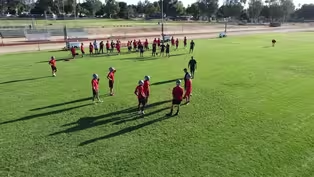
Book chronicles deaf football team's rise to state champions
Video has Closed Captions
'The Boys of Riverside' chronicles school for the deaf's rise to state football champions (8m 24s)
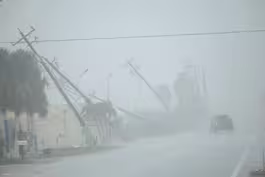
Florida braced for brutal impact from Hurricane Milton
Video has Closed Captions
Florida braced for brutal impact from Hurricane Milton (7m 47s)
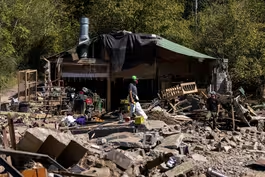
Greg Biffle becomes rescue pilot in Helene's aftermath
Video has Closed Captions
NASCAR driver Greg Biffle becomes rescue pilot in Helene's aftermath (5m 11s)
Harris, Trump focus on Arizona as early voting starts there
Video has Closed Captions
Harris and Trump focus on Arizona as early voting starts there (3m 7s)
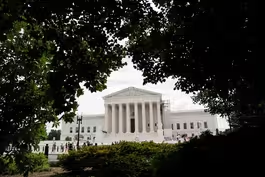
How an Oklahoma death penalty case reached the Supreme Court
Video has Closed Captions
How an Oklahoma death penalty case reached the Supreme Court (3m 52s)
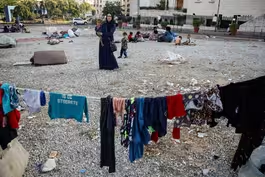
Lebanon's civilians in dire need amid Israel-Hezbollah fight
Video has Closed Captions
More civilians in Lebanon displaced and in dire need amid Israel's battle with Hezbollah (5m 45s)
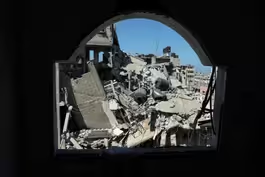
News Wrap: Dozens killed by Israeli strikes in Gaza
Video has Closed Captions
News Wrap: Dozens killed by Israeli strikes in Gaza (5m 1s)
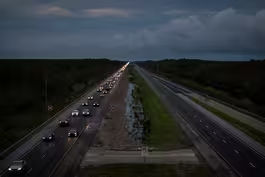
St. Petersburg mayor on threat of catastrophic storm surge
Video has Closed Captions
St. Petersburg mayor discusses threat of catastrophic and historic storm surge from Milton (5m 43s)

This county voted for every presidential winner since 1980
Video has Closed Captions
Only one county has voted for the winner of every presidential election since 1980 (3m 51s)
Providing Support for PBS.org
Learn Moreabout PBS online sponsorship
- News and Public Affairs

Today's top journalists discuss Washington's current political events and public affairs.

- News and Public Affairs

FRONTLINE is investigative journalism that questions, explains and changes our world.












Support for PBS provided by:
Major corporate funding for the PBS News Hour is provided by BDO, BNSF, Consumer Cellular, American Cruise Lines, and Raymond James. Funding for the PBS NewsHour Weekend is provided by...