
October 9, 2025
Season 4 Episode 74 | 26m 29sVideo has Closed Captions
A firm is pushing Kentucky lawmakers for more social media guardrails to protect kids.
A conservative Christian firm wants more social media guardrails to protect Kentucky kids, a Kentucky court backs a state law keeping convicted felons from having guns, KSP continues to investigate threats made to the Kentucky Parole Board, Amy McGrath discusses why she's running again for U.S. Senate, and a soybean farmer pleads for the U.S. to reach a trade deal with China.
Problems playing video? | Closed Captioning Feedback
Problems playing video? | Closed Captioning Feedback
Kentucky Edition is a local public television program presented by KET
October 9, 2025
Season 4 Episode 74 | 26m 29sVideo has Closed Captions
A conservative Christian firm wants more social media guardrails to protect Kentucky kids, a Kentucky court backs a state law keeping convicted felons from having guns, KSP continues to investigate threats made to the Kentucky Parole Board, Amy McGrath discusses why she's running again for U.S. Senate, and a soybean farmer pleads for the U.S. to reach a trade deal with China.
Problems playing video? | Closed Captioning Feedback
How to Watch Kentucky Edition
Kentucky Edition is available to stream on pbs.org and the free PBS App, available on iPhone, Apple TV, Android TV, Android smartphones, Amazon Fire TV, Amazon Fire Tablet, Roku, Samsung Smart TV, and Vizio.
Providing Support for PBS.org
Learn Moreabout PBS online sponsorship>> Look, I'm battle tested.
I'm somebody who's been in the arena not only from the battlefield in Afghanistan and Iraq, but also in the political battlefield.
>> Amy McGrath talks about why she's running for the U.S.
Senate again.
>> There's very dire economic circumstances that are facing our farm families across this country.
>> We go one on one with the president of the American Soybean Association.
How trade tensions with China are impacting Kentucky farmers.
>> People need to know that that's the way they travel.
150 years ago.
>> And we'll go back in time to explore river travel of the past and see how northern Kentuckians are keeping the tradition alive.
>> Production of Kentucky Edition is made possible in part by the KET Millennium Fund.
>> Good evening and welcome to Kentucky Edition for this Thursday, October 9th, I'm Christi Denton in our Louisville studio, filling in for Renee Shaw.
She'll be back tomorrow.
Thanks so much for joining us.
A conservative Christian law firm wants more social media guardrails to protect Kentucky kids.
So the firm is pushing a plan, giving parents more power to control what a child sees and how long the child can spend online.
Supporters made their case today to members of the Kentucky General Assembly's AI task force.
Our John Loeffler has more in tonight's legislative update.
>> A national group is working with a Nicholasville Republican on a social media bill.
The two testified before Kentucky's artificial intelligence task force today.
>> Even neutral content has a harmful impact on our youth, and that's because of the actual design of social media itself.
It is designed to be addictive.
>> The Alliance Defending Freedom is best known for its work at the U.S.
Supreme Court.
Successfully representing a wedding cake maker and a web designer who both refused to work with gay clients.
The group occasionally appears in Frankfort advocating for religious liberty legislation.
Now it is proposing state rules to limit what Kentucky's kids can see on social media based on parent preferences.
>> Where the parent can control time online, the type of content there's parameters and limitations, and the child's account is automatically set to the most private default setting you can have on the social media platform.
And then finally, it removes the ability to commoditize children's data in this this addictive arms race that we're in.
They cannot advertise to children.
>> State Representative Matthew Lockett successfully passed a bipartisan bill in 2024 to restrict kids from accessing pornography.
It required adult sites to verify a user's age with their ID.
The site Pornhub ultimately cut off access to Kentucky and other states altogether because of such laws.
>> The goal of this legislation is to protect our children from addictive natures of social media.
So the websites such as TikTok, Facebook, those, those types of things where there is infinite scrolling, where there is ads directed at children because we do know the harmful effects of social media on kids that is documented.
>> Some lawmakers suggest their kids are victim to lax age restrictions.
>> Last year, I did an informal survey of my seventh grade son's class, and more than half the boys had gambling apps that they were using on on their phones.
>> You know, when Charlie Kirk was shot, my son saw that video that day, even though his his phone set up.
YouTube knows he's he's 13 years old.
All the parental controls are enabled.
He saw, you know, him take a bullet to the neck and it affected him.
>> Full model legislation was not presented at this meeting.
The Alliance Defending Freedom did not say if it's pushing similar legislation in other states.
For Kentucky edition, I'm John Loeffler.
>> The Kentucky Court of appeals backs a Kentucky law keeping convicted felons from having firearms.
In March of 2024, a Jefferson County circuit judge ruled against Kentucky's law and said felons have the second right to own guns.
The original case involved Jaquori Lamont Frazier.
Frazier had previously been convicted of drug trafficking and fraudulent use of a credit card, and prosecutors wanted to charge him with having a firearm.
Attorney General Russell Coleman and the Jefferson County Commonwealth's Attorney appealed the court's decision, and this week the Court of Appeals overturned that decision.
Coleman said we can support the Second Amendment and still have laws keeping felons from having deadly weapons.
No arrests yet as Kentucky State Police continue investigating threats made to members of the Kentucky Parole Board.
Governor Andy Beshear says existing state law required the recent release of Ronald Xantus, the man who killed six year old Logan Tipton in Versailles in 2015.
He says the parole board opposed releasing Xantus.
>> If you are calling and leaving one of these racist, violent messages for our parole board members, they were trying to do what you wanted them to do.
They made the decision the way that you claim that they should have.
And the only there's just no acceptable.
Reason to ever threaten another human being with violence.
And these people do a hard job on the parole board.
They shouldn't be subject to, to to these types of threats being made at them.
>> Governor Beshear says he's open to working with the Kentucky General Assembly to change the law that caused Xantus to be released.
Well, earlier this week, Marine Corps veteran Amy McGrath entered the 2026 race for the U.S.
Senate in Kentucky.
She ran for the U.S.
House in 2018 and the U.S.
Senate in 2020.
She told WKYT's Renee Shaw earlier this week she's driven by her desire to serve her country and to stand up to President Donald Trump.
>> What are Democrats missing, in your view, and why are you the person that can help them pivot to be more persuasive about what you believe is right for the country?
>> Yeah, and I also think it's important to note, though, that Mitch McConnell had all that dark money.
Tons.
And that's really important.
And we got to tackle that in our country number one.
But from the perspective of of this race, it's all about Kentuckians.
And so when I think about Democrats and what we need to do to rebuild, let's focus on what people care about what is happening right now.
You know, a lot of people in Kentucky voted for this administration and Republicans in office to make their lives better, to lower prices, to tackle inflation.
And what have we seen?
They've gotten into office.
And not only have they not done that, they've made it worse.
Renee.
They made it worse with these tariffs, which are attacks on you and me and attacks on our businesses, the bourbon industry, our farmers, our auto industry, you name it, and our pocketbooks.
And then you add that with this bill that they passed this summer, okay, this big, beautiful, whatever you want to call it, bill.
Well, what does that do?
It is the worst bill in my lifetime for Kentucky.
The worst?
Why?
Because it throws Kentuckians off of their health care.
It's going to make our premiums go up for those of us on connect.
And it's it's we have 35 rural hospitals that are now at risk of closing.
That's not what Kentuckians voted for, but that's what we're getting.
Okay.
And so my belief is that we all have to focus on Kentuckians, because here's the thing.
These guys in office right now, they know this stuff is bad.
They know it's bad for Kentucky.
And they voted for it anyway.
Why?
Because they're fearful of one man.
Okay.
And that's not me.
And I think that's where we need to focus on is everyday Kentuckians.
>> Why are you better and different and more prepared now than you were in 2020?
What are we going to see differently from the Amy McGrath campaign this time around that we didn't five years ago?
>> Well, I think the climate is different again.
I think that people of Kentucky and I hear this from my neighbors, I hear this from people I talk to who are Trump voters, who have said, look, enough is enough.
You know, he's he's gone too far and there's nobody there to check him.
There's nobody there looking in our interests, in Kentuckians interests.
And so to me, that's what I'm focused on.
And I think, you know, this is a really good opportunity right now because as I mentioned before, Kentuckians have been able to vote for somebody who, you know, whether they have a red jersey or a blue jersey for for the best candidate.
And I'll say something about the primary candidates.
And it's very interesting distinction here.
The primary candidates in this race, all on the on the Democratic side, have all served their country.
They're not lifelong politicians.
They didn't grow up within a political party.
CIA, Secret Service, Air Force, Marine Corps folks on the other side.
They're all Mitch McConnell's interns.
They all grew up within the party.
And politics is their thing.
And I think, you know, a lot of a lot of Kentuckians should, should take note of that, because it is a very big distinction.
>> Yeah.
To that point, and you think about Colonel Stevenson and others who, as you just mentioned, have pretty deep military backgrounds and credentials.
Why are you any different?
Aren't you all going to be singing from the same hymnal?
And would it not be better, as you have been doing in the last 4 to 5 years, putting your support behind other Democratic candidates?
>> Well, I'll tell you, I haven't really been focused too much on my primary opponents campaigns.
But I can say this.
Look, I'm battle tested.
I'm somebody who's been in the arena not only from the battlefield in Afghanistan and Iraq, but also in the political battlefield.
I have gone up against Washington insiders, and I have gone up against Mitch McConnell.
And, you know, some I think it's really important to have somebody who can build a grassroots operation, which we've built in the past, the largest Kentucky has ever seen.
And somebody who's been able to go toe to toe with these Washington insiders.
And here's the thing.
At the end of the day.
You I think what what people really desire is somebody who has the courage to just stand up for them.
We're so tired of the political back and forth of of oh, you're you're, you know, just following the party leadership.
That's not me.
There's nobody in Washington that that tells me what to be or how to be.
I'm just who I am.
Somebody who loves this country.
Somebody who loves Kentucky, you know?
And that's, I think, what we all want from our public servants.
>> You've probably heard the question before about did you decide to do this on your own, or were you coaxed into doing it because of national political leaders or those who are already in Washington who said, we'll get behind you.
We'll put the money behind you.
We want you.
Or did you say, this is my time, I'm going to do it?
Or were you coaxed into it?
>> I'll let you in on a little that a lot of people don't know about politics.
First of all, there's no party leaders that gives you anything in a state like Kentucky, okay?
And you go out and you have your campaign.
Campaign.
You rely on Americans and Kentuckians to power that campaign.
No party does that.
And in this case, you know who encouraged me?
>> Who?
>> My son.
My 13 year old son.
>> Why?
And what did he say to convince you?
>> He said, mom, you know what you believe.
And right now.
I think we need people to stand up.
And you can do this.
You've done it before.
And I looked at him and I said, you know, my son Teddy is really the only one who who truly remembers the campaigns because my my kids were tiny when Teddy was old enough.
And for him to say that to me, that was a pretty big deal.
And my husband was a part of it, too, who said, you know, we need better leaders.
You've always said that you ran way back in 2018 because you needed.
We need better leaders in this country now, Renee.
Are things better?
They're not better.
We still need leaders in this country.
And I would say things are actually worse.
>> Some people would wonder, where have you been the last few years?
Did you go?
Crickets in radio, silent.
And then you want to come back and go on the national Washington scene?
What have you been doing these last few years?
>> Well, I haven't been silent.
And anybody that's been following me.
But no, I haven't been silent.
I've been out there speaking out on a range of issues, but also doing a lot behind the scenes to help other candidates around the country.
Pro-democracy candidates.
This is one of the things that that my campaign helped with.
You know, we we we may have have not won the race in Kentucky, but we put our assets to the Georgia Senate races in 2020.
And then we raised a ton of money to help pro-democracy candidates for secretary of states around the country.
So those are really important, very big projects that I took on in the last 4 or 5 years, along with veterans advocacy and post 911 veterans groups that I'm in.
And being a mom, you know, I have I have been the softball coach, the baseball coach, the soccer coach, and really been there for my kids.
So it's been really fun.
>> That was part two of Renee's interview with Amy McGrath.
See part one from yesterday's Kentucky edition at ket.org.
Now to continuing coverage on the plight of soybean farmers as trade talks continue between the U.S.
and China.
A national advocate lives right here in Kentucky.
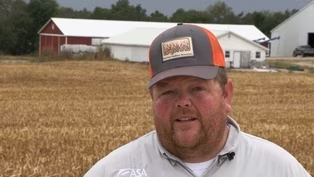
Caleb Ragland is president of the American Soybean Association and has recently become a fixture on national news, pleading his case for the U.S.
to reach a swift trade deal with China.
Our Laura Rogers spent some time with Ragland on his LaRue County farm.
>> Soybeans are the largest agricultural export from the United States.
>> And China is our biggest customer.
>> China historically has purchased more soybeans than all other export customers combined.
>> But that's come to a grinding halt.
There have been no U.S.
soybean sales to China since May, with none currently on the books.
>> That is a concerning trend long term, because you don't just snap your fingers and replace that large of a customer.
>> Because of tariffs, American soybeans are no longer price competitive compared to South American countries like Brazil and Argentina.
>> Would be.
Unlike.
If you have the opportunity to fill your car with gas for $3 over here, or you can go across the street for 250 and it's pretty similar product, you're probably going to go for the cheaper price every time.
>> Caleb Ragland of Magnolia raises 1200 acres of soybeans.
Hill harvest in the next couple of weeks.
>> It's alarming when we should have had sales starting in August and here it is October.
We still don't have any sales.
We go very much longer and we bypassed our window of opportunity.
>> He says.
Every day that goes by without a trade deal poses concern for both short and long term implications.
>> And as a soybean farmer, I absolutely am concerned about permanent loss of the Chinese market to the Brazilians.
>> Ragland says the Chinese market is critical.
They consume 61% of the world's soy among both their people and livestock, representing a large economic impact for the 500,000 soybean farmers in the United States.
>> We're very good as U.S.
soybean farmers at producing quality soybean for economical price.
We just we need the markets and we need the opportunities to sell them.
>> The Trump administration says it plans to announce an aid package for soybean farmers, hard hit by the Chinese boycott.
Ragland says while it may be necessary, it's not ideal.
>> We don't need to be in a position where we need the government to come and bail out the market or to fix it.
We just simply need the government to stay out of the way.
>> But Ragland says he fears soybean farmers are, quote, falling on the sword for the greater good.
>> Our government is well aware of our plight.
Unfortunately, nothing has been done yet because I think that, quite frankly, we are the sacrificial lamb, along with other industries and so forth in this trade war.
>> As president of the American Soybean Association, Caleb Ragland cites economists who say the average soybean crop will lose $109 an acre this year.
>> There's about 83 million acres of soybeans, so you get into some big numbers there at over $100 an acre of economic loss.
>> It comes at a time when there are already economic hardships for farmers, like inflationary concerns.
Ragland hoping better times are ahead.
>> The American farmer is the best in the world.
If you don't do things to hold us back, to build artificial walls, to build barriers that hurt us and make us uncompetitive, we're going to do well.
>> For Kentucky Edition.
I'm Laura Rogers.
>> Thank you Laura.
Another sector of the economy is also feeling the impact of trade tensions.
A new report says exports of spirits that includes bourbon fell by 9% during the second quarter of 2025.
But in some key markets it's much worse.
We talked about that today with Janet Patton, a business reporter for the Lexington Herald Leader, who says there are other signs that Kentucky's $9 billion bourbon industry is on the rocks.
>> So right now, I think through April, exports are down about 13% for American whiskey globally.
But to Canada, it's as high as 85%.
And that's already cost companies here, more than $40 million.
Even knowing what I knew about Canada, I was really surprised at the big drop because, you know, Canada has been such a strong market for such a long time.
And so I think to see that hold for months, that boycott going on for months with no end in sight, has got to be pretty distressing for a lot of a lot of whiskey makers, because that's one of the biggest export markets for Kentucky bourbon and American whiskey.
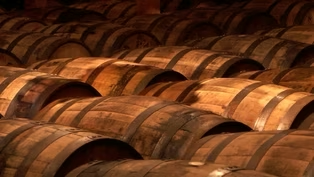
The Kentucky Distillers Association just released a report that the state had 16.1 million barrels of bourbon as of the first of the year.
That's a record high for Kentucky.
And I think inventory around the US is also at an all time high.
That's a problem for Kentucky and all spirits makers, but particularly for Kentucky, because we've been on a really big building boom here right now.
There's a lot of evidence that the market for what they call new make, you know, barrels that would be filled, new is frozen.
That was the term that they used in the Kentucky Owl bankruptcy case.
The judge there said that expert testimony convinced him that the market was so dismal that he could not sign off on a plan to let Kentucky Owl and Stoli Group pay off more than 70 million in bankruptcy debt with whiskey barrels.
That's what they wanted to do.
They wanted to basically trade 35,000 barrels and some other assets for this debt that they owed to Fifth Third Bank and Fifth Third Bank said, we'll never get our money back out of that.
And the judge has agreed with that kind of alarm bells going off.
I think the industry has begun to pull back in a big way.
Whiskey production has slowed down.
It actually began to slow late last year, but now it's it's dropped considerably.
But the really disturbing thing is that even as that production has slowed down, demand has continued to drop.
Bottling has fallen, but not as much as there's still there's still a big lag.
So we're going to be looking at this massive overhang of excess supply for some time.
>> Nearly every state exports distilled spirits.
Last year, Kentucky exported more than $750 million worth of distilled spirits, second in the country, behind Tennessee.
Last night we told you about America's River Roots Festival, which is taking place in Northern Kentucky this week.
Well, tonight we'll give you some history on a centuries old travel method.
The steamboat, our Emily Sisk takes us to the river to learn more about the vessel.
>> Before steamboats, you either rode a horse or walked.
>> Before the railroad, and certainly before airplanes.
Steamboats were how people and goods moved across the world.
That was especially true along the Ohio River in cities like Newport, where steamboats allowed for commerce and settlement.
>> Steam engines became important to the communities.
And then you got commerce and then the staples of our community, Bourbon and beer started to travel up and down river all the way to New Orleans.
>> But as times have changed, how important is the steamboat today?
Captain Alan Bernstein, who owns BB Riverboats in Newport, said gas and diesel engines have taken over the riverboat industry.
But preserving steamboats is a way to honor America's history.
>> The steamboat is not the important part today.
It's a history part of today, and people need to know that that's the way they traveled 150 years ago.
>> That's one of the hallmarks of the America's River Roots Festival, which is currently ongoing in Newport and Cincinnati in celebration of the United States 250th birthday.
One of the highlights of the festival will pay tribute to the history of the steamboat.
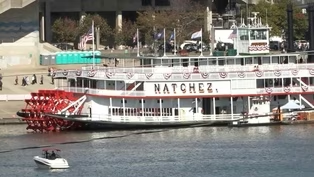
>> The only two steamboats on the river left in commercial operation, the Natchez from New Orleans and the Belle of Louisville.
They will race on Sunday.
>> Captain Bernstein said steamboat racing was a major event in the late 1800s.
The festival organizers hope to reenact the old time sport for a new generation to see.
>> It is the slowest two minutes in sports, but it is so much fun to see.
>> This is the only city in America that this takes place.
>> As for BB riverboats, the Northern Kentucky Company, which has been in operation for more than 40 years, they're keeping the riverboat tradition alive with daily cruises along the Ohio River.
Bernstein said.
The company has become a mainstay of Northern Kentucky and Cincinnati tourism, and he said nothing beats the view from the Ohio.
>> When it comes to river travel and what to see on the river.
Downtown Cincinnati and now Newport is all growing up around the river.
>> For Kentucky edition, I'm Emily Sisk.
>> Thank you Emily.
As part of the River Roots Festival, attendees can book a cruise on a historic boat.
And just so you know, the Belle of Louisville is the oldest operating steamboat of its kind.
It was built in 1914.
Well, we hope that you will join us again tomorrow night at 630 eastern, 530 central for Kentucky Edition, where we inform, connect and inspire.
You can find Kentucky Edition on the PBS video app and on your mobile device and smart TV, and send us a story idea at Public affairs@ket.org.
That's
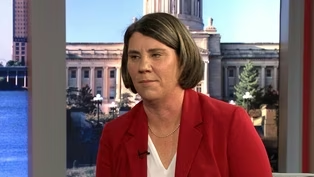
Amy McGrath on Why She's Running Again for U.S. Senate
Video has Closed Captions
Clip: S4 Ep74 | 8m 45s | Amy McGrath talks with KET's Renee Shaw about why she's running for the U.S. Senate again. (8m 45s)

Christian Firm Wants More Social Media Guardrails
Video has Closed Captions
Clip: S4 Ep74 | 3m 7s | Firm is pushing Kentucky lawmakers for more social media guardrails to protect kids. (3m 7s)
Video has Closed Captions
Clip: S4 Ep74 | 3m 3s | Exploring the history of one of the oldest methods of transportation. (3m 3s)
Report Find Spirits Sales Falling
Video has Closed Captions
Clip: S4 Ep74 | 4m 3s | Exports of spirits, including bourbon, down by 9%. (4m 3s)
Soybean Farmer Pleads for U.S.-China Trade Deal
Video has Closed Captions
Clip: S4 Ep74 | 3m 36s | President of American Soybean Association urging U.S. to make trade deal with China. (3m 36s)
Providing Support for PBS.org
Learn Moreabout PBS online sponsorship
- News and Public Affairs

Top journalists deliver compelling original analysis of the hour's headlines.

- News and Public Affairs

FRONTLINE is investigative journalism that questions, explains and changes our world.












Support for PBS provided by:
Kentucky Edition is a local public television program presented by KET