
October 9, 2026
10/9/2026 | 55m 39sVideo has Closed Captions
Alex Gibney; Evan Gershkovich; Kamilah Woodson
Alex Gibney, director of “MUSK,” examines Elon Musk’s return to Washington to lead Project Meridian after a falling out with Pres. Trump. Evan Gershkovich, author of “This Cursed Beautiful Land,” reflects on Russia and his 16 months in prison. Howard University psychologist Kamilah Woodson discusses a white teacher who claimed to be Black and Palestinian, and what it reveals about racial identity.
Problems playing video? | Closed Captioning Feedback
Problems playing video? | Closed Captioning Feedback
October 9, 2026
10/9/2026 | 55m 39sVideo has Closed Captions
Alex Gibney, director of “MUSK,” examines Elon Musk’s return to Washington to lead Project Meridian after a falling out with Pres. Trump. Evan Gershkovich, author of “This Cursed Beautiful Land,” reflects on Russia and his 16 months in prison. Howard University psychologist Kamilah Woodson discusses a white teacher who claimed to be Black and Palestinian, and what it reveals about racial identity.
Problems playing video? | Closed Captioning Feedback
Where to Watch Amanpour and Company
Amanpour and Company is available to stream on pbs.org and the PBS app.
Watch Amanpour and Company on PBS
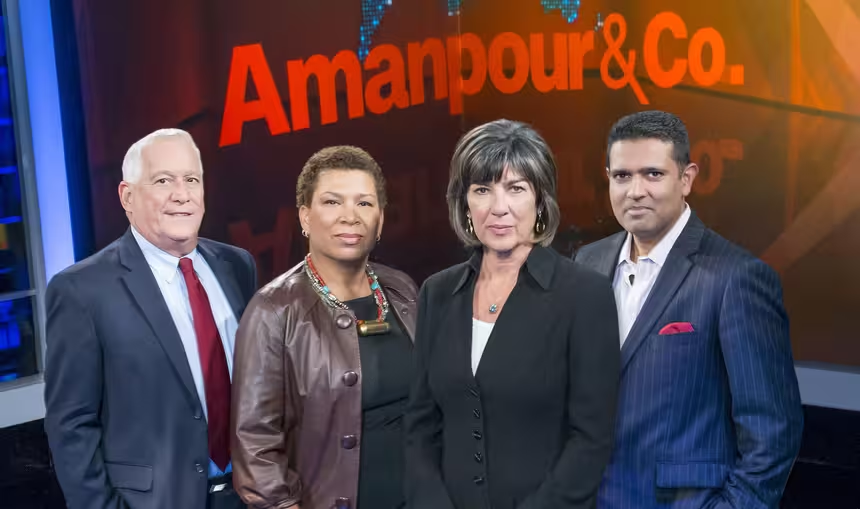
PBS and WNET, in collaboration with CNN, launched Amanpour and Company in September 2018. The series features wide-ranging, in-depth conversations with global thought leaders and cultural influencers on issues impacting the world each day, from politics, business, technology and arts, to science and sports.Providing Support for PBS.org
Learn Moreabout PBS online sponsorshipHello everyone and welcome to Amanpour & Co.
Here's what's coming up.
The idea of Elon Musk in charge of the future of war is a terrifying prospect.
As Trump ties U.S.
national security more closely to artificial intelligence, a look at the man who's making that vision a reality with director Alex Gibney.
He joins me about his controversial new documentary on the world's richest man, Musk.
Then... From that point, I think, "Oh my God, they think I'm a spy."
Wall Street Journal correspondent Evan Gershkovitz tells me about the fear, the tough lessons, and the drive to keep reporting after spending 16 months in a Russian jail when he was falsely accused of spying for the United States.
There was a violation of trust.
The complex power of racial identity in America, Michelle Martin speaks to psychologist Kamilah Woodson about the rare times when cultural belonging becomes deception.
Amanpour & Co.
is made possible by committed to bridging cultural differences in our communities, and by contributions to your PBS station from viewers like you.
Thank you.
Welcome to the program, everyone.
I'm Christiane Amanpour in London.
Alarm bells are ringing in Washington and the Pentagon after U.S.
Secretary of Defense Pete Exet tapped tech billionaire Elon Musk to help lead "Project Meridian," a new Pentagon commission mapping the future of warfare, including automated and AI weaponry.
It is a remarkable turn of events for Musk, coming just a year after his chaotic and highly destructive attempts to cut government spending at Doge and his very public falling out with President Trump.
Indeed, just yesterday, Musk was back to receive a National Medal of Science from the President.
So how has he negotiated this return to favor?
Director Alex Gibney seeks to answer that very question.
And what motivates Musk in his new film, which is called Musk, a look at the tech mogul's rise and accumulation of power.
Here's a short clip.
He's possibly the greatest living inventor.
He's one of the greatest builders of all time.
The greatest capitalist in history.
He's chaotic, random, capricious.
He's chaotic, random, capricious, manifestly cruel and selfish.
In a science fiction novel, he would not be the hero.
So a mixed bag then is Musk.
When we spoke with Alex Gibney, he told me about delving into Musk's psyche and why he says it's a punishing place to be.
Alex Gibney, welcome back to our program.
Yet another timely and very incisive portrait of a person in power who is so visible in the United States and around the world.
As we know, Elon Musk.
You said when you went into making this movie, you set out to solve a mystery.
You say, you know, how has Elon Musk assumed so much power and why have we allowed him to amass so much power?
Were you able to crack that case, Alex?
I think I was, in the sense that I found something about Elon Musk's character that I think was terribly important.
But in terms of the latter question, I think what I learned was that Elon Musk was extraordinarily gifted at manipulating the flaws in our political and economic systems.
And that's what's given him the kind of outrageous power that he now commands.
Based on what you just said, you interviewed Ashley St.
Clair.
She's a former conservative influencer who has a child with Musk.
He has about 14, as far as we know, with various partners.
Here's a clip of Ashley.
If you were to ask someone on the right what they think of Elon, he's a free speech god.
He's just someone who sends hateful tweets and he's lost his mind.
Both are very comforting, but both are completely insufficient to be immense amount of power and influence he has.
It's really interesting to hear somebody that close to him say that.
And she goes on to ask, "Do we know his goals?
Do we know his motivations?
Do we even know the man at all?"
In all the time you spent on this four-hour movie, and it must have taken a lot of research, a lot of time to put together, do you feel you can answer those questions?
well i think the disturbing thing may be that on the one hand we do know his goal or his sort of pragmatic goals his pragmatic goals were to amass an extraordinary amount of power uh... he started out with a mission uh... kind of two-fold mission one he wanted to make uh... our civilization multi-planetary and he also wanted to help solve the climate crisis by helming a car company called Tesla.
And those missions were very powerful in terms of building two big companies.
But since then, he's amassed more power than we could possibly imagine, not only with his business as he's the richest man in the world, but also through his alliance with Donald Trump.
The disturbing part of his story and his character is that for all his ambition and all his confidence and all his ability to make the unreal real for a fantastic profit, I'm not sure he knows what his actual goals are.
Maybe one of the most disturbing moments in the film is when somebody asks him, "You've got Starlink, you've got Tesla, you've got SpaceX, XAI, you're in AI, why?
What are you doing this for?"
And the remarkable thing is he can't answer the question.
There's about a two-minute moment where he stumbles.
He literally can't answer the question of why.
And that may be the most disquieting thing of all.
So that is really interesting.
You talked about trying to make us an interplanetary species, but also trying to help the climate crisis.
That second one is a very noble goal.
And he did create Tesla, which became an enormously popular car.
And he was very prescient about it.
I guess the first in the United States to come up with that kind of EV car.
It's not that simple though.
You're speaking here to Martin Eberhard, whose name is actually on the Tesla Incorporation papers, about how all this started.
Let's take a listen.
When Musk fired Eberhard, Musk refused to pay him what he claimed he was owed.
A lawsuit followed, and it was settled only when Musk was able to claim that he was what he wasn't, a founder of Tesla.
What I learned in that process is there's no legal definition of founder.
You can call yourself a founder, there's nothing illegal about that.
Sure.
Why not?
You should be.
You'd be a good founder.
I think it's telling because, you know, we can admit that most CEOs are credit grabbers, okay?
But to go to the extent of not settling a lawsuit until somebody will actually invest in a lie, that is to say that Elon Musk was a founder of Tesla, is really interesting.
it speaks to the creation of a kind of character that Musk wanted to be and that character, particularly in the sort of political economy of Silicon Valley, is the founder the founder who is both an inventor and an investor in fact he was only an investor but to be thought of as the founder has economic ramifications too both for him personally and also for his ability to kind of cast himself as this larger-than-life character so that even if the economic fundamentals of his companies didn't justify a big stock boost, investing in Elon and the figure of Elon and what he's going to do for us in the future, that was the key to the financial success of Tesla.
I mean you know that is kind of revealing though because most people as you say would have assumed that he was in every way not just an investor but a founder you know the innovator etc now he calls your movie as you know a hit piece boring saying dog do is worth more respect he has not seen the film his lawyer threatens to sue you for defamation does that concern you because again this is a very powerful person with very I assume armies of lawyers and very rich able to really I guess influence you, the film, potentially even the distribution.
Tell me have you felt any of that kind of pressure?
I certainly have and I'd be a fool not to.
I mean, he's the world's richest man.
As we know, you know, in court, money matters.
And so I'd be foolish not to consider those threats seriously.
At the same time, you know, I find it rich in a different context than ironic that the man who fashions himself a free speech absolutist would threaten to sue over a film that he hasn't even seen.
I would think he'd welcome the debate, but that apparently is not the case.
So I'm a realist and I'm concerned about that possibility, but at the same time, something I learned long ago when I did a film about Henry Kissinger that was critical, which is that when somebody like Kissinger or Musk sues you, they open themselves up to something called discovery.
And I can tell you that if he were to sue me, I'd be delighted to engage in discovery of Elon Musk.
Particularly all those emails around the data that he had access to while he was at Doge.
Did Universal delay the distribution or is that all sort of idle Hollywood chit-chat?
I don't think it was idle Hollywood chit-chat.
There was a time when we were flummoxed that Universal wasn't engaging.
Something was going on there.
But we have had recent conversations and now they seem firm in the faith and are going to distribute the film internationally.
And Bleaker Street is going to release it here theatrically.
And we're told that HBO, even after the recent takeover by Paramount, is going to show the film in January.
The thing, the shadow over this though, is that I remember when we released our trailer, we tried to place ads for our trailer on YouTube, on Meta, on TikTok, and also on X. And those ads were initially refused.
And then even after appeal, they were refused again.
It was only by making it public that YouTube and Meta relented.
And that, I think, gives us a sense of what this kind of media consolidation landscape represents for freedom of speech.
You know, it's being curtailed.
You know, you start the film by, you know, a lot of his achievements and they have been pretty big.
And you say a lot of this that we're talking about right now, essentially, COVID was the place and the time when you say a switch got flipped in his brain.
What do you mean by that?
How did he change?
Well, I think what happened was he was beginning to create a lot of power But also he saw a moment I think in kovat where Tesla might have certain advantages because of its production capacity in the United States He didn't have trouble with supply chain and so forth and suddenly there were constraints on his power because the state, and this is early in COVID, when bodies were piling up in morgues in New York City, because the state was trying to keep workers safe.
Well that wasn't interesting to Elon Musk and he bristled at the idea that there would be any slowdown at his factory even though really all he had to do was engage in dialogue with the state and so he became, he went rogue and started to declare that the state of California was fascist for trying to, you know, put in rules that might safeguard the health of workers and it was at that moment you can begin to see his turn to the right he goes to Texas where it's a lot easier to engage in pay-to-play and begins a rightward turn that ultimately ends up with the embrace of Donald Trump and indeed let's not forget the 275 million investment dollar investment in the Trump campaign that paid off and he got rewarded with a I guess it's a cabinet position or not but it was Doge and his task was to essentially hack through the federal government and the bureaucracy and the administration of much of American life.
How does that going rogue around COVID do you think play into how he executed the Doge mandate?
Well I think ultimately he begins, as he bristles more and more over any constraints on his power, he begins to act more erratically and more spasmodically.
And I think actually the replay action with Doge is a replay of what he did at Twitter, where he went into Twitter when he acquired it and summarily fired 80% of the workforce.
but he often fired a lot of people who happened to be absolutely vital in terms of keeping the system running.
He never bothered to check.
And so that kind of essential arrogance and stupidity was replayed at Doge.
But I would like to point out something about Doge, though.
You know, it was allegedly about waste, fraud, and abuse.
I don't think that's what it was about for Musk at all.
I think it was about destroying the regulatory state writ large, and also providing for him and other big tech executives to do whatever they wanted with artificial intelligence.
There's one other thing that I think is terribly important too, is that I think he was motivated to get behind Trump because he was facing a number of civil investigations into his business and one criminal investigation that might have landed him in prison.
Once Trump was elected and the Department of Justice became the Department of Revenge, suddenly all of those investigations went away.
Yes, and also, didn't a lot of inspectors general get fired?
In other words, I guess the people who would investigate a lot of these issues.
And a government accounting office report notes that 96% of Doge reported savings can't be verified.
So this is all areas of interest that you explore in this.
But after having a split with Trump, then he's back now.
And apparently he's inside the administration at the Pentagon.
Secretary Hegseth has appointed him to quote "map the future of warfare" for a project that's called Project Meridian.
What on earth is this?
I have no idea and I'm not sure Pete Hegseth knows either.
But the idea of Elon Musk in charge of the future of war is a terrifying prospect.
I mean his AI system, XAI, is one of the most reckless frontier AI companies that exists.
And I think you have to see in this something interesting.
On the one hand, he's being given this title to dig into the future of war, because Musk is all about the future, and he's become a kind of meme about this kind of future inventor, which I think is false.
But more importantly, maybe for Musk, is this is a kind of bailout of XAI.
And in that sense, I think the corruption that Musk represents and his ability to understand and exploit the flaws in our political system is that you get what you pay for.
He puts Trump in power.
Now he gets back all sorts of goodies from our taxpayer dollars in order to be able to enrich himself and his businesses.
It's Putin-esque corruption.
When you ended and finished with this and put this all together and you attract the story of Elon Musk from when he was a kid, a youngster, to now, do you think and synthesize how he was as a young person and how he is now?
Do you sort of ask yourself or recall the good side?
Yes.
I mean I think you know I think Elon Musk to some extent is a character who fell victim to what I would call noble cause corruption.
He did have noble causes.
I mean the idea of you know working to solve climate change with an electric car.
Even the space program.
I mean you could argue that in many ways SpaceX saved or at least made reasonably efficient a space program that had become horribly bloated.
And to see those reusable rockets launch and land is an inspirational sight.
But at the same time, over time, he kept cutting corners.
He kept telling more and more fabulous fictions about himself and his businesses in ways that would ultimately have a terrible cost, because he felt at the end justified the means.
Noble cause corruption is like the cop on the block who senses extortion, and so he plants drugs in the perp's pocket, and then he can arrest him.
But that has a way of spinning out so that ultimately you become utterly corrupt.
And now the guy who was championing a solution for global climate change is now endorsed the man whose central slogan was "Drill, baby, drill," and is doing more to destroy the planet than anybody on planet Earth.
So you wonder how that corruption takes place.
It started, I think, from a pure place and ended up somewhere very bad.
Just that arc, personal arc, is just so fascinating.
In those four hours that you present all of this evidence in that unique filmmaking way that you do, it's really interesting and important.
Alex Gibney, thank you so much indeed.
Thank you, Christiane.
Always a pleasure.
And the Gibney Doc.
Musk is in New York and LA theaters now, and it'll be in cinemas nationwide next weekend.
Global calls for transparency after a researcher at a Russian anti-plague lab fell ill and died in undisclosed circumstances this week.
More than 200 people in the area were quarantined, but huge questions remain over the cause of death and the authorities response.
Wall Street Journal correspondent Evan Gershkovich has spent years reporting on the murky world that Putin runs, including from inside his prison system.
Gershkovich was famously arrested in 2023 on trumped-up charges of spying and he spent 16 months in Moscow's notorious Lefortovo jail.
He recounts that experience in a new memoir, "This Cursed, Beautiful Land."
And when we spoke, he told me what he learned behind bars about the Russian system's inner workings.
Evan Gershkovich, welcome to our program.
How much did you know about the country you were going to?
What was it about Russia that made you want to go there?
- So I grew up in a Russian speaking family.
My parents both left the Soviet Union in 1979.
My sister and I both had Russian names at home.
We watched Soviet cartoons and movies and ate Russian food, but we'd only visited once.
And I was actually a news assistant at the New York Times in New York, hoping to work my way up when colleagues of mine who had also worked in Moscow before kind of come up there as foreign correspondents that moved back home said, "Well, you speak Russian.
You might as well use that to your advantage."
So I moved in essentially on a whim.
Until that time when you were now a full-fledged reporter for the Wall Street Journal.
It was after, about a year after I think, of the full-scale Russian invasion.
You were doing your job and I think you were trying to find out more about the military aspect of this and you had a source, at least you thought you had a source, and you traveled 900 miles out of Moscow to Yekaterinburg and you met Pavel in a steakhouse.
So I'm going to ask you to read that very evocative first sort of chapter of this particular story.
Sure.
I was jotting down my own notes from the papers when I heard the sound of marching feet.
I looked up from my notebook.
A group of men was moving toward us from behind the bar.
"I believe we booked that table," one of the men barked to us.
Their sudden appearance, along with the odd statement, was bewildering.
As they drew closer, I realized they were masked, only their eyes visible through their balaclavas.
Pavel stood up abruptly.
A pang of guilt ripped through me.
Had I compromised a source?
But panic immediately replaced that thought.
Instinct took over, and my hands moved to hide the papers in a gap between the couch and the wall.
The men quickly descended on us.
An arm yanked my neck, pulling me out of my seat.
Just before I was forced onto the ground, my face pressed against the floor, I noticed Pavel drifting away into the crowd.
Someone shouted, "You are under arrest by the Federal Security Service of the Russian Federation."
It registered immediately that this wasn't the police.
These men were FSB, the successor to the Soviet-era KGB.
That told me only one thing.
This wasn't a misunderstanding.
So your heart must have absolutely sunk.
What did you think then, because you know so much about the system?
It wasn't a misunderstanding, they were coming after you.
What did you think they wanted with you?
So I've been reporting on the country for five and a half years at this point, and when you hear the FSB, you understand that it's directed from on high.
This is a big, obviously a big deal.
But immediately, you know, thinking of myself, here it takes over, they're dragging me out into a van, and there they put a hood on my head.
Eventually, they take it off.
They ask me who I work for, I say the Wall Street Journal.
Hood goes back on, they pummel my midsection.
Hood comes back off, they ask, "We're going to repeat that again.
Who do you work for?"
And at that point, I think, "Oh my God, they think I'm a spy."
And I'd reported on cases where even in regular, you know, run-of-the-mill crimes, people are tied up to a chair just like this, electrodes are attached to their body, shocked until they sign papers attesting their guilt.
And I thought, if they think I'm a spy, oh my God, they're going to be torturing me and trying to get information about me and the source.
But when we get to the station, they actually just, nothing happens.
They just hand me the charges.
They tell me I'm accused of espionage and we go to Moscow.
And that's when that moment of, you know, Poggle stepping away from the crowd comes into relief of, oh, this was a sting.
Why do you think the Russians were trying to lure you into this state?
So, end of 2022, Putin addresses the FSB and he says, "Next year we need to do a better job of catching, he says, traitors, foreign spies and saboteurs."
So, the FSB has an assignment.
Typically, they follow through on their assignments.
There's also negotiations going on about a certain prisoner, Paul Whelan, an American who was arrested on espionage charges back in 2018, and the Russians were telling the Americans he's only ever leaving Russia if actually a Russian, actually in Germany, leaves Germany.
And he was one of the worst, right?
He had actually been accused and convicted of murder.
Murder, and he was sentenced for life.
This is Vadim Krasnikov.
He was an FSB assassin sent on assignment, and he murdered somebody in broad daylight in a park in front of families, and he was sentenced for life.
So the Americans were telling the Russians this is crazy.
And so I think they started looking at their environment.
They have an assignment to catch a spy.
Americans are valuable.
And I'm up to reporting that I don't, you know, I clearly don't like very much.
Whether, you know, they're suspicious of me being a spy or not, maybe they use journalists as cover for their spies.
Or maybe I'm just a pawn and they just decide we're going to get him.
Have you figured that out in your reporting and writing?
In the book, the end of it is this kind of investigative reckoning.
I get back out and I start investigating how the swap happened, why I think I'm arrested.
And I think, the conclusion I came to, which I don't think we'll ever have the answer, is that the higher ups at the FSB who plan the operation, I don't think they believe I'm a spy.
I think they don't really care.
They don't like me.
It's easy to package the story.
They have a way I also found out there was a second sting operation that they were dangling at the same time.
That was a story about Wagner, the paramilitary group.
And so they were doing both, went for this one.
It's a better story, easier way to do it.
I think that Putin actually believes I'm a spy.
Talking about Putin, I guess you were in prison, you saw your name on Russian television, and you watched that famous interview between Vladimir Putin and Tucker Carlson, basically him saying to Tucker that you were a spy.
And you write, "Watching Putin and Carlson talk about me on TV while I sat in a prison cell felt, in a way, like I was an object in a museum that had suddenly turned conscious, hearing myself discussed as an item of curiosity."
What was that like?
I think being a journalist, you know, we, you know, you and I have this amazing seat of a kind of an observer.
We meet interesting people, we ask questions, and we're kind of observing history happening, and here suddenly I become the story, and it's a very, you know, it's a surreal moment, I think, for a journalist.
It's even more surreal speaking in a prison cell and watching Tucker Carlson and Vladimir Putin speak about you.
And you must have been a little bit nervous when the president said that you were a spy.
When Putin says you're a spy... I was more nervous about what he was saying actually in that interview when he's hinting, basically saying, you know, there's this guy, this Russian patriot who's sitting in one of European jails.
So he kept telegraphing that that's what he wanted.
And I understood that was a really difficult swap.
In terms of the spy, that's where the journalist side of me was clicking in because I found that very curious.
Tucker Carlson was pushing back on him.
He said, "There's a difference between a journalist collecting information and a spy collecting information."
Putin said, "No, he was a journalist, but he was also tapped."
That was Putin's story.
Exactly.
And so I thought, "Oh, that's an interesting way to see how he was reading the world."
So when I got out, I went to go see Carlson.
I went to thank him for asking for Putin to release me, but also to find out what else they talked about.
And Putin, after the interview, took him around the Kremlin and Carlson asked about me again.
And Putin said, "There's one thing I don't understand.
Why did the Americans work so hard to free a basketball player, Brittney Greiner, but not a spy?"
And then in another conversation, one world leader kept pressing Putin on the fact, "Don't you think it was too easy to catch Evan?
If he was a professional spy, he might have seen how a SING operation works, he might have seen it closing in on him."
Putin banged his fist on the table, said, "No, he's an idiot.
He was working much too obviously."
So I think that's a little evidence for how he sees, how he filters the same story that we might see in a different way.
But also, I mean, what you're saying speaks to a little bit of delusion, a little bit of out of the loop, which means what does he think about what's going on on the front?
What does he know?
I mean, that story that I had reported about Putin getting information from the front and making decisions, I think it was the same story of him thinking he was a spy.
We know he doesn't use a smartphone.
We know he doesn't use the Internet.
He gets briefings printed out for him, put in these leather-bound folders every morning, and he trusts his security services over others.
He's a former KGB man, head of the FSB.
The system is incentivized to essentially deceive him.
They don't want to give him bad news.
Since I've gotten out, the sources I still have around the Kremlin, which I think amazingly I haven't lost a source, tells you something about how much people thought I was really a spy or not.
That is actually amazing.
I think it's pretty insightful or illuminating of the story, but they say he really believes that everything's going well.
The army's inching forward, his generals report to him that things are going well, and I think those generals do not want to report to him that actually things are not so great, that Ukraine is actually taking back territory currently.
But you know what's so interesting?
Just this summer, President Trump sent the head of the CIA to tell Putin's intelligence people exactly how it was going, hoping that they will tell Putin exactly how it's going.
And Putin ignored the meeting, right?
And then I don't know if they are willing to raise it to that level.
I've spoken with people who get to see Putin, who say, "I would never, never, never bring up any criticism around him.
Like, never."
And then they'll say, "Well, you know, you are a good, you know, there's a good example of what can happen."
Let's go back to you in prison.
You pretty much figured out that you were kind of a valuable pawn.
Yeah.
You weren't being tortured.
You weren't being what you might have mistreated.
You were taken into court.
There's a famous... No interrogations at all.
Really interesting.
Yeah, right.
There's you behind glass that we all see.
At one point you give a smirk and a smile.
What was that about?
Well, yes, very quickly, you know, early on from the station with the no torture to being brought to Moscow, some of this, this being official smirking, you'll write a book one day about this.
And then I'm brought to my cell, you know, they're treating me fine.
I'm getting food and hot water.
And, you know, I've reported on stories where people are tortured.
Ukrainians are tortured in these places.
So that's a signal.
My loved ones that don't know any of this, right?
Or don't either believe it, understand it.
It's they're freaking out and naturally they would be, of course, in a situation like this.
Prison's a black box.
So this is my one, you know, three weeks in.
This is my first time to appear publicly.
And so I want to present a stoic image to them to comfort them.
But also, it's the one time the news media is going to see me, the international news media.
And so aside from smiling to them, I wanted to smirk because if this whole thing is theatre, it's a spectacle.
I mean, the Russian, the conviction rate in the Russian justice system is 99.7%.
When you got 16 years, what did you think?
I already knew the swap was happening.
So I had a kind of dual feeling.
When the trial started, 15 months after the arrest, so the FSB's investigations take 12 to 18 months normally, we reasoned with my lawyers that, well, they always say they have to convict a person before they swap them.
The swap talks are going well, maybe it'll be four or five, six months.
15 months, you can tell the swap talks aren't going that well.
Trial starts, it's the end of June, the judge says, "I'm taking a six-week recess "for my summer vacation to the spa town, Kislovodsk, Caspian.
And my heart, you know, my stomach sinks like, okay, the swap talks aren't going well.
Two weeks later, my lawyer comes for a visit and says, you got a call from the FSB saying we need to request, you know, the theater of Russian trials.
We need to request to have the trial start next week on a Wednesday and end on a Friday.
Requested it starts on a Wednesday, ends on a Friday, and you'll be declared guilty and freed.
And my lawyer starts protesting, we need some more time to prepare, and he goes, "It's in everybody's best interests for the trial to end on Friday."
The whole thing is a farce.
It's all a farce.
But I have this kind of dual feeling.
I thought, I'm excited, time should go quicker, I'll start sooner I'm convicted the better.
But in that moment when he's reading this sentence of 16 years, I actually get, I think for the first time, angry, because I was keeping my emotions really in check the whole time, trying to stay stoic through the whole experience, and depressed.
Let me ask you about being a reporter from inside the Forteveau prison.
It's a pretty unique perspective, and you're a journalist, and you wrote, you interviewed, you wrote.
What kind of people were you talking to?
Was it easy to write, and people seeing what you were doing, and then you mailed it out every week?
Yeah, I mean, I think this kind of goes with this whole situation of, you know, they want to show a humane face to the world.
We have a, you know, we're not going to take this person and make his life miserable, and I think they were totally fine with me having access to information.
They also gave me regular old cellmates, not interesting kind of political prisoners.
It's in the second prison where it's more loose when I'm sent back to trial and I'm able to talk to people who fought in Ukraine, to political prisoners and so forth.
And that's a kind of amazing reporting experience.
I think a reporter has this kind of coping mechanism of, well, I can't change the situation, it's interesting, I might as well report.
Tell me about your girlfriend who you're still with, Masha.
Masha, yep.
Did you meet her when you were in prison or were you friends?
How did that happen?
We met at a mutual friend's New Year's party in 2018.
Started romantically, she was getting out of a relationship, she didn't want to be in a relationship, I felt spurned, kind of got over it.
So, you know, moved on, we became friends, and with the years, and I think this part is more usual, where your friends start saying that you should be dating, but you haven't totally seen it yet.
What was unusual was that, given that she had fled the country after the full-scale invasion began, because she was a Russian journalist, and I had stayed, and I was going between London and Moscow, and then I was going to go see her, but I got arrested.
So, then this is where the unusual part begins.
We keep up a correspondence, and a few months in, I tell her, "I think this is unfair.
We don't know when it's going to end.
We know it's going to end in a swap, but we just don't know when."
And she, in this brilliant, I think, kind of Russian way, just said, "I never want to hear anything more about this.
I'm waiting for you."
And so, both usual and unusual at the same time.
Happy ending.
Happy ending.
I mean, it's not easy after you get out.
Obviously, she's dealing with a formerly incarcerated person, but she's, you know, one of the most patient people I know.
Absolutely happy ending now.
I'm glad to hear it.
You seem to be very energetic, very positive.
To me, seeing you for the first time, you seem to, you know, have a sense of equilibrium, but it can't have been easy.
How, even though you knew what it was going to look like in the end, how are you?
I think, you know, one of the difficulties for me at the beginning was that I had tried to stay, you know, sort of stoic the whole time, was keeping my emotions pent up.
I wouldn't let myself cry.
I felt like that would break down.
So when I got out, all that came out.
And that was also a short burst of temper.
And there was also panic attacks.
I mean, I describe it in the book as coming down from the International Space Station and also graduating from kindergarten back into adult life all at the same time.
You're so isolated from all these senses, you know, sights and sounds, people, and at the same time you have to learn how to make decisions again.
You had lost your agency, you'd become an institutionalized person.
So the beginning was characterized by no sleep, panic attacks and crowds of people, anger.
And so I worked really hard.
I got a PTSD therapist at the beginning and we graduated six months later.
He let me go because, you know, you track how the symptoms develop over time and if they're improving, you're okay.
And then I got a talk therapist because I felt like I still needed some work.
And so I would weekly do therapy.
And then I had the book.
You know, for a while it was hard.
My head was constantly in prison still, you know, for I think as long as I was in, so long I was out.
But I finished the book by the late spring and I stopped my therapy.
I got tired of analysis, wanted to just live and had a great, lovely summer.
I got back to work for the journal.
And so that also helped me feel normal, sending out requests for interviews, doing the job again.
And just so I feel good now.
Now it feels like sort of an experience that happened a few years ago.
Then it's kind of just that that's an experience and life is going onward.
Evan Gershger, thank you very much indeed.
Thanks for having me.
Now to a year's long deception that's igniting a conversation about the racial identity in the United States.
It began after a white Jewish school teacher in Philadelphia was revealed to have spent years claiming to be black and of Palestinian descent.
Michelle Martin speaks to clinical psychologist Dr.
Kamilah Woodson about this bizarre case.
Thanks Christiane.
Professor Kamilah Woodson, thank you so much for joining us.
Thank you for having me.
You are a clinical psychologist.
You study race, colorism, and identity.
We called you because we're interested in the case of a woman named Hannah Gann.
She's white.
She's a teacher.
She is a teacher and activist in Philadelphia.
And she recently acknowledged that she has spent years presenting herself as black, Tunisian, and Palestinian.
Now, there's not a huge epidemic of this, but there have been a number of examples over the years that have gotten a lot of attention.
There's a woman named Rachel Dolezal.
People remember that.
This is more than a decade after she was exposed.
People are calling Gann the Palestinian Rachel Dolezal.
So the first question I had for you is, why do you think these stories get so much attention?
>> Well, if you think about how we organize ourselves, that, you know, we have a human taxon where it allows us to situate ourselves in our culture.
And so with individual cultures, there comes a pride and for some, a colorful history that then instills that pride and helps people have a unique and specific identity.
And so to have someone usurp the experience, the lived experience, and then assign that identity to themselves can be very disconcerting and upsetting.
And then, you know, if you think about letting someone into your sacred space or into your safe space, only to find out that they're an imposter, it creates fear, like a cultural mistrust.
And then you have individuals who are less likely to open up, less likely to be able to trust.
And so on so many levels, on an individual level, you know, some people are just offended.
It feels like the person who has assumed this or reconstructed their identity is making a mockery of that lived, real experiences of that group of people.
It's interesting because, you know, for much of American history, Black people who had the appearance and were able to do so, not all, but some, certainly we know all the some, passed as white because being white offered safety.
It offered economic advantage.
It certainly offered political advantage.
I mean, for example, it has recently been confirmed, based on DNA evidence and a lot of research over many, many years, that Thomas Jefferson did in fact father children with a woman who was enslaved by him, a woman named Sally Hemings.
She had two sons who passed as white.
But this idea of going the other way seems kind of new.
And so people wonder, like, why would you do that?
And I know that you haven't examined any of these folks, but I am curious if you have a theory about, like, why would somebody do that?
I think there are a couple of reasons.
One is if you are a part of a Chiclon group where there have been resources set aside, so opportunities to get a job, get a scholarship, be admitted to a particular program.
So that some people do it for instrumental reasons, like it helps them advance themselves in some way or gives them access to some sort of resources that they wouldn't necessarily have access to.
And then there could be like a psychological reason.
And that could be relative to a sense of self or core identity and people wanting to feel connected to a particular group or there's some trauma associated with being in connection with their biological heritage and so they may want to get away from that and feel embraced by this culture that they are putting themselves into.
And then there's yet perhaps another reason and then that reason speaks to wanting to infiltrate and then get inside, find out some information.
And that could be one negative way or even positively being able to be an advocate or an ally from the inside.
But part of what I think most people think is like, "Oh my God, this is crazy."
And what I would argue is that to actually do it, the real psychological concern is the consequences of having had to live this way.
I couldn't imagine that.
Like the psychological symptoms are innumerable.
Can you imagine the anxiety of having to wonder every day, "Is someone going to find out?"
And what are the consequences of this?
And the depression of having to grieve the loss of the other identity, even if they didn't want it.
And the disconnection from your source, from your root, from your family, to have to do that in order to create a new identity.
We've actually, on this program, there was a New York Times reporter who discovered that there were members of her extended family who had passed as white, and she reached out to them.
And when they sort of thought about it and put it together, they realized that their parents had been, there were certain behaviors that they didn't understand at the time.
They said like their father, for example, never wanted them to stay out in the sun too long, right?
And was obsessed with making sure that they wore their hair straight and things of that sort.
So that's from the sort of passing into, you know, whiteness side.
But that had, like I say, clear economic and political advantages.
It's an interesting paradox, though, isn't it?
I would argue the same, that for some, in certain contexts, being African American is advantageous.
Does give you access to certain resources.
Does give you a platform to have a voice and make a difference or some substantive contribution to the world.
And so, we often think about membership in minority populations or people of color or African-Americans must mean that you're relegating yourself to a position of subordinates.
But in certain contexts, that's not the issue.
People who knew this latest woman, Hannah Gann, said she sometimes wore African clothing.
She affected what people would call a black scent.
A former classmate says she appeared to darken her skin after returning from the Peace Corps.
She reportedly described herself as mixed, sometimes differently, depending on the audience.
And so in that case, again, forgive me, I'm asking you to speculate about somebody you don't know and haven't examined, but is it the solidarity piece?
Is it the idea of wanting to be heard on certain issues and feeling you need the authenticity for that?
I think it's all of it.
I think that assuming another, being Black would allow you to have certain conversations that other groups may or may not feel comfortable having, or to be in spaces where you can really get, like almost like being a fly on the wall, and you get a bird's eye view into conversation and experiences that you may or may not have.
Like the idea of being in mixed company and no one knows, you're the confederate, and you get access, you get the social pieces of it, you get information, there may be some safety, there's some belonging, and so all of these things can be true simultaneously.
The New York Times columnist, the linguist, John McWhorter wrote about this recently, and he grouped her with some examples of white women, mainly women, interestingly enough, who presented themselves as black or brown, like Rachel Dolezal, Jessica Krug, and he writes that these cases suggest a subtype of modern white identity.
For this person, the commitment to contesting the evil of whiteness is all-consuming, an ideological north star that orients her entire worldview.
And he says, he describes this as an extreme version of a worldview that divides people into oppressors and victims, white oppressors and sort of nonwhite victims and not wanting to participate in sort of oppression.
You know, on some level I agree.
Like, about a year ago this time, there were many people on TikTok, white people, saying, "White not practicing.
White not practicing."
And they said it in jest.
But what that said to me, particularly in the history in the United States, there, to have to accept or reconcile that your privilege or the way one benefits may have been on the backs or shoulders of other people can be very disconcerting, particularly if you are an ally to that community.
And so it makes sense to want to be distant from that.
And as we know, whiteness today is being associated with the history of our country, and that can be very painful to have to reconcile that.
And so what the gentleman said makes sense, that the trauma of being in this particular racial category can be enough to make someone want to exile themselves from the group.
And I wonder whether that's a part of the sense of outrage that some people feel about this.
Because they took on this sort of outward-facing spokesperson role, that that somehow is triggering.
Yes.
Because it's like, how could you advocate for or speak to the vulnerabilities of a group that you are also misleading?
And how people have instilled this trust within you to allow you to speak for them?
And you're being dishonest, you as in, you know, the person doing it.
So it lends itself to widening the chasm that is between groups.
Because the women that we're talking about were very much entrusted and brought into spaces like I said before that was safe or even sanctuaries.
And then there was a violation of trust.
And so I think that's the piece of it, that there was an agreement that we trust one another and that things are as they appear.
And then that was violated.
But I do wonder whether it speaks to a certain cultural moment that being Black or having these other identities has a certain cachet that it did not have before.
There is a moment right here, right now, where we are more conscious of race probably now than we have been in a very long time.
But if you think about the existence of African Americans in this country, we are the only group who were immigrants.
We were stolen and brought here.
And so that is a set aside in and of itself.
Just to have not -- our ancestors have not made the conscious decision to come to America.
And I think being able to watch over the years all of the progress that has been made in spite of our culture and racial climate, I think that creates a uniqueness that, you know, people certainly would want to be a part of.
And all the creativity that comes out of African-American culture.
And this is not to suggest that it isn't a part of other cultures, but uniquely because they, you know, women have chosen to be African-American, it makes sense.
Why do you think it's mostly women?
Do you have a theory about that?
In our society today, black women have a voice and a platform and people understand the plight and experiences of black women very clearly these days.
Black women are very visible in all parts of everything that we do.
And so I think that is what there's a... Of course, there are stereotypes and schemas, the black, strong black woman kind of picture.
But certainly when people feel disenfranchised, they would likely go towards what appears to be strength and progress.
In terms of white men, I wouldn't imagine that you'd have one that would want to be a black man, but you know, who knows?
I think culturally, black women are doing very well.
There's a 2026 American Journal of Sociology study that found that when black and white Americans were asked to judge claims to black identity, both groups gave ancestry more weight than simply how one identifies.
And that's interesting because it's such a loaded question because of the history of blackness in America, the one-drop rule, meaning that, you know, anybody with a drop of black ancestry could be considered black.
And you can understand why from an enslavement perspective, this is very attractive to slaveholders, even who enslave their own progeny, right?
But so we know that this is a very fraught issue.
And we also know that Black people present in all kinds of ways.
I mean, all kinds of ways.
The range of skin tones and presentations is quite large.
But why do you think it is that people put so much weight on ancestry when I think it's pretty well understood that race is a social construct?
- So that's what's so interesting to me.
If we think about the psychological underpinnings of, you know, why would someone decide to reconstruct their identity and be a part of another race?
I think the maintenance of this social construct is the larger group.
It is us.
And that if we were to just let it go, you know, you get to be what you decide you want to be.
I think our experiences as humans, as people, humanity would be much different.
The one job rule is instituted, was instituted by law.
And so that then becomes part of the fabric of our country, our laws and how we understand how we're supposed to govern ourselves together as a society.
But if we make a decision for it to not be as just one drop in this genetic inconsequential marker, we probably do really much, much better as a people.
Before we let you go, you know, there are plenty of people who appreciate aspects of the African American experience.
There are plenty of scholars I can think of who study African American studies.
There are plenty of people who appreciate the music that's originated in the black community, who don't feel a need to, you know, present themselves as black.
So I'm just wondering if, are there healthier ways that you would direct people if they feel a strong identification with a culture other than, forgive me, just lying about it.
- So, you know, immersing yourself in another culture is amazing.
I think that is the beauty of the way in which we can move through the world.
But there is something, as you're suggesting, very extreme between wanting to immerse yourself in the culture and appreciating a people or wanting to be the person.
And so I think there is a solution to this, that we change how we evaluate each other's work and value.
Because if we didn't put value on race or on a particular ethnicity, we wouldn't see these extreme kinds of behaviors in terms of people trying to actualize it.
And so I think on an individual level, people need to, as people say, do their work.
But from a societal level, we need to be thoughtful about what our priorities are and recognize that there is beauty in all, as opposed to upholding various groups because of how they look.
Professor Kamilah Woodson, thank you so much.
- Thank you for having me.
- And that's it for our program tonight.
If you want to know what's coming up every night, sign up for our newsletter at pbs.org/amanpour.
Thanks for watching and goodbye from London.
[Music]
 New Episode
- News and Public Affairs

Top journalists deliver compelling original analysis of the hour's headlines.

- News and Public Affairs

FRONTLINE is investigative journalism that questions, explains and changes our world.
 New Season




 New Episode



 New Season
Support for PBS provided by: