
Off the Beaten Path
Season 21 Episode 20 | 26m 46sVideo has Closed Captions
Visit unique locales across the state, including an astronomical research facility.
Visit unique locales across the state, including an astronomical research facility and stained glass emporium.
Problems playing video? | Closed Captioning Feedback
Problems playing video? | Closed Captioning Feedback
North Carolina Weekend is a local public television program presented by PBS NC
Off the Beaten Path
Season 21 Episode 20 | 26m 46sVideo has Closed Captions
Visit unique locales across the state, including an astronomical research facility and stained glass emporium.
Problems playing video? | Closed Captioning Feedback
How to Watch North Carolina Weekend
North Carolina Weekend is available to stream on pbs.org and the free PBS App, available on iPhone, Apple TV, Android TV, Android smartphones, Amazon Fire TV, Amazon Fire Tablet, Roku, Samsung Smart TV, and Vizio.
Providing Support for PBS.org
Learn Moreabout PBS online sponsorship[piano intro] - Next on "North Carolina Weekend," join us from Clemmons Educational State Forest as we go Off the Beaten Path across the state.
We'll visit a stained glass emporium in Pittsboro, a soda shop in Forest City, and spend the night at a Cold War spy station.
Coming up next.
- [Announcer] Funding for "North Carolina Weekend" is provided in part by Visit NC, dedicated to highlighting our state's natural scenic beauty, unique history, and diverse cultural attractions.
From the Blue Ridge and the Great Smoky Mountains across the Piedmont to 300 miles of barrier island beaches, you're invited to experience all the adventure and charm our state has to offer.
[bright instrumental music] ♪ [bright instrumental music continues] ♪ [music ends] - Welcome to "North Carolina Weekend," everyone.
I'm Deborah Holt Noel and this week we are visiting places that are a little bit off the beaten path, but still well worth exploring.
Right now, I'm at Clemmons Educational State Forest in Clayton, and this 800-acre resource is like a living outdoor classroom with guided tours, amenities, even talking trees.
We'll explore it more throughout the show, but first, let's head to Pittsboro, where we found an amazing stained glass emporium with a fascinating story.
[cheerful music] [cheerful music continues] Right off Highway 64 here in Pittsboro would you believe is the largest collection of imported antique stained glass in the country?
Well, it is, in this warehouse right here, Paynes Antique Stained Glass.
Let's go check it out.
This family-owned business began in England over 47 years ago by John Payne.
- I got into it, I was doing the demolition, and I found five of these little windows in a tin box outside in the yard of an abandoned house.
And a friend of mine was an antique dealer.
So I took these to him, not knowing the value, and he paid me, and it was really good.
So I put out an advert in the "Nottingham Evening Post," and off it went.
'Cause in them days, you either threw 'em away or kept 'em in the rafters.
There's no market for it.
The oldest we've got is about 1860, '70, and the newest is 1938.
- [Deborah] And there's a World War II connection.
- After the war, we just threw the houses up 'cause there's so much bomb damage that they threw the houses up.
So there was no more stained glass, very little after 1938.
- I love that one.
- [Deborah] Customers choose from a vast selection of patterns, colors, and sizes right off the shelf, or have them altered, resized, and customized by John's son, Kurt Payne, who uses his own craftsmanship to carry on the family business.
- This one, this has got one broken piece in here, so I've gotta cut the piece out, open this up, replace it, and I'll resolder it back together.
- [Deborah] Beautiful.
- And then if people say they like this, but it's the wrong size, I can add to it, build borders, change colors, or I can do custom work straight from scratch if that's what they want.
My father started the business, what, 46 years maybe ago?
I've been working for him since I was 18, so quite a long time ago.
And then now my daughter, she started working a few years ago.
So pretty much in the family.
- [Deborah] Does your wife work with you?
- Yeah.
- [Deborah] And what does she do?
- She runs it.
[both laugh] - Let's take a look at some of these pieces.
- Of course, you've got Henry VIII from the 1800's, possibly from a school or college or something like that.
We're not sure.
And then this piece is one of several we have out of buildings.
It was depicted buildings in Leicester.
- [Deborah] This one's very intricate, because did they have to cut out little pieces of glass to go inside of each of these?
- [Cathy] Yeah, all these little teeny, tiny pieces and the way they've done these to make the windows, it really is, a lot of work went into it.
- And what's this for?
- And that's a little scene as well.
Little girl sitting by a windmill.
I think she's sitting by a river.
- [Deborah] Oh, I'm seeing it.
- [Cathy] Yeah, yeah.
- [Deborah] Well, some of these really do tell a story.
- Yeah, and then of course, this one is another one from Leicester, and we did find a photograph to go with that.
- [Deborah] Oh, I see.
- [Cathy] It's the Magazine Gateway in Leicester.
- Oh, that's pretty, it's got pink in it.
I like that.
- [Cathy] Yeah, those were originally sash windows.
Very unusual to see the beveled glass in England.
We didn't use a lot of the bevels.
- A sash window, you said?
- Yes, an up and down sash.
- That really is pretty, I love that.
- So that's had a new frame put on it.
[soft music] - Housed outside of the main gallery, you'll find even more of Paynes' growing collection of imported antique stain glass doors and windows for even more to choose from.
How many pieces are out here?
You said you've got all of the pieces here and then all of the pieces on the inside.
- [Cathy] Oh, there's thousands.
- Thousands and thousands.
[gentle music] Paynes Glass and Antiques is at 17 Paynes Road in Pittsboro and they're open daily.
For more information, give them a call at 919-545-3008 or go online to paynesglass.com.
I'm here with Kevin Pittman, who is the forest supervisor.
Kevin, what is an educational forest?
- An educational state forest is a place where people can come to learn a little bit about forestry practices.
We're different from a park.
We actually harvest timber on this land.
And our primary audience is for school groups to come out to learn more about the forest setting and helping the kids to be able to recognize that the things they use each and every day that's so common, from the furniture they have that they sit on, the house they live in that's made of wood, and even the paper they write on, even materials that goes into making a shirt or skirts such as rayon can come from the forest.
Some folks will wonder, "Well, where's all the animals?"
Well, it's not a zoo.
And the thing is they're everywhere.
Not right there at you, but you just never know.
From the birds we're hearing in the trees, and then there's a tree that's down this trail that has like nine holes in it.
I've seen owls in there, I've seen squirrels.
What's in there now, I don't know.
But that's real estate for an animal and you just don't know if there's something nearby or far away.
- [Deborah] Well, I've heard that some of these trees actually talk.
- They do, they do, we have talking trees.
- [Wood Box] Howdy, I'm White Oak, the first and oldest guide tree on this trail.
I was born in 1910 when wagon wheels raised dust and mules were still the farmer's most important tool.
- And each time you press the button, there's several messages there, so you can hear something a little different each time.
- [Deborah] And access to the forest is free, correct?
- That's correct, there's no charge for anything.
There's no charge for the admission to come to the forest, even programs that we do for school groups and others, there's no charge or fees for those.
- Kevin, thank you so much for telling us more about this educational forest.
It's a great resource and a wonderful spot off the beaten path.
- Thank you, glad you came.
- [Deborah] Clemmons State Educational Forest is at 2256 Old Highway 70 in Clayton, and it's open every day except Monday.
To find out more, give them a call at 919-553-5651 or go online to johnstonnc.com/parks.
At one time, drugstores had soda fountains and lunch counters.
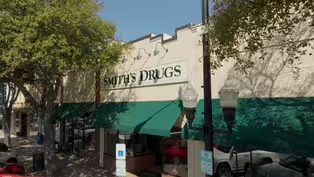
Those have mostly disappeared, but Clay Johnson and his videographer, Eric Olson, take us off the beaten path to a drugstore in Forest City where you can still buy a cheeseburger and a milkshake.
[upbeat music] - [Reporter] It's another busy lunch hour at Smith's Drugs in downtown Forest City.
- We have a large customer base that come here daily or weekly to eat either breakfast or lunch, and sometimes both.
We have customers that have been eating here for many years, 30, 40 years.
I talk to people all the time and they say, "Yeah, I came in here when I was five years old and I'm still coming here."
- [Reporter] A man named JM Smith opened Smith Drugs in 1939.
It was one of 12 stores he opened in Western North Carolina and upstate South Carolina.
- We're one of probably two that still are around from those dozen Smith's Drugs that were opened that long ago.
- [Reporter] Over the years, it expanded into some adjacent storefronts to add medical equipment and home healthcare supplies, but it remains a full-service pharmacy that also sells over-the-counter medications and has a gift shop just as it did when it opened in 1939.
- A lot of things have changed, but a few things are still the same since then.
What we aim to do here is to provide good customer service to all of our customers and all of our patients.
That's the same as it was 80 years ago.
- [Reporter] The soda fountain and lunch counter are pretty much the same too.
What are you famous for?
- Pimento cheese, we sell a lot of pimento cheese.
We sell a lot of burgers, and of course, the tenders and the wings are a big hit now.
- [Reporter] Wyatt added the tenders and wings trying to modernize the menu a bit, but she says the old timers still like the traditional soda fountain fare.
- They love BLT, we sell so many.
Every day they'll come and eat a BLT or they'll get pimento cheese, and we wanna keep them, but we also wanna bring in newer people too.
- [Reporter] And of course, there are milkshakes and hand-dipped ice cream.
- Kids love the ice cream [laughs].
I strive for my servers to be super friendly and we try to be fast, and we want you in and out, but we want you to really enjoy your time.
- [Reporter] Weekends bring more out-of-towners.
- Saturdays it's a lot of different people from everywhere.
- [Reporter] Weekdays are mostly locals like Michael and Lori Benfield, who come here to fill their prescriptions and their bellies.
Michael moved here from Hickory in 1985 and has been coming to Smith's Drugs ever since.
- The menu is just a total variety, whether it's breakfast or all the way through lunch and stuff.
And then they've got wonderful desserts.
I just tried one of the pound cakes that they had, it's just awesome.
- [Reporter] Lori is a Forest City native who's been coming here her entire life.
- I especially like the gift shop.
Most everybody I have brought here has really enjoyed it.
They enjoy the food and the shopping.
- That's right, I understand.
There's familiar faces always behind the counter.
If you get to know your customers, we know people by name, and we greet them when they come in.
I want them to feel like that they're coming to a place where they're taken care of, where they're family, that people know them and greet them and care about them when they're here.
- [Reporter] And along with the soda fountain and lunch counter, Higgins says that's what separates Smith's Drugs from the big chain drugstore we all know.
[upbeat music] - Grab a stool at Smith's Drugs of Forest City at 139 East Main Street.
Fountain hours are Monday through Saturday from 7:30 AM to 3:00 PM and you can find out more by visiting their website at smithsdrugsfc.com.
Did you know that there's an old Cold War spy station in Pisgah National Forest?
That's right, and it was once the site of an old NSA and NASA station.
But today you can actually camp there, watch a meteor shower, or learn about space.
Let's join Rebecca Ward on her quest to learn more about the Pisgah Astronomical Research Institute.
- I've always been fascinated by Cold War relics.
There's something inherently intriguing about visiting places that were once classified, secret listening stations, underground tunnels, atomic bomb shelters.
These are like ghostly time capsules of once immaculate sophisticated systems.
A few years ago I visited Field Station Berlin, an old NSA listening station in West Berlin where the U.S. military eaves dropped on Soviet, East German and other Warsaw Pact conversations.
I never thought anything like it could exist in my own backyard.
[upbeat music] I grew up here.
I've been all over this state and I never knew there was an old Cold War spy station here.
I feel like I should be in a suit.
- [Companion] Like a space suit?
- [Rebecca] Well, first it was a NASA station.
- This was the birthplace of many types of satellite technology, - [Rebecca] Then an NSA station.
- This place was built to be hidden from the world.
- [Reporter] And today it is PARI, or the Pisgah Astronomical Research Institute, a nonprofit observatory, research facility, and international dark sky park where you can see the cosmos.
It's tuberous.
- [Companion] So cool.
- I became curious about Cold War relics in North Carolina after learning about an underground bunker in Charlotte.
I wondered what else could be here, which is when I started researching and came across the Rosman Research Center, an old NSA listening station buried deep in Pisgah National Forest.
You can stay, you can stay there.
- [Companion] Seriously?
- Okay, we're going.
We're going, we gotta go.
[upbeat music] ♪ Blinded by the light ♪ This is it.
Are y'all ready to step back in time?
Oh, dang it, I forgot the code.
I got it, I know I got it.
We're in, we're in.
- The moment you pull into this place, the first impression you get is maybe we shouldn't be here.
[upbeat music] - [Rebecca] Okay, so when you get here, you'll notice the vibe is a little bit severe, but that's kind of what makes it so cool.
- We have left the aesthetic of the Department of Defense here, because a lot of these sites have been completely abandoned or destroyed.
- [Rebecca] Not only do they now want people to know about this place, you can come stay here.
- Now we want people to come, we want tours, and we're fully open to discussion about anything that we have or do here now.
- [Rebecca] So wrap your head around this.
The same place that used to be this super lockdown NSA station is now where you can camp for a meteor shower, look through a $15,000 telescope and step on the moon.
- Now you can tell people that you have set foot on the moon.
- [Rebecca] It's also a summer camp.
- Summer camps, field trips, homeschool groups, Boy Scouts, Girl Scouts.
We do a lot of science outreach and education.
Our main goal is to make astronomy and space science very exciting and accessible to anybody with an interest to learn about it.
- If you want to explore something in the universe or figure out how this nebula is expanding, the tools you need to do that are right here at this site.
- [Rebecca] Right, so all of that's cool, but what happened here?
Let's get back to this guy.
This guy's name is Brad.
Brad is a third-generation facilities manager at this site.
His dad worked here, his granddad worked here, and the sunglasses don't come off.
- Well originally, the Rosman Tracking Station was the first entity here.
- [NASA Recording] Trust is go.
- [Brad] It was the East coast tracking station for NASA.
NASA chose this particular area in 1961, and that was under the STADAN Program.
That was Satellite Tracking And Data Acquisition Network or Space Flight Tracking And Data Network.
And they were 22 of these sites around the world all reporting back to the control center in Greenbelt, Maryland.
- [Rebecca] But why here?
Why rural western North Carolina?
- NASA had chosen this spot because of its natural dark sky, lack of radio interference and its natural bowl shape.
So you're looking at the highest points of the parkway right here.
- [Rebecca] Wow.
There are NASA remnants everywhere on this site.
It's like a living museum.
Okay, so this is a what?
- [Brad] This is the NASA freight elevator.
- The NASA freight elevator.
Okay, so I just press what?
[elevator beeps] [elevator bangs] Whoops, sorry.
Whoa!
So, are we gonna ride in this thing?
- [Brad] No.
- [Rebecca] One of the coolest things here is actually not open to the public.
- This place originally was built with the buildings interconnected by a tunnel system.
So there would be no satellite imagery of them going in or out of the buildings whatsoever.
At some points, there's 4,800 volts coming out of the wall and at other points there's 7,200 volts.
Don't touch it.
- Is that water?
- There are some leaks.
This can be a creepy place.
I do not have lighting for the rest of the tunnel.
- Wait, no.
All right, so we're officially in a horror movie.
- [Cameraperson] Oh my god, what's that?
- [Rebecca] Don't do it, I swear, Dan.
How long is this?
- 1,100 feet from start to finish.
In 1980, the STADAN Program was basically over.
There wasn't a need for these giant receivers on the ground, and so they were simply repurposed for the Department of Defense for surveillance of this earth.
Any illegal activity that could be considered a threat to the United States from '81 to '95 was monitored right here.
- [Rebecca] When the state took over the site in 1980, the Rosman Tracking Station became the Rosman Research Station, which was part of NSA field stations throughout the United States and the world.
- [Brad] The surveillance at the time that has been declassified is Russia was a primary target.
The smiley face was a friendly wave back to Russian spy satellites monitoring the United States while we were monitoring them.
We were also monitoring Cuba.
Even the Colombian drug cartel was monitored from this site.
- How were you able to tell me all of this?
- Because I didn't work for the government or the NSA.
My father, my uncles, multiple family members did.
I've not been debriefed.
The information I'm sharing has been declassified.
- So can anyone read this information?
- Yes.
- But technically your family's not allowed to talk about it.
- My family is not.
If you worked here under a government contract, no, you are not.
You could be court martialed all the way until your death.
- So nothing over coffee with you and your dad?
- Never, I learned way more from the History Channel.
Now, he taught me everything about how to run this place, facilities and security wise, but as far as what happened between '81 and '95, everyone who worked here has perfect amnesia [laughs].
- So how do you go from being a space station to a spy station?
- There's not much of a transition.
Satellite communications is satellite communications.
It all uses the same technology, the same equipment, you have to know where to look, what to look for, and how to interpret what you've found.
That's basically the only difference.
- And then be careful of what not to look for.
- Be extremely careful what not to look for.
- [Rebecca] Do you still listen to the Russians?
- No ma'am, we do not.
Are we capable?
Possibly, but no.
No, we are a nonprofit organization all about science and education.
[upbeat music] - Shall we?
- [Dan] Let's go.
- Okay, got helmets for the crew.
That means I'm putting this on you.
- We let people touch things and hold things and control things.
When you come here, you can control a nine-story tall telescope.
- [Rebecca] Brad tells me there's a house in here.
- [Lamar] It would be a little difficult to live in it.
- This is my new Airbnb.
- It's literally an air Airbnb.
We have three speeds, deathly slow, really slow, and slow.
- [Rebecca] Wow, look at that.
- What if we wanted to look at what the sky looked like in the 1880s?
We actually have some of the recorded data here on photographic plates.
- February 13, 1939.
How many glass plates do you have here total?
- [Worker] 421,350.
- [laughs] I love how you just rattled that off.
- It comes from South America, South Africa, Canada, the United States, Java.
- It looks like little black specks.
- [Thurman] Yep, those are stars.
- So we do have a museum, and there's a lot of really cool things to see.
- Follow me to the rock rave.
Whoa.
[upbeat music] - We have a couple of artifacts from the different space shuttles, a rocket engine, a whole gallery devoted to earth minerals and rocks and gemstones.
[upbeat music] - As a dark sky park, we are a place that follows certain guidelines of the International Dark Sky Organization and also does events for the public and outreach to try to tell people what that means.
And for optical astronomy, that's a huge benefit.
[tinkling music] Do ever look up at the sky yourself and see the Milky Way?
You can't do that without dark skies.
- It's Jupiter, I can see the lines.
Wow, Dan, do you wanna see Jupiter?
- [Dan] I'm definitely trying to see it.
- Okay, okay, cool.
Alright, so now we're gonna try and look at Mars.
- [Dan] Whoo, there's Mars.
- [Rebecca] It is moving incredibly fast.
Is that us moving or is that- - [Companion] That's us moving.
- [Dan] It's all moving.
- [Rebecca] From NASA to the NSA to PARI, this place is more than the land of acronyms.
It's a place where anyone with curiosity about our place in the universe is welcomed.
[upbeat music] - The Pisgah Astronomical Research Institute is at 1 PARI Drive in Rosman, that's in Transylvania County.
To book a stay or arrange a tour, give them a call at 828-862-5554 or go online to pari.edu.
I'm standing in front of one of the scenic beauties here at Clemmons Educational Forest.
This is truly a wonderful place to just come, relax, bring the kids, or explore.
We've had a great time, and if you've missed anything in tonight's show, remember, you can always watch us again online pbsnc.org or you can find us on our YouTube channel.
Have a great North Carolina weekend, everyone.
[bright music] ♪ [bright music continues] ♪ [bright music continues] ♪ [bright music continues] ♪ [bright music continues] ♪ [bright music continues] - [Announcer] Funding for "North Carolina Weekend" is provided in part by Visit NC, dedicated to highlighting our state's natural scenic beauty, unique history, and diverse cultural attractions.
From the Blue Ridge and the Great Smoky Mountains across the Piedmont to 300 miles of barrier island beaches, you're invited to experience all the adventure and charm our state has to offer.
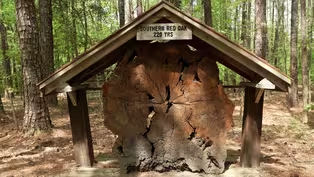
Clemmons Educational State Forest
Video has Closed Captions
Clip: S21 Ep20 | 2m 9s | Learn about forestry practices and more at the Clemmons Educational State Forest in Clayton. (2m 9s)
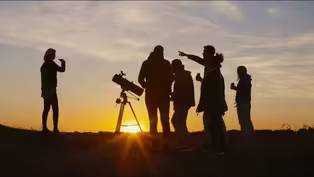
Video has Closed Captions
Clip: S21 Ep20 | 11m 53s | Explore an old Cold War site deep in the mountains that's now an astronomical research station. (11m 53s)
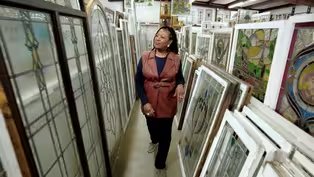
Video has Closed Captions
Clip: S21 Ep20 | 5m 18s | Step back in time at at a stained-glass emporium just outside Pittsboro. (5m 18s)
Video has Closed Captions
Preview: S21 Ep20 | 26s | Visit unique locales across the state, including an astronomical research facility. (26s)
Video has Closed Captions
Clip: S21 Ep20 | 3m 59s | People flock to Smith’s Drugs in Forest City for the old fashioned soda fountain experience. (3m 59s)
Providing Support for PBS.org
Learn Moreabout PBS online sponsorship













Support for PBS provided by:
North Carolina Weekend is a local public television program presented by PBS NC