
Offutt Lab, Fungus Creations, Retail Aware, Grain Weevil
Season 3 Episode 1 | 28m 55sVideo has Closed Captions
This episode features how scientists identify missing service members and more.
"What If..." tells stories of innovation and creativity in Nebraska. This episode of features: how scientist-detectives identify missing service members at an Offutt Air Force Base lab; making a canoe and bee hotels out of mushrooms; technology that's helping stores and products learn how we shop; and a robotic weevil that may save lives.
Problems playing video? | Closed Captioning Feedback
Problems playing video? | Closed Captioning Feedback
What If is a local public television program presented by Nebraska Public Media
Offutt Lab, Fungus Creations, Retail Aware, Grain Weevil
Season 3 Episode 1 | 28m 55sVideo has Closed Captions
"What If..." tells stories of innovation and creativity in Nebraska. This episode of features: how scientist-detectives identify missing service members at an Offutt Air Force Base lab; making a canoe and bee hotels out of mushrooms; technology that's helping stores and products learn how we shop; and a robotic weevil that may save lives.
Problems playing video? | Closed Captioning Feedback
Where to Watch What If
What If is available to stream on pbs.org and the PBS app.
Providing Support for PBS.org
Learn Moreabout PBS online sponsorship- [Mike] A robotic weevil that may save lives.
Making bee hotels and a lot more, out of mushrooms.
Technology that's helping stores and products learn how we shop.
How scientist-detectives identify missing service members in this lab.
What if?
(upbeat rock music) (windchimes) - Hey there.
Going to hit the water for this episode of "What If..." Because this canoe is a great example of the innovation and creativity we feature in the series.
We'll tell you why in a bit.
We'll also tell you about that music that you're hearing.
But first, let's visit a place using science and detective work to identify some missing service members.
- [Narrator] Remarkable work happens here.
Fueled by brainpower and a desire to help families of the 80,000 missing American service members from World War I, Korea, Vietnam, and other wars.
Guys like Gerald Clayton and Louis Tushla.
Nebraskans who joined the Navy in the late 1930s.
(bomb roaring) Both were on the USS Oklahoma during the attack on Pearl Harbor.
Like most of the 400 plus onboard who died that day, their unidentified remains ended up in mass graves in Hawaii.
- It's our nation's greatest promise to those who serve and their families, to say, "You have put your life on the line by stepping into those boots.
And we are here for you, and we will come and find you no matter how long it takes, no matter how hard it is, and we will bring you home."
- [Narrator] That's the mission of the Department of Defense POW/MIA Accounting Agency.
It has two labs in the country.
One is in an Offutt Air Force Base building that was once a World War II bomber factory.
DPAA is the largest employer of forensic anthropologists in the world.
Staff also include dental experts, data scientists, historians and others.
Almost all with advanced degrees.
- This is 50% science, 50% detective work?
50% something else?
(laughs) - What would Willy Wonka say?
(laughs) Yeah, well, it's all science, it is the science arm of detective work.
- [Narrator] Research and recovery comes first.
A team excavating the site of a plane crash or with the USS Oklahoma disinterring remains from graves.
Then remains arrive here.
One of the next steps is laying out bones on tables for analysis.
Out of respect, we don't show bones of actual service members.
- Hi, Katie.
- Hi, there.
We'll start with the cranium.
Actually, if you want to place that in the ring there.
- [Narrator] But Katie East gave us a good idea of how this works using a teaching skeleton.
- So, would this be a fairly typical sample that you might have come into the lab?
- Yes, it can be.
Very often, we'll only get parts of skeletons depending on where the remains come from.
- Making sure bones fit together or articulate so they know it's a single individual.
- And this is a nice articulation here.
So, after we have a single skeleton ready for analysis, essentially what we'll do is start building a biological profile.
Take measurements that can help us do the analysis, and then we'll assess things like sex, age, height, and then look for anything like injuries or signs of disease.
- [Narrator] Skull and pelvis assessment helps determine sex.
- So, we'll look here in this area, that's glabella.
It's larger in males than it is in females.
- [Narrator] Looking at the surface of a joint connecting two pubic bones helps determine age.
- And that will degrade over time as you get older, unfortunately.
And we have some references that tell us sort of the pattern of decline.
- [Narrator] Abnormalities provide clues that could connect the skeleton to a medical record.
Like indication of an earlier-in-life injury.
- But the fact that we're missing a big chunk of bone here and that we have some spiculing and this perforation here, it leads me to believe that there was injury.
- So, a broken ankle, maybe?
- Probably something like that.
- [Narrator] Other anthropologists are doing this work on real cases.
Done in the blind, meaning they don't know much about the case.
- We want to try our best to limit as much bias as an analyst may have in their assessment.
- [Narrator] Larkin Kennedy sorts through bits of a wool blanket that covered a service member in their casket.
- So, in order to make sure that there's no small pieces of evidence or small teeth or anything like that, that might be something we want associated with an individual.
So we have to pick through all of that.
- One thing that's really interesting about these remains is that they are all black as you can see.
And so, you can get different color staining for different taphonomic processes, or you can also get it from things that happened around the time of death, like burning.
So, if you were, for example, in a plane crash or something like that, you could see burning on bones as well.
- And in this case, there are no duplicated or overlapping bones, however, there are some differences in the skeleton that may suggest that this is actually more than one person.
For instance, the left leg is in general much shorter than the right leg.
- It's amazing that every single skeleton is a little bit different.
Everybody has something strange about them or something interesting about them, honestly.
- [Narrator] DNA is a key tool, especially with a sample from a family member for comparison.
- And we take DNA for two reasons.
One is to make sure that all of the elements go together.
And then the other one of course is to help with identification.
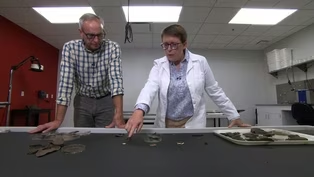
- [Narrator] Items found at a site or in a casket are examined in the material evidence lab.
- This looks like possibly part of a boot.
So you've got like a rubber sole or insole.
- And this looks like part of a zipper.
- So zippers could have come from basically anything.
It could be the uniform, it could be gear that they were wearing, it could be from the plane itself.
- [Narrator] A 1929 coin helps date an event.
The prescription of these glasses could match medical records.
Watches, buttons, rings provide more clues.
- Most of the evidence that we get is supporting, it says we are in the right place, we're in the right time period.
- [Narrator] Multiple lines of evidence are needed to confirm the identity of the missing service member.
A DPAA medical examiner makes the final decision.
- Every case is unique in its own way.
Some present their own challenges.
We've been able to make an identification as fast as six days.
That is not the norm.
That's when everything lines up, or it could take years.
- [Narrator] USS Oklahoma case work began in 2015, with 13,000 bones from 388 unidentified sailors and marines mixed in more than 60 caskets.
- When the project started, it was the primary thing being done in this laboratory, and so every table had Oklahoma skeletal remains.
- Welcome to the Defense POW/MIA Accounting Agency ceremony.
- [Narrator] After more than five years, the Offutt lab is on track to identify more than 90% of the men who died on the USS Oklahoma.
- I would like to take this time to welcome the family members of the USS Oklahoma Sailors and Marines who are present with us today.
They're the families of Fireman First Class Louis James Tushla, and Storekeeper Second Class Gerald Lee Clayton.
(audience clapping) - It's like a closure.
It's like we're representing our family who waited so long for word of him, and it's like a closure now.
- [Narrator] Identified remains are returned to hometown cemeteries or back to Hawaii for burial with a marker, a name, and those scientist-detectives who made it happen watching.
- It gives us that opportunity to step back, look at the big picture and the effect that this has on ourselves and everyone, family members, other people within the organization.
And it makes it special.
(gentle music) - That music you're hearing now and in our stories?
Created by a wide range of Nebraska composers who submitted more than 170 pieces of music for use in our show.
Check out the "What If..." website to learn more about this very creative music.
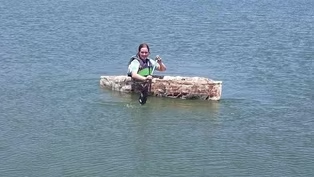
This is a Guinness World Record fungal mycelium canoe.
What's mycelium?
Something the woman who built this is super passionate about.
- Well, my name's Katy Ayers, and I grow things out of mushrooms.
- [Mike] Like this.
And this.
And hotels for bees.
We'll explain later.
And this.
(gentle piano music) (water bubbling) (record scratches) Hold on a second!
This seems like a good time for a science break to learn about mycelium, the unseen, vegetative body of a fungus that forms mushrooms.
- So what you normally see above ground is that mushroom, and then all these hyphal strings together, as a whole, are what we refer to as the mycelium, or the body of the mushroom.
(air whooshes) - This is the hard part.
- Learn to control mycelium, and you can make things, like a canoe.
So kinda walk me through how you made this.
- So we started off by building a wooden skeleton, which you can kinda see through some of these right here, and then we made paper mache molds.
- [Mike] Fill it with spawn, basically ground-up wood with mycelium already in it.
- [Katy] And then hung it in a hammock to grow.
(air whooshes) - [Mike] So how long did it take that to grow?
- The my-canoe took about one week to grow, and then we left it outside in the sun for another week to dry.
- Is it fun paddling around on this thing?
- I love it.
It's definitely a workout, too.
- [Mike] This started with an English class assignment.
Write a paper about solving a sustainability issue.
Ayers did some research and landed on a documentary called "Super Fungi."
She was hooked.
What was it that hooked you?
- The fact that there's so much that we don't know about fungi.
- [Mike] Her love of fishing led her to making a canoe.
- Catch some rays.
But now, we're focusing on conservation biology of our native pollinators.
Pollinator numbers are dwindling rapidly, and we have over 400 species of bees and wasps that do pollination here in Nebraska, so we thought we could provide them some habitat with a native fungus.
Pretty happy with how this one came out so far.
- [Mike] Habitat in the form of hotels.
Ayers saw a study that exudates, basically the juices of this mushroomy fungus, kill some viruses threatening bees.
Create a place for bees to live and lay eggs, and... - Every time it rains, this will make a tiny bit of exudates, and we hope that the bees will actually go out and drink those as a water source.
(bright, chirping electronic music) - [Mike] Pack more ground-up wood into a mold.
How long's it take to do one of these?
- It depends on who you are.
It takes me about 45 minutes.
- [Mike] Ayers, Gillespie, and fellow students make about 10 hotels a week.
You want a nice, tidy hotel for each bee, right?
Okay.
- Yeah.
- [Lisset] Who wouldn't want a tidy hotel?
(Mike and students laugh) - Because you don't want a bad Yelp rating from a bee, right?
- Right.
You don't.
- [Mike] Is that kinda what happens.
- [Katy] And then we just tape it up so it's airtight and put it in our incubators.
- [Mike] Incubate so it grows for about five days.
- [Katy] So the packing tape is the best, 'cause it takes it longer to get through this clear plastic.
It'll grow straight through the duct tape, painter's tape.
This is actually really beautiful to look at under the microscope because of how it grows.
- [Mike] Tell me about Katy.
- Katy is an incredible young woman.
She's absolutely an inspiration to myself, to the other students, to emulate her work ethic and her passion.
As you've seen, her passion is contagious.
- (laughing) This is the fun part.
- Alright, so we're gonna unpack a bee house.
- Yes.
- [Mike] It smells like mushrooms.
- Imagine that!
- Yeah.
- It's actually one of my most favorite scents now.
Perfect.
- I wouldn't say perfect yet.
(Katy laughs) Wait till you see the outcome.
This one's a little sticky over here.
- Trying to eat the plastic.
- This isn't coming off very easily.
- No, it's not.
It's not.
- It's because we have a camera on.
- Uh-huh.
(laughs) - That's how it works.
- [Katy] There it goes.
(hotel thumps) - [Mike] Voila!
That looks good!
- That looks really nice, actually.
- Yeah!
- [Katy] Beautiful.
And that's what we want to happen.
- [Mike] Perfect!
And it doesn't seem like these are sticking at all.
- [Katy] Yeah, this one looks really great.
Not too bad!
- [Mike] Bee hotel.
Into a humidity tent for a week.
- [Katy] Keeping the humidity up actually helps it to continue growing.
- [Mike] Bake the inside to stop it from growing, put the inside and outside together, and you have a bee hotel.
(post-hole digger clanks) Ayers is installing hotels throughout Nebraska.
She'll retrieve them, see how and how often bees use them, make adjustments, make more hotels.
And maybe take the product to market after a few more years of development.
Grants allow her research to continue, even though she's now graduated from Central Community College and starting a bachelor's degree at Washington State.
- The fact that we really don't know if this is gonna work or not, and that's the most exciting part to me.
There is a risk involved with it.
It could crash and burn.
But this could also be game-changing for our native pollinators.
(air whooshes) - [Mike] Benefits for bees, benefits for the environment.
Using a more sustainable biomaterial instead of solid wood or Styrofoam, often used now for bee hotels.
Ayers is a part of a movement.
A fungal materials Facebook group has more than 22,000 members worldwide.
They're making all kinds of stuff out of mycelium.
- You can grow packaging, chairs, lampshades, insulation, fireproofing.
There are so many things.
(air whooshes) (gently intense electronic music) - It's fun, it's creative, but what's the big message of what you want people to learn from the canoe?
- I want people to experiment and realize that there's so much that mushrooms can do.
Here in the Western world, we tend to be a little mycophobic, when really, we should look to mushrooms and learn to love them a little more.
(mushrooms pop) - Katy Ayers wants to change how we think about mushrooms.
Our next story is about a self-described "hustler" who wants to change retail shopping.
(gentle music) - [Narrator] A TV host walks into a convenience store.
This business and companies buying stuff sold here will eventually know what I bought and what I didn't buy.
They don't know what I looked at and didn't buy, what I never saw, how I traveled through the store.
In other words, the same info online sellers get when I'm shopping on my computer instead of here.
A hustler had an idea.
Create motion, light and contact sensors that anonymously capture that missing information.
Create platforms to analyze the data.
- Think of the four P's: product, place, price, promotion.
We really solve for the place aspect of that.
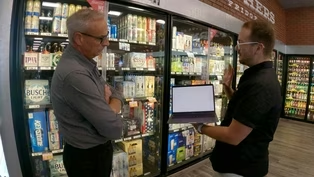
- [Narrator] Retail Aware tests tools in this West Omaha convenience store, a good place for Keith Fix and team to show us how it works.
- So we have a monitor here.
What's that telling us?
- So, that sense device is actually looking at motion.
So, we're characterizing your hand movement to say you picked up whatever was underneath there.
So, we can see how many folks walked by, but then we can also see how many people picked up product.
So it gives you your conversion rate, and it's the most likely indicator to a sale.
- So in this case, if I were to take this out, look at it, and put it back, you'd have that data as well?
- You got it.
We see engagement.
- [Narrator] There are sensors showing when products are out of stock, helpful for stores that don't have a lot of employees.
And sensors tracking customer movement.
- We want to understand what is going on in this space.
- Alright, tell me what you're seeing?
- So what you're looking at is compiled data.
Combined with sales data, we can actually see the full, what we call the path to purchase or the full customer journey.
Brands specifically spend a hundred billion dollars a year just in North America on all of the stuff that you see inside the store.
So that includes these merchandising displays, these light fixtures, messaging, those posters that you see that go into the store or special product displays.
We're wrapping data around those decisions.
- If you find out that nobody is even walking in a certain part of the store, you either need to come up with a good idea of how to get them there or reinvent that space into a better purpose.
So, I think that kind of data would go a long way and actually be worth paying for.
- [Narrator] The journey Keith Fix took to creating Retail Aware is just as windy as my path through this store.
- Tell me about yourself.
How's that for wide and open-ended?
- (laughs) Oh man, okay.
So let's start.
I've always been a little bit of a hustler.
Like I've always been to the point where I got suspended for selling erasers and magazines on the school bus.
Just stuff like that.
I used to help with the computer lab as a... Oh, I think I was in first grade.
No one asked, I just kind of started doing it.
I was Airbnb before Airbnb.
I would bill my aunts and uncles for staying (laughs) at our house.
And I always knew I was gonna do something in business, but it really wasn't until we had a family friend that needed help with a website.
He was like, "Yeah, you like computers.
You can do a website?"
"Sure."
I had no idea how to do a website.
Basically, I made my mom drive me down to the library and I got every book on HTML, CSS, Dreamweaver.
- What drives a 10-year-old to just say, "You know what?
I'm gonna learn how to code.
I could make some money doing this"?
- Unfortunately, when my parents split, my world was flipped upside down.
We went from having a very decent middle class life to my mom and I being in a homeless shelter.
It came out of I needed to do it.
I enrolled in classes and I think I got involved in a collegiate entrepreneur's organization.
We started a daily deal site.
I started a handful of ventures, all while I was full-time in college.
- [Narrator] One was Blabfeed, digital displays for doctor's office waiting rooms.
Born from winning a business plan competition.
Fed by investment from the Winnebago Tribe's economic development corporation, bought by the economic development arm of Nebraska's Ponca Tribe.
Important, because Fix is a Ponca Tribe member.
- I realized that building these enterprises and entrepreneurship was absolutely key to breaking some of the barriers and breaking some of the systemic challenges that have plagued tribal nations.
(keyboard clanking) - [Narrator] Which brings us back to his latest hustle, Retail Aware.
- Oh my gosh, the dude has an entrepreneurial mind like no other.
I keep seeing photos that go back further and further.
They just crop up and I'm like, "Oh my gosh, is he even 18 in this photo?"
So, as long as I can even see in his past, it's just part of his DNA.
(wire fizzling) - [Narrator] Born in 2018 from all the retail and tech experience Fix gained from the other ventures, now Retail Aware engineers and builds and ships sensors all over the world.
Without naming names, Fix says customers include the largest beverage company, a top electronics company and big box stores.
Millions of Americans pass by these sensors each year without knowing it.
Yes, more people shop online these days, but Fix says most purchases still happen in physical stores.
Only bad retail is dying and good retail is stores of the future, where data drives decisions just like online.
- Did you have any notion whatsoever that this was going to be as successful as it was?
- We've always had this idea of how big we could get, and I don't think it was ever an option not to make things work.
- You still a hustler?
- (laughs) Oh my gosh, there's a Beyonce song about that.
(laughs) It's funny.
As a kid, I think like you evolve from the hustler to the innovator, and I think there's a very fine line (laughs) between the two.
(gentle music) - Getting a bit of a workout here in the mushroom canoe, it's a good thing we're almost done.
Our last story is about robots, grain bins, and three guys with an idea.
- [Announcer] Sunday!
Sunday!
Sunday!
Watch grain get annihilated!
By Grain Weevil!
Quatro and friends toss, thrash, trash the enemy into submission!
Grain Weevil!
Coming soon to a grain bin near you.
(gentle soothing music) - [Narrator] Monster truck show jokes aside, there's a serious reason three guys who had never seen a grain bin before are building this robot.
Farmers often store grain in these bins after harvest, before it's sold.
Sometimes a farmer goes inside to make grain flow easier and break up clumps.
- Right now there's not really any solutions other than a farmer with a shovel.
If there are problems inside of a bin.
- [Narrator] That can be deadly.
If grain collapses or a crust breaks or an auger is turned on accidentally while someone is inside.
Suffocation happens in seconds.
These accidents kill about 20 US farm workers yearly.
- This is a safety mission.
Keeping farmers out of the bin will keep them safe.
- Yeah.
- No.
- No.
- [Narrator] Chad with his son Ben and Ben's best friend Zane turned an interest in robotics into a tech startup, prompted by a farmer friend's suggestion.
- [Mike] When he told you about the problem you're trying to solve, did the idea of using a robot to solve it, just click right away?
- Well, I always knew we were going to use a robot, but we had no idea what it would look like.
(upbeat music begins) So we actually built what we call a scurry bot.
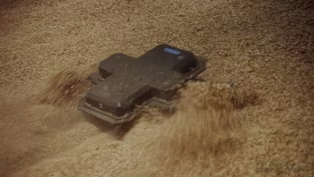
It's a little 18 by 20 inch robot with augers and it scurries across the surface of the grain.
That's where the name Grain Weevil came from.
- So why do you call it a weevil?
- So inside of these grain bins, you know, sometimes if let grain out to spoil or if you don't take good care of it, there's these little, little bugs called grain weevils that crawl on it.
- [Narrator] The Grain Weevil team thinks farmers will like the robot more than the bug.
- [Ben] It does.
It scurries across the top of the surface and the engagement of our augers, not only moves the robot, but it manipulates the grain.
We're using gravity to manipulate the grain and do different tasks inside of the grain bin.
- [Chad] So we're increasing what, the scientific word is, the sediment gravity flow, introduce a little more air to the process and it flows down into a level state, which is an important process of managing a grain bin.
- Imagine creating an avalanche.
- Yeah, yeah.
Controlled.
Right?
(hammer banging) - [Narrator] The guys were spending long days testing and working out the bugs (guys laughing) when we caught up with them.
(engine whirring) - Nice.
- [Narrator] Trying different prototypes - There we go.
- [Narrator] And monitoring the results.
- [Mike] So tell me what you're seeing there.
- So this is all of our positional data from the robots.
So I get acceleration, angular velocity, orientation, all of our temperature data, voltage, current, everything that we need to make sure that the robot's running correctly.
- [Narrator] Because it's not easy to get a robot to run on piles of grain.
- It took us over a year to even get a robot to drive on the grain.
- Quatro your favorite, then?
- Absolutely.
- Quatro going to win?
(energetic rock music) Be the one on the market?
- Oh yeah.
I mean he's winning so far, so if he just keeps on his trajectory he's going to be, going to be the best robot out of them.
- [Announcer] Quatro!
Quatro!
Quatro!
- [Mike] What happened to Quatro?
- Well he got a little cross signal or mixed signal or something.
Flew all the way backwards and shredded up his augers, so.
- [Mike] This has got to hurt to see the death of Quatro.
(nervous laughing) - It's devastating.
- He'll be back - Really.
- Yeah.
- He'll be back.
- Zane, Zane kind of latched onto this, but you know, all of our robots are doing everything that we wanted to do and Quatro was our favorite, but not anymore.
- No (inspirational fanfare music) - [Chad] We always like to break things cause then we know how to fix it, to make it better.
- [Narrator] What started as an idea for an educator and still in school Nebraska engineering students is close to reality.
Armed with funding, including a prestigious MIT student prize, they're now running on-farm trials in Nebraska, Iowa and Tennessee.
The hope is it'll eventually be something farmers can just keep in a bin, operating on its own.
- [Mike] What do you hope eventually happens with this, this product and this company?
- Truly I hope that one day farmers don't ever get into a grain bin again.
(music dramatically ends) - Alright that was fun.
Hey, you can watch all of our "What If..." episodes, stories, and Innovator Insights educational segments online.
And follow what we're doing on social media #WhatIfNebraska.
Thanks to Ash Gordon of Nebraska Mushroom for bringing out the mycellium canoe he helped Katy Ayers create.
and thank you for watching "What If.." (rock music) - Trash bag camera?
(laughing) - [Camera Operator] You can stand normally.
- [Offscreen] A little lower, Mike.
- Like cereal?
- [Mike] How's it going?
- Cold.
(rock music)
Video has Closed Captions
Clip: S3 Ep1 | 6m 19s | Katy Ayers "grew" a canoe from mycelium, the vegetative body that forms mushrooms. (6m 19s)
Video has Closed Captions
Clip: S3 Ep1 | 5m 3s | Three guys build robots to shift grain in grain bins. (5m 3s)
Video has Closed Captions
Clip: S3 Ep1 | 7m 41s | Identifying missing service members inside the Offutt Defense POW/MIA Acct Agency Lab. (7m 41s)
Video has Closed Captions
Clip: S3 Ep1 | 6m 58s | Keith Fix demonstrates his last tech venture, Retail Aware. (6m 58s)
Providing Support for PBS.org
Learn Moreabout PBS online sponsorship











Support for PBS provided by:
What If is a local public television program presented by Nebraska Public Media