
Lidia's Kitchen
One Dish, Two Meals
12/1/2021 | 26m 46sVideo has Closed Captions
Weeknight dinners just got a little easier by Lidia simply serving one recipe two ways.
Weeknight dinners just got a little easier by Lidia simply serving one recipe two ways! Lidia prepares her creamy and delicious Zucchini, Peas and Pancetta Risotto. She talks to cookbook author Katie Parla about Capellini and Asparagus Frittata that she turns into an Involtini alla Piazzetta. Then, Lidia prepares her Risotto Cakes – a favorite recipe that uses any leftover risotto.
Problems playing video? | Closed Captioning Feedback
Problems playing video? | Closed Captioning Feedback
Lidia's Kitchen is presented by your local public television station.
Distributed nationally by American Public Television
Lidia's Kitchen
One Dish, Two Meals
12/1/2021 | 26m 46sVideo has Closed Captions
Weeknight dinners just got a little easier by Lidia simply serving one recipe two ways! Lidia prepares her creamy and delicious Zucchini, Peas and Pancetta Risotto. She talks to cookbook author Katie Parla about Capellini and Asparagus Frittata that she turns into an Involtini alla Piazzetta. Then, Lidia prepares her Risotto Cakes – a favorite recipe that uses any leftover risotto.
Problems playing video? | Closed Captioning Feedback
Where to Watch Lidia's Kitchen
Lidia's Kitchen is available to stream on pbs.org and the PBS app.
Providing Support for PBS.org
Learn Moreabout PBS online sponsorshipLIDIA: Buongiorno!
I'm Lidia Bastianich.
And teaching you about Italian food has always been my passion.
It has always been about cooking together and ultimately building your confidence in the kitchen.
So what does that mean?
You get to cook it yourselves.
For me, food is about delicious flavors... Che bellezza!
...comforting memories, and, most of all, family.
Tutti a tavola a mangiare!
♪ ANNOUNCER: Funding provided by... ANNOUNCER: At Cento Fine Foods, we're dedicated to preserving the culinary heritage of authentic Italian foods by offering over 100 specialty Italian products for the American kitchen.
Cento -- Trust your family with our family.
ANNOUNCER: Authentic and original -- Amarena Fabbri.
A taste of Italy for brunch with family and friends.
Amarena Fabbri -- the original wild cherries in syrup.
ANNOUNCER: Grana Padano -- authentic, Italian, rich in tradition, yet contemporary.
ANNOUNCER: Locatelli Pecorino Romano cheese from Italy.
Handcrafted from 100% sheep's milk.
ANNOUNCER: Olitalia.
"From chef to chef."
ANNOUNCER: And by... LIDIA: Dinners I make just a bit easier by serving one recipe two ways.
Risotto makes a great canvas for a variety of flavors.
Here I combine peas, zucchini, and pancetta.
If you're lucky enough to have leftover risotto in the fridge, you can have this dinner on the table in less than 20 minutes.
Creativity reigns in today's kitchen.
One dish, two meals.
Italians are masters at good food, but they are even more important masters of recycling leftovers.
I mean, I remember as a child.
Do not waste food.
Food is precious.
We might not have enough for everybody.
First of all, the idea is you cook enough so that everybody is full, but that everything is eaten.
Sometimes it is not.
And the Italians repurpose that into a new dish.
Pappa al pomodoro.
Old bread cooked in tomatoes with some basil, and you've got this delicious soup.
Pasta.
You know, some left over?
Next day, it goes into a frittata.
Risotto.
Next day, risotto al salto.
And you got this crispy rice hamburger, should we say.
So whatever you do, do not waste.
Recycle it in some fashion the next day so it's a new dish.
Zucchini, peas, and pancetta risotto.
Oh!
Sunny Italy!
It looks like Italy, doesn't it?
But this is my backyard.
This is where I cook.
It was a beautiful day, and I decided that I'm going to cook -- that we are going to cook outside.
And today we're going to make risotto.
And risotto -- You always ask me about risotto.
I've made it many times, and you continue to ask me because it's a popular dish.
It's an easy dish.
All you need is a wide pan because you want the rice to cook.
You're going to add some liquid, but you want the liquid to evaporate to make the creaminess.
So, this risotto is going to have bacon, or pancetta.
This is pancetta.
Pancia means "stomach" in Italian, and it is the belly fat of -- of the pig.
But could you use regular bacon?
Yes.
Even, you know -- Sometimes you like your prosciutto.
The end part of the prosciutto when you're shopping -- And you see them slicing the prosciutto, and then they have, like, the last part on a bone with the skin.
Ask them to sell you that.
And it's not expensive.
And out of that, you can cut and cook many things.
So let's render the pancetta.
What's important also in a risotto is you need a liquid to let the creaminess, the starches come out.
So you need some hot stock.
In this case, this is chicken stock, but you can use vegetable stock.
Even if you don't have stock, simple water is okay.
It's not going to be as flavorful, but it's okay.
But it needs to be hot.
So let's get the onions ready.
So, I'm going to use regular onion here, but you could use leeks.
You could use scallions.
You can use shallots.
Any of the onion family will do.
And you can even mix it.
Just be careful because the shallots cook much sooner than the onions, so you add the onions first then so on down the line.
Okay.
So, let me render this.
So, let's talk a little bit about the basics of risotto.
For a good risotto, you need a short-grain rice.
This is Arborio.
The starches in the short-grain rice, when you add the hot stock to it, it comes out.
It seeps out of the kernel, hence making the risotto nice and creamy.
But there's a whole technique that once you have learned it, it's easy.
So, we have rendered the pancetta halfway.
I'm going to add on the onions.
[ Sizzling ] So, I'm thinking, you know, I like to salt my ingredients as I go along.
But in this case, the pancetta is salty, so you have to kind of use your judgment.
Nonetheless, I think that a little bit of salt to the onion would be a good idea.
Not too much.
A little bit of salt.
So here we are.
And when the onion wilt, we'll add the dry rice.
Do not wash your rice.
Because if you do wash it, you begin the releases of the starches, and you will get the mush where the rice is soft and falling apart.
And the heart of the rice is not cooked yet.
So that's why we are going to toast this rice as it is, in the oil, and with the onions to form, like, the little...
So, now let's toast the rice.
I always get the question, "Do I have to stand by the pot and mix?"
Well, you do have to stand by and mix.
And now we're going to add at this point when it's nice and toasted -- you hear it clicking... [ Sizzling ] I'm going to add some white wine.
♪ Now the rice is absorbing in the acidity, the flavor of the wine.
And we are going to let this completely dry out.
The wine is going to be absorbed by the rice, and the alcohol is going to evaporate.
[ Sizzling ] Just enough to cover the rice because one cup of rice will yield 2 cups of risotto, and we'll take 3 cups of liquid to get there.
And I'm going to lower it a little bit, continue to mix, and I'm going to get my vegetables ready now.
♪ So, here I have an e-mail from Lisa.
She is wondering, when my recipes call for bacon, am I really using pancetta?
So, they're two different things.
Bacon is cured as a slab, and ultimately it is sliced or cut in piece, and it has a lot of fat, and in between, it has some of the meat.
Pancetta is the stomach of the pig, but the Italians season it -- salt, peppers -- and they roll it like into a jelly roll and then let it age that way.
Sometimes I recommend pancetta.
Sometimes I say bacon.
But they're interchangeable.
You can use one or the other.
So, the rice is cooking.
And let's put it in the zucchini.
That's good.
Let's mix that.
Okay.
I see it's a little sticky.
Make sure you go in all the corner.
I have a nice round pot, which is good.
Let's add a little bit of hot stock again, just enough to cover the rice.
Next, frozen peas, defrosted.
The frozen peas take less time to cook.
And, of course, we all love corn.
Everybody loves corn.
I love corn.
I'm looking at this, and I know that I need some salt for the vegetables.
Okay.
I'm going to add some chives.
Chives are delicious, especially in risotto like this.
There's the last step in making the risotto, which is mantecare.
Mantecare is to sort of whip up, if you will.
And you do that with some room-temperature butter and some grated cheese.
So, I'm looking at this.
Is it -- You see?
The sauce is becoming creamier.
But the rice is not cooked.
In the center, it is more intense white, if you will, if it's not cooked.
It will become all uniform in color, almost translucent when it begins to be fully cooked.
But, of course, you don't want to overcook your rice.
You want it al dente like the pasta.
You want it al dente.
So how do you gauge that?
You know, how much more liquid do I have to put?
And, again, I tell you, you know... Get a little spoon.
Us chefs always have spoons on our stations because we continuously taste because, you know, that's how you really can relate to the flavors in what you're cooking.
So...
Flavor is good.
Delicious.
Salt is good.
Let me add the chives.
♪ And what I'll do now is that I will close the heat because the rice is cooked.
Turn it off.
And I will do the last step, which is the mantecare.
The mantecare is adding the butter.
♪ Little pieces of butter.
When you put butter -- for that matter, whatever you cook with butter -- you put it towards the end, and you really get maximum flavor out of the butter.
And then, of course, the cheese.
The grated cheese.
The same thing.
And the same principle holds as far as flavors.
You retain the maximum flavor of the cheese, adding at the last minute.
I think we are ready to serve it.
So let me clean up a little bit here, and then I will serve it and show you how beautiful it will look.
And it was simple.
Jim sent a video from a cornfield.
Can't wait to hear what he has to say.
JIM: Ciao, Lidia.
This is Jim Martinez from Brentwood, California.
Here we're known for our sweet corn.
So, Lidia, my question to you is, how would you use corn in your kitchen?
Grazie.
Tutti a tavola a mangiare!
LIDIA: [ Laughs ] Bravo!
Bravo!
That's really nice, Jim.
I love it.
Everybody loves an ear of sweet corn.
I like to take the raw corn and just cut the corn right out.
I use it in soups.
I use it in making pasta.
Pasta primavera.
When in season, why not add corn?
I use it to mix vegetables, sauté.
Mushrooms and corn sautéed, and then at the end there, just add a little bit of balsamic vinegar.
Delicious.
So, Jim, continue growing that corn.
It looks beautiful.
And send it our way.
I hope I gave you some ideas.
Risotto is finished, so let's plate them.
Whenever you plate, you take in consideration what you're plating.
And, you know, like a frame of a picture.
A plate should be like a frame of a picture.
Just like that.
I am just generous here.
Maybe I put a little more.
Okay.
Now... That looks like a good plate of risotto.
Let me serve the next plate.
♪ Mmm!
I'm looking at this.
I think that's two beautiful portions.
And now where is Lidia's portion?
Okay.
My little portion.
I want to taste.
Mmm.
And I know your guests would like a little grated cheese.
And what you could do is certainly you can put grated cheese on the table.
But if you put a chunk of cheese like that and a grater, I think it's fun.
Now...I want to taste.
Mmm.
Mmm!
The creaminess of the rice.
The sweetness of the onions.
The zucchini has that really verde, green flavor.
And then the corn kind of pops under your teeth.
And the peas -- simple and delicious.
ALL: Salute!
LIDIA: It always brings me such joy to connect with my Italian roots.
I always stay in touch, whether it's traveling there, cooking the food, or catching up with friends who live there.
Sharing Recipes with Katie Parla.
Capellini and asparagus frittata and involtini alla piazzetta.
Katie Parla.
A dear friend.
She just came up with a cookbook about Southern Italy, and I love picking Katie's brain.
She knows what's happening on the Italian table from south to north.
And here she is calling.
Katie, how are you doing?
KATIE: Ciao, Lidia.
How are you?
Oh.
Bellissimo.
Dove sei?
Are you in Rome?
KATIE: A casa.
Roma.
Si.
LIDIA: That's wonderful.
Now, you have written 5 cookbooks, 30 guidebooks, and article upon article.
You do trips and take people into the most beautiful, flavorful places.
Tell me all of that.
KATIE: I'm really driven by this desire to take people away from the maybe more obvious attractions and show them the remote mountains, the Apennines, the heartland of Italy, and remote islands.
I think you can only understand Italy if you get the full panorama.
LIDIA: So, Rome is very unique.
Explain to us -- what is Roman food and what are the highlights of Roman food?
KATIE: Well, I feel like Rome is a collection of ingredients, cooking techniques, and dishes that are really only found here and executed here.
And, then, you know Romans.
They are very accepting of fried foods from other places.
So we're very accepting people as long as the food's fried.
LIDIA: Talking about fritture, you made my frittata, the pasta, but you went a step further.
Tell us.
You -- KATIE: That's right.
So, first of all, the frittata with pasta from your cookbook is amazing on its own, but I had this idea.
Because I have a recipe for meat rolls.
So I thought, why not do the beef roll with Lidia's capellini frittata?
And it came out so delicious.
LIDIA: So that -- You took a piece of meat, pounded, and then took a piece of the frittata once it has chilled, and you roll it up, and you make, like, a rollatini, and you braise it in tomato sauce, is it?
KATIE: Absolutely, and the frittata kind of absorbs the sweetness and acidity of the tomatoes as the meat cooks, and you have this gorgeous involtino plus a bunch of tomato sauce.
And, you know, if I have a lot of leftover sauce and a lot of leftover involtini, that's great because the involtini taste better the second or third day.
They like living in that tomato sauce in the fridge.
They really marinate, and it's a different flavor days after.
LIDIA: They absorb it.
Absolutely.
KATIE: I'm getting really hungry.
Are you?
[ Laughs ] Just talking about all the food.
LIDIA: I am, I am.
I have a little vino here because I wanted to toast you.
I can't wait to come to Italy and travel around with you.
So salute to our next trip.
KATIE: Salute.
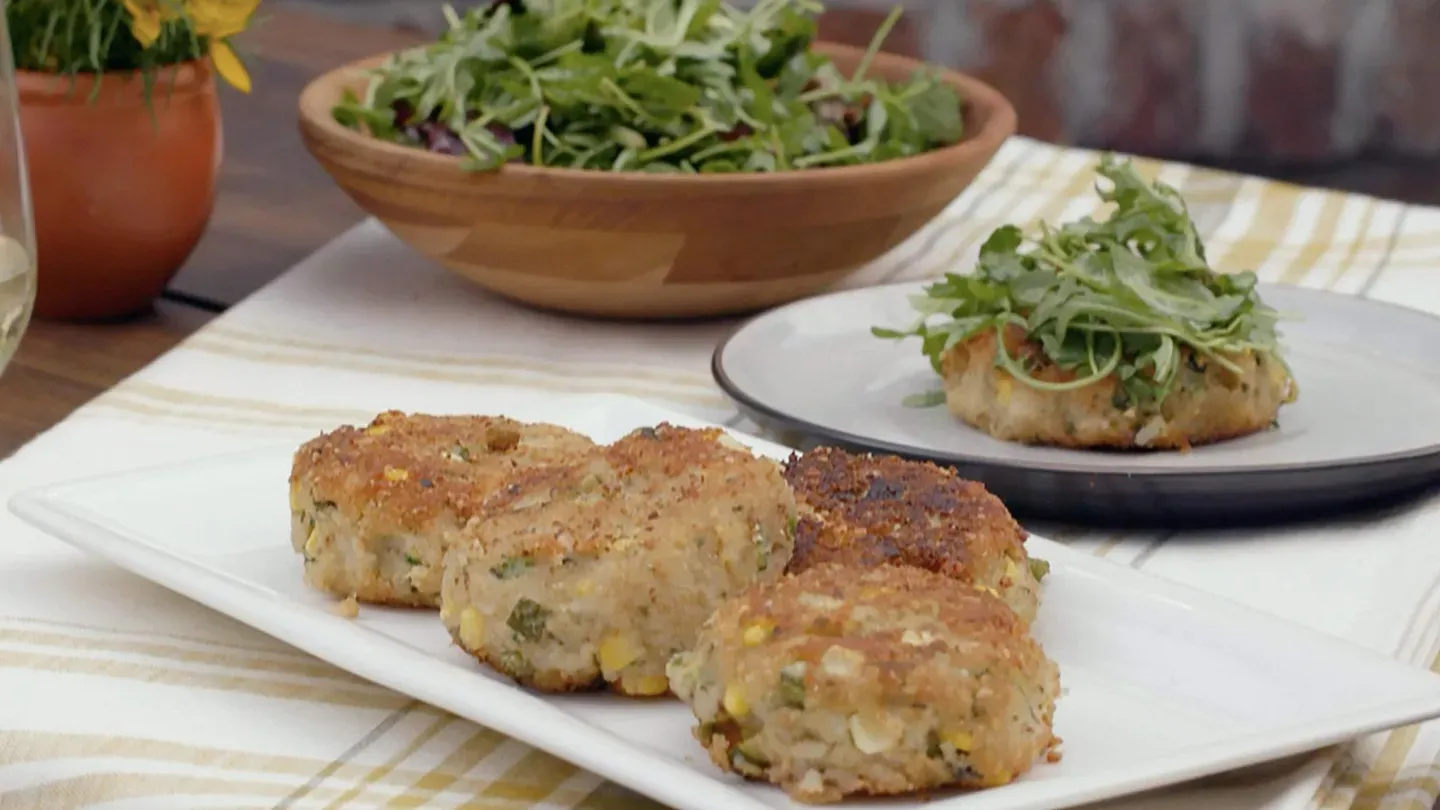
LIDIA: Risotto cakes.
Here's the leftover risotto, and we'll make risotto cakes out of it.
I'm going to add some zucchini.
And I shred the zucchini just like that.
♪ We'll put in an egg to bind it.
♪ A little bit of salt.
Just a little bit.
♪ Some chopped parsley.
Some chives.
And depends on the density of your risotto -- if you need to bind it, always keep in mind those two things, and that is you have the cheese and we have an egg to bind the whole thing.
So let's put some cheese.
And I'm looking at it.
And, yes, the zucchini looks like they have some water in them.
And it's a little wet.
So let's put some breadcrumbs.
And breadcrumbs, you know, arbitrarily.
As much as you think you need.
So you can fry it.
Let me get in there with my -- my hands.
I always say my best tools in the kitchen are my hands, and I think I should get about six risotto cakes out of this.
These risotto cakes are delicious, even for dinner with a salad.
They are also delicious in the morning for breakfast.
If you're having risotto patties, you put a poached egg on top of it.
And if you have a brunch, you have your meal planned out.
Okay.
So, let me clean up, and we'll be ready to fry them.
Let's see.
Here I have Carly.
She made my recipe for potato stuffed mushrooms and sausage but ended up with a bit of leftover stuffing.
What can be done with the stuffing so it does not go to waste?
Good thought, Carly.
Don't waste anything.
So if you have that stuffing, what I would do is turn it into breakfast.
Make little patties, put it in the freezer.
Next day, take those patties as they are.
Sauté them, make it crisp.
Make two eggs next to it.
If you have some potatoes.
And here's breakfast.
Reuse everything.
Don't waste any food.
The risotto cakes have chilled.
They're nice and firm.
We'll just pass them in the breadcrumbs.
No egg, no flour.
Just a little breadcrumbs.
I have here vegetable oil.
The temperature.
Not yet.
Just about.
So we'll wait to put these in.
I'll bread them in the meantime.
You know, these little things are good.
You can also freeze them.
Make the patties like this.
You wrap them in cellophane paper, and then you freeze them.
I think the oil is hot enough.
[ Sizzling ] Yes.
Okay.
And, you know, you don't need that much oil.
Just -- You want the crust to form.
Yes, there is an egg in there, but that will cook.
And the zucchini will also cook in this heat.
That's plenty.
So let them fry.
And, of course, we got to make a salad to go with these cakes.
So...oil, vinegar.
I like red-wine vinegar.
I know balsamic has been in vogue.
A lot of people like it, but I like wine vinegar.
Some salt.
Some mustard.
The question a lot of times -- what is the ratio of oil to vinegar?
Usually anywhere from 1/3 of vinegar to 2/3 of oil.
Or maybe a little bit more vinegar if you like it acidic.
Let me... check how these are doing.
These look good.
They're getting nice and golden.
Let them get a little browner.
And let's go back to the salad.
So, I have here a lot of dressing, and I think it could be a little bit even too much for the whole thing, so I'm going to put what I think is right.
Let me toss it.
This is funny, you know, because if you overdress the salad, the salad becomes heavy.
Ground pepper.
♪ And that looks good.
So let's get back to those cakes.
I think this one is done.
And I'm going to put... to drain.
This one...is done.
And I think they are all done.
So let's plate.
All right.
That looks good.
So, this is number one.
And that's one portion.
And where is Lidia's portion?
That's for Lidia.
And additional guests or whomever might come.
You have an additional four or five.
♪ I would serve mine just like that.
Now let's bring them to the table.
This is for that special guest.
Here... for those extra guests.
A little salad on the side.
Family style.
Let me taste this.
Mmm.
This is delicious.
It really is.
It's sweet.
It's crunchy.
The corn, the peas, and the salad with a little rughetta getting there.
Mmm.
It's delicious.
And now let me try a little bit of the sauvignon.
♪ Indeed.
So...this is leftover turned into another meal.
And tutti a tavola a mangiare!
Let's go!
Mangiare!
♪ Sometimes you're ready to cook something and you have a recipe or you look at a recipe, and say, "Oh, my God.
This is going to make so much.
I'm not going to use it."
But don't be stuck by that.
Even if you are alone, don't get intimidated by the size of the recipe, but rather look at it as an opportunity.
"Yes, we are going to eat half of this.
But the other half, what am I going to do with it?"
And already plan ahead the next meal so it's flowing in your mind already what you're going to do with the other half.
Don't treat it as a leftover.
"The other half."
Inevitably, in our family, you know, after having a meal, Grandmother was adamant about reusing the leftovers... as adamant as she was about her songs and singing them.
ERMINIA: Bevevano i nostri padri?
LIDIA: Si!
ERMINIA: Bevevano le nostre madri?
LIDIA: Si!
BOTH: ♪ E noi che figli siamo ♪ ♪ Beviam, beviam, beviamo ♪ ♪ E noi che figli siamo ♪ ♪ Beviam, beviam, beviam ♪ ♪ ANNOUNCER: The food from this series makes Italian cooking easy for everyone and showcases simple-to-prepare recipes that require fewer steps, fewer ingredients, and less cleanup, without sacrificing flavor.
The recipes can be found in Lidia's latest cookbook "Lidia's a Pot, a Pan, and a Bowl," available for $29.95.
To purchase this cookbook and any of her additional products, call 1-800-PLAY-PBS or visit shop.pbs.org/lidia.
ANNOUNCER: To learn more about Lidia, access to videos, and to get recipes, tips, techniques, and much more, visit us online at lidiasitaly.com.
Follow Lidia on Facebook, Twitter, or Instagram @lidiabastianich.
♪ ♪ ♪ ANNOUNCER: Funding provided by... ANNOUNCER: At Cento Fine Foods, we're dedicated to preserving the culinary heritage of authentic Italian foods by offering over 100 specialty Italian products for the American kitchen.
Cento -- Trust your family with our family.
ANNOUNCER: Grana Padano -- authentic, Italian, rich in tradition, yet contemporary.
And by... ANNOUNCER: Authentic Italian cured meats.
Paolo Rovagnati, the true Italian tradition.
ANNOUNCER: Closed captioning provided by San Benedetto.
"Lidia's Kitchen" studio provided by Clarke, New England's official Sub-Zero and Wolf showroom and test kitchen.
- Food
Christopher Kimball’s Milk Street Television
Transform home cooking with the editors of Christopher Kimball’s Milk Street Magazine.







Support for PBS provided by:
Lidia's Kitchen is presented by your local public television station.
Distributed nationally by American Public Television