
One Foot in Front of the Other
Season 2 Episode 2 | 27m 1sVideo has Closed Captions
Rio and Jay Jay learn about solo backpacking and Filipino and Hawaiian martial arts.
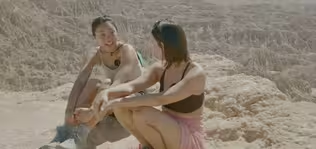
Rio heads to the desert to meet with Isabel Cautivo, a solo female backpacker who loves to hike and inspire people to get outdoors. Jay Jay learns self-defense moves from Pete “Sweet Pete” Salas, a martial arts instructor who preserves and embodies history through movement.
Problems playing video? | Closed Captioning Feedback
Problems playing video? | Closed Captioning Feedback
Out of the Boondocks is a local public television program presented by KPBS
One Foot in Front of the Other
Season 2 Episode 2 | 27m 1sVideo has Closed Captions
Rio heads to the desert to meet with Isabel Cautivo, a solo female backpacker who loves to hike and inspire people to get outdoors. Jay Jay learns self-defense moves from Pete “Sweet Pete” Salas, a martial arts instructor who preserves and embodies history through movement.
Problems playing video? | Closed Captioning Feedback
How to Watch Out of the Boondocks
Out of the Boondocks is available to stream on pbs.org and the free PBS App, available on iPhone, Apple TV, Android TV, Android smartphones, Amazon Fire TV, Amazon Fire Tablet, Roku, Samsung Smart TV, and Vizio.
Providing Support for PBS.org
Learn Moreabout PBS online sponsorshipIsabel Cautivo: I think by showing that I'm outside, other Filipina girls could go outside and feel safe knowing that there's another woman doing what they potentially would like to do; all people of color.
Like, it's always nice seeing someone you kind of relate with in outdoor space.
Rio Villa Ezell: I personally love the desert, but I wouldn't have voluntarily gone out there on a day as hot as this one if it wasn't to meet with someone I admire.
She sets the standard high with a passion requiring her to hike, sleep, and eat in often harsh conditions.
On her visit from the Bay Area, we meet in Anza Borrego Desert, home to the Kuliah tribe and a popular destination to see the spring super-bloom.
I'm here to learn more about her and who she aims to inspire as a solo female backpacker, content creator, and Filipina.
Rio: Hey.
Isabel: Hey.
Rio: Thanks for meeting me here.
Isabel: Thank you for having me.
Rio: I know you normally do your hikes alone.
So thank you for having me come along.
Isabel: Yeah, I'd love to have you.
I am Isabelle Riza Cautivo and I am a solo female backpacker.
Rio: Awesome.
You are very cool.
Isabel: Thank you.
Thank you.
Rio: What was it that inspired you to get into solo backpacking?
Isabel: I used to go to Yosemite and do day hikes and I would see people with their huge backpacks going up all of these steep trails, and I saw them and I was like, "I want to do that.
I don't know how to, but I'll figure it out."
And that's kind of where it sparked.
I think it was, like, 2016, 2017 when I saw someone do that.
And yeah, I figured it out along the way.
My family is not all that outdoorsy, so it was hard to get into the outdoor, like, learn how to get outside, but when we would go on those small vacations and we would see, like, the parks nearby or, like, even visiting their hometown in the Philippines, I would love being outside, and I think from there I just tried to get outside as much as I could.
Rio: Mm-hmm.
What part of the Philippines is your family from?
Isabel: My mom is from Nueva Ecija.
Rio: Me, too.
Oh my God, me too.
Isabel: I did not--really?
Like, Lupao?
My mom is from Lupao.
Rio: Oh my God.
We're from Jaén, Nueva Ecija.
Isabel: What?
Rio: Oh my God.
Isabel: Small world.
Okay.
Rio: We're from the same part of the Philippines and yet here we are in the middle of the desert, like... Isabel: The opposite climate.
Yeah.
Rio: Are you not afraid to be alone out in nature?
Isabel: I definitely am, but I've done what I could do to become comfortable outside, so that means like learning about the area in depth, like getting certified in wilderness first aid and learning self-defense where it allows me to be comfortable outside and to know what to do if something does go wrong.
Like, always follow your gut.
Like, sometimes, like, yeah, it might not be safe, then you can always, like, rearrange your plan and figure that out.
Rio: I don't know about you, but I am super introverted.
One of my favorite things to do is just go walk by myself like near the beach or hikes where I feel safe.
Are you also, like, an introvert or are you an extrovert?
Isabel: I am definitely an introvert.
I can try to socialize when I want to, but I recharge on my own, so I'll do the same thing.
I'll go on walks, like, I'll go on hikes, I'll go on, like, overnight hikes and I recharge, like, just fine, but I still do love going backpacking with my friends.
It's a really fun experience.
But yeah, I love doing it at my own pace.
Rio: What feelings do you have when you are out in the middle of nowhere just on your own?
Isabel: I feel like when I complete or, like, in midway through a hike I, at first, am scared, but as the day goes on I feel very empowered knowing that I can take care of myself in the back country, like, I can bring what I need to on my back, and I can do it alone.
I feel independent, I feel strong and empowered, but it--when I do start, I am terrified.
Rio: Do you think hiking is, like, really good for your mental health?
Isabel: Definitely, yeah, I think just having, like, your body somehow connected to nature really helps.
Like, I know, like, obviously I can't solve everything, but being--feeling--I feel like it helps you feel grounded and it helps give you a space to think and reflect.
Rio: What is your typical routine when you are doing an overnight backpacking trip?
Isabel: It really depends on the trail, but what I like to do is start the trail early.
I don't know how long I'll be on the trail.
Like, depends on, like, how many miles there are.
But I'll start early, take a break during the hike when I get tired, and I try to set up camp before sunset, and during sunset I like to cook dinner, and right when it gets dark I like to just automatically go to sleep.
Like, I am pretty scared of the dark.
Like, any sound outside, any critter, I will get pretty spooked 'cause I don't know what's there.
Rio: I wouldn't expect that from you.
Isabel: I mean, like, I do.
That's why I like to sleep before it gets dark.
It's like I don't care.
Rio: Just don't hear it.
Isabel: But a lot of the times I do bring, like, headphones and I'll listen to, like, white noise or a podcast to fall asleep, but that's my routine, and then I'll wake up, like, around before sunrise, make breakfast, coffee, and then pack up, and head out.
Rio: What's your favorite thing to eat out on the trail?
Isabel: I'm lazy, so I bring dehydrated meals.
I love dehydrated lasagna.
So I'll boil water, add it to that, let it sit, and then eat it in like 20 minutes.
And pad thai.
Pad thai was my go-to for like 2 years, and I finally got tired of it.
Rio: As the sun sets in Anza Borrego, temperatures drop and the wind picks up.
There were aspects of this hike and the camping opportunities that Isabel, an experienced backpacker, found difficult, so one must be ready for all extremes in desert settings.
Luckily, as a professional, she is always prepared.
She walked me through her evening routine of setting up camp, which is second nature to her.
Once she finds the perfect spot, it takes Isabel less than an hour to set up camp, cook dinner, and get ready for bed, a fairly streamlined process that ends with a peaceful sleep under the brightest stars.
Apart from filming herself throughout the hike, using GPS, and listening to calming music before bed, her nature stints are mostly tech-free.
I could understand why she treks off into the wilderness alone.
For those not keen or able to backpack, Isabel's videos can simply be a reminder to flex our willpower and get into nature once in a while.
Rio: So who are you when you're not out in the wilderness?
Isabel: Right now I'm a full-time student at Stanford.
I study clinical lab science.
So I got into a very intensive program.
And there's only four of us at Stanford, so they focus on us, like, a lot, but I make it work 'cause this is what I love to do.
Rio: And how do you balance going from nature and then kind of back into classes?
What is that like?
Isabel: I think it works out really well.
When I'm out in nature I can relax.
We mentioned, like, I'm an introvert, so, like, I have my alone time outside, and once I get back into the lab, I'm recharged so I can just carry on like how I would, and then back when it comes to, like, the weekends I can just go back into nature.
I feel like the weeks where I don't get to get outside, they are rough for me though.
Rio: That's--I think that's really interesting because a lot of people think of resting as being inside and, like, being, you know, on the couch and, like, watching movies and stuff, but your version of resting is, like, getting back into the world and just, like, walking.
So I think most people might think that hiking is like this really, like, strenuous thing, but for you it's the opposite.
The strenuous thing for you is work and then you get to relax when you are out in places like this.
Isabel: Yeah, I think--well, I think it goes both ways.
I do get tired on multi-day trails, but, like, just a quick hike like a mile or 2, like, that does wonders for me, but I also do like to go home and clean up from a day--like, days on the trail and get into bed, my warm bed, not just, like, sleeping bag that sticks to my skin after a couple of days outside, yeah.
Rio: Yeah.
Isabel: I think that's always a nice feeling.
Rio: I understand that, like, solo-backpacking takes an investment.
Like, you have to invest in your gear and stuff and invest in training before you go out there, but seems like it's pretty doable for the average person.
Isabel: Yeah, I think so.
I think I got my first backpacking bag for Christmas and it was, like, not a very expensive bag, and over the years I slowly built my gear to get, like, the essential items.
As I got older and started working, I could pick out, like, what I really wanted, and for training I would literally train in, like, my backyard, like, my local hills.
I would map out the longest trail that I could, do that, like, after class, like, really quickly, and then come back home.
I got lucky 'cause I got more heavily into this during the pandemic and I had a lot of time, so I just hike all the time, and I think that really built the stamina and the endurance that I needed to hike for a long time, but I know you do need, like, a lot of time to do it.
Rio: Sure, and why do you think, like, getting outdoors is such a luxury?
Isabel: You do need, I think, a bit of planning and money to--like, to get outside.
Like, not only do you need, like, gas and, like, a form of transportation, there's equipment that you could bring that could help you, like, enjoy the space much more.
And it gets quite expensive, but there are places where you could, like, rent gear and, like, there are a lot of foundations within the Bay Area that help get people of color outside, and that's actually how I started.
Rio: So I actually came across your content on Tik Tok.
What's it like, you know, also being a content creator and a creative person?
Isabel: It's very interesting.
I never really wanted to show my face too much, like, being outside.
Like, I always wanted to show the views, but I thought, like, "Okay, I should try something new to see if I can, like, do this for a living."
So I was like, "Okay, I have to show my face.
Like, I have to, like, start filming."
And it's been great.
Like, it does add, like, an extra mile to my hikes going back and, like, getting my tripod to, like, film, but I think it's worth it and I think, like, being able to show other people, like, this is what I do and that you can also do it too, like, it's a possibility, yeah.
Rio: If you had any advice for people who want to get into solo backpacking, what would you say?
Isabel: I feel like if you want to get into solo backpacking, start small, like, don't jump into some huge strenuous trip, and plan it thoroughly, let everyone know where you are going, and practice setting up your tent before going, like, just in your backyard, know how to use your gear, research the location, research what animals might be there for, like, your protection.
I feel like go somewhere that's familiar.
Like, go somewhere you've been with a friend backpacking before, and then go back and do it yourself for your first solo trip.
I think that's a good way to prepare and, like, be comfortable outside.
Rio: Mm-hmm.
Who are you trying to, like, inspire with your content?
I mean, you definitely inspired me.
I'm out here right now with you, so-- Isabel: All people of color.
Like, it's always nice, like, seeing someone you kind of relate with in outdoor space.
By showing that I'm outside, other, like, Filipina girls could go outside and feel safe knowing that there's another woman, like, doing what they potentially would like to do.
Rio: I feel empowered by Isabel to continue walking and to rely more on what I can bring with me to enjoy that time longer.
While filming in the desert with our crew was very different from her solo hikes, there were moments of solitude and quiet the desert gifted us.
I see how backpacking there is a great way to connect to the environment and unplug.
Isabel and I said our goodbyes and I wished her happy trails as she walked off into the horizon.
Pete Salas: I wanted my people to be proud, I wanted them to look at it and say, you know, all the values that we share as a people have helped me to excel at this, and I wanted to send a message that if you embrace your culture--and I think that's one of the most important things about our cultures, is the values, the human values.
If you embrace that, you can--the sky is the limit.
You know, you can accomplish so much.
Jay Jay Maniquis: Many enjoy watching martial arts movies depicting an underdog's rise to success, but understanding the history of martial arts styles, their original purpose, and the sacrifices made to preserve them add a deeper layer of appreciation.
I had the opportunity to meet with a skilled teacher in Chula Vista who teaches his students both the physical techniques and the deeper messages behind the art.
Pete: My name is Pete Salas.
I'm the head instructor of this school, which is called Sweet Pete's Martial Arts Academy.
At the current time I'm a 10th degree black belt in the kenpo system from Hawaii and I'm also an instructor in the Filipino martial arts.
Jay Jay: How long have you been doing kenpo karate?
Pete: Actually I started at the age of 14.
I think I started in 1973.
Jay Jay: Wow, nice.
So you've been at it for years.
Pete: It's been a long time.
Jay Jay: Are you from San Diego?
Pete: I'm originally from Hawaii.
Jay Jay: You're originally from Hawaii.
Pete: Born in Hawaii at least third generation.
My mother says I'm fourth, but I know at least third generation from Hawaii on my mother's side.
Unfortunately, I only lived there for about 3 years and then moved over here to San Diego and been in San Diego ever since.
Jay Jay: Have you been all over or is it more of the south side South Bay Area?
Pete: You know, it's really been pretty much the South Bay ever since we moved here.
Jay Jay: That is awesome.
So you were 14, and you started getting into karate, and you've risen through the ranks through the years.
You're a grandmaster?
Pete: Yeah, that just--actually that promotion just came September of last year.
Jay Jay: Well, congratulations.
Pete: Thank you.
I appreciate it.
Jay Jay: And you're a very, very, like, humble guy.
So you wouldn't even, you know, say it unless I asked you.
So what does it mean to have that high of a ranking and be there?
Pete: Well, I jokingly tell people it, first of all, means you're pretty old, but in our system it's--it was a great honor to get there because, you know, they--it--basically they based that rank for us on your accomplishments as far as your training, but it's also in what you've contributed to the martial arts.
So they look at things like if you run a school, if you've promoted several black belts to their black belt rank.
I'm a tournament competitor.
I've been a tournament competitor since I was 14.
So they looked at that.
I had a performance team that traveled all around the state of California performing.
So the instructors that were above me, they looked at all those things.
They got together as a board based on the fact that they felt that I've done some things to make the martial arts better in San Diego.
So they basically voted to promote me, and then they surprised me.
They didn't tell me they were going to do it.
They basically just showed up at the school one day with a certificate and said to my students, "This is what we're going to do."
Jay Jay: That is well-deserved.
Congratulations.
Pete: Thank you.
I appreciate that, Jay.
I appreciate that so much.
Jay Jay: And in terms of joining martial arts or self-defense class for--especially for Filipinos, Filipino Americans, Asian Americans, or anyone for that matter, why do you think it would be important just to at least learn the basics of self-defense?
Pete: Anybody obviously learning self-defense is beneficial for protecting yourself.
I think for Asians especially.
I think it's important because, you know, most of us grew up learning from our parents to be humble, to be polite, to be respectful, to--you know, to try not to cause trouble, and sometimes that can make us targets in our everyday life because people feel like, "You know, these guys are a little bit easier to take advantage of."
So I think for our people it's important to learn to be able to take care of yourself in those situations.
I don't go around fighting very much, but what the martial arts has done is has given me this--you know, this not only the sense of confidence, but the assertiveness, the self-esteem, just a lot of good qualities that you can use every day.
Jay Jay: And security too.
Pete: Absolutely.
Jay Jay: Just knowing that you have these skills-- Pete: Absolutely.
Jay Jay: --to defend yourself.
Pete: Yeah, so I think for us as Asian Americans, it just becomes another tool.
You know, we have our values, you know, we have the things that our parents gave us, which we're thankful for, but when you have that added value of that--you know, that self-esteem, that awareness, that good confidence to know that, "I can handle myself well," I think that--you know, that helps us to survive life.
Jay Jay: Yeah, exactly.
And for me when I'm out walking around the streets and I'm doing my filming, I usually have pepper spray with me, but that's all I have, right?
I don't know any other moves.
So you said you're going to show me a few self-defense techniques today?
Pete: I'd be honored to do that.
Jay Jay: Should we get me in a gi for this or is this-- Pete: I think it would make you feel more like you're doing the real thing.
Jay Jay: Do you have something for me?
Pete: I think I have something that you can try hopefully.
You're a little taller than me, but I think it will-- Jay Jay: Amazing.
♪♪♪ ♪♪♪ ♪♪♪ Jay Jay: This is my first time in a gi, so I'm excited that you're going to show me a few self-defense techniques.
Pete: Well, I thought what we would do is we would do something pretty basic, just a basic block-and-counter strike move, and then I thought we'd incorporate some of the foot movement that we talked about earlier that's based in dance type of movements, and then we'll kind of see how it's applied.
And what we're going to do, once we have that nice balance base, we're going to just put our hands up in this position.
A lot of times what we like to do is practice from this position because-- Jay Jay: Arms open?
Pete: Yeah, 'cause it looks like we're trying to de-escalate the fight.
Jay Jay: Yeah.
Pete: Like, we're trying to say, "I don't want to fight, but we can still fight."
Jay Jay: Got you.
Pete: 'Cause if I do this, it kind of looks like I-- starting a fight.
So we'll go from this position, and we'll just throw a one, two punch, just a basically one, two.
Mm-hmm.
We'll go one, two, and then we'll go two palm strikes.
So we're going to go punch, punch, paw, paw.
Jay Jay: Mm-hmm.
Pete: If somebody came up to you and attacked you, this is a real natural move.
Jay Jay: Yeah.
Pete: So we just take something natural and turn it into a strike 'cause one of the problems in the street is you're filled with adrenaline, you know, the nerves are going.
If I show complicated movements and you're new to this, you're not--you're never going to remember that and it's probably not going to come out, but if I show you this and it's kind of natural, there's a good chance that if you practice it a little bit it'll come out as a strike.
So that's one of the reasons where you like to use it as a basic.
Let's say I come up to you and I'm trying to pick your pocket and throw a couple of those palm strikes at me.
So I come up, and boom.
Go ahead and throw it right at my face.
Bam, bam.
Let's do that just like that.
So I come in.
And you see how natural that is?
You see how that just comes out?
See, you just learned it 2 seconds ago.
Jay Jay: Yeah.
And you throw a little force with the adrenaline, that's going to--that might stop the issue right there.
Pete: So that's one of our favorite basics.
It's just your basic punch strike.
Jay Jay: So the palm strike.
Pete: Yeah.
You know, hopefully you won't have to do it, but if you do you have the tools necessary to protect yourself.
Jay Jay: Definitely.
♪♪♪ Jay Jay: So you're Filipino American as well.
How did you incorporate, you know, Filipino martial arts with kenpo?
Pete: For my school, the culture, both the Hawaiian culture and the Filipino culture, we feel like it's an integral part and a really important part of what we teach.
So I'm happy that I got into the Filipino martial arts.
I think one of the things that fascinates me is there's a common ground in Hawaii and the Philippines.
And it's really interesting 'cause in both Hawaii and the Philippines at one point in time, their martial art was outlawed by the ruling government.
In Hawaii they were not allowed to practice publicly because they were afraid of uprisings and things.
So a lot of the Hawaiian martial artists took the art kind of underground and they started practicing in the form of dance.
In fact, a lot of the original hulas, if you look at them, they were dance movements.
So they would dance and sometimes even entertain the rulers and--but they were really disguising their martial arts movements in their dance.
And then the same thing happened in the Philippines.
When the Spanish were occupying the Philippines there was a long period of time where martial arts was outlawed there too.
So the native Filipinos would do the same thing.
They would dance.
And in fact if you go to a Philippine dance show, a lot of the dances they do are warrior dances.
So they would disguise the fact that they were training martial arts, but they were actually training in case they needed to use it.
So we feel like the reason that's important to know is because the movements that we do are based upon those dance-like activities, but in my opinion I think when you're training it just adds an important dimension to your art when you know where it's coming from and the history of what's behind it, so you understand that these movements are not just, you know, random made-up movements, but they have a history, sometimes a rich history based in dance, in actual combat, in actual battle situations.
And for my students, I want them to appreciate that.
You know, it makes you humble to know that there's so much history behind what we do and it makes you appreciate what you do.
And I think, like, anything else in life, the more you appreciate the background of what you do, I think the better you become at it.
So I require that my students understand this and respect it.
Jay Jay: You need to know exactly why this happened-- Pete: I do.
Jay Jay: --and why these movements are done.
Jay Jay: For the Filipino American community here in the Chula Vista South Bay Area, you've been doing this for over 30, 40 years.
Pete: Yeah.
Jay Jay: How cool and gratifying has it been to see some of these kids grow up?
Pete: One of the things I hear a lot that really makes me feel good is when they come and they say, "What we learned here is, number one, to strive for excellence, number two, to understand that I--you know, I can accomplish anything if I just focus, concentrate, do all the things that we learn in karate."
And so when they say, "You know, this helped me not only to get where I am, but to be successful at it and to excel at it," I like hearing that.
So as I was growing up as a sport karate competitor, it was really important to me to represent my community well.
I wanted to be the kind of person that would make my people proud.
So as I was competing and by the grace of God having some success, I wanted my people to say, "You know, that's one of us that's doing that."
So when I became nationally ranked, it wasn't really about me.
I wanted my people to be proud, I wanted them to look at it and say, you know, all the values that we share as a people have helped me to excel at this, and I wanted to send a message that if you embrace your culture embrace the values that our culture brings--and I think that's one of the most important things about our cultures, is the values, the human values.
If you embrace that, you can--the sky is the limit.
You know, you can accomplish so much.
So I became, you know, one of the few Asians from the San Diego area to ever become nationally ranked in the sport karate circuit, so-- Jay Jay: Wow, that is very impressive.
Pete: Well, I'm proud of the--that part of it, you know, the part that I could do something that hopefully would make my people proud that I was one of them.
Jay Jay: Well, you definitely do, not just the Filipinos but also the Hawaiians.
Like you said, it all mixes together because we have a lot of shared values in our systems.
So thank you for showing me a few things.
Pete: You did absolutely great.
Jay Jay: And Chula Vista is happy to have you all these years.
I know you said you've been on the same street on Third for how long?
Pete: When 2025 rolls around, and I'm going to make myself sound old, but it's going to be 40 years that the school is been in operation.
Jay Jay: Wow, congratulations.
Pete: What a blessing to be part of this community for that long, like you said.
Jay Jay: Well, Pete, thank you so much for talking about your journey through martial arts.
Pete: Thank you.
Jay Jay: It was really awesome.
And thanks for showing me a couple of moves in the self-defense techniques.
I may have to use them one of these days.
I'm always out on the streets with my camera.
You never know what's going to be around, so-- Pete: That's right.
Jay Jay: Thank you so much and much love.
Thank you.
Pete: My pleasure.
Isabel: I also like to pick up stuff from H Mart, and-- Rio: H Mart?
Isabel: --they have, like, good stuff that, like, you don't need to refrigerate.
male: Two seconds?
Rio: Yeah.
male: Your head is covered in bugs, dude.
They are all over you.
Rio: Okay.
male: It's the wet.
Jay Jay: That good?
male: That's great.
Jay Jay: No, you're not going to get a yell from me.
male: All right.
I'll make you look epic, man.
Don't worry.
♪♪♪ ♪♪♪ female announcer: Support for this program comes from the KPBS Explore Local Content fund, supporting new ideas and programs for San Diego.
Video has Closed Captions
Preview: S2 Ep2 | 30s | Rio and Jay Jay learn about solo backpacking and Filipino and Hawaiian martial arts. (30s)
Providing Support for PBS.org
Learn Moreabout PBS online sponsorship













Support for PBS provided by:
Out of the Boondocks is a local public television program presented by KPBS