
One on One With Chicago's Budget Director
Clip: 9/16/2024 | 9m 46sVideo has Closed Captions
The city is projecting a nearly $1 billion shortfall in the 2025 fiscal year.
The city is projecting a nearly $1 billion shortfall in the 2025 fiscal year. Chicago officials have since issued a hiring freeze, as well as limits to travel and some overtime in an effort to right the fiscal ship — but there are still gaps that need to be filled.
Problems playing video? | Closed Captioning Feedback
Problems playing video? | Closed Captioning Feedback
Chicago Tonight is a local public television program presented by WTTW
WTTW video streaming support provided by members and sponsors.
One on One With Chicago's Budget Director
Clip: 9/16/2024 | 9m 46sVideo has Closed Captions
The city is projecting a nearly $1 billion shortfall in the 2025 fiscal year. Chicago officials have since issued a hiring freeze, as well as limits to travel and some overtime in an effort to right the fiscal ship — but there are still gaps that need to be filled.
Problems playing video? | Closed Captioning Feedback
How to Watch Chicago Tonight
Chicago Tonight is available to stream on pbs.org and the free PBS App, available on iPhone, Apple TV, Android TV, Android smartphones, Amazon Fire TV, Amazon Fire Tablet, Roku, Samsung Smart TV, and Vizio.

WTTW News Explains
In this Emmy Award-winning series, WTTW News tackles your questions — big and small — about life in the Chicago area. Our video animations guide you through local government, city history, public utilities and everything in between.Providing Support for PBS.org
Learn Moreabout PBS online sponsorship>> Chicago is facing a 223 million dollar budget gap this year.
But that's not all.
City is also projecting a nearly billion dollar budget shortfall in the 2025 fiscal year.
City officials have since issued a hiring freeze as well as limits to travel and some overtime in an effort to right the fiscal ship.
But there are still gaps that need to be filled.
Mayor Brandon Johnson says the challenges the city currently faces are significant.
That sacrifices will be made in the gap underscores the need for strategic decisions.
Here to talk more about those strategic decisions is and that Guzman, budget director for the City of Chicago.
Welcome to Chicago tonight.
Thank you for having So Mayor Brandon Johnson has blamed the structural problems with Chicago's finances for the projected 982 million dollar budget gap next year.
Did the Johnson administration do enough to prepare for this moment since it was predicted a year ago?
>> You know, I think that, you know, we've we've we've done a number of things since coming into One when we first got in, we have 4 months to create a budget before it had to be passed by City Council.
But since that time, January, beginning this year, we did start to look at our expenditures to better understand, you know, where our expenditures we're going also where our revenues are coming in.
We we project out month after month prepare report starts in council to public to understand how are we achieving against our budget.
so as we saw our revenue starting to come a little bit softer this year, we started to contract on our expenditures, which is why in our budget forecasts, forecast that we would at least 200 million less than what we budgeted for this year.
And that was because of what we were seeing that the revenues, one thing that we didn't anticipate that came to us a little bit later in the year was the non receipt of a very critical revenue source that we used to support our pension obligations.
And so once that became even more evident that that wasn't something that 100% knew was going to calm.
We started to restrict our expenditures even further.
One of the conversations between the city and CPS been like with regards to that pension payment that the school district has opted not to pay.
>> So, you know, we continue to have conversations with CPS of the Board of Education because as much as we commit to supporting our workers who, you know, put in their blood, sweat and tears and spent years in city service and in CPS service.
We want to make sure that we are making good on that commitment with the Board of Education, shifting away from one that's merrily control to one that's elected.
We have to start to shift toward CPS being able to support their costs independent of the city's resources.
And so those conversations have been about how do we make sure that we are working together to ensure that our our schools have the resources they need that we're talking at both the federal level and the state level in support of our colleagues at CPS to ensure that they have those resources were still in conversations.
As as I've said many times, people we still expect the payment to be made.
But at the time that the forest forecast comes out, we have to be honest about what we know at that time.
And at that time, CPS had created a budget that did not include that payment.
It for next year.
If the problem is structural, what kind of changes are necessary to prevent deficits from happening year after year?
>> I think, you know, you asked me earlier, what have we been doing since we got into office?
If we knew that this was coming?
You know, one of the things that we've been doing is really looking at department budgets really looking at how our contracts are structured, looking at what projects were in place that, you know, were approved under former administrations that we have to ask ourselves are the still important?
Are these still critical projects that have to move forward if they have to move forward if they move forward in the same way that they were originally proposed, you know, and we're also having very serious conversations about where the revenue source is that we need to support the work going forward.
The mayor has been very transparent that, you know, he's always going to be putting forth referee proposals in front of city council.
The once he thinks are necessary.
The once think reasonable to make sure that the services that the city of provides in these are critical services that the city does provide can continue on into the future.
The mayor has, you know, vowed to minimize the impact on city services and programs in the workforce.
But of course, you know, we've also expressed of the city has also expressed that sacrifices will have to be made instituting a hiring freeze citywide.
>> But how much will those steps actually help towards getting you where you need to there already You know it being very intentional about what hiring can continue through this year.
Weve immediately seen those savings every every day.
We see those savings because they are being spent on on personnel.
>> And so we work really closely with our departments to understand like what critical services and what critical needs are, what emergency needs.
We'll go unmet if we don't allow a specific position to be hired in 2.
Those are the conversations we're having directly, especially with our public safety departments.
We were.
Can talk very frequently with CPD with our Emergency Management office with our fire department to ensure that we can continue to provide those services and that we're not creating gaps for the safety of our residents.
What other solutions are immediate solutions are on the table for now.
We're looking at critical projects as well you projects that we that we doing with our space needs are do we need to move forward with changing our spaces right now and building more offices, things like that.
We're also looking at what cost that we can hedge against what energy costs seem to be higher.
How do we how do reduce our energy consumption to ensure that we can still save on those costs.
We're looking at it projects that we had no great.
you know, we wanted to make sure that those things got done, but they're coming in slower than we thought they were gonna come.
And so are those projects that are needed to move forward this year.
Can they be delayed even further but still not impact the ability to provide city services.
How long do you anticipate this hiring freeze might last and and what impact might that have on some of your department and the services they provide?
So right now the hiring freezes in place until the end of the year.
If things change with some of our revenue sources that could have an impact on whether or not the hiring freeze continues through the end of this year.
But I want to be really clear.
You know, we have to understand where our budget for next year is going to because the last thing we would want to do is to hire into position and then not have the resources to support that next year.
Even long term.
So we're having those critical conversations with our departments.
You know, what are the things that we need to have in place to make sure that we provide the basic services that we are required to provide that the city has come to expect of government and what things where, you know, we might have to delay that because our resources are not sufficient to match.
You know, our ambitions.
Now, the mayor, in this instance, he has not ruled out increasing property taxes, though he campaigned on that and saying that he would not do that.
But other than property tax increases.
>> How could the city creator generate revenue to help fill this Sure.
glad you asked that question.
So, you know, right now, you know, our main funding source for most for operations or corporate fund, our corporate find is actually supporting a lot operations that actually said on other funds as well.
And so we're looking at a number of things our fees properly calibrated to support the cost of the service that they're providing because the corporate find right now is supporting that because they're, you some of them might be a lot lower than they have not changed in 2030, years where the cost of those services have obviously changed over the last 30 years.
We're having conversations at the state level about resources and revenues that we think will help actually get us over the long term to more structural balance.
so those are the conversations that we think will have much more long-term impact to help us get to a place where our resources are meeting that the services that we provide.
And of course, you'll have to convince 26 out of 50 older people to vote in favor to support the mayor's budget in October.
Tell us a little bit about what's next and what challenges you anticipate with getting all the men on board.
Yeah, 26 is is a high bar it's it's not impossible.
But we know that they're they have ambitions.
They have desires to see nothing's happening within their words and within the city barge.
And so those are conversations that we're having right now to truly understand.
How can be a line, those ambitions with what our resources provide for.
You know, a lot of our alders are really clear about the exercise.
The really clear about the challenge and they know at the end of the day there certain things and that the city must do and has to provide because we're the only ones that provide that service.
And so I think that will focus on, you know, what is it that we're preserving within this budget that we know is critical and that your constituents look to the city to provide one of the things that we can start to continue to shift our budget to support that are also really important to the people that live in their in their words as well.
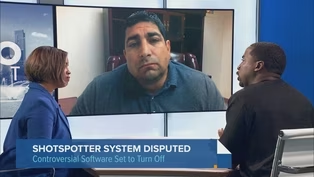
Chicago's ShotSpotter Contract Coming to a Close
Video has Closed Captions
Clip: 9/16/2024 | 9m 44s | Some City Council members are making a last-ditch effort to save the controversial technology. (9m 44s)
Providing Support for PBS.org
Learn Moreabout PBS online sponsorship
- News and Public Affairs

Top journalists deliver compelling original analysis of the hour's headlines.

- News and Public Affairs

FRONTLINE is investigative journalism that questions, explains and changes our world.












Support for PBS provided by:
Chicago Tonight is a local public television program presented by WTTW
WTTW video streaming support provided by members and sponsors.