
One portrait speaks a thousand words
Clip: Season 12 Episode 8 | 5m 59sVideo has Closed Captions
The Memory Project aims to create a kinder world through art.
The Memory Project connects high school art students with children in 57 countries through handmade portrait gifts. Students study photos of children in orphanages, refugee camps and conflict zones, creating personalized artwork that becomes a meaningful keepsake.
Problems playing video? | Closed Captioning Feedback
Problems playing video? | Closed Captioning Feedback
Wisconsin Life is a local public television program presented by PBS Wisconsin
Funding for Wisconsin Life is provided by the Wooden Nickel Fund, Mary and Lowell Peterson, A.C.V. and Mary Elston Family, Leon Price & Lily Postel, Stanley J. Cottrill Fund, UW...
One portrait speaks a thousand words
Clip: Season 12 Episode 8 | 5m 59sVideo has Closed Captions
The Memory Project connects high school art students with children in 57 countries through handmade portrait gifts. Students study photos of children in orphanages, refugee camps and conflict zones, creating personalized artwork that becomes a meaningful keepsake.
Problems playing video? | Closed Captioning Feedback
How to Watch Wisconsin Life
Wisconsin Life is available to stream on pbs.org and the free PBS App, available on iPhone, Apple TV, Android TV, Android smartphones, Amazon Fire TV, Amazon Fire Tablet, Roku, Samsung Smart TV, and Vizio.
Providing Support for PBS.org
Learn Moreabout PBS online sponsorship- Ben Schumaker: I knew how powerful it feels to study someone's face and to try to capture every detail of their eyes and their smile to create the most personal form of art to give to that person as a gift.
It's extremely intimate.
It looks like an art project, but in truth, the real purpose is trying to bring youth around the world together in a positive way.
My name is Ben Schumaker.
I'm the director of the Memory Project.
The Memory Project is a youth arts organization that has a mission of creating a kinder world through art.
So, these photos were... We gather photos of children around the world, and then we give those photos to high school art students who study the children's faces and create handmade portraits as gifts for them.
And then we deliver those portraits to the children.
When we started 20 years ago, we were focusing mainly on orphan, children in orphanages.
We called it the Memory Project because many of those children didn't have any keepsakes that could be a special memory of their childhood.
We thought, well, let's create this beautiful portrait to really capture the child as a work of art and give them that special memory, something they can hold in their hand and take with them through the rest of their life and to know that, you know, someone cared enough to help them capture that piece of their personal life story, how their story began.
We've made portraits for kids in 57 different countries.
We started with children in orphanages, and then, over the years, we started to reach out to children in all types of different situations.
Children in refugee camps, children living in slums or extreme poverty, children living in conflict zones where they're literally hearing gunfire and bombs.
What we ask all of our students to create is on the front of the artwork, that's the portrait of the child.
Some students are using digital art, mixed media, however they want to portray that child, capture that child as a work of art.
But then on the back of the portrait, that's where we ask the high school art students to put a photo of themselves so that the children who receive the portraits can see who made it for them.
And we also ask them to trace their hand so that the kids can touch hands with them symbolically.
- Abby Otteson: I have never seen our kids more focused on a project than the Memory Project.
I think their heart really goes into getting to know the kid.
It's really fun that the kids suddenly say, "Oh, this is my kid," and they take ownership over those little kids.
It's a perfect project to be able to have our kids give back with art.
And it does turn out to be the most meaningful project that our students take part in.
- Isla Holmstrom: I am painting Rachel.
She is seven, and her favorite things are reading and swimming.
Since she describes herself as fun, I want to use a lot of different colors and undertones to really bring out some of that colorful, fun energy that she has.
I just think it's cool to be able to really show who a person is and, like, capture who they are in an image.
But there's a different level of creativity and a different level of expression you can get when you're painting or drawing.
- Ben: At certain times of year, hundreds and hundreds of packages of portraits come into my mailbox.
My coworker, Sarah and I, open every package.
Then we bring them here to my parents' house.
We get a whole bunch of their friends together, volunteers, for a whole day just to sort all those thousands of portraits into numeric order.
And by the end of the day, we have all the portraits in order and then we can do our final processing of them, pack them into bags.
And ultimately, take them on an airplane to wherever they need to go.
And then we'll host a big event for the kids.
It feels like a big party.
And just, it's a wonderful celebration.
[children sing] We deliver all of these portraits.
Fresco, there you go!
It is amazing to see how the kids love to see the portrait, to see themselves for the first time.
Okay, who is this?
They're very surprised that someone would, that they've never met, that this stranger took the time to create this gift for them.
Hugh made that for you.
It's fantastic to watch their reactions.
There you go, good, good.
So you're touching hands with Margot.
[chuckles] We really hope that our art students will realize how impactful their action was, that they took this action to selflessly create this portrait or a piece of identity art, and that it resulted in this magnificent event on the other side of the world.
But I personally feel it's just as important to educate our nation's youth on how to be the most caring, kind people we can be so that we can create a kinder society, which is why the mission of the Memory Project is to create a kinder world through art.
Yes!
This was emailed to me yesterday from a teacher in Massachusetts who has been doing this for 14 years.
He said, "I have had a generation of students "take part in this project, and the experience has been invaluable."
Rachel!
It's beautiful!
"In addition to the international bridges "of goodwill and the lasting memories provided to those in challenging situations..." - Thank you!
- Ben: "... our students have benefited so much from participating."
- Thank you!
- Ben: "It is increasingly rare for students "to have the opportunity to perform a truly selfless act.
"So many of my students got to make art for a higher purpose "than a grade or a possession.
"Thank you so much, and I hope you you will keep the project going for a long time."
[gentle music]
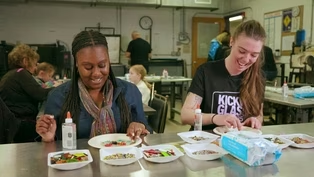
Bergstrom-Mahler Museum of Glass makes art accessible
Video has Closed Captions
Clip: S12 Ep8 | 3m 36s | The free glass museum in Neenah invites families to create art at monthly activity days. (3m 36s)
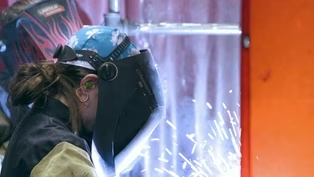
Mentoring the next generation of welders
Video has Closed Captions
Clip: S12 Ep8 | 3m 44s | Wanda White mentors teens in a six-week welding class focused on basics and safety. (3m 44s)
Preview: Bergstrom-Mahler Museum of Glass
Preview: S12 Ep8 | 30s | Take in vibrant glass art at the historic Bergstrom-Mahler Museum of Glass in Neenah. (30s)
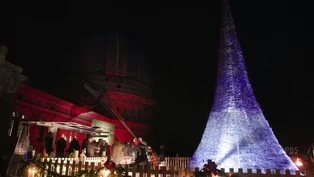
Creating the world's tallest glass tree
Video has Closed Captions
Clip: S12 Ep8 | 3m 38s | Glass artist Jason Mack helps create a one-of-a-kind holiday experience. (3m 38s)
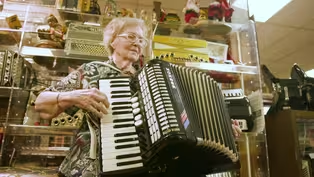
World's largest accordion museum preserves musical heritage
Video has Closed Captions
Clip: S12 Ep8 | 5m 23s | A musical family history inspired Helmi Harrington to create Superior's accordion museum. (5m 23s)
Providing Support for PBS.org
Learn Moreabout PBS online sponsorship













Support for PBS provided by:
Wisconsin Life is a local public television program presented by PBS Wisconsin
Funding for Wisconsin Life is provided by the Wooden Nickel Fund, Mary and Lowell Peterson, A.C.V. and Mary Elston Family, Leon Price & Lily Postel, Stanley J. Cottrill Fund, UW...