
One Year into the Pandemic with Governor Whitmer
Season 4 Episode 20 | 23m 55sVideo has Closed Captions
One Year into the Pandemic with Governor Whitmer | Episode 420
Christy takes a look back at the year with Gov. Gretchen Whitmer, Bill Kubota talks to epidemiologist Dr. Abdul El-Sayed and virologist Oveta Fuller about five things we'll be hearing more about in the months to come. Plus, Nolan and Stephen discuss the transparency of decision making and the governor’s emergency powers. Episode 420
Problems playing video? | Closed Captioning Feedback
Problems playing video? | Closed Captioning Feedback
One Detroit is a local public television program presented by Detroit PBS
One Year into the Pandemic with Governor Whitmer
Season 4 Episode 20 | 23m 55sVideo has Closed Captions
Christy takes a look back at the year with Gov. Gretchen Whitmer, Bill Kubota talks to epidemiologist Dr. Abdul El-Sayed and virologist Oveta Fuller about five things we'll be hearing more about in the months to come. Plus, Nolan and Stephen discuss the transparency of decision making and the governor’s emergency powers. Episode 420
Problems playing video? | Closed Captioning Feedback
How to Watch One Detroit
One Detroit is available to stream on pbs.org and the free PBS App, available on iPhone, Apple TV, Android TV, Android smartphones, Amazon Fire TV, Amazon Fire Tablet, Roku, Samsung Smart TV, and Vizio.
Providing Support for PBS.org
Learn Moreabout PBS online sponsorship- Hi, I'm Christy McDonald and here's what's coming up this week on "One Detroit."
Marking a year since COVID changed all of our lives, where we've been, and what the future holds.
I talk with Governor Whitmer.
Plus equity in healthcare, new office rules for businesses, and economic recovery.
Nolan and Steven debate What's next policy-wise in Lansing and transparency and what the next generation thinks post COVID.
It's all coming up on "One Detroit."
- [Announcer] From Delta faucets to Behr paint, Masco Corporation is proud to deliver products that enhance the way consumers all over the world experience and enjoy their living spaces.
Masco, serving Michigan communities since 1929.
- [Male Announcer] Support for this program provided by the Cynthia and Edsel Ford Fund for Journalism at Detroit Public TV, the Kresge Foundation, Community Foundation for Southeast Michigan.
- [Announcer] The DTE Foundation is a proud sponsor of Detroit Public TV.
Among the state's largest foundations committed to Michigan-focused giving, we support organizations that are doing exceptional work in our state.
Visit DTEfoundation.com to learn more.
- [Male Announcer] Business leaders for Michigan, dedicated to making Michigan a top 10 state for jobs, personal income and a healthy economy.
Also brought to you by and viewers like you.
(upbeat music) - Hi there, and welcome to "One Detroit."
I'm Christy McDonald.
So glad to have you with me.
So this week marks one year of shooting and producing "One Detroit" from my house.
March 10th, 2020, we found out about the first cases of COVID in Michigan and our lives all drastically changed.
What a year it has been.
The week the world changed, March 10th, 2020.
We experienced lockdown.
Schools closed.
Restaurants, retail shuttered.
Factories screeching to a halt.
Getting contactless groceries, investing in vats of hand sanitizer, not meeting with our loved ones, the fear of getting COVID, and watching the numbers rise, losing family and friends from the disease.
Nurses and doctors became our heroes.
We learned how to make and wear masks.
And dealing with the crisis in our homes, with our kids, worried about our health, brought us to a common feeling of what next?
Here at "One Detroit," we Zoomed our way through multiple interviews a day, changed our operations to home base.
Now a year later, the death toll in Michigan is over 15,000.
Vaccines are being distributed as quickly as supply can keep up from three manufacturers.
And as we move forward, a look at the future of healthcare, how COVID has exposed inequities in the system.
Then heading back to work, will office space ever be the same?
As for schools, more kids are back in-seat, but districts making different decisions based on community need.
And in Lansing, policymakers wrestle with spending, transparency, and the governor's powers in an emergency going forward.
It's been a year, with so much more ahead.
(upbeat music) When you look back at this year what would you say the largest accomplishments of your administration have been?
And then what would you say, you know, in hindsight, we did a couple of things here that may not have been the best idea?
What would you have done differently?
- Yeah, that's a great question.
I think, you know, as we commemorate this moment, it's really important to recognize the incredible toll that COVID took on our state and is still taking on our state, right?
Almost 16,000 Michiganders have lost their lives to this virus.
That's three, over three 9/11 events that one state has sustained in 12 months.
It's staggering when you think about it, and remembering how dire things were a year ago when we couldn't get enough masks to even get our hospitals through a weekend of shifts with ERs that were filled with COVID patients and an incredible death toll that was climbing so quickly every day.
So I think that as we look back on this year, I'm grateful and inspired by the people of our state who have taken upon themselves to do their part.
I'm grateful for Dr. Khaldoon and the Department of Health and Human Services and University of Michigan School of Public Health and all of the different people and groups that came together on Merck to help advise us in our next steps that we take for re-engagement.
So we've done, you know, we followed the science.
We saved, studies have shown we saved thousands of lives, but of course, if I could go back in a time machine with all the knowledge we've accumulated, would we do some things different?
Sure, but we have to recognize this has been a novel virus, and we've been learning every step of the way, and we've made adjustments so that we can protect people.
- Let's talk a little bit about that federal funding that's coming to Michigan to recover from the pandemic.
Explain how you see this working for Michigan and what your top priorities are.
- So these resources are, give us an incredible opportunity to make some investments in things that will not just help us get out of this tough time we've been confronting, but to lay the groundwork for some, putting Michigan in a leadership position in a lot of ways.
I think one of the concerns that I have of course is the legislature has been not moving federal funds to deploy them into our economy.
We have to get past whatever it is that's holding them back because when we have $5 billion coming into Michigan for the education of our kids, for the dissemination of our vaccines, help for small businesses, we can't let anyone get in the way of us getting that deployed into our economy.
And unfortunately, that's what has happened.
As we look to this new COVID relief bill, there are going to be so many resources.
And the work we do in the next couple of months is gonna set the tone for our ultimate economic resurgence and success.
So whether it's meeting the needs of our children who have learning loss because of COVID, or it is helping small business get back on their feet, or it is the vaccination dissemination, we've gotta get these done right, and we've gotta find common ground together quickly 'cause minutes are, can be very costly if we're not deploying these resources.
- Let's talk about it, which can only be described really as a power struggle between your administration, the Republican majority in the legislature that wanna tie spending to reduced emergency authority.
How do you explain to critics why the authority of the state health department, your ability to implement emergency parameters should not be changed at this time and after this year?
- Well, first let me, let me explain that these federal dollars have gone to every state, no strings attached.
They are to be used, I mean, they are prescriptive, right?
They are to be used for things like getting our kids back in school, vaccine rollout, to help small businesses, to say that these dollars won't be used for the benefit of the people of Michigan unless we take away the tools that the governor has used to keep us safe is dangerous on all fronts.
These are dollars that were allocated, signed into law by Donald Trump, supported by a bipartisan group of our congressional delegation that the legislature is looking backward.
And they're mad about things that happened last year, not putting $5 billion into our economy.
These are dollars that will help us get back on track.
So to say that they're only gonna do it if I give up powers that we've been, they've been trying to take away for the last year, they know what the answer is.
And so they're playing games with money that's so important for the people of our state.
And so I'm hopeful that they will discontinue that, so that we can deploy these resources and help our small businesses and our families get through this time.
- Yeah, where's the common ground on that?
Because people in Michigan might be saying, oh gosh, here we go again, power struggle back and forth.
Nothing gets done.
What do you say to that?
- Oh, we're getting a lot of things done, and we will find some common ground.
There's no question.
You know, dealing with a legislature that wants to take executive powers away from the governor, I mean, we've been seeing this for the last few years.
It's not surprising.
It's disappointing though because we have to move fastly to get these resources deployed for the health of our economy.
(upbeat music) Now we're in a position that we can re-engage more of our economy.
Today we are announcing that restaurants and bars can operate at 50% capacity.
- Effective next Wednesday, all businesses of any type are allowed to open 100%.
Also, I am ending the statewide mask mandate.
(audience cheering and clapping) - We are 50 states in the USA, and different States can set different regulations.
Unfortunately, the virus knows no borders.
- The reality is that Ohioans continue to die each day from the virus, but there is something seemingly even more tragic and poignant about a death that occurs when the war is almost over.
- I think as we come out of this pandemic there is going to be a real question about how do we think about risk.
- Dr. Abdul El-Sayed, an epidemiologist who ran for Michigan governor, now, a podcaster and author.
His latest book about "Medicare For All."
- If people want to get to a point where there is zero risk of getting coronavirus, that's not gonna happen for a very long time, frankly, if ever.
- The pandemic will end, so what should we expect?
I made a list.
One, we won't know when the pandemic's officially over.
Leave that to the historians of the future.
- This is not the kind of thing where we declare victory, and you know, the troops come home.
There's still gonna be risk of transmission.
It's still going to take lives, but at a far lower rate, and we're still gonna need to protect ourselves from it.
And it's probably gonna end up very similar to the flu which you know, started out as a roaring pandemic.
And now is something that unfortunately takes 50 to 70,000 lives a year.
So it's going to be with us for awhile.
- [Bill] Number two, masks and social distancing won't end soon if you listen to the public health people.
- What's probably gonna happen is that this virus is gonna become endemic, meaning that we're gonna need to be wearing masks for a while longer.
- When that masking all clear does come, you should still keep them handy.
Oveta Fuller's a virologist at the University of Michigan Medical School.
- And so I think there might be surges and periodic times when we might have to don our masks again, but that won't be always, all the time because if we work together, we can reduce the amount that's in the atmosphere, reduce the number of people that are infected and keep them from producing lots of virus that go into the environment.
- [Bill] Three, expect more COVID variants.
They'll keep popping up.
- These variants are going to continue to be a wild card in our calculus.
Every warm body that this virus infects is a new evolution opportunity.
And because it's a new evolution opportunity, there is a real risk that we are gonna have yet more transmissible and yet more deadly viruses at the same time, right?
- [Bill] But now we have vaccines.
So number four, expect more vaccinations to come.
More manufacturers in the game and booster shots to cover the newest variants.
The challenge?
Getting more to take their first round of shots.
- There is a lot of vaccine hesitancy, and I just wanna do some math for folks.
You know, 20% of the population is under the age of 16, so they're not eligible to receive a vaccine at all.
We know that we need to get about 70 to 90% people vaccinated to achieve herd immunity through this vaccine and finally bring the pandemic to its knees.
So you take 20% off the top right there, and now you're talking about 80%.
That's if every single adult chooses to get vaccinated, and upwards of 25% say that they're not ready yet.
- Doctor El-Sayed figures the coverage at around 50%, problematic!
- I would hope that by fall of this year that we could see that children may be vaccinated and be, also have immunity.
You know what, it could be, who knows?
It might be something that we do like measles, mumps.
You know, at four years old you get your COVID vaccine for the first time.
- [Bill] Five, expect more misinformation.
Stuff social media just can't shake.
- Please share this video now.
- [Bill] Here, a physician who claims vaccines will change your DNA and turn people into crypto currency.
- So there's going to be and continue to be, you know, misinformation about this thing.
And we're gonna have to lead with the science and the evidence and be fully 100% transparent in what is going to be a very unsure and unsettling situation because there is no perfect outcome.
- (laughing) I've done okay so far?
- [Bill] Then there's the Centers for Disease Control.
That government agency has a new director.
- Historically, the CDC is not very political.
- And then we hear politicians starting at the White House talk about how there's nothing to worry about, how public health is overplaying this.
- It seemed like some of that got a little bit more politicized than we've seen in the past, regarding science versus point of view, politically.
What's in store for things now?
- Coronavirus got politicized.
And because of that a lot of people lost lives and health and income, and it could have been avoided.
You can see the CDC turnaround already.
There's public health information that's coming out.
There's a single message about things.
So I've seen the turnaround already, and it's very welcomed.
- There are a lot of policy and spending decisions to be made moving forward, including the transparency of decision making and the governor's emergency powers.
And governor Whitmer's agenda and the agenda from the Republican majority in the legislature are at odds.
"One Detroit" contributors Stephen Henderson and Nolan Finley debate the biggest sticking points.
- Steve, if we thought that the pandemic was going to bring us together that certainly wasn't the case in Lansing.
The mistrust, the anger between Governor Gretchen Whitmer and the Republican-controlled legislature stronger than ever.
- Yeah, it is.
And look, I'm not ambivalent about this.
I think, you know, the things that the governor did were reasonable responses to a pandemic the likes of which we've never seen before.
She did what needed to be done.
She had the power to do that in most of the cases.
Republicans have made this into a political issue.
It is about control for them.
They don't like that what she did affected a lot of their constituents, businesses who pay for a lot of Republican politics in this state, but her priority was the citizens and trying to protect them.
I mean, I've not seen a more garish dereliction of duty to protect citizens and put their interests first than this tantrum that the Republicans have been throwing for months and months now, and now holding up this federal money, which is critical to all kinds of things, including the reopening of schools which we're starting to see.
Schools need that money to make sure they can reopen in the safest possible way.
- The only justification is to force some transparency from this governor.
Governor Whitmer has been one of the least transparent governors we've ever had.
She keeps talking about science and data and justification and doesn't share it.
We saw that with the recent confidentiality agreements with the health director.
That has never happened before, in at least in the past four decades.
What is she hiding?
And why does she feel that this public information is hers to control?
That information belongs to us.
You can't fault the legislature for wanting to know what's going on.
- Yeah, I don't fault them for wanting to know what's going on.
We all have a right to know as you point out.
It's our information, but leveraging this money which is critical to again getting a handle on the public health crisis, literally stopping people from dying is absolutely the wrong, the wrong approach.
The GOP leadership there is focused entirely too much on the power struggle.
It's not that I don't think they have a legitimate issue on transparency.
I think they do.
They don't have a legitimate issue on control I don't think which they keep, continue to apply as well.
- Well, they very much do, Steve.
I mean, this law was never tended to go forever.
And when it was put in place, the justification was we don't want our hospitals to get overwhelmed.
We have to bring down this death rate.
Death rates coming down, will continue to come down with vaccines.
Hospitals haven't been overwhelmed.
I was very open in my opinion, throughout the last year that much of governor Whitmer's policymaking and approach to governing was rooted in her political ambitions, in her desire to be on the Biden ticket.
And she fueled that suspicion with this secrecy that she surrounded herself with.
And when you have an executive who feels that way, who doesn't feel accountable, then you have things happen like these secret payoffs.
- Well, she is accountable.
She's accountable to the people who will get to vote in two years.
- In two years, but the policies aren't accountable in the moment.
- Whether she gets another four years.
She isn't accountable to the legislature, and even if she were, the position that these guys have taken is so absurd.
And so obstructionist that you can't fault her for not dealing with them.
I mean, these guys are running around, palling around with the same white supremacists who were threatening her life, and won't come out and say, hey, I don't want anything to do with that.
They're speaking one thing to the public and saying another thing behind closed doors.
Talk about transparency, they have their own huge transparency problem.
I don't think you can blame the governor here for her first focus on the pandemic, and second insistence that she not be held hostage by dishonest brokers.
- Well, she owes the people accountability, and she has resisted that I think.
- She does owe that.
She does owe them transparency.
- We have to close that, Steve, and we'll see you soon.
- Yeah, we'll never agree.
- Ah, but that's good, we shouldn't.
- COVID has drastically changed business and work for millions of people.
Forget office meetings and in-person collaboration, remote and home Zooms replaced your cubicle.
And it could take a lot more time before business recovers.
And there will be many small businesses that won't make it.
Gerry Anderson is the chairman of DTE Energy and the co-chair of the Michigan Economic Recovery Council.
He talks about what working could be like going forward.
- The look of the workplace is gonna change a lot.
Every business I talk to is fundamentally rethinking what it's going to mean to be in an office.
There's gonna be fewer days spent in the office.
The look of offices will be in some cases radically different.
The idea of a permanent office may not exist in many companies.
And so that will look and feel different.
I think it's gonna introduce more flexibility into people's lives, and in a way may be really good for family life in the sense that, you know, being gone sorta eight, 10 hours a day, five days a week, when you got a young family can be hard, and this can introduce some flexibility that really may be healthy.
And it's gonna have impact on things like how much we drive and our use of energy.
So there'll be efficiencies introduced.
So in a strange way, there were ideas accelerated during this pandemic that we've thought about and sort of toyed with for some time, that got pushed forward, and they're gonna stick.
- As of this week, thousands of kids at Detroit public schools community district are back in class after face-to-face learning stopped in November because of the high number of COVID cases.
Many schools across the state are offering some kind of in-seat option and hybrid model this month.
But it is a constantly changing situation from district to district with families, teachers and safety measures and planning for the next year.
The state did not get a federal waiver for standardized tests.
And so we are still watching to see what will happen with a third grade reading law.
Districts are also trying to financially plan for safety measures and more going into the fall.
COVID is Gen Z's where were you when the world stopped moment.
And it got me to thinking about how this pandemic has changed the way teens now see their future.
Has it inspired them to do something different in life?
Has all that Zoom school rewired their brains in a different way?
So we gave our PBS NewsHour Student Reporting Labs kids an assignment, a video diary on how they feel now about a post-COVID future.
- We're not all the same people.
So we don't react to things the same way that other people do, so the way I reacted to the pandemic or the way it impacted me was different than how it impacted some of my friends.
And I think the lesson that I learned from that was just be kind, be a good friend.
- I've learned how to cope in difficult situations.
I've learned how to stay happy in all the highs and lows.
And I learned to not take anything for granted because something like this can just knock us all back down again, and we'd be back where we started.
- The changes that affected me the most in 2020 was losing loved ones.
It was definitely a eye-opener that COVID is literally so scary.
- My thoughts about the world have changed because I feel like for a moment we were all coming together.
With COVID, we all just wanted to beat COVID.
Now I feel like everything's just falling apart.
- My thoughts on how the world has changed this year is just that I think it's a cruel place right now.
Everybody's just going at each other really badly.
- I think that people really need to start coming together and stop being so selfish because if we want the pandemic to come to an end or at least get a lot better, we need to just work together.
- I don't know how long we're gonna have to wear these masks, but I think I'm going to wear them after the pandemic, just to be on the safe side.
- Seeing everyone being affected negatively when it comes to finances, it really got me into things like building wealth and stocks and like kind of set, like put me on a track of what I want to do in the future.
- I think the pandemic has shaped me into a better person because I've been reading a lot more, working out, talking to people a lot more at home than I would in school.
- Kind of went through this whole social reconstruction with myself.
I just kind of redrew the boundaries that I put on myself.
- Compared to last year, I'm a lot more mature.
I look at life completely different because of how it was changed.
And I'm honestly a lot happier now.
And I'm in a better mental state.
- What a year.
Thanks so much for staying with Detroit Public Television as a trusted source for information and context.
For all of our daily stories, just head to onedetroitpbs.org.
Find us on social media at One Detroit That's gonna do it for me.
Have a great weekend, and I will see you next week.
Take care.
You can find more at onedetroitpbs.org or subscribe to our social media channels and sign up for our "One Detroit" newsletter.
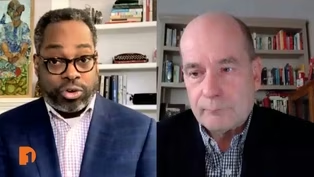
The Deepening Divide in Lansing
Video has Closed Captions
Clip: S4 Ep20 | 4m 46s | Stephen & Nolan debate about transparency in Lansing and Gov. Whitmer's emergency powers. (4m 46s)
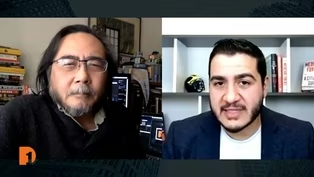
Video has Closed Captions
Clip: S4 Ep20 | 5m 19s | Epidemiologist Dr. Abdul El-Sayed and virologist Oveta Fuller consider the pandemic's end. (5m 19s)
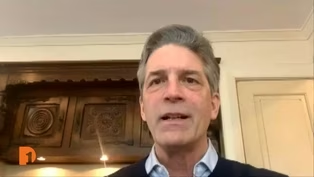
Video has Closed Captions
Clip: S4 Ep20 | 1m 13s | Gerry Anderson from DTE Energy & the MERC on how the nature of the workplace will change. (1m 13s)
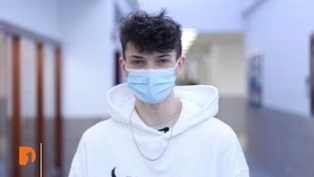
Video has Closed Captions
Clip: S4 Ep20 | 2m 12s | From the PBS NewsHour Student Reporting Labs: how kids feel about a post-COVID future. (2m 12s)
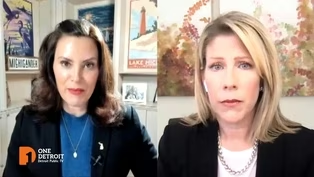
One Year Into the Pandemic with Governor Whitmer
Video has Closed Captions
Clip: S4 Ep20 | 5m 33s | A look back at the year w/ Gov. Whitmer: COVID, inequities exposed, and what's ahead. (5m 33s)
Providing Support for PBS.org
Learn Moreabout PBS online sponsorship
- News and Public Affairs

Top journalists deliver compelling original analysis of the hour's headlines.

- News and Public Affairs

FRONTLINE is investigative journalism that questions, explains and changes our world.












Support for PBS provided by:
One Detroit is a local public television program presented by Detroit PBS