
Ornie Alness
Clip: Season 17 Episode 2 | 10m 53sVideo has Closed Captions
Ornie Alness reminisces on his WWII US Navy tour and life as a farmer in Clarkfield, MN.
Ornie Alness of Clarkfield enlisted at the age of 20 and served in the Pacific theater during World War II. After coming back home from the war, he settled down, raised a family and operated their family farm for the rest of his life. Ornie passed away on Nov. 24, 2025, at the age of 104.
Problems playing video? | Closed Captioning Feedback
Problems playing video? | Closed Captioning Feedback
Postcards is a local public television program presented by Pioneer PBS
Production sponsorship is provided by contributions from the voters of Minnesota through a legislative appropriation from the Arts and Cultural Heritage Fund, Explore Alexandria Tourism, Shalom Hill Farm, West Central...
Support provided by:


Ornie Alness
Clip: Season 17 Episode 2 | 10m 53sVideo has Closed Captions
Ornie Alness of Clarkfield enlisted at the age of 20 and served in the Pacific theater during World War II. After coming back home from the war, he settled down, raised a family and operated their family farm for the rest of his life. Ornie passed away on Nov. 24, 2025, at the age of 104.
Problems playing video? | Closed Captioning Feedback
How to Watch Postcards
Postcards is available to stream on pbs.org and the free PBS App, available on iPhone, Apple TV, Android TV, Android smartphones, Amazon Fire TV, Amazon Fire Tablet, Roku, Samsung Smart TV, and Vizio.
Providing Support for PBS.org
Learn Moreabout PBS online sponsorship(bright music) - Well, my name is Ornie Alness, and I've lived here on this place all my life, with the exception of the time I spent in World War II in the US Navy.
And then I came out of the service and I went back into farming.
I farmed the rest of my life.
I'm still called that actual farmer.
I still got 101 tractor, although I don't do anything like my full farming.
I rent out most of my land.
(bright music) I got married in 1954, I think it was, and we had five children.
I had over about 50 years of nice wonderful life.
Wonderful life and family.
So I had a real wonderful life, actually, a long one and a good one.
(bright music) Well, I was on the troop and supply ship, 535 feet long.
It was actually a passenger liner when it was built because we made some pretty long trips across the ocean.
I went to board ship as a disciplined seaman deck force and I didn't stay there too long until I started working up.
From then on, I was on that ship for 26 months.
I didn't, that was my home and that was underwater back and forth in the Pacific.
We went to the Aleutian Islands, Dutch Harbor, Kodiak four times, hauling sailors up.
After four different trips we went to Alaska.
The first trip I was on was the worst and the stormiest.
We had ended up with 50 foot swells.
That's what they said it was.
It was kind of a little bit scary.
A lot of times when the old nose would go down in the water and you were wondering if you were coming up again or not.
You know, the bow of the ship, not the main stripper structure, but the bow would go into, down into the water.
And when that did come up, my water was just flying tons of it off the top.
(bright music) After we left Aleutian, so then we started going south to the southern islands, south of equator.
I was in on two different take backs or whatever you want to call it, when we took the islands back from the Japanese that they'd take it from us.
You know, I was in the marshals when we took them back, and then Guam was the next one that we, I helped take back.
That was a big one and a tough one.
They were both tough enough, but that was another big fight.
(bright music) It was wartime so you just, that's what you had to live by.
You had to be ready for it 'cause you never knew.
We'd have to stand and watch four hours on and four off and watch for any air raid or airplanes coming in for bombing or anything like that.
We were on the alert on our guns all the time.
We were retaking the Guam Islands.
We had an awful lot of wounded Marines and army guys.
We flew the white flag, so we were supposed to be neutral, but anyway, they didn't pay no attention to that.
Oh, I got into several hair racing experiences, I guess.
So Guam, one time there, the Japanese were on the other side of the mountains, they weren't that close yet at that time.
And they lobbed a bomb over the mountain and come down and land at about 150 feet away from the ship.
(tank firing) War... War is hell.
Nothing else.
But you get in and you do what you have to do, whatever happens.
(bright music) When we were done, we'd taken the Guam Islands.
I was already far enough along in my duty, so I put in for a transfer 'cause I've been on there 26 months.
So if I could get, if they'd transfer me off, I'd take duty to some other place for a while, which I did.
I ended up down San Diego down at the welding school down there, went through more training on that, then I, they transferred me right from the welding school to the repair base there in San Diego.
So I worked on the ships that come in and were shot up.
I was at the repair base there then in San Diego.
So then after the war was over, I stayed there until my turn come up to get discharged and I got, made it home in December, middle of December, right before Christmas.
So then I come back then to peace time, I come back here, got discharged to the Minneapolis.
I got my discharge shapers here at the airport or old gym room.
Got my discharge and I come back here and here I am.
(vehicle engine roaring) - Was it difficult to adjust much when got back from the war?
'Cause you said you served for, how many months did you say?
- Oh it takes, it took a while to kind of, you know, get back in it, but then you got back into your groove.
You got your work to do and you know, it just smooth it off.
But I don't know.
You went right back into the rhythm you had back here instead of in the military.
(gentle music) That is such a change from the time that before the war when I was growing up till now, that you can hardly comprehend what it goes on, you know.
(bright music) Your transportation, your electrically.
We didn't have electric lights out here or nothing.
We didn't, we got them in '40 something, 1940, '41.
(tractor's engine roaring) Your farm equipment is from by stars.
From then till now, you know, there's no comparison there.
And then 100 years, quite a change.
That's for sure.
I don't know, it's hard to comprehend now on what did, everything is so different, you know.
(bright music) - So how often do you think about your time in World War II, like today?
Did it come to your mind fairly often or do you not think about it too much or?
- Oh, I think about it once in a while, but I am happy I could serve my country.
I'm proud of that, by the time I spent in there.
So that's about it.
I probably went and done my little bit and that's about what it amounted to like everybody else did, I think.
(tractor engine roaring) You've done your job there just like any other place and you... And you ended up serving and being thankful that you could.

Video has Closed Captions
Clip: S17 Ep2 | 9m 43s | Veteran Dave Roth shares his music and family history with the Madison Bottling Company. (9m 43s)

Ornie Alness, Rustic Designs Flower Farm, Dave Roth
Preview: S17 Ep2 | 40s | WWII US Navy Veteran Ornie Alness, a flower farm & veteran Dave Roth talks music and family history (40s)
Video has Closed Captions
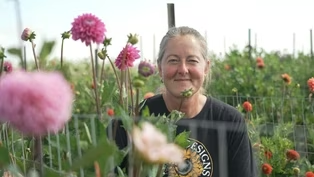
Clip: S17 Ep2 | 8m 48s | In Belgrade, Mary Solbreken has always, even from a young age, had a passion for flowers. (8m 48s)
Providing Support for PBS.org
Learn Moreabout PBS online sponsorship

- Arts and Music
The Best of the Joy of Painting with Bob Ross
A pop icon, Bob Ross offers soothing words of wisdom as he paints captivating landscapes.













Support for PBS provided by:
Postcards is a local public television program presented by Pioneer PBS
Production sponsorship is provided by contributions from the voters of Minnesota through a legislative appropriation from the Arts and Cultural Heritage Fund, Explore Alexandria Tourism, Shalom Hill Farm, West Central...