
Martin Amis
Season 5 Episode 9 | 26m 46sVideo has Closed Captions
Martin Amis is a celebrated and prolific author whose credits include London Fields, Th...
Martin Amis is a celebrated and prolific author whose credits include London Fields, The Rachel Papers, Time’s Arrow and The Information. His fourteenth novel, The Zone of Interest, is a satire set at Auschwitz. It has attracted attention and controversy, especially in Europe.
Problems playing video? | Closed Captioning Feedback
Problems playing video? | Closed Captioning Feedback
Overheard with Evan Smith is a local public television program presented by Austin PBS
Support for Overheard with Evan Smith is provided by: HillCo Partners, Claire & Carl Stuart, Christine & Philip Dial, Eller Group, Diane Land & Steve Adler, and Karey & Chris...
Martin Amis
Season 5 Episode 9 | 26m 46sVideo has Closed Captions
Martin Amis is a celebrated and prolific author whose credits include London Fields, The Rachel Papers, Time’s Arrow and The Information. His fourteenth novel, The Zone of Interest, is a satire set at Auschwitz. It has attracted attention and controversy, especially in Europe.
Problems playing video? | Closed Captioning Feedback
How to Watch Overheard with Evan Smith
Overheard with Evan Smith is available to stream on pbs.org and the free PBS App, available on iPhone, Apple TV, Android TV, Android smartphones, Amazon Fire TV, Amazon Fire Tablet, Roku, Samsung Smart TV, LG TV, and Vizio.
Buy Now
Providing Support for PBS.org
Learn Moreabout PBS online sponsorship- [Narrator] Funding for "Overheard with Evan Smith" is provided in part by MFI Foundation, improving the quality of life within our community.
And from the Texas Board of Legal Specialization, board certified attorneys in your community, experienced, respected, and tested.
Also by HillCo Partners, a Texas government affairs consultancy.
And by the Alice Kleberg Reynolds Foundation.
And viewers like you.
Thank you.
- I'm Evan Smith.
He's a celebrated and prolific author whose credits include "London Fields", "The Rachel Papers", "Time's Arrow", and "The Information".
His 14th novel, "The Zone of Interest", has just been published.
He's Martin Amis.
This is "Overheard".
- Actually, there are not two sides to every issue.
- So I guess we can't fire him now.
I guess we can't fire him now the night that I win the Emmy!
- Being on the Supreme Court was an improbable dream.
- It's hard work and it's controversial.
- Without information, there is no freedom, and it's journalists who provide that information.
- Window rolls down and this guy says, "Hey, it goes to 11."
(audience laughing) (gentle music) - Martin Amis, welcome.
- Thank you.
- Nice to see you.
- Nice to see you.
Nice to be here.
- You had me at a comedy about the Holocaust, which is, you know, I think in some ways a very simplistic way to describe this book, because it's not really a comedy or a comic novel per se, but it is entertaining.
- Yeah, part of me shrivels up when people call it a comedy, or an office comedy, even worse.
- Black comedy, comedy of manners.
You've heard all of that stuff, right?
- Yeah, but I would edge more towards satire.
- Satire.
- That doesn't quite get it either.
But I want to emphasize that laughter is a much more versatile human response than people think.
I mean, give it a few seconds thought and it's obvious that we don't just laugh for gaiety and irony.
- Right.
- We laugh out of hatred, contempt, relief.
- Discomfort, anxiety.
- Yeah, anxiety and embarrassment.
- Right.
- It's not just a lightheaded kind of response.
- And no one should misunderstand that this is not a serious treatment of a serious subject, but the way that you've told the story is just unexpected.
- Yeah.
- Right.
- Yes, well, it's a very, it's perhaps an impossible subject to meet head on.
So I have these characters, two out of the three narrators are sort of interested in their own lives, and they're getting on with that.
And the Holocaust is sort of taking place against the background.
Although it does come into focus later on.
- Now, in some ways, as I have remarked to you, this could really be thought of more as a love story than as a book about the Holocaust.
- A frustrated love story.
- Frustrated, but how many are frustrated?
Many love stories are frustrated, right?
But really, it's a character driven novel.
- Yeah.
- More than an event driven novel.
- It is.
Novels start with a kind of shiver.
Nabokov called it a throb.
And it's just an image or an idea or a character that comes to you in a distinctive way, and you know you can write some fiction about it, a story, a novella, maybe a novel.
And what I started with is the first page of the book, it was a sort of love at first sight moment against this incredibly anomalous background.
- Well, in fact, you read the first page, the first two paragraphs of the book, and you would be forgiven for thinking you were reading just another love story, but for the phrase, I believe it's three wheeled gallows, is that right?
- Yeah, that's the only thing that gives you a clue.
- The only indication that you're reading something different than the conventional.
And of course, I wanna come back to this in a moment, but let us remember that this is your second novel about, or set against the backdrop of the Holocaust.
"Time's Arrow" long ago, '91?
- '91, yeah.
- '91, was the first.
- Yes.
- So you touched the third rail then, and then liked it enough that you came back to it the second time.
- Yeah, yeah.
It is a third rail kind of subject.
But on the evidence of this, some people have said, "Are you running out of ideas?"
But two novels, you know, do not exhaust the Holocaust.
And I hope to write another one.
And one of the reasons for that is that no one really understands why it happened.
And no one understands Hitler.
Stalin, quite intelligible character.
- A little bit more logical- - Well, yeah.
- Progression to what he did and why.
- Yeah, and not necessarily incompatible with achievable aims.
To build a socialist utopia is not a, you know, a negligible ambition.
We all know how these things go wrong, that you can't force utopia.
But Hitler, you know, there's not a single historian I've read who claims to understand him, and in fact, most of them make a point of saying that they don't.
And his first biographer, Alan Bullock, said, "The more I learn about him, the harder I find it to understand."
And I can't think of another historical figure who arouses so much consternation.
- So let's talk without revealing too much, because the plot does go in interesting places, but let's sort of sketch in broad outline.
The structure of this book is as interesting to me as the substance of it.
So you have six chapters, you have chapters that are divided roughly into three parts each, each with a different narrator, right?
- The three parts, yes.
- And each of the parts is a different narrator.
- Yes.
- And you have a Nazi officer who is one of the narrators.
You have the camp commandant who is another.
And then you have a Jew who is actually tasked with terrible, unspeakable things.
So, the division of the narration is itself an interesting device, and I think it's quite compelling as a reader to encounter that.
But it really is a love story in that the Nazi officer becomes smitten with the camp commandant's wife.
- Yes.
- Yeah.
It's not exactly a meet cute moment if we're talking about Auschwitz, but there is kind of this love at first sight, as you say, as you describe it.
- And he's actually quite a refined sensibility, but he's become coarsened as everyone was under the Third Reich.
- And he, the Nazi officer, let us say also, is the nephew of Martin Bormann, who is Hitler's private secretary.
- That's right.
- So he actually is not just any Nazi officer.
He has a pedigree.
- And a Zelig ability to move through various echelons of the regime.
And again, it's only the...
They were called the Sonderkommandos, the people, the Jews who had to process the dead bodies.
And also deceive, help deceive the prisoners when they arrived, murmuring reassuringly to them.
So, an absolutely desperately degraded character who nonetheless still has his humanity.
And the Sonders... Primo Levi wrote a great essay about the moral position of Sonders, but he didn't seem to know that they occasionally did save a life.
They would go up to a young man and say, "You are 18 years old and you have a trade, and so when the selection happens on the ramp, left to death, right to life."
A kid could say, "I'm 18 and I'm a carpenter," and that would make them live.
- Spare their life, yeah.
- Yeah, yeah.
For a while at least, you know?
- Well, again, the plot unfolds in interesting ways, and the relationship between the Nazi officer and the wife of the camp commandant is interesting, but the relationship between the camp commandant and his wife is a very important place in the narrative as well.
- Well, I mean, I think- - I don't wanna give too much away.
- No.
But perhaps the novel quickened into life when I was reading and just discovering that these SS officers had their wives and children at Auschwitz.
- Right.
- Why would you wanna do that?
'Cause it was a sort of varnish of normality was what they provided.
- But impossible nonetheless, right?
- Yeah, well, they had their theater, they had their (speaking in foreign language), you know, they had cinema.
They had a sort of community there as well with all this, you know, filthy smells and disgusting sights.
- Let me come back to the third rail aspect of this.
I said to you before we came out today, you know, "Well, are you doing much touring with this book?"
And you allowed us how it's a little difficult to market in an aggressive sense this book about the Holocaust, right?
As a topic, it's not exactly one that would... One would not gravitate to it if one wanted to be expressly commercial.
- No.
- Right.
- No, and I mean, there are special responsibilities if you take on a subject like this.
- So why this book as opposed to any number of other subjects that you could have tackled?
- Well, just because you never decide to write a novel.
It's more the other way round.
- It decides to be written.
- Yeah.
And it chooses you.
And that's in itself a responsibility.
And then it's down to the main challenge of writing fiction, which is, it's called decorum in literary critical terms, and it means close to the opposite of what decorum means in real life, which is etiquette, politeness.
Literary decorum doesn't care about those things, good taste and etiquette.
All it cares about is finding the words to match, finding the words and the tone to match what you're describing.
- And one imagines also the organizational structure.
I mean, I come back again to the decision, you know, quite compelling as a reader to encounter it, to tell the story trifurcated as you have in these chapters.
"Time's Arrow", I'm reminded, was told in reverse chronology.
You went all Tarantino on the story before Tarantino even existed, right?
I mean, the fact is that that kind of disruption of narrative is a little more conventional these days.
Not entirely, but is nonetheless radical to encounter as a reader still, because we are conditioned to believe things are gonna be told in some orderly fashion.
- Well, it is orderly, but it's backwards.
- But it's backwards, right.
- It's like a film going backwards.
- Right.
- And I made some fascinating discoveries, for instance, that the arrow of time is identical to the arrow of morality, that if you reverse things in time, the moral weight of the event completely flips.
- [Evan] Flips, right.
- So if a child is crying in a backwards in time world, you slap its face and it's happy again.
And that applies to the whole project of the Holocaust, which backwards in time is a kind of dirty miracle.
You're summoning a race down from the sky and then taking them back to their towns and villages and putting them back in their houses, rather roughly, it has to be said, but that's what you assume- - But nonetheless, right.
- So, flips the whole morality.
- I'm interested in contemporary political conversation.
Not so much the Holocaust, because that is still kind of a third rail, but Hitler has come to be this symbol that is, who is, that is thrown around very loosely, where, you know, you have political candidates who compare one another to Nazis or to, you know, to the SS or to Hitler.
You have this imagery that has been appropriated from this horrific event for very mundane, very selfish purposes.
It's kind of interesting that that's where we've come.
- Yeah, and I recoil from that, that the whole quiddity of Hitler is that he occupies this position, as German diarists wrote at the time, he's beyond history, he's outside history.
And it's as if some sort of weird cosmological gap appeared, and all these really strange events started to occur.
And for no good reason.
- It's kind of a remarkable thing, isn't it?
- Incredible thing, yeah.
- One of the things that this book made me contemplate was the somewhat cliched question of the nature of evil.
And we live at a time when we are seeing unspeakable acts of evil around the world.
Whether it's the beheadings of journalists or the mass slaughters of people by their own governments or by people who presume to exist as state actors, but in any case, evil is among us.
Maybe evil's always been among us, but it seems particularly pernicious now.
- There's some talk in the novel about whether the supernatural is involved.
It feels supernatural.
- Well, when you can't explain something, you assign otherworldly qualities to it, or you say, "Something must be doing this work."
- Yeah, I'm not sure I believe in pure evil.
Although Anthony Burgess, the author of "A Clockwork Orange", said to me, "There's no sort of A. J. P. Taylor type."
He's a sort of utilitarian historian for what happened in Eastern Europe, 1941, 1945.
But he was a Catholic, so he did believe in evil.
What I believe in is death, that death takes on a certain momentum at certain times.
It happened after the Russian Revolution, the value of human life collapsed, and it didn't matter to kill someone.
But something even worse happened in Nazi Germany, where it was as if death became a sort of positive quality.
You know, it's not just the 6 million, it's not just the other, you know, 50 million who died in the war, he was killing old people, crazy people, young people.
Anyone who was defective in any way.
He was sterilizing, he was castrating.
A real enemy of life.
- Do you see an analogy to the things we're seeing today?
- Yeah, I do, and it's this, that a very good, popular historian, German, Sebastian Haffner, said, "It's quite wrong to think that Nazism was an ideology.
All it was was a rallying cry for sadists."
He was saying, "Those who are prepared to beat and kill and rob for no reason."
And you know the jihadis who come from South London.
Now,is he going there to restore the caliphate?
No, he's going there 'cause he likes killing people, and he feels empowered.
He likes people to be frightened of him.
And then it just becomes a nihilistic cult of death.
- But of course, we have a tendency very simplistically in the culture of the society in which we all live now, to lump everyone in together just because it is orderly, back to orderly again, you know?
It makes sense.
So this fellow who, as we sit here just a few days ago, opened fire in the Canadian parliament, who is associated somehow with folks who are under a similar banner doing equally unspeakable acts elsewhere.
I mean, somehow this is all of a piece, and I'm not sure that it actually is of a piece, because if it's of a piece, we'd have to assume that there's an ideological thread that runs through it as opposed to individuals committing acts for individual reasons.
- Yeah, I think it's what happens with radicalism.
- Explain.
- That it can only get more radical, and then it forgets its aims.
- But not any connective tissue to speak of.
- Well, the paradoxical thing is that life is getting less violent.
There's a huge book by Steven Pinker called "The Better Angels of Our Nature", where he proves beyond doubt that it's a much less violent world than it used to be.
- And yet we seem to be- - We seem to be.
- Focused more attention on than these more isolated or more random acts, and we elevate them to a place where it's all we talk about.
- That's right, but the figures are all pointing the other way.
Murder is what he concentrates on, and the figures are way down.
The reasons he give for this, invention of printing, very important.
The rise of women.
The state leviathan taking the monopoly of violence and saying, "We are the only ones who are gonna have weapons."
And America conspicuously declined to do that.
- Well, I was about to say, it doesn't sound like the America I know.
I mean, in fact, here, we're an outlier as far as believing that the better course to pursue is to leave weapons in the hands of everybody.
- Yeah, and the good guy must have a bigger weapon than the bad guy.
- Well, you know, the phrase of the moment here is that the only person who can stop a bad guy with a gun is a good guy with a gun.
- But with a bigger gun.
- With some version, right, yeah.
- But the other reason he gives and concentrates on rather flatteringly is the rise of the novel.
- The rise of the novel.
In the end, you will save us.
That's great.
That's perfect.
- If you'd asked me 10 years ago what I thought I was doing, apart from writing fiction, I would say, I'm in the education business.
- Now you're a superhero saving the world.
- I'm making people less violent, and that couldn't have been better news for me because- - (laughs) Who knew?
- I think violence is the ancient curse of man in particular.
And it's something that we just can't seem to get rid of.
But if we are...
The reason fiction does this is because it puts you in the shoes of someone else.
Suddenly you're Clarissa Harlowe or you're Tom Jones or you're Sophie Weston, you're occupying another consciousness, and that teaches you imaginative sympathy.
And Pinker thinks that's one of the main reasons.
So, to be involved in that effort is a great privilege.
- You're happy to be signed up.
- Yeah, yeah.
- In uniform, right.
Let me ask you about Great Britain.
Give me your short version of the health and wellbeing of the country and of the country's leadership these days, you know?
Not an incidental actor in much of the drama we're talking about happening in the world, but maybe a supporting player.
And I don't know that Britain ever saw itself as a supporting anything.
- Well, England, ever since the war, Britain has led the world in decline.
(audience laughing) Trailblazing decline.
But I think it did it with more dignity than most- - And grace and class, right?
- Post-imperial powers.
And there was no great period of illusion.
Now, America is due to decline in about 30 years' time.
- And is likely to do so, let's be candid, arrogantly.
- Illusion, I think.
And I sometimes get the feeling that it's already in the air, American decline, and this leading from behind.
- Should the world wish for America to get a swift kick in the collective pants?
- No, our children will find out what it's like when you have the Chinese doing it, and they will be very nostalgic.
- Nostalgic or romanticize the time when we were in the lead, yeah, right.
- Well, I mean, it's a sort of blundering giant.
But this marvelous American... You have to say an illusion that they will be loved, and no other country, no other power has ever been so confident that basically it's lovable.
Remember, in Iraq, we said flower- - What was the phrase?
- Flowers and sweets.
- Great phrase, I loved it, they were to greet us as liberators, right?
That was the phrase of the time.
Didn't happen exactly.
- It didn't happen, no.
They were hated.
Very shocking.
Remember Bush said at one point, "I think they should show more gratitude."
And look at it now, I mean, it's not even a state anymore.
- Yes, and in fact, our involvement in this new conflict is not being received with any more gratitude than it was the previous 10 or 12 years.
- Yeah.
But we'll see.
I mean, it's too early to say, but I think ISIS's Islamic State Daesh is burning itself out.
- [Evan] You think so?
- Well, who's left to kill?
How much more outrage can you dream up, you know?
If you're killing children, you're killing old people.
- Right.
But where's the outrage there over this?
- And where is it in the Muslim community?
- I mean, in some ways, the fact that it's an independent entity I think is actually more problematic in terms of the long tail of it than if it were a nation state or an actual state actor, because there's no accountability, there's just... - No, and they don't have to govern, so they- - Right, they've got the inconvenience of having to actually do stuff is removed from the conversation.
- No, just cult of death.
- Remarkable.
We have a couple of minutes left.
May I say a word to you about your dad?
- Yeah, sure, yeah.
- Your dad was a remarkable man and a remarkable writer and an inspiration for so many people.
And I can't, for the life of me, imagine what it must have been like to be his son.
And I wondered if you would say a word or two about that and about what you learned from him.
- Sure.
Well, the first thing that has to be said is that it's very rare in any language for two generations of writer, roughly, of rough parity, almost unknown.
And it's a very unusual thing.
And that's why I get an unusual treatment often.
It's because it's weird.
- Do you feel like it's a little dynastic in a bad sense?
- Well, yeah.
In the days of anti-elitism, I'm thought to be, you know, like Prince Charles.
Sounding off without having ever done anything, just through birth.
And that sort of delegitimizes you a bit.
But I think the key to it, I think there would be many more sons and daughters of writers if they'd done what I did, and I think you can't do it otherwise.
I started when I was 21, really.
So, I was brave and stupid.
And you need those two products- - Best combination of both.
- Yeah, you do.
I mean, 'cause I've talked to many other sons and daughters of writers, and they say, "I'm gonna leave it a bit," you know?
"I need to consider this."
And their twenties go by and then they get so self-conscious about what they're writing.
They imagine objections to every sentence, you know?
And anyone starting out writing a novel, get to the end and then worry.
But don't worry along the way, be brave and stupid.
But unless you start then, I think it's impossible.
- It's an amazing thing.
- But he never encouraged me to write.
And that's vital, I think.
I know a world famous writer who ruined his relationship with his son by saying he was a genius poet at the age of 18.
There haven't been any genius- - It has to happen organically.
- Yeah.
But it's egotistical, it's a way of saying, "You can have my life, you can be a little me," you know?
So he never did any of that.
- Well, in that respect, that was probably the best thing he could have done for you.
- Oh, yeah.
- Indeed, okay.
Well, we're out of time.
A treat.
- Thank you.
- And love the book.
Congratulations on it and everything else, and it's a treat, brilliant, a pleasure to get to talk to you.
- Thank you very much.
- Martin Amis, thank you so much.
(audience applauding) - [Narrator] We'd love to have you join us in the studio.
Visit our website at klru.org/overheard to find invitations to interviews, Q&As with our audience and guests, and an archive of past episodes.
- Another Nabokovian trope is that you can't read a novel.
He said, "Funnily enough, you can only reread a novel."
- Reread.
- Yeah.
'Cause you wouldn't listen to a piece of music once and think- - I've got it.
- I've listened to that.
- Right.
- You've gotta know what to expect as you come in again, as you reenter it.
(upbeat music) - [Narrator] Funding for "Overheard with Evan Smith" is provided in part by MFI Foundation, improving the quality of life within our community.
And from the Texas Board of Legal Specialization, board certified attorneys in your community, experienced, respected, and tested.
Also by HillCo Partners, a Texas government affairs consultancy, and its global healthcare consulting business unit, HillCo Health.
And by the Alice Kleberg Reynolds Foundation.
And viewers like you.
Thank you.
(gentle music)
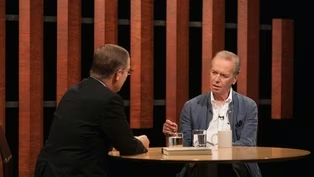
Clip: S5 Ep9 | 7m 38s | Martin Amis is a celebrated and prolific author whose credits include London Fields, Th... (7m 38s)
Providing Support for PBS.org
Learn Moreabout PBS online sponsorship New Episode
- News and Public Affairs

Top journalists deliver compelling original analysis of the hour's headlines.

- News and Public Affairs

FRONTLINE is investigative journalism that questions, explains and changes our world.

 New Episode
 New Episode
 New Episode

 New Episode
 New Episode
 New Episode
 New Episode
Support for PBS provided by:
Overheard with Evan Smith is a local public television program presented by Austin PBS
Support for Overheard with Evan Smith is provided by: HillCo Partners, Claire & Carl Stuart, Christine & Philip Dial, Eller Group, Diane Land & Steve Adler, and Karey & Chris...