
Owning the Block
Season 2 Episode 5 | 26m 46sVideo has Closed Captions
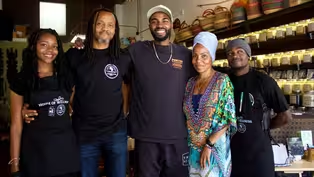
Roy meets Leimert Park residents using food to counteract gentrification.
Roy breaks bread in Leimert Park with legendary artist and activist Chuck D, explores local businesses like Simply Wholesome and Harun Coffee with artist Six Sev, and meets with elders to find out how a neighborhood so rich in food, art, music and culture can counteract the forces of gentrification in the community.
Problems playing video? | Closed Captioning Feedback
Problems playing video? | Closed Captioning Feedback
Broken Bread is a local public television program presented by PBS SoCal
Owning the Block
Season 2 Episode 5 | 26m 46sVideo has Closed Captions
Roy breaks bread in Leimert Park with legendary artist and activist Chuck D, explores local businesses like Simply Wholesome and Harun Coffee with artist Six Sev, and meets with elders to find out how a neighborhood so rich in food, art, music and culture can counteract the forces of gentrification in the community.
Problems playing video? | Closed Captioning Feedback
How to Watch Broken Bread
Broken Bread is available to stream on pbs.org and the free PBS App, available on iPhone, Apple TV, Android TV, Android smartphones, Amazon Fire TV, Amazon Fire Tablet, Roku, Samsung Smart TV, and Vizio.
Providing Support for PBS.org
Learn Moreabout PBS online sponsorship(upbeat music) [Roy] From Harlem to Tremeé in new Orleans, Louisiana.
From Atlanta to Jackson Ward in Richmond, Virginia.
From Bronzeville in Chicago to Clarksdale, Mississippi.
From Detroit to Oakland, California, the U.S. is full of black neighborhoods that gave birth to much of the best America has to offer.
In Los Angeles, there's another neighborhood fighting to keep its place in history.
Leimert Park is known by many as the Harlem of the West Coast - a.k.a Africatown.
It's an epicenter of community culture & common principles, but it's in danger of disappearing, through a pandemic, gentrification and interest from the outside.
This black neighborhood is fighting every day to keep what's theirs.
(Upbeat music) [Roy] I'm a street cook.
Even before I was a street cook, I was a street person.
I'm out there doing things, whether it's approved or not.
My whole existence in this world is to nourish and feed people.
I want this show to be about the power of us as humans to come together.
Again, let's not make assumptions.
Let's not make stereotypes.
And from there, we can start to talk about these things and maybe understand each other, whether your beliefs differ from mine, we're breaking bread.
(upbeat music) Leimert locals, aren't just residents and consumers.
They're the people who built and created the unique fabric of this area.
When housing covenants were lifted in the 1950s, black families transformed the area into an epicenter of art and culture.
In the 1990s, after the uprising, following the Rodney King trials, the area was hit hard and it took some time to regenerate.
In recent years, a new generation of entrepreneurs are raising questions about the level of ownership, black tenants, residents, and businesses have in this haven they've created (upbeat music) Statistically, it's rare for black owned businesses to actually own the buildings or land where they do business, but there are other creative ways to get around owning a brick and mortar, especially in the food industry.
Chef Whitt of Voodoo Vegan and Imani Jackson of Nature's Thirst Trap are answering the needs of the community by making historically black food accessible and healthy, with plant-based Creole recipes and fresh pressed juices.
And they're meeting customers where they're at, literally on wheels.
- I'm gonna tell you what you have actually.
So this is our shrimp po'boy shrimp po'boy is like New Orleans 101, like nobody goes to New Orleans and doesn't get a po'boy and you can get an assortment of ways.
We do all different types, oyster mushroom, hot sausage, smoked sausage, but shrimp is our number one seller.
- Okay.
[Woman] So fire.
- Oh man, it's on fire.
- Right and that's our voodoo sauce, which is like similar to a remoulade, which is something that we make in in-house.
- I mean, it's delicious.
And if you had never told me that wasn't a shrimp po'boy, I would have never known.
- And the craziest thing that people always say is like, oh, this tastes like real food.
And I'm like, dude, it totally is.
- So I wanted to talk about veganism within the black community.
It seems like something that is gaining even more momentum in the last five years.
Why is it so important and why is it so prevalent right now?
- The cool thing about it is that the community needs it, you know?
So we come to food deserts, like glimmered, and we're in south central, you know, in different places because there's a need that's unmet.
And so if we can do it, you know, we're definitely there.
- Just speaking about food deserts and stuff like that.
I realize that it's not that we even live in a food desert from my perspective, because there's tons of restaurants.
Like we said, the McDonalds, the Burger Kings, all these other just foods that contribute to the diseases in our community.
But I think that we're living in a nutritional desert.
And so, you know, I think it's just amazing that we're able to provide this nutrition for our community.
- Hopefully, you know, we start something, we've got a couple of other people in the neighborhood that are out here.
- It looks like you have a following.
- Man, we do it for the hood.
Like, you know, always.
- If there are 10 more businesses like yours, 20 more businesses like yours that start to change the landscape from food apartheid, food desert.
- Businesses like ours.
And that's what's important because right now what we're dealing with is we're dealing with unfortunately, and it's the G word and everyone throws it around and right, And so Leimert Park is literally one of the last standing cultural epicenters, like in this country, like black culture.
And we're all trying to like, you know, build this community of our culture and not outsiders who come in, you know, and then they dictate and they strip us of everything.
You know, we're left with nothing.
- Can you imagine if Leimert was not black anymore, you know, and it's like impossible, but it's not that impossible.
- It's the trajectory that they're trying to take it.
We have an African marketplace and drum circle that happens every Sunday.
We have a farmer's market and this market has been going on for over 40 years.
You know what I'm saying?
And then people hit us with the politics, like, oh, all of a sudden, now that Leimert is, you know, gaining popularity and it's trending and Rihanna has her eye on Leimert and this person has their eye on Leimert.
Now it's like, okay, well we need to change it.
We're just hoping that we can flip the script.
Our generation is trying to, you know, get out here and - - But you already are flipping the script.
Yeah.
I just hope that trajectory keeps going.
- And that's what I hope too, and I'm sure it will because you know, we're all out here fighting extra hard and we're gonna make it happen.
You know, you got to manifest things.
You got to believe it and claim it.
- Cheers to you.
(upbeat music) [Roy] To learn more about the new generation.
I'm hitting the streets with artists and entrepreneur, Six Sev also known as the Mayor of Leimert.
- We're in Leimert Park, you know, epicenter of black culture in Los Angeles.
Definitely been a very, very monumental place for me.
So I'll just give you a tour and let you know what we got over here.
- Inspired by the late great Nipsey Hussle, Sev highlights, black enterprise, gentrification, social change, Nelly culture and his music and art.
As a community leader, he is working to ensure that what they have will not be co-opted or taken away.
- Art everywhere.
This is like historically artistic community.
How you doing?
These guys do a lot of work too, they hold down the Sunday marketplace.
- Anything you want to say to the world about - All the support we can get, you know, financially, politically, we just need support.
- Absolutely.
- I want to say something.
My name is Kevin Warren Price.
I'm with Africa Town Coalition.
Africa Town, and they call us a Leimert Park, but Africa town is a center of black revolution.
In a sense, anytime something happens in the black world, we come here, a black person is murdered in the city or anywhere in the nation.
We come here, when there's issues to be fought politically, we come here to that park.
This was built for the black family, black people to have a place, a cultural place.
And when it first opened, it was beautiful.
And you know, when you look around this community right here, this community right here has been depressed for awhile.
And what happened was that they deliberately did that so that they can become, they can let this community become blighted.
And so they could come in later on and began what they're doing now, selling property.
So we have this game being played by property owners who are dictating the flow of the community.
And we don't like that.
You know?
So gentrification is something that we've been fighting for awhile.
I'm one of the elders, you know, around here as well.
And you know, we feel passionate about what we do.
We are passionate about what we do, and this is our black Mecca.
This is our community.
And we don't plan to give it up.
And we will fight for this community.
(upbeat music) [Roy] Residents are making an impact in the community by educating and supporting each other.
The same can be said for the business owners who are invested in this neighborhood.
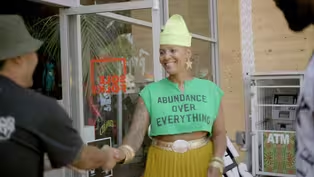
(upbeat music) Sole Folks is a business incubator that champions creative ownership.
It's a space that features not only black labels.
It's also been designed to allow local aspiring designers, the tools, mentorship, and space to make it happen for themselves.
Owner Akil West and brand manager, Ferriss Mason are providing a path to ownership for the next generation of design entrepreneurs.
Can you tell me about what you're doing here?
- You know, so this is a space man that we put together to, to shed light to black designers.
You know, it's the largest concentration of black millionaires in the United States.
So we wanted to kind of meet them where they were and bring some black talent over here and through the help of Ferriss Mason, she curated, you know, most of these artists that are here.
Yeah.
So that was, that was really the purpose man to create a space man for us by us.
- So when you say for us, by us, it brings me back to FUBU, brings me back to the nineties, early two thousands.
Where are we now?
Are we just consumers?
Or do we have a stake in this now?
- I think, I think the consumers are really paying attention.
You know what I'm saying?
And I think they're guiding the industry.
You know what I'm saying?
They're purchasing black.
They're making sure that the designers are getting their just due.
And I think the industry is kind of following.
When these designers are able to see what we're able to do with our own money and our own neighborhoods.
They're like, look, man, we can raise this, this area.
When we got the neighborhood skate shop across the street, we got Sole Folks, we got Sev creating spaces over here and - - Cause in the past, it was just a poaching of culture, in many ways right?
Like the, like the music industry or whatever.
- We're in a better space.
But like he said, the consumers are also driving it.
Like people want to buy black.
I mean, if you have a fabric from Ghana, that's handmade and, and you know, this came all the way from overseas.
What makes something from France more luxury than that?
(upbeat music) [Roy] Speaking of luxury, I mean, I used to wear a lot of this stuff.
This is real tight.
I have to get the Sade.
I'm definitely getting this for myself.
I never wore a crop top before.
Basquiat (upbeat music) - They have manufacturing stuff and things in the back that young artists and designers can use.
If they don't have the resources.
- All of our co-op members.
(upbeat music) - So, and this is the space you're talking about the - - Yeah, yeah this is the space.
So they come back here.
- Does it cost anything?
- No, no, no, no.
They come up in here and they figure it out.
Some of them figured it out on their own.
Most of them get help from other designers.
Who've been doing this for a long time and they come up here and they do the work.
We have like a - a space where they can do photography for their websites.
We partnered with a Shopify to help them get their, you know, their product on online and things of that nature.
So yeah, this was still going on, man, for, this whole year.
- Man, this is - this is the manifestation of everything.
So I just want to say that on film, you know, - Give thanks.
- Yeah, give thanks.
- That's what they say in Leimert.
(upbeat music) - Akil and the other businesses in this complex recently united together to buy back the block.
It's unclear whether they'll be able to get the funding they need, but working as a collective will only help to push them forward and shed light on the issue of ownership in the neighborhood.
The people we've met today are doing their part to provide opportunities for the community and to stay put in a neighborhood.
They want to see flourish, but there's always a dance between growth opportunity and being aged out.
Down the street, the owners of Nappily Naturals, open their shop after seeing the need for natural products made for and by black people, their family run business has quickly been welcomed into the neighborhood.
Even this Nappily Naturals is seeing success as a newcomer.
There's still a tenant that's only around as long as their landlord allows.
- I did not expect this walking in.
(laughing) I feel like it's been here forever.
- Oh yeah.
We call this our house of wellness.
This is a holistic space that we've brought to the community where we use herbs and teas.
And we go back to the earth to, you know, stimulate the body to heal itself over here, which I'm sure you can relate is our exotic spices.
- Oh yeah.
- Well we want it to do a little pop quiz with you.
- Yes.
- I'm horrible at pop quizzes, and when anybody ever ask me top 5 dead or alive I'm like, oh.
I'm horrible when I'm put on the spot.
- I think one of you will have, let's get that one right there.
You could come closer so you can smell it.
- Oh yeah.
That was, he started off easy.
- That's truffle, right?
- That is black truffle, yeah.
- Let me try another one.
- I want you to smell this one.
We're going, we're going medium right now.
It smells like an amchoor or some type of chili.
Is it a dried chili?
- Chili, in the range of that for sure.
- In the range of chili.
So it's a mixed blend.
Oh, that's why.
- Yeah that's a mixed blend.
So, and then you know just a lot of the seasonings you already know that you use.
We have the, you know, Ethiopian seasonings.
- May I smell that?
Is that this one?
Berbere?
- Mmhmm.
Yep.
Good.
You got it.
- No, I swear.
I swear usually I'm not this good, but maybe because it was food though.
This could easily just be a shop with soaps and oils and, and, and detergents.
But why go into the realm of food?
- Primarily?
You know, my father Sunni Muhammad, he raised us in Mississippi, very rural in a lot of our staples.
We had to either grow, pick or raise.
And we were very healthy.
We went to the hospital maybe like once in our life.
So this is definitely a way to sustain the health and also appreciate nature and culture a lot more.
So it's very, very important to have a very healthy diet.
If you want a positive and a productive community.
- If you don't know any better, then you won't do any better.
So that was pretty much the reason why we wanted to open up here.
You know, not only, you know, sell the products, but we want to teach them, you know, how to eat, what to eat and things like that.
So we're hoping that, you know, that will resonate throughout the community.
And then we also have our holistic Poplar carry.
So this is where we started.
- Sharon and Umaar's Shop started with a simple mission, to make chemical free products and herbal remedies readily available.
Now their store has expanded from hair and skincare to a one-stop shop for healthy living inside and out.
- I'm happy to have two stores and we employ our son here.
Our daughter Porschae, my husband and I.
- That's your daughter?
- Uh-huh - Wow - Yeah, this is what we were trying to create, you know, legacy and generational wealth.
And not only do we employ other youths here, we also encourage them to become entrepreneurs themselves.
And now they have some of their products on the shelves and they're earning money that way as well.
- What are some of the dreams that you have through a store like this through a legacy through passing on.
- You know, the only thing that I would love to own is the property 'cause this area - we love Leimert, Leimert is just everything.
Just the vibe, you know, the atmosphere, the people.
And so I'm hoping that, you know, that will continue, but it's not on me because I don't own the property.
- I know.
- So we we're hoping to change that narrative.
- Thank you.
I think you're doing a lot.
This is, this is amazing.
I already feel better.
It feels so good in here.
(tribal music) - It's rare for black owned businesses to actually own the buildings or land where they do business.
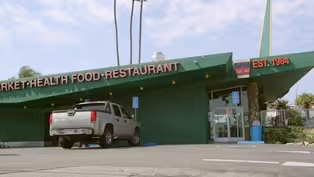
But this one bucks that trend Simply Wholesome run by Purcell Keeling and his daughter Amelia is a family owned health, food store and restaurant.
They've been providing information and inspiration to the community since 1984.
(upbeat music) - So we support over 116 small black and brown businesses.
We're all about giving others an opportunity to showcase how amazing their products are.
I think you might like this.
a little.
- Okay, cause I'm a chef?
- Yes.
These are also, we have Bobby Brown's whole collection here.
- Oh yeah.
- It's so good.
We have.
- Why didn't he call it My Prerogative?
That's all - (laughs).
(upbeat music) Let's go down this aisle - Okay.
I actually make it.
- You make it.
- Yes, so let me take him to the restaurant.
(upbeat music) As you're walking from the restaurant to the store here, you'll find books that will uplift you.
So I like to call it our Gateway to Wakanda, - Okay.
- It's a space where you find not only that you're raising your vibration, but you're surrounded by information.
- This is a family business.
Correct.
And you guys own the business and own the building.
- We own the business, we own the property.
- As an owner, what does that mean to you?
- It's about representation.
It's about not being afraid of being bought out or having to move or leave.
I've grown up in this space.
You know, if my father didn't have the sight to see it, then all of these things that we're bringing to the painting now might not be possible.
- Might not even be here.
- It might not be here.
- Not just for your family and your guys' prosperity, but for the community.
Yeah.
- Everybody.
It's more than just me and I, and it's more than just my direct family.
You know, it's realizing that this is an example for other people on how they can make it work for them.
So yeah.
- We've been talking to so much about the market and the, and the Gateway to Wakanda as your philosophy.
But tell me about the food.
- The food here is amazing.
It's an awful, we have over 65 smoothies here, a secret menu on our Instagram.
And we are known as a transitional restaurant, - Okay.
- Even though a lot of people think that we're vegans.
What we say and mean by transitional is we provide different options for people as they're transitioning.
So we do have vegan and vegetarian options, but we also sell chicken, seafood and fish.
So it's a really great stepping stone for those who are interested in exploring healthier options.
- That's beautiful.
- while not being afraid.
- The way that we got here was through Chuck D because I had to talk to him about health, especially with all the deaths within Hip Hop in the last year, because then he was like, okay, I'll meet you at Simply Wholesome.
- Yes.
- And so we're going to sit down and chop it up and eat.
- Let me show you guys what we're going to see you.
It's gonna be on the patio of the year.
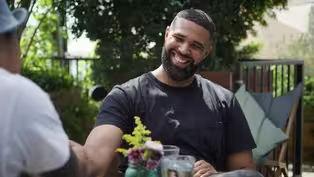
(upbeat music) [Roy] Chuck D, one of my all time favorite artists, has a lot to teach me about legacy and it's linked to the food system.
To him, the systems of inequality and food access have played a critical role in the lives and deaths of so many black legends.
(upbeat music) - Thank you.
First of all, for joining me, I'm just going to geek out for 40, 45 seconds, because if it wasn't for a nation of millions, my life would be on a whole other trajectory.
And I feel like the link between when I was 17 years old, picking up the CD and putting it in my car and it changed everything about who I am, you know.
- There's a sign there, that says, give thanks.
So that's what that's about.
So, you're here to enhance or you take away and whatever you get, you know, you're supposed to give back more so that, that even that was all our processes.
When we did our music, public enemy explored all the outside elements that, that we were kind of just conditioned to just accept without looking into food, shelter, clothing, philosophy, history, all those things.
And we wanted to challenge that, we wanted to challenge the information.
We said, don't believe the hype because not to say not to believe anything, but to challenge the information that was coming at you.
So that's where all that, all that came from.
- But do you think the choice exists, like, especially right here in the hood?
- You think like Black Sheep's album, The Choice is Yours.
- I don't know because the question, the question is.
- Look at this store.
- Well this store exists, but we could go down the street.
- It's an oasis in the desert, yes.
- Yes.
You need a proper agenda against the propaganda.
- There we go.
So is the lack of food within, within black communities an agenda?
- Yeah.
You need food because food in the communities of color and the black community, especially is a machine gun, man.
- Absolutely.
Absolutely.
- World War III, man is, is food.
- While he probably didn't see it as a war on food at the time, looking back, it's clear that Purcell Keeling has been fighting on behalf of his neighborhood for almost four decades.
- What was your spark point that said, listen, I got to do this.
This is, this is something.
- Well, I remember one day I was talking to my friend.
I said, man, somebody needs an open up a health oriented restaurant in the community.
Because prior to me moving in this community, I was living in Redondo Beach and I'm a distance runner.
And so one morning I was running with a friend of mine and we're coming up over hill here.
And something kind of hit me internally in my chest and said, turn around.
So I came back, memorized a number, was able to call and I was fortunate to get the building and Simply Wholesome was born.
And I really felt I could be independent.
I didn't even think about it.
It was going to morph into where is and where it might end up and really fortunate to have a daughter like Amelia.
My other daughter that's interested in the business and wants to take on, take that legacy to the next level.
- Thank you for just like being an amazing spot in the world, in the world.
- Thank you so much.
- Thank you.
(upbeat music) [Roy] Building a legacy is no small feat in a world that throughout history has been trying to erase you.
Can neighborhoods grow and change without harming the residents that have loved this place and called it home for so long?
Can two seemingly opposed truths exist at the same time?
Or am I just too optimistic?
I invited my old friend, Alex, a.k.a 2Tone, to meet me and Sev at Harun Coffee.
He's a Venice, California native who's seen his neighborhood changed dramatically in the last few decades.
So the reason why I wanted to get you guys together, really, to talk about gentrification, you know?
Cause I know that's something you're dealing with right now.
- Yeah.
- So I just wanted to set it up cause like, can you talk about what the Venice was like in the nineties and how it's like now and kind of what, what are we scared of with Crenshaw?
Because right now I can't even imagine Crenshaw not being a black neighborhood, but nothing's impossible.
Look what happened to Venice, - Venice has always had a different angle on things because there's always an attraction to Venice and people outside of Venice.
Right?
And you had like Dennis Hopper living in Venice.
Events has always had hippies and bikers, you know, gang members, surfers, skaters, all that mixed in a way that made it this really interesting place.
That kind of culture kept it what it was for a long time.
And people weren't trying to live there.
Years later, like, I remember seeing a paper for a house selling in my neighborhood and the house was selling for like 300 grand.
And we were just like scandalized, we were like $300,000 for this little house and still not seeing the writing on the wall.
- Is there writing on the wall?
- I would say it is - everyone pretty much is aware.
Now what's going on.
They see the changes.
New developments, uh, landmarks being torn down.
- Yeah.
- And like rent going up, it's more expensive.
They built these new developments and they said that they're going to be affordable income, but it's like trick words, you know, it's like tricknology.
So it's like, it's not affordable for the people that live in this neighborhood.
- You think there's a threat that Leimert could one day not be a black community?
- I think so.
Like the culture is a big part of the community first.
So culture erasure is the first step to like really displacing people.
- The thing that's going to make it different is that his generation and the, and the people younger than him have started to care about things, right.
It's become cool to care about.
When I was a kid it was not cool to care about anything, the new kids coming up, give it interaction.
And, and they're just, I mean, I think they're smarter.
I think they have more information.
I think they know more.
I think they have more access to information.
(upbeat music) [Roy] We live in the era of information & people like Sev are making sure that the community is getting that info by encouraging them to get involved.
(upbeat music) It's only together as a collective that the community becomes a force, powerful enough to own it for themselves.
(upbeat music) Leimert Park, a.k.a Africa Town, could easily be swallowed up by the encroaching city, but something tells me the legacy planted here by these entrepreneurs will be tended for generations to come.
Video has Closed Captions
Clip: S2 Ep5 | 30s | Roy meets Leimert Park residents who use food to counteract gentrification. (30s)
Prophet Walker: Housing for Human Beings
Video has Closed Captions
Clip: S2 Ep5 | 6m 7s | Prophet Walker discusses how his development, Treehouse, helps people connect again. (6m 7s)
Simply Wholesome is the ‘Gateway to Wakanda’
Video has Closed Captions
Clip: S2 Ep5 | 2m 48s | Roy Choi gets a tour of Simply Wholesome, a Black-owned community institution in Crenshaw. (2m 48s)
Sole Folks Is Helping Black Design Thrive
Video has Closed Captions
Clip: S2 Ep5 | 2m 9s | Why incubators of Black creativity like Sole Folks are so crucial to the community. (2m 9s)
Providing Support for PBS.org
Learn Moreabout PBS online sponsorship
- Food
Christopher Kimball’s Milk Street Television
Transform home cooking with the editors of Christopher Kimball’s Milk Street Magazine.


Support for PBS provided by:
Broken Bread is a local public television program presented by PBS SoCal