The Darkroom MCs
Ozier Muhammad (AD, CC)
Episode 4 | 14m 57sVideo has Audio Description
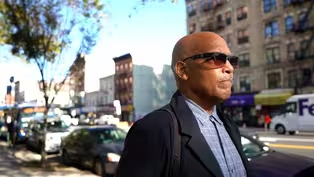
Photojournalist Ozier Muhammad talks through his over 40-year-long career.
Ozier Muhammad has been a photojournalist for over 40 years. A former staff photographer for The New York Times, the Pulitzer Prize-winning photographer has covered Africa, Harlem and more. Here, Muhammad goes into the darkroom to print a photo from 1994 of street performer Dancing Harry, while also discussing his passion for photographing his community.
See all videos with Audio DescriptionADProblems playing video? | Closed Captioning Feedback
Problems playing video? | Closed Captioning Feedback
The Darkroom MCs is a local public television program presented by WLIW PBS
The Darkroom MCs
Ozier Muhammad (AD, CC)
Episode 4 | 14m 57sVideo has Audio Description
Ozier Muhammad has been a photojournalist for over 40 years. A former staff photographer for The New York Times, the Pulitzer Prize-winning photographer has covered Africa, Harlem and more. Here, Muhammad goes into the darkroom to print a photo from 1994 of street performer Dancing Harry, while also discussing his passion for photographing his community.
See all videos with Audio DescriptionADProblems playing video? | Closed Captioning Feedback
How to Watch The Darkroom MCs
The Darkroom MCs is available to stream on pbs.org and the free PBS App, available on iPhone, Apple TV, Android TV, Android smartphones, Amazon Fire TV, Amazon Fire Tablet, Roku, Samsung Smart TV, and Vizio.
Providing Support for PBS.org
Learn Moreabout PBS online sponsorship- [Announcer] The following program is available with audio description and closed captions.
(bright music) - My name is Ozier Muhammad, I've been a photojournalist for 40 years.
I have been photographing all together since I was 15, I'm 71, so you do the math, 56 years.
- Whoo!
(laughs) - [Russell] Yo, what's up, people?
This is Russell Frederick.
- [Anderson] Yo, and I'm Anderson Zaca.
- [Russell] Yo, we are here live from the darkroom in Brooklyn.
- [Anderson] We have some guests for you.
- [Russell] Every episode, really take it back and show you all some culture.
- [Anderson] With photographers, masters, legendary printmakers, who are gonna come into the darkroom with us.
- [Russell] Tune in to Zaca and Russ Live from The Darkroom.
(upbeat music) For this episode, we are gonna be meeting up with Ozier Muhammad, former staff photographer for The New York Times.
Ozier got his BA in photography from Columbia College in Chicago.
He's won a Pulitzer Prize, he has covered Africa, Harlem, and everything in between, Zaca.
- Back and forth.
- [Russell] Indeed.
- [Anderson] Mali, Burkina Faso, Ethiopia, South Africa, and his work with Nelson Mandela during the election.
Are you kidding me?
- [Russell] Listen, y'all about to be blessed by one of the industry's finest.
(cool music) Looking at your work, these prints, they are majestic photographs of our people.
What made you pick up a camera?
How did you know that this is what you was going to do for the rest of your life?
- Well, after that camera fell off that UPS truck, I knew it was for me.
- Is that how it happened?
(all laughing) - Awesome.
- Yeah.
Since I was a teenager, I knew that that I wanted to be a photographer, I just knew that it's something that I wanted to do.
I had met Gordon Parks in the '60s because he was spending a lot of time with the community in which I grew up in Chicago, the Nation of Islam, and photographed the community, my, you know, relatives and my grandfather.
That was the spark.
- Did you, at a young age, see like some of the sociology and psychology in photography and how Black people were depicted and you wanted to use your camera to change that like Gordon Parks did?
- [Ozier] Yes, because there was sort of these movements that were parallel.
One of the movements was the Nation of Islam, which was a hybrid of religion and Black nationalism.
- [Russell] Yes.
- It was a very fervent period in the human rights of African Americans, and it made me interested in documenting our community because I thought it was very important that this was a very important time in which our community was very active in regards to civil and human rights.
- Yes.
- And culturally, African Americans were affecting the arts across the board in popular music and jazz, which is a unique contribution of African Americans to the world, period.
And that's why I hit the street so much, I hit the streets as a kid.
- Oh my gosh, this is good.
- This was a photograph I took of a street baptism in central Harlem.
These are members of the United House of Prayer for All People, "Daddy" Grace's church.
- [Russell] Yep.
- To- - Jesse Jackson, wow.
- This was the first sort of rubric that he used for his movement in Chicago, Operation Breadbasket.
- [Russell] Right.
- [Ozier] But this is Jesse around 1970, maybe '69.
- Fantastic.
- He had shortly arrived in Chicago to take over Dr. King's work.
- I see a lot of your photographs, like people don't even notice you are there.
How did you develop your style?
- Yeah, I developed my style basically from Henri Cartier-Bresson, just let it happen in front of you and wait for that moment to peak.
I definitely made my presence known in some photographs that I love and I felt like were very successful.
- [Russell] Right.
- But I find that I'm most comfortable when I'm not intrusive, when I don't affect the dynamic of that situation.
- [Russell] Right.
- And your choice of lens is a 50?
- Not necessarily, but I like what one of my friends at The New York Times called an "honest lens," which are, you know, like normal lenses.
- Like a 35, 50?
- 35, 50, 35.
- Right, right.
- "Honest lenses" 'cause you have to- - [Anderson] You have to come up on it.
- You have to be there.
- You really gotta be close.
- You know, it's like shooting from a window with a 500, you know?
You know.
- (laughs) Exactly.
- It's not stealth photography, you know?
- Indeed, indeed, indeed.
- And finally, this was five years after Dr. King had been assassinated, so it was 1973.
These two gentlemen came out of a barbershop, you can see this guy was having his hair done to take a look at a march through downtown Atlanta to Dr. King's crypt.
- Oh, okay, okay, right.
- [Ozier] Crypt where the eternal flame was burning.
- [Russell] Right, right, right.
- So these young men were just checking out the procession.
- And was this a cropped image, or?
- No, this is a full frame, it's not cropped.
- Wow.
So you were right there.
- I had like a 180, you know, before the 200s came into use, I had a Nikon with a 180, ...a super sharp lens, I don't know if you ever never knew of what a 180mm Nikon lens.
- No, I never...
Probably... - 2.8.
- Wow.
- We can see this is like razor blade sharp.
- When you work as a photojournalist for a newspaper, those photographs, do you get to keep them?
Who keeps them?
What happens to them?
- Yeah, the way it works is that, primarily, the newspapers have the rights to the photographs, but when photographers leave, they tend to appropriate a lot of the work.
For instance, I worked at Ebony for at least a year before I was hired, and I did a lot of work for them.
At the time, I was a little, you know, naive and, you know, I just gave them the work so I didn't ask for my negatives back.
- Right.
- So when I left there, when I was leaving there, I was a lot smarter, so, you know, I kept some of them.
And The New York Times has been very progressive about the way they use the work after you retire.
It's sort of an unspoken agreement that if you can move your work, if you can sell the work, there hasn't been any friction.
(lively music) What I'm printing today is a photograph that I took in 1994 on 125th Street, near the Apollo Theater of a guy who was well known in the neighborhood as Dancin' Harry.
When I first exhibited the picture, actually, I showed it to an editor at The New York Times.
She said, "Oh Ozier, that's a great shot of Dancin' Harry."
- (laughs) Oh, she knew him by name.
- I said, "I didn't know that he was as well known."
- (laughs) A little celebrity.
- You know, he was very modest.
He didn't tell me how, you know, well known he was in the neighborhood and how famous he was.
All right, so let's get negative, let's get to it.
(lively music continues) - All you have to do now is push the magic button called, right here, exposure and it exposes.
- And it exposes, all right.
- [Anderson] Yeah, now, boom.
- [Ozier] Okay, cool.
All right, here we go.
I always dunk it like this, face down and then I make sure it gets submerged evenly.
- [Anderson] Look at that, look at that!
- [Russell] What?
(all laughing) - [Ozier] Not bad, not bad.
- [Anderson] Okay, so I think we did it at 2.8 as opposed to 5.6, and that's what it is.
- That's what it is.
- It didn't get closed down.
- [Anderson] It didn't get closed down.
- Right, right, right.
- Okay.
- [Anderson] So I think we're still at 2.8.
- Okay.
Clockwise, it's closing it down, right?
- [Both] Yep.
- [Ozier] One, two.
All right.
- [Anderson] All right.
- [Ozier] And I'm going to- - [Anderson] Need a new sheet of paper.
- You know, but you being in Chicago at the time, at a young age, you know, where the Nation of Islam is thriving and the word, the message is spreading, how did that even inform you as a man and to photograph?
And to photograph the Nation almost from the inside out?
- The Nation put me right into kind of the thinking of what was going on.
It helped me to start think deeply about the condition of Blacks in America 'cause I was like in the middle of it, you know?
- Right.
- I was like, it really affected my thinking about who I am as a Black man in America and how the condition of Blacks were being affected by empire and colonialism and racism, et cetera, and I think it affected my photography for sure 'cause I wanted to, you know, I wanted to photograph my people, that's the only thing I really wanted to do, and that's really the only thing I really want to do today, you know, is photograph the African condition and the diaspora, and anybody wanna come along for the ride, welcome!
You know?
- Whew.
(claps) - No matter who their race are.
I had lot of hope in Occupy Wall Street when that started, I thought, "Man, oh this is wonderful," and it was just before I retired from The Times and I really fought to get involved in that story 'cause, you know, all that stuff always interested me.
So you can see that's still washed out.
- Right?
- Yeah, it's still washed out a lot.
- [Ozier] Yeah, washed out a lot.
I may open it up and just dodge Harry.
- Okay, rip it.
- Okay, here we go.
(lively music continues) - Oh right.
- Oh!
- The top needs more.
- Look at that.
- It's very washed out at the top.
- No, it's coming up.
- It's coming up, right?
- We haven't put the timer on.
Put the timer on it there.
There you go.
- [Russell] Now you on the money with that.
- At least it looks on with the developer, we'll see.
When the lights go on, the truth will be revealed, right?
- The truth will be told, right?
(all laughing) (lively music continues) - You are one of a few brothers to win a Pulitzer.
Can you tell us what the experience was like and what was the assignment like?
- The Pulitzer represents a body of work that was done from somewhere around late September until December 2nd or 3rd of 1984.
There was word trickling out that people were starving all over Ethiopia.
So we went into Ethiopia and we spent about a month there and we did the story and that's what culminated into the Pulitzer.
(dynamic music) Photographs in this corner are from the 1984 assignment for Newsday to cover the drought in the Sahel region of Africa, culminating in Ethiopia, where the impact was much more severe.
We were all over Ethiopia, Josh Friedman, Dennis Bell and I, my two colleagues, the reporters, I was the sole photographer.
And this man is holding a basket of provisions that he had just received.
I believe these came from the Ethiopian government and these provisions were supposed to last him, according to this gentleman, for a week, and you can see how meager they are, a couple of pieces of fruit and some grain.
(dynamic music continues) There wasn't one picture here that won the Pulitzer Prize, the Pulitzer Prize was in international reporting, but the photography was an integral part of the story.
We spent two months in Africa all together.
- Wow.
- And the reason why I was on the team and Dennis Bell is because we really had a strong voice in the newsroom in the way of Les Payne.
Les Payne really advocated for Black reporters and photographers being involved in big stories.
- How do you feel now that maybe more photographers from the continent, who may be the local photographer, do their voices need to be probably heard a little bit more, as opposed to, you know, with the voices of the West?
- Yeah, definitely, and the reason why you see more indigenous Africans contributing to the big newspapers today.
- [Anderson] Yes.
- It's because of the digital age.
- Yes.
- Yeah, the talent has always been there.
- Always.
- Oh, we always know that.
- But, oftentimes, the work suffered from not capturing the image, but controlling the environment.
Maybe your film will get overcooked, you know?
- Right, right.
- Because of something, all of a sudden, the water temperature went up or something.
But all that is not factored into the production anymore, so the local photographers are contributing more.
- So is that true to say that digital photography has benefited and exposed photographers who otherwise wouldn't be exposed today?
- I think so, I do, I really think so.
And also the fact that, you know, it doesn't cost them a fortune to send the images back to the paper.
So, yeah, absolutely, the digital age has helped us appreciate the talents on the ground.
- [Anderson] Yo, thank you for one more time and one more episode, this one with Ozier Muhammad.
- [Russell] This man is just eloquence, poetry with a camera, and the way he captures our people.
Thank you, Ozier, for blessing us for these past 50 years, from Ebony and Jet Magazine to The New York Times and all your travels across the world.
(upbeat music) (upbeat music continues) (upbeat music continues)
Video has Closed Captions
Preview: Ep4 | 30s | Photojournalist Ozier Muhammad talks through his over 40-year-long career. (30s)
Providing Support for PBS.org
Learn Moreabout PBS online sponsorship

- Arts and Music
The Best of the Joy of Painting with Bob Ross
A pop icon, Bob Ross offers soothing words of wisdom as he paints captivating landscapes.












Support for PBS provided by:
The Darkroom MCs is a local public television program presented by WLIW PBS