Roots, Race & Culture
Pacific Islanders in Utah
Season 8 Episode 5 | 26m 3sVideo has Closed Captions
Learn how Pacific Islanders have helped define Utah’s history and now work to shape its future.
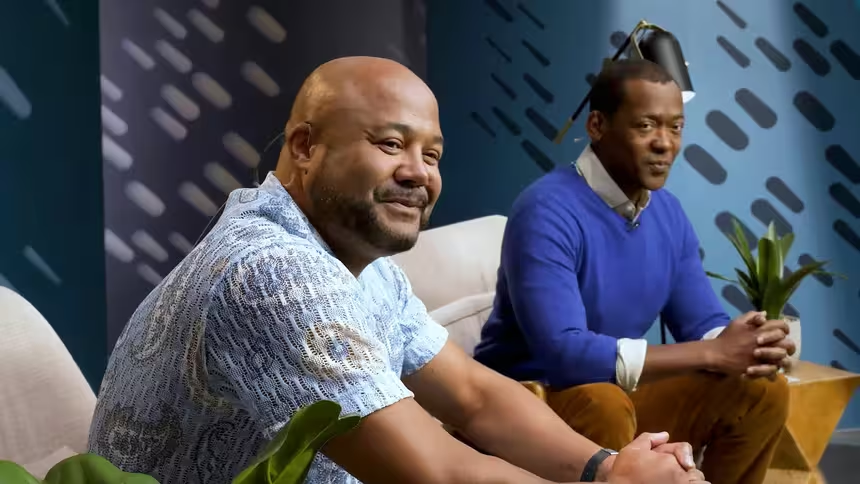
From early pioneer migration to today’s educators, entrepreneurs, athletic stars, and leaders, Pacific Islanders are an important part of Utah’s history and cultural landscape. Where did Utah’s Polynesian story begin? Two local leaders with Pacific Islander heritage to talk about how faith, family, and leadership molded their community into forces for change.
Problems playing video? | Closed Captioning Feedback
Problems playing video? | Closed Captioning Feedback
Roots, Race & Culture is a local public television program presented by PBS Utah
Roots, Race & Culture
Pacific Islanders in Utah
Season 8 Episode 5 | 26m 3sVideo has Closed Captions
From early pioneer migration to today’s educators, entrepreneurs, athletic stars, and leaders, Pacific Islanders are an important part of Utah’s history and cultural landscape. Where did Utah’s Polynesian story begin? Two local leaders with Pacific Islander heritage to talk about how faith, family, and leadership molded their community into forces for change.
Problems playing video? | Closed Captioning Feedback
How to Watch Roots, Race & Culture
Roots, Race & Culture is available to stream on pbs.org and the free PBS App, available on iPhone, Apple TV, Android TV, Android smartphones, Amazon Fire TV, Amazon Fire Tablet, Roku, Samsung Smart TV, and Vizio.
Welcome to Season 7
Bold and honest conversations tackled with humor, insight, and empathy.Providing Support for PBS.org
Learn Moreabout PBS online sponsorship- [Announcer] Funding for Roots, Race & Culture is provided in part by the Norman C. and Barbara L. Tanner Charitable Support Trust, and by donations to PBS Utah from viewers like you.
Thank you.
(bright music) - Hey everyone, and welcome to Roots, Race & Culture, where we bring you into candid conversations about shared cultural experiences.
I'm Lonzo Liggins.
- And I'm Danor Gerald, thanks for joining us.
Today we'll be discussing the story of Pacific Islanders in Utah, particularly Samoan and Tongan communities.
From early migration to today's athletic stars, educators, entrepreneurs, religious and non-profit leaders, Pacific Islanders are an ingrained part of Utah's landscape.
So where did Utah's Polynesian story begin?
What challenges and strengths defined these populations?
And how has faith, family, and leadership molded this group into forces for change?
- To help us explore these questions, we're joined by two incredible leaders in the community.
So welcome, ladies, - Welcome, and one of these incredible leaders is Susi.
Susi, could you tell us a little bit about yourself?
- I'm Susi Feltch-Malohifo-Ou, and I'm Tongan.
I was born in Tonga, lived there until I was five years old.
I was adopted to a white family, so I am, what they call a transracial adoptee.
When I was three years old, my parents worked for the LDS church.
My biological grandfather was the foreman on a coconut plantation, and my dad's from Vernal, Utah, so that's where I was raised.
- Well, thank you.
Verona, tell us about yourself.
- Yeah, well, thank you for having me here.
Verona Sagato-Mauga.
I'm Samoan.
My parents immigrated to the States back in the seventies from Samoa.
My dad got a scholarship to BYU Hawaii, and that's where I was born.
We moved to California, and then from California, we moved here to Utah, and Utah's been home ever since.
I am someone who has always been very involved in community and organizing.
I'm a small business owner and a lawmaker, and so I'm just a person who really enjoys community and thrives when I'm around people who have the same shared values.
And you know, just someone who wants good things for the state.
- And you're the proud owner of a bakery called Sagato Bakery.
- I am.
You know, I mentioned that my parents immigrated from Samoa and so growing up as a way to make ends meet my parents made baked goods out of our home, and on the weekends, we would take it to the park.
They drop me and my siblings off at Kearns Park, and we would sell meat pies and pani popo and all different sorts of treats from the islands.
We now own a bakery and we sell those exact same things.
- Wow, that's wonderful.
So I have a question for you, Susi.
Now, Pacific Islander advocacy has taken on a lot of different shapes, and can you tell us a little bit about what motivated you to get involved in leadership and a little bit about PIK2AR, your organization?
- First of all, leadership to me more is in a Pacific Island definition, which is service.
And I think in America's leadership means you're in the limelight, you're in the front.
- Right.
- And I totally am not that.
And so I've never really taken the word as leader as me.
I'm more in the context of a Pacific Islander definition of leader, which is of service to our community community.
- So that's a big part of your cultural understanding of what leaders are then.
- Yeah, leaders serve in the Pacific Island context.
For me, I came from being transracially adopted.
My father was a judge, and I came from a very privileged life.
And when I saw my own ethnic communities, like why aren't they able to have the same things I had growing up?
And they started making me curious, not just them, but everybody.
How come they don't have food when you open up their refrigerator?
How come this?
And I was like, this isn't right.
That should not be how this country is.
And so I was like, how come this works like this?
What can we do about it?
How come nobody's helping us?
Well, how about we just help ourselves?
And that's kind of where I came from, was like, we don't need anybody's help.
Our ancestors, we built villages.
We took villages on canoes.
- [Danor] Right, right, right, right, right.
- So we got this.
- What is PIK2AR?
- Yeah, so tell us about PIK2AR then.
- So PIK2AR is Pacific Island Knowledge 2 Action resources.
What I saw when I came to Utah 12 years ago was there was a lot of work being done, but not that was making any action, a lot of education going on.
But I wanted to have an organization where people were getting resources and then put it into action.
And so we named it Pacific Island Knowledge 2 Action.
We're 10 years old.
We started out in domestic violence, and my husband started this actually.
- Wow.
- He wanted to educate Pacific Island men about the American definition of violence.
Very different, right?
Because he could see that violence was after he learned what violence by definition.
Whereas if you grow up in the islands, it's not a thing.
Right?
- Yeah.
- It's just- - Well, I mean, from what I understand from some of my Polynesian friends, warrior culture is just a part of their culture, right?
So that's that's different.
- Yeah, and so he wanted to just like start having conversations with men.
Do we like it?
Is this violence like working for us?
What's the effects on our kids?
And so he just wanted to have this conversation.
And now, 10 years later, we have a weekly men's support group in the prison and in the community, and teaching skills, tools, a safe place for men just to talk, learn how to communicate, learn how to be vulnerable and emotional in a safe place for men to talk.
- Oh, I love that, - And so that's how it started.
- So I have a question for both of you.
Is there a point, and what was that point in which you realize your cultures aren't just something to celebrate, but something to preserve?
- You know, I think for me, I've done a lot of work in the community, and so much of our culture is service.
And and when you think about leadership, we think about serving, and it's always like doing things together for the betterment of the entire community, for the family, right?
And I recognize the values and our culture in all the things that they do.
Like when I look at athletes and I see the drive that they have and how dedicated they are, I recognize that in our Polynesian culture.
I recognize where that specific value comes from.
I recognize that from my own household.
And even in the state legislature, there's four of us Pacific Islanders now and we're navigating a very new space.
But I see that navigator heart and recognize that from our culture too.
And so I think no matter where you go, and no matter what you're doing, that drive and that desire to do something good, it comes from that foundation and from these values, family, faith and God.
- What are your thoughts about that?
- I mean, right along with that, I think for me is, it doesn't have to be that damn hard, right?
And what I saw from growing up in a white world was how come my people aren't getting the same shake?
Why is this?
Right?
And Verona's right, we have hardworking people.
- Oh yeah.
- But we're not getting the same opportunities and in the same way that other communities are getting it.
And that to me is sad and I wanna do something about it.
I mean, Pacific Islanders, we will make it happen outta nothing.
- Yeah.
- We will do it with no help.
- Yeah.
- But does it have to be that way?
It shouldn't be that way, not in this country.
And so for me, that's been a lot of my work is like, no, that's not right and we're not gonna accept it.
You know, we've been taught to work hard and that God will provide.
And I'm like, yeah, but we are gonna get some help from other places as well.
And we say that our programming is based on Pacific Island values, God, family, community, service, reciprocality, reciprocity, I guess is the right way to say that, and collective power, right?
If we can learn white people's way when we came here, they can learn Pacific Island values.
- Wow, that's great.
- And Tongans, this is the biggest Tongan community outside of Tonga, correct?
- I think it's number four, yeah.
I think the demographics have changed since the census.
I think there's more Samoans now in Utah, but I think one in every four Tongan lives here.
- Wow.
What are some of the myths and stereotypes that you feel like you all face in your various cultures as Samoan and Tongan and Pacific Islander?
Are there things that you feel like you have to constantly overcome?
- You know, I think people just not taking the time to recognize the differences, to recognize that Susi is a Tongan, and that I'm a Samoan, and to just lump us all, you know, in the same group at all times for all things.
And that happens often.
I think people also look to Polynesians and they think about football and The Rock, and they overlook the other great things that we bring to the table and the different values that we bring.
- Do you face any challenges being a Pacific Islander and working as a state legislator?
What are some of those challenges that you feel like you have to overcome in that regard?
- You know, I think the main challenge is that there's four new legislators.
We all got elected in 2025, like we all started serving together.
And so really, it's just navigating that space and being as authentic as we can to who we are, our upbringing.
But at the same time, I always go back to this, I think our upbringing and our culture is what makes us great in these spaces.
I think we bring, it's a added value to the state and to this legislature that we bring.
And it's something different, and it's a new way to look at things.
And it's also an opportunity for people to say, to recognize like, you're different, you grew up different, your household was so different.
But we also align on so many things.
- I love that we could bring some of those Pacific Islander values into our law making process, and hopefully, integrate that into the laws of the state.
I think the state will be better for it.
- And you guys, do you feel like you get drowned out a lot in comparison to some of the other racial groups such as Blacks, Hispanics?
Do you feel like that your voice is not as loud in that aspect when it comes to the state of Utah, because you are a vital, an integral part of our state?
- We're not in the history books.
We've been here how many years?
We started Pacific Island Heritage Month, I think we're going in our 14th year, and that was the reason why we started it, was to show that we had similarities, but that we have been giving to this state and are an integral part of this state.
- Well, look, let's talk about that history now and educate people.
What can you tell us about Iosepa?
- You know, Iosepa people came here because they wanted to to help build the LDS temple here in Salt Lake City.
And so a lot of Hawaiians came, migrated here during that time.
Even Samoans and Tongans, my great aunt Nelly Iosepa was one of the very first Samoans in this state.
She was the first Samoan woman to go to BYU in Provo, and she came during that time.
And so we've had so much history of Pacific Islanders coming to the state and not just migrating here, but doing work that really impacted our state and made Utah what it is.
And growing up, I never saw anyone who looked like me on TV, in the legislature, owning businesses.
And so for me to be in this space, I feel so grateful and honored.
One of my favorite things about being in the legislature is the elementary students who come up and visit us.
And whenever there's Polynesian kids in the group, and I say, "Does anyone have any questions?"
The Polynesian kids always raise their hand and they say, "Are you Tongan?
Are you Samoan?"
And you don't know how grateful I am that they recognize themselves in, you know, one of the highest offices in our state.
- I love that.
- And I think that's something that Susi probably recognizes as well as, as we're out in the community serving.
- That is so important.
- Yeah.
- And so I really appreciate that.
Thank you.
- I'm gonna say that we've talked a lot about some of the great things that have happened to our culture, but let me just go back to why Iosepa even happened.
- Let's do that.
- Please.
- Is because white people didn't want us in Salt Lake anymore.
So they gave us land out in the desert.
- Tell it Susi.
- Right.
- Tell the truth.
- So that's what I just wanna say, and part of that history is not so pretty.
Right?
- Colorful.
- We're gonna learn from those things, and I think that's part of the history that also needs to be told so we learn from it so it doesn't happen again.
- I wanna read a quote, a quote that you have.
It's from the Deseret News.
It says, "Our ancestors navigated the oceans wide, and our job now is to navigate the systems."
And I'm wondering if you can explain how storytelling, art, traditions, wisdom and church, identity, you know, build resilience and economic mobility and how you guys navigate those new oceans.
- I think first of all, you have to know who you are.
You have to start there, know what your values are, what are you gonna stand up for, what are you gonna sit down for?
And then learning those systems.
You know, what Verona does, what the legislators do, we have to learn those systems before we can do anything about 'em, right, and to be effective.
- Yeah.
- And so that's when I say we have to learn how to navigate systems for our communities to thrive, because that's the American way.
- Yeah.
- And so how do we use our own cultural village?
I love that we have four legislators, because I'm telling you, they're probably the only four that really know how a village works.
- Right.
- Right.
- When people say, oh, it's all about government, have you ever lived in a village?
- Yeah.
- Do you understand?
- Yeah.
- Because you're using that term like you've lived it.
These four legislators have lived it, understand it, and they are going to make it a village.
If they are allowed, the four legislators will make Utah a village.
- That's great.
So tell me then, I want to tee off of that, that's a perfect setup.
What do the institutions, what do the policy makers need to understand about Samoan and Tongan culture to help bring that village to life for our state?
- You know, I think it's really important that we recognize what a village is, what community looks like.
When I decided to run for office, it was because I felt that there was a lack of representation.
I believe that the perspective I have as a Pacific Islander, as a woman of color, as someone growing up, you know, living in West Valley and Taylorsville, that that was lacking in our legislature.
And I wanted to ensure that people who look like me and who share my lived experiences had true representation.
Someone who could say as a bill was coming through, "Oh, I experienced that."
Or, "I know someone in my family who struggled in that way."
And so as decisions are happening, I think it's so important that we understand the people we're serving.
And I think that's such a big thing, regardless of what your culture is, is having an understanding and having a desire to know the people you actually serve.
And so, as someone who represents West Valley and Taylorsville, I stay in my community.
I work with those people.
We work together.
Like this is something that we are working towards together.
And so I think if you wanna be in these spaces, know the people you are choosing to serve and understand their struggles and their wins and their goals, and what their family dynamics look like, that's the only way that we're gonna get things right.
And so, to answer your question, I just think that it's really important that we know the people we're serving.
- So the institutions, the policy makers, it sounds like there's two things coming out of that.
They need to make sure that everybody's represented, that everybody has a voice, that we're giving the opportunity for the villagers to influence those who are making the rules and doing the hiring and everything else in the village, so to speak.
- I mean, they can't do their job without us and we can't thrive without them.
And so we have to learn to work together, which is to learn how to communicate with each other.
- Yeah.
- I mean, I look at the state, on the backs of the communities, poor communities do, they go and get grants and go get money?
And that trickle down effect does not work.
It doesn't come to us.
- Yeah.
- So this state goes out and gets millions and millions of dollars based on our bad health, our incarceration rate, all of the negative things, but it doesn't come to us.
That bothers me.
- Yeah, that's a problem.
- Right, it's a problem.
And so, because Pacific Islanders have a lot of these, we're a big part of that.
And I tell people, you either gonna help us on the front end and give us donations so that we can help this, or you're gonna give automatically in taxes on the back end.
You choose which one it is you wanna give, right?
But we would appreciate the investment in our community before people are incarcerated, before people have chronic diseases, before so we can do the preventive work that needs to be done, and nobody can do it better than us.
- Right.
- I'm not mad.
This is my passion that's coming through that I wanna see some changes, and I wanna work with people that have the liked mind to let's work together.
80% of the people in this world are people of color.
- Yes.
- So what if we live in a state that we're not.
- We are not the minority.
- We are not the minority.
And that's what I tell people.
Yeah, we may be the minority here in Utah, we're only at 25%, but globally, we're 80%.
Come on now.
- Right, right.
- Yeah.
Yeah.
- Stand up together, let's stand up shoulder to shoulder.
Let's make the difference.
And if our ethnic communities, and I'm gonna say this, I say to this to the Black community that I work with is do not do to us what others have done to you.
- Right.
- Right.
- We need to stand together, shoulder to shoulder.
This year has been a tough year for our communities.
- Yeah.
- The only way we are going to make a difference is if we stand together, let some of that other crap go away.
Let's focus on the good and the things we wanna do, and let's get it done.
We don't need everybody.
We're good.
- And the good is a good- - [Danor] Yeah, that's a place to focus on, the good, right?
- Yeah, yeah, yeah.
Tell us about some of the wonderful positive aspects of the Samoan community.
Let's start with you.
- You know, I think one of the biggest things is we are so family oriented.
- Mm.
- Everything, like there's no individualism.
And it's really about taking care of each other and loving on each other, and making sure that we move together in a way that's beneficial to the entire ecosystem, right?
And so, I think that we are grounded in things like family and service and faith.
And those things are what make our culture so bright and so beautiful.
And so you hear about these other things and that's a very small percentage, but you look at the root of who we are, and we are such a loving people and we're so, you know, we just love family and we love community.
We laugh loud, we love dancing, we love singing.
- Y'all are like Black folks in many ways.
(laughing) - Yeah.
- When we first moved here, my dad was like, "There's a lot of light-skinned black folks out here."
(laughing) - We love food.
Food is the center of everything.
But when you go back to it, it's always about gathering and connecting.
- Yes.
- And I think that's what makes us so great.
So no matter what we're doing in life, no matter what spaces we're in, we always go back to that space that's rooted in connection and gathering together as a family.
And I think for me, personally, that's what keeps me centered.
No matter what I'm doing, if I'm up at the legislature or if I'm working in business and things get really tough, I know who I am, and I know exactly where I come from, and I know how good that feels.
- Right.
- And I think I can say that for most Polynesians.
- Yeah.
- You know, when we have a friend, they become our family member.
- Yeah.
- Come in, and now, I'm sure if you have Polynesian friends, you know.
- Oh yeah.
- You can go to their house, eat, whatever.
- Yeah.
- Nobody, we don't see that color.
- Yeah.
- Right, in a negative sense.
- Right.
- It's just our brother.
- Yeah.
- It's just our sister.
- Yeah.
- Right?
- And if we have one piece of bread, we all gotta take one bite and we are gonna laugh about it.
And we are gonna be hungry, but as long as we're together, we can survive anything.
And I think that that's the beautiful thing about us, is that if there's a challenge, we'll figure out a way to do it, right?
And we're gonna laugh.
We're gonna have a good time and enjoy that connection that we have with each other.
I had an experience, we had an event, just a few of us were getting together and a group of Polynesians got stuck in the elevator and you could hear them singing hymns in the elevator.
And the elevator guy came and he said, "They're not scared down there."
I said, "Oh, we don't know scared."
That's not really in our vocabulary.
- Yeah.
- Right?
"But like they're singing church songs."
I said, "Yeah, that's our norm."
- Yeah.
- Right?
We're bored.
We just sing a church song.
- Yeah.
- Right?
- The faith is so powerful.
- The faith, yes.
- Can you just kind of give us some final thoughts and help us understand what we can do to help support the Samoan community?
- Yeah, you know, I think one of the best ways to support and to get to know the Samoan community is go to the community.
You know, a lot of times, you see government agencies hold events and it'll be somewhere far on the east side or somewhere where there's not a very big Polynesian community.
But if you wanna know the community and you wanna support the community, go to the community.
There's so many events.
There's organizations like Alofa Fa'a Samoa, Nuanua Foundation, Nafanua Foundation, Le Malu.
Even go to our restaurants.
- Yes.
- Come to my bakery.
- Ask questions.
- Yeah, ask question, get to know your neighbors who are are Samoan or Polynesian.
Go to our churches.
But I think the best way to learn and to get to know each other is to go to who you want to know about and who you wanna learn about.
And our community is so welcoming.
You come to our restaurants, you come to our churches, you will be so welcomed there.
- Awesome.
And where can more people learn about PIK2AR?
- You can go to our website and learn about us.
And for the Tongan community, we have the National Tonga American Society.
They're the oldest nonprofit here.
Think they've been running 30-40 years.
It's my sister-in-law's, my husband's older sisters that started that.
And I wanna say, invest, invest your time.
Come out, like Verona said, come out and volunteer.
There's so much to do that we can help.
We run the Food Bank, feed about 500 families every other Wednesday, and we do our homeless work.
Once a month, we'll be at Pioneer Park.
There's a lot to be done.
I would say volunteering your time would be helpful.
Your talents.
- What's the website?
- It's www.pik2ar.org.
But I think that's how you get to know the community, come out and volunteer.
Have lots of laughs, always eat good food and meet new people.
- Awesome.
- Thank you.
- Yeah, it's been a wonderful, wonderful show.
So from all of us at PBS Utah, thanks for joining this conversation.
As always, other episodes can be found on our website, PBSutah.org/roots, or on the PBS Utah YouTube channel.
- And if you have feedback or ideas for other episodes, be sure to give us a shout out on social media.
Until next time, for Roots, Race & Culture, y'all, we are out.
(bright music) - [Announcer] Funding for Roots, Race & Culture is provided in part by the Norman C. and Barbara L. Tanner, Charitable Support Trust, and by donations to PBS Utah from viewers like you.
Thank you.
(bright music)














Support for PBS provided by:
Roots, Race & Culture is a local public television program presented by PBS Utah