
Påle' Eric Forbes
Season 2025 Episode 1 | 26m 45sVideo has Closed Captions
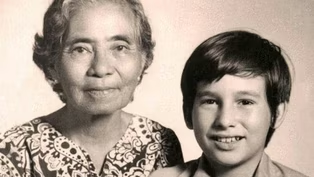
Påle' Forbes recalls his journey with faith as a young boy and a household of elders.
Entering the Capuchin Franciscan Order in 1984 and later ordained a Catholic Priest, Forbes served as a pastor on Guam and Saipan for many years. Likening himself to a sponge, Forbes often reflects that his ability to easily absorb and learn information helped him not only connect better with congregations, but also helped him become very knowledgeable in Marianas and CHamoru Culture and History.
Problems playing video? | Closed Captioning Feedback
Problems playing video? | Closed Captioning Feedback
SAINA is a local public television program presented by PBS GUAM
This program has been made possible by the Government of Guam Education Stabilization Fund.
Påle' Eric Forbes
Season 2025 Episode 1 | 26m 45sVideo has Closed Captions
Entering the Capuchin Franciscan Order in 1984 and later ordained a Catholic Priest, Forbes served as a pastor on Guam and Saipan for many years. Likening himself to a sponge, Forbes often reflects that his ability to easily absorb and learn information helped him not only connect better with congregations, but also helped him become very knowledgeable in Marianas and CHamoru Culture and History.
Problems playing video? | Closed Captioning Feedback
Where to Watch SAINA
SAINA is available to stream on pbs.org and the PBS app.
Providing Support for PBS.org
Learn Moreabout PBS online sponsorshipMy advice to the hopeless.
Give St.
Jude some work.
He's the patron of hopeless causes.
So if you're Catholic, ask St.
Jude to help you.
Otherwise, if you're hopeless, I would say look at the world around you.
Look at nature, Look at the tree that you thought was dead come back to life.
You know, I always say that we on Guam have the advantag of having the typhoons we have.
So I understand that younger people may not have had the advantage of learning a lesson from typhoons, but the rest of us have been through many bad typhoons.
They teach us a lesson, because you walk out when the typhoons over and it's utter destruction and yet new life comes back.
So if you're hopeless, learn a lesson from Mother Nature.
And if you're open to it, learn a lesson from Christ who died and rose again.
The dead can come back to life and you may feel dead.
But that's just today.
Tomorrow could be a whole different experience.
So I grew up in Sinajana in the late 1960s when the houses were like one inch apart and the kids played in the street and we picked up people's garbage and we made toys out of them.
And I grew up when climbing trees was a big deal and picking ib and putting them in soy sauce.
That was a big thing.
And I grew up in a generation where full blown CHamoru wasn't spoken by my peers.
But, we called each other doffe' or dokngos.
And I grew up in a village where everything was pretty much focused on either the commissioner's office, the fire station, the schools and the church.
And I happened to live basically next to all of these things.
And I didn't have to actually get out of bed to listen to the priest at mass because my house was so close; I could listen to him- wake up to him sometimes I was raised by mom, dad, grandmother, numerous aunties, a few uncles and the village elders because we went to church all the time and all the man biha.
All the old ladies in church were also partly responsible for raising me.
Because if they didn't scold me themselves they told my grandma and my other relatives what I was doing and I'd get it when they get home.
My grandmother had a siste who could barely speak English.
As a matter of fact, she couldn't even pronounce my name correctly.
I was Eeh-ric to her and she was the family techa.
And every night at 8:00, we turned off the TV and our knees hit the floor.
Rita, whom we all called Nina because she was the matlina for half the family.
She began the rosary and devotions.
And so those devotion went on for a good half an hour, if not more.
And all of those things captivated me, even though I didn't understan a word of what was being said.
The sound of CHamoru, the sound of the hymns penetrated my soul and became a part of me I think from an early age, I kind of realized I was given a personality that is akin to a sponge.
I sort of have an ability t soak up whatever I'm placed in.
As a matter of fact, I had a coworker we were both teaching in the same school and he was from Minnesota, and I remember taking him after school to do errands or something and we pulled up to a gas station because I needed to put some gas.
The other car in the other lane was able to shout at me and say, "Hey!"
And I turned around it was somebody I knew.
He happened to be local CHamoru.
And so he and I wer speaking English to each other.
And then he was done and took off and my stateside friend looked at me and said, "Do you realize what just happened?"
I go, "No."
He said "You spoke English to that guy, but in a completely different accent from the way you speak English to me."
I said, "Oh I didn't know that."
And I think that's really served me well because when I was stationed up in Saipan for three years, that was a real soaking up.
When I was assigned ther in 1991, there were old ladies who were my parishioners, who if I had to speak English, looked at me with total blankness.
They had absolutely no idea what I was saying.
After Mass, I would sit down with the old ladies and they would bust out the pugua.
But more than pugua, they busted out the pupulu and the afok.
And some of them the amuska.
I was not used to chewing all of that, but to go into their world, to be that sponge and soak it all up.
I asked them to make me a wad like they were chewing.
And before you know it, I was really into it.
Doing that, I listen.
I listened to the way they spoke, and I didn't just listen to vocabulary.
I listened to the ways they said things.
A lady was saying how someone was giving her advice, and she said "Ya hu åkka yu."
Literally what she was saying as she bit it.
But what she was really meaning was she grabbed onto it.
So I had to learn CHamor in order to connect with them.
I mean, that was my whole purpose as a pries is to connect with these people.
With whoever I a and to try and connect with them on some of the deepest levels of human interaction.
And so how can I do tha if I don't speak their language, which which was supposed to be my language.
And so they became my teachers.
But I had to be a sponge and I soaked up as much as I could.
Although I do know that life is not- and people are not so black and white that even me, the sponge can be a brick at times.
So I would just say, be true to yourself and not just at this moment, but every moment, which means you could be a different person in the next moment, but just be true to yourself.
So if you are in nee of absorbing, go out and absorb, and if you need to maintain your convictions firmly then maintain them.
I think the best advice I would give anyon who is trying to learn CHamoru is learn CHamoru the way you learned English and how did you learn English?
You learned English by bein surrounded by English speakers.
So as difficult and a challenging it might be today, try to find CHamoru speakers.
I mean, if you have to crash Uncle and his five drinking buddies who are in the back of the house, but they're all speaking CHamoru.
If you have to just kind of creep and just be on the side and not be seen.
In order for you to listen to that, do it, because that's the best way to learn language is immersion with people who already speak the language.
And I didn't have to tell people to speak CHamoru to me because in the case of Saipan that was the only language they knew.
They had to speak to me in CHamoru and if I didn't understand it, that was my problem.
Because language belongs to a community that speaks it and that's the best way to learn it.
If you're ashame or if you're easily embarrassed when you make mistakes, when you're my mamåhlao.
It goes back to what I said about learning CHamoru, the same way you learned English.
When you first started to say, "Mama.
Dada."
But you had really bad grammar.
People were constantly correcting you.
It's not ike cream, it's ice cream.
Whatever it was that you were messing up, but you didn't have the self-consciousness and the embarrassment of a one year old.
It wasn't an issue.
So it's the same thing with CHamoru.
You have to just forget that self-consciousness.
You have to put that pride away and you have to make a ton of mistakes.
And that's also how I learned.
I remember proclaiming the gospel one day in Malesso' and I said "tentago.
because I had never learned the word.
I just read it.
And I knew from the English gospel that it meant servant or someone you send on an errand.
And after the mass, this Malesso' lady came up to me and said, "Pale', ahe ti tentago na tentågo."
"Oh tentågo.
Okay.
Si yu'os ma'ase."
You can be darned sure that from that day forward I never said tentago again.
And so sometimes the embarrassment of making mistakes is actually great.
It's actually what you nee to go through in order to learn.
Because if you do have that pride, you won't make the same mistake twice.
I wanted to be an altar boy before I received first communion.
And I would pester Sister Optata all the time, "Can I join?
Can I join you?"
She goes "You haven't made First Holy Communion yet."
So as soon as I made First Holy Communion I think I was a server the next day.
And so I wanted to be a priest since as early as then.
So I like to tell peopl that I was raised in a convent, but not the Mercy Sisters or the Notre Dame sisters.
I was raised in the Kita'an convent.
Kita'an is the family nam for my extremely small family, because it was made up of all women except for one man, and the one man never got married.
But the Kita'ans of Sinajana, are these old wome who were super, super religious.
Even Nina, our family techa, who was also our family cook.
I'll remember this day to the day I die.
I think I was four or five years old.
And she said, "Eric, what you want?
Eat?"
And I said, "Oh I'll have fried rice, eggs and bacon.
And she said, "Ti siña bacon!"
It was a Friday and lent.
But I was four years old.
I was excused from abstinence.
I was too young to abstain.
But no, you had to abstain even if I were two years old, She probably wouldn't have given me any meat.
So these older ladies were super Catholic, and so I just grew up with it.
I absorbed it.
I didn't even really understand it because so much of it was in CHamoru.
But somehow, just something in the sound of their voices singing something in their facial expressions when they prayed.
I just could look at Nina when she was praying, and I can't put words to it, bu just something profound hit me.
I just felt that I didn't think these words at the time, but I'll put words to them now.
I just looked at the and I said, "Well, that's cool.
I like it.
This means something."
And my mom and dad are also Catholic, But nowhere near as Catholic as grandma and those older aunts who raised me.
Let's just say that going to mom and dad's house was maybe ten degrees cooler.
In the CHamoru and Catholic house here with grandma, there was life, there was flavor there was color, there was sound, there was taste.
It was warmer.
It was all embracing.
It was full of life.
It penetrated the soul.
So for me, religion that was just [INHALE] like breathing.
It was just part of my life.
When I was a teenager, I didn't lose my faith, but I lost my focus.
And in those years I wa totally absorbed into politics.
When I was going to school that Bishop Baumgartner I just heard that the school was looking for candidates for the Guam Youth Congress and found myself down at the legislature representing Bishop Baumgartner and the Guam Youth Congress.
And I loved it because it was social.
You got to hang around people your age and they were interesting and had all kinds of ideas.
And we had meetings.
And it was the first time I got my feet wet because you have to get up and speak in front of all these people.
So my years in politics which were my high school years, that was a great world education into human nature, into public speaking, communication.
So many things that I couldn't have learned just in the seminary and I couldn't have learned just from books.
But it did mean that I becam a Christmas and Easter Catholic.
I had been an altar boy all my life, and once I got involved in politics and not just Guam Youth Congress, but because I was hanging ou at the legislature all the time.
So I stopped serving mass.
But I think it was a necessary phase for me to go through where I learned to connect with people from all shades of life, Catholic and non-Catholic, non-practicing Catholic.
And then I remember January of 1980, I was due to graduate.
Just the thought hit me.
You know, kiddo, you got five months and then you're on your own.
What are you going to do with your life?
And I just visualized myself on the top of a mountain and in front of me a vast plain.
And I could go or this way or that way or this way or that way.
And if you looked at my graduating yearbook, it's all made out to to the future governor of Guam.
To the future congressman for Guam.
And yet, as I said, be true to yourself.
When I looked from the top o that mountain on this vast plain and all the choices in life were available to me, I could do whatever I wanted I said to myself "What do I really want to do?"
And I couldn't deny it.
The voic came back saying "Priesthood."
And I said, "You?
Priest?
You've been away from the church for so long now."
And I said, "Yeah, I know but the voice is still there."
That was another good thing is that if I didn't become a priest, I probably would have ended up being a politician.
And I had already tried i I kind of said to myself after, reaching the pinnacle of that, and it was like, "Is that all there is to it?"
And I said, "There's got to be more."
And that more was the priesthood.
I met my first pope when I was ten years old.
So I guess the family got together and before my grandmother got too old that she couldn't do it, they all chipped in and got her and me tickets to join this pilgrimage.
So long story short, we end up in Rome.
1972 and we have a papal audience.
There was a huge hall buil next to Saint Peter's Basilica and the Guam group.
Our group got in and we were placed about half way from the front.
But then there was an Italian TV crew.
I don't know how they found out, but they found out we were from Guam.
I guess they said to themselves, "Wow, we never get anyone from Guam.
You guys can't be stuck back here."
And they moved us up.
We were only ten benches or ten rows from the pope.
So in comes Paul the VI, he comes down to our side and he starts shaking hands of the people up till row ten, which was my row.
And then as soon as he was done with row ten on our side, he moved across the aisle to row ten on the other side and worked his way back up to his chair.
So the Guam pilgrims all got a chance to shake the han or kiss the hand of Paul the VI in 1972 and I was one of them.
The next pope I met was John Paul the II.
And of course, he came to Guam.
The night he came in, the pope came in to the cathedral.
And there's a picture of me actually.
In that photo, you can see me because I'm standing on top of the pew.
Other younger people also wer climbing on top of each other to stick their hands out.
And sure enough, the pope grabbed mine.
The next day was the papal mass, where his statue is now in the middle of the street.
And I was a chauffeur.
So I was told, "Okay, you take so-and-so to the airport at such-a-such a time.
And when I got up there to the airport, I thought I was just going to drop this VIP and be on my merry way.
Well when I got up there, security was directing me onto the tarmac.
And then somebody said "Okay, all you drivers line up."
Lo and behold, the pope' limousine comes onto the tarmac, the limousine stops, and out comes the pope.
And the pope shakes the hands o every driver that was lined up.
So I got to kiss Pope John Pau the II's hand twice in my life.
So that many years later, in the year 2000, when I was a delegate to a certain meeting in Rome all these other delegates were racing, elbowing each other, leaping over each other to get to the front seats, so that they could be close enough to touch Pope John Paul the II.
And I was the last guy in the line and people were like, "Eric don't you want to run up there and get as close as you can?"
I said, "I've already touched his hand two times on Guam."
The first time I came across the word "inafa'maolek" was on top of the confessional at the cathedral in the 1970s when they decided to put the CHamoru equivalent of confessional.
One door said "Reconciliation room" and the other door said, "Sagan inafa'maolek."
And I learned that inafa'maolek means "to make something good."
And it's the work of two or more people.
It's mutual.
Fa' means "to make."
Maolek means "good."
A means "mutally."
A-fa'-maolek.
Mutually making something good.
The first meaning I- and the only meaning reall for a long time that I gave to afa'maolek or inafa'maolek was to repair something that's broken.
So two people who are fighting and they make peace?
Umafamaolek i dos.
The two repaired their broken relationship.
The two reconcile, and in confession we reconcile with God.
Now inafa'maolek has become an umbrella term.
Almost anything good under the sun fits underneath the umbrella.
I hold on more to what I learned was reconciliation.
Repairing something that's broken.
What brings me joy.
Being asked these questions.
These questions are what's really on our minds.
And it's so much nicer to talk about these things other than "Wow, wasn't the traffic really bad today?"
This is the kind of stuff tha more of us should be talking abo about and support each other, learn from each other.
And even if we don't have anything to say because the problem is so complicated maybe or weighty that we just don't know what to say.
We don't have any piece of advice to give as long as we listen and then end with a hug and just say, "Hey, I may not have a solution for you, but I'm with you."
To the young people, who may be having a ver difficult time figuring out life and what they want to do.
If you are right now in a very painful moment of your life and have been maybe for quite a while, that's not the end of your story.
It's part of your story.
But it's not the full story of your life.
You have a lot to live for and you can make some decisions in your life that can change the story of your life for the better.
So don't think that the past and the present is all there is.
There is a futur and much of it is in your hands.
Yu know, and figure out what you're good at.
And if you're not sure about that, maybe point you in the direction.
"Well, try this and try that."
And if you try it and it's not something you're good at, well, at least you know that.
And don't try it again and try the next one.
And you know, you'll find the hat that fits best.
But you got to try maybe, 10 or 20 different hats until you find the one that fits you the best.
And then when you find what you're good at, go in that direction, cause you're meant to contribute to this world.
Find someone good to talk to, someone who really wants the best for you and can give you honest advice.
Because I talked t people from all walks of life.
I talked to people in their moments of glory, and I talked to people in their moments of darkness.
And there are people who really are lost.
And I feel for them.
I really feel for them.
I haven't been in that situation since I answered the call to become a friar and then a priest.
And so I just can't imagine myself being anything else or doing anything else.
And I've had that feeling since 1981.
I still believe that God has a reason and we will find out that reason.
And when we do, we're going to say, "Okay.
Got it."
Video has Closed Captions
Preview: S2025 Ep1 | 30s | Påle' Eric Forbes discusses how fino' CHamoru helped him to connect with people. (30s)
Providing Support for PBS.org
Learn Moreabout PBS online sponsorship












Support for PBS provided by:
SAINA is a local public television program presented by PBS GUAM
This program has been made possible by the Government of Guam Education Stabilization Fund.