
Pandemic Politics, Vaccine Mandates for Teachers, and More
9/23/2021 | 26m 46sVideo has Closed Captions
Pandemic Politics, Vaccine mandate for teachers, Right of Conscience Act, and More.
Host Hannah Meisel (NPR IL) and guests Charlie Wheeler (UIS) and John O'Connor (Associated Press) discuss the latest in pandemic politics including a vaccine mandate for teachers, an increase in lawsuits based on the Health Care Right of Conscience Act, and the mandate for congregate careworkers.
Problems playing video? | Closed Captioning Feedback
Problems playing video? | Closed Captioning Feedback
CapitolView is a local public television program presented by WSIU
CapitolView is a production of WSIU Public Broadcasting.
Pandemic Politics, Vaccine Mandates for Teachers, and More
9/23/2021 | 26m 46sVideo has Closed Captions
Host Hannah Meisel (NPR IL) and guests Charlie Wheeler (UIS) and John O'Connor (Associated Press) discuss the latest in pandemic politics including a vaccine mandate for teachers, an increase in lawsuits based on the Health Care Right of Conscience Act, and the mandate for congregate careworkers.
Problems playing video? | Closed Captioning Feedback
How to Watch CapitolView
CapitolView is available to stream on pbs.org and the free PBS App, available on iPhone, Apple TV, Android TV, Android smartphones, Amazon Fire TV, Amazon Fire Tablet, Roku, Samsung Smart TV, and Vizio.
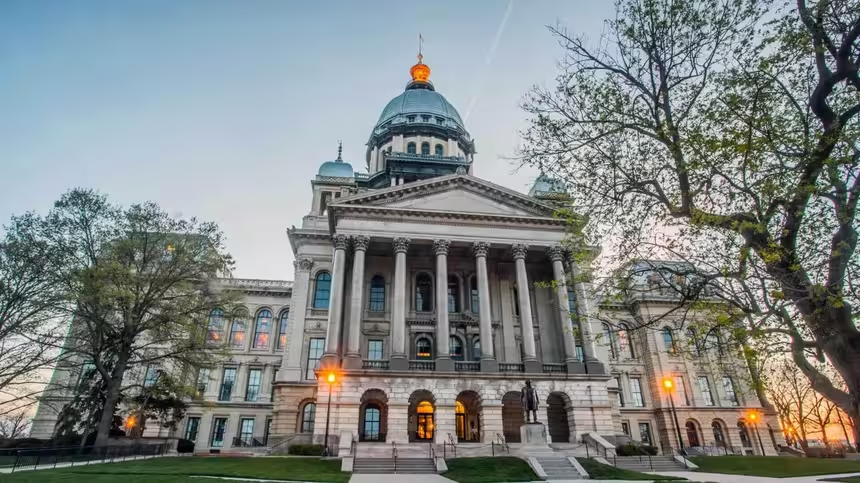
CapitolView
CapitolView is a weekly discussion of politics and government inside the Capitol, and around the state, with the Statehouse press corps. CapitolView is a production of WSIU Public Broadcasting.Providing Support for PBS.org
Learn Moreabout PBS online sponsorship(dramatic music) - Welcome to "Capitol View," where we discuss the latest in state government and politics.
I'm Hannah Meisel with NPR Illinois.
Joining us this week is Charlie Wheeler, director emeritus of the Public Affairs Reporting program at the University of Illinois, Springfield.
Thanks for being here, Charlie.
- It's always a pleasure.
- And also here is John O'Connor, political reporter for the Associated Press.
Glad you're here, John.
- Thank you, Hannah.
- Well, we would love to not have to discuss it every week, but COVID is sticking around.
And so we've got a whole lot of pandemic politics to talk about this week.
In late August, the governor announced, and he was one of, I dunno, I think the first at least dozen states that announced a vaccine mandate for teachers.
and Illinois' mandate also goes for higher ed personnel and also students along with healthcare professionals.
And the deadline for the people getting their first shots came and went on Sunday.
But it's not as simple as just saying, okay, you have to get your shots, because lots of folks are wanting to opt out still.
And also, the testing that was supposed to be provided to schools for free, that has not quite worked out in the ways that we thought it would.
So Charlie, what is going on with the SHIELD testing and the access that schools were supposed to have for free because of the federal stimulus money that was supposed to pay for it?
- Well, I think part of the problem was, as I understand it, the school administrators sort of, what would you say?
Procrastinated.
And as we came within a week or two of school starting, suddenly all the schools wanted these tests, and we didn't have the capacity to be able to give everyone what they needed immediately.
And so I think we're working on getting that straightened out.
And ultimately, I'm not sure how many weeks it'll take, but ultimately all the school districts that want these tests will get them and the means necessary to evaluate the tests.
And basically, the tests we're talking about, as I understand it, is called a SHIELD test which was developed by scientists at the U of I in Champagne.
And it involves, not to be gross, but you basically drool into a test tube and then they test it.
And it's pretty quick.
Usually you can find out within the same day.
As a matter of fact, all last year at UIS, if you wanted to be on campus, you had to be tested.
And I believe at one point, you had to be tested twice a week on Monday and Thursday if you were gonna be there full-time.
You went and you drooled into the tube, and then a couple hours later, they say, okay, you're clear, or, uh-oh, you seem to be positive.
So I think more than anything else, it wasn't that schools didn't wanna do it, it was that there was such a demand, and the facilities, the capacity to produce wasn't there.
And with the supply chain issues that we're having, some of the materials needed to make the tests weren't there.
So I believe things are being ramped up, and hopefully in a couple of weeks, this problem won't be as severe as it is now.
- John, is there an argument to be made that, someone should have foreseen that?
Someone in the governor's office possibly who has a 40,000-foot view of, yes, supply chain problems and the COVID numbers, and what kinds of mandates are gonna be coming down the pipeline?
Or is it just that the Delta variant and its spread came on so quickly that no one could have predicted this?
- Probably a little bit of both.
Yeah, It would be nice to think that somebody from that 40,000-foot view is monitoring that and thinking of all the things.
But there are lots of contingencies.
And as Charlie spoke there, I thought about all the things that go into getting a school year moving after a three-month break.
From parents getting their kids ready and the teachers and the administrators.
And it all seems to be done at a very fast pace once the first-day kids.
And so it doesn't surprise me that schools would at the last minute think, oh wait, we need these tests as well, and everybody orders them at once.
- And I think the point about the Delta variant is really relevant because, say a year ago, we were anticipating that, well, when we get the vaccines and we get everybody vaccinated, this stuff will (audio cuts out) go away and it won't be any more prevalent than some of the other viruses we had over time.
And then the virus mutated into Delta, which as I understand it, is roughly twice as transmissible and can have much more severe consequences than your basic, generic, original COVID.
And in my mind, that's one of the real dangers that we have when we have such a vast pool of unvaccinated people out there.
Because the virus, as it replicates, as it reproduces itself, inevitably, there'll be glitches in its offspring, so to speak.
And Delta is glitch that's proving itself to be difficult to deal with because it's so much more transmissible.
What happens when, as I think ultimately will occur, there is a glitch in the reproduction and suddenly we come out with a mutant and a variant on which these vaccines don't work.
So in my mind, that's the big danger of having this vast pool of unvaccinated people who basically serve as a breeding ground for the next variation of the virus.
- Sure, and the statistics from the Illinois Department of Public Health say that in the last month or so, that pool of an unvaccinated people, it's really the younger crowd who is seeing the most infections per 100,000 or whatever the metric is there.
So that is worrying.
We are seeing of course a dip in the numbers.
Hopefully, that means that we're getting to the other side of the Delta-fueled wave in Illinois.
Although a lot of other states, you're not so sure.
It's definitely a lot worse in other states.
So we are at least a little bit insulated.
But there are pockets of Illinois who are still not doing well.
Southern Illinois especially.
We've seen in recent weeks, having very little ICU capacity, very few free beds.
And as we discuss in the program this week, and perhaps the week before, that means that if you are rushed to the hospital with, maybe you have a heart attack or maybe you're in a bad car accident, you might not have a bed available.
And that's scary.
That's not a situation anyone wants to be in.
But in that "Tribune" article that was examining what was going on with the rollout of the SHIELD testing, it said that, this was last week, so the numbers might've changed a bit, but 550 public school districts, which is more than half of the districts in Illinois, had asked for SHIELD testing, but only about 80 had started testing.
And as of Wednesday, as in yesterday, we're sitting here filming Thursday morning, 200 schools had outbreaks.
Despite that, lots of teachers in certain districts have pushed against the governor's vaccine mandate.
And some of them have even pushed against being forced to test for COVID if they're opting out.
And one of the interesting things that we're gonna start seeing is a lot of lawsuits based on this Health Care Right of Conscience Act which was a law that was enacted decades ago to kind of protect doctors, nurses, other healthcare professionals from having to do anything with abortions if they objected religiously.
But Charlie, I mean, because the act was written so broadly, can you see legal outcomes that the governor's office just can't touch because they're just kind of reaching the end of their executive power here.
- I am not sure how this will all play out.
But as you say, when that law was enacted, and I think it was enacted at a time when I was still a reporter, I seem to vaguely remember it.
I think (clears throat), excuse me.
(coughs) Excuse me.
I think the most convenient way around it, because obviously when the law was enacted, nobody was thinking about how 30, 40 years in the future we might have this pandemic.
Something that we haven't seen since the 19 teens.
In my mind, the obvious solution would be for the General Assembly to make clear that this does not apply to a pandemic.
Because that was never the intent of the sponsors or the people who voted for it way back then, that it could be used to prolong a public health emergency.
I think I would be inclined if I were a school district, I would be inclined to say, well, you take the test or you're out of here.
And I think that's within their power.
And they can always say, look, if you don't take the test and you infect some kid and we get sued, our insurer has said, we're not gonna pay that.
That's negligence on your part.
And if I were to administrator, I would go ahead and can the person and say take me to court.
And hope that in the meantime the legislature would act, and that some judge would be, in my mind, rational enough to say, look, this law was not meant to apply to this situation.
We're in a public health pandemic, and for you to try and use this as an excuse to avoid doing the responsible thing for whatever pseudo reason you might have, I'm just not gonna allow that.
- Well, as you pointed out, Hannah, that the law, and it's come up since its inception, that it applied to those healthcare providers.
That they didn't have to provide the service.
And I think initially it was centered on abortion.
If I have a religious objection to abortion, I don't have to perform an abortion.
And what we see now are the recipients of the healthcare saying I have a right of conscience not to accept that healthcare.
Now, it seems to me, and I haven't reviewed the law, but as I recall it, it would be pretty clear that it doesn't apply to the recipients of healthcare.
However, we know that people can go to court and challenge the legality of such things.
And as Charlie says, it would make sense for schools to say, you follow these rules or you're not allowed in this building.
But I think we're gonna see, and we are seeing, not to get ahead of you, but I think we've got some lawsuits on that issue too.
That you can't exclude me my kid from school because he's not vaccinated.
- Yeah, and the other difficult proposition is, especially in these rural districts, we've seen for years a teacher shortage.
And so I think a lot of districts, especially downstate, would be hard pressed to adopt such a hard line when they already are suffering from this teacher shortage.
Trying to figure out how to get these kids educated in ways that are fair and equitable and not overstuffing classrooms.
But I mean, the other thing here is that the governor's office is having to play kind of a legal whack-a-mole.
And Charlie, before we filmed, we were discussing the other adjustment that the governor had to make to his executive orders this week, I believe, in reaction to another lawsuit.
Can you tell us about that?
- Yeah, there was a lawsuit brought by none other than Tom DeVore, our favorite plaintiff's attorney.
And it involved kids in Effingham County whose parents said, we don't want our kids to have to wear masks.
And a judge in that particular circuit, the Fourth Circuit, agreed.
And the argument was that masks are somehow a medical device and that you can't be ordered to wear a medical device unless you agree to it.
And I'm thinking if a mask is a medical device, I wonder if the people who work in a factory, say a welder and has to wear that shield, I wonder if he has to get permission from his doctor to do that, that kind of thing.
In my mind, it was a goofy decision.
But then this particular circuit and its judges have made a number of decisions that I think are goofy regarded to this pandemic.
And the Fourth Circuit, it's nine counties in South Central Illinois.
And on appeal, their decisions have been overturned, and I expect that's what's gonna happen here too.
But anyway, the argument had to do with masking.
Another one had to do with whether or not you could require a quarantine.
And so what the department of public health did, And I think they did it, what, a few days ago, they issued an executive order saying that school districts don't need court action to require testing, masks, or excluding students and school personnel.
And that the state department or local health departments can administer vaccines or medications to prevent the spread of contagious or infectious diseases.
And it says people can still refuse to get the vaccinations, but then they could be kept off school property.
And nowhere in this new emergency rule did they mention the word quarantine which appeared to be what set the judge off in that particular case out in the Fourth Circuit.
- And stepping away from schools, John, the vaccine mandate for congregate care state workers, those who are in close proximity to folks who kind of don't have a choice to be in state-run facilities like prisons or mental hospitals, veterans homes, the governor's initial deadline for those folks to get their first shots was pushed off from I think October 4th to the 14th, as he works through more bargaining with the state's largest public employee union, AFSCME.
He announced earlier this week a deal with a much smaller union that represents, gosh, roughly like 250 maybe, employees at prisons and juvenile detention facilities.
But John, with the might of AFSCME being the largest public employee union, and the folks who are resisting their vaccines, especially in these facilities downstate, Choate Mental Health Center, for example, they staged a protest not wanting to get vaccinated.
What do you think the outcome might be?
Is asking AFSCME gonna stick to their guns well past the deadline and not cave to the pressure?
- [Charlie] I would hope, oh, go ahead, John.
- Yeah, I was was just gonna say that it was interesting because AFSCME, their campaign, has been let's get vaccinated, let's get vaccinated.
But they are often loathe to force members to do something.
And particularly when you talk about prisons, some mental health centers, some of the developmental centers that we're talking about, facilities that are in Central and Southern Illinois which tend to be more conservative.
So their members are gonna be more conservative and they're going to be more resistant to a government mandate to do something.
And that's kind of, if you're a union member, that's kind of your mojo.
We're going to resist the man, if you will, to make sure that we have our rights.
And that could be part of what's at play here.
- I would suggest that they do have their rights, but I guess being cynical, if I'm a prison guard in Southern Illinois and I say, no, I'm not gonna get vaccinated, I'm not gonna wear a mask, I have my rights, I'm gonna stand up to the man and all that, and they fire me.
How likely is it that I'm gonna find another job as good in terms of salary benefits, a lifetime pension as you can get from the state.
As I say, that's kind of cynical, but.
- But if my union is backing me up, that's what the point is here.
- Yeah, and I would argue that the union needs to be responsible and tell their folks, look, unless you have a serious religious, - Objection.
- what would I say?
Yeah, a serious religious objection to this.
The fact that maybe you don't believe in COVID or whatever shouldn't count.
You have a responsibility, particularly in a congregate setting, because you come and go.
You go into prison, the people that are in there, the inmates, they have no choice about being there.
They can't really socially distance themselves.
So you bring it in from the community, you infect the prison.
Or in a nursing home.
If one really wanted to be harsh and mean about it, then you would say, well, they're prisoners.
They deserve to die.
That kind of nonsense.
But in a congregate setting, in a nursing home or a developmental facility, you bring in a disease from outside that could really ravage the people there, I think just common sense and human decency requires you to take steps not to do that.
And it's interesting.
We talked about AFSCME.
On the other hand, if I'm not mistaken, both the Illinois Education Association and the Illinois Federation of Teachers are okay with having their workers, the teachers get vaccinated or do the testing.
- Right, but AFSCME and those teachers unions, they're fundamentally different types of unions, and not all public employee unions, not all trade.
I mean, we've definitely seen them pull together in the past, but they've historically not all been on the same page.
So it will be really interesting to see how this plays out.
But before we go, John, I wanna ask about one more pandemic-related thing.
The governor's office has extended the state's eviction moratorium once again to, I believe, October 3rd.
And it's possible that it'll get extended again and again.
Is there an end in sight do you think?
Or do you think that the governor's office is feeling the pressure to keep extending it because there's just no clarity about what will happen and the ramifications that would happen if we saw a mass wave of evictions?
- That's an interesting, it's surprising to me that that this has been extended so long.
However, when you think about the fallout from COVID, there are a few things that are a worse result than losing your home.
And I think what the governor's thinking is is that to have people evicted with no place to go, all their belongings on the front lawn is a much worse situation for the state as a whole than the inconvenience of some landlords.
So is there an end in sight?
There has to be, but it's probably one of the easier things politically to do as well in the interim.
To keep people in their homes and keep roofs over their heads.
And when you lose your home, often, you have no way to keep your job, for example.
So I think it's one of the smaller things and one of the easier things.
And the extension, there's nothing new in the extension other than in the rules, other than just the days have been extended.
- And I would say one of the things also that could mitigate against it is the fact that we received a lot of money from Congress and the president in these relief acts that have been passed.
And part of it is to help people pay their rent to avoid being evicted.
And if I'm not mistaken, we've distributed, oh, 330 million I believe was the latest figure I saw, out of roughly 630 million of our allotment.
And the notion is that by extending the time period again for evictions, in the interim, we'll continue to be able to get out more money to people so that they can pay the landlord their rent so that they don't lose their home.
- Sure, but on the other hand, the program that you're supposed to do that is you're supposed to have cooperation from the landlord or else it's a much harder process.
But we'll see how that plays out.
I know that there's supposed to be another tranche of money.
And unfortunately though, in the first few rounds that we've seen in the last 18 months, there's a lot more demand than supply.
But we're almost out of time.
I'd like to thank our guests, John O'Connor, Charlie Wheeler.
I'm Hannah Meisel.
And thanks for watching "Capitol View."
And we'll catch you again next time.
(dramatic music)

- News and Public Affairs

Top journalists deliver compelling original analysis of the hour's headlines.

- News and Public Affairs

FRONTLINE is investigative journalism that questions, explains and changes our world.












Support for PBS provided by:
CapitolView is a local public television program presented by WSIU
CapitolView is a production of WSIU Public Broadcasting.