
Paradox & Son
4/12/2021 | 28m 3sVideo has Closed Captions
Cellist, John Marshall, Bassoonist, Lynne Feller-Marshall and son James on viola perform.
Spokane Symphony Principal Cellist, John Marshall, and Principal Bassoonist, Lynne Feller-Marshall are the musical duo Paradox. They perform with son James playing viola.
Problems playing video? | Closed Captioning Feedback
Problems playing video? | Closed Captioning Feedback
Inland Sessions is a local public television program presented by KSPS PBS
Inland Sessions is made possible with support from the estate of Merrill O’Brien, The Avista Foundation , and VIP Production Northwest
Support provided by:


Paradox & Son
4/12/2021 | 28m 3sVideo has Closed Captions
Spokane Symphony Principal Cellist, John Marshall, and Principal Bassoonist, Lynne Feller-Marshall are the musical duo Paradox. They perform with son James playing viola.
Problems playing video? | Closed Captioning Feedback
How to Watch Inland Sessions
Inland Sessions is available to stream on pbs.org and the free PBS App, available on iPhone, Apple TV, Android TV, Android smartphones, Amazon Fire TV, Amazon Fire Tablet, Roku, Samsung Smart TV, and Vizio.
Providing Support for PBS.org
Learn Moreabout PBS online sponsorshipQuiet on the set, and anytime.
Tonight, on Inland Sessions... ♪ The Marshall family makes a talented trio when Spokane Symphony musicians John and Lynne perform with their son James, it's Paradox and Son.
♪ ♪ John Marshall: We are the Marshall Trio though Lynn and I are duo that we've had for 20 some years is called paradox.
So now we think it should be called paradox and son incorporated that my name is John Marshall and I play cello.
Lynne Marshall: My name is Lynn Feller Marshall, and I play bassoon.
James Marshall: And my name is James Marshall and I play Viola.
John Marshall: It just seems like a very natural, um, musical idiom to wake up every day or most days and play duos together.
And we do a lot of playing of all types in all different scenarios.
Now, with James coming into the picture now, as he's grown and starts playing with us, it opens up a whole new world of music, making both the, both in the type of music that we can play and kind of the quality I'll even say of it.
So, it's an ongoing, evolution of, Paradox.
Lynne Marshall: We are thrilled that the three of us can make music together.
Physically, we can sit in a normal configuration.
You don't have to be six or even 12 feet apart from each other.
So we are, I guess you would say were some of the blessed ones because we get to still do that.
And so many of our colleagues cannot do that.
♪ Lynne Marshall: James has just come off studying with a world-famous historical practice professor at Eastman.
And so, he's bringing things hot off the, what right off the front burner, basically back to us.
And so, and he's kind of begging us on like, well, why don't you try it, try it.
And then just a little bit different try this way.
Okay.
That wasn't so great.
Try it this way.
So, we've been doing a lot of that, especially since over this break.
John Marshall: We used to kick him in the pants, and he kicks us in the pants in a good way.
♪ Lynne Marshall: My dad befriended this bassoonist who taught at the local conservatory and he was thrilled.
So, when my dad left with his colleagues, he presented him with these two booklets of music, and they managed to stay in touch for several years.
The first book consists of strange characters and numerals, western style, zero six, five, a lot of circles.
It almost looks like binary code and I never noted that at the end of the second book, there were actually duets in standard based clef.
So, we've been playing them a lot ever since.
♪ Lynne Marshall: Eugene Bordeaux was a bassoonist in Paris, but 1850 till about 1926, he taught at the Paris Conservatory.
They had a long tradition of what were called contest solos for all the instruments.
So, every bassoonist for example, would learn one selected bassoon piece for that calendar year.
And so, he came up with this solo and what we played today was, a good portion of that, about two thirds of that solo.
John Marshall: You know, it's written for piano, so then we have to find out some way to translate it that how it sounds and works best on our string instruments.
♪ Alessandro Rolla was a violinist and violist and composer who lived in the late 17 hundreds and early 18 hundreds.
He is known today for being the teacher of Paganini, who was the famous violin virtuoso.
I discovered this trio, um, and he, he wrote it for himself, a cellist and a bassoonist colleague that he had, and they traveled around Italy playing this.
I think it's really cool because it's until these pieces that have been written for the, for the three of us specifically, this is the only other piece found written for this instrumentation.
♪
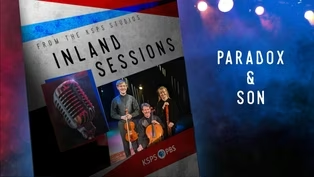
Preview: 4/12/2021 | 30s | Symphony musicians John and Lynne Marshall perform with son James. (30s)
Providing Support for PBS.org
Learn Moreabout PBS online sponsorship

- Arts and Music
The Best of the Joy of Painting with Bob Ross
A pop icon, Bob Ross offers soothing words of wisdom as he paints captivating landscapes.













Support for PBS provided by:
Inland Sessions is a local public television program presented by KSPS PBS
Inland Sessions is made possible with support from the estate of Merrill O’Brien, The Avista Foundation , and VIP Production Northwest