At Issue with Mark Welp
Building a More Sustainable Home in Central Illinois
Season 3 Episode 35 | 27m 3sVideo has Closed Captions
Rebecca Johnson and Ryan Reber explain a new passive house development in Bloomington.
Rebecca D. Johnson and architect Ryan Reber join Mark Welp to explore passive houses and a new Bloomington development built around the concept. They explain how efficient construction can reduce energy and water use, improve indoor air quality and lower long-term costs while discussing home designs, pricing and plans for 22 homes on three acres.
Problems playing video? | Closed Captioning Feedback
Problems playing video? | Closed Captioning Feedback
At Issue with Mark Welp is a local public television program presented by WTVP
At Issue with Mark Welp
Building a More Sustainable Home in Central Illinois
Season 3 Episode 35 | 27m 3sVideo has Closed Captions
Rebecca D. Johnson and architect Ryan Reber join Mark Welp to explore passive houses and a new Bloomington development built around the concept. They explain how efficient construction can reduce energy and water use, improve indoor air quality and lower long-term costs while discussing home designs, pricing and plans for 22 homes on three acres.
Problems playing video? | Closed Captioning Feedback
Where to Watch At Issue with Mark Welp
At Issue with Mark Welp is available to stream on pbs.org and the PBS app.
Providing Support for PBS.org
Learn Moreabout PBS online sponsorship(warm music) (warm music continues) - Many people are retrofitting their homes with solar panels, energy-efficient appliances, and smart technology to save money and help the environment.
But what if you could build new homes that already address those issues?
Passive houses can conserve energy and water and provide better air quality, among other benefits.
And there's a company in the Twin Cities preparing for a new development as the area also faces a housing shortage.
Joining me are Rebecca D. Johnson, CEO and founder of COII, or Community of Imaginative Ingenuity, and Ryan Reber, lead project architect.
Thank you both for coming in.
We appreciate it.
- Thank you.
- Thank you.
- Thank you for having us.
- So I talked a little bit about the benefits of a passive house, but kinda give me the definition, your definition of a passive house.
- So I first learned about passive house when I started visioning COII.
And it is a really cool feature that utilizes passive systems.
And I'm gonna let Ryan Reber dive into that a little bit more.
- Yeah, sure, so, passive house is essentially a building standard that focuses on creating very energy-efficient buildings that also have very low energy consumption as well as providing a very comfortable and healthy indoor environment for the occupants.
- Okay.
And are there examples of any passive houses in Central Illinois that we can talk about?
- Yeah, sure.
There's a really notable example in Urbana, Illinois.
That's the Equinox House built by Ty Newell about 15 years ago.
And it's a very good example of a passive house and passive energy systems.
There's also the Solar Decathlon projects that are made by the University of Illinois that sometimes make appearances in the community around.
So, those are the ones that I'm most aware of.
- Mm-hmm.
Before we get into the specifics, I'm curious to ask both of you how you got into this.
You know, what really was your motivation, and when did the light bulb go off?
- The light bulb went off in my garage in my Tesla.
(chuckles) - Okay.
- And I started thinking about all the issues that I have with my home and that I don't have with my car and the advancements we're making in our culture, in our society, but our homebuilding practices really have not advanced for over a hundred years.
And so I started thinking about what solutions would I like to see as a homeowner in future homebuilding.
And then I took that vision, and I thought, somebody surely has thought of this before.
And I found online, Jim Soules developed a really beautiful neighborhood called Keller Court Commons in Petaluma, California.
And I was very inspired by the focus on sustainability and conservation and took that and modified that to fit something that would work well in the Midwest.
And we don't really have a lot of conservation-focused developments in the Midwest, so it was really exciting to start visioning that.
And here we are today.
And in 2024, Ryan came on board with the project.
- Okay, before we get to Ryan, I'm curious.
- Yeah.
- What's going on with your house that you're not happy about?
(Rebecca laughs) - Well, it's not very energy-efficient.
(laughs) - Yeah.
- You have air leakages.
There's a lot of space that could be utilized more effectively.
It really has no water conservation within the home build, which is typical of a traditional build, so it's not out of the ordinary.
- Sure.
- Just we can do better.
- [Mark] And Ryan, how did you get on board?
- Well, believe it or not, my graduate school thesis project was creating energy-efficient homes on a mass scale, right?
And in my professional career, I had the opportunity to make a few of these projects, but it wasn't until I was approached by Rebecca and the COII Team that I've really had this wonderful opportunity to actually build a lot of these houses and design a whole community at once.
- Rebecca mentioned that, you know, homes haven't changed a whole lot in the last a hundred years.
Why do you think that is?
- Well, a lot of it is because of our reliance on fossil fuel technologies.
You don't have to take into consideration a lot of design elements when you can just plug into the grid or burn coal to provide the heat and also being able to cool your home with electricity.
But now as energy prices have spiked and people are becoming more aware of the limitations of our natural environment, it's very important that we kinda make this transition and maybe rediscover some of the sensibilities we had at one time.
- Sure.
I wanna talk about the five core principles of a passive house.
First of all, continuous superinsulation.
Can one of you tell me what that is?
- Yeah, continuous insulation, think of it like a sweater that your house has and it wraps all the way around without any breaks.
It's the thermal barrier that kinda prevents heat and cool from coming in and out of your building, right?
And we're also trying to have higher R-values than is typically required because we're trying to slow that, you know, the transfer of heat from the inside to out, or vice versa.
- Now, we hear about R-values when we're talking about windows, but explain that a little bit more for people.
- Well, the R-value is basically a method of describing the resistance to thermal transfer.
And for windows it's referred to as the U-value, which is just the inverse of the R-value.
- Okay.
Okay.
- Yeah.
- And then this one, I think, is interesting, airtight construction.
Now, we all know our homes leak.
Now, how do you go about getting airtight construction?
- Well, airtight construction is just creating an airtight barrier around the home, making sure there are no penetrations and you don't get any transfer of heat and cool through the building.
It's essentially like wearing a windbreaker, right?
So, you go outside, you have a sweater, that's your insulation, but you also want a windbreaker because you don't want air, you know, being able to attack your body.
So if you have both those layers of protection, you have your airtight barrier, which can be sheathing or a smart vapor retarder.
It can prevent the heat from being transferred via wind.
- Okay.
And then I just mentioned windows, high-performance windows.
Are these windows that are any different from what you can typically get on the market now, or are these just the best of the best?
- So, we're working on having a combination of three-pane and two-pane windows on the home.
So three-pane windows are gonna be a step up from your standard window, but window placement, and that's where some of the passive house features come in, is really important, and I'll let Ryan talk more to that.
He's done excellent job in our designs with that.
- Yeah, so, one of the aspects of passive houses is looking at the building orientation and the fenestration so that you can kind of allow sunlight to come in during the winter when you want it but blocking it in the summer when you don't.
And like we were talking about, a lot of these concepts are things that people used to use when they were building buildings, but we've kinda gotten away from that as we've, you know, sorta relied more and more on fossil fuels.
Now, these high-performance windows and doors, we want them to be airtight, like we talked about, insulative, like we talked about, and also we wanna make sure that they manage the solar heat gain correctly.
Either letting it in when you want it or blocking the solar radiation when you don't, right?
And also, we want these windows and doors to be thermally broken so they don't transfer heat from the inside to the outside.
- [Mark] Speaking of thermal, what is a thermal bridge-free design?
- (chuckles) Well, thermal bridging is essentially building elements that kinda penetrate that thermal envelope, right?
Now, some of 'em are unavoidable, right?
Like doorknobs, deadbolts, things like that.
But you need to have a mechanical fail-safe to get in and outta your home, right?
But some of them might not be strictly necessary.
Think about a two-by-four or two-by-six stud, right?
That's a heat superhighway, actually, that is the construction of your home, right?
So it actually allows heat to transfer from the inside to the outside of the house, right, because it, you know, spans from the outside to the inside.
Now, what if we were able to put exterior insulation on the other side of that, right?
Then we'd be able to arrest that flow of energy to the outside.
So not having any building elements that kind of puncture that building envelope is really important because wherever there's a chance for energy to get, you know, sucked outta your building, it's gonna happen, right?
- Sure.
And finally, heat and energy recovery ventilation.
What is that?
- Oh, well, if we've done all these things, right?
We've got our windbreaker, we've got our sweater, we've got really efficient windows and doors and no thermal bridges, well, we win, right?
It's a hermetically sealed little box that performs really well.
The only problem is we breathe air, right?
So we need to provide fresh air ventilation for the inhabitants.
And if we're bringing in this fresh air, we're gonna wanna make sure that we're controlling the source, right, and we're also controlling how we bring it in.
What do I mean by that?
We're gonna run it through an energy recovery ventilator.
So, as we exhaust some of the building air, we'll run it through, like, a heat transfer mechanism so that we capture some of the energy from the exiting air and transfer that to the incoming air.
So, that way we're not losing as much energy as we would if we just, say, opened a window, right, to gain fresh air.
- Okay.
I wanna talk a little bit about, I'm sure folks watching have two big questions, A, what's this gonna cost me?
And B, what do these houses look like?
Let's talk about what the houses could potentially look like.
And we've got some examples.
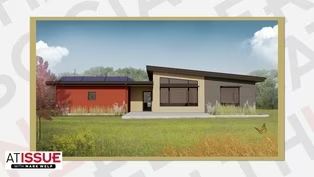
Tell us about Skyline-Vibe, your two-story.
- Yeah, so the Skyline-Vibe came about.
We're looking at a really cost-effective but a little bit larger model.
So our first model, the Beau units, are ranch, slab-on-grade.
So the Vibe models, and Skyline, because they're higher, they're two-story models, gives us an 1,800-square-foot, three-bedroom, two-and-a-half-bath home at a more cost-effective price.
And we say cost-effective 'cause these are high-performance passive house, really high quality materials going into the homes.
So when we're looking at pricing these, we're in the range of 390 to 590K.
So kinda the workforce plus range.
Typically, in the East and West Coast when we've seen homes like this being built, you're looking at over a million dollars for these types of homes because the materials are such a higher-quality material.
It was our goal from day one to make sure that we're building a cost-effective home.
And when you look at that upfront cost, you also have to think of the backend cost.
There's no gas bill.
We're not using gas, this is an all-electric home.
You're gonna have reduced energy costs because of the passive house and high-performance features.
You're also gonna have a reduced cost with the water reclamation system, which I am personally very excited about because it's gonna reduce your water usage by 50%.
- So it's kinda like buying an electric car or maybe solar panels, you're gonna pay a little bit more upfront, but in the long run, you're gonna be saving money.
- Correct.
Correct.
And our per square footage cost is getting very comparable to the current new construction on the market, so we're working to make that as comparable pricing-wise as possible.
- You mentioned the water reclamation system, that's something that most houses don't have.
Tell us how that would work and the benefits of that.
- Yeah, so the Equinox House, which Ryan had mentioned earlier, has this water reclamation system that uses rain water for toilet water.
It was actually the first home in Illinois approved for that.
And so we are also seeking that approval for the full development to use rainwater that can be used as toilet water and then also as landscaping water.
Your toilet water usage is about 50% of your usage of water in your home.
So that's a lot of water, you know, being flushed down the toilet.
(laughs) - And it doesn't need to be purified, doesn't matter what it tastes like.
- No, but it'll still meet the requirements for indoor water.
- It'll go through a UV sanitation, so that if your dog drinks outta the toilet bowl, it doesn't croak, right?
(Rebecca laughs) - Yeah.
(laughs) - Good to know.
- Yeah.
- Let's take a look at another design you have, the Cool-Blue Ranch.
Is that right?
- Cool-Beau.
- Cool-Beau, I'm sorry.
- You're close.
It's okay.
(chuckles) - [Mark] Cool-Beau Ranch.
These houses, I mean, they look modern.
- [Rebecca] Yes.
- [Mark] And they, you know, not necessarily cookie-cutter homes.
Are these houses, can people do a lot of customization on them, or right now is it kind of, you have a couple different options?
- There will be some customizations.
It'll be what I call semi-customs.
So you'll have options.
And that streamlines the buying process and makes it simpler for the homeowner.
It also keeps the focus on those conservation features, which includes low to no VOC products on the inside of the home and sustainability in terms of carbon footprint.
So we're looking to go as local as possible with our materials and the services that we use.
- [Mark] And explain to us what VOC is.
- The volatile organic compounds that can come off of materials like your sofa or paint.
- Okay.
- Or the stain that you use on a cabinet, right?
So we're gonna have no VOC cabinets.
That means we're not putting a coat of anything on there that would then release those volatile organic compounds.
- So are there any challenges in building a house like this in terms of, I don't know, building codes, since this is something kind of new to our area.
Any challenges in that way, or is it just kind of like, hey, we get the materials, we get the land, and we can do this?
- I mean, we're fairly unrestricted here, but one thing that is fairly important is to have an educated contractor and builder so that they understand sort of the goals of the project so that they can kind of construct it accordingly, right?
There's no particular building codes that these would get in the way of.
In fact, these are much more energy-efficient than most houses, so they would have no problem satisfying the energy codes, for example.
- Sure.
Now, are there any, we've talked about all the pros of these kinds of houses, any cons or anything people might be concerned about that are maybe different than, say, from a typical home?
- Sure, I think the care is gonna be a little bit different.
We're using EPDM and metal roofing, so some of the materials are not uncommon but maybe less common in a traditional home build.
So we, along the way, starting this last fall, we've done educational sessions on the products that we're using and the sustainability aspects.
The home will come with a COII Home Guide to help guide owners through the care that's needed.
It's really quite a bit less than your traditional home.
So that's the great part of it.
And that was the whole purpose from the beginning.
- Sure.
- Less burden, more fun.
- I've always wondered about (Rebecca laughs) metal roofs.
What are they like compared to your traditional shingled roofs in terms of energy efficiency or, you know, their lifespan, things like that?
- Well, obviously, the lifespan's gonna be more, and they're actually set up for photovoltaic systems quite a bit, you know, easier.
Another thing that's nice about 'em is steel roofing, especially, can be recycled, whereas asphalt shingles are a little, you know, more environmentally unfriendly, of course.
- Let's talk about the outside of the house a little bit more.
And are you doing anything in terms of maybe landscaping that is environmentally different or environmentally better than we might typically see?
- Absolutely, and I'm really excited about this.
We're doing an all-native landscaped development, and that includes the lawn.
So it is an HOA development to help protect that conservation effort.
That helps with storm water runoff, that helps with our local ecological systems in terms of for nature.
It helps with keeping water cleaner, it helps with root systems to protect the home from water, foundational water issues.
There's so many benefits to native landscaping, and we're really excited to implement that.
- When you say native landscaping, I'm thinking prairie grass.
Am I thinking wrong there?
(Rebecca laughs) - It's definitely more than prairie grass.
There's a lot of different ways to do it.
I mean, you can have an edible lawn, so your lawn can be, you know, low-lying gardens.
You could incorporate different rocks and do just, you could do some of the simple prairie grass.
But it doesn't mean you're having eight-foot-tall grass in front of every home.
It can be done in a very clean- and modern-looking way, and we're excited about that.
- Gotcha.
Now, you've, we should say, you haven't built any houses yet, but you have purchased land- - Yes.
- Over in Bloomington, between, I believe, 55 and the Marcus Theatre area.
- Correct.
- Why did you pick that spot?
Because I know, you know, there's not a lot of land in that area.
- [Rebecca] Yes.
- We've got a housing shortage in the Twin Cities, so why'd you pick that spot?
- So early on with COII, choosing the land was one of the very highest priorities for a lot of reasons.
One, the sustainability aspect.
So we were looking for land that wasn't really being utilized so that we weren't taking farmland or taking land that needed to be used for other important purposes in the community but also sat in a place where home buyers would want to be in.
Like, with mature trees, it's actually pretty quiet even though 55, I mean, I can hear 55 from my home right now.
- So can I.
- (laughs) And yeah.
You can hear it everywhere.
But there's so much mature trees in that area.
It also has a lot of access points, which one of the barriers with development is infrastructure costs get really high.
And because we have more access points, we're able to build our roads more conservatively and that concrete cost then comes down.
- Gotcha, and are the, you know, is the infrastructure similar in terms of, you know, sewers and electric and the way things are run?
- Correct.
Yep, yep.
Sewer, water, and electric, just no gas.
- Gotcha.
Are you worried at all, with the state of the housing market in that area, at all about, you know, like I said, there's a housing shortage and... You know, I live not too far from there, and I remember four years ago when we bought our house, there's bidding wars on everything and houses were being sold in less than 24 hours.
- Sure.
- And now there's just with... You're close to Rivian, so that would be good, I would assume, for a Rivian employee.
- Absolutely.
- But is that, any concerns about the environment we're in now economically?
- I don't think so, 'cause this is something different.
And as I've done my research over the last four years, this appeals to, you know, people ask, like, "What's your market?"
You know, "Who's your target market?"
And it's more of a mindset, and that can be any age group or demographic.
And young people are looking for something different on the market.
If we're gonna offer something like this at a similar value to a traditional home for that upfront cost but over the long run you're gonna save with a COII home, that becomes an obvious choice.
- Sure.
- Yeah.
So I think there's a differentiation in the market that is important, and important for future generations, too, to be inspired to build more innovatively.
- And Ryan, from the research you've done, and, like you mentioned before, there's a lot more of these homes on the coast than there are here in the Midwest.
What kind of results have you seen in terms of the bills people have to pay and things like that?
I would assume the electric bills at some point get to be pretty low.
- Mm-hmm, yeah.
So, I mean, a passive house can have up to 90% of the energy costs taken away, right?
So that's pretty significant.
And it's not just saving money on your energy bills, right?
That gives people more money in their pocket and all of a sudden they can reinvest that back in the community, right?
They can go out shopping, they can go out to eat, right?
So, there's a lot of downstream sort of economic effects that come from just saving money.
And it's also, like we pointed out, less strain on the local infrastructure.
Especially when we talk about the water reclamation, that's something that's gonna help everybody out, not just the homeowners.
- Yeah, we do have water issues in Bloomington, too, so that would be something to think about.
Now, in terms of, you know, you mentioned it's a little bit more than a traditional house to build.
Is that because of the elements that are being put into the home, or is it labor because it takes longer to build?
What would you say about that?
- Well, a little of both, right?
Because I think one of the cons is it's gonna be a little bit more upfront cost, right, but I think people understand, if you get a premium product, you're gonna pay a little bit more, right?
In addition to being a better product, it's also gonna take a little bit more time to detail and make sure it's constructed correctly, right?
So those are two things that sorta drive the cost a little bit.
- Sure.
Have you been in touch with the city at all about this?
- Yeah.
- You know, your ideas, what kind of feedback have you gotten from the City of Bloomington?
- City of Bloomington has been excellent to work with.
They're excited about this project.
This is the first project of this kind in the State of Illinois.
The closest thing would be Prairie Crossing up in my hometown of Grayslake, which is a 600-acre conservation subdivision that is absolutely stunning and been thriving for over 30 years.
So they're very excited about us bringing this to Bloomington.
- Yeah, I know, they want more housing.
And in terms of the land that you've bought, how many houses could you build on that?
- We're gonna have 22 homes on three acres, and that's the part of the pocket neighborhood.
In the middle of the development, we call it a cottage cluster, so there's six homes.
They'll have what I call VIP parking spaces but no garage, which really helps bring the cost of the home down.
So we're offering a lot of variety in that small 22 footprint.
- So I'm trying to do the math here.
Three acres, 22 houses.
Those yards, pretty small then?
- Yep, very maintainable, easy to care for.
Again, we want more play, less burden.
- Yeah, especially, I wonder if young people even care about having yards these days, you know?
(Rebecca laughs) They're nice to have, but who wants to maintain 'em?
- Well, less to maintain.
And we'll have a really nice open green space in the middle of development for the community members to come together.
And then also to the north, we look forward to having wetlands preserves.
- Okay.
You've had some open houses so far, and I know you've got some coming up that we'll tell people about, but what are some of the more common questions that people have about these passive houses?
- Well, I mean, sometimes people think they're gonna look weird, right?
Or they're gonna have to really maintain the houses in a way that's different than normal construction, but none of those things is really true.
They can be just like a typical house but just have much better features, right?
- Mm-hmm.
And as far as the interior of the houses, are they similar to traditional houses in terms of, you know, you got your drywall and you've got this and that?
- Mm-hmm.
- Absolutely.
- So you could be standing inside of a passive house and not know it, right?
Technically?
I mean, it could look like any other house?
- Yeah, so I was in the Gable House very early on.
A friend of mine invited me to come and sit in the Gable House, which is the passive house on the U of I campus.
And I'll tell you, the air quality was almost better than outside, just because of that way that the CERV system works with the house, the CERV ventilation system, so.
And with the air tightness, you get a lot more air quality control.
So I would say the air quality was the thing I noticed most, but otherwise, it's just like another home, yeah.
- And as far as the mechanics of the HVAC system, maybe you can tell us a little bit more about that in terms of, are we talking more kind of heat-pump-type things that people use?
- Yeah, so it's gonna be an air source heat pump, which is essentially an air conditioner that can run in reverse, so it provides both the heating and the cooling.
In addition to this, we're also going to be using a energy recovery ventilator, and not just any one.
We're very fortunate to be working with Build Equinox, who produces the CERV system.
That's the conditioning energy recovery ventilator.
And it's better than a regular ERV because it doesn't just recapture the energy.
It also sniffs the air and kinda monitors the VOCs and the CO2, right?
It'll even give you a little readout on an app you can use, and you can kinda monitor the levels whenever you're home, right?
It also will have a UV system that can actually zap the air for bacteria and viruses if you want that feature.
And it filters the air and purifies it in addition.
And it doesn't just stop there, it'll actually sniff the exterior air.
And if you're picking up smoke from, say, like a wildfire or dust or allergens or maybe chemicals, maybe a crop duster went over your house or something, right, it'll actually see that in the exterior air and it'll choose not to bring that in and will actually recirculate the interior air so that you'll actually have a much more intelligent air management system in your home.
- So since you're talking about the VOCs and you're concerned about that, does that mean there's not gonna be gas lines coming into these homes?
Is it gonna be mostly- - Correct.
- Okay.
- All electric.
- All electric.
Okay.
Very interesting.
Well, tell us a little bit about your upcoming open houses if people wanna find out more info and ask questions to you directly.
- Absolutely.
So we'll be at Green Top Grocery on June 20th with Jennifer Crawford, our interior designer, and she specializes in eco-friendly design.
She's also really well engaged with our local people who manufacture and do services for interior design products.
And that'll be from 10:00 AM to 12:00 PM.
You can stop by anytime.
It's an open-house style.
You can meet and talk with Jennifer and myself, and we also have a interest form out.
If you sign up for our newsletter, you would get the interest form.
- Okay, and your website is?
- The website is www.coii, C-O-I-I, .co.
Or our new website, which just got released, is www.coiicommunities.com.
And on July 11th, you can meet Ryan and I at Green Top Grocery as well, 10:00 AM to 11:00 AM.
- Well, I think a lot of people are gonna be watching this experiment to see how it goes.
And who knows, this could be the future of new homes in Central Illinois.
- That's the goal.
- All right.
Rebecca D. Johnson and Ryan Reber, we appreciate all the info, and very interesting topic.
Thanks for coming on.
- Thank you.
- Thank you.
- Thanks for having us.
- All right, appreciate it.
And thank you for joining us.
If you wanna watch this again or share it with a friend, just go to wtvp.org.
Have a good night.
(warm music) (warm music continues) (bright music)
Do Passive Houses Require More Maintenance?
Video has Closed Captions
Clip: S3 Ep35 | 1m 13s | Rebecca Johnson and Ryan Reber discuss maintenance, metal roofs and sustainable materials. (1m 13s)
What Makes a Passive House Different?
Video has Closed Captions
Clip: S3 Ep35 | 1m 5s | Rebecca Johnson and Ryan Reber explain how passive homes cut energy use and boost comfort. (1m 5s)
Why Passive Houses Cost More Up Front
Video has Closed Captions
Clip: S3 Ep35 | 1m 11s | Ryan Reber explains passive home costs and Bloomington's response to the new development. (1m 11s)
Providing Support for PBS.org
Learn Moreabout PBS online sponsorship New Episode
- News and Public Affairs

Top journalists deliver compelling original analysis of the hour's headlines.

- News and Public Affairs

FRONTLINE is investigative journalism that questions, explains and changes our world.
 New Episode
 New Episode
 New Episode
 New Episode
 New Episode
 New Episode
 New Episode
 New Episode
 New Episode
Support for PBS provided by:
At Issue with Mark Welp is a local public television program presented by WTVP