
The Church: Presenting Solutions
Season 2 Episode 206 | 26m 48sVideo has Closed Captions
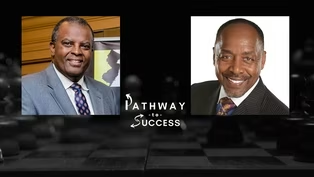
Bishop David G. Evans talks about his ministries goal to present solutions to problems.
John E. Harmon, Sr., Founder, Pres. & CEO of the African American Chamber of Commerce speaks with Bishop David G. Evans about his ministries many initiatives to develop & impact the lives of people at Bethany Baptist Church in Lindenwold, NJ, as well as the over 90 churches he oversees around the globe. Produced by the AACCNJ, Pathway to Success highlights the African American business community.
Problems playing video? | Closed Captioning Feedback
Problems playing video? | Closed Captioning Feedback
Pathway to Success is a local public television program presented by NJ PBS
The Church: Presenting Solutions
Season 2 Episode 206 | 26m 48sVideo has Closed Captions
John E. Harmon, Sr., Founder, Pres. & CEO of the African American Chamber of Commerce speaks with Bishop David G. Evans about his ministries many initiatives to develop & impact the lives of people at Bethany Baptist Church in Lindenwold, NJ, as well as the over 90 churches he oversees around the globe. Produced by the AACCNJ, Pathway to Success highlights the African American business community.
Problems playing video? | Closed Captioning Feedback
How to Watch Pathway to Success
Pathway to Success is available to stream on pbs.org and the free PBS App, available on iPhone, Apple TV, Android TV, Android smartphones, Amazon Fire TV, Amazon Fire Tablet, Roku, Samsung Smart TV, and Vizio.
Providing Support for PBS.org
Learn Moreabout PBS online sponsorship- Support for this program was provided by...
Horizon Blue Cross Blue Shield of New Jersey.
PSE&G... proud sponsors of "Pathway to Success."
JCP&L and the African American Chamber of Commerce of New Jersey, working together to build a stronger community for all.
Investors Bank, banking in your best interest.
Berkeley College, education drives opportunity.
Be inspired.
NJM Insurance Group.
Wardrobe provided by Vandiver.
[upbeat jazz music] ♪ ♪ [person speaks indistinctly, gospel choir singing] - No matter the situation, no matter the circumstance, let Jesus fix it.
[choir sings] - You know, there's no greater sound than inspirational sound from the Lord, and it makes all the difference in the world.
It just changes the atmosphere.
Today's show is a very special show because the atmosphere has been set.
Our very special guest, the Honorable Bishop David G. Evans, senior pastor, teacher, Bethany Baptist Church.
And, you know, he's not only here in our state of New Jersey, but he has a global presence.
My good friend, David Evans, how are you today?
- Good morning, man.
How are you?
- We're delighted to have you.
We're going to start off with a few questions just so that our viewers get to know you.
Provide us a little bit on your background, where you're from, your family.
- I was born in Philadelphia, Pennsylvania.
Came from a broken home, moved to Chester, Pennsylvania, to the Fairground projects, and I say that with honor, because it was not a housing development.
It was a project-- government cheese, powdered milk, powdered eggs.
My mother worked hard, two, three jobs, went to college, got her advanced degrees, moved us out of that situation into West Philadelphia-- very quiet residential street.
And went on to college after boarding school.
And she had to get me out of the streets.
I was starting to get a little caught up in what was going on out there, so she sent me to boarding school, which helped to straighten my path.
I went to Lincoln University, the oldest-- for all you Morehouse folk out there, the oldest HBCU in the nation.
Later served as chair of the board of trustees for that college.
Majored in economics, minored in education, went on to become vice president in three of the top ten banks in the world, moved from that over to pastor in God's church, but in the transition, started a very successful, groundbreaking building-maintenance company in Philadelphia, Pennsylvania, and God has just been moving our lives, and we've been touching lives for the last 30 years at Bethany Church and in Lindenwold.
- You came from a household where if you looked at statistics, you're supposed to be probably just bailing out of jail or just have done a long term.
- A statistic.
- Clearly a statistic for not good.
Was there someone in your life that was an influence or inspired you?
- I have to say my mother, who inspired me with a work ethic, my grandfather, who took the place of my dad and kept encouraging that we could do anything, overcome any obstacle.
In our family, there was never any conversation as to whether you were going to college or not.
It was not a conversation in our family where you had the option.
There were no options.
You were going to graduate, you were going to do well scholastically.
If you participated in athletics, you were going to do well athletically, you were going to do well socially, you're going to do well culturally.
If you were going to be a member of our family.
In each chapter of my life, there has been someone significant, and then as I started to matriculate through various careers, I got to banking and young man named Jay Hill mentored me through, and it accelerated my progress.
- But you spent some time on the New Jersey Turnpike Authority.
- Yes.
- What was that all about?
And how did you, in that capacity, influence to impact the community and businesses in the community?
- I had overcome some barriers at first.
I spent my time influencing the inclusion of Black businesses around the nation in the Turnpike Authority's business plan, also making sure that everyone that worked at the Turnpike had equal opportunity.
In addition to that, began to help people get jobs with the Turnpike, really kind of turned up the pressure on equality as an activity rather than a concept.
- Why is it important someone in your capacity, particularly a Black male, to take on the responsibility of being kind of, you know, to use kind of a ministerial term, the shepherd of the flock, the visionary?
- I think one of the challenges that we face as African-American men who find themselves in board positions-- But what I find is that there's a silent question that's always asked for us.
Are you willing to trade your integrity for the seat they're offering you?
And in each situation, I've I've made sure that my integrity stayed intact and did not allow my desire to just be present to influence my ability to raise a problem and press the issue if it was valid.
- Holding the line and being true to yourself, and moreover, in this case, true to the God you serve and honor... there's no value that can be exchanged for that.
- For me, there's no need getting to a top floor and then pulling the ladder up.
When God gives you favor, it's not just for you, it's so you can influence the lives of other people.
As the pastor, it is not enough for us to simply preach every week, which why our outreach is so broad-based, which is why we are involved in every major area of cultural life.
So these positions that we occupy, especially me as pastor-- You know, I oversee 90-some churches.
I'm raising people in the ministries.
I oversee 20,000 members in our church... and impact other ministries around the nation and around the world simply because of the position that God has given us, the favor He has given us.
So, to stay there and kind of wallow in the honor of the position and not leverage the position to help other people, I think is a waste of time.
- But speak to a little bit about the programs-- in your vision, about the role that this ministry plays, not only here in New Jersey but globally.
- Some of our work includes not only lifestyle ministries like singles and couples and millennials and young people, but also we had to form a community development corporation years ago to deal with what we call the life change-- generational impacts that happen in people's lives.
So out of that creation came our senior house, The Harvest House, because we wanted to provide a place where our seniors in their later years could have an invariably stress-free life as much as possible, live longer, quieter, more secure in an environment where they're living independently.
Seniors are forgotten in a lot of places, and we decided we were not going to forget them because we stand on their shoulders.
Secondarily, our family ministries, our ministries for young people, our prison ministries, where we visit at least six prisons a week, when COVID was allowing that, feeding people, clothing people, educating, mentoring, advocating for kids in legal situations which are not to their advantage, but also stepping in to the lives of people in a very real way, causing them to live better lives.
That's what Generations is all about.
One of the highlights of my life was a trip to Ecuador for missions with an organization that... allowed me to see some things I'd never seen before.
I was able to go into people's homes that were very disadvantaged.
And out of that trip to Ecuador, members of our church adopted 400 children and are taking care of them every month, feeding them, clothing them, housing them, contributing to their well-being.
I think that to go to another country for five days, spend time in people's homes, changes your perspective.
One of the things I noticed-- we noticed that there was an overwhelming sense of joy by the adults and the children.
And after spending about an hour and a half in a home that none of us would want to spend any time in at all, we emerged from the home, about eight or nine of us, and when we got into the street, I mentioned, I said, "Did you see the joy?"
And one of the people with us said, "They have no choice."
And I said, "Perhaps you've given us the answer."
And they looked, and I said, "Maybe we're miserable because we have so many choices."
And it showed me something when I came back from South America, it had such a profound effect upon me in that a lot of things that I was concerned about were not nearly as important.
We don't have a cookie-cutter-type ministry.
What the culture presents as a problem, we present the solutions to that cultural issue.
And, of course, we can't solve every problem, but we can solve problems in families.
We can help mentor young people.
We can help develop entrepreneurial mindsets.
We can help people with emotional and psychological issues, and, of course, that all starts with a spiritual foundation being strong and doctrinally correct.
But if you do that, if you give people-- It's like with men.
They talk about us like we're a lost part of the ethnicity.
But the reality is this-- if you give the average man a blueprint of who he has been created to be, he will start to self-correct, because what we do-- Most of us have been asked the incorrect question when we were young, and that question was, "What do you want to be when you grow up?"
What that inspires is an outward search.
I start to look around me for examples of something I may want to emulate.
The question is, what problem do you want to solve?
That question alone causes you to search internally.
You'll connect with what you've been created to do, and you'll have authentic passion for solving a problem in the world.
Value is raised when problems are solved.
- I'm getting a lot of nuggets here.
I feel like I'm in church.
[laughter] No.
You know, you hit so many points.
Just take us back a little bit.
Was there any reluctance, any apprehension... [laughter] Because I want to take that and try to apply it to business on this.
- That word is not strong enough.
I personally-- You know, when God called me to preach, I was running a business that had made "Black Enterprise" magazine twice.
Franchise was doing wonderfully well, and then I got saved.
I don't have time to go to church because my restaurant's 24-7.
So that caused me to stop working for a year and search for a career that was going to be compatible with my faith.
- You know, oftentimes when... an individual is confronted with the choice of serving the Lord or serving... or doing other things, the question is, "What am I giving up in exchange for this journey?"
Can you talk to that a little bit?
- I was a vice president at a bank, and I had a very successful business at the same time.
So I left the bank totally for the business.
That gave me flexibility of schedule, all at nine yards, and had been in business, like, seven years, pastoring and running the business.
One of the largest colleges in New Jersey calls and says, "We heard about you.
We want to give you this humongous contract."
One of the biggest contracts I've ever had, and at that moment, I realized it was a defining moment.
I mean, the deal was sweet.
I knew it was God, on one hand, because there was favor in it, but I suspected it wasn't God because it was going to take me away from what He told me to do.
So I gave up this multimillion-dollar contract to pastor my church, believing that during the time I'd pastor that God would return that to me.
- So what you just confirmed to me and to our viewers is that obedience is better than sacrifice.
It's John Harmon here on the "Pathway to Success."
We're going to take a break.
We'll be back in a minute.
- We encourage you to visit our website at www.aaccnj.com or call us at 609-571-1620.
We are your strategic partners for success.
- Welcome back to the "Pathway to Success."
Our guest today is Bishop David G. Evans, senior pastor, Bethany Baptist Church, Lindenwold, New Jersey.
And what advice would you give to a young person, a person that might be a little more seasoned, who may be contemplating starting a business?
They currently have a pretty decent career.
They're making ends meet, but they've had this entrepreneurial bug just burning within and now they want to launch out in the deep, if you will.
- Sometimes after we've worked in a certain industry for a number of years, we become unmotivated.
Kind of a misconception has been birthed that the motivation has to come from outside the individual and not inside the individual.
It's my job to stay motivated about what I do by reinventing my goals every year.
So that keeps passion and that keeps drive going.
The second thing you don't want to do-- you don't want to walk away from a career that has prepared you to be an expert, a consultant, or to be an entrepreneur.
Oftentimes we want to step away from a wealth of experience into a fresh, brand-new field without any experience at all.
One of the things you want to do is make sure that you can, if I can say, monetize your experience into a new business.
That will shorten the learning curve if you take the experience that you've already achieved and move that towards an entrepreneurship.
The next thing you want to do is not immediately start a business because emotionalism concerning creating something can cause us to step out too quickly.
So the first thing you want to do is study yourself full, concerning the industry you want to make an impact in.
The next thing you want to do after studying yourself full, after you've gathered all the information, is think yourself clear about the things that you study, then make that information make sense as it relates to what you want to pursue.
Then you're ready to start to have conversations about your desire or about the endeavor you want to create.
People that you want to impress need to hear what you know about it.
And remember this--when you're talking to professional people, they usually understand the deal in the first five to ten minutes, and then they spend the next 20 or 30 minutes trying to figure out whether they want to work with you or not.
- Wow.
- From a spiritual context, now you want to hear from God.
You want to think yourself clear, and then you want to let yourself go.
First rule of a successful life is a structured life.
Self-discipline is key for success.
- So Add to that... the significance of having relationships.
What does relationships-- As a part of that whole continuum, how important are relationships?
- Relationships are leverage in this world.
Show me people that are negative about relationships, and I'll show you people that probably don't have influential leveraging relationships.
Networking is not kissing someone's behind.
Networking is building relationships.
And you cannot build relationships without exposing yourself, fellowshipping with people who are of like mind or like direction.
So, to me, relationships are cultivated, and the influence of those relationships happens over a period of time.
So we have to learn that part of success is cultivating the correct relationships-- not only contribute to your success, but help the people that you impact every day.
- And so a significant part of what the African American Chamber of Commerce of New Jersey's all about is relationships.
We talk about resources, opportunities, and information that would ultimately contribute to your success.
So, if we as an organization did not have the requisite relationships with government at the highest level, with the corporate sector at the highest level, with the community, and with financial services institutions, our value proposition back to those who invest in the organization is limited.
So, to that point, several years ago you served as our chairman of our foundation board, and we embarked on a very important initiative.
From that time we came together, why was it important to you to get involved with the African-American Chamber of Commerce of New Jersey?
- Well, first, representation, and, second, viable representation, because without it... we...
It's not enough to be invited into the room.
It's not even enough to simply be invited to the table if there's no menu, no place setting.
We have to desire not only a place in the room but at the table and a place of influence at the table.
And without the Chamber, we don't have that bridge to that particular advantage for those of us that are African American.
Now, as far as the New Jersey Chamber of Commerce is, I think it's the same equation.
Without representation, you have no voice.
Without a voice, you have no influence.
You need the position, but then you need to know how to skillfully insert yourself in the flow of power.
Without that, we remain people sitting by the door or simply sitting in the room, and that is no longer enough when you're going to try to help people escape historic... limitations and step into what is possible for us.
We've never lacked for creativity.
We've never lacked for talent.
What we've lacked is opportunity.
- You know, when the playing field is level and Black people, Black businesses have an opportunity to compete, they excel, and there's a mutual benefit to those who afforded us an opportunity to be a part of the equation.
As we wind down here today... Bethany Baptist Church, in your ministry, you know, you're involved in a lot of stuff.
What is the future?
What are some of the things on the horizon?
- Well, about five years ago, I began to rebrand the entire ministry, and the rebranding was not as much for me as it was for the next two generations that are coming down the road.
We are becoming more involved on the political end, and that is biblical.
Every king had a priest.
We're becoming more involved in people's health care.
Not only do we partner with a medical center right around the corner from us on White Horse Pike that has our name, Generations Inc., but also this week we should get final notice for becoming a vaccination center.
We're also a place that feeds the hungry on a weekly basis.
Also one of those places that offers counseling to people, emotional and family counseling.
Because if you're not impacting the life cycle of people, I believe that you're missing the assignment and the purpose of the church.
- In these trying times... the murder of George Floyd, the COVID-19 pandemic...
I'll let you have the final word of inspiration.
Give some hope to those who are looking to cling on to something to get through the next day.
- I believe in my heart that Mr. Floyd's death is the second most historically influential... crucifixion in the history of this world.
I say that because the only individual who has been publicly executed that had a wider impact worldwide, multi-ethnicity nations, however you want to picture it, has been Jesus Christ Himself.
And the great things that came from that sacrifice are still being enjoyed today.
I believe that the general groundswell of support, the visceral nature of the response because most people have seen people die through gunshot, but they've never seen something as intimate as strangulation, it touched another nerve.
And I believe it's going to move us culturally.
It's going to open up opportunity.
And we will absolutely-- If we keep the momentum going-- We cannot become quiet.
Despite whatever happens in this case, we have to understand that things need to be changed, and they cannot be changed unless God's people lead the chase.
- Just so thankful to our guest, Bishop David G. Evans.
Done such great work not only here in New Jersey, but across the globe.
And we're just delighted to have him here today.
This is John Harmon, founder, president, and CEO of the African American Chamber of Commerce of New Jersey.
Until the next time on your pathway to success, God bless you, and thank you for tuning in.
[upbeat jazz music] ♪ ♪ The message today is unity.
So my word to my fellow brothers and sisters, NAACP, the Urban League, faith-based institutions, elected officials that happen to be Black, we need to get on one accord.
I know that the African American Chamber of Commerce of New Jersey has positioned itself to be the vanguard for the 1.2 million Blacks in New Jersey on issues of health, education, workforce, and business in the over 80,000 businesses-- looking to put them in a better place on economic opportunity.
I know there's others out there.
It is time for us to come together 'cause our people are suffering needlessly.
I've been in a number of meetings where I know we could have had better representation.
Advocacy through the leveraging of all of our voices could be transformational.
It is time for us as a people to seize the moment and get unified for the betterment of our people.
♪ ♪ - Support for this program was provided by...
Horizon Blue Cross Blue Shield of New Jersey.
PSE&G.
JCP&L.
Investors Bank.
Berkeley College.
NJM Insurance Group.
Vandiver.
The Church: Presenting Solutions
Video has Closed Captions
Preview: S2 Ep206 | 32s | Bishop David G. Evans talks about his ministries goal to present solutions to problems. (32s)
Providing Support for PBS.org
Learn Moreabout PBS online sponsorship
- News and Public Affairs

Top journalists deliver compelling original analysis of the hour's headlines.

- News and Public Affairs

FRONTLINE is investigative journalism that questions, explains and changes our world.












Support for PBS provided by:
Pathway to Success is a local public television program presented by NJ PBS