
Building Success & Giving Back
Season 2 Episode 202 | 26m 46sVideo has Closed Captions
Leon Baptiste talks about his successful electrical design and installation company.
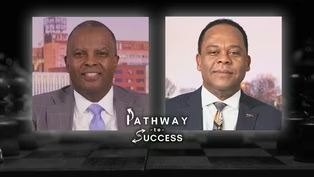
John E. Harmon, Sr., Founder, Pres. & CEO of the African American Chamber of Commerce of NJ, talks with Leon Baptiste about his successful electrical design and installation company and his philosophy of giving back to the community to change lives. Produced by the AACCNJ, Pathway to Success highlights the African American business community.
Problems playing video? | Closed Captioning Feedback
Problems playing video? | Closed Captioning Feedback
Pathway to Success is a local public television program presented by NJ PBS
Building Success & Giving Back
Season 2 Episode 202 | 26m 46sVideo has Closed Captions
John E. Harmon, Sr., Founder, Pres. & CEO of the African American Chamber of Commerce of NJ, talks with Leon Baptiste about his successful electrical design and installation company and his philosophy of giving back to the community to change lives. Produced by the AACCNJ, Pathway to Success highlights the African American business community.
Problems playing video? | Closed Captioning Feedback
How to Watch Pathway to Success
Pathway to Success is available to stream on pbs.org and the free PBS App, available on iPhone, Apple TV, Android TV, Android smartphones, Amazon Fire TV, Amazon Fire Tablet, Roku, Samsung Smart TV, and Vizio.
Providing Support for PBS.org
Learn Moreabout PBS online sponsorship- Support for this program was provided by...
Horizon Blue Cross Blue Shield of New Jersey.
[soft upbeat music] PSE&G, proud sponsors of "Pathway to Success."
♪ ♪ JC P&L and the African American Chamber of Commerce of New Jersey-- working together to build a stronger community for all... ♪ ♪ Investors Bank, banking in your best interest, Berkeley College, education drives opportunity.
Be inspired.
NJM Insurance Group.
♪ ♪ Wardrobe provided by Vandiver.
- Hello, I'm John Harmon, founder, president, and CEO of the African American Chamber of Commerce of New Jersey.
I'd like to welcome you to "Pathway to Success."
You know, we bring this broadcast to you to showcase the talent that exists within the African American community, men and women who have started business enterprises, taken considerable risk to present their products and services to the marketplace or men and women throughout the community who are just making a difference.
That's what this show is all about-- pushing back on perceptions that Black people cannot meet the value proposition, that Black people don't have the wherewithal to be successful in life.
And so, throughout this broadcast, not only today but down the road, we're gonna be showing you folks that many of you did not know exist.
And today we have a very established businessman, Mr. Leon Baptiste.
This is an amazing individual story about how he started a business and how he stuck with it.
Leon, welcome to "Pathway to Success."
- Thank you, John.
- Well, Leon, we're gonna start-- just a little bit about you.
- John, thank you for the opportunity to be here today.
My family, there's about 11 of us.
My parents are immigrants from the island of Haiti.
We grew up in a culture that failure was not an option.
So... as one of the eleven-- I'm number ten.
There's many others in front of me.
My parents were very hard and tough on everybody.
Everybody went to school and got an education.
So one of the things that inspired me to be who I am today was my grandfather.
He was a civil engineer, and throughout my career, I was told that he's very similar character-- his characteristic are very close to mine and that one day I could become an engineer.
So, as a kid-- and I think every family should also project and help their young ones to understand that they can become anything in life.
- So, Leon, so where you from?
- So I grew up in Newark, New Jersey.
- Mm-hmm.
- I went to Bergen Street School, Avon Avenue School.
- Mm-hmm.
- And I went to Weequahic High School.
I played football for Weequahic.
While I was at Weequahic, one of the things that inspired me the most was the Weequahic Father's Club.
And I had ex-mayor Sharpe James, Peter Rodino, the... Judge Irvin Booker, and Congressman Donald Payne.
- Mm-hmm.
- We were one of the groups that really got nurtured and understand that anybody can become something in life if we keep our mind and educate ourselves-- and used football as a tool.
Football was a tool for me to graduate and then go to college, and that's what I did.
I then transferred from Weequahic to-- after I graduated, went to Cheyney University, and I played two years of football.
And after two years, I decided to come back home, and I went to NJIT--New Jersey Institute of Technology-- and I obtained my engineering degree, electrical engineering.
- So share with our viewers a little bit some of the types of jobs you had leading up to the formation of LB Electric.
- In fact, I started from college in the industry of electrical company.
I worked there for 15 years.
- Mm-hmm.
- Through that process, I got to understand what this industry was all about.
And once again, it was an opportunity that was provided to me, and I took it and never looked back.
- So you worked for this company about 15 years.
And after that, you decided to establish your own business?
And what was that like-- the initial start of LB Electric?
- It was a leap of faith.
The one thing that I can say-- I was very confident in understanding what I was getting into because the fact that I had the experience for 15 years.
I started out as an estimator, project manager, vice president of estimating, vice president of marketing and business development, and I ran a small testing company for them, which was preventative maintenance.
So, when I left the company, I was very confident that I can do it on my own.
- Give us a little overview of your organization today.
- Currently, we have about 115 employees.
My wife, who's been a very core, key member of the company, she has been very supportive when I decided to say, "Yeah, I want to open my own business."
And we've been pretty much finding ways to make it work.
We're all very successful as a team, and I have a lot of great employees that are working for me.
- Types of projects.
- The types of project-- when I first started the business, we were strictly involved in building wiring.
As an engineer, my mind was always moving and looking at different things.
So, from building wiring, we got into all different type of-- arena type of work.
We're involved with the Prudential Center in Newark, the MetLife Stadium, and in New York, we performed the Tappan Zee Bridge, which is now the Mario Cuomo Bridge.
We have done many different type of traction power work.
So one of the very important projects that we have performed here in New Jersey was the Harrison Station train--the train station.
This is one of the projects that we were very proud of.
We started the project out with an understanding of completing, making a change to the community of Harrison.
And it's an amazing project.
We spent a couple years in developing our team.
We have a joint venture of a Port Authority project-- a substation, which is Substation 9, that we're currently working on, and the project is going pretty smooth.
We've had some COVID issues, but we're moving along, and it has been a very successful project for LB Electric.
Recently we were involved with the Verrazzano Bridge-- the new tolling-- and that's a project that was very aggressive schedule, and we met the schedule and were able to get the governor to open the tolling on time.
- These are some rather large projects.
And so when I opened up the show, I talked about perceptions about Black businesses being able to perform on large projects.
The perception is, given that, in New Jersey, 93% of Black businesses are sole proprietorships, so there's only 7% of Black businesses, the over 80,000 Black businesses in the state that have employees.
So the perceptions, I'm assuming, and you could educate us a little bit on this, is that, when you come on a job or early on when you came on some of these jobs, they probably perceive you as one of the workers and not the owner.
Have you had those types of experiences?
- Absolutely.
First of all, you're being looked at as if unable to perform, unable to meet a deadline, financially struggling.
So those are-- And not only among all-- you have to represent yourself as if you have to work three times harder to do what you have to do.
Even the employees that are working for you, they even look at you with a different set of eyes.
So it's a very hard environment, and one of the things that I learned many years ago and, again, through my mentor, Judge Irvin Booker, is that we all have rights in this country.
But at the end of the day, when we are in charge, we have to show that we are in charge, and that's one of the things that I'm very proud of.
I stand behind what I do, and I don't have to go to work with a suit on every day to represent that I am the owner of LB Electric.
And, quite frankly, many years I was asked who is behind me.
Who's the owner of LB Electric?
- Could you share with our viewers just in general the size of some of these projects.
- Yeah, so the size of projects that we have performed, they range between $5 million to $40 million.
- So we're gonna take a break right now here on "Pathway to Success."
I'm enjoying my conversation with Leon Baptiste.
He is the president and CEO of LB Electric, and we'll be back in a minute.
- The African American Chamber of Commerce of New Jersey is your pathway to success.
We encourage you to visit our website at www.aaccnj.com, or call us at 609-571-1620.
We are your strategic partners for success.
- Welcome back to "Pathway to Success."
I'm your host, John Harmon, founder, president, and CEO.
And before we go back to our special guest today, Mr. Leon Baptiste, just want to take a minute to thank NJTV and PBS for allowing us to have our show on their rail, if you will, and it's a great opportunity to expose the African American Chamber of Commerce of New Jersey's mission and its membership to this global audience.
We really, truly appreciate it, and we're getting great feedback from the community, and we just want to continue to do what we're doing.
So, Mr. Baptiste, can you contrast, you know, union contractor versus non-union, and how did you get involved in that, and how has it helped your business?
- So thank you, John, for this question.
I started out in the industry in the union environment when I was working 15 years ago prior to starting LB Electric, so I understood what being in the union was all about.
When I started LB Electric, it was in 1999, and it took me about four years before I joined the union, but I knew that was my goal-- to become an electrical union contractor.
So it does make a big difference being a union contractor, because working for Port Authority in the larger, public contracts almost have to--you have to be a union contractor in order to get the opportunity to bid those jobs and perform them.
- Several years ago, your firm was involved in solar panel installation.
Are you still doing that?
- My responsibility is to push that knowledge to the minority communities-- the inner city, the reentry individuals.
So the solar training is still taking place.
I partner with NJIT.
One of the things that I'm also very proud of-- we had a young man who was part of the city of Newark gang members that we took, and he was one of 30 that got trained when we were doing a project for the city of Newark under Mayor Booker.
This individual, Michael, came in, and we gave him the opportunity to work on top of a building.
So, throughout the training, LB Electric always provide a yellow vest that everyone has to wear for safety and hard hats.
This young man, when he gets up in the morning, the first thing that he does-- he puts on this yellow vest, and he goes into Dunkin' Donuts or someplace where-- before he stops and get his coffee, before he comes to the office.
One of the things that he always said to me-- used to call me Mr. B for Baptiste.
He says, "Mr. B, you know, I don't take this vest off when I go to sleep at night."
He says, "Because when I go to someplace "and get coffee in the morning, they always ask me, 'Do you work for this company?'"
And I said, "Michael, one of the reasons why you're here "is because you really appreciate getting the opportunity that you have."
He says, "Yes, I want to be as good as I can be "because I represent LB Electric, and that's what this vest is all about."
So, in my life, I think that we all can try to talk about our community, but we have to give them opportunities.
And an opportunity can change anyone's life, change their character, their motive, and everything.
So I preach to everyone that please keep supporting your community because we can change lives by supporting each other.
- I think that's phenomenal.
We also talked about your work with smaller businesses and minority- and women-owned businesses, how you've extended opportunities to them as well.
Share a little bit about that.
- Yes.
What I do upon receipt of any large contracts or any contracts that I can... Identify a certain part of the work to sub out to smaller or minority contractors, I utilize firms which is part of the African American Chamber of Commerce-- the number of members that belong to the chamber-- and I spend many hours communicating with them, let them understand the way they can develop their own businesses and also allow them to become part of what I do.
- You know, I think that's great.
I mean, it's always... Great when you can extend your success and help others.
You know, a friend of mine said, "Bring some, take some, leave some.
There will always be some."
Right?
And so this is your reinvestment back into the community to help others ultimately get to a level of success.
But I hear you have a son that is a very good lacrosse player.
That's a sport that's not played by a lot of Blacks.
So I know Jim Brown was very successful at Syracuse and went on to the NFL.
Speak to our viewers a little bit about lacrosse, your son, and why you are so involved with his development in this sport.
- Yes, John, you're actually touching an area that's very dear to me.
My son and my daughter-- you know, I only have two kids, and they're both wo nderful children that my wife and I was able to raise, and my daughter, she just finished her master's in psychology and looking to continue on with her doctorate degree.
So she also was an athlete.
She swam in high school and a year or two in college.
But my son, as a kid, I used to coach him playing football, but he decided to play lacrosse, and from high school on, you know, he made the state-- first team state when he was in high school and decided to, last minute, got recruited to play at University of Denver and became a four-time all-American lacrosse player, and only six players have ever done that in the lacrosse industry since 1906.
He won his first gold medal playing for the U.S. team, and one of the things that was very important for me, John, is that I went to every game that he was playing from his freshman year to his senior year.
It wasn't easy.
Every Friday, I was almost on a plane whether I was going to Denver or wherever, but the important thing for me is to make sure that he knew he had a support structure, and having that... was more important for me whether he was a four-time all-American or whatever.
I can't say--you know, maybe one day he can tell us that that was...
The force behind what he was able to do, having seen myself or my wife at the games, but it was very important for me to know that I was there for him and supported every game that he played in college.
- I think that's phenomenal.
And, again, that speaks to what this show is all about.
There is a perception that Blacks don't do this, we don't participate in that, but it is well documented, when the playing field is level and we have access to participate, we do very well.
What's the next five years like for LB Electric?
- So, John, I thought about start looking at an exit strategy because of the magnitude of responsibilities that I have.
You know, I have done everything, to be truthful... in the industry.
I'm looking to be a support structure to the new or the existing minority companies that hasn't been able to see the same path or the dream that I've accomplished.
- So, Leon, I've really enjoyed our discussion today, but can you share a little bit about your experience with the African American Chamber of Commerce of New Jersey?
- I would certainly recommend anybody or lead anyone to this organization, because one of the things that I do understand-- without the support or someone advocating for what we need, our needs, we will never be at the table or given any opportunity to do business with some of the prominent contractors.
- Well, Leon, I just want to thank you for being at the helm of LB Electric and setting a good example of how to run a successful business enterprise, but, moreover, looking to grow.
Sometimes folks are in business, and they get content when they reach a certain level, but given the breadth and depth of the projects and the different types of projects you've had-- yeah, I guess that's the point I want to make-- you've been able to excel and sustain your business, you know, but also you have a lot of employee, and that means, as the president and CEO, you have a lot of households that you're taking care of, and they're--you know, when you go to bed at night, you're thinking about how you're helping them feed and provide for their families.
- John, that's probably the most important part of my doing every day.
I am very proud and blessed to be able to-- since 1999, all the employees that have been working for LB Electric, I have been able to provide a paycheck to them, provide their insurance benefits.
- I'm just delighted that we have had you today, Mr. Baptiste, to talk about your great enterprise.
And continue to encourage others that you network with about the mission of the African American Chamber of Commerce of New Jersey and to consider being a part of what we do.
Until the next time on your "Pathway to Success," this is John Harmon, founder, president, and CEO of the African American Chamber of Commerce of New Jersey.
Thank you.
[upbeat jazz music] ♪ ♪ My question to you is, how will you pivot in the new year?
I'm thinking about Booker T. Washington when he established the Negro Business League back in 1900s.
40 chapters between Maryland and Texas, showing people who was just a few years removed from slavery how to start business enterprises, how to pursue capitalism, free enterprise, the American Dream.
I say to you your pathway to success and creating wealth is starting your own business.
Takes a little risk.
No risk, no reward.
There's plenty of resources in the marketplace today.
The African American Chamber of Commerce of New Jersey is here to partner with you to help contribute to your success, but you have to have the willingness, have the courage to believe that it's possible.
And if it was possible for folks like Booker T. Washington then and folks like Leon Baptiste, who you heard from today, it's possible for you.
Blacks in New Jersey, net worth is abysmal-- $5,900-- compared to whites' over $309,000 We have to find a way to get a more equitable piece of New Jersey's prosperity from all sectors.
So that is my word for you.
Find your lane.
Pursue it with vigor, passion, focus, perseverance, and you, too, will be successful.
Thank you.
♪ ♪ - Support for this program was provided by...
Horizon Blue Cross Blue Shield of New Jersey, PSE&G, JC P&L, Investors Bank, Berkeley College, NJM Insurance Group, Vandiver.
♪ ♪
Building Success & Giving Back
Video has Closed Captions
Preview: S2 Ep202 | 26m 46s | Leon Baptiste talks about his successful Electrical Design & Installation Company. (26m 46s)
Providing Support for PBS.org
Learn Moreabout PBS online sponsorship
- News and Public Affairs

Top journalists deliver compelling original analysis of the hour's headlines.

- News and Public Affairs

FRONTLINE is investigative journalism that questions, explains and changes our world.












Support for PBS provided by:
Pathway to Success is a local public television program presented by NJ PBS