
Rising to new heights
Season 2 Episode 208 | 26m 46sVideo has Closed Captions
Brett Hart, talks about famliy, career and his role as President of United Airlines.
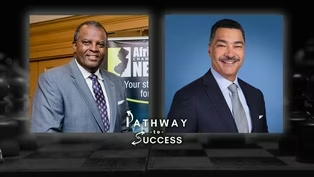
John E. Harmon, Sr., Founder, Pres. & CEO of the African American Chamber of Commerce speaks with Brett J. Hart, President of United Airlines, about famly, career and the value of planning and staying focused on your goals as well as giving back as a way of life. Produced by the AACCNJ, Pathway to Success highlights the African American business community.
Problems playing video? | Closed Captioning Feedback
Problems playing video? | Closed Captioning Feedback
Pathway to Success is a local public television program presented by NJ PBS
Rising to new heights
Season 2 Episode 208 | 26m 46sVideo has Closed Captions
John E. Harmon, Sr., Founder, Pres. & CEO of the African American Chamber of Commerce speaks with Brett J. Hart, President of United Airlines, about famly, career and the value of planning and staying focused on your goals as well as giving back as a way of life. Produced by the AACCNJ, Pathway to Success highlights the African American business community.
Problems playing video? | Closed Captioning Feedback
How to Watch Pathway to Success
Pathway to Success is available to stream on pbs.org and the free PBS App, available on iPhone, Apple TV, Android TV, Android smartphones, Amazon Fire TV, Amazon Fire Tablet, Roku, Samsung Smart TV, and Vizio.
Providing Support for PBS.org
Learn Moreabout PBS online sponsorship- Support for this program was provided by: Horizon Blue Cross Blue Shield of New Jersey; PSE&G, proud sponsors of Pathway to Success; JCP&L and the African American Chamber of Commerce of New Jersey, working together to build a stronger community for all; Investors Bank, banking in your best interest; Berkeley College, education drives opportunity, be inspired; NJM Insurance Group.
Wardrobe provided by Vandiver.
[jazz music] ♪ ♪ - Welcome to "Pathway to Success."
I'm John Harmon, founder, president, and CEO of the African American Chamber of Commerce of New Jersey.
Very delighted today.
We have a very special guest, but before I introduce him, I just want to take a moment to just thank a lot of people.
We were recently awarded a gold Telly award.
It's a big deal in this industry.
And for a relatively new show on the NJTV PBS platform, we're just extremely excited.
Just want to thank our producer, Chris Daniel, Jacqueline Baptiste, also the fine professionals behind the camera-- these individuals work very hard on every time we put the show together-- and then, most importantly, the sponsors.
I mean, people make the world go round, but without money, there's very little that you can do.
And then, to today's guest, Mr. Brett Hart.
He is president of the United Airlines Holdings Inc., so we're delighted to have him today and looking forward to this conversation.
And Brett, thank you so much for joining us today.
Why don't we just start with a little background on you, where you're from, your family, and we'll talk a little bit about your education?
- I appreciate it, John.
And look, first and foremost, it's a real pleasure to be here with you and an absolute honor, so thanks for having me on.
I grew up in small town called Cassopolis, Michigan, in the southwest corner of Michigan.
There's about 1,500 people.
It was actually a stop on the Underground Railroad, and so a lot of the families have been there for a very long time.
Great place to grow up.
I'm the last of four in my family.
Probably enough of a distance between me and my next sibling for me to be a pleasant surprise, I would hope, but all in all, a great place to grow up in.
And I went on to the University of Michigan for undergrad and University of Chicago for law school.
And I've been in Chicago for the better part of the last 25 years or so, except for a couple years in Washington, DC.
- Well, we have a lot of friends in the Chicago area, and we'll talk about maybe some of those before we're done.
But you also have just a beautiful family.
I think, three sons.
Is that correct?
- I do, three boys.
17, 15, and 12.
- So we have something in common.
I have three sons as well.
So let's talk a little bit about, you know, your career leading up to United.
- Yeah, so, as I mentioned, I went to University of Chicago law school, so I'm a lawyer by training.
I spent the first part of my career at a large law firm here in Chicago; Sonnenschein, Nath, and Rosenthal.
Took a couple years off to go to U.S. Department of Treasury in Washington, D.C., as a legal appointee in the backend of the Clinton administration.
Then I returned to Chicago, made partner at the firm, and then went off to the Sara Lee Corporation.
I eventually became general counsel of Sara Lee Corporation.
I left Sara Lee Corporation to go on to United Airlines as the general counsel of United Airlines.
After a few years at United, I served as the chief administrative officer.
I also served as the acting CEO for approximately six months while Oscar Munoz was out on medical leave.
And just about a year ago in May of 2020, I was promoted to president of United Airlines.
- Well, when I heard about the announcement, of course, I felt proud as if we were brothers, you know.
So in your current capacity, share with us a little bit what a typical day is like in your life.
- Yeah, you know, the strange thing about this job is that there are very few typical days.
Even when we sleep, there are aircraft flying somewhere in the world.
So, you know, first morning I do when I get up in the morning is I try to get caught up on what happened while I was sleeping.
Spend a fair amount of my time talking to members of Congress and state and local legislatures, making sure they understand the state of our business, what we're trying to accomplish, how we're trying to rebound.
And making sure that our people are okay.
- You talked about your conversations with local officials and those at the federal level, and we too, as an advocate for business in general New Jersey, always talk about the cost of doing business in New Jersey, from the taxation, the labor cost, and regulations.
Can you speak to that a little bit and how difficult it is to be competitive in this region?
- Yeah, so if think about our operations and our size in New Jersey, we are obviously one of the largest employers in New Jersey.
And with well over--even through the pandemic, well over 10,000 employees in the Newark area, and we are the home town carrier for both the state and the city.
And so we are, in some instances, disproportionately impacted by what happens in the legislature and from a regulatory perspective.
So at times, it is challenging.
There's no doubt about it, especially when we are confronted with legislative initiatives that maybe it's hard from the outset to have a full understanding of the impact on our operation because it is so significant.
So it's something that we're very focused on.
We need to make sure that at the end of the day that New Jersey can remain competitive for us.
- I can relate to what you said, but by the same token, we are working in tandem to try to create a better environment for organizations like United and others.
But in terms of the pandemic, can you speak to-- although we're still dealing with the effects and there's still some signs, some positive signs, that things are starting to open up, but how has it impacted the industry, and where are you today as it relates to getting back to normalcy?
- Yeah, it's a great question, John.
So, without question, the pandemic had an enormous impact on our business and on the airline industry across the board.
And keeping in mind that I've only been president during the pandemic-- the pandemic started two to three months before I became president, so if you look back to the very outset, through the first four to six months or so, our operations were down approximately 95%, and that was across the industry.
- So, can we talk a little bit about business diversity and the significance of it as it relates to your organization?
And then I want to talk a little bit about that network you have with other Black CEOs, and what does that mean to you in terms of helping you be a better leader?
- Absolutely.
Great question.
So, look, the way that we're approaching diversity, equity, and inclusion and also doing business with, in particular, our Black partners, is we treat it not just like it can or should be a business imperative, but we are focused on it being a business imperative.
And the difference for us is from going about talking about it and dealing with it in theory versus actually building it into the business model, actually building it into expectations for performance, and then measuring it.
And that is what we are with respect to, in particular, our dealings with Black business partners, and that's progress for us.
That's not a place that, in all candor, that we as a business have always operated from.
We've been good, but there's room for us to be much, much better.
And I think that what you're going to see from us is a much more deliberate approach.
- But also, I saw a photo of you with a gathering of Black professionals, so if we can speak to Chicago in general and also the significance of that gathering and what that meant to--what that means to you today.
- After I became acting CEO here, the first thing that a significant group of Black professionals here did, including Don Thompson, who you referred to, was holding dinner for me.
And I was the acting CEO, but they wanted to take the moment just to recognize what that meant.
And moreover, they wanted to take the time to say that they were here for me.
I got calls from across the country from Black professionals, and that's the beauty of who we are, offering support, making sure that I knew that they were thinking about me and that they were supportive and that they were just proud.
- I think that's so critically important, and we're going to be coming up on a break here shortly, but can we drill down just a little bit?
Are there any examples in your career of inspiring folks who gave you inspiration, encouragement, mentorship?
- Earlier in my career, I was actually doing everything I could to make it to the next level.
While I was at the Sara Lee Corporation, and I was the deputy general counsel and the general counsel became available, I didn't get it.
And some of the best advice that I got was from two Black executives who reached out and said, "I know that your natural inclination "may be to simply throw your arms up in the air "and walk away in frustration, but go take a deep breath, "walk around the block, figure it out, "get back in there again, "and do your job, and good things will happen.
"And be as supportive as you possibly can, "but think about things not in terms of the next step "but the next two to three steps, and just reconfigure your plan."
But honestly, John, my first inclination would have been to throw my hands up in the air and walk away.
But within eight months, I was the general counsel at the Sara Lee Corporation, so at the end of the day, it set my career on the path that I'm on now.
And that's the kind of advice that I've continued to receive from mentors and sponsors along the way.
- No, I think that's some phenomenal advice.
You know, to stay focused, be intentional about your goals, and, you know, try to continue to hit the cover off the ball.
So we're going to take a break here on the "Pathway to Success."
We're here today with Brett Hart.
He's president of United Airlines Holdings Inc., and we'll be back in a minute.
- We encourage you to visit our website at www.aaccnj.com or call us at 609-571-1620.
We are your strategic partners for success.
- Welcome back to "Pathway to Success."
I'm John Harmon.
I'm your host, founder, president, and CEO of the African American Chamber of Commerce of New Jersey, and I am truly enjoying my conversation with Brett Hart.
He is the president of United Airlines Holdings, Inc. And so, Brett, I want to talk a little bit about Chicago or my experience with businesses from that region.
But I want to just share this little anecdote with you.
Although we're based here in New Jersey, I believe we have seven companies that are based in Chicago that are members in the African American Chamber of Commerce of New Jersey, and what I've found in working with those business owners is that they have considerably more capacity than most Black businesses here in New Jersey.
Their experience level is wide and deep.
- Yeah, absolutely, John.
The Black business community here is special.
It really is.
From the very outset of my career, the access and the support that I've received at every stage of my career has been just phenomenal.
There's a deep sense of community here with the businesses.
They have just been at it for a long time, and they understand what each of them are going through.
They understand how difficult it is to succeed in business, and they understand that in order to do it, they need to lock arms and they need to be supportive of one other, and they are very, very good at it.
So I've always found it to be an incredibly supportive environment, and you're right.
It's a deep environment, and the capacity and the expertise, the people here are just phenomenal and capable of playing on any field.
So it's just a great business community, and we all have to work harder to make sure that they get their due.
- You know, I would have to agree.
I can recall being there with my colleague, Larry Ivory.
He is the president of the Illinois State Black chamber, and I was there with him one time.
We went to a community meeting, and in that meeting was John Rogers, Don Thompson, Jim Reynolds, and Jesse Jackson.
And this is a community meeting, and they were exchanging information, answering questions for the community, giving them advice.
I thought that was a rather unique experience.
It's something that, back here in New Jersey, we would probably be watching on television and be in awe, but that's kind of, like, was a normal thing for that community.
- Yeah.
What you described is a natural occurrence here.
There's a deep appreciation for the fact that business isn't just business.
Business is about community as well.
It's about nurturing professionals who are coming out; it's about exposing people to opportunities and ensuring that you know, when you talk about Chicago, you're not just talking about Chicago center.
You're talking about the communities that encompass Chicago and making sure that everyone has an opportunity to participate in the effort to follow up businesses in the community, and to also engage and build, and quite frankly, build wealth for each and every community.
So it's not uncommon to see Black business people in the community here engaging at all levels.
Quite frankly, to not see it here would be against the norm.
- But you have found the time, and your organization has found the time, to connect with people, and sometimes, individuals not being in the best of health.
I know you've visited a young man and he had the honor of putting on the skipper's hat, if you will.
Share with us a little bit what that experience was like there, encouraging this young man to feel better and hopefully get better.
- Yeah.
We...
It is really an important part of who we are as a company and, for me, it's always been an important part of who I am as a person.
That particular instance each year, producing a bear that symbolizes travel around the world, and that we use to raise funds and to distribute to kids who are fighting critical illnesses to keep their spirits up, and sharing a small token from our organization.
But for me, in a broader sense, John, we talked about my parents and how I was raised.
My father had a small construction company.
We would spend our weekends putting on roofs or doing other construction projects for families who couldn't otherwise afford it with material that was left over from other jobs.
And that was just--I was just taught that that's what you do.
- Can you speak to, from your perspective, the significance of having a relationship with the African American Chamber of Commerce of New Jersey?
I know it means a lot to me.
- Yeah, absolutely, John.
Obviously, as you know, we have been connected from the very outset.
And it has been critically important for us, and we have partnered on a number of initiatives over the years.
What I would suggest to you is, as important as it's been in the past, it's even more important going forward, in particular with the things that we all need to accomplish as we're coming out of the pandemic now, and in particular, also for United Airlines as we take a fresh look at how we're engaging with the Black community and the Black business community, and ensuring that we are not only directly engaging, and doing business but we are nurturing those businesses and nurturing the community.
So as we take a fresh approach to our engagement, both short- and longer-term, the relationship that we have with the Chamber and with you and your leadership and your support, it will be more important than it ever has been in the past.
- Well, we certainly appreciate it, and, you know, I have one more question for you, but I would be remiss if I didn't acknowledge two amazing women that work for United here in Newark, and you have a lot of great people here, but Monica Slater Stokes and and Blenda Pinto.
I mean, these are just top-of-the-line people.
Very professional, very focused, and when they're out representing United, they're trying to move the needle in a mutually beneficial way all the time.
- They're fantastic.
And let me say, to the broader business community, that they are ours, so we want them to stay with United.
We want them to be the best-kept secrets in the industry.
- That said, why don't we close with this?
Can you share with us-- you know, what can we expect?
We're coming out of the pandemic.
The next three to five years from United, any new, new things on the horizon you want to share with us at this time?
- Now look, over the next five years, we are trying to emerge from this crisis as a different company.
We really are, in a lot of different respects.
Not only in the way that we operate our network and our organization, and with some flights that you'll see us, and routes that you'll see us putting on.
In particular, our engagement flying out of Newark with Africa.
We now have flights in Cape Town and Johannesburg we just recently launched, Accra, and you'll see more of that as we start to push in the areas that, frankly, we have not had an opportunity to go to in the past.
Very important, and will be very important to the community and Newark.
But over and above that, I think what you're going to see is a clear move by United towards being a better partner to our communities, and with a clearer focus on diversity, equity, and inclusion and on sustainability, which is critically important in all neighborhoods, but in particular, in our communities as well.
So my take is simple.
The next five years, you will look back, and you will say that you used to like what United Airlines looked like and what we represented, but my hope is that next five years, you will look back and you will say that you love what we've become.
- No, that's fantastic.
Well, that's something to look forward to.
And so, Brett, we're going to have to bring this conversation to a close.
To all of you who've tuned in today, Brett Hart is the president of United Airlines Holdings Inc. We thank you for being here today, and on your next time on your "Pathway to Success," this is John Harmon, founder, president, and CEO of the African American Chamber of Commerce of New Jersey.
Thank you for tuning in.
[jazz music] ♪ ♪ The message today is about relevance, it's about the significance of diversity, and it's about acknowledgment.
Recently, we received a gold Telly award, and those that are in this industry of video and broadcasts around culture and diversity, and just great programming, you know, you receive this recognition, and we were fortunate to receive a gold award.
But leading up to this, the vision for our "Pathway to Success" was all about showcasing excellence within the Black demographic in the state of New Jersey and around the country and leveraging that diversity to make New Jersey a better state for all.
I would be truly remiss if I did not take this time to acknowledge my friend and colleague, Tom Bracken.
When we a reached out to NJTV about hosting the show, I asked Tom Bracken to give us a hand.
Tom was on the board, very familiar with the folks within the organization.
He stepped in and made the process a whole lot smoother for us, and we were fortunate to be granted the opportunity to have this show.
So we must thank him.
We thank our producer, Chris Daniel, my executive assistant and also producer, Jacqueline Baptiste, and a host of people who work beyond the scenes and our sponsors.
But in today's environment, where there is a lot of division and discord, which impedes our overall competitiveness, I would encourage you to just take stock in the example that I just shared.
Working with Tom and others like him across the state of New Jersey has really helped the African American Chamber of Commerce of New Jersey be in a better place and be in a position to help more Black businesses across the state.
At the end of the day, we're always better together, and the only way to truly be successful is embracing one another and work towards achieving a common goal together.
God bless you.
Thank you for watching.
Until the next time on your "Pathway to Success," this is John Harmon, founder, president, and CEO of the African American Chamber of Commerce of New Jersey.
♪ ♪ - Support for this program was provided by Horizon Blue Cross Blue Shield of New Jersey, PSE&G, JCP&L, Investors Bank, Berkeley College, NJM Insurance Group, Vandiver.
♪ ♪
Video has Closed Captions
Preview: S2 Ep208 | 30s | Brett Hart, talks about famliy, career and his role as President of United Airlines. (30s)
Providing Support for PBS.org
Learn Moreabout PBS online sponsorship
- News and Public Affairs

Top journalists deliver compelling original analysis of the hour's headlines.

- News and Public Affairs

FRONTLINE is investigative journalism that questions, explains and changes our world.












Support for PBS provided by:
Pathway to Success is a local public television program presented by NJ PBS