
Hard Work leads to Success
Season 2 Episode 210 | 26m 47sVideo has Closed Captions
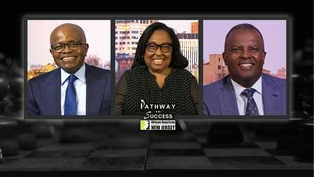
War hero Doug Crawley and his wife Shirley Crawley talk about their successful businesses.
John E. Harmon, Sr., Founder, Pres. & CEO of the African American Chamber of Commerce, speaks with war hero Doug Crawley and his wife Shirley Crawley about their successful businesses. They discuss their lifelong commitment to hard work and passing on that legacy and businesses to their family. Produced by the AACCNJ, Pathway to Success highlights the African American business community.
Problems playing video? | Closed Captioning Feedback
Problems playing video? | Closed Captioning Feedback
Pathway to Success is a local public television program presented by NJ PBS
Hard Work leads to Success
Season 2 Episode 210 | 26m 47sVideo has Closed Captions
John E. Harmon, Sr., Founder, Pres. & CEO of the African American Chamber of Commerce, speaks with war hero Doug Crawley and his wife Shirley Crawley about their successful businesses. They discuss their lifelong commitment to hard work and passing on that legacy and businesses to their family. Produced by the AACCNJ, Pathway to Success highlights the African American business community.
Problems playing video? | Closed Captioning Feedback
How to Watch Pathway to Success
Pathway to Success is available to stream on pbs.org and the free PBS App, available on iPhone, Apple TV, Android TV, Android smartphones, Amazon Fire TV, Amazon Fire Tablet, Roku, Samsung Smart TV, and Vizio.
Providing Support for PBS.org
Learn Moreabout PBS online sponsorshipannouncer: Support for this program was provided by Horizon Blue Cross Blue Shield of New Jersey.
[mellow music] PSE&G.
Proud sponsors of "Pathway to Success."
♪ ♪ JCP&L and the African American Chamber of Commerce of New Jersey.
Working together to build a stronger community for all.
Investors Bank, banking in your best interest.
Berkeley College.
Education drives opportunity.
Be inspired.
NJM Insurance Group.
Wardrobe provided by Vandiver.
[jazzy music] ♪ ♪ - Hello, I'm John Harmon, founder, president, and CEO of the African American Chamber of Commerce of New Jersey.
And welcome to "Pathway to Success."
Today, we have two distinguished guests, in which in my opinion, represents Black excellence.
Doug Crawley, who is the CEO and president, and his wife, Shirley Crawley, executive vice president, Staffing Synergies and Synasha packaging and distribution company.
Welcome, the two of you, to Pathway to Success.
- Thank you, John.
- Thank you.
We appreciate this opportunity.
Thank you for inviting us.
- No, we're, as I said at outset, extremely excited.
And just wanna start off with a little background on the both of you.
And we'll start ladies first.
- I grew up in Central Texas a small town called Centerville, Texas.
It's about 120 miles north of Houston, Texas.
I grew up in a two-parent family household.
I am the oldest of five children.
We grew up at a time where things were short for us economically, but we didn't know that we were poor.
We never did without anything.
And although my parents were just high school graduates, they really believed in education.
We were not able to bring home Cs and Ds, you know, they really--we had to strive for excellence.
And one of the things they always taught us was that we could do anything that we wanted to do.
We could be anything that we wanted to be.
So when I graduated high school, I knew I wanted to go to an HBCU, got a degree from Texas Southern University and the rest is history.
- So, Mr. Crawley.
- I grew up in Mobile, Alabama.
I grew up in a household.
And my biological father and my mother divorced before I can remember.
But I had a father.
He's my stepfather.
And so if I say anything my father, he's really my, not my biological father, but is stepfather, from whom I get work ethic and who raised me.
I grew up in a household where I had three siblings, two sisters, and a brother.
It was in the height of segregation in the South.
I remember the freedom rides and the sit-ins and all of those kind of things.
The good thing about the household that I grew up in, my father and my mother.
My father didn't treat me any different than he treated his biological kids.
In fact, my brother and my sisters would probably say he treated me better.
But I would say this because I didn't get into the same trouble that they did.
And so I grew up.
I went to Central High School in Mobile, Alabama.
It was segregated.
It was separate and unequal.
I graduated number seventh out of my class with 415 students.
But during that time, I could not even envision or think of going to a major institution.
In fact, while I was in school the lady who went to the University of Alabama when George Wallace stood on the steps and won't let her in, she was one year ahead of me from my school.
So it was a different time.
So I graduated from Dillard with a bachelor's degree in mathematics.
It is at the--it was during the Vietnam conflict.
It was during the draft.
And so my last year in school my classification went from a student classification to 1A, which meant I was gonna be drafted.
So I ended up going to officer training school in the Air Force.
They were probably 1,000 people and there may have been 15 people who were Black.
But I ended up being the flight captain.
And I ended up graduating and going to flight school.
While I was in the military, I used my GI Bill and I went to the University of Utah.
And I got an MBA.
At that time, I had thought that when I get out what I really wanna do is be an entrepreneur.
Years later, I got another degree because I became the pastor of a church, and I went back to seminary to get a doctorate in ministry.
- So you're married now 37 years.
Talk a little bit about your family, your children, grandchildren.
- I'll go first.
- Okay.
- We're the parents of three sons, three grown sons, and from those sons, we have six absolutely adorable grandchildren who range from, I guess 25 to 8.
- Mm-hmm.
- And in our company, we are fortunate enough to have a son and a grandson who works with us.
Our son, Geoffrey, is vice president of business development.
Geoffrey is a Princeton University graduate.
And he's vice president of business development for the Synasha side of the business.
And then his son, Adam, is vice president of business development for Staffing Synergies.
He is a West Point graduate.
What we hope to do is develop a legacy with our businesses so that when Doug and I are no longer here, Geoff and Adam can move it forward.
And then we'll leave something for our grandkids to be educated and perhaps, at some point, join the business if they choose.
- Ms. Crawley, you spoke about coming home with less than excellent in terms of academic performance was not acceptable.
How did that shape your future trajectory as you pursue a professional career?
- Well, I think the fact that my parents instilled this excellent, the idea of excellence in me, I always worked very, very hard.
Nothing was ever given to me.
They stressed that, you know, you gotta be better than sometimes some other people on your team, but you can do it.
So right out of college, I went into the real estate industry.
I was fortunate enough to work for the leading homebuilder at the time in residential construction.
And that was U.S. Home Corporation.
And then I left there as vice president controller.
And then I left there and worked as a region controller for Trammell Crow Company, which was the leading commercial developer at the time.
And from there, in 1994, I was introduced to packaging and distribution and supply chain.
And that's where I've worked since then.
- So Mr. Crawley, what did you do professionally, leading up to establishing the respective companies?
- I actually started-- my first company was a karate studio when I first got out of the military.
From there, I went to work for a Fortune 100 company, which was at the time General Foods.
It was the Maxwell House division.
And that's how I really got my experience in staffing.
I left there and went to a company called Union Carbide, which was a Fortune 100 company.
And I also did employment, hired engineers, various kinds of people.
From there, I went to work for the same company that Shirley just mentioned, U.S. Home.
I went to work for their largest division and as the personnel director or now would be the HR director.
And I did that for a short period of time and transferred over into real estate development.
After that, I started a construction company.
I was a general contractor in Houston.
So I had to close my company down.
Later on, moved to New Jersey.
Again, went back to work for U.S. Home.
I worked for another real estate developer and did some consulting over the years, as I began to become a pastor of a church.
The consulting work led me to the boss.
The owner of the company that Shirley worked for.
And one day Shirley comes home and says that "They're gonna offer you a job."
So I became the EVP of a packaging and distribution company.
And so that's how I got the packaging and distribution experience.
- For the benefit of the viewers, I need to get a little more understanding of what Synergies does and what Synasha does.
- Well, Staffing Synergies is the staffing arm of the company.
We provide staffing to major corporations.
They give us a number of employees that they need us to fill.
And we fill those to their requirements.
One of the things Doug and I want to do, we don't just want to make money for ourselves.
We want to invest in people and give people opportunities who may not otherwise have them.
Yes, we are a profit motive company, but we want to make a difference in people's lives.
- So there's saying you can do well and good at the same time.
- Synasha is a joint venture between Staffing Synergies and our major customer.
But we own the majority of the joint venture.
Through the joint venture, our major customers are CVS, PepsiCo, Johnson & Johnson, and Abbott Labs.
What we do is we provide for the joint venture.
We provide the workers in the warehouse, the forklift drivers, the assembly line workers that put together the assembly of the displays that we have.
We don't manufacture anything.
We may get in the components that goes into the package and we may put that into a display.
And take those displays, put them in shippers, put those on a pallet, and ship those pallets out either to a distribution center for the customer or directly to the Walmarts, the Kmarts, and those kind of things.
- So we'll take a break right now here "Pathway to Success."
We'll be back in a moment.
- We encourage you to visit our website at www.aaccnj.com.
Or call us at 609-571-1620.
We are your strategic partners for success.
- Welcome back to "Pathway to Success."
And I'm just having a ball today with our two distinguished guests.
Talk to us, what is a day like in running these businesses?
- I would try to tell about the day-to-day operations from the staffing company, but Shirley would normally say to people that I really don't do anything.
She does all the work.
So as a result, I'll tell you about the day-to-day operations for Staffing Synergies.
Now, the day-to-day operations for Synasha are more of the business development, talking to clients, trying to figure direction for the company, going to meetings, making presentations, those kinds of things.
- Well, for Staffing Synergies, I guess I'll break it down between our corporate office and our onsite activities.
On-site is where all of those line industrial employees are working.
They are working on manufacturing line, and they are assembling all of those products that Doug spoke about previously.
From a corporate environment, I'm, you know, making sure that we are meeting our fill rates.
Our clients gives us a fill rate requirement of sometimes is weekly, sometimes is daily, sometimes it might be a requirement for four, five months.
And our goal is to achieve 95% of that fil rate.
And for me and my daily activities, I'm also responsible for the financial aspects of the company.
So anything that has a financial component to it, I touch.
- So Ms. Crawley, suffice it to say that you keep an eye on the money.
And you make sure that you're hitting the mark every time.
But I want to talk a little more about, you know, today the big conversation is about diversity, equity, and inclusion.
- And with diversity, you get diversity of thought, you get diversity of meaning.
There are just so many opportunities to learn from each other.
And I think when you bring people together in a diverse setting, one of the things we learn is that we are more alike than we are different.
And we can build on those things to create the successful company that I believe all of us want.
- Someone, and I don't remember where I read it, said that "Diversity would be being invited to the party, but inclusion would be being asked to dance."
The one thing that has been I think is central for me and I think for Shirley, is that we learn to work hard.
We had parents who would work hard.
Both of our fathers were just people who worked hard.
My dad was, not my biological father, but the father that raised me, he was--he died at 85.
But up until a year before he died, he had retired twice from the federal government, from the state government, and not only had he retired, but he was still working three days a week as a barber.
I learned my work ethic.
And if one is going to an entrepreneur and try to do the things that we are doing, if success is on the other side of hard work, we have to work hard.
And that's something that we both learned growing up and I think has been a central in our efforts together.
- What a profound statement.
Success is on the other side of hard work.
What advice would you have for someone who's watching and saying, "Hey, they endured the segregated South.
They endured at times probably being marginalized."
What would you say to them if they're pondering about starting a business today?
- The first thing I'd say is prepare yourself.
Learn everything you can and there are a couple of ways to do that.
One is by just reading everything you can about the business that you would like to start.
I think in our business, we have run across a number of people who want the product without the process.
You have to work through, make a plan, work your plan, and don't be afraid to fail.
I think you've learned from, my husband, in this conversation that he is a serial entrepreneur.
Not everything he's done worked.
- We went broke twice.
- Yes, just don't give up if you have a dream.
And then for me as a Christian, I think you make your plan, do all the research, get all the coaching you can, but I believe there is a verse in the Bible that says, "Commit your ways unto the Lord.
And your plans will succeed."
So for me, that was a huge component as well.
- No, I embrace that as well.
So, Mr. Crawley, you're also an author?
- Yes.
- Can you share with us a little bit about this amazing book that you put together?
- The book is entitled "Collaborate As If Your Life Depends On It."
And the secondary title would be "Working Together To Be Better Together."
It's based on the mission that we flew in Vietnam, particularly the night mission where we're flying 500-- 50 miles per hour at 500 feet above the ground, we're in a valley and rock formations.
It's jet black.
They're no lights in the sky.
They're no lights on the ground.
And it's two of us in the airplane.
The airplane has a radar system such that you can navigate and stay on course.
It also has the ability to tell you how higher you are above the ground.
So it's two different modes.
The pilot in the front seat, he wants to know to make sure we don't run into the ground.
Me, as the weapons system operator, the navigator, I wanna make sure we get the targets at night and stay on course.
The problem was they designed the radar system such that you couldn't read both at the same time.
So we had to collaborate at 500 feet, 500, 50 miles per hour in the mountains at night.
And so we shared that radar system.
And we said that that was the ultimate of collaboration.
That's why I called the book "Collaborate As If Your Life Depends On It."
I have five C's: Commitment, Confidence, Clarity, Caution, and Courage.
And I go through those in the book to talk about the ability to work together.
I think, personally, that the superpower we have as people and as Black people is one, we don't use as much as we should.
And that is our ability to work together.
We need to be able to work together.
So I wrote the book based on the mission that I flew, and it applies to business, it applies to anywhere there's more than one person.
I read somewhere it said that Alex Haley had a picture in his office, and it was a picture of a turtle on top of a pole.
And the caption said, "If you see a turtle "on top of a pole, you know he didn't get there by himself."
And so if we're going to do anything, it takes us working together.
- I mean there's no better example of leveraging diversity, perspective, inclusion to get the best outcome.
Tell 'em that, speak to that.
- Well, let me just say this.
First of all, the guy that I flew with was Hawaiian.
And so we came from totally different backgrounds.
In fact, he went to become the first native-born Hawaiian general of the Air Force.
But race didn't matter, culture, it didn't matter when we were in that airplane.
It was the ultimate of working together.
- Wow.
- And it didn't matter who your mother was, who your father was, whether your father was at home, how many kids were in the family.
No one of that mattered when it was the two of us in that airplane because if one of us die, both of us die.
- No, I think the story, the experience was just incredible.
Can you share with us a little about the significance of your relationship with the African American Chamber of Commerce of New Jersey?
- One of the secrets to this, if you're gonna be a supplier of a businessperson, is the development of relationships.
And John, you've done a good job with that.
You've helped us as much as anybody.
And so the kind of activities that you do for Black businesses getting Black businesses to work together and the relationships that you have with corporate America are things that are--the things that we really want to concentrate on.
We think the Chamber would give us opportunities to do more things that are related to helping the Black community or helping other Black businesses be successful.
- So Doug and Shirley Crawley, we just wanna thank you both for joining us today.
Throughout this conversation, you emphasized so much by way of example of your abilities, not only to run a very effective or effective business enterprises, but to have also been committed to doing well and doing good by your fellow man.
So I wanna thank you.
This is John Harmon, founder, president, and CEO of the African American Chamber of Commerce of New Jersey.
And just thank you until the next time on your Pathway to Success.
Have a great day.
The Crawleys, what a phenomenal conversation.
Their story really underscores the Black experience, our resolve, our perseverance, our commitment to excellence, and ultimately, our value proposition.
Within the membership of the African American Chamber of Commerce of New Jersey, we have a multitude of men and women like the Crawleys who put the dollars at risk, who put forth a business plan, who preserver.
You know when Doug Crawley and his wife shared about their experiences and their commitment to success and excellence what they said to me and what they said to the viewers today that Black people truly make the difference.
When afforded the opportunity to partner with corporations and with government and through the participation of blacks in capitalism and free enterprise, we make it better for all of us.
It not only makes New Jersey great, but it makes these United States great.
Thank you.
announcer: Support for this program was provided by, Horizon Blue Cross Blue Shield of New Jersey, PSE&G, JCP&L, Investors Bank, Berkeley College, NJM Insurance Group, Vandiver.
Video has Closed Captions
Preview: S2 Ep210 | 32s | War hero Doug Crawley and his wife Shirley Crawley talk about their successful businesses. (32s)
Providing Support for PBS.org
Learn Moreabout PBS online sponsorship
- News and Public Affairs

Top journalists deliver compelling original analysis of the hour's headlines.

- News and Public Affairs

FRONTLINE is investigative journalism that questions, explains and changes our world.












Support for PBS provided by:
Pathway to Success is a local public television program presented by NJ PBS