One-on-One
Patrice Lenowitz; Amy Tuininga, Ph.D.; Edwin Reyes
Season 2024 Episode 2704 | 27m 49sVideo has Closed Captions
Patrice Lenowitz; Amy Tuininga, Ph.D.; Edwin Reyes
Patrice Lenowitz, who lost her son to a fentanyl overdose, discusses the extreme dangers of synthetic fentanyl; Amy Tuininga, Ph.D., Director of PSEG Institute for Sustainability Studies at Montclair State University addresses sustainability challenges in the Garden State; Edwin Reyes, Principal of Technology High School, discusses their 2023 Blue Ribbon Award and the ongoing teacher shortage.
Problems playing video? | Closed Captioning Feedback
Problems playing video? | Closed Captioning Feedback
One-on-One is a local public television program presented by NJ PBS
One-on-One
Patrice Lenowitz; Amy Tuininga, Ph.D.; Edwin Reyes
Season 2024 Episode 2704 | 27m 49sVideo has Closed Captions
Patrice Lenowitz, who lost her son to a fentanyl overdose, discusses the extreme dangers of synthetic fentanyl; Amy Tuininga, Ph.D., Director of PSEG Institute for Sustainability Studies at Montclair State University addresses sustainability challenges in the Garden State; Edwin Reyes, Principal of Technology High School, discusses their 2023 Blue Ribbon Award and the ongoing teacher shortage.
Problems playing video? | Closed Captioning Feedback
How to Watch One-on-One
One-on-One is available to stream on pbs.org and the free PBS App, available on iPhone, Apple TV, Android TV, Android smartphones, Amazon Fire TV, Amazon Fire Tablet, Roku, Samsung Smart TV, and Vizio.
Providing Support for PBS.org
Learn Moreabout PBS online sponsorship- [Narrator] Funding for this edition of One-On-One with Steve Adubato has been provided by Horizon Blue Cross Blue Shield of New Jersey.
Here when you need us most.
PSEG Foundation.
PSE&G, committed to providing safe, reliable energy now and in the future.
New Jersey Sharing Network.
The Fidelco Group.
New Jersey’s Clean Energy program.
Lighting the way to a clean energy future.
Englewood Health.
PNC Foundation.
And by The Adler Aphasia Center.
Promotional support provided by BestofNJ.com.
All New Jersey in one place.
And by ROI-NJ.
Informing and connecting businesses in New Jersey.
- This is One-On-One.
- I'm an equal American just like you are.
- The way we change Presidents in this country is by voting.
- A quartet is already a jawn, it’s just The New Jawn.
- January 6th was not some sort of violent, crazy outlier.
- I don't care how good you are or how good you think you are, there is always something to learn.
- I mean what other country sends comedians over to embedded military to make them feel better.
- People call me 'cause they feel nobody's paying attention.
-_ It’s not all about memorizing and getting information, it’s what you do with that information.
- (slowly) Start talking right now.
- That's a good question, high five.
(upbeat music) - Hi, everyone.
Steve Adubato.
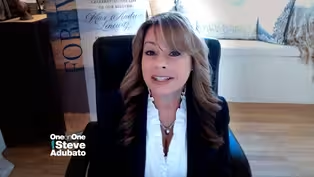
We kick off the program with Patrice Lenowitz, who is the mother of Max.
And we'll talk about Max in just a minute.
His story is incredibly important to what we're about to talk about.
Patrice is here to fight the scourge of fentanyl poisoning.
There is an epidemic going on in our state, in our nation.
Patrice, you honor us by being with us.
Thanks so much.
- Thank you so much, Steve, for the opportunity to talk about this because we're only gonna save lives by sharing this information.
- Talk to us about Max.
- Well, in preparation of talking with you today, Steve, I've been bawling all morning.
When I talk about, you know, the work we're doing behind the scenes to stop it, I have the courage, but speaking about Max, my firstborn baby, he was, you know, as I always told him, and all my children, I have three, Max is the oldest, that he was a blessing from heaven.
And, well, I can tell you this, Steve.
Besides being an amazing athlete, he went to Pascack Hills.
He was a lacrosse player.
25 was his number.
He was an amazing brother.
He was an amazing son, grandson, and had a vast array of deep, powerful friendships.
He was just an incredible human being.
I got Stage 3 colon cancer in 2021, and I was diagnosed and had to undergo chemotherapy.
And Max lived in South Jersey at the time.
And every three weeks when I had to go for chemo, he would come home and I would say, "Please don't come home when I'm getting chemo, because I feel awful and I can't get out of bed, Max."
I wanna be with him and I wanna spend time with him.
I wanna cook for him, and I wanna, you know.
And he said, "Well, if all you can do is lie in bed, I'm gonna lie in bed with you."
And for three weeks, Max came home and lied in bed with his mom undergoing chemo and cooked for me and his stepdad 'cause he wanted to take care of his stepdad because he knew that, you know, everyone was frightened.
And that's the love of Max.
He actually knew how to meet you where you are and support you and love you.
And that's what we're missing now.
And that's what we're missing in this nation, you know, losing so many of our young people to fentanyl poisoning.
- Max connects to Fentanyl how?
How does that happen?
- So, it was Max's 25th birthday.
And a rule in our family was, if we're not gonna actually be together on our birthdays, we have to talk at midnight.
So James and I called him at midnight and sung the "Happy Birthday" song, monkey song to him and got to hear about what his plans were.
And I'm so grateful for that call because it was so full of love and laughter.
He told us about his plans for his 25th birthday.
His closest friends were driving down from North Jersey to South Jersey to be with him.
They were going to stay overnight in Atlantic City and go to a restaurant that he had worked at for many years, Shuckers in Margate, and it was wonderful.
However, he never made it to his birthday celebration.
His friends couldn't find him, got a bit panicked and even went to his apartment.
And the landlord who knew them let them in and he wasn't there.
What we know is, Max told them that he was going to find the best price for them for a hotel in Atlantic City for the overnight and that he was gonna let them know where to meet him.
He checked in at the Hard Rock Hotel.
We know that from video cameras that a few people went in with him, three people.
And we know that they left the room.
We know Max locked the door from the inside, and we know that it was the last day of his life.
So, Max took a Xanax.
The police found Xanax and marijuana.
And the Xanax was pure fentanyl.
- Patrice, tell folks what fentanyl is.
- So, Fentanyl is a synthetic opioid created in China.
We know that not only did China create this fentanyl, now, it's important to say how important fentanyl is in, you know, end-of-life care for patients who have cancer.
- Right.
- It's very important to help them manage their pain.
And it's 100 more potent than heroin.
Morphine, excuse me, 50 times more potent than heroin.
And the synthetic opioid that was created in China is so dangerous, two milligrams, so if you imagine the tip of a pencil, two milligrams can fit on the very tip of a pencil.
That's how much it takes to kill you.
Now, when China was creating this synthetic opioid, they also created a pill press.
And a pill press is something that you can duplicate any prescription drug out there in the market to look identical, except it's pressed with fentanyl.
So now all of our young people and young adults are maybe exploring with street drugs.
And when I say that, these are prescription drugs.
Most of the time they're prescription drugs, so Adderall, Xanax, Percocet.
These street drugs now, these counterfeit drugs look identical, and the young people are thinking they're taking a prescription pill.
- But Patrice, the thing that strikes me, and thank you for sharing what I can't even imagine is so, how painful this is for you and difficult, but you chose to take this pain, Max's passing, his dying because of fentanyl and do what for others?
Your mission to fight against this scourge is also tied to one of our recent guests, State Senator Holly Schepisi, who's very involved in legislation that actually takes specific steps to prevent young people from finding, dying from Fentanyl.
What's your mission?
- So this is the most important part, and I'm so grateful to Senator Holly Schepisi and her Chief of Staff Alyssa Dawson because when I went to their office, I knew when, I'm in the bowels of hell, losing a child, and I'm in a fetal position every day.
But how do I honor my son and not let any other parent feel this pain?
I knew that we had to do something, and I contacted my senator, my senator's office, and Alyssa Dawson and I worked on this, the joint resolution declaring Max's birthday and the day he left us, July 14th, as Fentanyl Poisoning Awareness Day for the State of New Jersey.
The reason- - To do what?
I'm sorry for interrupting, Patrice.
To do exactly what?
- Thank you.
This is so important.
The reason why that bill is so important is because I didn't know about fentanyl.
I knew about it as, you know, end-of-life care.
- Right.
- A drug.
I did not know that it is coming at our children with such speed and velocity that we have lost, right now, the CDC tells us that 84% of children, children, teenagers that are dying today is related to fentanyl poisoning.
So with the grace of God, and, you know, our legislators, so Holly Schepisi jumped on board.
Senator Joe Vitale jumped on board.
And with this bill, in 25 days, Steve, in 25 days, this bill passed both houses.
- To do what, though?
I'm sorry, Patrice, but I want people to understand what it does.
- So the first thing is education and awareness.
We cannot combat it unless parents and young people know what it is, right?
That it's in street drugs, that it's everywhere.
It's in marijuana, it's in cocaine, it's in prescription pills.
And so that's the first thing.
Declaring Fentanyl Poisoning Awareness Day for the State of New Jersey is going to let people get an education first to raise awareness, and now next steps are coming.
So that's the next step that we're working on with a new organization that we just started called Love Unlimited New Jersey to- - We actually put up the website.
Go ahead, I'm sorry.
I got a minute left.
Please, Patrice.
- To combine our youth mental health crisis.
So this is what's underlying this crisis right now with fentanyl is our young people are battling with a mental health crisis that we've never seen before combined with fentanyl poisoning that we've never seen before.
We have to run at this with everything we've got, Steve.
So raising awareness and getting our young people involved, teaching them about Narcan, teaching them about fentanyl test strips.
So if they are gonna partake in taking illicit drugs, they can test it and see if there's fentanyl in it.
- To Patrice Lenowitz and the folks she's working with, to the folks in the legislature involved in this legislation that would create greater public awareness, particularly for young people as to the crisis, the epidemic of fentanyl poisoning, we thank you, Patrice, and we'll continue the conversation with you and wish you and your family all the best.
- Thank you so much, Steve.
- Stay with us.
We'll be right back.
- [Narrator] To watch more One on One with Steve Adubato find us online and follow us on Social media.
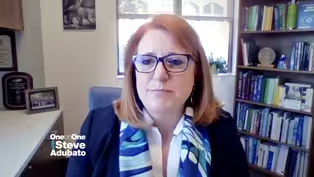
- We're now joined by Dr. Amy Tuininga, who's the Director of the PSEG Institute for Sustainability Studies at my alma mater, Montclair State University.
Doctor, good to see you.
- Thank you, it's nice to see you as well.
- Tell everyone what the institute is because its impact is important now more than ever.
- Well, the PSEG Institute for Sustainability Studies has been around, it preceded me, but I came in 2016 and we built out the Green Teams program that serves corporations, communities, and students partnering together to solve sustainability issues.
- This whole Green Teams thing.
When I was reading about it, I thought, who's on the Green Team and what impact are they having?
- Huge impact.
So students come from all over the country and outside of the country, 90 different colleges and universities and 135 degree programs.
We put 'em on teams of five and they are partnered up with corporations or nonprofits to solve some of their own sustainability challenges.
Everything from emissions to water, waste, and some food kinds of issues as well.
- Amy, connect the work that's being done at Montclair State at this institute, with the larger crisis of climate change.
- Yeah, I mean, the work that we do is local and regional, but it impacts global systems.
The weather systems that are operating globally that feed back for crises that we see in our neighborhoods.
So the flooding that we see in the streets in Hoboken and Hackensack, and we're able to implement mitigation strategies like green infrastructure in Hackensack to reduce flooding from two feet down to like a quarter of an inch.
- So it's interesting because I don't wanna, whoever believes in, doesn't believe in climate change being real, that that's your business.
It's real.
That's not editorializing, it's science.
But I wanna be clear.
The work that's being done is impacting people's lives in very tangible ways.
And I'm gonna get to a couple of other things.
The community garden.
How is the community garden that you're involved in connected to sustainability, and what does that have to do with climate issues, please?
- Right, so climate is changing the way that crops can grow and the pests that are there and the fungi that are affecting the crops.
We connect with technology and students and faculty to come in and grow fresh vegetables.
Hundreds and hundreds of pounds are going into our food pantry, the Red Hawk food pantry on campus.
About 40% of our students, 41%, are food insecure.
So they don't have enough to eat on a regular basis.
They go hungry.
These fresh vegetables go into the food pantry and they could come and access them anytime.
So we're taking these global challenges, studying them from a scientific perspective, and making resources available at a local level.
- Amy, I wanna follow up on this.
The students at Montclair State, and having been around Montclair State and taught there and being connected to the university for many years, I know that for many of the students, in their families, they're often the first in their family to go to a higher ed institution.
But for the work that you are doing at the institute, this is the first generation of students involved in these kinds of activities around sustainability, climate change, et cetera.
What impact does that potentially have, not just on those students, but on the work that they will do moving forward?
- It's huge.
So we're all about belonging and purpose, right?
And so we build this inclusive culture that helps people to feel like they belong.
That boosts their confidence.
By working in a team with other people, they realize, oh, what I'm learning in my math class is applicable in the real world, and this is where I go for a job.
Because they don't, if you're first generation, you don't necessarily have a role model that's doing the kind of career you wanna go into.
So they're able to build social capital, is what we call it, but it's a network, right?
And so if you have family members that are working in all the kinds of companies you wanna work in, you have that social capital, you have that network.
But so for these students, it's like a springboard.
It helps them to see what they would actually be doing.
And it's different than just a regular internship.
We've moved away from apprenticeships, but really for first generation college students, you need an apprenticeship in a corporate kind of job.
And that's what this is.
It's a bridge into those careers.
- Real quick on this, Doctor, what kinds of jobs are we talking about?
- So, these are 135 different majors that these students have come from.
And so it's everything from accounting and finance to communications to STEM, engineering, physics, math, the humanities, writers.
And they're going into jobs at EY and Deloitte and Accenture.
So some of the big companies, but also locally in government in the New Jersey Department of Environmental Protection or the Environmental Defense Fund.
They're also working for Bureau of Public Utilities and Municipalities and nonprofits.
So it's a huge range of jobs that the students are going into.
Some of it in the environment, the environmental sector as consultants, but some of it in a regular finance position.
But now they're able to include sustainability.
- As I'm listening to Amy and thinking about this, it's funny.
People say things like, oh, someone's in the environmental field or the field of sustainability as it relates to climate change.
But the reality is, and Amy knows this better than I ever could, is that there is no job, there is no industry, there is no field that you can be involved professionally that does not...
There are banks that we interact with that are involved in sustainability initiatives, climate change initiatives, trying to make a contribution.
You can't get away from this.
And so it seems to me that what the institute is doing is embracing that reality.
Real quick before I let you go, Amy, you're so passionate and committed to this work because?
- It's the future, right?
So last summer when we saw those orange clouds passing through, we've been talking about this happening for decades.
It's here, we can't breathe.
We want future generations to have a healthy life and environment.
And they need a job to be able to address those issues.
So this is how to connect all of those dots.
- Dr. Amy Tuininga is the Director of the PSEG Institute for Sustainability Studies at Montclair State University.
Amy, great to have you with us.
Thanks so much.
- Thank you very much, I appreciate it.
- You got it.
We'll be right back, right after this.
- [Narrator] To watch more One on One with Steve Adubato find us online and follow us on Social media.
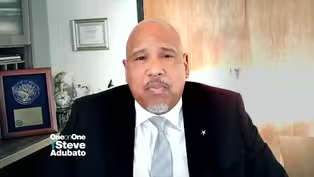
- We're now joined by Edwin Reyes, who's the principal of a terrific school in the city of Newark, a Technology High School, a 2023 Blue Ribbon School Award winner.
Good to see you, Principal Reyes.
- Good to be here, Steve.
Thanks for having me.
- You gotta let everyone know why the Blue Ribbon Award is so significant.
- Oh, I call it almost the equivalent of an Emmy or those types of awards.
It is probably the pinnacle for any school, and I do say school, 'cause it's not an award that's won by one person.
It's extremely, extremely special.
And I'm extremely grateful to the hard work and dedication of our entire school community, our teachers, our parents, and obviously, more importantly, our wonderful students.
- Well said, we're gonna put up a graphic for our series, "Who Will Teach Our Children".
As you talk about your teachers, what makes the teaching slash learning experience at Technology High so special, please.
- Yeah, so, it really is simple, right?
People kind of overcomplicate this.
Our motto is, if you take care of a student's social and emotional wellbeing first, then everything else just falls into place.
It is truly a student centered, student first type of school, where we make sure that we provide everything that students need in order to be successful, but beyond that, we take care of them and we make them our own.
And so my agreement with parents when they come to our school is that when you drop them off at the doorstep, they become my child.
And thus, that's the way we treat them.
And we ensure that all our staff member, everyone who works here, understands that philosophy.
- So you've actually said our teachers become their parents, and maybe there are people who may bristle at that.
What do you mean you're not their parent?
I'm their parent.
But tell folks what that really means.
- Yeah, so my parents don't bristle at it at all.
They know that the students are being sent to a community of people who just care about them left and right.
We have great partnerships with our parents.
What it means is that we are going to provide the same love, attention, and honestly, education, that we would for our very own children.
And that partnerships works really well with our parents.
They know that they're sending their child to a school, where their child becomes the center of everything that we do, and they're very grateful for that.
- Principal Reyes, let me ask you this.
The learning loss, the impact of COVID, vis-a-vis learning loss.
First, what have our students lost in terms of their learning?
And then what have they lost in your view from a social and emotional perspective, please.
- I mean, they've lost a lot.
I think we're starting to come around now.
I think we're starting to leave COVID behind.
I try not to even use the word around here, because I think it really is time for us to move on.
However, it has impacted our students, you know, socially and emotionally.
We have more students coming with problems to the school, more meetings with social workers and with guidance counselors regarding just their emotional state.
Same thing goes for teacher, right?
So teachers are human beings, too.
And a lot of people don't believe that, but us in education, you know, we have emotional instability sometime.
And I think COVID did a lot to do that.
However, I do see it, right?
I do see us getting over the hump.
I think our school is almost to the point where we were prior to COVID, and I think, and I hope that that's what's gonna start to happen across this entire country.
- You know, there've been a lot of reports about this, Mr. Reyes, that make it clear that there's a teaching or teacher shortage, and the city of Newark, it's no different.
In fact, it may be more, it may be worse, because the needs of our students are so great in our inner cities.
Are you seeing more teachers leave the profession?
And if so, what the heck are we doing to keep the teacher pipeline as healthy as it needs to be?
Please share with us your thoughts.
- Sure, and that's probably one of the biggest impacts of COVID.
You know, a lot of teachers spent a lot of time at home behind the camera, and they understood that they could actually make a living working from home, or because there's a shortage of teachers, there's been this competition between districts for hiring teachers away from other districts, which kind of becomes a problem.
I think that we have to make teaching appealing again to young kids that are sitting in a college classroom at this particular time.
And, you know, I'm not gonna sugarcoat it, right?
The way we do that is by making sure that they are supported, but more importantly, that they're paid like the professionals that they are, right?
So increasing pay for teachers is something that I advocate for.
Our district has done a good job of raising the starting salary.
When our superintendent found out that we were having these shortages, he actually raised the teacher salary for a starting teacher and gave out bonuses, to especially to teachers in math and science, which are hard to fill subjects.
But again, it's giving them the support that they need when they come out, kind of making it an appealing job as opposed to going somewhere else.
- Let me share this in the time we have left, that the Newark Public Schools have been a long time partner of ours for a series.
We had over 20 years, our Stand & Deliver Program, that Principal Reyes knows well, where we taught our mentors and teachers, our workshop leaders would teach and coach public communication skills, leadership skills.
So let me disclose that, and also, my final question to you is you're a big advocate of student leadership and students making mistakes to learn, why?
- It's the only way to learn, right?
So we've instituted some policies here in the school that allow students to make mistakes.
So for example, we were one of the first schools to allow students to retake an exam, right?
So what we said was, "It's okay for you to make a mistake, but then what do you do afterwards?"
And if we just give them a grade and let them go, then they don't come back and they don't wanna learn.
Student leadership is huge, right?
So this is where students get the opportunity to learn the skills that they need to become effective leaders, to communicate with other people, and to work effectively with people who they may not necessarily agree with all the time.
- That's Edwin Reyes, who's the principal of a terrific Blue Ribbon School award winner, Technology High School in Newark.
Thank you, Principal Reyes, we appreciate it.
- Thanks again, Steve, I appreciate you.
- You got it, thanks so much for watching, and we'll see you next time.
- [Narrator] One on One with Steve Adubato is a production of the Caucus Educational Corporation.
Celebrating 30 years in public broadcasting.
Funding has been provided by Horizon Blue Cross Blue Shield of New Jersey.
PSEG Foundation.
PSE&G, New Jersey Sharing Network.
The Fidelco Group.
New Jersey’s Clean Energy program.
Englewood Health.
PNC Foundation.
And by The Adler Aphasia Center.
Promotional support provided by BestofNJ.com.
And by ROI-NJ.
- Hi, I'm Abbie.
You might see me as an ordinary person, but I've been living with a brain injury since 2018.
Opportunity Project gave me hope and I've gained confidence through job skill training and helping my family.
Despite my challenges with memory, I see a possibility to keep improving.
- [Narrator] If you have a brain injury, you don't have to face your road to recovery alone.
Learn more about Opportunity Project and its partnership with Children's Specialized Hospital.
The Extreme Dangers of Fentanyl Poisoning
Video has Closed Captions
Clip: S2024 Ep2704 | 11m 45s | The Extreme Dangers of Fentanyl Poisoning (11m 45s)
Setbacks due to COVID at Technology High School
Video has Closed Captions
Clip: S2024 Ep2704 | 8m 24s | Setbacks due to COVID at Technology High School (8m 24s)
Sustainability Challenges Facing The Garden State
Video has Closed Captions
Clip: S2024 Ep2704 | 8m 23s | Sustainability Challenges Facing The Garden State (8m 23s)
Providing Support for PBS.org
Learn Moreabout PBS online sponsorship
- News and Public Affairs

Top journalists deliver compelling original analysis of the hour's headlines.

- News and Public Affairs

FRONTLINE is investigative journalism that questions, explains and changes our world.












Support for PBS provided by:
One-on-One is a local public television program presented by NJ PBS