State of Affairs with Steve Adubato
Patricia Campos-Medina; Matthew Edson; Brenda Hopper
Season 7 Episode 16 | 26m 43sVideo has Closed Captions
Patricia Campos-Medina; Matthew Edson; Brenda Hopper
Patricia Campos-Medina, Ph.D., President of Latina Civic Action, highlights the importance of recruiting Latina women in office; Matthew Edson, DVM, Founding Dean of Shreiber School of Veterinary Medicine at Rowan University, discusses the challenges of retaining in-state students; Brenda Hopper, Founder and Owner of CannaBoy TreeHouse, shares the challenges of breaking into the cannabis industry.
Problems playing video? | Closed Captioning Feedback
Problems playing video? | Closed Captioning Feedback
State of Affairs with Steve Adubato is a local public television program presented by NJ PBS
State of Affairs with Steve Adubato
Patricia Campos-Medina; Matthew Edson; Brenda Hopper
Season 7 Episode 16 | 26m 43sVideo has Closed Captions
Patricia Campos-Medina, Ph.D., President of Latina Civic Action, highlights the importance of recruiting Latina women in office; Matthew Edson, DVM, Founding Dean of Shreiber School of Veterinary Medicine at Rowan University, discusses the challenges of retaining in-state students; Brenda Hopper, Founder and Owner of CannaBoy TreeHouse, shares the challenges of breaking into the cannabis industry.
Problems playing video? | Closed Captioning Feedback
How to Watch State of Affairs with Steve Adubato
State of Affairs with Steve Adubato is available to stream on pbs.org and the free PBS App, available on iPhone, Apple TV, Android TV, Android smartphones, Amazon Fire TV, Amazon Fire Tablet, Roku, Samsung Smart TV, and Vizio.
Providing Support for PBS.org
Learn Moreabout PBS online sponsorship- [Narrator] Funding for this edition of State of Affairs with Steve Adubato has been provided by The New Jersey Economic Development Authority.
Hackensack Meridian Health.
Keep getting better.
Community FoodBank of New Jersey.
Valley Bank.
Robert Wood Johnson Foundation.
Working for a more a healthier, more equitable New Jersey.
Choose New Jersey.
PSC.
Where your story is our business.
Veolia, resourcing the world.
And by IBEW Local 102.
Lighting the path, leading the way.
Promotional support provided by The New Jersey Business & Industry Association.
And by Northjersey.com and Local IQ.
Part of the USA Today Network.
[INSPRATIONAL MUSIC] - Hi everyone, Steve Adubato.
We kick off the program with a compelling and important conversation about politics, women in politics, women of color in politics with Dr. Patricia Campos Medina, President of Latina Civic Action.
Doctor, good to have you with us.
- What a pleasure to be here this morning with you.
- Tell us a little bit, as we put the website up of the organization, what is the organization, and what is it trying to do?
- Latina Civic Action is our organization by Latina women for Latina women that was originally founded after the 2000 census.
When we looked around, and we saw that only 3% of Latinas, Latinos overall, were represented in the New Jersey legislature.
At that point, we decided that we needed to do the work of training, supporting, and elevating Latina women, so that we can improve those numbers.
Since 2000 when we were founded, we have grown, and we have changed our name.
We were founded as LUPE, and now we are Latina Civic, and we have a foundation, a PAC, and an action arm, and our main priority is to make sure that the representation of Latinos in New Jersey and Latinas specifically, is reflected in our legislative body, in our government offices, and in our local political positions.
- Doctor, why is it so difficult to break in to elected office for Latinos?
What are the primary barriers?
- First of all, we, at the Latina Civic aim to create a network of women supporting each other to erase this narrative, this stigma, that there is not enough interested Latinas out there to run for office, or that somehow we don't have the ambition to run for office, because what we, Latinas, don't have is an ambition gap.
What we have is an opportunity gap to run and be selected to run for office.
So the number one challenge that women face in running for political office, and Latinas even more at a greater number, is the lack of recruitment.
Our political parties have failed to recruit women and support them to run for office.
And there's one simple reason in New Jersey, well it's not a simple reason, it's a structural issue.
Our political parties invest in what's called the Democratic line or the Republican line, the party line, and the party line in New Jersey favors incumbents, and incumbents are in the majority.
They're white, and they're male, and unless the parties make a conscious, proactive choice to recruit women to run for office, we will never change the numbers.
So what we do at Latina Civic is to ring the alarm and say both political parties, party leadership has the responsibility, not just to say, "We want more women in office," but to recruit them, to invest in them, and to support them once they get elected.
- Doctor, I'm curious about this.
We've had a leader in the state senate, Senator Teresa Ruiz on many times, and you should go on our website and check out previous interviews with Senator Ruiz.
With Senator Ruiz and other women who come from the minority community, to what degree do they influence, in your view, other women of color, minority women, to say, "You know what, I'm gonna give this a shot."
- We truly believe in the whole saying, "You cannot be what you cannot see."
And having more women be in positions of power in leadership, inspire younger women to run for office and aspire.
Senator Teresa Ruiz is one of our biggest joys in leadership.
She's a number two position in New Jersey's legislature, and she spends a lot of time talking to young women.
She's very (indistinct) in Latina Civic, in our Latinas Building the Bench, because she believes in being a role model for other women.
So that is essential for more women to be elevated for office.
That is why, once we get Latinas elected, and remember, Latina Civic was part of the movement to get Senator Nellie Pou in office, Teresa Ruiz in office, Nilsa Cruz-Perez in the South, who was the first Latina to run for a legislative assembly.
Those three senators that we have, they are role models for all of us- - That's right.
- and (audio breaks) legislators.
So, but they're not enough.
We need six, we need nine, we need 12, and more Latinas in the Senate, and we need to see a Latina go to the United States Congress.
We never sent a Latina to the United States Congress from New Jersey- - Never?
- We have (audio breaks) one run.
- We've never had a Latina in the congressional delegation in New Jersey?
- No, we never have.
So that's what I say, we don't, we have, and we have people who wanna run.
We have people interested in running, so we don't have an ambition gap, we wanna send a Latina to Congress, and that's one of our main priorities for Latina Civic in the next 10 years, to build the bench to send a Latina to Congress.
What we have is an opportunity gap for more Latinas to be supported to run.
Now, the political parties have a responsibility, not just to say, and I'm gonna repeat it, because this is important.
Latina Civic can only create the opportunity.
We can train women.
We can raise political money through our PAC.
We can advocate for policies for Latinas, so the legislators who are in office have issues to work on and win and have a record of accomplishments.
But it is the responsibility of the political leadership of the state to allow Latina women to build a record of accomplishment in legislature, to be out there and put in charge of leadership and allow them to build the network to fundraise money based on the records.
One of the biggest obstacles that Latinas have and the biggest disincentive to run for office is that they make it very difficult or have this belief that it's very difficult to raise political money, and it is- - It is.
- Political money gets raised based on what networks do you have, what professionals invest in you, because they see you as having influence.
So, if we want the political class to invest in Latinas, to advance political issues and advance policy issues, the party leadership has to allow and to have leadership to create a legislative record, to be in charge of things.
And unless we change that around, it's not an either or, it's both.
And this is why we, at Latina Civic, keep saying, we are sounding the alarm that it's not just about training women for office, and we have a great partnership with the Center for American Women in Politics, in which we have what we call AIA Wins.
It's a leadership and campaign training program.
We also have a program called Latinas Building the Bench, where we're going to every county to create a network of women.
Our responsibility is to raise the alarm that there's not enough opportunity for Latinas to run.
The responsibility of the political parties and the leadership of the state is to create the opportunity and invest in Latinas.
- Last question, we have a few seconds left.
Doctor, do you believe that women, particularly women of color, Latina leaders, would in fact govern differently than white men?
- Most definitely.
(laughs) There is research that shows, both from the Center for American Women in Politics and from the Peer Research Center that shows that when women come into public service, come into government, they are focused on making sure that there are policy wins.
They are focused on consensus building.
They are focused on issues of bread and butter issues, about family- - Child care.
- Economic advancement, education and therefore, they are focused on building policy gains, and they're shown to be more ethical and less prone to corruption.
And therefore, if we can get real policy and less corruption, it will be a win for New Jersey.
- You've been listening to Dr. Patricia Campos Medina, President of Latina Civic Action.
Doctor, thank you so much for joining us, we appreciate it.
Come back soon.
- Yes, thank you.
Thank you for having me.
- You got it, stay with us, we'll be right back.
(grand music) - [Announcer] To watch more State of Affairs with Steve Adubato, find us online and follow us on social media.
Here in New Jersey, we have an unprecedented shortage of veterinary professionals.
Right now, it's very difficult, especially for folks with large animals that aren't horses.
So goats and sheep and alpaca to even find care for those animals.
New Jersey has no school of veterinary medicine, so every student that applies has to apply out-of-state.
You know, a student goes to Kansas and stays in Kansas.
So here, if we can keep these students in-state, we can keep them here as veterinarians later.
- Allow me to introduce you to the dean, the founding dean, of The Schreiber School of Veterinary Medicine at Rowan University, Dr. Matthew Edson.
Good to see you, doctor.
- You too.
Thanks for having me.
- And also, let me disclose that Rowan is one of our higher ed partners.
Dr. Edson, this is the first veterinary school in New Jersey.
There are only 33 veterinary schools in the United States.
There's a greater need and demand for veterinary schools.
Is there not?
- There is.
With such a small number and an average of about a hundred students in a class we're not graduating enough veterinarians to meet the need here in Jersey and across the country.
So this is a major step forward for us here in the state.
- And also, let's make sure everyone understands that Rowan is not a private entity and a private institution.
It is a public research university.
Your interest in veterinary medicine, talk about that please, doctor.
- Oh, personally, I think that stems from most of us that are in this field.
This is something that I wanted to do ever since I was a child.
Had a lot of interesting pets growing up, and this is sort of the dream that I had.
And I think that's a dream a lot of folks have in the same position.
And having access to that here at home has been very important part of this project for us.
- Reading about your background, you talked to our producers.
You grew up in South Jersey?
- Burlington County, yes.
- Who's Boris?
(Dr. Edson laughs) - Boris is my dromedary camel.
- Hold on, go back and please, Georgette, our producer, Georgette, please put a picture in to prove this.
It's your camel?
- Yeah, yeah.
Us veterinarians have a tendency to accumulate some interesting pets along the way and that's probably one of the more interesting ones I accumulated.
- I'd say so.
So, other than Boris, let's pursue this a little bit more.
In terms of the veterinary school, it's a postgraduate degree program pending accreditation.
The school's schedule to open in the fall of 2025, correct?
- Yes, that's our plan.
We're in the midst of the accreditation process now, and our hope is to admit the first class in the fall of '25.
- How do we retain, you know, the whole brain drain issue.
We lose so many New Jersey students who out-of-state universities and colleges.
Talk about the need to keep New Jersey students in New Jersey, particularly those who wind up going to the veterinary school and are here to serve the animals in our state.
- Without having an in-state option everyone has to go somewhere else to go to school.
And there's a tendency sometimes for those folks to go off to school and perhaps not come back to New Jersey.
So, having an option here in-state allows us to provide in-state tuition at a reduced cost and hopefully keep them at home, get them interested in some of the practices they might rotate through as a student, and then stay here after graduation to help solve the shortage here in our state.
- Lemme do this.
Tell us about the name, The Schreiber School.
And by the way, the irony is as we're taping this program you may or may not hear it, but there's a dog barking outside of the studio.
Our team over here just heard it.
It's just, it's fortuitous.
- Perfect timing.
- It's not even our dog.
We have two, but that's okay.
The Schreiber School, the name.
- Yeah, we are very excited that Jerry Schreiber has stepped up to provide a scholarship endowment of $30 million for our program.
And in honor of that, we've named this school The Schreiber School of Veterinary Medicine of Rowan University.
We are very appreciative of his gift.
Jerry's a longtime animal advocate.
Just a wonderful, wonderful person.
And this really sets us in a great direction for this brand new program.
- In fact, I'm curious about this.
We have, you know, we're taping this at the end of June, 2023, and we often talk about the impact of COVID on professions, on people, on our psyche, on our emotional wellbeing, et cetera, et cetera, on the work environment.
What we don't talk about, and I don't think I've ever asked anyone this, is the impact of COVID, the long-term impact on animals.
- I think that's more of an indirect impact.
And during COVID vets, vets in general, offices everywhere became really, really busy.
And there's some theories that people were home and adopted more pets.
I think one of our theories is that people were home and saw their pets doing things they'd been doing for the past 10 years and now they were a problem because now they witnessed it, right?
- Exactly.
- Practices became overwhelmingly busy and that was hard, right?
We had people coming in, sitting in the parking lot, not in with their pets.
We had issues getting medical supplies, so, as rough as COVID was on the human population, there were some serious challenges here in the vet world as well.
And I think we're still recovering from that to some degree.
And the timing of the employment crisis, not having enough vets, not having enough technicians and COVID, the aftermath of that has been really hard to catch up from.
So, it has been a challenge and it's a challenge that still persists in our industry.
- Who's most likely to be in that first class at the veterinary school at Rowan?
- It's an interesting question.
We're a little bit different in our admissions process and we really want a diverse group of students from all sorts of backgrounds and all sorts of experiences.
It's really important to have enough academic success in your past that you can get through a really rigorous academic program.
But we want people from interesting backgrounds.
We want the bartenders and the people who've worked out there and dealt with humans, right?
We can teach everyone the medicine.
It's not as easy to teach 'em to get along with people.
And there's a lot of people in veterinary medicine.
So, we want a lot of different perspectives.
We're hoping to have at least 50% of our class from the state of New Jersey and then we'll fill the rest of the class from the rest of the country and internationally, and make sure we can bring as many good people together, because good humans are gonna make good doctors.
And we wanna put an emphasis on the sort of people we're bringing into this program, not just their academic performance.
- We'll be following the opening of that school.
The Schreiber School of Veterinary Medicine at Rowan University.
Dr. Matthew Edson, the founding dean.
Again, Rowan, one of our higher ed partners.
Thank you so much, Dr. Edson.
- Thank you.
Appreciate it.
- You got it.
Stay with us, we'll be right back.
(grand music) - [Announcer] To watch more State of Affairs with Steve Adubato, find us online and follow us on social media.
- We're now joined by Brenda Hopper, who is the founder and owner of CannaBoy TreeHouse, and the former state director of New Jersey Small Business Development Centers.
Brenda, it's been too long.
Good to see you.
- Yes, it's good to see you.
- So you have gotten into the marijuana business.
- I know, I know.
But that was my son that said, "Ma, you gotta do this."
So I did it.
(giggles) - Okay.
First of all, what was his rationale as to why you should do this?
- Well, first of all, he's in criminal justice, and he said, "Ma, this new industry is going to blow up.
You're retiring from the state directorship, let's see if we can do something with the cannabis business."
Now, mind you, we have a CBD store in Union in 2019.
So it was a natural progression.
- Question, you said 2019 with the CBD store, right?
- Mm-hmm.
- COVID's impact on the cannabis industry from your perspective?
- I think that people are in tune to cannabis now more than ever.
What I've noticed since it was approved by the governor and New Jersey, that suddenly our CBD business wasn't as popular.
People came in for the real thing, which prompted us to apply for a retail license.
- How challenging to get that license?
- Oh, God.
- Really?
- It continues to be.
- And this is for someone who knows the system.
So go ahead, Brenda.
- Yes, absolutely.
And it is horrendous.
I mean, you have to deal with the New Jersey CRC, which is fine.
And they take their time.
- Is that the cannabis regulatory folks?
- That's correct.
The cannabis regulatory folks.
So you apply and you wait and wait and finally you get approval for a conditional license.
So we have a conditional license.
However, you have to have the municipality approve you, and that's another long process with the planning board, with traffic studies, with make sure the children don't think this is a tree house versus a cannabis shop.
I mean, we had three or four board meetings with the township of South Orange, and we're still waiting on the final approval for a permit.
- Are feds involved as well?
Is the federal government involved as well?
- No, no, this is strictly the municipalities and the Cannabis Regulatory Commission.
- So, Brenda, it's challenging for anyone to get into this industry, but is it even more challenging for people of color, specifically women of color?
- Absolutely.
Absolutely.
First of all, the CRC says, okay, they wanna give minorities and women a shot at this.
What they don't tell you is how expensive it is.
- How expensive we talking?
- Oh no, very expensive.
I took a shot at it and used my pension to actually get into this business.
When I tried to get a location on Route 22 West, either the landlord did not want cannabis or the rents tripled then what they were.
So I had to end up buying a building.
I bought a commercial property in South Orange, and I tapped my pension to buy a building.
And now we're paying for planning board meetings, we're paying for architectural drawings, we're paying for lawyers, we're paying for, it's just crazy.
It is so expensive.
- If you knew then what you know now.
(Brenda chuckles) Yeah, seriously Brenda, would you have done it?
- I have to think about that, because I had a very nice pension and I could have just retired and traveled all over the world.
But no, after six months of retiring and COVID, I was getting very antsy.
So it was, okay, let's do this.
And I'm all in it now at this point and waiting to open.
And hopefully we can compete with the franchises that are coming into the state so that we have a real shot at this.
- Whoa, whoa, whoa, hold on.
Franchise, what are we talking here?
- The major franchises from other states that come into New Jersey, and they have the deep pockets, they know the system, they know how to set up everything.
So we are also competing with that group.
So I'm- - So you're saying, again, a small business issue, which is obviously this is what you did for years.
- Yes.
- As the leader, as the state director of New Jersey Small Business Development Centers.
You understand this better than most, but you're saying that there are different kinds of cannabis operators and owners, and small business cannabis operators and owners are challenged in many of the same ways small business owners, regardless of your business.
Plus, it's more challenging because it's a new industry, right?
- Absolutely.
That's it.
You hit the nail on the head.
It is so challenging.
And like I said, you have to have deep pockets, and you have to have the fortitude to really continue with this business.
And I- - Is it a family business?
I'm sorry for interrupting, but this a family business?
- Yes.
My son.
- Who's in it?
- Linsey, my son Linsey Lofton and my two granddaughters, Tatiana Lofton and Sasha Lofton.
So it's a family business, small family owned business.
- What's that like?
(Brenda chuckles) - Well, they do all the work.
I do all the political things and writing for grants and trying to get funding for this business because I'm good at that part.
Linsey and Tatiana know CBD, they know cannabis, so they are really experts at it.
- Brenda, who's the market?
Who's the market?
What is the market?
- Well, initially we thought it was just the medical marijuana, but you had this underground of people that smoked weed, they smoked and they would buy it on the corners or they would buy it underground.
So now that market is now coming up to buying it legally and not getting in trouble for having it.
We still have people coming to our Union store asking, "Can we get cannabis yet?
Can we get cannabis yet?"
And that's when I said, "We're still opening up in South Orange."
So, yeah, there is a market for it.
- Real quick on this, are there, 'cause there are edibles.
I'm not as informed as I should be here.
There are edibles and then there are different forms, right?
- There's, yeah, all kinds of product.
Edibles, you have tinctures, you have capsules, you have the flower itself.
It's makeup.
They even have cannabis in makeup product.
We sell CBD products to pets to calm the anxiety, to all kinds of things.
So there's a huge market, and we certainly hope that we're successful in it.
- Well, Brenda, we wish you and your family all the best, and many, many times you've joined us in the past talking about other people's.
- Yes, yes.
- This is your business with your family.
This is Brenda Hopper, who's the founder and owner of CannaBoy TreeHouse and the former state director of New Jersey Small Business Development Centers.
Brenda, thank you so much.
We appreciate it.
- As always, thank you, Steve.
And you do look good.
- Thank you, Brenda.
We'll see you next time.
(chuckling) - [Narrator] State of Affairs with Steve Adubato Is a production of the Caucus Educational Corporation.
Funding has been provided by The New Jersey Economic Development Authority.
Hackensack Meridian Health.
Community FoodBank of New Jersey.
Valley Bank.
Robert Wood Johnson Foundation.
Choose New Jersey.
PSC.
Veolia, And by IBEW Local 102.
Promotional support provided by The New Jersey Business & Industry Association.
And by Northjersey.com and Local IQ.
- (Narrator) Life is full of changes.
At Hackensack Meridian Medical Group, we're ready for them.
If you have a cold or chronic illness, our five star doctors can treat any ailment.
Whether you're starting recess or retiring, we're prepared with pediatric and adult specialists.
And if you just moved here, we are in your neighborhood.
You now have access to a health team thousand strong.
So no matter what or when, we're ready.
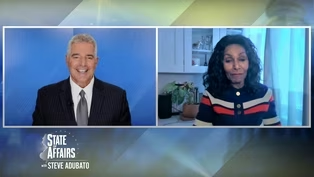
The Challenge of Breaking Into the Cannabis Industry in NJ
Video has Closed Captions
Clip: S7 Ep16 | 9m 33s | The Challenge of Breaking Into the Cannabis Industry in NJ (9m 33s)
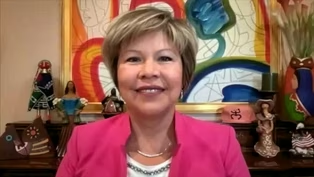
Recruiting and Retaining More Latina Women in Politics
Video has Closed Captions
Clip: S7 Ep16 | 9m 55s | Recruiting and Retaining More Latina Women in Politics (9m 55s)
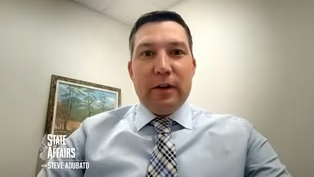
Rowan University Opens the State's First Veterinary School
Video has Closed Captions
Clip: S7 Ep16 | 8m 9s | Rowan University Opens the State's First Veterinary School (8m 9s)
Providing Support for PBS.org
Learn Moreabout PBS online sponsorship
- News and Public Affairs

Top journalists deliver compelling original analysis of the hour's headlines.

- News and Public Affairs

FRONTLINE is investigative journalism that questions, explains and changes our world.












Support for PBS provided by:
State of Affairs with Steve Adubato is a local public television program presented by NJ PBS