
Patrick Lyoya Case, COVID Guidelines, Bassist Marion Hayden
Season 6 Episode 22 | 26m 46sVideo has Closed Captions
Patrick Lyoya case update, Michigan COVID guidelines, Detroit jazz bassist Marion Hayden
This week, One Detroit's Will Glover gets an update on the Patrick Lyoya case as the Michigan State Police investigation continues. Then, Michigan Chief Medical Executive Dr. Natasha Bagdasarian joins for an update on the state's COVID-19 guidelines and recommendations. Plus, WRCJ host Cecelia Sharpe talks with legendary Detroit jazz bassist Marion Hayden. Episode 622
Problems playing video? | Closed Captioning Feedback
Problems playing video? | Closed Captioning Feedback
One Detroit is a local public television program presented by Detroit PBS
Patrick Lyoya Case, COVID Guidelines, Bassist Marion Hayden
Season 6 Episode 22 | 26m 46sVideo has Closed Captions
This week, One Detroit's Will Glover gets an update on the Patrick Lyoya case as the Michigan State Police investigation continues. Then, Michigan Chief Medical Executive Dr. Natasha Bagdasarian joins for an update on the state's COVID-19 guidelines and recommendations. Plus, WRCJ host Cecelia Sharpe talks with legendary Detroit jazz bassist Marion Hayden. Episode 622
Problems playing video? | Closed Captioning Feedback
How to Watch One Detroit
One Detroit is available to stream on pbs.org and the free PBS App, available on iPhone, Apple TV, Android TV, Android smartphones, Amazon Fire TV, Amazon Fire Tablet, Roku, Samsung Smart TV, and Vizio.
Providing Support for PBS.org
Learn Moreabout PBS online sponsorship- [Will] Just ahead on "One Detroit."
An update from Bridge Detroit's Bryce Huffman on the fatal shooting of an unarmed black man by a Grand Rapids police officer.
Plus, "One Detroit's" Bill Kubota catches up with Michigan's chief medical executive to get the latest on the fight against COVID-19.
Also ahead, Detroit musician and educator Marion Hayden talks with WRCJ host Cecelia Sharpe about the jazz culture in Detroit.
It's all coming up next on "One Detroit."
(upbeat music) - [Announcer] From Delta Faucets to Behr paint, Masco Corporation is proud to deliver products that enhance the way consumers all over the world experience and enjoy their living spaces.
Masco, serving Michigan communities since 1929.
- [Will] Support for this program is provided by the Cynthia and Edsel Ford Fund for Journalism at Detroit Public TV.
The Kresge Foundation.
- [Announcer] The DTE Foundation is a proud sponsor of Detroit Public TV among the state's largest foundations committed to Michigan focused giving.
We support organizations that are doing exceptional work in our state.
Visit DTEFoundation.com to learn more.
- [Will] Nissan Foundation and viewers like you.
(upbeat music) Just ahead on this week's "One Detroit."
Where does Michigan stand in the fight against COVID 19?
We'll clear up some questions about vaccine boosters and masks when "One Detroit's" Bill Kubota talks with Michigan's top doctor.
Also coming up, popular Detroit bassist Marion Hayden sits down with WRCJ's Cecelia Sharpe for a wide ranging conversation about her introduction to music as a child, her all female band, and Detroit's rich jazz culture.
But first up, the latest on the shooting death of unarmed African immigrant Patrick Lyoya at the hands of a Grand Rapids police officer.
The 26 year old man will be laid to rest on Friday as the investigation by the Michigan State Police continues.
Bridge Detroit reporter Bryce Huffman has been closely following the case and I caught up with him for an update.
(upbeat music) - Bring us up to speed on what has happened with the police shooting and where we are today.
- Yeah, so on April 4th which was about two weeks ago, yesterday, in the morning, Patrick Lyoya, a 26 year old Congolese immigrant in Grand Rapids was driving his car in the southeast side of the city in the Boston Square neighborhood.
He was stopped by a police officer.
He gets out of the car to, you know, talk to the officer.
That's something that is pretty normal in several African countries.
He didn't think anything of it, but the cop obviously did.
A struggle ensued.
By the end of the struggle, the officer shot Patrick in the back of the head, killing him according to the independent autopsy that they released today, nearly instantly.
- In the Congo, I believe, is where he's from.
- The Democratic Republic of Congo.
- Right.
So there, it's normal if you're stopped by the police or approached by a police officer to walk up to them to see what they want, what the problem is, correct?
And is that kind of how this whole scenario got started, that misunderstanding?
- Yeah, so like we said, Patrick is from the Democratic Republic of Congo.
And there, if you're stopped by the police, it's customary to get out of your car and talk to the police officer, you know, person to person outside of both cars, and then figure out, you know, what to do next.
Here, obviously, that is not the case in America, many of us grew up black, you know, had our parents tell us, you know, two hands on the steering wheel and make sure your license and registration are out, don't reach for anything.
You know, those are conversations that we had growing up, that Patrick and many other immigrants did not.
(speaking in foreign language) - I am Peter Lyoya.
(speaking in foreign language) I am the father of Patrick Lyoya.
(speaking in foreign language) I didn't know, I didn't believe that in this country.
(speaking in foreign language) That there was a genocide in this country.
(speaking in foreign language) I didn't know.
(speaking in foreign language) I didn't know that here in America.
(speaking in foreign language) There be can be an execution stunt to kill someone.
(speaking in foreign language) To kill someone with a gun.
(speaking in foreign language) And to be killed by the police officer.
(speaking in foreign language) On my wish now.
(speaking in foreign language) I knew that if you met with a police officer in America.
(speaking in foreign language) You will be safe.
You life will be spared.
(speaking in foreign language) What is making me cry more to see my son.
(speaking in foreign language) He has been killed by a police officer.
(speaking in foreign language) For a small, small mistake.
- What has been the reaction in Grand Rapids since this has come to light.
- Yeah, the reaction from a lot of people, activist, residents, even even some city officials is just a terrible sadness, a terrible regret.
This didn't need to happen.
People on the streets are, you know, marching and trying to hold the police department accountable.
People, kind of at the city government level are wishing they had maybe taken some of these concerns about their police department even more seriously over the past five years.
And then on the police side, they're not really talking to media other than their public information officer or their chief.
Everyone else is kind of just trying to keep their heads down and let people peacefully protest.
And that's what we've been seeing so far.
Back in the summer of 2020, after the George Floyd protests, Grand Rapids was one of the cities that did see some property destruction and some violence occur at their protests.
But so far, following the Lyoya's unfortunate death, his family has asked everyone to be peaceful.
Because that's the kind of the person that Patrick was.
He wasn't a violent guy.
- What has been the relationship or I guess the status of the Grand Rapids Police Department over the years?
Because it seems like there have been instances that created concern in black and brown residents.
And it seems like this is kind of the result of those grievances being, you know, falling on deaf ears.
- Yeah.
So I think I wanna clarify two things.
I'm only gonna go back five years, because that is really my introduction to the Grand Rapids police.
You know, that's when I moved there and started covering them.
And the second thing I wanna make clear is these complaints actually haven't fallen on deaf ears, the police department itself after there was an incident in March of 2017, where they pulled over five unarmed young black boys and held 'em at gunpoint after they were coming out of a community center.
And that was really the the first story I ever really knew about the Grand Rapids police.
So when I got there, I knew this was in the backdrop, this was in everyone's mind.
There was also a traffic stop study that was done, or I think it was released the next month that showed black drivers are twice as likely to get pulled over in Grand Rapids as white drivers.
So when I got there, there was already this momentum that had built up of people saying, "Hey, Grand Rapids police, we need to change how we operate or the worst could come."
And unfortunately, Patrick's death is kind of emblematic of the fact that even though the department had been going to some lengths to change, those changes simply weren't enough.
- So what happens next?
We know that there's been an autopsy done.
They haven't released the name of the officer who was involved in this.
Where do we go from here?
- So next steps are Michigan State Police are still doing their investigation.
I would expect that people are probably still gonna be in the streets protesting and demanding accountability, still demanding the name of the officer who probably won't be named until after Michigan State Police conclude their investigation.
And after that, either from the county level or the state level, I would expect to see charges filed against the officer.
But there's not quite a timetable on when those charges would be announced yet, because Michigan State Police are still doing their investigation.
- [Will] As the COVID 19 pandemic eases a bit there are questions about masks, vaccine boosters and other guidelines.
"One Detroit's" Bill Kubota spoke with the state's top medical executive, Dr. Natasha Bagdasarian about the recommendations and strategies here in Michigan in the fight against COVID 19.
(upbeat music) - Let's talk infection rates, vaccinations, hospitalizations, what are the numbers?
Where are things now?
Where are they going?
- Well, I can tell you that in general, we are in a low, we're in a low point here with cases and hospitalizations.
And what that means is when we think about the pandemic, we're really thinking about this in a cycle.
We're thinking about different approaches, depending on where things are overall in the state.
And right now we are in a recovery phase.
And what that means is that we just got over this big surge.
in the winter.
We just got over our delta and omicron surges back to back.
We now are in a place where transmission is low and we do have some protection based both upon vaccination as well as some prior immunity from that very recent omicron surge.
So we're in a relatively good spot at the moment.
However, when we think about where we're heading in the pandemic, we do expect to see future surges of cases, we do expect cases, and hospitalizations even to go up at times in the future.
And when we think ahead, what does that look like?
That could be the emergence of a new variant, it could be schools reopening in the fall, we have seen surges of cases around school reopening in the past.
It could be around colder weather in the winter.
So we're looking at this as really being a phased approach to the pandemic.
We're in recovery right now.
But that doesn't necessarily mean that it is all smooth sailing.
Because as you know, we have the BA.2 subvariant that we are closely monitoring and it's causing increased cases in other parts of the world and in other parts of the country.
And we do expect to see a rise in our cases here in Michigan.
- But on top of that, we're also looking at that push for that second booster.
How does that fit into all of this?
- Well, again, vaccines are one of the most important tools that we have.
We really have to use all of these tools in a very holistic approach and use them together.
So you are safest if you are using what we call non-pharmaceutical interventions, meaning, you know, you're avoiding very large, very crowded gatherings.
You're doing what you can prevent getting exposed to the disease as much as you can.
And then also, you are making sure you're vaccinated and boosted so up to date with vaccinations, that you've spoken to your doctor that you have a plan for whether or not you'd be eligible for one of these COVID therapeutics.
And then making sure that you've got some of these tools at home.
So making sure that you've got masks, and hand sanitizer on hand for future surges.
Making sure that you've got over the counter tests on hand so that you can use those over the counter tests if you become symptomatic, if you've been exposed to someone with COVID, or before attending a large gathering.
So making sure that people have all of these tools at their disposal is really one of the keys to moving forward.
You know, federal judges just recently, very recently kind of lifted this mask mandate on airplanes and transportation.
What about that?
What do you think?
Will you still be wearing your mask on a plane now?
- You know, we have been saying for some time now that we're in a phase of the pandemic where making these sorts of decisions are really up to individuals.
So we now have access to well fitting, high quality masks that can protect the wearer.
In the beginning, when we were talking about cloth masks and masks that were not well fitting, really everyone had to wear a mask in order to prevent spread from happening.
But now, if you are wearing a really high quality, well fitting multilayered mask, you can provide protection to yourself.
And so people need to make decisions that work for them.
So we still recommend wearing a mask if you are unwell, if you've tested positive, if you are quarantining, for example.
So there are still some times when we would recommend masking if you're in a high risk congregate setting.
So if you're in a healthcare setting, or a long term care facility, that's another time to mask up.
And then we also want people to comply with local and federal rules.
So if there are any laws, mandates, rules around masking in a place you're going to, it's important to comply with those rules.
But overall, people can now make decisions that work for them.
And there are lots of different reasons why people may want to continue wearing a mask.
So number one, you may have young children who aren't eligible for the vaccine yet, you may be immunocompromised yourself, someone in your family may be immunocompromised, you may be wearing a mask for them.
And then there's also just wearing a mask to be considerate to others.
You don't know who's around you, you don't know if there are people who are very vulnerable, who are sitting next to you.
And so you may wear a mask for them and for their comfort.
And so when you ask if I will continue wearing a mask, I do generally wear masks when I'm in public, when I'm in especially indoor public settings.
But again, it's a personal decision that I make with my family and do what's best for us.
And people have to make those decisions for themselves as well.
- Yeah, you mentioned your family, children.
How are schools doing in dealing with all of this these days?
- I think it has been a very hard two years for schools.
I think schools have been put at the frontline of this pandemic.
And really, they wanna get back to the business of educating our kids, which is their primary goal.
But they also need to be able to stay open and make sure that kids are healthy enough to be able to stay in school.
And that does mean preventing outbreaks.
And when I talk about those tools, and I mentioned that vaccines are one of the most important tools that we have, we see that vaccines have not been utilized to the degree we would want them to be in our younger age groups.
So when we look at overall vaccination we're at above 60% for vaccine uptake across the state.
But when we look at our younger age groups, when we look at our pediatric population the five to 11 population, that's lower, that's at about 28%, statewide.
And then when we look at certain communities, that rate, especially in children drops even lower.
And when we look at communities of color, again, we're seeing lower vaccine uptake.
And that matters because we are expecting future surges of cases.
And we need to make sure that everyone and all communities across the state are protected.
So if we don't have vaccine uptake in that younger age groups, we could be seeing school closures again in the fall, school closures into next year and even beyond.
We could be seeing outbreaks in schools.
And then of course, we know that children who are exposed and transmitting in school settings, for example, can bring those infections back to their family members and to, you know, vulnerable grandparents, or younger siblings.
So we really need to make sure that vaccine rates are up across the board, because if we are not all protected, if we have vulnerable individual, vulnerable communities among us, then as a state, we're not gonna be able to move out of this pandemic.
(upbeat music) - [Will] Marion Hayden is well known around Detroit as a musician, educator, Kresge Arts fellow and university lecturer on jazz.
Plus, she's the co-founder of the popular all female band Straight Ahead.
WRCJ hosts Cecelia Sharpe sat down with the bassist to talk about her introduction to music and Detroit's jazz culture.
(upbeat music) - One, two.
One, two, three.
(upbeat music) - Marion, you are definitely a trailblazer, a role model to so many here in Detroit and abroad.
I think that we should talk about your journey and how you got started.
So many of us look to you as that role model.
But I would like to know and maybe our audience would like to know how you were introduced to music?
- Well, that's a great question.
Well, one of the things I like to always say is that parents must play music for their children.
And I was really, really, very, very fortunate that my parents were both music lovers.
My dad was actually a kind of a closeted piano player.
He was actually really, really good.
But he didn't really want folks to know.
But every once in awhile, he'd sit down and play the blues and he was just fabulous.
My parents were Herbert Hayden, and Marion Ford Hayden and later Thomas 'cause after my dad passed, my mom got remarried.
But they were both just really big lovers of music.
So my dad was a huge jazz lover.
He had all kinds of jazz records to listen, that he listened to and that I accessed.
They were just in the sphere of our house all the time.
Just, you know, just Miles Davis and Oscar Peterson just floating through the airwaves.
And my mother was more of a lover of more of a classic American Songbook.
So I remember that she had a record of Gershwin's music, and she used to play Gershwin around the house all the time.
And so there was always just a lot of music to be absorbed for me as a young person.
And so by the time I finally got to be the age of eight or nine, when I was in my little elementary school, and they asked me if I wanted to play an instrument, and cello was a possibility because I was kind of a tall girl.
And I couldn't see myself playing a little violin, loved those, but I needed something bigger.
And soon as I got that cello, I was back at the house actually trying to play some jazz on the cello.
And then finally, when I figured out that it was gonna be a little hard to do, and I got a bass because actually I wanted to a bass first, but they didn't have any small basses.
But when I got big enough to play bass, which was about 12, then I just took my bass to the basement and started playing along with records because that was the music that was in my ear, and I just loved it so much.
So that's really how I got started.
During that time, we had really good public school music education which I think we still have really great Detroit Public School music education, it's just that we don't fund it as well.
But during those times, it was funded really well.
We have excellent Detroit Public School music teachers.
I loved my music teachers, they were awesome.
They just gave us so many really great opportunities.
They were so passionate about what they did.
And the ones that I know now that are in school are still very, very passionate.
They just need to be supported better.
- We also know that Detroit has a rich, deeply steeped and deeply rich jazz culture here.
Can you talk about how the jazz culture in Detroit influenced you as a musician?
- Oh, yes, I'm always glad to talk about that.
Well, you know, especially, I'll just say this in the playing of my instrument in particular, it's really important to have really good foundational training, and when I think about it, I think classical training is really good for that.
Because you're going to get all kinds of really great technical information, you're gonna learn how to read, you're gonna learn how to play up and down properly in the positions, play correct intonation.
And just address the bass properly, so that you don't have, you know, poor problems with, you know, bad posture and those kinds of things.
But when it gets to jazz, you really do need to be able to hook into the community that plays it.
And so luckily, Detroit has had such a rich and expansive community of players in so many genres of music, too.
I mean, you know, I'm talking, you know, ragtime, New Orleans, you know, early bebop, you know, more hard bop.
All the different, more avant-garde free jazz, just so many different ways, so many different genres of music, and so many different ways that people play.
- You definitely are a part of Detroit's Jazz Foundation.
One of those things being the all female jazz ensemble straight ahead, which you are co-founder of, can you talk about forming Straight Ahead, and what that meant to women in jazz music at that time.
And what it means for women today.
How that has impacted women today?
- Well, I'm always glad to talk about my sisters, and the great group Straight Ahead.
For so many people, they had not really seen women really out there playing instruments.
Occasionally, you'll see, you know, you might if you go to church, you may see some women as pianists, perhaps some concert pianists, but very rarely did you see them in jazz as much as we would like.
They weren't rare, but you just didn't see them as much.
And in terms of women playing things like drums and bass, rarely, you just did not see it.
People will come up to me and say, "I brought my daughter 'cause I really think that she has to see what women can do.
That a little girl can do whatever.
Whatever she wants to."
And so that that really made us feel really good.
And it continues to be so.
Now people still come up and say, you know, they of course they bring their sons as well 'cause frankly, young men needs to see the same thing.
They need to continue to see women as colleagues, across the board colleagues in this business.
- I know that you value music, education and passing on your wisdom and knowledge to others.
Can you talk about what the future of jazz in Detroit looks like to you?
- Hmm.
I think the future of jazz in Detroit is really looking completely rosy.
So great.
I know I'll just say this, that a lot of the nuts and bolts of jazz education has gone from the community where it was when I first learned into academic institutions.
And there's some really great things that are happening there in terms of giving young musicians a good baseline of knowledge, and understanding, giving them time to really work on their craft, hone their craft, technically on their instrument, and just getting some really good information about improvisation.
And then really, luckily, we still have a really active community of musicians that lives here.
So once they get that information, they can take that back out into the community and really engage with each other, and with with those of us who are more experienced in really learning what this music is actually all about.
♪ As long as you keep your head to the sky ♪ ♪ You may win ♪ ♪ As long as you keep your head to the sky ♪ - [Will] The documentary "Detroit Jazz City" featuring Marion Hayden and other local jazz greats gets an encore presentation here on Detroit Public Television on April 24, at 4:30pm.
The film is produced in partnership with WRCJ 90.9.
FM and focuses on the history of jazz in Detroit and the legendary artists who made major contributions to the original art form.
That will do it for this week's "One Detroit."
Thanks for watching.
Make sure to come back for "One Detroit's" arts and culture on Mondays at 7:30pm.
Head to the "One Detroit" website for all the stories we're covering.
Follow us on social media and sign up for our weekly newsletter.
- [Announcer] From Delta faucets to Behr paint, Masco Corporation is proud to deliver products that enhance the way consumers all over the world experience and enjoy their living spaces.
Masco, serving Michigan communities since 1929.
- [Will] Support for this program is provided by the Cynthia & Edsel Ford Fund for Journalism at Detroit Public TV.
The Kresge Foundation.
- [Announcer] The DTE Foundation is a proud sponsor of Detroit Public TV among the state's largest foundations committed to Michigan focused giving.
We support organizations that are doing exceptional work in our state.
Visit DTEFoundation.com to learn more.
- [Will] Nissan Foundation and viewers like you.
(upbeat music)

Jazz Bassist Marion Hayden Discusses Detroit's Jazz Culture
Video has Closed Captions
Clip: S6 Ep22 | 8m 20s | Detroit jazz bassist Marion Hayden discusses Detroit's storied jazz culture (8m 20s)
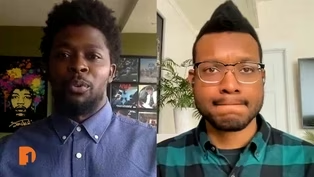
Justice Sought for Patrick Lyoya as Investigation Continues
Video has Closed Captions
Clip: S6 Ep22 | 6m 39s | BridgeDetroit reporter Bryce Huffman gives an update on the Patrick Lyoya case. (6m 39s)
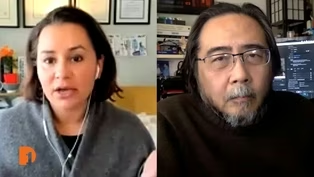
Where Does Michigan Stand Against COVID-19 Two Years Later?
Video has Closed Captions
Clip: S6 Ep22 | 7m 32s | Dr. Natasha Bagdasarian gives an update on COVID-19 two years after the pandemic began. (7m 32s)
Providing Support for PBS.org
Learn Moreabout PBS online sponsorship
- News and Public Affairs

Top journalists deliver compelling original analysis of the hour's headlines.

- News and Public Affairs

FRONTLINE is investigative journalism that questions, explains and changes our world.












Support for PBS provided by:
One Detroit is a local public television program presented by Detroit PBS