One-on-One
Paul Profeta; Michael Maron; Rev. Maria Crompton
Season 2022 Episode 2510 | 27m 17sVideo has Closed Captions
Paul Profeta; Michael Maron; Rev. Maria Crompton
Steve sits down with Paul V. Profetta to discuss the launch of the new education and research centers focused on real estate and entrepreneurship at NJIT; Michael Maron will talk about the challenges people have been facing over the past 2 years; Rev. Maria Crompton discusses the impact of being the first female to serve as Senior Pastor of the church.
Problems playing video? | Closed Captioning Feedback
Problems playing video? | Closed Captioning Feedback
One-on-One is a local public television program presented by NJ PBS
One-on-One
Paul Profeta; Michael Maron; Rev. Maria Crompton
Season 2022 Episode 2510 | 27m 17sVideo has Closed Captions
Steve sits down with Paul V. Profetta to discuss the launch of the new education and research centers focused on real estate and entrepreneurship at NJIT; Michael Maron will talk about the challenges people have been facing over the past 2 years; Rev. Maria Crompton discusses the impact of being the first female to serve as Senior Pastor of the church.
Problems playing video? | Closed Captioning Feedback
How to Watch One-on-One
One-on-One is available to stream on pbs.org and the free PBS App, available on iPhone, Apple TV, Android TV, Android smartphones, Amazon Fire TV, Amazon Fire Tablet, Roku, Samsung Smart TV, and Vizio.
Providing Support for PBS.org
Learn Moreabout PBS online sponsorship- [Narrator] Funding for this edition of One-On-One with Steve Adubato has been provided by The Russell Berrie Foundation.
Making a difference.
The New Jersey Economic Development Authority.
NJM Insurance Group.
Serving New Jersey'’s drivers, homeowners and business owners for more than 100 years.
Horizon Blue Cross Blue Shield of New Jersey.
Here when you need us most, now and always.
Choose New Jersey.
The Port Authority of New York and New Jersey.
Moving the region through air, land, rail, and sea.
The Robert Wood Johnson Foundation.
The New Jersey Education Association.
And by Suez North America.
Promotional support provided by Meadowlands Chamber.
Building connections, driving business growth.
And by NJBIZ.
Providing business news for New Jersey for more than 30 years, online, in print, and in person.
- This is One-On-One.
- I'm an equal American just like you are.
- The way we change presidents in this country is by voting.
- I'’m hopeful that this is the beginning to accountability.
- Life without dance is boring.
- I don't care how good you are or how good you think you are, there is always something to learn.
- I did do the finale, and guess where my trailer was?
A block away from my apartment, it couldn'’t have been better!
- People call me 'cause they feel nobody's paying attention.
-_ It'’s not all about memorizing and getting information, it'’s what you do with that information.
- (slowly) Start talking right now.
- That's a good question, high five.
(upbeat music) - Hi, I'm Steve Adubato.
Welcome to a very compelling program where we kick off with Paul V. Profeta, who's the president of the Paul V. Profeta foundation.
And he's affiliated with one of our higher-ed partners, NJIT in Newark, the Profeta Real Estate Center.
Paul.
Good to see you.
- Thank you.
Good to be on.
- Paul, we've had conversations in the past, both on and off the air, you've been involved and engaged in real estate all around the country but particularly in Newark.
Talk about as we're in into 2022, the real estate quote, quote the real estate market, particularly in downtown Newark.
- Well, I, I have specifically stayed out of Newark because I wanted to do philanthropic things and I, I didn't want my efforts to be misperceived but I'm certainly familiar with it.
The, the pandemic set the office market back terribly, when people were quarantined, no one could come to the office and then people came back slowly and landlords have had trouble collecting rent.
A lot of buildings have had problems.
It seems to be turning around and it seems like we're going back to normal.
Omicron seems to be declining.
And I hope by spring, summer we get back to being a normal country again.
- Talk about your commitment to the study of real estate that students involved in real estate at several universities, NJIT just being one of them.
Why are you so committed to helping students understand the study of, the science of, the art of real estate?
- Real estate has grown enormously in the last 10, 20 years and there's technical aspects that have been added to it.
When I first started 45 years ago, if you understood financing and marketing, you could make a living but today it's very important to know the bones of the building, how the building's made.
Is it, is it energy efficient?
Is it green?
And you have to know how to read a set of plans.
You need engineering skills and the best school in the state to do that is NJIT.
- Let me understand something.
Talk about the specific role of students in that work, Paul.
- Well, the, the students, you know, are are going to be learning this at NJIT.
And hopefully we can have intern programs where they can become involved as students with development and candidly educate some of their superiors about the the technical aspects of the field.
- Let, let me also ask you, you have again been involved in real estate all across the country, but in terms of commercial real estate, with more and more organizations, us included doing our work remotely, not everyone can do that.
What do you see as the longer-term impact of COVID two years plus into this pandemic on the commercial real estate market across the nation?
If more and more people are working outta their homes or working remotely?
- That's an excellent question.
And I, I'm involved often in debates with people who are very accomplished in the field.
There's people that think it'll eventually go back to normal.
Some people think it never will.
And other people think it'll become somewhat, I don't wanna say compromised, but somewhat of a a combination of both where people will work virtually two, three days a week from home and then two days, three days in the office.
People realize that there's a chemistry that occurs when people meet in-person and there's a body English, you sense.
And you can't, you can't replace that virtually.
So it is necessary for teams to get together once in a while and meet and go over the critical things.
Then if you're gonna go off and do a study by yourself, you could do that at home.
But then when you got your results, you come back and present them.
You present them to a group in person.
- Paul, you know, shift gears dramatically.
You and I have had offline conversations about our quote unquote ethnicity.
- Yes.
- And where our families come from in Italy, respectively where our families come from and someone might ask "what does that have to do with anything?"
What does your Italian-American background, your heritage with your family coming from Italy, immigrants into this country?
What does that have to do with your commitment, particularly on the university level, be it at NJIT or other places, as it relates to allowing students or, or or helping, encouraging students who are getting who are really the first very time, very often the first in their family to have a higher-ed experience or am I making too much of that?
- Oh no, no.
It was the, it was the drumbeat of my family growing up.
When my parents grew up, they they came from Italy at the turn of the century.
The systemic racism was fashionable.
I mean, you were judged by the people that you wouldn't associate with.
And Italians were at the bottom of the ladder.
Want ads would be in the New York Times.
Office helped wanted.
- No Italians apply.
- That's right.
No Italians apply.
But they knew, they knew that the road to equality in this country was education.
And it was the drumbeat of our family.
After dinner, you went and did your homework.
And if I came home with an A minus, it was a problem.
And they went to see the teacher.
"Why wasn't it an A?
Is there anything he can do to make it an A?"
They wanted us to get into the best schools.
And my father would say "if you get into the best schools, you can't be denied.
Even if you're Italian, you can't be denied."
So I look at education, it elevated him enormously.
He, as an immigrant, went to NYU then went to NYU law school.
He did that all at night while he worked then he got a PhD in, in law and he became a Professor of Law all in one generation.
And it's been, it's been the elevator for our family.
So I love education and what it does for people.
And that's why I've so oriented to trying to help schools help students.
- Paul listen, I wanna thank you for joining us for putting this in perspective.
We'll be monitoring the work of the Profeta Real Estate Center over at NJIT and also a whole range of other issues involving Newark.
Again, I'm, I'm a Newarker, born raised in Brick City.
So it isn't just downtown Newark.
People say, "well, look what's going on downtown."
It's much more than that when it comes to real estate.
And also the opportunity is being provided to those students who are going to the many universities in and around the Newark area.
They're the first in their family.
It's a big deal.
Paul Profeta.
Thank you so much for joining us.
We appreciate it.
- Okay.
Thank you.
- I'm Steve Adubato.
Stay with us, we'll be right back.
- [Narrator] To watch more One on One with Steve Adubato find us online and follow us on Social media.
- We're now joined by Mike Maron who is the president of Holy Name.
Mike, you are not at Holy Name up in Bergen County, you're actually in Haiti as we speak right now.
- That is correct.
- Put some context.
- So we have Hôpital Sacré Coeur which is in the town of Milot, it's in Northern Haiti it's a 200 bed hospital that Holy Name took over in 2011 and has been running ever since.
- Yeah, we've had many conversations with Mike over the years about Holy Name's work as a medical organization, as a hospital organization that he just described.
But I wanna lay this out, Mike, talk about the challenges of Haiti.
And Mike will tell you in a second, the way to be helpful if you want to be helpful.
The hospital on November the first, the hospital was forced to close its doors after an attack when an armed group tried to abduct a patient.
The hospital reopened in late December, 2021, there was a 7.2 magnitude earthquake that hit Haiti killed more than 1400 people.
60 almost 7,000 people were injured.
The president of Haiti was assassinated in July, 2021.
Mike, how much has all these things impacted the work that you're trying to do in Haiti?
- The impact here has been, it's just been one challenge after the other, Steve, right?
COVID is rampant here, cholera was rampant on top of all those other atrocities.
It makes every day living here very, very difficult, very challenging.
We're talking about the most impoverished nation in the Western hemisphere.
People live here the way they live 500 years ago.
There's been some advances in many areas which is one of the ironies.
Almost everybody has a cell phone, but they're still living in bamboo shacks with dirt floors and all the other sort of no fresh clean water, no utilities, all the things we take for granted at home just don't exist here.
- Mike, explain to people again why Holy Name is in even involved in Haiti.
- So we got involved really through one of our great physicians and a board member at Holy Name, Dr. Dave Butler, who's an obstetrician gynecologist, been on our staff for 40 years.
Dave got involved down here about 30 years ago and would come down on regular trips and we would supply him with medical supplies and drugs to bring down.
And it was after the earthquake that Dave asked for me to join him on one of those trips.
And when we saw the devastation and we saw just how bad things were, we believed we could make a difference.
And so we made the commitment and we've honored that commitment for the last 12 years.
- As we put up the website, if people want to be helpful, let everyone know what the situation is as it relates to COVID in Haiti right now, particularly at the hospital.
- So it's very much like at home where we have spikes and then we have a recession at the moment we are on the tail end of a spike.
So we have about 10 patients at the hospital today who are COVID positive in isolation that we're treating, untold numbers in the community because there's no testing here.
There's no way to really monitor and surveillance the size of the virus.
We can only tell by the way people present at the hospital in the ER, and ultimately get admitted.
- As we put up the website, what can people do to be helpful?
- So the greatest help is funds.
The, Haiti is a, it's a, while it's an unstable environment politically, unstable financially from many, many points.
What Holy Name has done is added a level of security and a level of insurance.
So I can assure you that any donations that are given to us for Haiti, a hundred cents on a dollar will come to Haiti and will absolutely make a difference.
It will not be stolen.
It will not be diverted.
It will be deployed right here to provide direct patient care.
And that's really what these people need at the moment.
- And let me disclose this, Holy Name is one of the healthcare organizations, one of the hospital organizations that is an underwriter of what we do, particularly in the area of healthcare.
Follow up on this Mike, what is the medical team facing?
The physicians, the nurses, the respiratory therapists what are they facing?
Cause it's one thing to talk about what they're facing in the United States, it's another thing to talk about Haiti.
What are they facing?
- Well, thing about it here.
There's a very limited supply of intervention.
So we don't have monoclonal antibodies.
We don't have the vaccine.
We don't have a ready supply of oxygen.
All the things that you need to combat COVID just don't exist here.
And so what we do is the best we can with the limited resources we have.
We hydrate people, we try to get them breathing by mobilizing and moving them because there's only one ventilator in the entire hospital.
And that's for a population of two and a half million people.
- Go back to the vaccine issue.
There... People talk a lot about vaccine accessibility in the United States, responsiveness resistance, et cetera.
Are you saying that in Haiti, the vaccine is not available?
- Not available, yeah.
They only, they are one of the three countries in the world that do not have a formal vaccine program part as because of the political unrest, part of it's cause the US just hasn't really helped.
The US shipped, for a population of 12 million people we shipped 500,000 doses of vaccine once.
And that was it.
- Why, why is that Mike?
- Don't know.
I've asked right up to the highest ranks in the Biden administration.
I have, because Holy Name runs one of the largest vaccine centers in New Jersey, to be able to divert some of our vaccine and bring it down here.
We were denied that request.
It's illogical to me.
It makes no sense.
And I get the rules around transporting drugs and I get the rules, but we've always made exceptions in times of crisis.
This should be one of those, but that failed to rise to that level.
- Mike, I'm curious about this before I let you go.
You've been heading out to Haiti, going down to Haiti for decade now?
- Yes.
- So the resilience, the grit.
- Yeah.
- On the part of the people of Haiti is extraordinary.
But you also mentioned at the time we have left, you mentioned political unrest.
What impact does political unrest have on healthcare?
The healthcare of the people of Haiti.
- So it again, when supplies are held hostage because of gang war, give you an example, one of the most valuable commodities for us is diesel fuel because we use diesel fuel to run our generators.
We, there is no public utility, so we have to generate our own electricity.
Imagine trying to run a hospital without electricity or when the gangs hijack the diesel trucks because it's liquid gold and the trucks can't refill our tanks and we have to limit our generators.
It impacts the whole operation in a very, very significant way.
- Mike Maron in Haiti.
Mike, thank you for joining us.
- Thanks for having me, Steve.
I appreciate it.
- Stay with us we'll be right back.
- [Narrator] To watch more One on One with Steve Adubato find us online and follow us on Social media.
- We are honored to be joined by Reverend Maria Crompton who is Senior Pastor of Elmwood United Presbyterian Church.
Reverend, good to see you.
- Good to see you too, Steve.
Thank you so much for having me as a guest today.
- You got it.
Tell us a little bit about where your church, where it's located and the community you serve.
- Absolutely, I love talking about this amazing church community that I get to pastor.
So we are Elmwood United Presbyterian Church.
We are located in East Orange, New Jersey.
And we have been here for well over 100 years but we merged with another congregation in Newark in the early sixties.
And so, we are celebrating 60 years as a combined church.
60 years of ministry in the East Orange community.
So, we are just grateful and excited to do the work that we do.
- Reverend, you come to us through a recommendation of one of our trustees, Michellene Davis, one of your parishioners.
- Yes.
- Who, one of the things she talked to me about and talked to our producers about was, is in fact the church's commitment and your ministry to the community you serve, not just in church but also East Orange is a food desert.
So health equity, social justice, dealing with people's issues of food insecurity.
That's a huge part of the ministry.
Talk about it.
- Absolutely, so before I jump to the work that we do, I have to let you and your viewers know that everything that we do is kind of rooted in scripture and rooted in our understanding of the the ministry and mission of Jesus.
So, when Jesus starts his ministry, right, he starts with this inaugural sermon and he says that he came to do five things, right?
Bring good news to the poor, to proclaim liberty to the captives, to heal the broken hearted, to recover sight for the blind and to also set free those who are oppressed.
So when hearing that, what that says to me what that says to all of us is that Jesus' work here on Earth was not just about the spiritual.
It was also about the social and the political.
Jesus wanted to make sure that socially people had what they needed to live the life that God wanted them to live.
And so in the same way, right, Elmwood roots our ministry in that same concept.
Yes, absolutely.
We are concerned about people's souls.
Absolutely, we want everybody to go to heaven but we are also concerned about the hell that they are living in here on Earth.
We want to be agents of change.
We want to do all that we can to change the social and the political conditions that are causing people to live in pain.
- Such as pastor, I'm sorry for interrupting.
Such as?
- Yep, so I'll give you a couple of examples of the work that we do here.
People should not have to live in a world where they do not have access to healthy food.
Where they do not have access to fresh fruits and fresh vegetables.
And so here at Elmwood, we are doing everything that we can to address food insecurity.
We have a food pantry that distributes groceries, bags of groceries to members of our community on a weekly basis.
We feed about 80 people weekly.
We also have a ministry called Cafe 5,000 and we provide warm meals to people in the community.
They can come to our church, sit down, they can eat here, right here at our church.
We also feel that people should not have to live in a world where they are made to feel as if their voice and their vote does not matter.
And so, at Elmwood, we are partnering with community organizations in order to bring about voter education and voter empowerment.
We want people to feel empowered.
We want them to be educated, so that they can make informed decisions when they go to the polls.
- Stay on that Pastor.
Pastor, I'm sorry.
Devil's advocate, which sounds ridiculous to say in this segment but those who say, you know, church, politics, keep 'em separate, you say?
- I say that for us, again, we root everything in our understanding of Jesus.
Jesus, was political.
And, I think, one of the biggest misunderstandings about the ministry and mission of Jesus is this idea that Jesus was this meek, mild savior who only came to save our souls.
I wholeheartedly disagree with that.
I believe that Jesus wanted to address and did address the social and the political, you know, conditions that were impacting God's people.
So for us here, its not Jesus or justice.
It's Jesus and justice.
We believe that in order for people to be truly free, we have to address what is keeping them bound here on Earth.
So, again, everything that we do is rooted in our understanding of the work of Jesus.
- Reverend, let me try this.
And I bet you I'm not the only one who's curious about this after they listened to you.
And again, after Michellene, a good friend told us about you and the work that you're doing at Elmwood.
I'm curious, and I know I speak for a lot of others.
When did you know that this would be your life's work, and why?
- I was 12, Steve.
I was 12 years old, when I knew that this would be my life's work.
Like most 12 year olds, I was forced to go to church.
I didn't enjoy going to church.
As a matter of fact, Steve, when I went to church, I didn't see me in church, you know, women in positions of leadership and authority at the church, it was unheard of.
And so... - Excuse me, you are the first.
Again, sorry for interrupting.
You are the first at Elmwood to lead the congregation.
Go ahead, I'm sorry.
- I am, I am the first woman to serve as senior pastor of this congregation.
But yeah, so I'm growing up.
I don't see any women in pastoral leadership and really did not think that this was for me.
And Steve, one day I'm sitting in church and I'm bored.
I don't want to be there.
And for the first time I saw a young woman come in and she was our guest preacher for the day.
Her name was Minister Tracy Blackwell.
She probably has no idea that I exist.
But she gave this sermon, and as she was preaching, in that moment, I knew, I knew something in my heart and my gut said, you were going to make people feel the same way she's making you feel right now.
And so from that moment on, this has become my life's work and my life's purpose.
- Wow, did you ever tell her that?
- So I didn't have an opportunity to because she was a guest preacher, she wasn't affiliated with our church.
She literally came in, gave a sermon and left and I never saw her again.
She had this amazing impact on my life and I never saw her again.
- You know, what's so interesting about that.
I mean, only have a couple seconds left.
You never know.
You just never know when you're going to have an impact particularly on a 12-year-old little girl in church bored on her life, on a young man's life.
Just never know.
And so, you were doing that.
I guarantee you and you don't need me to tell you this, Reverend.
You know, you're doing that for a lot of other young men and women at Elmwood United Presbyterian Church.
I wanna thank you for joining us.
You honor us by your presence.
Thank you, Reverend.
- Thank you so much for having me again, Steve.
- I wish you all the best.
I'm Steve Adubato.
That is Reverend Maria Crompton.
We'll see you next time.
- [Narrator] One-On-One with Steve Adubato has been a production of the Caucus Educational Corporation.
Funding has been provided by The Russell Berrie Foundation.
The New Jersey Economic Development Authority.
NJM Insurance Group.
Horizon Blue Cross Blue Shield of New Jersey.
Choose New Jersey.
The Port Authority of New York and New Jersey.
The Robert Wood Johnson Foundation.
The New Jersey Education Association.
And by Suez North America.
Promotional support provided by Meadowlands Chamber.
And by NJBIZ.
(Music playing) NJM Insurance Company has been serving New Jersey policy holders for more than 100 years.
But just who are NJM'’s policy holders?
They'’re the men and women who teach our children.
The public sector employees who maintain our infrastructure.
The workers who craft our manufactured goods.
And New Jersey'’s next generation of leaders.
The people who make our state a great place to call home.
NJM, we'’ve got New Jersey covered.

Launching New Research Centers at NJIT
Video has Closed Captions
Clip: S2022 Ep2510 | 8m 34s | Launching New Research Centers at NJIT (8m 34s)

Natural Disasters and the Aftermath of COVID-19
Video has Closed Captions
Clip: S2022 Ep2510 | 8m 58s | Natural Disasters and the Aftermath of COVID-19 (8m 58s)
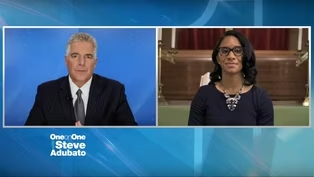
Social Issues Within Religious Communities
Video has Closed Captions
Clip: S2022 Ep2510 | 10m 10s | Social Issues Within Religious Communities (10m 10s)
Providing Support for PBS.org
Learn Moreabout PBS online sponsorship
- News and Public Affairs

Top journalists deliver compelling original analysis of the hour's headlines.

- News and Public Affairs

FRONTLINE is investigative journalism that questions, explains and changes our world.












Support for PBS provided by:
One-on-One is a local public television program presented by NJ PBS