State of Affairs with Steve Adubato
Paula A. Franzese; Sen. Anthony Bucco; Sen. Vin Gopal
Season 6 Episode 23 | 27m 51sVideo has Closed Captions
Paula A. Franzese; Sen. Anthony Bucco; Sen. Vin Gopal
Paula A. Franzese, Peter W. Rodino Professor of Law, Seton Hall University, sits down with Steve Adubato to address critical vacancies in our court; Sen. Anthony Bucco (R) - NJ, Republican Whip, 25th Legislative District, examines the high cost of clean energy; Sen. Vin Gopal (D) – NJ, Democratic Conference Chair and Chair, Senate Education Committee, addresses the new public-school curriculum.
Problems playing video? | Closed Captioning Feedback
Problems playing video? | Closed Captioning Feedback
State of Affairs with Steve Adubato is a local public television program presented by NJ PBS
State of Affairs with Steve Adubato
Paula A. Franzese; Sen. Anthony Bucco; Sen. Vin Gopal
Season 6 Episode 23 | 27m 51sVideo has Closed Captions
Paula A. Franzese, Peter W. Rodino Professor of Law, Seton Hall University, sits down with Steve Adubato to address critical vacancies in our court; Sen. Anthony Bucco (R) - NJ, Republican Whip, 25th Legislative District, examines the high cost of clean energy; Sen. Vin Gopal (D) – NJ, Democratic Conference Chair and Chair, Senate Education Committee, addresses the new public-school curriculum.
Problems playing video? | Closed Captioning Feedback
How to Watch State of Affairs with Steve Adubato
State of Affairs with Steve Adubato is available to stream on pbs.org and the free PBS App, available on iPhone, Apple TV, Android TV, Android smartphones, Amazon Fire TV, Amazon Fire Tablet, Roku, Samsung Smart TV, and Vizio.
Providing Support for PBS.org
Learn Moreabout PBS online sponsorship- [Narrator] Funding for this edition of State of Affairs with Steve Adubato has been provided by The Turrell Fund, supporting Reimagine Childcare.
The New Jersey Education Association.
Summit Health a provider of primary, specialty, and urgent care.
RWJBarnabas Health.
PSE&G, committed to providing safe, reliable energy now and in the future.
Bank of America.
Eastern Atlantic States Regional Council of Carpenters.
NJM Insurance Group.
Serving New Jersey'’s drivers, homeowners and business owners for more than 100 years.
And by Fedway Associates, Inc.
Promotional support provided by The New Jersey Business & Industry Association.
And by New Jersey Monthly.
The magazine of the Garden State.
Available at newsstands.
[INSPRATIONAL MUSIC] - Hi, I'm Steve Adubato.
We are honored once again to be joined by Paula Franzese.
She's, in fact, the Peter W. Rodino professor of law at Seton Hall Law School.
Good to see you, professor.
- It is so good to see you, Steve.
Thank you so much for having me.
- Our pleasure.
Paula, you've always been very helpful in putting judicial issues in context for us.
The situation, I don't wanna date ourselves, because we're taping on the 20th of September, and being seen later, people are being nominated to the State Supreme Court.
We don't know about the approval process.
Let's just say it's a little political at times, just a little, what does it mean when the full compliment of seven State Supreme Court justices are not in place?
What does that mean for the judicial system and for those who seek justice?
- Well, it is quite important that the New Jersey Supreme Court be fully constituted, it's seven justices that are supposed to, by tradition, and longstanding history, represent both parties to assure that the court stays above the fray as it always has to be non-partisan.
Right now, the court has four members with three members called up by Chief Justice Wagner from the appellate division, all three of whom are immensely well-qualified, but they're only interim appointees, it's very, very important for stability and also for the orderly administration of justice to have that full bench in place.
Our state Supreme Court is the gem of our state.
It's been referred to with great praise by "the New York Times" as New Jersey's New York Yankees for good reason.
It is a... Go, Steve.
- Well, I'm a Yankee fan, and I'm not sure they would be referring to the Yankees of today, but what I mean by that is the Supreme Court of then, when that was said is not the Supreme Court of now.
It is by many folks who understand this process and the politics of it, and state senators who block appointments.
There's something called senatorial courtesy, which is not in the state supreme...
Excuse me, not in the State 1947 Constitution, but it is a practice unwritten that state senators from a county where a judge is nominated to be on the... Or someone is nominated to be on the State Supreme Court, that senator can block and has blocked appointments to the Supreme Court based on what?
- It depends.
Based, oftentimes, at least theoretically, on assuring a healthy partisan, bi-partisan balance to make certain that the court is a fully and equally represented branch of government.
Senatorial courtesy cuts both ways as you're noting.
On the one hand, it is checked against unbridled power exercised by the governor and the legislative majority.
On the other hand, it can be a delaying tactic.
It can be a politics as usual tactic.
What I can tell you as a keen observer of the court is, that irrespective of party affiliation when nominated, it's been my experience that the New Jersey State Supreme Court justices abide that long tradition of rising above the political labels to do justice, to do what's right.
I think the court is the New York Yankees, if you're a Yankees fan, as I am, of the state.
The process that gets judges to the bench, leave a lot to be desired.
- But, Paula, here's the perplexing part for me, and P.S., I wanna be clear, Democrats and Republicans in the state legislation and people may be wondering, what does it have to do with the senate?
The governor nominates someone to be on the Supreme Court.
The states must approve or reject that nominee, or not even consider that nominee.
That being said, which is similar to the United States Constitution, excuse me, United States Supreme Court Associate Justice, if you will, nominated by the president, the senate has to act or not act.
That being said, what is the role of party affiliation?
If we're saying they're impartial, if we're saying the law is what matters, then what the heck is the difference what their party affiliation is, if party affiliation has no place in adjudicating a judicial issue?
- Because perception is important, and the court, our state Supreme Court, the U.S. Supreme Court has long been concerned with its perception.
It needs to enjoy the public confidence.
It also needs to communicate to the public that it's a representative full and equal branch of government, so the idea of 4-3 split on our seven member comprised court is important.
It's an important tradition to preserve.
- Okay, so let me nationalize this.
As we speak, the United States Supreme Court judges across this nation have incredible power to make difficult decisions in an incredibly polarized, divided nation, and I'm not asking you to comment on the situation in Mar-a-Lago.
That'll play out.
We don't want to date ourselves.
But when an appellate court judge in Florida makes a decision as to whether a special master is appointed or not, again don't date ourselves, and it's applauded by those who are supporters of former President Trump, because she's a Trump supporter.
I don't know if that's true or not, but I'll go back to perception.
Why would it even be relevant whether a judge is a Trump supporter, a Biden supporter, voted Democratic, or Republican, the law is the law, the constitution is the constitution, or am I being naive?
- No, I don't think you're being naive.
I think that what you're reflecting is part of the genius of our framers when devising this tripartite system of government.
The courts are supposed serve as umpires.
Chief Justice Roberts famously said that.
They call balls and strikes.
They are not to legislate from the bench.
They are to be fair, impartial adjudicators.
The problem is that judges do not work in a vacuum.
They're serving in a hyper-politicized, hyper-partisan culture.
The media does an awful lot to contribute to the punditry, and to stoking lots of the divisions which are click-bait for people.
I think that, as a nation, we are as a people far more reasonable than the portrayal of the very polarized, divisive split that we read about and hear about constantly in the media, and I also think that special master, you know, there's a great Buddhist wisdom, was it wise, was it not?
And the answer is always, "We'll see," because right now there are many who initially applauded the appointment of the special master who are delighting the appointment.
So, time will tell, but again, I remain very, very confident.
Confident, I hope confident, but very confident in our our great social experiment, this great democracy.
- Real quick on this, and P.S., we will not date ourselves because it will play out the way it plays out, that issue and others.
Can I get a response to this?
President Biden is turning 80 relatively soon.
Donald Trump, if he were to run again mid-70s, beyond, why is there a mandatory retirement age at 70 in the Supreme Court in New Jersey, and does that make sense?
- No, I do not think it makes sense.
As a matter of my opinion, 70 is not what it may have been perceived to have been generations ago.
70, a vibrant decade.
The 80s, a vibrant decade for so many of the most acclaimed jurists in our country who often, history tells, served beautifully on the U.S. Supreme Court, well into their 90s.
70 is too young.
The mandatory retirement age in New Jersey, it has to be changed.
We've got a crisis right now, and unfilled positions in the state bench will have another 15 or so vacancies in December, when 16 judges hit the mandatory retirement age.
- To Professor Franzese's point, there is no retirement age for the United States Supreme Court, but there is one at 70 for the New Jersey Supreme Court.
- Right.
- We'll follow this, and P.S., Professor Franzese will be joining us on our other series I do with Jacqui Tricarico, our executive producer and co-anchor of "Remember Them."
We'll be talking about very significant jurist in this state of New Jersey who passed away, but had a great impact on our lives.
Paula, thank you so much.
- It's always a pleasure.
Thank you.
- You got it.
Stay with us, we'll be right back.
(grand music) - [Announcer] To watch more State of Affairs with Steve Adubato, find us online and follow us on social media.
- We're now joined by State Senator Anthony Bucco, a Republican.
He's in fact a Republican Whip, which means he's a leader in the Senate in the Republican Party.
Good to see you Senator.
- Good to see you, Steve.
- You often put things in perspective for us on a range of issues, but one of the issues I wanna talk to you about right away is the Clean Energy Initiative in the state of New Jersey.
You have said in the past that you wanted to know the cost of the Governor's Clean Energy program.
And you have argued after a report came out on August 17th, it was a BPU report that was put together by The Brattle Group.
Long story short is, you don't buy the report.
The report says that ratepayers will not be paying more for clean energy.
You say they will.
What's wrong with this picture?
- Well look, the report is incomplete.
The report states that if you go to complete renewable energy in your household you'll save a couple of hundred dollars annually on your electric bills.
But what it doesn't tell you is how much it will cost the family to convert their home to an entire electric system.
You've gotta replace your furnace in many cases.
You've gotta replace hot water heaters, stoves, and it also includes the purchase of an electric vehicle.
So if you don't know what those costs are upfront how do you know whether or not it's beneficial to save a couple of hundred dollars a year?
You're talking about potentially $75,000 investment or more to a family and to save a couple of hundred dollars a year.
That seems, the cost benefit analysis for that doesn't seem right and the fact that the report doesn't address the amount of money it will take to get there to me says it's flawed.
And I don't think the report's worth the paper it's written on until we get that cost benefit analysis.
- Let me disclose one item here, which matters.
The Caucus Educational Corporation, our not for profit production company, receives a grant from the third party advertising agency that promotes the Clean Energy Program in the state of New Jersey to do public awareness, which also means we do important conversations like this where people have a different perspective on it.
That being said, Senator, I wanna read to you and we will have the BPU President Board of Public Utilities President Joe Fiordaliso on to share his perspective on this ratepayer impact study.
This is according to the Sierra Club.
The BPU report confirms that the ratepayer will ultimately pay less if we transition to clean energy sources and our homes and vehicles are electrified.
It goes on to talk about, now why would the Sierra Club make that statement if what you just said about the 75-grand is accurate?
- Look, they're making that statement because they're ignoring the fact of how much it's gonna cost to get us to that point.
So, they're correct when they say you may save $100 or $200 a year on your electric bill but they don't ever tell you how much it costs you to buy a new electric vehicle, to replace your furnace, to convert your home.
And if you don't know those costs up front how can you make a determination whether $200 savings a year is worth the initial investment?
You know, without those other numbers, without those cost numbers you can't make a logical decision.
And let's face it, Steve, 60 or more percent of our families are living day-to-day in the state of New Jersey.
So to say to them, you've gotta now make a huge investment.
You know, could be $100,000, could be $75, $100, could be more depending on the size of your home and the appliances that you have to change and the vehicles that you have to purchase.
If you have to make that investment you have to make sure that the amount of money you're putting out is gonna be recouped in a period of time which makes the investment a logical choice.
It also ignores-- - But Senator.
- Go ahead.
- I'm sorry for interrupting, Senator, but you do believe that our reliance on fossil fuel is problematic, environmentally, in terms of climate change.
You acknowledge that the current, the status quo is not acceptable, correct?
- This is, everybody wants a clean environment.
Everybody wants a clean environment.
But the fact of the matter is carbon emissions are at its lowest point in 33 years here in New Jersey.
We're headed in the right direction.
Whether or not we have to go to 100% renewable energy is a question.
And before you-- - What do you think we should do?
- Well, I think we have to know the costs.
We have to know the costs.
And I don't think we can ignore clean natural gas.
You know, to say that we're throwing out natural gas, along with everything else, I think is problematic.
I don't think the system can handle 100% renewable energy as it is.
- What do you mean the system?
Are you talking about the grid?
- The grid.
Sure.
I mean, when you look at other states that have tried to go this route you see that in the wintertime when it's cold there's not enough energy to produce the heat.
We've seen it all over the place.
So you're talking about a huge amount of investment that has to get here in order for this to even potentially work.
And then you're not even considering the fact that what it's gonna cost each family.
And the problem is this isn't going through the legislature.
- What do you mean?
- This is being done by regulation.
This is all being done by the DEP through regulation.
It's gonna be a regulation that takes effect in December that will require boilers in excess of a million BPU to be replaced by electric boilers.
So now when you think about that, I was just at the County College of Morris the other day and the president said to me, "Is this really gonna happen?"
He said, "Do you know how many millions of dollars this is gonna cost the college to replace our heating systems?"
So who's gonna pay for that?
The taxpayers and the students.
So there's huge economic impact associated with this plan.
And without knowing the cost, without considering clean natural gas we're making a big mistake.
We're heading in the wrong direction.
- Senator, hold that thought right there.
And I wanna reiterate that we will have the BPU Board of Public Utilities President Joe Fiordaliso.
And again, we're gonna have a very detailed comprehensive interview with Governor Murphy a half hour.
I assure you the clean energy discussion will be part of that conversation.
Real quick on this Senator, we have an initiative called Reimagine Childcare.
The graphic will be up.
How important is affordable, accessible, quality childcare, particularly as it relates to the New Jersey economy and people being able to work and have quality childcare at the same time, that they can afford?
- It's very important.
You know, we have to make sure that we provide for good, affordable childcare so that people can go back to work.
We saw during the pandemic, when things started to open up again, that parents were having trouble 'cause their kids weren't back to school and they needed somebody to be home.
They were learning remotely.
So we saw that really showed us how big a problem it can be.
We gotta get people back to work and we have to be able to have them be able to work comfortably knowing their children are being taken care of.
So that's an investment New Jersey needs to make.
- This is, you've been listening to State Senator Anthony Bucco who is a leader in the Republican Party and the State Senate Republican Party Whip, which is I believe the second most prominent position in the minority party.
Is that correct, Senator?
- It usually goes the leader, the conference leader and then the whip.
But you know, listen, I'm just honored to be in the State House.
I'm honored to represent my district and it's always great to be on with you to discuss these issues that affect people's livelihoods every day.
- Thank you, Senator.
Appreciate you joining us.
- Thank you.
- Stay with us, everyone, we'll be right back.
(grand music) - [Announcer] To watch more State of Affairs with Steve Adubato, find us online and follow us on social media.
- We are joined once again by State Senator Vin Gopal, Democratic Conference Chair and Chair of the Senate Education Committee.
Senator, great to have you with us.
- Great to be with you, Steve.
- Right now, we have a teacher shortage crisis, a crisis of not enough teachers in our schools.
What's the problem and what do we need to do?
- I think the profession has been taking a hit as a whole.
We're seeing bills across the country, ridiculous bills such as putting cameras in the classroom.
We're already starting with educators who, you know, the average teacher is starting in a salary of around 40, 50,000 over 30 years.
They're not making anywhere close to six figures.
And you know, we've seen this big misinformation campaign related to sex education.
I've spoken to kids, I call 'em kids, students at different universities who are interested in being teachers.
And there's just been a great attack on the teaching profession as a whole.
So, I think we've got a lot of challenges, but it has to do a lot of the misinformation on the attacks on teachers.
- And senator, I wanna go to the sex education confusion.
I don't even know if I call it controversy.
There's confusion, which for some may mean controversy.
That being said, I wanna go back to the shortage issue.
There are many states who are now considering ways to get folks in the classroom without their teaching certification.
And there are different processes in which to do this.
Should we be doing that in New Jersey?
- Absolutely, I just came from Lee Charter School over in the Central Ward in Newark, where I talked to the faculty and students there.
And I saw some incredible teachers there that had different pathways to get there.
So, I think we need to look at all options.
And I think, you know, professional experience should help equate to some folks becoming a teacher.
- But senator, how do we guarantee that they're qualified to be in front of that classroom if in fact, they're not certified?
And what does it say about all those have been certified?
- I think we have to look and see what the subject is, what the type of certifications.
I do think they have to take some kind of test.
I do think they have to take some kind of skill set.
Look, a lot of private schools right now, you don't need the same certifications to teach in public schools.
And we know that, I mean, we've had a lot of people have different careers and they come into the private school setting to teach.
I think we have to put everything on the table.
There's a number of bills that Senator Ruiz and I are moving in Senate Education later this month.
And I think we have to look at all approach.
I don't think what they did down in Florida was entirely helpful.
I think this has to be based on certifications and educational background.
- And I believe what you mean in Florida is there's absolutely no certification required and I'm not even sure what is then required to become a teacher.
- Correct.
- Switch gears.
There have been certain legislators, particularly certain Republican legislators, who are arguing that the education profession that our schools are trying to indoctrinate young children at a very early age around sexual orientation, around gender, et cetera, et cetera.
As it relates to the public school curriculum in different grades.
What is fact and what is inaccurate, Senator?
- Yeah.
This has really been discouraging.
This isn't even politics.
I've been extremely disappointed in Republican leader, Steve Oroho, not the precedent that his predecessor, Senator Kean and others sat, where politics is okay, but this is dangerous.
We are at September, end of September now, 600 plus school districts and we don't have a single school district out there that is public that we know about that is apparently teaching inappropriate material to school children, it's not happening.
So, this has been a small group of people that has spread a lot of misinformation to try to bring- - Why?
Senator- - Politics.
- Senator, why would they do that?
But what's the game?
First of all we're taping in September, be seen later, but Senator, what's the advantage to state something that is in, that you argue is in the curriculum regarding sex education that you argue is inappropriate if, in fact, you can argue it's inappropriate or not and people that could have different points of view.
But it is what it is and it's not what it's not.
So, it's either there or it's not.
- Yeah, it's not there.
They're just making it up, right?
They're telling that people are teaching sex acts to second graders and they're trying to change gender identity, that does not exist.
They're doing it because there's November elections coming up and Congress is at stake and they're gonna try to do it next year.
And usually when you, you know, parents are busy right now, they've gotta take care of their kids.
They got full time jobs.
So, they see a Facebook headline or newspaper article headline, Democrats are trying to indoctrinate their kids.
You know, they're counting on parents not to do more research and background 'cause they're so busy in their lives and hoping that fear allows them, 'cause you obviously, when your child is at stake, nothing is more important.
So, they're hoping that fear moves the way.
But here we are.
We can't name, Steve, a single school district out of 600 that's doing, apparently teaching anything inappropriate.
- Senator, shift gears.
You've joined us in the past and talked honestly and openly in a very helpful way around some of the personal mental health issues you have experienced and you've helped a lot of people in that process.
Not only talking to us, but talking publicly about this.
What is the Youth Mental Health Crisis Initiative in the state as it relates to the New Jersey Pediatric Psychiatric Collaborative?
I know there's a lot of jargon there, but I'm gonna put up the senator's website so people can find out more.
What is the New Jersey Pediatric Psychiatric Collaborative?
- This was championed by Speaker Coughlin with myself and many others.
Mental health continues to be the largest issues, I've spoken openly, Steve, on the senate floor with you.
I've struggled with depression.
I've struggled anxiety.
Breaking that stigma is important.
It's important for children to know that a lot has happened, not just around COVID, but things in their own families.
And sometimes that has a direct impact.
You can't go and sit on a standardized test when there's enough challenges that you're having outside of the home.
And, again, I just went to the charter school in Newark and to hear these kids personal stories, if I had to go through that, I can't imagine how I could take any test.
You know, I'm privileged that I had an upbringing that was different but so many people are having that challenge.
And we can't just go the old school model of, you know, go to school.
You're there, you're gonna be disciplined.
You're gonna take a test and then you're off at four o'clock and we don't know what happens to you the rest of the day.
So, we're gonna be pushing hard.
We got a hearing coming out later this year on mental health in our schools, about adding more counselors, adding more collaborative partnerships.
We've got a lot of great nonprofit organizations out there.
Like, we have Prevention First here.
And we need to make sure that there are partnerships in those counties and that schools kind of change their business model on how a student is gonna succeed.
It can't just be about them taking a test and then you're done.
I wanna thank Senator Vin Gopal, who is the Democratic Conference Chair and also the chairman of the very significant, important, and impactful Senate Education Committee.
Senator, I wanna thank you so much for joining us.
- Thank you so much, Steve.
- You got it.
I'm Steve Adubato, that is Vin Gopal.
We'll see you next time.
- [Narrator] State of Affairs with Steve Adubato Is a production of the Caucus Educational Corporation.
Funding has been provided by The Turrell Fund, supporting Reimagine Childcare.
The New Jersey Education Association.
Summit Health RWJBarnabas Health.
PSE&G, Bank of America.
Eastern Atlantic States Regional Council of Carpenters.
NJM Insurance Group.
Fedway Associates, Inc. And by these public spirited organizations, individuals and associations committed to informing New Jersey citizens about the important issues facing the Garden State.
And by Employers Association of New Jersey.
Promotional support provided by The New Jersey Business & Industry Association.
And by New Jersey Monthly.
(Music playing) NJM Insurance Company has been serving New Jersey policy holders for more than 100 years.
But just who are NJM'’s policy holders?
They'’re the men and women who teach our children.
The public sector employees who maintain our infrastructure.
The workers who craft our manufactured goods.
And New Jersey'’s next generation of leaders.
The people who make our state a great place to call home.
NJM, we'’ve got New Jersey covered.
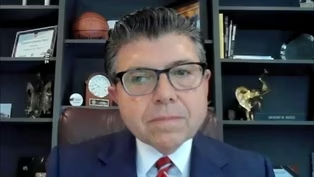
Sen. Anthony Bucco Discusses the Cost of Clean Energy
Video has Closed Captions
Clip: S6 Ep23 | 9m 43s | Sen. Anthony Bucco Discusses the Cost of Clean Energy (9m 43s)
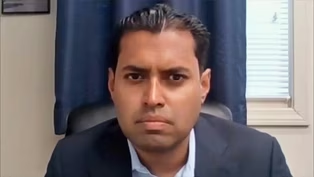
Sen. Vin Gopal Addresses the New Public School Curriculum
Video has Closed Captions
Clip: S6 Ep23 | 8m 40s | Sen. Vin Gopal Addresses the New Public School Curriculum (8m 40s)
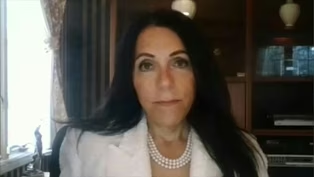
Seton Hall Law Professor Addresses Vacancies in our Court
Video has Closed Captions
Clip: S6 Ep23 | 10m 27s | Seton Hall Law Professor Addresses Vacancies in our Court (10m 27s)
Providing Support for PBS.org
Learn Moreabout PBS online sponsorship
- News and Public Affairs

Top journalists deliver compelling original analysis of the hour's headlines.

- News and Public Affairs

FRONTLINE is investigative journalism that questions, explains and changes our world.












Support for PBS provided by:
State of Affairs with Steve Adubato is a local public television program presented by NJ PBS