One-on-One
Paule Turner; Christine Girtain; Aly Maier Lokuta
Season 2023 Episode 2576 | 27m 44sVideo has Closed Captions
Paule Turner; Christine Girtain; Aly Maier Lokuta
Steve Adubato welcomes Paule Turner, Chair of the Department of Theater and Dance at Rowan University, to explore the power of dance; Christine Girtain, a Science Teacher at Toms River High School, discusses her plans for the next year; Aly Maier Lokuta, Senior Director of Arts & Well-being at the New Jersey Performing Arts Center, shares how the arts contribute to our well-being.
Problems playing video? | Closed Captioning Feedback
Problems playing video? | Closed Captioning Feedback
One-on-One is a local public television program presented by NJ PBS
One-on-One
Paule Turner; Christine Girtain; Aly Maier Lokuta
Season 2023 Episode 2576 | 27m 44sVideo has Closed Captions
Steve Adubato welcomes Paule Turner, Chair of the Department of Theater and Dance at Rowan University, to explore the power of dance; Christine Girtain, a Science Teacher at Toms River High School, discusses her plans for the next year; Aly Maier Lokuta, Senior Director of Arts & Well-being at the New Jersey Performing Arts Center, shares how the arts contribute to our well-being.
Problems playing video? | Closed Captioning Feedback
How to Watch One-on-One
One-on-One is available to stream on pbs.org and the free PBS App, available on iPhone, Apple TV, Android TV, Android smartphones, Amazon Fire TV, Amazon Fire Tablet, Roku, Samsung Smart TV, and Vizio.
Providing Support for PBS.org
Learn Moreabout PBS online sponsorship- [Narrator] Funding for this edition of One-On-One with Steve Adubato has been provided by The New Jersey Education Association.
The Turrell Fund, supporting Reimagine Childcare.
Horizon Blue Cross Blue Shield of New Jersey.
Here when you need us most, now and always.
RWJBarnabas Health.
Let'’s be healthy together.
Summit Health a provider of primary, specialty, and urgent care.
The Healthcare Foundation of New Jersey.
PSE&G, committed to providing safe, reliable energy now and in the future.
Newark Board of Education.
And by PSEG Foundation.
Promotional support provided by Meadowlands Chamber.
Building connections, driving business growth.
And by New Jersey Monthly.
The magazine of the Garden State.
Available at newsstands.
- This is One-On-One.
- I'm an equal American just like you are.
- The jobs of tomorrow are not the jobs of yesterday.
- I'’m hopeful that this is the beginning to accountability.
- Life without dance is boring.
- I don't care how good you are or how good you think you are, there is always something to learn.
- I did do the finale, and guess where my trailer was?
A block away from my apartment, it couldn'’t have been better!
- People call me 'cause they feel nobody's paying attention.
-_ It'’s not all about memorizing and getting information, it'’s what you do with that information.
- (slowly) Start talking right now.
- That's a good question, high five.
(upbeat music) - You can find me vogueing down the double-yellow lines that divide the extraordinary from the norm.
I am walking like a lion in full-throttle Because I found God in myself and I love her fiercely.
- You were just looking at Groove.
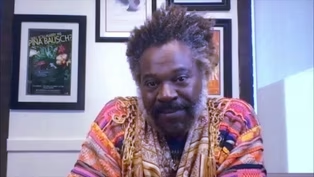
And that is a performance that also Paule Turner the associate professor and chair of the Department of Theatre & Dance at Rowan University, one of our higher ed partners is in.
Paule, how are you?
- Good, really good actually, I love this weather today.
- Yeah, we are taping in the late fall 2022.
It'll be seen a little bit later.
It'll probably be snowing by the time this is seen.
Let me ask you this, Paule, can we go back a little bit before we talk about your work at Rowan?
You're born and raised in Richmond, Virginia, if I'm mistaken, right?
- Yes.
- You get to Philly at what point?
- I came to Philly in 1994.
Right, out of undergraduate school I came to Philadelphia.
I wanted to live in Philly and therefore I moved here and then I continued my education in Philadelphia.
- And you become an active member of the Philadelphia Dance Community in 1994 to 2006, top 25 to watch in Dance magazine in 2020.
You were known as Philly's most quote Madcap movement artist.
But I gotta ask you this, you got a great quote here that Abi, our producer shared with me, I wanna share with you.
"They didn't know what to expect from me.
I could have looked at my situation being young, Black, gay performer a young Black and gay performer as three strikes, but since no one could clearly define any one of those three, it gave me power to constantly keep everyone guessing."
Sir, please explain that 'cause that is a motivating message for everyone.
- Yes, as I often talk with my students I communicate to them that art is about a point of view and always working to shift that point of view all the time.
And like I said in the quote, all of these things could have been thought of as x's against what I'm trying to do.
But since they aren't clearly defined by anyone therefore gave me lots of space to constantly show my point of view and proceed in what I was doing.
As an artist, I feel like I always wanna keep people guessing.
Never, because that's the point of modern art.
The moment that it becomes an accepted symbol you must challenge it.
- There's gonna be a graphic up right now that identifies a series that's been launched just recently, called The Arts Connection.
See the graphic up go on our website to find out more about past editions of The Arts Connection.
But I wanna ask you Paule, Dance, as part of the larger arts connection for you, at what age did the dance, it's not a bug, but a thing, when did it hit you and how?
- In 10th grade in Richmond, Virginia in high school, my art professor, teacher, visual art teacher decided to take us on the field trip to VC Virginia Commonwealth University where we watched a rehearsal going on with a duet with two students and renowned professor Chris Burnside.
And it was from that moment at first I was a little bit chuckled that you could major in dance at the university, how ridiculous.
But then I saw these two and I just thought as ridiculous as it sound, I found what I was gonna do.
And then they gave me tickets to that evening's performance.
I sat in the front row, I skipped all the way home, so excited as a high school student figuring out, oh, this is what I wanna do and it's been ever going, ever since.
I would say that at that concert there was a young African American dancer Reginald Ellis Crump who became my mentor, dear friend, my inspiration.
But I saw him perform, create as well as perform in faculty work and student work.
And I was just I knew right then exactly what I wanted to do.
- First of all, thank you for sharing that very personal side of you.
Well, but I'm curious about this.
Our daughter is 12 and into dance, I mean, loves it and I've watched her grow.
But it's highly competitive.
Meaning she wanted to be part of a competitive who's got the medals, I've got my own view on that, but that's another story.
But I'm thinking about your students, at Rowan, you and your colleagues in your department are not about competing, but go ahead, 'cause I can see you shaking your head already, because I tried to tell her daughter, "It's not about the medal."
Help all of us understand that the arts connection, the arts, particularly dance not about the medal.
- Well, I don't hate on anyone's hustle.
So therefore, there is dance as sport.
And here at the university there's where that distinction comes in of when you compete you're sport.
When you're not competing, you are as we would say, exploring dance as art.
And they're both valid.
And they could also with a very informed point of view, can intersect.
I mean, as Martha Graham says, "We are athletes of God."
And so, there is that sense of physical and also what dancers are, your competition is with yourself.
You can only get better.
You can only get better by doing.
So we don't sort of shine light or lesser on one than the other.
But making sure our students are clear on what they want to do.
We have a number of students who've danced with the New Jersey Devils, the Eagles, as well as aiming for the Rockettes and or managing Alvin Ailey, working in their public relations office.
So it's about both.
You can have both 'cause I think you compete with yourself, but we are here to evoke response.
No medal, response.
That's the only thing we can aim for is reaction.
So I'm curious about this.
At Rowan again, one of our higher ed partners, the place for, Professor, the place for dance in higher education particularly going into three years of COVID.
I think there should be really clear consideration of why would you study dance and other art forms at the university level.
It has to be beyond getting into shows, because there's a whole nother method of that.
You can get in line in New York, Atlantic City, everywhere for that.
So we're here to mine the intellectual pursuit of what we're doing.
There's more jobs within our field besides center stage.
And there's the creators, the curators, the producers the stage managers, all of those spaces.
COVID to a certain degree was a blessing.
- How so?
- Well, we had to start listening and seeing differently which is very powerful for artists to practice.
And when things stay the same, we lose that skill.
Change is important, but the most difficult and as artists, we need to explore that constantly.
So the universe, the atmosphere was helping us with this.
We did not stop.
We kept creating, we were producing- We did visual performance- I'm sorry, virtual performances.
We all became amateur film artists with classes.
I saw our students dancing in garages, bathrooms, kitchens, bedrooms.
Again, here's our art students exploring space and also being at home, you had to rely on what you knew and understood to translate through that screen.
Again, getting the artist to think and not just rely on external.
So it was a very powerful time and I'm constantly urging our students to remember this, remember what we learned from it - Paul, I wanna thank you for joining us.
Paule Turner is associate professor and chair of the Department of Theatre & Dance at Rowan University.
Professor, I cannot thank you enough.
You honor us by your presence.
Thank you, sir.
- Thank you so much.
I really enjoyed talking with you.
- You got it, stay with us, we'll be right back.
- [Narrator] To watch more One on One with Steve Adubato find us online and follow us on Social media.
All right, folks.
Jacqui Tricarico, the executive producer of Think Tank and Remember Them joining me down in Atlantic City for the NJEA, that's the New Jersey Education Association Convention.
Jacqui sat down with Christine Girtain from Toms River, a teacher there.
She is the New Jersey Teacher of the Year.
And here's Jacqui.
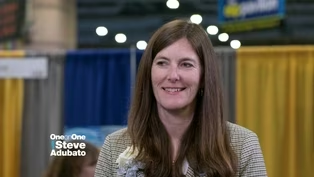
- Hi, I'm Jacqui Tricarico, on location at the NJEA Convention in Atlantic City, and so honored to be joined by Christine Girtain who is this year's NJEA State Teacher of the Year and a science teacher in Toms River.
It's so nice to meet you.
- It's nice to meet you.
- Thank you so much for taking the time to chat with us here at the convention.
Talk about your passion for science and STEM, and how that has evolved over the years, teaching for so many years in Toms River.
- Sure, I started off teaching biology and earth science, and I taught earth science for about 22 years.
And then I had the opportunity to learn about doing research with students, and I was the first research teacher at Toms River High School South.
And now, I teach research at both Toms River High School South and Toms River High School North.
When I get to speak with the students and really hear their interests, and then also get to expose them to possibilities that they don't even know are possible is really when you see that a-ha moment and you see them get excited about something new that they didn't know existed and that they didn't even know that they would like.
So for me, that is a powerful place to be, to be able to have that ability to open doors for them and to be able to give them more choices so that they can really experience who they can become.
- Your students, I've seen some video clips of them, especially after you won NJEA Teacher of the Year, talking about you.
They refer you as Mama G, right (laughs)?
- Yeah (laughs).
- And you could just tell how much they love you, and appreciate you, and respect you in the community.
How does that make you feel?
- It's great, it is.
And it's hard when they graduate, right?
Because they leave and they are my children, right?
But (laughs) it's a special, sorry, it's a special relationship with those kids because I teach them for three years, and when I taught earth science, I taught them for four years.
It was really special to teach my daughter's friends because she just graduated.
So that group of kids that graduated last year was amazing.
I knew some of them since kindergarten, and that's a bond that you don't usually have with individuals.
And I've had a lifetime with some of those kids.
They, you know, they call me when there's exciting things.
One of my students, Grace (indistinct), she's going to get her PhD, and she's originally from Nigeria.
So she got engaged and she messaged me and said, "You know, be prepared.
You're going to your first Nigerian wedding."
(Jacqui laughs) So those types of things - How fun.
and being able to share that with them, their lives and then also what they're becoming, you know, she's getting her PhD in psychology, and is going to herself, then, influence so many other people.
- I'm sure that just makes you so incredibly proud.
And having those students reach back out to you after graduation just shows how much you were dedicated to them and how much they wanna still involve you in their lives and their big moments.
It's so incredible.
Talk about too, creating opportunities for your students.
I know you've been able to do that in some really unique ways, including traveling to Costa Rica and Europe.
Can you talk about some of that?
- Sure.
So it's predicted that we'll run into a lot of antibiotic resistance by 2050, and working with Seeds of Change, which is a group that is working with the University of Wisconsin-Madison and then also the University of Costa Rica, we were able to bring 17 students, three of which were underserved students that were sponsored by a private funder, the Grunin Foundation, down to Costa Rica so that they could do hands-on research with leaf-cutter ants and the fungus that they farm.
The ants don't have any cases of antibiotic resistance and so, we're looking to them as a model and also looking to insects to be able to find new antibiotics to be able to, you know, offset disease not only in humans but also in crops and in livestock, because it's an issue as far as feeding and fueling the world in the future.
- Talk about feeding and fueling the world in the future.
I know you've said as teachers, it is part of your responsibility to make sure that your students' basic needs are met.
And during this time, you know, post-pandemic and during the pandemic, food insecurity was such a huge issue across New Jersey, across the nation.
How important is it to you to spread that message to make sure that teachers are looking past just the classroom, to make sure that your students are getting taken care of and helping them in those other areas of their life?
- Sure.
They can't learn if their basic necessities are not being provided for, and food is a necessity for life.
When you have students in your classroom that don't have that food, you can't concentrate, then, on homework or, you know, inspiring them to do some project that's after school because they haven't even eaten.
So addressing the food insecurity not only for our individual students but also in what is, like, causing that to happen, right?
Is it, you know, not having sustainable jobs, or not creating a sustainable workforce, or, you know, in the future, not having, you know, food being supplied.
We need to make sure that the students are learning that connection to their food, the high-tech and high-paying jobs that are in agriculture, because there's so much science involved in it.
And that was really new to me in the last two years and I got to connect with Nourish the Future, and then also a program called On the Farm.
So the National Corn Growers Association, the American Soybean Board, they both sponsor Nourish the Future.
And it educates teachers that aren't agricultural teachers to incorporate agricultural themes into their regular science classes, so that when you're teaching about antibiotic resistance students realize that there's diseases in crops and diseases in plants that they could be investigating and, you know, researching for their projects or even just to, you know, learn more about and have a connection to their food.
Most of us don't realize that popcorn's a whole separate plant than sweetcorn, especially in Jersey because we're the ninth largest producer of sweetcorn in the country.
And so when we see corn, you know, we think that's the corn on the cob that we're eating.
And sometimes it's popcorn growing in a field and sometimes it's, you know, field corn growing in a field.
I didn't know those things two years ago and if I don't know these things to pass on to my students, then they don't know them.
- And you touched upon job creation, job security, and just, job opportunity.
STEM being one of the several fields in our area in New Jersey, the tri-state area, where it can really give your students great opportunities for fantastic jobs after graduating high school and going on to college.
How important is that to you to spread that message, to get kids really engaged and excited about the STEM fields?
- I love that.
I love to teach them micropipetting and introduce them to biotechnology.
And we have large corporations in New Jersey that I would love to partner with to be able to reach more students and do more things across the state, so that we are, you know, building that sustainable pipeline of students that then stay in New Jersey for those biotech jobs.
I think that's super important.
- Yeah, great for the economy here in New Jersey and around our area.
And being named the NJEA State Teacher of the Year first, what was that like for you?
- It was crazy.
And I have to say I really wanted it.
I definitely, I wanted to have a voice.
I wanted to be able to speak with people like you and to be able to create change, right?
And be able to, just, not only make opportunities for the students that I teach, but for the other teachers that I teach with, you know, the county teachers of the year.
Those are great teachers that have all been recognized in each of their counties as superior educators.
And having them to work with, and being with that cohort, and being able to accomplish more across the state is pretty powerful.
So I really look forward to, like I said, having a voice and being able to make those networking connections so that, you know, our vision for education becomes more powerful when we work together.
- Beautifully said.
Thank you so much for taking the time to chat with us, and congratulations again on becoming the NJEA State Teacher of the Year this year.
- It's pretty cool.
I won't lie.
(both laughing) - Thank you so much, Christine.
- [Narrator] To watch more One on One with Steve Adubato find us online and follow us on Social media.
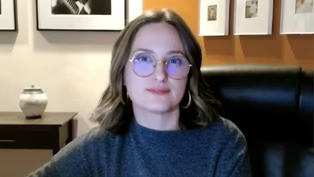
- We're now joined by Aly Maier Lokuta, who is Senior Director of Arts and Well-being at NJPAC, New Jersey Performing Arts Center.
Good to see you, Aly.
- Thank you for having me.
- Aly, is it not a fact that you told our producer, Georgette, that quote, "The arts are good for our health?"
And if so, what exactly does that mean?
(Aly giggles) That is a fact.
I think anecdotally, kind of instinctually, we can all think about a time where engaging with the arts made us feel good.
Whether that's going to see a play or a concert, going to a museum, or even singing in the shower.
But now there's research and evidence that points to physical and mental health benefits of the arts.
For example, going to a museum or concert just once or twice a month, can lower depression in adults by 48%.
- Along those lines, I'm curious about this, because COVID, we're doing this program in late 2022, be seen a little bit later.
The level of isolation that people have experienced is just extraordinary.
But, and the arts were delivered in all kinds of ways, virtual, hybrid, all kinds of ways.
Connect the issue of the arts with isolation and loneliness for people, please.
- Well, the arts are a great salve to loneliness.
The arts offer pathways to connection, communication.
They bring us together and help, help us understand what each other are going through and what we're feeling.
They can help us process grief.
The arts have been used immensely with healthcare workers for example, over the past two years, to help them with burnout, stress, and, and grief processing.
And they can be helpful in our communities too in social justice issues to bring- - How so?
How so?
- Bringing people together to have tough conversations using the arts as a pathway to understanding.
When folks engage using the arts, it's often through messaging that's culturally relevant and responsive, helping us understand, and understand one another's perspectives.
- Along those lines, to Aly and her team, along with John Schreiber, the, the leader at NJPAC, there've been so many conversations around tough issues.
There was a series just took a few years back, around police relations in the minority community.
Tough, important, substantive, forget about timely, 'cause unfortunately it's always timely.
That's what you're talking about, isn't it?
And, and people say, "Well that's not the arts."
It is.
- And this, some people don't think this is the arts.
It is.
Go ahead Aly.
- It is, it's the arts, and it's arts in health, which is a broader field that this work is a part of, whether that's social justice, health communication, arts in healthcare, or arts in our communities.
It's part of a, a broader conversation, and a field of study now that points to the evidence of its benefits.
- Talk about our kids, arts education, and the wellness issues that you're talking about for particularly for young people.
- Well, it's imperative right now that we get the arts, and we have students able to access the arts in schools.
We really see arts education as a public health issue.
The data now points to engagement in the arts being able to reduce social isolation and loneliness in adolescence and youth, reduce depression.
And as we see the facts and figures of the impact of the pandemic on our students, it's more important than ever that we give our students these outlets to connect with one another and to process what they've been going through.
- Aly, I wanna talk about social prescribing just a minute.
But do this for us, because it's the first time you've joined us.
I wanna make sure people understand.
Where do you come from originally, and how did you get into this field?
- Sure.
So I'm a visual artist by practice, a photographer, an undergrad.
And I discovered this field through the University of Florida Center for Arts and Medicine, which has a master's program at this intersection.
So I have an MA in arts and medicine, studying the- - One second.
Arts and medicine?
It's a concentration?
It is.
- It is, yes.
And it's a - And then how, Go ahead.
'Cause I'm curious as to how we get you at NJPAC.
- So I moved to New York, well I've moved back and forth to New York a couple of times, but most recently in 2019, when New York City Health and Hospitals was starting their arts and medicine department, and was the arts program manager and assistant director of that program.
- And then recruited you into NJPAC, correct?
- Yes, that's correct.
- What is "The Social Prescribing Program?"
- So this is a really innovative program that allows doctors, physicians, community health workers, to prescribe things outside of their normal clinical services, and connect people with their social needs in their community, and in particular arts and culture.
So we're developing a pilot with our partners at RWJ Barnabas and the Horizon Foundation of New Jersey, to enable their providers to prescribe arts to their patients.
- And the impact of such a program is, - We'll be looking to measure it.
What we know is that this provides pathways to care.
It provides folks with an opportunity to engage with creative activities in their communities where they are.
If we know that, for example, attending a, a concert or museum can reduce your risk of depression, or reduce your risk of hypertension, then by prescribing people free tickets to those things, we can reduce the incidence of that in the community.
- It's so interesting.
People, again, I'm not in any way being critical of prescribing medication, but it's not the only way to deal with some of the issues that Aly's talking about.
To you, Aly, to our longtime friends and colleagues at New Jersey Performing Arts Center, downtown Newark.
Check it out.
Make sure we put up the website.
Make sure the website has been up in post-production so people can find out not only about the programs going on, arts education efforts, but also the performances that go on there.
If I'm not mistaken, the recent 25th anniversary of NJPAC.
Is that correct?
- Yes.
Our 25th Anniversary.
- I saw the picture of Savion Glover, who was a little kid.
Talk about a great dancer.
Talk about a great artist.
That was a, he was a little kid there, first night, and then he was there for the 25th.
Anyway, that's too inside.
I wanna thank you so much for joining us, Aly.
Wish you and the team at NJPAC all the best.
- Thank you so much, Steve.
- You got it.
That's Aly, I'm Steve.
Thanks for watching.
See you next time.
- [Narrator] One-On-One with Steve Adubato has been a production of the Caucus Educational Corporation.
Funding has been provided by The New Jersey Education Association.
The Turrell Fund, supporting Reimagine Childcare.
Horizon Blue Cross Blue Shield of New Jersey.
RWJBarnabas Health.
Let'’s be healthy together.
Summit Health The Healthcare Foundation of New Jersey.
PSE&G, Newark Board of Education.
And by PSEG Foundation.
Promotional support provided by Meadowlands Chamber.
And by New Jersey Monthly.
- (Narrator) New Jersey is home to the best public schools in the nation, and that didn't happen by accident.
It's the result of parents, educators and communities working together year after year to give our students a world class education.
No matter the challenge, because parents and educators know that with a shared commitment to our public schools, our children can learn, grow and thrive.
And together, we can keep New Jersey's public schools the best in the nation.
How and Why the Arts Contribute to Our Well Being
Video has Closed Captions
Clip: S2023 Ep2576 | 8m 37s | How and Why the Arts Contribute to Our Well Being (8m 37s)
How Dance Can Challenge our Point of View
Video has Closed Captions
Clip: S2023 Ep2576 | 9m 49s | How Dance Can Challenge our Point of View (9m 49s)
NJ Teacher of the Year Discusses her Future in Education
Video has Closed Captions
Clip: S2023 Ep2576 | 9m 46s | NJ Teacher of the Year Discusses her Future in Education (9m 46s)
Providing Support for PBS.org
Learn Moreabout PBS online sponsorship
- News and Public Affairs

Top journalists deliver compelling original analysis of the hour's headlines.

- News and Public Affairs

FRONTLINE is investigative journalism that questions, explains and changes our world.











Support for PBS provided by:
One-on-One is a local public television program presented by NJ PBS