
Paying It Forward
Season 8 Episode 3 | 26m 48sVideo has Closed Captions
Host Angela Fitzgerald tours the Goodman Community Center, and share a variety of stories.
Host Angela Fitzgerald tours the Goodman Community Center, a vibrant neighborhood hub on the east side of Madison. She joins in on several activities at the center, all housed within two revitalized historic buildings. We also travel the state to share an array of experiences and stories.
Problems playing video? | Closed Captioning Feedback
Problems playing video? | Closed Captioning Feedback
Wisconsin Life is a local public television program presented by PBS Wisconsin
Funding for Wisconsin Life is provided by the Wooden Nickel Fund, Mary and Lowell Peterson, A.C.V. and Mary Elston Family, Leon Price & Lily Postel, Stanley J. Cottrill Fund, UW...
Paying It Forward
Season 8 Episode 3 | 26m 48sVideo has Closed Captions
Host Angela Fitzgerald tours the Goodman Community Center, a vibrant neighborhood hub on the east side of Madison. She joins in on several activities at the center, all housed within two revitalized historic buildings. We also travel the state to share an array of experiences and stories.
Problems playing video? | Closed Captioning Feedback
How to Watch Wisconsin Life
Wisconsin Life is available to stream on pbs.org and the free PBS App, available on iPhone, Apple TV, Android TV, Android smartphones, Amazon Fire TV, Amazon Fire Tablet, Roku, Samsung Smart TV, and Vizio.
Providing Support for PBS.org
Learn Moreabout PBS online sponsorship- The following program is a PBS Wisconsin original production.
- Coming up on Wisconsin Life : Meet a runner stepping up for her community, an artist bringing walls to life in rural Wisconsin, a teen skiing his way to success, and a maker of an unusual and touchless instrument.
It's all ahead on Wisconsin Life!
♪ ♪ - Funding for Wisconsin Life is provided by Lowell and Mary Peterson, Alliant Energy, Stanley J. Cottrill Fund, American Transmission Company, Focus Fund for Wisconsin Programs, and Friends of PBS Wisconsin.
- Hi, I'm Angela Fitzgerald, and this is Wisconsin Life .
Today, I'm checking out the Goodman Community Center, a non-profit offering accessible programming for all ages.
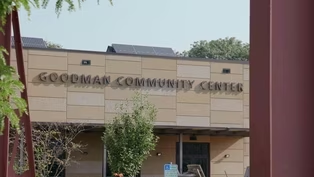
Sitting along the Capital City Bike Trails in Madison, the center is spread across two historic buildings.
The Brass Works building, once home to the only brass foundry in the area, and the Iron Works building, a former factory that's now bustling classrooms and communal meeting spaces.
The list of services provided here is overarching.
There's a free food pantry, activities for young adults, a fitness center, career resources, senior meet-ups, preschool and elementary programs, and the list goes on.
Partnering with local organizations brings additional opportunities like this mural.
Cultural Connections teamed up with the community center to bring artists and kids together to create works of art.
I'll help out with the mural later, and we'll get a chance to learn more about this organization's impact.
Let's go to Milwaukee to meet someone else serving their community by teaming up with others to go running together.
♪ ♪ ♪ Bust another move ♪ ♪ Get on down ♪ - Bust it!
- Okay.
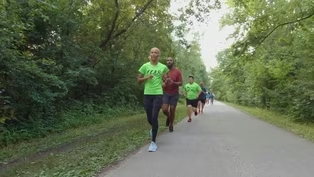
♪ Bust another move ♪ ♪ Get on down ♪ ♪ Bust another move ♪ ♪ Get on down ♪ We accept you-- any shape, size, running level.
Running level is very important.
People get really scared about coming out to run with us.
They're scared that they won't be able to keep up.
And we do a really good job of making everyone feel comfortable, making sure no one's left out.
No matter what type of person you are, you can join our group and run.
- ♪ Happy birthday, dear Tenia ♪ - Thank you.
- ♪ Happy birthday to you ♪ [cheers and applause] Yay, whoo!
- ♪ How old are you?
♪ - I think I would describe myself as an educator, a runner, and like a leader, motivator.
I'm really happy that we got to have some group.
Look alive, LOOK ALIVE!
[cheering] - Whoo, ay-oh!
- Thank you guys so much for riding it out with us.
This has been a very difficult season, of course.
[techno funk music] Recently, kinda of, like, an activist for creating safe spaces here in Milwaukee.
Even when I was growing up, I didn't see anybody that looked like me running long distance so I would sneak and try to be a sprinter, knowing dang well I had no business doing that 'cuz I'm not-- [laughing] I don't have that type of speed.
So, my coach would drag me over to the long-distance stuff and run that, and I end up being good at it.
I wanted people that looked like me running long distance, and they didn't.
So, I mean, I just had to suck it up and do it.
But imagine if a little girl, you know, sees a African-American woman running a 800, 1,500 that steeplechase, stuff like that, then they would, you know, they would think that they can do it.
Look at these baby panthers!
[laughs] So, today, on your run, I want you guys to think about how we are making change through F.E.A.R., through social acts, and I think the name "Forget Everything And Run" has taken like a new, like, meaning out.
This is our way of protesting.
This is our way of showing that we care about our bodies.
This is our way of showing that we can be united.
Those my people.
We're all each other's people.
♪ Baby, we holding each other ♪ - Whoo!
- I know running can be scary, and just because I used to run in college and all of this.
I have my bad days, too.
I'm no longer that fast anymore.
[laughs] No, but seriously, like, there are all type of people here.
Seriously, all type of people and even if you don't like running, if you wanna come because you think somebody is cute, that is fine.
I don't care!
Just come run a little bit first.
Literally, all you need is shoes, and we dang near probably can help you with that.
If you really can't get it, I promise you I'll help you.
Hold me accountable.
I'll help you get some shoes.
So, that's it.
You don't need the cute outfit, even though that's a reward.
Like when you do run, you get to look cute.
That is a reward, but you don't need all that... ...for you to, you know, show up on a Tuesday or Saturday and step up and be like, "I'm about to just put myself out here.
I'm gonna run with these people."
You'll have a whole different respect for one another for sure.
There are some things that you can share with one another that you wouldn't experience with any other sport.
I've always said, like, I can try to change the world through running.
[joyful cheering] - Whoo, WHOO, yeah!
Visibility matters.
I say that all the time.
People need to see people of color running.
It shouldn't be this, like, crazy thing that you see.
With our running group, we are fighting to desegregate Milwaukee through running.
People could do it all types of ways, whatever way, but this is our way.
This is what's near and dear to my heart, and this is what is-- has affected me throughout my life.
Not seeing people that look like me running these long distances.
So, this is my way of trying to make change.
[piano melody] - Up next, we head to Butternut, where an artist shares her talents by creating realistic paintings on a large scale.
♪ ♪ [pounding] - If practice makes perfect... - I think, to date, I've painted 1,800 people.
- ...then Kelly Meredith has spent the last 35 years of her life brushing against perfection.
- And the longer I paint faces, the more I notice, you know, very little intricate details that I didn't know the day before.
I say that every portrait teaches me a little bit more about the human face or something about the human face I actually didn't know yesterday.
Really weird things like, you know, the ridge of your eyelid and, you know, how that all works together.
And so, every day, I pick up a little detail or a little piece of awareness, and it's just through the sheer repetition.
- Kelly paints realistic historic murals.
Lots of them.
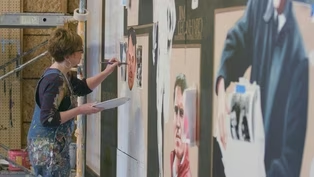
♪ ♪ To date, she's painted close to 128 small town murals across Wisconsin.
It's artwork that can take weeks or even months to complete.
- Once the piece is done and it's out the door, it's not mine anymore.
It's now-- it's the community's.
It's the people who interact with it.
I've always said, not that-- I don't have any kids, but I've always said it's kinda-- must be what it's like to send your child off to college.
You've done your work.
Hopefully, you've done a good job.
Now, it's up to them.
Now, they have to go and have a life of their own, and I feel like the pieces themselves have a life of their own.
Sometimes, I don't even feel like I belong to them anymore that they're-- they've even been done by me.
That feeling of separation helped Kelly complete her most challenging work, a nine-month installation at the Northern Great Lakes Visitor Center in Ashland, Wisconsin.
- I think it's 140 different species of animals, then like, maybe 72 different bugs and insects.
So every night, I would go and read about that particular animal or that particular bug and make sure what does it eat?
What eats it?
What is the appropriate environment?
And what size because everything has to be perfectly scaled?
I feel like I have a much better general anecdotal history of this area.
Simply because I've done so many historical murals.
I feel like I have a sense of, you know, how we got here?
What happened?
What was the boom and bust economies along the way?
How did they shape things?
How did they shape the people?
How did they shape the community?
I have all that because I had to do all this research.
- Kelly's efforts haven't gone unnoticed, especially by the people her art really highlights.
- I have two people that have passed away in my life: my brother, who was very young.
He was 21.
All my brothers and sisters said, "Yes, let's do that."
They chipped in and had purchased a space for him, and then, my son actually is on the mural.
Donna Kurilla: Just so appreciative all of us here at the center are that she was-- all the work that she invested and the time away even from the center.
She did so much research on this project, and she really got it right, and she wanted to make sure she got it right, too.
She wanted to include every animal and plant that was in this area and tell the story of the Chequamegon Bay.
- And for many, Kelly has gotten it right.
With each stroke of the brush, she adds another detail that just wasn't quite there before.
- So, much of this-- of what I do are people's relatives.
You sponsoring somebody that you care about.
Whether it's a veteran or it's a waitress, and so, oftentimes, it's people who aren't famous, aren't well known.
That's very emotional, and it means a lot to people and, you know, people plan family reunions around these things and so, no, it's a big deal.
It's work that honors my life, too, so.
- Work that Kelly hopes honors the lives that it's meant to illustrate the most.
- I hope that when you finally see your dad or your mom up there that you just have a sense of relief that you have this finally, you know, finally, they got something.
Finally, they're not invisible.
Finally, they're real.
Finally, they have a story.
Finally, they exist.
I think that's the biggest thing so that people don't feel invisible like they never existed in the first place, and I think most people harbor that.
I think that speaks to peole so...
So, yeah, relief.
I hope you feel relief and closure.
- I'm in Madison learning more about the activities and work happening at the Goodman Community Center.
Nestled in the streets of Madison along the Capital Bike Trail is a thriving neighborhood hub, the Goodman Community Center.
To learn about the wide range of programs offered here and their impact, I met with Letesha Nelson, CEO and Executive Director.
- So, our mission for the Goodman Center is to change lives and secure futures, and how we do that is with an array of programs, from our littlest ones starting at three years old all the way up to our oldest adults which we have some older adults that are 80 and 90 who come here and spend time at our center.
- Can you expand a little bit more on the programs you offer and, like, how they kind of span the lifespans?
- Yes.
So, we have our early childhood program, which we have three, fours, and fives that are in.
We also have after-school programming that's happening every single day during the school year where the kids come, and they do lots of activities and go on field trips and things like that.
Then, you get over to this building which houses all of our teenagers.
Then, you get to our older adults.
- Mm-hmm.
And our older adults are doing anything from yoga to health awareness, diabetes classes, things like that.
We also have a gym, and then, they also have, which we've just started back is a senior lunch period where they come in and they get to mingle with each other and see each other.
They love on each other, too.
It is an amazing thing to see.
So, that's a lot of the programming that we do here.
- Very nice, and I understand that all of these beautiful programs that you've described are supported in part by your volunteer base.
- Oh, yes.
- Can you tell us about your volunteers?
- We have a lot of volunteers that come to work from our food pantry into this space over here with our youth.
We have 'em reading to children, and they do different little handy things around the building with us.
Programming here is expansive, especially for young adults with goals to set them up for a successful future.
- So, my name is Alejandra, and I'm the assistant director of youth programs here at Goodman's and our middle school program, and all of our programs in the teen center are focused around four themes, which is health and wellness, community engagement, STEM, and culture and identity, and we take all of these themes with an SEL and trauma-informed care approach.
So, SEL is social-emotional learning and really, the goals for all of our youth is so that they have a broader vision for their future.
We really just want to expand those opportunities while they're in middle and high school.
= Wow, I love that.
That kind of, like, 360 sort of level of impact that you all see is happening as a result of the programs that you offer up positive impact that extends to anyone who walks through the doors here.
- My favorite thing about Goodman is being a place where it's a one-stop shop for a family that is in need and it doesn't matter what that family looks like.
- So it really is about community in the truest sense.
- Yes, yes, very much about community.
Very much about being in a space where everybody gets their needs met.
If we don't have what they need, then we go out and find it, or we know someone who knows where to get it, and so, Goodman is super reciprocal in giving the love and getting it back and giving the love and getting it back.
- It's a great example of community service in action, serving both young and old.
Now, let's meet someone else serving up their talent.
We now travel to Chippewa Falls, where a teen sets his sights on competing in the world championships.
♪ ♪ [class bell rings] In the halls of Chippewa Falls High School, Ty Wiberg is on a mission.
- Todos son muy curiosos, ¿no?
- Sí.
- Sí.
- Ty is starting the final semester of his senior year and studying Spanish.
[laughing] - i¡Esa es una oportunidad fantástica!
- In any language, the past year for Ty has been filled with fantastic opportunities.
Because of what he's done out here.
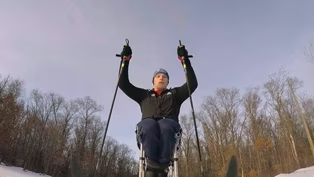
[click] [skis brush against snow] Ty competes for the Chippewa Valley Nordic Ski Team, sometimes practicing more than five nights a week.
- Come on, Ty, you got five seconds.
Go, go, go!
- So, if I'm going really hard, I'm thinking about just speeding up my stroke and just tell myself, just pull, pull, pull.
Or sometimes when I'm on a nice, easy ski, it's just kinda thinking about, you know, what am I gonna have for dinner tonight when I get done with practice.
Most nights, there's not a lot of time to think about dinner.
- Way to go, Ty.
- Because Ty has been training for the US National Championships.
- So, it's kind of a tough practice just to get those quicker sprints in to get me ready for a couple of the races I'm doing.
- Qualifying for nationals was a big deal for Ty and his parents.
- This is kind of amazing because he just got into Nordic within the last couple of years and to be competing in Utah at a national level.
[skis gliding through snow] - However, that competition would open the door for the unexpected.
- The coach for Team USA pulled me off to the side, and she asked me, "Ty, do you have a passport?"
And I looked at her a little puzzled, and she's like, "Well, you're going to Germany."
It took a second for it to register, and I was like, "Are you serious?"
- Team USA selected Ty to be part of their national development team.
The news spread quickly.
From that moment, Ty could feel the support of family and community at every turn.
- Keep that spirit up.
- Thank you.
It's a really cool experience to see that community behind me.
See all the people that are supporting me, even people that I've never met before.
- Get 'em, get 'em, get 'em!
- For his first international competition, Ty kept his aspirations simple.
- My goal is to go out there, have as much fun as possible, and soak up the environment.
I'm just gonna measure success by skiing my hardest.
I'm just looking forward to, obviously, skiing against the best in the world.
- Skiing for Team USA is quite an accomplishment for this Wisconsin teen born with spina bifida.
- So when I was born, my spinal cord was outside of my back so it affects all of the nerves below that.
I don't have control over my legs.
So I don't have feeling in my feet.
- Al Wiberg: That shock, I remember that day specifically when we were sitting in the doctor's office and they said that and then when we're traveling down to Mayo Clinic, it was actually 9/11.
And they're all telling you all these worst-case scenarios.
- Michele Wiberg: It would be very easy to make a million and one excuses as far as, "I can't do this because I have spina bifida.
I can't do this because of my disability," and instead, he says, "Well, maybe I just had to find a different way to do it."
- I had to overcome a lot of stereotypes having a disability and then, even just the challenges of trying to find ways to adapt the sports.
- At the World Championships, Ty's winning attitude paid off.
Not in a first-place finish or spot on the medal stand.
For Ty, it's about so much more.
- I didn't place super high, but my times improved a lot.
That's kind of all that mattered for me, and I was super happy placing where I did.
It was the best I had felt finishing last.
It showed me how much harder I need to work.
I definitely came back motivated, motivated more than ever because it's an attainable goal now.
- Michele Wiberg: And I think the best part about Ty, he just embraces who he is.
When people ask him, "If you could take away your disability," he would say, "Absolutely not."
He said, "My disability doesn't define me, but it is who I am and I would not be where I am today if it weren't for my disability.
- Ty Wiberg: I'm being noticed for my hard work, and it's just a great feeling.
If you wanna do something, go out and do it because you can't let anyone tell you differently.
Ty Wiberg is determined.
Ty Wiberg is tenacious.
- Our last story takes us to Mukwonago, where a craftsman creates a unique instrument that is played without touch.
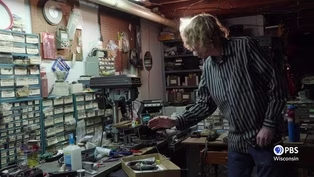
[ghostly theremin music] - Charles Collins: I started fixing musical instruments, amplifiers, and stereo equipment 35 years ago for a local store.
That had to go somewhere.
My name's Charles Collins, and I build theremins.
[sci-fi outer space theremin] The theremin is a musical instrument that you can play without touching it.
[theremin oscillates eerily] You don't find the theremin; the theremin finds you.
♪ ♪ [quivering high-pitched opera-like theremin] A person named Leon Theremin invented it back in about 1919, 1920.
[film reel static] [frightening theremin, heavy breathing] It's just a creepy sound that every B-movie had back in the '50s.
[ominous theremin] When the monster comes out, he always had a theremin.
- Actor: It's unbelievable.
[fearful breathing] - You listen to that, you gotta have one.
[heavy breathing] I was able to find one at a swap meet, and the guy thought it was a burglar alarm that didn't work very well.
It was fascinating, and I thought, "You know, other people would like this.
Maybe I could make a cheap one."
And it took off from there.
[futuristic squawking] There's the monster.
I've sold over 10,000 in 25 years.
It operates with two radio frequency oscillators mixing together to form a third frequency, which has an audio tone.
[ascending notes, then siren] Theremin has two circuits: one being the pitch circuit and the other is the volume.
This is the pitch antenna, and the note gets higher as your hand comes nearer to it.
[high-pitched saxophone-like sound] This is the volume antenna, and as your hand gets nearer to that, the pitch gets quieter until you can't hear it.
[sound waivers between audible and silent] It's essentially a pretty simple circuit.
It's still challenging-- It can be-- When things don't work quite right, there's a reason, and sometimes that reason can be very elusive.
['needle scratching a record' theremin] I started 25 years ago.
I didn't want to work in a factory, so I essentially made my own factory.
I haven't gone mad.
[funky music] There could be other worse things to do.
You're finally done making one, and it works, and it's going in the box and being sent out to the person.
That is the best feeling.
♪ ♪ - We've met a lot of motivated people, including the folks here at the Goodman Community Center.
To learn more about the people and places you've seen today, visit Wisconsin Life dot org.
Or email stories at Wisconsin Life dot org if you have stories to share.
I'm Angela Fitzgerald and this is our Wisconsin Life .
Bye!
- Hi!
[tricycle pedals clanging] [children chatting] - Funding for Wisconsin Life is provided by Lowell and Mary Peterson, Alliant Energy, Stanley J. Cottrill Fund, American Transmission Company, Focus Fund for Wisconsin Programs, and Friends of PBS Wisconsin.
Angela Fitzgerald Visits the Goodman Community Center
Video has Closed Captions
Clip: S8 Ep3 | 3m 32s | Wis. Life host Angela Fitzgerald tours the vibrant neighborhood hub on Madison's east side (3m 32s)
Video has Closed Captions
Clip: S8 Ep3 | 5m 3s | Hall of Fame track athlete encourages folks to try running as a way to build community. (5m 3s)
Video has Closed Captions
Clip: S8 Ep3 | 5m 39s | Ty Wiberg is a teenage skier on a mission competing at his first world championship. (5m 39s)
Video has Closed Captions
Clip: S8 Ep3 | 4m 55s | Kelly Meredith spent the last 35 years painting historical murals across rural Wisconsin. (4m 55s)
Video has Closed Captions
Clip: S8 Ep3 | 3m 22s | Charles Collins builds theremins, an ethereal-sounding electronic musical instrument. (3m 22s)
Providing Support for PBS.org
Learn Moreabout PBS online sponsorship













Support for PBS provided by:
Wisconsin Life is a local public television program presented by PBS Wisconsin
Funding for Wisconsin Life is provided by the Wooden Nickel Fund, Mary and Lowell Peterson, A.C.V. and Mary Elston Family, Leon Price & Lily Postel, Stanley J. Cottrill Fund, UW...