Paying More, Getting Less | Carolina Impact
Clip: Season 13 Episode 1327 | 5m 37sVideo has Closed Captions
Charlotte families paying more for less as shrinkflation squeezes budgets and food banks.
Shrinkflation is hitting Charlotte families at the checkout line and at home. This story explains how products can look the same while quietly shrinking, why economists say shoppers often miss it, and how Nourish Up says the squeeze is pushing more working families into food insecurity while also cutting into the donations food banks depend on.
Problems playing video? | Closed Captioning Feedback
Problems playing video? | Closed Captioning Feedback
Carolina Impact is a local public television program presented by PBS Charlotte
Paying More, Getting Less | Carolina Impact
Clip: Season 13 Episode 1327 | 5m 37sVideo has Closed Captions
Shrinkflation is hitting Charlotte families at the checkout line and at home. This story explains how products can look the same while quietly shrinking, why economists say shoppers often miss it, and how Nourish Up says the squeeze is pushing more working families into food insecurity while also cutting into the donations food banks depend on.
Problems playing video? | Closed Captioning Feedback
Where to Watch Carolina Impact
Carolina Impact is available to stream on pbs.org and the PBS app.

Introducing PBS Charlotte Passport
Now you can stream more of your favorite PBS shows including Masterpiece, NOVA, Nature, Great British Baking Show and many more — online and in the PBS Video app.Providing Support for PBS.org
Learn Moreabout PBS online sponsorshipCharlotte families are feeling the squeeze at the grocery store, and it's not just because prices are higher.
In many cases, packages are getting smaller too, leaving shoppers paying more for less.
Carolina Impacts' Chris Clark takes a closer look at shrinkflation.
- [Chris] For a lot of Charlotte families, the grocery bill doesn't just feel higher, feels like the food runs out faster too.
In many cases, shoppers aren't just paying more, they're paying more for less.
- Just because the box is bigger doesn't mean that there's more in.
They're getting skinnier and taller.
- [Chris] It's called shrinkflation.
When products get smaller or packages hide less inside, while the price stays the same or goes up.
Product can still look familiar.
Even when the value has changed.
- The price goes up at the store, customers can respond, but if the packaging changes a couple ounces get cut, a lot of consumers might miss that.
- And that quiet change adds up.
According to the Bureau of Labor and Statistics, American households paid an estimated $8.6 billion more in 2024 for products that quietly got smaller.
M&M's are up 102% per ounce since 2020.
Frosted Flakes now cost 51% more per serving with fewer servings inside.
And products like chips, sports drinks, peanut butter, coffee and packaged cheese have all found different ways to give shoppers less while charging more.
Gatorade made it pretty obvious.
The bottle that people remember, that was 32 ounces.
Now it's just 28, so you're getting less right off the top.
And with these potato chips, the bag looks familiar, but Lay's cut it standard size from 10 ounces to eight.
And all that does is leave people paying more for less product.
This final example is by far one of the sneakiest.
And it's peanut butter.
That's right, peanut butter.
I mean the jar still looks the same.
So what's the big deal?
Well, if you check out the bottom here, it dimples in.
That's what takes it from 18 ounces in its original shape down to 16.3.
It gives companies a way to protect sales without drawing the same reaction as a straight price jump.
- If we raise a price that's really gonna hurt sales and revenue, but if instead, if we reduce packaging and the amount they're getting, we can keep revenue the same or maybe even higher through that mechanism.
So it's kind of, it's an indirect way to raise prices.
- [Chris] His advice is simple, shop by the numbers, especially with packaged foods.
- The number one step is to just, you know, look at the price per unit, you know, price per ounce or whatever it is.
And the other key thing to think about is that most of the shrinkflation happens in packaged goods.
- [Chris] And for families already stretched thin, even a small cut in size can become a big problem.
- It makes it difficult, especially if you have a family.
If you have a family now you gotta stretch it out a little bit more and if you don't have the money for it, then it could be real difficult.
- [Chris] This isn't just sticker shock.
For families already on a budget, it means harder choices about what goes in the cart and how long it lasts - The families that we serve, this is a critical impact for them.
If you are on a budget and you have X amount of dollars to spend on food and your dollars that you have allocated aren't buying, isn't buying the food that it's necessary to feed your entire family, that puts you between a rock and a hard place.
- [Chris] And sometimes it means shopping week to week, not because that works better, but because that's what the budget allows.
- I don't really try to go too heavy or anything.
I just try to go for like something for the week.
So a little pack of chicken that could last me for, you know, two, three days.
- When you are on a fixed income, you are shopping the middle aisles and for canned goods for non-perishable items, and most of those items are filled with fat, sugar, and salt.
And so if you have to really shop cheaply, then oftentimes you are buying food that's not all that nutritious for you.
- [Chris] And for some families, the squeeze goes beyond what kind of food they can afford.
It comes down to how much food they can afford to bring home in the first place.
- We like to say here in Charlotte that rent eats first.
And so we know far too many people that go to bed hungry every night in order to keep a roof over their head.
- [Chris] And it's not just hurting families, it's hitting food banks too.
- Our food drive donations have gone down drastically because a lot of middle class families when they were out grocery shopping historically, you know, if there's a buy one get one, you know, they would buy one and then donate the other one.
But when the middle class families are feeling the pinch, they too can't even donate regularly.
- [Chris] If the trend keeps going, it could threaten something Nourish Up has managed to avoid for decades.
- We've been in this business of feeding people for the last 50 years, and I knock on wood when I say it, but we've never had to turn anybody away because we ran out of food.
If numbers continue at this rate, if we continue to break records and not in a good way, I don't know how much longer we can continue that promise.
- [Chris] It's what makes shrinkflation more than a grocery store annoyance.
It's changing what families can afford, what they eat, and how much help food banks can provide.
And for Charlotte Shoppers, what looks familiar on the shelf may not be the same value once you get at home.
For Carolina Impact, I'm Chris Clark.

Charlotte’s Nature Legacy | Carolina Impact
Video has Closed Captions
Clip: S13 Ep1327 | 6m 25s | Charlotte’s natural spaces reveal a legacy of conservation, growth, and community. (6m 25s)
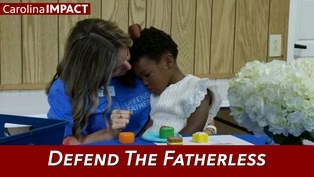
Defend The Fatherless | Carolina Impact
Video has Closed Captions
Clip: S13 Ep1327 | 7m 25s | Defend The Fatherless assists in Foster, Adoptive and Kinship care in York County, SC (7m 25s)
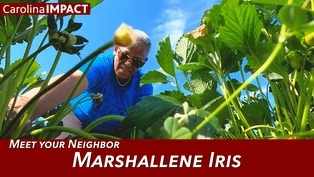
Meet Your Neighbor: Marshallene Iris | Carolina Impact
Video has Closed Captions
Clip: S13 Ep1327 | 5m 57s | Marshallene Iris pulls people in with her flavorful, handmade island jams. (5m 57s)
May 19, 2026 Preview | Carolina Impact
Preview: S13 Ep1327 | 30s | Paying More, Getting Less; Defend The Fatherless; Charlotte’s Nature Legacy; & Marshallene Iris. (30s)
Providing Support for PBS.org
Learn Moreabout PBS online sponsorship New Episode
- News and Public Affairs

Top journalists deliver compelling original analysis of the hour's headlines.

- News and Public Affairs

FRONTLINE is investigative journalism that questions, explains and changes our world.
 New Episode
 New Episode
 New Episode
 New Episode
 New Episode
 New Episode
 New Episode
 New Episode

 New Episode
 New Episode
Support for PBS provided by:
Carolina Impact is a local public television program presented by PBS Charlotte