
PBS NewsHour full episode December 6, 2017
2/28/2017 | 54m 10sVideo has Closed Captions
PBS NewsHour full episode December 6, 2017
PBS NewsHour full episode December 6, 2017
Problems playing video? | Closed Captioning Feedback
Problems playing video? | Closed Captioning Feedback
Major corporate funding for the PBS News Hour is provided by BDO, BNSF, Consumer Cellular, American Cruise Lines, and Raymond James. Funding for the PBS NewsHour Weekend is provided by...
PBS NewsHour full episode December 6, 2017
2/28/2017 | 54m 10sVideo has Closed Captions
PBS NewsHour full episode December 6, 2017
Problems playing video? | Closed Captioning Feedback
How to Watch PBS News Hour
PBS News Hour is available to stream on pbs.org and the free PBS App, available on iPhone, Apple TV, Android TV, Android smartphones, Amazon Fire TV, Amazon Fire Tablet, Roku, Samsung Smart TV, and Vizio.
Providing Support for PBS.org
Learn Moreabout PBS online sponsorshipJUDY WOODRUFF: Good evening.
I'm Judy Woodruff.
On the "NewsHour" tonight: DONALD TRUMP, President of the United States: My announcement today marks the beginning of a new approach to conflict between Israel and the Palestinians.
JUDY WOODRUFF: President Trump recognizes Jerusalem as the Israeli capital, breaking from decades of U.S. policy, drawing condemnation from many world leaders, and igniting calls for violence in the Middle East.
Then: A growing group of Democratic senators call on Senator Al Franken to resign, in the wake of new sexual misconduct allegations.
And we kick off a three-part series exploring Iran's rising influence in Iraq -- how the United States' trillion-dollar war has served its archrival.
MOHAMMAD MARANDI, Political Analyst: I think the reason why the Americans are so surprised at the amount of influence Iran has is basically because Iran has done everything that the Americans have not done.
JUDY WOODRUFF: All that and more on tonight's "PBS NewsHour."
(BREAK) JUDY WOODRUFF: Leaders of Arab and Muslim countries around the globe are warning tonight of disaster, while Israel's leaders are hailing President Trump's dramatic policy shift on Jerusalem.
John Yang begins our coverage.
JOHN YANG: It was a move long anticipated, and President Trump said, long overdue.
DONALD TRUMP, President of the United States: I have determined that it is time to officially recognize Jerusalem as the capital of Israel.
This is nothing more or less than a recognition of reality.
It is also the right thing to do.
It's something that has to be done.
JOHN YANG: He cited a 1995 law that called for recognizing Jerusalem as the capital, and moving the U.S. Embassy from Tel Aviv.
But while Mr. Trump today announced his intent to move the embassy, like previous presidents, he signed a waiver delaying that.
Israeli Prime Minister Benjamin Netanyahu quickly praised the decision.
BENJAMIN NETANYAHU, Israeli Prime Minister: President Trump, thank you for today's historic decision to recognize Jerusalem as Israel's capital.
The Jewish people and the Jewish state will be forever grateful.
JOHN YANG: In Jerusalem, many Israelis celebrated the news.
MAN: Trump's announcement is -- it's going to be very -- it is very important, and I think is a big celebration for Israel and especially for us, the Jerusalemites.
JOHN YANG: And Palestinians condemned it.
MAN (through translator): This topic assures how biased President Trump is with the state of Israel and how much he doesn't care about the Palestinians and the situation in the Middle East.
JOHN YANG: On the West Bank, protesters burned American flags and photos of Mr. Trump.
Palestinian President Mahmoud Abbas rejected the move.
MAHMOUD ABBAS, Palestinian Authority President (through translator): These denounced and rejected measures create deliberate constraints to all the efforts toward realizing peace and reflect the United States' withdrawal from practicing its role as a peace mediator.
JOHN YANG: In Gaza, militant leaders from the Palestinian group Hamas called it a flagrant aggression that opened the gates of hell.
Across the Middle East, key U.S. allies, including Turkish President Recep Tayyip Erdogan and Jordan's King Abdullah, warned of dire consequences.
RECEP TAYYIP ERDOGAN, Turkish President (through translator): Taking any wrong step regarding Jerusalem's status will cause public unrest in the Muslim world.
JOHN YANG: Egypt also blasted the decision, as did European leaders and the secretary-general of the United Nations.
ANTONIO GUTERRES, United Nations Secretary-General: Jerusalem is a final status issue that must be resolved through direct negotiations between the two parties.
JOHN YANG: Any change in the status of Jerusalem is fraught with risk.
It's been at the heart of the Israeli-Arab conflict ever since the U.N. drew the boundaries for the Jewish state in 1947.
The city is sacred to Jews, Muslims and Christians.
Palestinians want East Jerusalem as the capital of a future state.
Much of Israel's government resides in West Jerusalem, and many Israelis claim an undivided Jerusalem as their capital.
The president didn't refer to an undivided Jerusalem today, and he was at pains to avoid thorny details that have long plagued peace efforts.
DONALD TRUMP: We are not taking a position of any final status issues, including the specific boundaries of the Israeli sovereignty in Jerusalem or the resolution of contested borders.
Those questions are up to the parties involved.
JOHN YANG: Mr. Trump said today's action kept an oft-repeated campaign promise.
DONALD TRUMP: We will move the American Embassy to the eternal capital of the Jewish people, Jerusalem.
(CHEERING AND APPLAUSE) JOHN YANG: He's maintained that position since taking office, and also suggested earlier this year that he's not wedded to U.S. support for a two-state solution.
DONALD TRUMP: So, I'm looking at two state and one state.
And I like the one that both parties like.
I'm very happy with the one that both parties like.
I can live with either one.
JOHN YANG: But today's decision makes the road map to a resolution for the Middle East's longest-standing conflict much more complicated.
For the "PBS NewsHour," I'm John Yang.
JUDY WOODRUFF: We will hear from both Israeli and Palestinian officials right after the news summary.
And on another Middle East policy matter, the president called today for Saudi Arabia to end its blockade of war-ravaged Yemen and to allow in humanitarian aid.
In the day's other news: Minnesota U.S.
Senator Al Franken came under growing pressure to step down, with a groundswell of demands from more than 20 Democratic colleagues.
It started after a seventh woman accused Franken of sexual misconduct.
At least a dozen Democratic women in the Senate led the calls to resign, including California's Kamala Harris.
SEN. KAMALA HARRIS (D), California: I believe, first of all, that he's done a very good job on so many issues that are pressing issues for our country today.
But the numerosity and the type of complaints and accusations have led me to believe that it's probably in the best interests of a lot of people that he resigns.
JUDY WOODRUFF: The Senate's top two Democrats also urged Franken to resign.
He said that he will have an announcement tomorrow, amid reports that he will step down.
Separately today, a former intern added a new allegation of sexual harassment against Congressman John Conyers.
The Michigan Democrat announced his resignation yesterday.
Meanwhile, "TIME" magazine devoted its person of the year cover to what it called the silence breakers, women who have shared accounts of harassment and abuse.
The U.S. House of Representatives today voted down a resolution to impeach President Trump.
Texas Democrat Al Green offered the proposal.
He accused the president of promoting bigotry and racism.
Most Democrats voted with Republicans to set the resolution aside.
Democratic leaders said it is premature to raise impeachment.
Donald Trump Jr., the president's son, spent part of his day at the Capitol, answering questions from the House Intelligence Committee about his contacts with Russia.
Lawmakers have focused on a Trump Tower meeting in 2016.
It involved a Russian lawyer who had promised compromising information about Hillary Clinton.
Russia's President Vladimir Putin confirmed today that he will seek a fourth term, in 2018.
Serving another six years would make Putin Russia's longest-serving ruler since Joseph Stalin.
The communist dictator held absolute power over the old Soviet Union for nearly 30 years.
It is day three of an outbreak of wildfires across Southern California, with no end in sight.
Instead, the largest fire has now covered 100 square miles, and a new one erupted today in Los Angeles.
William Brangham has our report.
WILLIAM BRANGHAM: As the hours go by, the flames rage unchecked, consuming everything before them.
Overnight, the Thomas Fire in Ventura County jumped a major highway, marched over hillsides, and sent thick plumes of smoke into the sky.
MAN: Mandatory evacuation due to the fire.
WILLIAM BRANGHAM: The biggest and most destructive fire, it's spurred evacuation orders for nearly 30,000 people and destroyed almost 150 homes.
DOUGLAS JONES, Pastor: Something blew over and caught the palm trees on fire.
When the palm trees caught on fire, it just started.
WILLIAM BRANGHAM: Pastor Douglas Jones watched as the flames lit up the hills behind his church.
DOUGLAS JONES: We have families that go to the church that live all around here.
Fire department has done a wonderful job.
They saved all of our friends' homes on this side of the street.
WILLIAM BRANGHAM: In all, six destructive blazes are now burning across Southern California.
They stretch from northern Ventura County to San Bernardino in the east.
This morning's newest eruption was the Skirball Fire.
Here, firefighters doused one of the several houses burning in the wealthy Bel Air neighborhood of Los Angeles.
The wind-whipped flames forced a temporary closure of the 405 Freeway and mandatory evacuations in an area dense with multimillion-dollar homes.
At the same time, there was at least a glimmer of hope.
Firefighting aircraft were back in the air, dropping water and fire retardant.
Most were grounded yesterday as winds gusted to 60 miles an hour.
RALPH TERRAZAS, Los Angeles Fire Chief: We're experiencing favorable wind conditions.
WILLIAM BRANGHAM: Los Angeles Fire Chief Ralph Terrazas said crews are trying to take advantage of the gentler winds while they last.
RALPH TERRAZAS: We are anticipating a continuation of the red flag conditions throughout the week, at least until Friday.
That means our winds speeds will be above 25 miles per hour and a relative humidity will be below 15 percent.
WILLIAM BRANGHAM: Meanwhile, scores of homeowners are left to sort through the ash and rubble of what the fires leave behind.
MAN: It was roaring toward us, and faster than anything we had ever imagined.
We have had occasions when, oh, it didn't seem that close or it didn't seem too threatening, but this here was no joke.
WILLIAM BRANGHAM: It's no joke either for the hundreds of firefighters battling the blazes, some of them pushed to the very limits of their endurance.
And there may be more to come.
The fire department warns that, anywhere there is brush, there could be danger.
For the "PBS NewsHour," I'm William Brangham.
JUDY WOODRUFF: Wildfires ravaged Northern California two months ago.
Today, the state insurance commissioner said that claims totaling more than $9 billion have been filed since then.
A Mexican man in San Francisco now faces federal charges after being acquitted of murder in state court.
Jose Ines Garcia Zarate was found not guilty last week of shooting a woman to death in 2015.
The case helped fuel the national debate over immigration.
The new federal indictment accuses Zarate of illegally entering the country and illegally having a gun.
A federal judge in Detroit today sentenced a former Volkswagen executive to seven years in prison for emissions cheating.
Oliver Schmidt was also fined $400,000.
He has admitted to misleading U.S. regulators and to violating clean air laws.
Schmidt is one of several V.W.
officials who were accused in the scandal.
The U.S. homeless population is up this year, for the first time since 2010.
A federal report today counts nearly 554,000 homeless people across the country.
Of that total, some 193,000 have no access to nightly shelter, and instead sleep in cars, tents or on the street.
The biggest increases are on the West Coast, where rents have soared in several major cities.
On Wall Street today, the Dow Jones industrial average lost 39 points to close below 24141.
The Nasdaq rose 14 points, and the S&P 500 slipped a fraction.
Still to come on the "NewsHour": the Israeli and the Palestinian response to the U.S. recognizing Jerusalem as Israel's capital; calls for Democratic Senator Al Franken to resign; how Iran is trying to expand its influence in Iraq; and much more.
We return now to our lead story, President Trump's announcement that the U.S. government will now recognize Jerusalem is Israel's capital and begin the process of moving the U.S. Embassy there from Tel Aviv.
For how the Israeli government is reacting to this news, I am joined by Danny Danon.
He is Israel's ambassador to the United Nations.
Ambassador Danon, thank you very much for joining us.
Your reaction, your government's reaction to what President Trump had to say?
DANNY DANON, Israeli Ambassador to the United States: Thank you for having me today.
It's a courageous move by a courageous president, and we are grateful.
You know, we heard in the past, from 1995, from many presidents that they will do that, and they didn't do it.
And, today, we saw a leader who actually took this important step.
We know that Jerusalem is our capital.
We didn't need this resolution to know that.
But for 3,000 years, since the days of King David, Jerusalem is our capital.
And since 1949, when the modern state of Israel was established, Jerusalem is our capital.
And we are happy to see that the U.S. took the leadership.
Other countries are already following the U.S. And we think it will be fruitful for the peace negotiations.
It will be a reality check for the other players that we need to move on.
We need to move forward.
JUDY WOODRUFF: Was your government urging President Trump to do this?
Did you expect him to do this?
DANNY DANON: It is an American decision.
Whenever I was asked about this issue, I said, sure, we want to see not only the American Embassy.
We want to see all embassies in Jerusalem.
But it is an internal American issue.
But we respect this decision.
We are grateful for this decision.
And, you know, it reminds me, reading about our history, that, in 1948, President Truman was debating whether to recognize Israel or not.
And many people threatened him that it would be very dangerous, there will be a lot of violence.
And it took this bold decision, and we saw what happened 70 years later.
We have a beautiful, strong democracy, the state of Israel.
JUDY WOODRUFF: Well, as you know, the reaction from Arab and Muslim leaders is very different.
We're already hearing about protests in the streets.
The leaders of Egypt, Saudi Arabia, Jordan, and others are saying they think this is a mistake, that it's going to be harmful to the peace process.
How do you answer that?
DANNY DANON: We respect our neighbors.
Prime Minister Netanyahu says very clearly that we look forward to negotiate with other partners.
By the way, we already have peace treaties with Jordan and Egypt.
And I think it's about time that we negotiated with other partners in the region.
And if you heard very carefully to the president today, he spoke about the future.
He spoke about the possibilities.
And I think those countries also heard the voices coming from the declaration that, yes, he is moving the embassy.
It will take a few years.
Yes, he is recognizing Jerusalem as the capital of Israel, but still, he said, let's move on with the peace process.
So I think we should be optimistic about it.
JUDY WOODRUFF: But how -- I guess my question is, how does this advance the cause of peace?
Because it's being seen as, in effect, a stick in the eye of those who represent and believe in the -- that the Palestinians deserve an equal voice.
DANNY DANON: Well, I think it's exactly the opposite, because if you analyze the resolution, the president spoke about recognizing Jerusalem.
In Jerusalem, you have western parts and eastern parts.
We consider Jerusalem to be the undivided capital of Israel, no east, no west.
But even our partners in the Middle East, when they speak about a future agreement, they recognize that Jerusalem will be a part of the Israel.
So why they are against it?
Because everybody knows that the embassy, where it will be placed, it will not be in the eastern part of Jerusalem.
It will be in the western part of Jerusalem.
So I think if you really care about peace, this is the right decision because it tells the Palestinians, you have to make your mind, if you want to move forward or stay behind.
JUDY WOODRUFF: So you're arguing that this makes -- it makes it easier to reach a peace agreement?
DANNY DANON: I think it actually ignites the process.
We have seen what happened in the last 20 years, so many resolutions.
Last year, in December, there was a shameful resolution in the Security Council, Resolution 2334, speaking about the peace process.
What happened a year later?
Nothing.
So, I think there is a possibility here that it will be a wakeup call for the Palestinians, a reality check, and they will understand that they will have to come back to the negotiating table to negotiate with the Israelis and to move forward.
JUDY WOODRUFF: I mentioned the leaders of other countries.
Turkey's president, Recep Tayyip Erdogan, is saying this could mean that Turkey cuts diplomatic relations with Israel.
DANNY DANON: Well, we have diplomatic relations with Turkey.
We have had our issues that we resolved with Turkey.
And I think if the Turkey government would like to be involved, they would understand that, in order to be involved, you need to engage, not to cut, not to threat.
And that's what we do with other countries in the region.
We engage.
Even with some countries which we do not have diplomatic relations yet openly, but we engage with them.
JUDY WOODRUFF: As you know, Ambassador Danon, there's going to be or there's been called an emergency meeting of the leaders of the Arab countries.
What is your message to them as they gather and they look at this as a move on the part of the United States in Israel's favor and against their interests?
DANNY DANON: I think my call to them is to urge all parties to come back to the negotiating table.
This is the only way to move forward.
You cannot do it through the U.N. You cannot do it through the Arab League, the Security Council, the E.U.
With all due respect to all those organizations and bodies, the only way to move forward is to have direct negotiations.
That's how we achieved peace in the past with the Egyptians, with the Jordanians, and that will be the only way to move forward with the Palestinians.
JUDY WOODRUFF: Ambassador Danny Danon, the ambassador of Israel to the United Nations, thank you very much.
DANNY DANON: Thank you very much.
JUDY WOODRUFF: Many Palestinians, as we have said, are upset by today's announcement.
And for their perspective, I'm joined now by Husam Zomlot.
He's currently the chief representative of the PLO delegation to the United States.
Mr. Zomlot, thank you very much for joining us.
Your reaction, first of all, to this announcement by President Trump.
HUSAM ZOMLOT, Palestine Liberation Organization Envoy to Washington: Thank you for having me.
Actually, today's announcement is a bad day for peace in the Middle East.
We were anticipating and waiting for President Trump's promise to have a comprehensive, lasting, durable peace, what he coined as the ultimate deal.
We have been engaged with him, and we have met his team for many, many times, tens of times.
Actually, only the end of last week, I myself and senior Palestinian representatives came to Washington and met the Trump administration and discussed the ultimate deal -- deal.
And all of this comes out of the blue, actually.
And instead of injecting peace on the discussion, now this has injected anxiety, suspicion, anger.
And perhaps this has also delivered a blow to the peace process and to the role of the U.S. in the peace process, and also to the constituency of peace, to the peace camp, those who -- the hundreds of millions of people who want to see peace in the Middle East.
(CROSSTALK) JUDY WOODRUFF: So you -- if I could just interrupt, so you're saying you had no inkling this was coming?
Because President Trump was saying today this is fulfilling a campaign promise.
It was a law that's been on the books.
HUSAM ZOMLOT: No, we had no clue whatsoever this was coming.
As I confirmed, we were engaging them for the ultimate deal.
And we agreed with President Trump, whom we met with three times with our president, President Abbas, in a matter of a few weeks in the White House, in Bethlehem in Palestine, and again in New York.
And in all these meetings, President Trump confirmed that his interests is strategic, that he wants to focus on the big picture, that he thinks peace is possible and he thinks he is the one who can deliver finally what is desired, that is, peace in the Middle East.
And he's the one who said, let's not discuss details and issues and sidetracks and distractions.
And, all of a sudden, we have this biggest distraction that aggravated everybody and that has been a precious gift to those who do not want to see a solution, to the non-solutionists, to the extremists, to the Armageddonists, actually, who do not want to see the conflict as a political legal one that could be resolved, but a religious one that will never be involved.
To the (INAUDIBLE) movement in Israel, your previous -- your previous guest, the Israeli ambassador, did say that, you know, West Jerusalem and East Jerusalem, but, at the same time, he says Jerusalem will always be united.
And the Israeli Knesset has annexed, illegally, East Jerusalem.
So, this mincing of words and playing on words is no longer convincing.
The issue is, do we have a credible, genuine peace process?
Is the U.S. an honest, fair arbitrator?
Are we going into the direction of the international consensus for a two-state solution?
If we are, Jerusalem is at the heart of all this.
And President Trump, unfortunately, has delivered a very, very damaging blow to the three things, to the role of America, to the two-state solution, and to the hopes for peace.
JUDY WOODRUFF: So, when you -- you did hear the Israeli ambassador to the U.N. say that, while everybody knows the embassy will be in West Jerusalem, this shouldn't be offensive.
He also said that he thinks this should instigate the peace process for you, for your interests, for the Palestinians.
HUSAM ZOMLOT: You know, peace processes means negotiations, means that we sit to talk and discuss.
It doesn't mean unilateral acts.
And what happened today was a unilateral act by the U.S. president to decide on a matter that should have been decided upon by negotiations based on very clear, well-defined framework and bases.
These bases have been determined by the U.S. since 1991 through written letters to us.
Secretary Baker wrote to us in 1991, to the Palestinian leadership and to the Palestinians saying that, we invite you to the Madrid peace process, based on the U.S. commitment to the U.N. Security Council Resolutions 242, 338, i.e, land for peace, that Israel must end its occupation that began in 1967, including East Jerusalem.
In that letter, by the way, Secretary Baker confirmed that the U.S. will not recognize Israel's control of the city or Israel's annexation of East Jerusalem, that East Jerusalem will remain occupied.
JUDY WOODRUFF: Well, let me... HUSAM ZOMLOT: And, therefore, this is reneging.
Just last sentence.
President Trump today reneged on the U.S. commitment.
And it was a U-turn that was absolutely unexpected.
And, therefore, it leaves the peace process in the limbo.
JUDY WOODRUFF: So, so, from -- are you saying, Mr. Zomlot, from the PLO perspective, then, that this is the end of the peace process?
Or you can still sit down at the negotiating table under any circumstances with the Israelis and the Americans?
HUSAM ZOMLOT: There is decades-long, long-held U.S. policy, international consensus, international resolutions, including the one that was passed in December, and your previous guest referred to, that the U.S. actually abstained in acceptance of it, about the controls of the solution.
We have send the Palestinians, long ago, the international consensus of legitimacy.
We have accepted the U.S. conditions on us.
Those were three.
JUDY WOODRUFF: Right.
HUSAM ZOMLOT: The first to recognize Israel on 78 percent of our land, recognize U.N. resolutions, and renounce violence.
JUDY WOODRUFF: So... HUSAM ZOMLOT: And we have recognized, ma'am, we have recognized Israel all along.
But this recognition doesn't mean that we must recognize Israel's expansion, Israel's colonialism, Israel's appropriation of our land.
JUDY WOODRUFF: So, let me finally ask you, where do you see this going from here?
You're not saying this is the end?
HUSAM ZOMLOT: No, no, this is not the end, no.
This is not the end,.
We, the Palestinians, are committed to the three principles.
We are committed to peace.
Believe you me, our generations are aching for an end to this and a new beginning.
We have so many people who want a state that they can call home, a passport, an airport, a school, a cinema they can watch nice movies in it.
And I'm saying it this way because we are tired.
We also want to see an end to this, but not at any cost.
We are a dignified nation.
In fact, we are nation that has produced all religions.
We are celebrating Christmas now.
Bethlehem is the birthplace of Jesus and Christianity.
We are such an ancient nation.
And surrender is nothing we know.
But we know the message of Jesus.
We know the message of peace.
We celebrate it.
We are a model in the region of -- a model as a society, the Palestinians, of diversity and tolerance.
We will hang on the hope of peace.
But we cannot find peace in such dictations.
We cannot find peace in such unilateral acts.
I wish President Trump had stayed on course on the ultimate deal, stayed on course on the strategic action, not such an act that has really inserted much anxiety in the hearts of hundreds of millions of people, Christians and Muslims, worldwide.
JUDY WOODRUFF: Husam Zomlot, who is the PLO, the chief representative of the PLO delegation to the United States, we thank you very much.
HUSAM ZOMLOT: Thank you.
JUDY WOODRUFF: Next week marks five years since the elementary school shooting in Newtown, Connecticut, left 26 people dead, most of them children, along with the shooter himself.
In the wake of this and other mass shootings, federal lawmakers have been criticized for not moving on gun legislation.
But, today, the gun debate took center stage in both the U.S. House and Senate.
Hari Sreenivasan reports.
HARI SREENIVASAN: The tension was palpable on the House floor.
REP. DAVID PRICE (D), North Carolina: Make no mistake.
This bill would make it easier to cross state lines with hidden loaded weapons.
REP. STEVE KING (R), Iowa: I want to protect American people and I want to protect constitutional rights.
HARI SREENIVASAN: As the House passed its first major piece of gun legislation since two of the deadliest mass shootings in U.S. history.
The bill showcased a rare moment of bipartisanship on guns, with a measure to tighten the national background check system.
But it also included a provision requiring states to recognize concealed carry permits across state lines, just as they would a driver's license.
That's a top priority for the NRA, and that left House Democrats reeling.
REP. SETH MOULTON (D), Massachusetts: Republican leadership is pushing a bill with blood money from the NRA that will create a race to the bottom, where states with the weakest concealed carry requirements will rewrite the laws for everyone else.
HARI SREENIVASAN: The bill faces an uphill battle in the Senate.
But, today, the gun debate raged there, too, at a Judiciary Committee hearing.
Lawmakers discussed bump stocks, which allow semiautomatic rifles to fire faster, like the ones used in the Las Vegas concert massacre in October.
Heather Gooze was bartending when those shots rang out, leaving 58 people dead.
HEATHER GOOZE, Survivor: I am not someone who is anti-gun.
I am very pro-Second Amendment.
But I support Senator Feinstein's bill to ban bump fire stocks.
These devices are not for hunting.
They are not for target practice.
They are for hurting people.
HARI SREENIVASAN: It fed the debate about which federal agency should regulate those devices.
Yesterday, the Bureau of Alcohol, Tobacco, Firearms and Explosions said it'll determine if bump stocks fall within its jurisdiction.
Senators also touched on the national background check system, and the holes that allowed Air Force veteran Devin Kelley to buy the guns he used to kill 26 people in a Texas church last month.
Yesterday, a Department of Defense report found that while attention has been on the Air Force's failure to report criminal history to the background check database, other branches of the military fared even worse.
Air Force Secretary Heather Wilson acknowledged those lapses.
SEN. JOHN CORNYN (R), Texas: I think we need to have some means of enforcing this, as you said, accountability and discipline.
What would you suggest?
HEATHER WILSON, U.S. Secretary of the Air Force: Senator, one of the things that we have put in place is checks at different levels of command, so that it's more likely that if there is a failure to file a fingerprint card, that the next level of command will be able to see it.
HARI SREENIVASAN: For the "PBS NewsHour," I'm Hari Sreenivasan.
JUDY WOODRUFF: And the other major story at the Capitol tonight: the mounting calls for Senator Al Franken to step down amidst more allegations of sexual misconduct.
For that, we are joined by Lisa Desjardins.
Lisa, welcome back.
So, this story moved so fast today.
We woke up this morning, heard there was another allegation, and through the day, one Democratic senator after another saying he should step down.
LISA DESJARDINS: That's right.
It was remarkable.
And this was led not just by any group of Democratic senators, but female Democratic senators.
First, Kirsten Gillibrand of New York posted on her Facebook page a post that simply said, "I believe Senator Franken should step down."
After that, we saw other female senators, Maggie Hassan of New Hampshire, and then a slew of them, well over a dozen of the 16 members, say this.
And, Judy, this is a record number of women in the Senate right now, and we're showing that they actually seem to be influencing those around them today.
JUDY WOODRUFF: And ending -- or, I should say, at some point in the afternoon the leadership of the party in the Senate... LISA DESJARDINS: That's right.
JUDY WOODRUFF: ... also called for him... LISA DESJARDINS: That's right.
Senator Chuck Schumer, the leader of the Democratic Party in the Senate, said it was time for Franken to go, and also the head of the DNC, Tom Perez.
JUDY WOODRUFF: Remind us again, Lisa, what exactly are these allegations against Senator Franken?
LISA DESJARDINS: We will start with the newest one.
The one that seemed to tip the balance today was one from a former congressional aide.
She told a newspaper that she was at a radio show of Al Franken's.
She was leaving and that Al Franken kind of came up behind her and forcibly kissed her.
She said she ducked out of the way.
But that story was corroborated, the report said, by two people who knew her.
And this is in keeping with other stories we have seen from women.
We have now more than half-a-dozen, seven women who said that Al Franken either tried to or successfully forcibly kissed them or groped them, touching their behind or their breasts, sometimes in photo shoots, but in places as different on a USO tour or at the Minnesota State Fair.
He has said, some of these, he acted inappropriately on.
Others, like the allegation today, he said was patently untrue.
JUDY WOODRUFF: Well, and, as we know, there have been other allegations, but never -- because we have now gotten to, what did you say, seven, it seems the dam has broken.
You have been talking, Lisa, today with folks around the Capitol.
Democrats have to be in a whole lot of anguish over this.
LISA DESJARDINS: This is a moment of reckoning, and it's a very difficult moment, I think for both parties, but especially Democrats right now.
They are the ones that also saw, of course, Representative John Conyers in the House resign yesterday over similar allegations, which he has said are not true, but he's now leaving office.
So, today, talking to Democrats, Judy, I saw a real divide.
There is one group, led by women, like Kirsten Gillibrand and others, some men as well, who say, this is time to draw a hard line and to say none of this behavior is remotely acceptable in public office.
There are others who say there is a spectrum of behavior here, that there are different kinds of behaviors that are inappropriate, but they shouldn't all get the same kind of punishment, which is being forced out of office.
I think an example of that might be Republican Blake Farenthold.
We learned last week that he is someone who actually did pay, used taxpayer money to pay a sexual harassment claim while he was in office, but yet there's no pressure on him that we know of to resign.
In fact, he spoke on the House floor today.
He's a Republican.
And there's questions about, are there different standards here?
I think what to watch, Judy, is the question of Roy Moore will be interesting.
Here is a man who said that he has done nothing wrong and voters will decide whether he should join the Senate.
There's a question of then whether senators who say they don't believe him think he should keep that job or not, if he's elected.
JUDY WOODRUFF: Two more quick things I want to ask you, but just quickly on this question, the political calculation for Democrats with Franken.
LISA DESJARDINS: The Trump wave last year made Minnesota a purple state.
Hillary Clinton won Minnesota, but barely, just by a point-and-a-half.
Talking to Republican strategists today, they think a special election, should Franken resign, which would happen in 2018, could be a seat they could pick up.
Who knows.
JUDY WOODRUFF: Entirely different story, but very important, the government runs out of money this Friday.
LISA DESJARDINS: Oh, just that.
Right.
JUDY WOODRUFF: Just two days from now.
Just that.
You have been doing a lot of reporting on that as well.
LISA DESJARDINS: OK, so, today, the House Republicans made a big decision.
They said they are going to try and push a bill that would extend funding through December 22.
And there are reports that the president says he would sign it.
So, we will see.
Hopefully, that passes tomorrow, and we get two more weeks of funding.
JUDY WOODRUFF: Two more weeks, and then we have no idea what happens after that.
LISA DESJARDINS: Then it gets even more complicated, yes.
(LAUGHTER) JUDY WOODRUFF: Lisa Desjardins, you have most fun job anywhere.
(LAUGHTER) LISA DESJARDINS: I think so.
JUDY WOODRUFF: Thank you.
JUDY WOODRUFF: Stay with us.
Coming up on the "NewsHour," we explore a recent boom in rooftop solar panels.
But, first, we begin tonight a three-part series we're calling Iran Rising in Iraq.
Special correspondent Reza Sayah and videographer Gelareh Kiazand, in partnership with the Pulitzer Center on Crisis Reporting, traveled throughout Iraq to examine the growing influence of its neighbor the Islamic Republic of Iran.
Just how far has Iran extended its reach in Iraq?
What are its intentions?
And are American concerns that Iran is destabilizing Iraq justified?
Over these three nights, the series takes us to the capital, Baghdad, to the outskirts of Mosul, to Sulaymaniyah in Iraqi Kurdistan, and to the contested city of Kirkuk.
We begin in the holy city of Karbala and a look at Iran's religious and political influence, one that's growing, but also which faces some serious limits.
REZA SAYAH: On a countryside highway, heading south from Baghdad, weary Shia pilgrims, some of whom have walked for days, pause to soothe their aching muscles.
Allah Ghazi and his helpers say their modified electric car polishers always deliver relief.
ALLAH GHAZI, Iraq (through translator): I am working hard for the Islamic nation.
I do this every year for my fellow Muslims.
REZA SAYAH: The roadside massage pit stop, free of charge, embodies the charitable spirit of Arbaeen, the annual pilgrimage that marks the martyrdom of Imam Hussain, the Muslim Prophet Mohammed's grandson.
Pilgrims come by any means from all directions.
Marching columns stretch as far as the eye can see.
Their destination is the holy city of Karbala, where the revered Shia figure was beheaded in the seventh century.
Among the masses, millions are from neighboring Iran, the country with the largest Shia population in the world.
MAN (through translator): I'm from Mashhad, from Iran.
MAN: I'm Adel.
I'm from Iran.
MAN (through translator): I'm Bijan Felij.
I come from the nation of Iran.
REZA SAYAH: Raise your hands if you're Iranian.
When the swarms of worshipers finally reach the shrine of Imam Hussain, many pray for healing and forgiveness.
Others give thanks.
The crowds are huge here, and some of the estimates are staggering.
Officials say as many as 20 million gather here every year for Arbaeen.
To put that in perspective, that's equal to the population of New York cramming into a city of less than one million.
And, literally, every few steps I take, I hear an Iranian speaking Farsi.
See?
He was just speaking Farsi.
RAMIN YAZDANI, Iranian (through translator): Everyone here is Iranian.
Look around.
All you see are Iranians.
REZA SAYAH: For the 24 years Saddam Hussein ruled Iraq, few Iranians dared to make this journey.
The two countries were mortal enemies, at war for eight years, and the secular dictator had banned the pilgrimage.
In 2003, the U.S.-led coalition toppled Saddam.
In came a Shia-majority government, and back came Iranian worshipers.
Today, few events reveal the return of Iran's powerful religious influence in Iraq more so than Arbaeen.
Iranian religious music is everywhere, Iranian clerics offering spiritual guidance, donation boxes for Iranian religious charity organizations filled with Iranian money.
Ali Khaledi came from Iran with a homemade flag to show the bond between the two countries.
ALI KHALEDI, Iranian (through translator): I wanted to show the whole world the friendship between Iran and Iraq.
REZA SAYAH: Are you Iranian?
Reza Shirzadi and Ali Hassanpour are among 2,000 sanitation workers sent here by the Iranian government.
Why was it important for you to come here and do this?
REZA SHIRZADI, Iranian (through translator): We volunteered from the heart for Imam Hussain.
We believe in him and love him.
We came to clean the streets for his followers.
REZA SAYAH: Iran's religious presence here sometimes extends to where the lines that separate faith, politics, and power begin to blur.
Images of Iran's supreme leader and the late Imam Khomeini, the leader of Iran's Islamic Revolution, are common sights.
So are posters of the Iranian-backed militia that played a key role in fighting ISIS in Iraq.
The sheer number of Iranians here creates the impression that Iran, its government and its leadership has huge influence in Iraq, and perhaps even intervening in Iraqi affairs, something that has very much alarmed Washington.
But during our visit here, we learned that Iran's influence is not as clear-cut, not as simple, and not as extensive as many in Washington describe.
There are powerful barriers to Iran's influence in Iraq.
Among them is Iranian-born cleric Grand Ayatollah Ali Sistani.
Sistani is Iraq's highest religious authority.
His roughly 20 million Shia followers say he strives to keep religion separate from politics and supports an inclusive Iraqi democracy.
Sistani is increasingly viewed as a rival to Iran's top religious authority, the anti-U.S. Supreme Leader Ayatollah Ali Khamenei.
Ahmad Lashkari is a senior cleric within the Sistani movement.
Lashkari says the movement stands firm against political influence from Iran or any other country.
AHMAD LASHKARI, Cleric (through translator): We try to maintain independence in this movement to prevent any unacceptable outside interference.
REZA SAYAH: When Iranian-backed Nouri al-Maliki refused to step down as prime minister in 2014, it was Sistani who pressured him to bow out, clearing the way for Washington's favorite candidate, current Prime Minister Haider al-Abadi.
When one of Iran's top clerical envoys visited Iraq in September, Sistani reportedly refused to meet him.
And nowhere among Sistani's followers here do you see pictures of Iran's religious leaders.
AHMAD LASHKARI (through translator): Our most important aim from this event is to distance ourselves from the culture of posting pictures and advertising for one person.
This is not the place for advertising the presence of one individual.
REZA SAYAH: Soon after that comment, a picture of Iran's supreme leader does appear, a sign that the struggle for control over Iraq's Shia population continues.
Throughout Iraq, there are similar dichotomies in Iran's cultural and economic influence.
In the streets of Baghdad, most taxis are Iranian-made SAIPAs.
In supermarkets, Iranian products often line the shelves, as Iran-Iraq trade ties strengthen, although Iranian imports are still outnumbered by finer and more popular products from other regional trade partners like Turkey.
In the city of Sulaymaniyah, Iranian music plays in open air markets that sell Iranian goods.
At this Iranian-themed cafe, patrons smoke hookahs and play the ancient Iranian game of backgammon.
And at the local university, students rave about Iranian culture.
MAYA HUSSAIN, Student: Actually, I see a lot of people here, they listen to the Iranian music, songs.
HUSSAM HAMADA, Student: Our culture and theirs is, like -- it's almost the exact same thing, OK, like, the language, the poetry.
REZA SAYAH: But the praise rarely translates into political support for Iran.
ZANA OSMAN, Student: We can simply see the Kurdish people love Iranian culture, but they hate Iranian political policy, because Iranian political policy towards Kurds is not friendly.
REZA SAYAH: Iran's influence in Iraq is not always welcome, but throughout our journey, we saw that it's clearly growing, much of it the natural result of two neighbors with ties that go back 2,500 years.
We also learned that U.S. allegations that Iran is destabilizing Iraq by meddling in its affairs are not totally supported by what we saw on the ground.
What few dispute is that nearly 15 years after the U.S. ousted Iraqi dictator Saddam Hussein and spent nearly a trillion dollars on the war, it's Iran's influence that seemingly outweighs Washington's.
MOHAMMAD MARANDI, Political Analyst: I think there's no competition.
The Iranians have far more influence.
REZA SAYAH: Iran-based political analyst Mohammad Marandi says the U.S. is partly to blame.
MOHAMMAD MARANDI: I think the reason why the Americans are so surprised at the amount of influence Iran has is basically because Iran has done everything that the Americans have not done.
The Americans came in, occupied the country, dictated terms.
The Iranians, on the other hand, didn't open bases in Iraq.
They went to the actors in Iraq that existed, the different parties, and tried to establish good links with them.
And the reason that they have the influence is that they treat the Iraqis as their equals.
REZA SAYAH: Despite Iran's gains, analysts say America is unlikely to back down, and the fight for influence in Iraq between Washington and Tehran is only beginning.
For the "PBS NewsHour," I'm Reza Sayah in Baghdad.
JUDY WOODRUFF: Tomorrow, Reza Sayah continues our series with a report on the controversial Iranian-backed militias in Iraq that were instrumental in the fight against ISIS.
Now: As the Trump administration is considering whether to put tariffs on solar panels made outside the U.S., the rapidly plummeting price of solar panels has led to a boom in rooftop installations and jobs.
The solar industry now employs almost three times as many people as the coal industry.
This growth is also raising questions about how utility companies should respond.
William Brangham is back with this report from Vermont.
It is part of our occasional series of reports Peril and Promise: The Challenge of Climate Change.
It's also our weekly look at the Leading Edge of science and technology.
WILLIAM BRANGHAM: Andrea McMahon and her son Caulder (ph) run a dog kennel and grooming business just outside Waterbury, Vermont.
During the recent windstorm that knocked power out for hundreds of thousands of people in the Northeast, the lights and blow dryers stayed on at their business.
That's because McMahon had just installed these: two brand-new Tesla batteries connected to the solar panels on her roof.
All your neighbors were out of power, but you weren't?
ANDREA MCMAHON, Solar Customer: No.
No.
We -- it worked.
WILLIAM BRANGHAM: McMahon installed the panels five years ago.
In the summer, with its ample sun, they generate more electricity than she can use, so the extra energy is sent to the local utility, Green Mountain Power.
ANDREA MCMAHON: And they credit our bill for the winter, which we use up in the winter, because there's not quite as much solar working in the winter.
WILLIAM BRANGHAM: Right.
ANDREA MCMAHON: But we basically have no electric bill.
And it's usually pretty big.
WILLIAM BRANGHAM: No electric bill?
ANDREA MCMAHON: No electric bill.
WILLIAM BRANGHAM: You went from paying about $200, $250 a month to now paying nothing?
ANDREA MCMAHON: Right.
Yes.
Nice, huh?
WILLIAM BRANGHAM: The new batteries, which she leases from Green Mountain Power for $30 a month, will allow McMahon to, in effect, become her own personal power plant.
She can operate independently from the grid when power outages occur, and she can sell electricity back to the utility during peak usage, even when the sun isn't shining.
ANDREA MCMAHON: What we're not using here is going over here to the grid.
Kind of a win-win-win situation.
WILLIAM BRANGHAM: Green Mountain Power CEO Mary Powell also thinks it's a win-win.
In fact, she's the driving force behind her company's expanded push into solar and batteries and new energy technology.
On the day we met her, she was checking in with line men who were still at work restoring power to customers.
Powell likes to describe her company as an un-utility.
MARY POWELL, CEO, Green Mountain Power: One of the things we really feel like we're in the business of doing here in Vermont is accelerating what we believe is a consumer-led revolution to distributed resources and a completely different model.
WILLIAM BRANGHAM: Powell calls existing utility models grandpa's electric grid, powered in large part by coal, as well as natural gas, hydro and nuclear power.
Indeed, the bulk of Green Mountain's power comes from such sources.
But she says it's an inefficient system.
MARY POWELL: On a good day, the system is built for about 40 to like 43 percent economic efficiency.
You have massive power-generating stations, and you move energy over miles and miles and miles.
You have substations that convert it down to distribution level.
You then have miles and miles of distribution lines, and eventually you get to homes, businesses and communities.
WILLIAM BRANGHAM: Powell's vision is to begin to move away from that, to using a series of commercial and residential micro-grids all over the state that can store and share power with each other.
A micro-grid is any small self-contained network, like this housing community, where, if they get cut off from the main electrical supply, they can generate enough electricity to meet all of their needs right here.
This 14-unit development in Waltham, Vermont, was built by industry and nonprofit groups in a first-of-its-kind experiment for low-income housing.
Each home has a six-kilowatt solar panel system connected to a battery, so in the case of an outage, residents can power their homes independently.
And residents like Alexis LaBerge pay nothing for electricity.
ALEXIS LABERGE, Solar Customer: I wasn't quite sure what to expect when they were like, oh, we're building some solar-powered housing, and it's going to be energy-efficient.
And it's really reasonable.
And, as a single parent, that's obviously really important.
(LAUGHTER) WILLIAM BRANGHAM: CEO Powell concedes that it's easier to re-imagine a power system in a rural state like hers, with just 600,000 residents.
But she's convinced that even more populous cities and states need to change the way they think about energy delivery.
MARY POWELL: I drive around different parts of Brooklyn or Queens, and there are, you know, neighborhood after neighborhood where you could be delivering absolute energy transformation services, lowering the energy costs of the people that you serve, because you're looking at it from a total energy perspective.
WILLIAM BRANGHAM: Fifteen miles south lies another vision for changing energy delivery.
Florida Power and Light, the largest utility in Florida, is in the midst of a large-scale solar construction boom.
This site was one of the first, built nine years ago.
The company now has six other sites, enough to power about 60,000 homes.
WILLIAM BRANGHAM: Kelly Fagan oversees the solar construction.
KELLY FAGAN, Florida Power and Light: We have three plants we just commissioned at the end of last year.
We have got four more behind that, and we have four more the next year behind that.
WILLIAM BRANGHAM: Those utility scale arrays will use more than 2.5 million solar panels to generate electricity for the grid, making Florida 10th in the nation for solar generation.
Even so, it will be a small fraction compared to their nuclear and gas resources.
Fagan says it's all about doing what's best for its customers.
KELLY FAGAN: If we go too far in solar, we lose the reliability of our system.
That's why we still need our gas plants and our nuclear plants.
They are the backbone of the system.
They keep us running.
They keep us going when the clouds are out, when the rain is falling and when it's nighttime.
SUSAN GLICKMAN, Southern Alliance For Clean Energy: Historically, despite our nickname of the Sunshine State, Florida has really lagged behind in adopting solar.
WILLIAM BRANGHAM: Susan Glickman is a lobbyist with Southern Alliance For Clean Energy, and she has been a loud critic of Florida's private utilities.
She applauds their recent solar building spree, but thinks they game the system by continuing to build expensive conventional power plants.
SUSAN GLICKMAN: Big monopoly utilities get a guaranteed range of a rate of return on their capital expenditures.
WILLIAM BRANGHAM: Meaning, if they build a power plant, they're by law allowed to charge all you customers here in Florida to pay back the cost of that?
SUSAN GLICKMAN: That's right.
Florida regulators will put that in the rate base, and we will all pay for it.
So, like a waiter in a restaurant where there's a guaranteed tip, the more that is spent, if you buy dessert or you get a bottle of wine, the more money they're going to make.
WILLIAM BRANGHAM: Glickman also says utility companies have tried to put up roadblocks so that homeowners won't install their own solar panels.
She points out that the utility here spent tens of millions of dollars backing a failed, and widely criticized, 2016 ballot measure that would've curtailed individual solar projects.
SUSAN GLICKMAN: They want to build power plants, and too often they see rooftop solar as a threat to that business model.
WILLIAM BRANGHAM: Florida Power and Light says it doesn't discourage residential solar, but says it isn't very practical.
KELLY FAGAN: FPL is providing solar power through our transmission grid at such a low cost, it's very difficult to put rooftop solar, even on my own house.
I have looked at it on my own house.
The payback is not very good in Florida because our bills are so low.
WILLIAM BRANGHAM: So, you're arguing that because you guys have provided a lower utility bill overall, that, on balance, it doesn't make sense for people to do solar individually.
KELLY FAGAN: Yes, that's correct.
Financially, it just doesn't make sense.
WILLIAM BRANGHAM: But that may be changing.
Solar panels have dropped dramatically in price, some 70 percent over the last seven years.
When we visited Glickman, she was having panels installed on her house, and she says she knows more and more people who are doing the same.
SUSAN GLICKMAN: I do think there are some people that want to go solar for environmental reasons.
But more and more people want to go solar for economic reasons, because they see the payoff.
Solar panels are improving.
They are more efficient.
They can operate even with less solar radiance, so the demand is really there.
WILLIAM BRANGHAM: If that demand continues to grow, Florida utilities may move more into rooftop solar, joining Vermont and other states where residential solar micro-grids are becoming almost commonplace.
For the "PBS NewsHour," I'm William Brangham in Arcadia, Florida.
JUDY WOODRUFF: Fascinating.
And on the "NewsHour" online right now: A dinosaur with a collage of bird-like features, never seen in any other prehistoric creature, has made its scientific debut, after this unique Mongolian fossil circulated on the black market for years.
You can learn more on our Web site, PBS.org/NewsHour.
You can find it all here.
And that's the "NewsHour" for tonight.
I'm Judy Woodruff.
Join us online and again here tomorrow evening.
For all of us at the "PBS NewsHour," thank you, and we'll see you soon.
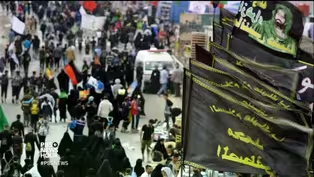
Does Iran's religious influence translate to Iraqi politics?
Video has Closed Captions
Clip: 12/7/2017 | 9m 59s | Revealing Iran's powerful influence in Iraq. (9m 59s)

House passes major gun bill as senators debate bump-stocks
Video has Closed Captions
Clip: 12/6/2017 | 2m 56s | The House passed its first major piece of gun legislation. (2m 56s)

How Israelis and Palestinians see Trump’s Jerusalem move
Video has Closed Captions
Clip: 12/6/2017 | 13m 15s | While Israeli leaders praised President Trump’s decision, many Palestinians are upset. (13m 15s)

Key allies blast Trump’s Jerusalem announcement
Video has Closed Captions
Clip: 12/6/2017 | 4m 29s | The president officially recognized Jerusalem as the capital of Israel. (4m 29s)
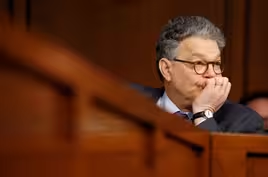
New allegation sparks calls for Franken’s resignation
Video has Closed Captions
Clip: 12/6/2017 | 4m 38s | Sen. Al Franken came under growing pressure on Wednesday to step down. (4m 38s)
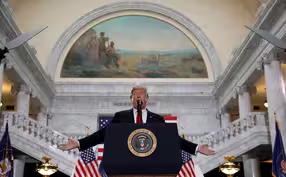
News Wrap: House votes down Trump impeachment resolution
Video has Closed Captions
Clip: 12/6/2017 | 6m 45s | The House killed a resolution to impeach Trump, a proposal offered by a Texas Democrat. (6m 45s)
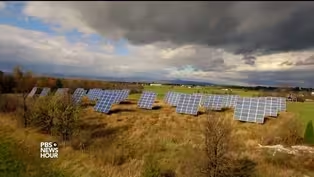
Rethinking the utility company as solar power heats up
Video has Closed Captions
Clip: 12/6/2017 | 9m 6s | What does solar power mean for the evolution of utility companies? (9m 6s)
Providing Support for PBS.org
Learn Moreabout PBS online sponsorship
- News and Public Affairs

FRONTLINE is investigative journalism that questions, explains and changes our world.

- News and Public Affairs

Amanpour and Company features conversations with leaders and decision makers.












Support for PBS provided by:
Major corporate funding for the PBS News Hour is provided by BDO, BNSF, Consumer Cellular, American Cruise Lines, and Raymond James. Funding for the PBS NewsHour Weekend is provided by...