
PBS NewsHour full episode January 10, 2018
1/10/2018 | 53m 23sVideo has Closed Captions
PBS NewsHour full episode January 10, 2018
PBS NewsHour full episode January 10, 2018
Problems playing video? | Closed Captioning Feedback
Problems playing video? | Closed Captioning Feedback
Major corporate funding for the PBS News Hour is provided by BDO, BNSF, Consumer Cellular, American Cruise Lines, and Raymond James. Funding for the PBS NewsHour Weekend is provided by...
Support provided by:

PBS NewsHour full episode January 10, 2018
1/10/2018 | 53m 23sVideo has Closed Captions
PBS NewsHour full episode January 10, 2018
Problems playing video? | Closed Captioning Feedback
How to Watch PBS News Hour
PBS News Hour is available to stream on pbs.org and the free PBS App, available on iPhone, Apple TV, Android TV, Android smartphones, Amazon Fire TV, Amazon Fire Tablet, Roku, Samsung Smart TV, and Vizio.
Providing Support for PBS.org
Learn Moreabout PBS online sponsorshipJUDY WOODRUFF: Good evening.
I'm Judy Woodruff.
On the "NewsHour" tonight: Deadly mudslides slam into Southern California, leaving rescuers to search for survivors amid the destruction.
Then, I sit down with two U.S. senators from both sides of the aisle to discuss bipartisan efforts to protect future elections against foreign meddling.
SEN. AMY KLOBUCHAR (D), Minnesota: Forty-two states haven't upgraded their election equipment in over a decade.
And Russia knows it.
JUDY WOODRUFF: And after being hit with extreme winter flooding, Boston plans for the promise of more storms to come.
But will it be enough?
NASSER BRAHIM, Senior Climate Change Planner, Kleinfelder: In the future, when we have three feet of sea level rise, this is going to happen on, let's say, a monthly basis.
So this is really a snapshot of what the future looks like if we don't get our emissions under control.
JUDY WOODRUFF: All that and more on tonight's "PBS NewsHour."
(BREAK) JUDY WOODRUFF: They're still digging tonight in Southern California, where huge mudslides wiped out at least 100 homes early Tuesday.
Authorities have confirmed 15 deaths.
Another two dozen people are missing in a disaster zone that covers 30 square miles.
Home after home destroyed, filled to the roofs with mud or ripped from foundations.
WOMAN: I would say it's apocalyptic.
I had no idea that the devastation was like this.
JUDY WOODRUFF: Splintered remains and a river of mud now cover much of Montecito.
The small, coastal community in Santa Barbara County suffered the worst of the damage.
People say they woke in the middle of the night Monday to the roar of a torrential rainstorm.
It pounded some parts of the region with more than an inch of rain an hour.
WOMAN: It sounded like a hurricane or freight train coming through.
I can't -- can't quite believe it.
Is that a house behind us?
Is that a house?
JUDY WOODRUFF: The deluge overwhelmed the nearby hills that had been burned bare of vegetation just weeks ago by the largest wildfire in California's history.
Soon, fast-moving mudflows carrying large boulders tore through the wealthy neighborhood of 9,000.
They had been ordered to evacuate, but many refused or left too late.
MAUREEN CLAFFEY, California: I panicked.
I mean, they were both asleep.
And I was in my boots, and I just said there's mud in the driveway, there's mud in the driveway.
JUDY WOODRUFF: Today, rescue crews kept digging through mud and debris in search of survivors.
More than 50 people have been rescued so far.
Many, including this family of five, were airlifted out, plucked from their rooftops by the Coast Guard.
And crews from the Santa Barbara County Fire Department pulled a 14-year-old girl from her destroyed home in Montecito on Tuesday.
She had been trapped there for hours.
Robert Riskin was still looking for his mother late yesterday as he searched through her home.
ROBERT RISKIN, California: It's my mom.
And I'm fighting with all my heart to find her.
I have just been clawing through the mud.
And it's hard to hold hope when the mud is so deep.
JUDY WOODRUFF: It is believed hundreds are still trapped or missing around Montecito.
The storm also triggered mudflows and flash flooding across parts of nearby Los Angeles and Ventura counties this week, submerging highways and cars.
Officials say there's no telling how long the region's recovery will take, as crews try to clear away mud and debris.
MAN: You're going to follow my treads, OK?
You got six to eight to 12 inches of mud out there.
JUDY WOODRUFF: For now, travel in the area is near impossible.
Parts of the coastal 101 Highway are still closed, covered in several feet of mud.
For more on rescue and recovery efforts in the flood and slide areas, and how residents are coping, we turn to Sharon McNary of Southern California Public Radio.
She is in Montecito, and she joins us by phone.
So, Sharon, tell us -- thank you for joining us.
Tell us, exactly where are you?
SHARON MCNARY, Southern California Public Radio: I'm on Highway 192, which is that dividing line between the voluntary and the mandatory evacuation, just on the outskirts of the mud zone.
And there's just a ton of activity going on here, including some military helicopters overhead.
JUDY WOODRUFF: And what is it, Sharon, about this mud that is making it so difficult to remove?
SHARON MCNARY: When you get a heavy rain on burned soil, the lower layer bakes hard, and all the topsoil on top of it gets all this water in it and that makes it slow down.
It also makes it sit in a very viscous, watery layer, and it's like the sort of mud that will suck the boots right off your feet.
Also, I'm sure that with 24 people still unaccounted for, they're being very careful how they dig.
JUDY WOODRUFF: And, Sharon, were people, were these towns in that area prepared for this?
SHARON MCNARY: I would say that the government did as much preparation as they could, but they had so little time between the end of the fires and the beginning of the rain, it was probably difficult to put enough protection in place.
The citizenry, people had the mandatory evacuation orders above Highway 192, where I am.
Below, it was voluntary, and people had been out of their homes for nearly a month.
So you had evacuations setting in, and people might have taken comfort that this is an evacuation warning, not a mandatory evacuation.
And that might have accounted for some people being in their house when it was unsafe to be there.
JUDY WOODRUFF: And these people, as you say, have had so much to deal with.
So perhaps they didn't take these warnings seriously.
SHARON MCNARY: I think it's more that people are very unfamiliar with what happens when you have a mud debris flow.
You can be in a place that looks perfectly safe, that looks kind of flat.
You cannot imagine what it's like to be at the bottom of a funnel of literally acre-feet of watery mud, and it comes very, very fast.
I was in a mud flow yesterday and it went from a wash channel being six inches of water to being 10 feet of water full of boulders.
You just don't understand how fast it can come on you.
So, I don't think people were careless.
I think they lacked understanding of how serious this was.
JUDY WOODRUFF: I think really hard for people to imagine who are not part of it.
And just very quickly, any estimates on how long this is going to take, this rescue and recovery?
SHARON MCNARY: I have not heard one.
I can't imagine it would be any less than just days to dig it out.
JUDY WOODRUFF: Well, Sharon McNary, Southern California Public Radio, we thank you.
SHARON MCNARY: Thank you.
JUDY WOODRUFF: In the day's other news: President Trump sharply criticized a federal judge who blocked his decision to end the DACA program.
It protects young immigrants brought here illegally from deportation.
In a tweet today, Mr. Trump said, "It just shows everyone how broken and unfair our court system is."
Federal immigration agents showed up today at nearly 100 7-Eleven convenience stores nationwide.
They ran checks on employees' immigration status and arrested 21 people.
U.S. officials say that it was the largest such operation since President Trump took office, and they say -- quote -- "the first of many."
There is word that President Trump will not reimpose broad-based sanctions on Iran, at least, not yet.
The Associated Press and others are reporting that he is expected to announce the decision by a Friday deadline.
That's despite his criticism of the 2015 nuclear deal.
But the reports say he will restore some targeted sanctions on specific businesses and individuals.
A new diplomatic effort on North Korea appeared to gain momentum today.
Both President Trump and South Korea's President Moon Jae-in said they are open to direct talks with North Korea's leader, Kim Jong-un.
In Seoul, Moon said that Mr. Trump's tough stance led to yesterday's North-South talks, and could yet pave the way to a summit with Kim.
MOON JAE-IN, South Korean President (through translator): I think President Trump deserves big credit for bringing the inter-Korean talks.
I keep myself open to any meeting, including the summit with North Korea, if it's helpful for an improvement of South-North relations or a settlement of the North Korean nuclear issue.
JUDY WOODRUFF: In Washington, President Trump welcomed yesterday's North-South meeting and said -- quote -- "Who knows where it leads?"
The White House said that U.S. talks with the North are possible, at the appropriate time, under the right circumstances.
Senate Democrats are out with a report that warns Russia is intensifying efforts to undermine democracy in the U.S. and Europe.
It argues President Trump has offered no response, and declares -- quote -- "Never before has a U.S. president so clearly ignored such a grave and growing threat to U.S. national security."
We will discuss election security with two leading senators from both parties later in the program.
Another veteran of Congress says that he will not seek reelection.
California Republican Representative Darrell Issa announced today that he will retire after nine terms.
He had once chaired the House Oversight Committee, and was a dogged critic of the Obama administration.
So far, 35 Republicans and 16 Democrats have announced that they will leave Congress or seek other offices.
New York City today sued five oil giants over global warming.
The suit named BP, Chevron, ConocoPhillips, ExxonMobil and Royal Dutch Shell.
Mayor Bill de Blasio said the city wants to recoup billions of dollars in costs related to climate change.
And on Wall Street today, the Dow Jones industrial average lost 16 points to close at 25369.
The Nasdaq rose 10 points, and the S&P 500 slipped three.
Still to come on the "NewsHour": two leading conservatives react to the fallout from the explosive book "Fire and Fury"; bipartisan efforts to protect the next election after last year's Russian interference; a vulnerable Boston tries to protect itself from additional extreme flooding; and much more.
We begin tonight with politics.
After holding a Cabinet meeting this morning, President Trump joined Norway's prime minister, Erna Solberg, for a joint press conference in the East Room.
The president took questions from reporters, but wouldn't say if he would sit for an interview in the Russia investigation without condition if special counsel Robert Mueller asked.
DONALD TRUMP, President of the United States: It's a Democrat hoax that was brought up as an excuse for losing an election that, frankly, the Democrats should've won, because they have such a tremendous advantage in the Electoral College.
So it was brought up for that reason.
But it has been determined that there is no collusion, and by virtually everybody.
So we will see what happens.
QUESTION: Would you be open to... DONALD TRUMP: We will see what happens.
I mean, certainly, I will see what happens, but when they have no collusion and nobody's found any collusion at any level, it seems unlikely that you would even have an interview.
JUDY WOODRUFF: This appears to contradict what Mr. Trump had said earlier this year.
In June, he told reporters that he was -- quote - - "100 percent" willing to testify under oath to special Robert Mueller about conversations he held with former FBI Director James Comey.
In that same answer today, Mr. Trump also brought up the FBI's investigation into Hillary Clinton's e-mail server.
DONALD TRUMP: Hillary Clinton had an interview where she wasn't sworn in, she wasn't given the oath, they didn't take notes, they didn't record.
And it was done on the Fourth of July weekend.
That's perhaps ridiculous.
A lot of people looked upon that being a very serious breach.
JUDY WOODRUFF: And while it is true that Mrs. Clinton wasn't under oath or recorded, notes were taken, and they were released by the FBI afterward.
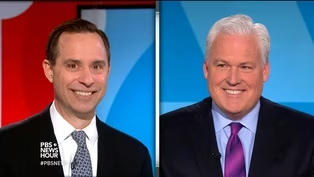
To sort through the president's remarks today, as well as the continued fallout from a scathing new book, I'm here with Matt Schlapp, chairman of the American Conservative Union.
He also served as White House political director for President George W. Bush.
And Chris Buskirk, radio talk show host and editor of the online journal American Greatness.
Thank you both for being here.
We wanted to hear from both of you tonight.
We have been hearing a lot of criticism of the president lately.
We had former Vice President Biden on the program last week.
We interviewed Michael Wolff about his book this week.
We want to hear your perspective.
But -- and I want to start, Matt Schlapp, by asking what we just heard from the president.
How much is this Russia investigation defining his first year in office?
MATT SCHLAPP, Former White House Director of Political Affairs: Well, I think it took up a lot of the time and a lot of the coverage.
I think, initially, the White House didn't exactly do helpful things, but I think, as the year went along, most Democrats I talk to, Judy, believe that there really was no evidence that was ever presented or leaked - - and, by the way, this whole investigation, there's always been a lot of leaks.
And there really -- there doesn't seem to be any hard evidence that there is any collusion.
Most Democrats I know have moved on to trying to attack clearly his mental fitness.
That's now the new theme.
They have moved on to these other themes, and they're hoping special counsel can snag the president on anything.
In the end, I think the American people are pretty fair.
If he doesn't find evidence of the underlying charge of collusion, then I don't think the rest of it is going to matter.
JUDY WOODRUFF: Chris Buskirk, has the president let this Russia thing get under his skin too much?
CHRIS BUSKIRK, AmericanGreatness.org: No, I don't think so.
He has had to sort of thrust and parry with the media throughout 2017, even into 2018.
And there's been times, of course, when people have said shouldn't have reacted this way, he overreacted that way.
I think that's not who Donald Trump is.
But this is an attempt to undermine and to overturn the last election.
And so Donald Trump's senses that.
He says, I'm going to push back on this.
This is not only on attack on me.
It's an attack on the office and on the process, so I'm going to go back at this full force.
JUDY WOODRUFF: Well, of course, as you know Republican senators, including James Lankford, whom I interviewed today at the Capitol, said that there are real questions about what the Russians did and that this investigation is legitimate.
CHRIS BUSKIRK: Yes.
JUDY WOODRUFF: So, even Republicans are saying that, is my point.
CHRIS BUSKIRK: Yes.
And I think people like Devin Nunes have been on this Russia thing since before the last election.
And making sure that Russia is not doing things that they ought not do in our elections is something everybody agrees on.
JUDY WOODRUFF: All right, well, let's move to the book "Fire and Fury."
MATT SCHLAPP: What book are you talking about?
(LAUGHTER) JUDY WOODRUFF: Not that there hasn't been a lot of conversation about it.
But, Matt, Michael Wolff has some pretty strong criticism of the president from people inside of the White House, calling him everything from an idiot to a dope.
MATT SCHLAPP: Right.
JUDY WOODRUFF: Much of it is coming from Steve Bannon, but it's coming others as well.
Is it your contention that everything in the book is wrong?
MATT SCHLAPP: No, but the hard part is this.
So, I chair the A.C. which puts on CPAC.
There's an entire chapter in this book on CPAC.
He never called me.
He didn't call anybody on our team.
He didn't call anybody else who was involved with CPAC.
He has tons of factual errors in that chapter alone.
He says that General Kelly has a job that he does have.
He says that Secretary Ross has a job that he doesn't have.
He just gets error after error.
And, Judy, I think you have to ask yourself, even all the journalists who are covering it, which is, if there's this many errors on little things, maybe he was also sloppy on big things.
JUDY WOODRUFF: Well, I did talk to him.
He acknowledges there are some errors.
But his point is that the bulk of the book reflects genuinely, Chris Buskirk, what people told him after living -- he basically lived in the White House six or eight months.
CHRIS BUSKIRK: Yes, that's the odd part about the whole book, leaving aside the contents of the book, was why he was there for so long.
I don't think that what Michael Wolff was setting out to do was to do a piece of serious history or even a piece of serious journalism.
This was a way to sell books.
And so you make it as sensational as possible.
And he has said it in his -- in the dedication to the book, that, well, you know, you can't expect it all to be accurate, that I'm just putting it together the way I understood it.
JUDY WOODRUFF: Well, one of the outcomes from this book, certainly, Matt Schlapp, is the departure from Trump world of Steve Bannon, who was the president's chief strategist.
MATT SCHLAPP: Right.
JUDY WOODRUFF: He was at the president's side.
He was, in many ways, I think, the tribune of the meaning of Trumpism.
I think we're left wondering, what is the difference now between Trumpism and Bannonism?
And what now is gone from those voices around the president?
MATT SCHLAPP: Steve Bannon is a very talented guy, but over the course of the last several months, it has been painful to watch him make very big mistakes.
One of the mistakes that he made here, obviously letting Michael Wolff into the White House, if he did, talking to him too aggressively or too casually, and in leaving the inference that he believed things that I know he doesn't believe in conversations I have had with Steve.
He doesn't believe, for instance, the Don Jr. is a traitor.
These are things that I think that either he was misquoted on or he got sloppy on.
And so I think that when it comes to what conservatives and Trump supporters, where they are, where are their hearts, they're very happy with what the president's done in his first year.
And there's no separation.
This will have no impact on the support of President Trump's agenda by those who supported him in the election.
JUDY WOODRUFF: What do you think the absence of Steve Bannon means for President Trump?
CHRIS BUSKIRK: I'll tell you, I think that it strengthens Donald Trump's hand as president.
This is Donald Trump's party who won the election.
And the fact that there's not going to be what I have called Avignon Papacy, there's not another power structure that is outside of the White House, I think that's good for Republicans.
It allows Republicans to have the serious debates that Republicans need to have about policy and about ideas.
That's good, but they always know that the head of the party is the president.
JUDY WOODRUFF: But who now articulates what the president believes?
Because one of the things that comes through in this book is that Bannon was -- Steve Bannon was there to basically express a vision for Donald Trump.
That's not there anymore.
MATT SCHLAPP: Well, I never heard Steve Bannon compared to a pope, so that was interesting.
(LAUGHTER) MATT SCHLAPP: But I also think it's a mistake - - Donald Trump is his own best spokesperson.
And I think people assume who don't think he has the intelligence or the political experience, they assume someone has to feed him these ideas.
And I knew Donald Trump before he was president.
He's been talking about these issues for a very long time.
Nobody really feeds him.
So, I don't think he needs a guy like Steve there to tell him what to think.
What he actually needs is people around him to help him organize the process of government to get it done, and that's what they now have around him.
JUDY WOODRUFF: Chris Buskirk, do conservatives believe Donald Trump is conservative?
CHRIS BUSKIRK: Conservatives believe that - - some of them -- they do now.
Conservatives believe, though, that Donald Trump is doing something that's been necessary for a long time, which is updating what it means to be a conservative.
Ronald Reagan did the same thing in the '80s, brought in a set of new policies that upgraded the party.
Donald Trump has brought in new set of ideas and a new set of policies that still go back to the same principles, those first things, but is talking about policies that are relevant in 2016, '17, '18.
JUDY WOODRUFF: But, as head of the American Conservative Union, Matt Schlapp, what do conservatives think about the president?
He may not withdraw from the Iran nuclear deal after all.
He's going to Davos, Switzerland, to be with a group of people who believe in a lot of globalist -- a globalist philosophy.
MATT SCHLAPP: We call it globaloney, OK?
(LAUGHTER) JUDY WOODRUFF: So, seriously, who is this Donald Trump?
MATT SCHLAPP: It's the same guy.
And the thing is, is this, which is Donald Trump can play in a lot of different milieus.
And that was always well understood.
The question is, can he be successful in politics?
And I think where the conservatives are, Judy, mostly is, they felt like there had to be a lot of abrupt change to the order of things in Washington in order to have a chance to reset things.
And he's doing that and doing that effectively.
They are happy with what he's done on Iran.
They are happy with what he's done on climate change.
They know he is going to hobnob with some global elite at Davos.
It probably makes them a little nervous.
That press conference the other day in the Cabinet Room probably made them a little bit nervous.
JUDY WOODRUFF: Well, I want to ask you about that, because, Chris Buskirk, the president is there talking about DACA, the dreamers, and he's saying, sure, we can do a dreamers deal and worry about the rest of immigration later.
You saw the conservatives in the room say, wait a minute, what about the wall, border wall?
CHRIS BUSKIRK: Well, and good for them.
That's what they should have been doing there.
I think Donald Trump has been very clear.
And he's clarified some of those statements.
He wants a wall.
Right?
There's nothing that is more associated with Trump's candidacy than build the wall.
That was the phrase.
I don't think that has changed.
I think that what he was doing there was a bit of political theater, but a little -- a bit of negotiating, too.
We have got to see what the final legislation looks like.
And, of course, that is going to come from those very senators and representatives who were in the room.
The conservatives in that room, it's up to them to write a bill that is consistent with what the president has outlined.
JUDY WOODRUFF: Prediction quickly from both of you.
Matt Schlapp, what is -- how is this second year of the Trump presidency going to differ from year one?
MATT SCHLAPP: It's going to be much more orderly.
He starts out the year with a team that feels like it's starting to hit its stride.
They're working more as a team in the White House.
They're working better with Republicans on the Hill.
So, I think what you will see is less unforced errors.
And it started off with some bipartisanship.
JUDY WOODRUFF: But we're reading, Chris Buskirk, a lot of people in the White House and the administration are leaving.
CHRIS BUSKIRK: Yes.
No, that's true.
But that's OK.
The key players are there.
And the key player always, of course, is the one who is sitting behind the Resolution Desk.
There are people who are now coming into the White House.
There is a structure there.
There is order there that wasn't there a year ago.
And what's going to happen in 2018 is, we're going to see people come together both in the White House and in Congress and focus on the election in November.
I think that's going to be something that brings them together and unifies them in a way we didn't see a year ago.
JUDY WOODRUFF: It will focus a lot of minds.
CHRIS BUSKIRK: Yes.
JUDY WOODRUFF: Chris Buskirk, Matt Schlapp, thank you both.
MATT SCHLAPP: Thanks.
CHRIS BUSKIRK: Thanks.
JUDY WOODRUFF: Appreciate it.
With primary voting set to begin in just two months, a bipartisan effort to secure the nation's voting system is under way on Capitol Hill, led by Senators Amy Klobuchar and James Lankford, Democrat and Republican.
I spoke with them on Capitol Hill today about their effort, about President Trump's call for Republicans to take control of the Russia investigation, and about immigration negotiations.
Senator Amy Klobuchar, Senator James Lankford, thank you very much for joining us.
I first just want to make sure my eyes don't deceive me, that there is actually a Republican and a Democrat sitting next to each other for an interview.
SEN. JAMES LANKFORD (R), Oklahoma: That actually does happen more often than is captured by camera.
SEN. AMY KLOBUCHAR (D), Minnesota: It does, and even from Oklahoma and Minnesota, so there you go.
JUDY WOODRUFF: We appreciate your talking to us.
Let's begin by talking about the legislation that the two of you are backing having to do with election security.
Normally, Senator Lankford, people think about ballots and how they're counted.
It's mechanical.
Why is that a priority right now?
SEN. JAMES LANKFORD: It's a priority because, in 2016, the Russians tried to interfere in our election.
We watched them try to be able to probe through different election systems, to be able to try to reach out to different secretaries of state offices in different states, and to be able to determine how they're doing voter registration, what voting machines are they using.
We should take that as a good fair warning that we should be aware that there are outside entities that do mean to do us harm and try to interfere in our democracy, and we should be better prepared for that in the future.
JUDY WOODRUFF: So, Senator Klobuchar, what are you trying to do with this bill?
SEN. AMY KLOBUCHAR: We're trying to help the states shore up their election equipment.
This was basically a cyber-attack from Russia, and we know that.
Our intelligence agencies have very strongly, under both President Obama and President Trump, made that clear that they tried to get into our elections.
Twenty-one states, including the two of our states, there were attempts made to hack the states.
So, what we do with the bill is this, first of all, better sharing of information.
It's unbelievable to me that it took months for state election officials to find out that a foreign government had tried to hack in.
So, this bill says, you have got to share that information, have someone designated in the states that can get this classified information, and, secondly, giving them some resources to scan for vulnerabilities, to get the right election equipment, and also backup paper ballots, which I think would be very helpful for a lot of these states.
Forty-two states haven't upgraded their election equipment in over a decade, and Russia knows it.
JUDY WOODRUFF: I think, Senator Lankford, a lot of people hear paper ballots, and they are saying, wait a minute, that's the way it used to be.
SEN. JAMES LANKFORD: Right.
Right.
JUDY WOODRUFF: Are you talking about going back the way it used to be?
People are thinking hanging chads in Florida in 2000.
SEN. JAMES LANKFORD: There's a lot of varieties now.
Really, what we're trying to do is say, we should be able to audit an election, that after the election is over, we should be able to evaluate.
If we find out that some outside entity was trying to interfere in the election, everyone will immediately back up and say, did they get in?
So there has to be able to have a way to verify that.
So, it could be a paper ballot, an optical scanner.
It could be a digital machine, as some of them have now, that you punch in your ballot and it prints a piece of paper to confirm, is this what you really voted?
You push yes, and then it locks off a paper ballot, as well as your electronic.
There are lots of ways to do it.
We just -- we're not telling the states how to do it.
The states run their own elections.
We're just saying there should be a way to audit an election after it's over to make sure that we can verify, if they were attacked in a cyber-means, there is a way to be able to verify we actually have an accurate result.
JUDY WOODRUFF: We're, what, just a couple of months away from the first primary election voting in this country, just 10 months away from the general election, the midterms.
Can this happen in time for it to make a difference?
SEN. JAMES LANKFORD: No, not for 2018.
That's the unfortunate part.
There's a lot of work that has gone into it already to be able to evaluate what DHS is currently doing to be able to work with states to be able to help them.
We are encouraging them to have engagement now, which they have engaged.
DHS has been good about engaging with our states and providing whatever resources and help that they can in communication.
We just think there's more to be done.
But the states already have their election equipment right now for the 2018 election.
And they're not going to change it right before the election.
But we can be prepared for the next presidential election and have it in place and we can start cooperation sooner.
SEN. AMY KLOBUCHAR: One point, yes, that the two things that could change immediately if we can get this bill done, either in the omnibus or very quickly, would be, one, they could get some money for screening for vulnerabilities of their existing equipment, and, two, as James just pointed out, the sharing of information and just putting the stamp of Congress on this and saying, you must do this, you have got to share this information, and it has to happen now.
JUDY WOODRUFF: But it sounds like bottom line is that the state election systems are vulnerable this year to Russian hacking or hacking from other countries.
SEN. AMY KLOBUCHAR: Twenty-one states.
I mean, that's a lot.
SEN. JAMES LANKFORD: Yes, we don't necessarily know the level of engagement.
Obviously, 21 states were probed.
Most of those states, the Russians were not successful in getting through to the system.
They were trying to get into the system.
Oklahoma is one of those they were trying to get into.
They weren't able to actually penetrate the system.
The important thing is, we're better prepared and that aware that we're not just trying to be able to guard and protect security information after it's over.
We have to be prepared beforehand.
Our states will be better prepared the next time.
We want to make sure, though, that they are actually better prepared.
JUDY WOODRUFF: But not completely safe from interference this year.
SEN. AMY KLOBUCHAR: Well, and we know, in Illinois, they did get into the voter data.
But what -- the information we have so far is that this didn't change votes, but they simply attempted to get into the data.
And we don't want it to go the next step in the next election.
And that's why, remember, while we're doing this, the states are doing a lot of things on their own, but this has to be a national priority.
JUDY WOODRUFF: But you're saying, this year, states are vulnerable?
SEN. JAMES LANKFORD: States are vulnerable if they don't do the work that they need to do ahead of time.
There are 12 states that cannot audit their elections.
And that's one of our challenges.
We don't know vulnerabilities.
They may not be vulnerable at all, but if there is a question after the fact, they can't audit their elections afterwards to verify that.
And we think that's very important.
JUDY WOODRUFF: Russia, of course, a big part of this conversation.
They were the ones behind what happened in 2016.
They are still active.
The president today is tweeting that the Russia investigation, which is connected to this in a way because the Russians ended up trying to help his campaign, that that investigation, he's calling it the single greatest witch-hunt in American history.
He's calling on Republicans to finally take control, in other words, get this over and done with.
SEN. AMY KLOBUCHAR: First of all, I look at it as a truth hunt.
And I -- every time we get a question that starts with "the president tweeted today," there's a pause.
But, in this case, he has said this before over and over, so this isn't new news.
He said it's a witch-hunt.
And I think it's a truth hunt.
Mueller is someone that has been first been appointed by a Republican president, has broad support, and is simply trying to do his job.
And I think it's important for this country that we get to the bottom of what happened, regardless of what the president tweets.
JUDY WOODRUFF: But when the president says Republicans finally take control, how do you read that?
SEN. JAMES LANKFORD: You know, I don't know how to be able to read that, what he means by that.
I would tell you I serve on the Intelligence Committee.
And my responsibility is to not try to be a partisan in that, is to go after the facts on that.
The facts need to go where the facts go.
We need to follow the facts wherever they may go to be able to get out as many of those out as we possibly can, to be able to run down every lead, again, to be able to establish by the end of this some sense of bipartisan support, we have looked at everything, and this is where we are now.
JUDY WOODRUFF: One other issue I want to ask you both about quickly, and that is immigration.
Senator Klobuchar, the president had kind of a remarkable session at the White House yesterday.
Senator Lankford was there.
But what I want to ask you is, the president said at one point in that meeting that he thought there should be movement direct to address DACA.
This is the measures to protect young people who came to the United States without documentation.
That should be dealt with, and then comprehensive immigration reform.
How did you interpret what he said?
SEN. AMY KLOBUCHAR: To me, the immediate emergency is DACA because of these 800,000 kids that 97 percent of whom work and are in school in this country.
And then you can go to comprehensive immigration reform.
So I viewed it as positive.
SEN. JAMES LANKFORD: It has to be done with border security.
Now, even the president yesterday said he's not talking about a 2,000-mile wall.
But there are sections of it that we should have authorization for.
Quite frankly, most are already authorized now.
There are 650 miles of wall that currently exist that was authorized in 2006.
JUDY WOODRUFF: Senator Klobuchar, is that going to fly?
SEN. AMY KLOBUCHAR: I think there will be some negotiation on border security.
It wouldn't surprise me if there would be something in there with border security.
But this wall along with the whole border, there's a number of Republicans who are opposed to it.
There's issues with that.
But what I found remarkable about yesterday was just the openness to a discussion, but this focus also on comprehensive reform.
JUDY WOODRUFF: Are we going to see more Republicans and Democrats working together on other issues?
SEN. JAMES LANKFORD: I think we should.
SEN. AMY KLOBUCHAR: We have a lot of fun doing it.
It's good.
SEN. JAMES LANKFORD: Yes.
There's a lot of areas of common ground.
And my great frustration right now in the Senate is, we're not voting on a lot of legislation.
We're doing so many things on nominations that are taking so long.
We're not getting to anything on real voting on other legislative issues.
There are so many issues of common ground that we have that, if we had the opportunity to be able to cover the floor, debate it out, have a vote, they'd pass with 70, 80 votes.
But it's just getting to the point that we can start getting us back to voting again.
SEN. AMY KLOBUCHAR: Pharmaceutical issues, the price of prescription drugs, issues with apprenticeship, there's just so much we could doing.
And I would like to go there as well.
JUDY WOODRUFF: Well, we appreciate both you sitting down to talk to us today.
SEN. AMY KLOBUCHAR: But we won't talk about college football vs. the Vikings right now.
(LAUGHTER) SEN. AMY KLOBUCHAR: But the Vikings are doing really well.
JUDY WOODRUFF: Right.
Senator Klobuchar, Senator Lankford, thank you both very much.
Appreciate it.
SEN. JAMES LANKFORD: Thank you.
SEN. AMY KLOBUCHAR: Thank you.
JUDY WOODRUFF: Stay with us.
Coming up on the "NewsHour": voter rights come into question amid Ohio's voter purge; and using cameras to see how animals like raccoons are impacted by urbanization.
But first, science correspondent Miles O'Brien looks at how conditions during the recent cold snap in the Eastern U.S. sometimes came together in unfamiliar ways, and what one city is doing to try to cope.
It's the latest installment of Leading Edge, our weekly science series.
MILES O'BRIEN: Surprising as it seemed, the experts saw it coming, an epic nor'easter, a full moon high tide and a rising sea, all conspiring to swallow up swathes of Boston with an icy cold winter flood.
It got wall-to-wall live attention on the local news.
MAN: This was the one rescue that they had to actually go through several hours ago here at Atlantic and State.
MILES O'BRIEN: I met Nasser Brahim in the same place on the Boston Waterfront near the New England Aquarium.
NASSER BRAHIM, Senior Climate Change Planner, Kleinfelder: Water was probably right around up to here.
There was a little bit less than a foot of flooding at the station entrances.
MILES O'BRIEN: Brahim is a senior climate change planner for the engineering firm Kleinfelder advising the city on ways to defend against the impact of climate change.
He says the storm was a classic hundred-year flooding event today, but a much more common occurrence a century from now.
NASSER BRAHIM: In the future, when we have three feet of sea level rise, this is going to happen on, let's say, a monthly basis.
So this is really a snapshot of what the future looks like if we don't get our emissions under control.
MILES O'BRIEN: For New Englanders, the term nor'easter is familiar, but this time a new moniker entered the popular lexicon.
LESLIE HUDSON, MyRadar: It's called this bombogenesis, and it's basically a bomb cyclone or a snow hurricane, snow cyclone.
There's all kind of names for this thing.
MILES O'BRIEN: That's Leslie Hudson, the digital meteorologist for the weather app MyRadar.
Researchers coined the term bomb cyclone in 1980.
It refers to a non-tropical winter storm that rapidly intensifies, specifically, air pressure that drops at least 24 millibars in as many hours.
LESLIE HUDSON: Most common from October to March.
So this bombogenesis making all kinds of headlines across the Northeast and Mid-Atlantic, as it's expected to dump a lot of snow.
MILES O'BRIEN: It's the result of a collision between warm air over the ocean and cold air from the Arctic.
These types of storms are not uncommon, but there is reason to believe climate change may make them more likely to occur in the Northeastern United States.
Radley Horton is a climate scientist at Columbia University's Lamont-Doherty Earth Observatory.
RADLEY HORTON, Lamont-Doherty Earth Observatory: It's very early days in this research, but there is some evidence suggesting that loss of sea ice in the Arctic and extreme melting of snow in May and June in the High Arctic may be shifting the climate in a way that's weakening the jet stream and making it more prone to these kind of meanders.
MILES O'BRIEN: The jet stream is a river of air that flows west to east across North America.
It is created by the temperature difference between warm air at the equator and cold air in the Arctic.
Some scientists suspect that, as climate change has warmed the Arctic, the temperature difference has reduced, causing the jet stream to weaken and wander.
This would allow Arctic air to move farther south and linger there, creating the record cold temperatures recently in the U.S.
The arrival of the warm, moist air from the south provided the missing ingredient to create a bomb cyclone.
The other factor at work here in Boston is sea level rise.
RADLEY HORTON: We have had about eight or nine inches of sea level rise since, say, 1900.
That doesn't sound like much, but it's already leading to much more frequent coastal flooding than what you had in the past.
MILES O'BRIEN: And the sea level will continue to rise.
The mid-range estimate is more than three feet by the end of this century, depending on how much humans do to curb the production of greenhouse gases.
RADLEY HORTON: Even if storms remain the same, we're going to have much more frequent coastal and much more damaging coastal flooding because of that higher baseline.
MILES O'BRIEN: Human beings have built civilizations during a 7,000-year period of unprecedented climate stability, but since the Industrial Revolution, the rate of climate change has far outstripped the pace of adaptation.
Kerry Emanuel is a professor of atmospheric science at MIT.
KERRY EMANUEL, Massachusetts Institute of Technology: If the sea level rose over the next thousand years by five or six meters, it wouldn't be a problem.
We wouldn't even notice.
The problem, I think, for civilization is the high rate of change of the climate.
And the question is, can we adapt without serious consequences?
MILES O'BRIEN: In Boston, they say they are serious about doing something to build in resilience against the effects of climate change.
AUSTIN BLACKMON, Boston Chief of Environment, Energy, and Open Space: The concern is that we want to make sure that we can get Boston back to normal as quickly as possible.
MILES O'BRIEN: Austin Blackmon is chief of environment, energy and open space for the city of Boston, 30 percent of which is landfill built to stay just dry above high tides of the 18th and 19th century.
So, what does that mean for the 21st century?
AUSTIN BLACKMON: By the end of the century, we're expecting about $80 billion of assets to be in the FEMA floodplain.
If you annualize what that risk would be, it would be about $1.4 billion worth of annual damage if we do nothing.
MILES O'BRIEN: They have drafted a plan to try and protect this low-lying city.
Climate-ready Boston envisions strategically placed flood walls, berms, waterfront green space and elevated streets.
But cities can only do so much to fight something that is, after all, global in scale.
STEPHEN FLYNN, Northeastern University: I worry sometimes that we are creating islands of resilience in seas of frigidity.
MILES O'BRIEN: Stephen Flynn is director of the Global Resilience Institute at Northeastern University.
STEPHEN FLYNN: Where the real challenge lies is that cities don't control entirely their destinies.
They rely on transportation, energy networks, communication networks that sprawl across the country, across borders.
And so it's so important to have national leadership, in some cases to take this on globally, is because these systems we rely on have to essentially be able to built resilient across multiple jurisdictions.
MILES O'BRIEN: In Washington, there is much talk of a huge investment in infrastructure nationwide.
DONALD TRUMP, President of the United States: Dramatically reform the nation's badly broken infrastructure.
MILES O'BRIEN: But in August of 2017, President Trump undid an Obama era order that the federal government account for climate change as it designs public works projects.
STEPHEN FLYNN: It's an act of recklessness, frankly.
We are investing as taxpayers in these assets.
We want them to be around their lifetime, their entire life span.
DONALD TRUMP: And, by the way, if it doesn't meet environmental safeguards, we are not going to approve it, very simple.
MILES O'BRIEN: It may be reckless, and it may be human nature.
This is where scientists look to the humanities for answers.
KERRY EMANUEL: I ask historians this question.
Can we find examples in human history of a whole generation consciously doing something for the benefit of more than one generation downstream that doesn't benefit that generation itself?
It's very, very hard to find examples of that.
Not sure we ever have.
MILES O'BRIEN: The experts who saw this storm coming say much more of this lies ahead, a time bomb for our children and grandchildren to defuse.
In Boston, I'm Miles O'Brien for the "PBS NewsHour."
JUDY WOODRUFF: The Supreme Court heard arguments today in a case challenging the removal of hundreds of thousands of people from voter rolls in Ohio.
In a moment, Jeffrey Brown will talk to Marcia Coyle of "The National Law Journal" about the questions the justices asked inside the court.
But we begin with a report from Karen Kasler of PBS' Ohio station ideastream about what's at stake in the Buckeye State.
KAREN KASLER: U.S. Army Sergeant Joseph Helle was in Iraq in 2006 and 2007, and in Afghanistan in 2009.
But when he came home to Ohio in 2011, he found a battle he didn't expect.
Helle showed up to vote that fall, and found his name had been removed from the voter rolls.
JOSEPH HELLE, Mayor of Oak Harbor, Ohio: I started crying.
It was heartbreaking to be told that one of those fundamental rights that I put my put my life on the line for, raised my right hand for, that I wasn't allowed to exercise it.
And I was protecting it for others, but others weren't able to protect it for me.
KAREN KASLER: Helle, who is now the mayor of Oak Harbor, a small village near Toledo, has joined the coalition of mostly progressive-leaning groups opposing the two-pronged approach Ohio has to maintaining its voter rolls.
If a voter doesn't cast a ballot for two years, a postcard or mailer is sent to the address listed on the voter's registration.
If the voter doesn't respond, and then doesn't vote for another four years, the voter is removed from the voting rolls without further notice, whether the voter has moved or not.
More than 4.6 million of those mailers have been sent to voters since 2011, the year Helle found out he was removed.
At least hundreds of thousands of voters have been removed, but it's unclear exactly how many.
Republican Secretary of State Jon Husted says the two-year window and the mailers are part of the state's legal obligation to remove the names of dead, imprisoned or otherwise ineligible voters.
JON HUSTED (R), Ohio Secretary of State: It's trying to say to the voter, gee, have you moved?
Do you want to update your information?
It's done to try to be helpful to the voter, and helping them update their information, and also to make sure that we maintain the voter rolls, which is another piece of the law.
So, you have, in the end, a six-year period to interact, to vote, to let us know that you still want to be on the voter rolls.
KAREN KASLER: But those challenging the process say voting is not a use-it-or-lose-it right, and that voters choose not to cast ballots because of illness, apathy, or other reasons, and not just because they have moved.
FREDA LEVENSON, Legal Director, ACLU of Ohio: Failing to vote is a very poor proxy for someone moving.
Close to 50 percent of Ohioans don't vote in every given election.
But not close to 50 percent of Ohioans have moved.
The number is much closer to 2 percent.
So the secretary is purging vast numbers of completely eligible voters just to try to target a small, tiny handful of people who may have moved.
KAREN KASLER: But Husted says this method of voter roll maintenance has been in place Ohio since 1994, with virtually no problems, until the lawsuit was filed in 2016.
JON HUSTED: This process has worked very well in Ohio under Democratic and Republican administrations.
Nobody in Ohio has expressed problems with this.
It's only out-of-state folks who seem to have trouble with how to we are implementing the laws in Ohio.
KAREN KASLER: But the plaintiffs challenging the state, led by the AFL-CIO-affiliated A. Philip Randolph Institute, say they're doing so on behalf of Ohioans like Larry Harmon.
The Northeast Ohio man is featured in a video produced by the ACLU, another plaintiff in the case.
Harmon says that after several years of not voting, he discovered he'd been removed in 2015.
That was the same year that many Ohioans who registered in 2008, when Barack Obama won the state, also found they had been erased from the rolls.
The plaintiffs won an appeals court ruling that resulted in more than 7,500 ballots cast by voters who'd been removed must be counted in the 2016 presidential election.
Last August, the Justice Department under President Trump reversed the position it had taken under President Obama, and filed a brief to support the state of Ohio's case.
Seven states use a process similar to Ohio's, so potentially millions of voters around the country will be affected by the court's decision.
For the "PBS NewsHour," I'm Karen Kasler in Columbus, Ohio.
JEFFREY BROWN: Marcia Coyle covers the high court for "The National Law Journal," and she was in the courtroom, as always, as the justices grappled with this potentially far-reaching dispute.
Marcia, so, start with the argument against Ohio's law.
How was it made in court today?
What were they looking -- what laws were they looking at?
MARCIA COYLE, "The National Law Journal": OK, really, there are two laws that are at the heart of the dispute here, the National Voter Registration Act and the Help America Vote Act, which followed the national act.
Both were designed and intended by Congress to make voting easy and accessible.
The challengers to Ohio's system represented by Paul Smith today argued basically the same argument that they had won in the lower court.
Ohio is... JEFFREY BROWN: They were the winning argument, right?
MARCIA COYLE: Absolutely.
Ohio is going wrong with its system for removing voters from its registration rolls.
JEFFREY BROWN: So what kind of reception did they get from the justices?
MARCIA COYLE: Well, I would say the justices seem divided, but you never can really tell what's going on until the decision comes out.
JEFFREY BROWN: To say that they're divided is not a surprise, right?
But go ahead.
MARCIA COYLE: That's right.
It's also the safe prediction, too.
JEFFREY BROWN: Yes.
MARCIA COYLE: Justices Kennedy and Breyer, for example, they spoke to the concern that states have about maintaining the integrity of voter registration rolls.
That is something that states have to do.
Justice Breyer, for example, said, well, if you can't use the fact that a voter hasn't voted in two years to send out these notices, what can you do?
JEFFREY BROWN: Yes.
So, they're in essence supporting the Ohio... (CROSSTALK) MARCIA COYLE: Well, it sound that way.
They're raising one of the major concerns here of Ohio.
And Mr. Smith said, well, Ohio is really only one of eight states that uses the process it uses.
It's the most aggressive.
There are other ways.
I learned through this case that there is a national change of address database that keeps track of changes of address that are sent to postal offices.
And he said states can compare their registration addresses with that database.
So, there was this concern about, how can states maintain integrity?
JEFFREY BROWN: And where did the challengers get their support from?
MARCIA COYLE: Justices Sotomayor and Kagan, for example.
Justice Sotomayor is concerned about what she said appears to be the disproportionate impact of Ohio's process on cities and neighborhoods that have a high percentage of low-income workers, who work odd shifts, have difficulty getting to the polls, and also on minorities.
She pointed out there have been a number of new voter restrictions put in place by states that create even more obstacles.
Justice Kagan looked at Ohio's argument that, no, it's not the trigger, the two-year trigger, that removes voters.
It's the failure to respond to our confirmation notice that removes voters.
She looked at it and said, what it looks like to me like is, failure to vote, failure to respond, failure to vote.
JEFFREY BROWN: Yes.
MARCIA COYLE: And she didn't quite agree that it was the cause of the removal, was the confirmation notice.
JEFFREY BROWN: So, briefly, there's a lot on the docket for the court this year, this term, over voting rights and redistricting.
MARCIA COYLE: Yes, there is.
JEFFREY BROWN: But the implication -- political implications perhaps of this particular case?
MARCIA COYLE: Well, as you probably know, Ohio is often a battleground state... JEFFREY BROWN: I do, yes.
MARCIA COYLE: ... in national elections.
So, the number of voters who are purged from the rolls could make a difference in a close election.
So it's being closely watched.
And you're right.
The court has two partisan gerrymandering cases.
It may well see another partisan gerrymandering case out of North Carolina.
It continues to get racial gerrymandering cases, voter I.D.
The whole election landscape is alive right now with these types of cases.
JEFFREY BROWN: All right, this is all to be continued.
Marcia Coyle, thank you, as always.
MARCIA COYLE: My pleasure, Jeff.
JUDY WOODRUFF: Now to a "NewsHour" Shares, something that caught our eye that we thought might be of interest to you.
In Seattle, trail cameras in urban parks are giving researchers new insights into how coyotes, raccoons, and other carnivores are thriving in the harsh environment of big cities.
From PBS station KCTS in Seattle, Eric Keto sent in this nocturnal story.
MARK JORDAN, Associate Professor of Biology, Seattle University: We get some photographs that are just amazing, like the raccoons posing in front of the camera or the coyote at the water hole, all sorts of cool things.
I'm Mark Jordan, associate professor of biology at Seattle University, and I am a conservation biologist.
The big-picture question I'm interested in is, how does urbanization affect wild mammals, in particular predatory mammals that are higher up on the food chain?
Is it that way?
We will try that way first.
We're using camera traps to identify raccoons and opossums and coyotes in the parks in Seattle.
WOMAN: Yes, here it is.
MARK JORDAN: Understanding the wildness that surrounds us, I think, is very valuable for us, deepening our understanding of the natural world; 2,321 pictures.
(LAUGHTER) MARK JORDAN: From last summer, we have 50,000 photos to go through, and we put out a baited station, so we get about 100 to 150 hair samples.
My students right now are working on a project where they're coming up with a genetic way to identify the species that left a hair sample, to try to figure out, how does urbanization affect their ability to move around the city?
I would argue that the city is as much a natural area as what we call more wilderness areas.
Now, the physical environment itself has been changed, but the general rules of ecology still apply.
The species out there are still interacting with each other.
Now, they're coming into interactions with us more frequently.
And one of the really interesting insights has been, as you increase urbanization, you actually get an increase in the detections of raccoons.
So, within a square kilometer of Seattle, you might actually find more mammalian carnivores than you would in the same square kilometer out in the forest.
We have gotten at least one photograph of a raccoon in every single park that we have sampled.
Oh, that one's missing a tail.
There are a couple hypothesis.
One is that in urban areas, things like mountain lions in particular, are not competing with or eating raccoons.
Also, of course, we have a lot of trash.
We leave out food for our pets, all sorts of resources that these animals like.
Any pocket park in a neighborhood, look for a big tree.
Raccoons do kind of a daily commute, especially in the summer, when the moms have their kits, because you can hang out at the base of the tree and see them coming up and down.
We create conditions for raccoons that tend to make them quite happy.
Nature doesn't stop at the edge of the city.
JUDY WOODRUFF: The things that go on at night.
And that is the "NewsHour" for tonight.
Tomorrow, the latest on the deadly mudslides in California.
I'm Judy Woodruff.
Join us online and again right here tomorrow evening.
For all of us at the "PBS NewsHour," thank you, and we'll see you soon.

The bipartisan effort to protect future elections
Video has Closed Captions
Clip: 1/11/2018 | 10m 7s | Is the U.S. voting system secure in case Russia tries to interfere? (10m 7s)

Boston plans for climate change’s promise of more storms
Video has Closed Captions
Clip: 1/10/2018 | 7m 49s | A nor'easter, a full moon high tide and a rising sea all conspired to swallow up Boston. (7m 49s)
Does aftermath of ‘Fire and Fury’ affect Trump’s agenda?
Video has Closed Captions
Clip: 1/10/2018 | 11m 41s | Trump declined to say whether he would sit for an interview in the Russia investigation. (11m 41s)

How animal cameras are capturing Seattle’s wild side
Video has Closed Captions
Clip: 1/10/2018 | 3m 23s | Researchers are peeking into the lives of animals who are trying to make it in the city. (3m 23s)

News Wrap: Trump says courts ‘unfair’ after DACA ruling
Video has Closed Captions
Clip: 1/10/2018 | 3m 22s | Trump sharply criticized a federal judge who blocked his decision to end the DACA program. (3m 22s)

What makes the California mudslides so treacherous?
Video has Closed Captions
Clip: 1/10/2018 | 6m | Huge mudslides have wiped out at least 100 homes in Southern California. (6m)

Why Ohio's method for removing voters is at the high court
Video has Closed Captions
Clip: 1/10/2018 | 8m 32s | A case challenging the removal of people from Ohio's voter rolls went to the Supreme Court (8m 32s)
Providing Support for PBS.org
Learn Moreabout PBS online sponsorship
- News and Public Affairs

FRONTLINE is investigative journalism that questions, explains and changes our world.

- News and Public Affairs

Amanpour and Company features conversations with leaders and decision makers.











Support for PBS provided by:
Major corporate funding for the PBS News Hour is provided by BDO, BNSF, Consumer Cellular, American Cruise Lines, and Raymond James. Funding for the PBS NewsHour Weekend is provided by...