
PBS NewsHour full episode May 1, 2017
5/1/2017 | 54m 11sVideo has Closed Captions
PBS NewsHour full episode for May 1, 2017
Monday on the NewsHour, Congress reaches a deal to keep the government funded through September. Also: President Trump's controversial White House invitation to the Philippines' strongman leader, the civil war ravaging South Sudan, an investigation into thousands of sexual assaults at school, a busy week on Capitol Hill starts with Politics Monday and a behind-the-scenes look at Instagram.
Problems playing video? | Closed Captioning Feedback
Problems playing video? | Closed Captioning Feedback
Major corporate funding for the PBS News Hour is provided by BDO, BNSF, Consumer Cellular, American Cruise Lines, and Raymond James. Funding for the PBS NewsHour Weekend is provided by...
Support provided by:

PBS NewsHour full episode May 1, 2017
5/1/2017 | 54m 11sVideo has Closed Captions
Monday on the NewsHour, Congress reaches a deal to keep the government funded through September. Also: President Trump's controversial White House invitation to the Philippines' strongman leader, the civil war ravaging South Sudan, an investigation into thousands of sexual assaults at school, a busy week on Capitol Hill starts with Politics Monday and a behind-the-scenes look at Instagram.
Problems playing video? | Closed Captioning Feedback
How to Watch PBS News Hour
PBS News Hour is available to stream on pbs.org and the free PBS App, available on iPhone, Apple TV, Android TV, Android smartphones, Amazon Fire TV, Amazon Fire Tablet, Roku, Samsung Smart TV, and Vizio.
Providing Support for PBS.org
Learn Moreabout PBS online sponsorshipWILLIAM BRANGHAM: Good evening.
I'm William Brangham.
Judy Woodruff is away.
On the "NewsHour" tonight: Congress reaches a deal to keep the government's lights on through September -- a look at the first bipartisan agreement of the Trump administration.
Then, we begin our series on the brutal civil war in South Sudan, how ethnic cleansing and government corruption ravaged the world's youngest nation.
JANE FERGUSON: Civilians are fleeing towns and cities across South Sudan because of repeated attacks, and they're just turning into ghost towns.
WILLIAM BRANGHAM: And inside the popular photo-sharing app Instagram.
We explore how the young tech company has taken the world by storm.
KEVIN SYSTROM, Co-Founder, Instagram: You would post an image, and anyone anywhere in the world could see that image, and understand what you were trying to say without speaking your language.
WILLIAM BRANGHAM: All that and more on tonight's "PBS NewsHour."
(BREAK) WILLIAM BRANGHAM: In the art of the latest deal to come out of Capitol Hill, a number of President Trump's top priorities were cast aside to get enough Democratic votes on board.
Lisa Desjardins reports.
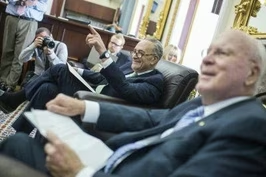
LISA DESJARDINS: The massive trillion-dollar-plus spending deal keeps government funded through the fall and gives this Congress its first bipartisan success.
SEN. MITCH MCCONNELL (R-KY), Majority Leader: These are important priorities for Congress and for the president.
They reflect a lot of hard work.
They promise to positively and meaningfully impact the lives of the men and women we represent.
SEN. CHUCK SCHUMER (D-NY), Minority Leader: And, at the end of the day, this is an agreement that reflects our basic principles, something both Democrats and Republicans can support.
LISA DESJARDINS: President Trump told Bloomberg News he's -- quote -- "very happy" with the bill.
What's in it?
First, what was a sticking point, security.
In the end, the Pentagon got a healthy boost of some $20 billion.
And Immigration and Customs Enforcement will see an increase of 8 percent, much of that for increased detention beds.
The bill also funds 10 new immigration judges.
But it provides nothing for a President Trump priority, the border wall.
Despite that loss, Vice President Mike Pence, speaking on CBS, called the deal a bipartisan win.
MIKE PENCE, Vice President of the United States: It'll avert a government shutdown, but more important than that, there's going to be a significant increase in military spending.
Our armed forces have been hollowed out in recent years by budget cuts.
LISA DESJARDINS: Outside of defense, and in contrast to President Trump's proposals, few agencies face significant cuts.
Some, like the National Institutes of Health, will get a big lift, $2 billion.
Plus, there is increased funding to help Puerto Rico's financial crisis, to fund Pell Grants year-round, expand a mental health office and to fight opioid addiction.
Also in the billion, $2 billion to extend, permanently, health benefits for a large group of coal miners and their families.
House Speaker Paul Ryan said the bill makes America -- quote -- "stronger and safer."
But contrast that with Republican Jim Jordan of Ohio of the conservative Freedom Caucus.
REP. JIM JORDAN (R), Ohio: I think you're going to see a lot of conservatives be against this plan this week.
Why did we last fall do a short-term spending bill, if we weren't going to fight for the things we told voters we were going to fight for?
LISA DESJARDINS: White House spokesman Sean Spicer acknowledged Republicans needed Democratic votes.
SEAN SPICER, White House Press Secretary: This is something that required 60 votes in the Senate.
We couldn't have our entire way on this, but we're five months away from having a 2018 budget, and I think the president's priorities will be reflected much more in that.
LISA DESJARDINS: With the latest stopgap funding measure set to expire Friday, the legislation could see a vote in Congress as early as tomorrow.
Two very hot topics, Planned Parenthood and sanctuary cities, as they are called, were ignored in this bill.
Both keep their current funding for now, but expect those fights to heat up again likely as part of other bills, William.
WILLIAM BRANGHAM: Lisa,the Democrats are claiming this is a pretty big victory for them, the GOP, as we saw in your piece, a little bit less so.
How do you see this shaking out?
LISA DESJARDINS: Well, today, the e-mails came out first from the Democrats overnight.
And it took a little bit longer to hear from the Republicans.
But let's look at -- what their broad priorities, what they did here.
Republicans made one big trade-off.
They wanted defense spending to go up.
They wanted some more border security spending, but not the border wall.
For that, they trade off a slew of issues that were important to Democrats, as we said, Puerto Rico.
But there is a whole other range of them, including, for example, the National Endowment for the Arts, which got a slight increase in this as well.
WILLIAM BRANGHAM: In the past, we have had shutdowns, or we came very, very, very close to having a shutdown.
This wasn't the case in this.
The GOP seemed to think that they were just going to get blamed if the government shut down, and that is why they seemed to have backed off a little bit?
LISA DESJARDINS: I think that is exactly right, because there were Republicans talking to us privately last week trying to get reporters in the framework of, oh, Democrats will be blamed if this shutdown happens.
But the very fact that they were bringing that up, William, you knew that they were worried that they would catch the blame.
Part of that is because they were blamed the last time that happened, because they shut down government over the Affordable Care Act and trying to end that.
But I think there's also an issue with Republicans that they are concerned that some of the issues they feel the most strongest about do not yet have majority of approval in polling, like Planned Parenthood.
Most Americans want that to continue to be funded.
So if they are willing to shut down government over something that is unpopular, they think that will go blow up against them.
So they didn't take those stances in this bill.
WILLIAM BRANGHAM: You touched on some of the very broad things that were being cut or being supported.
But there are some very specific, real people that are targeted here or benefit here.
Tell us about those people.
LISA DESJARDINS: I get to use more graphics.
I'm excited.
(LAUGHTER) LISA DESJARDINS: Let's talk about some of the winners here that I found poring through the bill that you might not hear about otherwise.
The top of the list are military personal.
They will receive a 2.1 percent pay raise.
That's something they have been fighting for.
That is not an enormous pay raise, but it more than they had been getting, 1.6 percent, otherwise.
Now, the cities of New York and Palm Beach, they have a lot of residents in common, I think often, in winner and summer.
One of those, of course, is President Trump.
And he has been costing millions of dollars to those two cities to try and protect him and protect their residents as he comes.
They will receive some $68 million to help pay for that added protection.
They are the two largest recipients of that money.
And Amtrak, people who travel up and down the East Coast in particular, Amtrak is getting a big funding boost.
Now, not everyone did all that well.
A couple of things that I noticed that did get some cuts, you might not hear about, the Coast Guard.
The U.S. Coast Guard will not be getting as big of a pay raise as the rest of the military, and they're also getting a cut.
And the U.N., listen to this, William.
The U.N. will see some $640 million less from the United States in this bill that was passed than last year.
That is a lot of money.
WILLIAM BRANGHAM: Indeed, it is.
But from the outside, as an observer, this certainly seemed like a relatively civil process, with not the usual sort of fighting and recriminations.
Is it too much to read into this, or do you think this actually could be a change in the tone on Capitol Hill?
LISA DESJARDINS: Imagine that.
I don't think so, actually.
I noticed, when senators and congressmen came back from their Easter recess, that there seemed to be less of a personal sense of animosity that we had had up until that point, and that there had been more of a sense of the political.
So, I guess to paraphrase "The Godfather," it's not personal, it's political.
It had been personal.
I think that's good for civility, that's good for conversation.
But we still have a very large political problem, especially for Republicans.
They still don't have all the votes coalescing to get across the bills that they want.
WILLIAM BRANGHAM: Speaking of those, quickly, the health care bill, what is the likelihood we're going to see something this week?
LISA DESJARDINS: Yes, I think you will talk to Amy and Tam coming up.
I would like to hear what they say.
But I think right now, unlikely, for now.
They do not have the votes.
I think, we look ahead, a lot of these things, they are going to kick down the can.
I also understand that the White House has been saying tonight that they will bring the border wall back up again later this summer.
So I think we're going to be regurgitating all of these issues again.
Republicans will have more and more chances to get their votes.
We will see if they do.
WILLIAM BRANGHAM: All right, the "NewsHour"'s Lisa Desjardins, thank you so much.
In the day's other news: Thousands of demonstrators across the country took to the streets in massive May Day events, mostly protesting President Trump's policies.
May 1 is ®MDNM /International Workers Day, and has become a rallying point for immigration advocates and labor unions.
Strikes and marches were organized in more than 200 cities.
One protest in New York City denounced the president's views on immigration.
MAN: There is fear and there is anxiety.
But what gives me hope and gives me resilience moving forward is that the community is resisting and saying this is not the way that we should operate in the United States and we have got to stop.
And we are going to push back.
And that's what I am excited today.
That's why we're here marching and being loud and visible.
WILLIAM BRANGHAM: May Day demonstrations also took place around the world.
In France, protests grew violent when activists interrupted a peaceful union march in Paris by throwing Molotov cocktails at police officers.
They responded with tear gas and batons.
In the U.S., parts of the South and Midwest braced for more severe weather today.
This comes on the heels of a line of powerful weekend storms that killed at least 16 people.
That weather system spawned tornadoes and heavy flooding, and inflicted widespread damage.
Deaths were reported across five states: Texas, Missouri, Arkansas, Mississippi, and Tennessee.
North Korea said it is ramping up its nuclear arsenal in the face of growing U.S. and international pressure.
This comes two days after North Korea conducted another ballistic missile test, which failed.
State television announced the new threat today, and hinted at more tests to come.
MAN (through translator): Now that the U.S. is kicking up a racket overall for sanctions and pressure against us, we will speed up at the maximum pace to bolster our nuclear deterrence.
It will be taken in consecutive and successive ways at any moment and any place decided by our supreme leadership.
WILLIAM BRANGHAM: President Trump told Bloomberg news he's open to meeting with North Korean leader Kim Jong-un, if the circumstances were right.
He said: "If it would be appropriate for me to meet with him, I would absolutely.
I would be honored to do it."
Meanwhile, President Trump's reelection campaign unveiled new ads today, hailing accomplishments of his first 100 days.
The $1.5 million TV and online ad campaign touts achievements like the confirmation of Supreme Court Justice Neil Gorsuch, tax cuts, and the approval of the Keystone XL pipeline.
It doesn't mention the failed attempt to repeal Obamacare or the president's controversial travel ban.
FOX News co-president Bill Shine has resigned amid turmoil at the network.
Shine has worked for FOX since 1996.
He was tapped as co-president after CEO Roger Ailes was ousted last summer, following a sexual harassment scandal.
Shine was named in at least four lawsuits or allegations involving alleged sexual harassment or racial discrimination.
His departure comes just two weeks after anchor Bill O'Reilly also left the network.
The Trump administration today rolled back the nutrition standards for federally funded school lunches that were put in place under President Obama.
That means schools can now delay implementing stricter requirements on the amount of sodium and whole grains in the food they serve.
Agriculture Secretary Sonny Perdue signed the order at a school in Virginia, after eating lunch with elementary school students.
The Supreme Court ruled today that cities can sue banks for discrimination under the Fair Housing Act.
But they must prove a direct connection between predatory lending and the city's loss of revenue.
The case involved a lawsuit filed by Miami against Bank of America and Wells Fargo, which accused them of targeting minority borrowers with risky, more expensive loans.
And stocks were mixed on Wall Street today.
The Dow Jones industrial average lost 27 points to close at 20913.
The Nasdaq rose 44 points, and the S&P 500 added four points.
Still to come on the "NewsHour": Trump's controversial White House invitation to the Philippines' strongman president; inside the civil war ravaging the world's newest country; from elementary to high school, an investigation into thousands of sexual assaults; and much more.
Now: the president's weekend phone call with the president of the Philippines and the uproar that has ensued.
SEAN SPICER, White House Press Secretary: There's a lot that the president talks to these leaders in private about.
Privately talking about them, building a relationship can achieve results.
WILLIAM BRANGHAM: The White House defended what it said was a very friendly phone call.
On the other end of that call, the president of the Philippines, Rodrigo Duterte, a man who's presided over a bloody anti-drug crackdown that's killed thousands of people in his country.
Also during Saturday's conversation was an apparent surprise invitation from President Trump to Duterte to visit him in person at the White House.
That prompted an outcry from human rights advocates, including the United Nations' human rights commissioner.
ZEID BIN RA'AD ZEID AL-HUSSEIN, United Nations High Commissioner for Human Rights: My hope is that the president of the United States will convey this deep sense of alarm about the apparent shirking of the obligations under law.
WILLIAM BRANGHAM: The scale of the killing in the Philippines is enormous.
Human Rights Watch found that over 7,000 people were killed in Duterte's first six months in office.
Duterte has been defiant, and was roundly condemned for comments like this last fall: RODRIGO DUTERTE, Philippine President: Hitler massacred three million Jews.
Now, there is three million, what is it, three million drug addicts, there are.
I would be happy to slaughter them.
WILLIAM BRANGHAM: White House officials said the overture part of a wider effort to rally Asian leaders against North Korea and its missile program.
Speaking to a summit of South Asian nations just before the phone call with President Trump, Duterte appealed to the U.S. to show restraint.
RODRIGO DUTERTE: I will say just, Mr. President, please see to it that there is no war, because my region will suffer immensely.
WILLIAM BRANGHAM: Poor relations with the Obama White House led Duterte to threaten a pivot to warmer relations with China.
The Philippines and China continue to dispute territory in the South China Sea, but, today, Duterte welcomed a Chinese naval fleet to his country's shores.
As for taking up President Trump's invitation to the White House, Duterte played coy, saying he was -- quote -- "tied up" with a full schedule.
For more on President Trump's invitation to President Duterte, as well as his relationships with other authoritarian leaders, we turn to David Kramer.
He served as assistant secretary of state for human rights during the George W. Bush administration, and is now with the McCain Institute for International Leadership at Arizona State University.
Welcome.
DAVID KRAMER, Former U.S. Assistant Secretary of State: Thanks.
WILLIAM BRANGHAM: Your first reaction to the invitation to President Duterte?
DAVID KRAMER: I think it's one thing for the president to have a phone call with President Duterte.
It needs to be done, given the tensions in Asia, the problems with North Korea, the challenges with China.
It is a different matter, though, to embrace Duterte and to invite him here to Washington and to visit the White House.
I think that's going much too far, given the gross human rights abuses that are occurring in the Philippines, with estimates of some 7,000 people killed since Duterte became president in June, a number of victims of extrajudicial killings.
WILLIAM BRANGHAM: We touched a little bit of this in the setup.
How much do you hold Duterte responsible for those killings?
DAVID KRAMER: He certainly is not discouraging them.
In fact, he is encouraging them.
He has taken credit for some killings, including when he was mayor before becoming president.
And he is creating an environment in which this kind of action is being encouraged, not just condoned.
So, I think Duterte does deserve a lot of responsibility.
It is popular in certain segments, in part because a lot of the people being killed come from poor, impoverished areas, and they don't have strong advocates speaking out for them.
But there is this concern that it could spin out of control and create all sorts of problems.
And it already has.
I mean, 7,000, if that number is right, is an extraordinary number in such a short period of time.
WILLIAM BRANGHAM: Apparently, President Trump didn't clear this with the State Department before issuing this invitation.
Is that unusual?
DAVID KRAMER: Well, the president of the United States, whether it's Donald Trump, Barack Obama, George Bush, can basically do what he wants when it comes to invitations to the White House.
But it is a little unusual that this kind of invitation wouldn't have been prepared ahead of time as part of his talking points.
The reports indicate that it came as a surprise, not only to the State Department, but to some people on the National Security Council and the White House as well.
WILLIAM BRANGHAM: Do you think of this invitation as an endorsement?
You have described this as an open-arms embrace of sorts.
Is the president endorsing this behavior by bringing this man seemingly with open arms?
DAVID KRAMER: Well, in the statement, there didn't appear to be any reference to human rights concerns in the Philippines.
And by inviting a leader to the White House or to the United States to visit with his American counterpart, it does send a signal that the president is not attaching much importance to human rights concerns.
We have seen the embrace of President Sisi from Egypt, the phone call to President Erdogan after the very controversial referendum in Turkey.
We have seen the admiration voiced by candidate Trump and President Trump toward Vladimir Putin.
So, there does seem to be this affinity for strongmen around the world, without an accompanying expression of concern about the human rights abuses that are occurring in these countries.
WILLIAM BRANGHAM: You were in the State Department.
You know that presidents often have to deal with unsavory characters and sometimes that there is a strategic goal in putting your arm around someone who you may personally feel is a reprehensible human being.
Couldn't there be a strategic interest?
I mean, couldn't this really just be about North Korea?
DAVID KRAMER: Well, for sure.
Those of us in the human rights community have never argued that human rights should drown out other interests the United States has.
We have energy, economic interests with countries, security interests, but we also have democracy, human rights interests with countries.
And our argument is that that last set of interests shouldn't be shortchanged in the pursuit of these other interests.
WILLIAM BRANGHAM: Let's say President Trump did speak out and somehow condemned what Duterte has been doing or been involved in.
Isn't there a risk, given Duterte's personality, that we could jeopardize the Philippines as an ally, who are a very crucial ally to us?
Isn't there a risk that he could sully that relationship?
DAVID KRAMER: There is a risk.
And we saw this last year when President Obama indicated he was going to raise human rights issues if he had met with Duterte, and Duterte responded with an epithet toward the president, and basically said he was going to turn to China and Russia.
I think that's a little more bluff, even though today there were Chinese naval vessels in a port in the Philippines that Duterte himself visited.
But, at the end of the day, the Philippines-American relationship is longstanding.
We have very strong ties between our peoples, our countries and our governments.
And I think it's important to use those ties as leverage to insist and press for better treatment of the people of the Philippines.
WILLIAM BRANGHAM: Last quick question.
President Trump today also said that he would meet with the North Korean leader.
How does that sit with you?
DAVID KRAMER: I would hope that that would be a last resort after everything else is tried at lower levels.
Granting an audience to the worst abuser of human rights, the North Korean leader, President Kim, is something I would hope we don't see any time soon.
The problem is, obviously, not just nuclear concerns, nuclear security, but also the treatment of North Korean people by its leader.
That is a huge problem.
And I hope that would also not get swept under the rug.
WILLIAM BRANGHAM: All right, David Kramer of the McCain Institute, thank you very much.
DAVID KRAMER: Thank you.
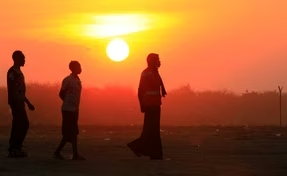
WILLIAM BRANGHAM: The world's youngest country is tearing itself apart.
South Sudan was founded in 2011, but, two years later, forces allied to the president and vice president began fighting each other.
That civil war has now led to the near collapse of the country.
In partnership with the Pulitzer Center on Crisis Reporting, special correspondent Jane Ferguson begins a series of three reports.
Tonight is a look at this brutal war and its tribal roots.
And a warning: Some images and stories in this report are disturbing.
JANE FERGUSON: This was once a busy market town.
Villagers from the countryside would come to Leer to trade goods and catch up on news.
Now there is no one.
All the people have fled into the bush, hiding from violent raids by government soldiers.
We found some of them a few miles away in rebel-held land.
They had crept out of hiding to get help from aid agencies.
Without it, they will starve.
Their stories of what they have endured are horrifying.
MAN (through translator): The government is killing men, women and children, and sometimes they even cook the dead bodies and force us to eat them.
My 5-year-old daughter was slaughtered, and they made me eat her body.
JANE FERGUSON: Tales of such brutality are common in South Sudan's civil war.
A fallout between president Salva Kiir and his vice president, Riek Machar, began in 2013, tearing the country along tribal lines.
Kiir is from the Dinka tribe, Machar from the rival Nuer tribe.
Fighting between the two sides soon involved other subtribes.
Battles broke out across the country.
Murderous raids on civilian communities are a favored tactic, according to Jonathan Pedneault of Human Rights Watch.
JONATHAN PEDNEAULT, Human Rights Watch: Both opposition and government fighters see various specific ethnic groups as being supportive of their -- either of their opponents.
And in order to decrease the military capacities of their opponents, they decide to target civilians, because, without civilians, those fighters won't have a place to stay, they won't receive food, they won't receive popular support.
So, the aim by targeting civilians is, in effect, to cut the grass under the feet of those fighters.
JANE FERGUSON: This is what ethnic cleansing looks like.
Entire populations of specific tribes are being forced out of areas in South Sudan.
Malakal town was a mixture of tribes.
Government and opposition forces have been fighting over it throughout the war, both committing atrocities.
Each time the town changed hands, civilians of a specific tribe were targeted.
It's now controlled by Dinka government soldiers.
Entire neighborhoods, where the Nuer and other tribes at risk used to live, lay silent and empty, the grass reclaiming streets that used to be home for so many.
We are not allowed to get out and film in the town center.
There's lots of police and army around, but what there aren't are civilians who live here.
This was once South Sudan's second biggest city.
And the streets and neighborhoods are completely abandoned now.
Civilians are fleeing towns and cities across South Sudan because of repeated attacks.
And they're just turning into ghost towns.
They ran to this camp just outside the town.
It is a dusty, miserable place, where sewage runs between shacks and desperately poor survivors of the violence try to go on living.
Elizabeth is one of them.
A single mother of six, she sells cups of tea in the camp to earn some money.
But the memory of what happened in the town is always with her.
ELIZABETH SHOL ROUT, South Sudan (through translator): I saw many people killed, including my brother.
They called my brother to come out of the house and shot him in front of me.
JANE FERGUSON: The only thing standing between her and the government soldiers are U.N. peacekeeping soldiers.
They guard this camp and others like it across South Sudan, trying to stop more massacres.
The U.N. said in December in a statement South Sudan is on the brink of all-out genocide, similar to what happened in Rwanda in 1994.
And yet its peacekeepers seem unwilling or unable to stop it.
Last year, government soldiers forced their way into the camp, and over several days murdered more than 25 people and injured and raped many others.
Elizabeth shows us where they came in.
She remains bitter that the U.N. soldiers didn't stop them.
ELIZABETH (through translator): They did nothing.
When they saw the soldiers cut the fence and come into the camp, they just opened the gate to allow the people to escape.
JANE FERGUSON: There are over 13,000 U.N. peacekeeping soldiers in South Sudan.
More than 200,000 civilians have fled to their bases across the country when targeted by the violence, forcing the U.N. to create guarded camps in order to protect the people.
Despite having authority to use force if needed to stop attacks against civilians, the peacekeepers have come under criticism for not doing so when attacks have happened in front of them.
MOUSTAPHA SOUMARE, United Nations: Peacekeeping, and that's all it is.
It's really you keep peace.
So, normally, the people who come in peacekeeping, the troops and so on, are really prepared in the spirit of peacekeeping, not really entering into direct fight.
JANE FERGUSON: Despite this, he says the U.N. have now pushed their forces to improve.
MOUSTAPHA SOUMARE: They have been instructed that, if you see something like that, you make a warning shot.
If people are -- really not responded, you can actually use your firearm on that.
JANE FERGUSON: South Sudan is the world's youngest nation, and the international community played a major part in its creation.
After decades of devastating civil war with the North, South Sudan finally won its independence with a referendum in 2011.
American church groups and politicians had campaigned for the peaceful birth of the nation for years.
But it was South Sudanese fighters, community leaders and advocates who sacrificed so much to see this country find its freedom.
One of them was Alfred Taban.
A veteran journalist and newspaper editor, he was jailed and tortured repeatedly for years in the northern capital of Khartoum for calling for independence.
ALFRED TABAN, Journalist: Well, I knew we were going to succeed.
I knew we had not -- we had not done anything bad.
We were struggling for our rights as human beings.
And that's what led me to survive.
I knew we will succeed.
JANE FERGUSON: After sacrificing so much for his country, its rapid descent into civil war has broken his heart.
ALFRED TABAN: The killing of one another started, the Nuers being killed, the Dinkas being killed and other tribes, then I knew things had really gone bad.
Then I knew that partly we -- or they themselves, they were not only struggling for the people, but they were struggling for themselves to lead or to rule.
I became very, very disappointed.
JANE FERGUSON: In frustration, he wrote a column in the newspaper he runs calling for the leaders of both sides in this war to step down.
Shortly after, the government he sacrificed his freedom for jailed him for nearly two weeks.
ALFRED TABAN: They were not struggling for their people.
They were struggling for themselves.
And this is why really the struggle of the people of South Sudan has been hijacked from the very beginning.
It has become a struggle for position and wealth, not a struggle for the betterment of the lives of the people of South Sudan.
JANE FERGUSON: Yet neither side in this war is backing down.
It is spiraling into a frenzy of ethnic-driven murder and revenge.
The dream of a peaceful South Sudan is dying with its people.
For the "PBS NewsHour," I'm Jane Ferguson in Juba, South Sudan.
WILLIAM BRANGHAM: For the record, the South Sudanese information minister canceled an interview with Jane Ferguson to respond to charges against the government.
Tomorrow, Jane reports on the famine that the war has caused.
WILLIAM BRANGHAM: Stay with us.
Coming up on the "NewsHour": a weekend chockful of politics kicks off a busy week on Capitol Hill -- our Politics Monday duo breaks it all down; and a behind-the-scenes look at one of the world's fastest growing social media networks.
But first: A new investigative report finds a disturbing pattern.
Sexual abuse of students by other students happens more frequently in schools than reported, and the consequences for the offenders vary considerably.
Jeffrey Brown has the story.
JEFFREY BROWN: A hidden horror educators have long been warned not to ignore -- that's the description of sexual abuse in schools by the Associated Press, which published its story today.
AP Reporters found that students were seven times more likely than adults to sexually assault another student.
During a four-year period, the AP tallied at least 17,000 cases around the country.
These included many cases that were treated as bullying or hazing instead.
Emily Schmall is a member of the AP team.
She joins me now from Dallas.
Emily, thanks for joining us.
One key point you're making is that this happens more often than we know, right?
Is it possible to say how pervasive it is?
EMILY SCHMALL, Associated Press: Yes, it's absolutely true.
It happens far more often, I think, than people realize.
To say exactly how pervasive it is, it's difficult though, because, just like rape and sexual assault perpetrated in other places, rape and sexual assault in schools is definitely under-reported.
So, while we have been able to tally about 17,000 incidents over the four years, experts have told us it's just the tip of the iceberg.
JEFFREY BROWN: So, let's establish what we are talking about.
Really, we're going beyond bullying, beyond hazing.
Tell us what you are looking at exactly.
EMILY SCHMALL: Yes.
So, we were very, very deliberate in what we counted.
And we are looking at sexual assault as defined by the Justice Department, which means forced intercourse or sodomy, forced oral sex, the most severe forms of sexual assault.
We deliberately didn't include categories like sexual harassment or bullying, even though, as you noted, sometimes, sex assaults are reported as these things.
JEFFREY BROWN: Well, so if you look at the rules governing schools, I gather that it really varies from state to state in terms of how much this is tracked and what kind of actions are taken.
EMILY SCHMALL: Yes, and even sometimes within school districts.
There's no federal requirement that says schools have to track student-on-student sex assault, even though for a long time schools have been tracking things like free and reduced lunch, guns, drugs on school property.
This is just something that they are not obligated to track.
So, various states do collect some sort of information, but it's inconsistent state to state.
And a lot of times, school districts sort of have the discretion over how they report these things.
Therefore, in a case -- there were plenty of cases we found where they have led to a criminal charge, but the act it itself was categorized and reported to the state as bullying or as sexual harassment or as a lesser form of sex offense.
JEFFREY BROWN: You referred to this a little bit earlier, Emily.
Just in terms of why these cases float so much under the radar, why we know so little, spell that out a little bit.
EMILY SCHMALL: Yes, so the experts we spoke to said there's just a real reluctance on the part of not only school administrators, but parents as well, to acknowledge this for what it is.
They have a hard time recognizing that kids at such a young age can be perpetrators or be victimized in this way.
So, that's part of it.
The other part is that a lot of schools have said that they aren't really aware of what they are supposed to do when an allegation of sexual assault between students surfaces.
And then, lastly, some experts have actually said that schools are just looking after their public image more than they are the victims.
JEFFREY BROWN: And, of course, in the wider public, it's just something hard for all of us to want to even discuss, I assume.
EMILY SCHMALL: I think so.
I mean, I think there's still really a stigma about sexual violence, not only in the context of K-12 schools, but in our country at large.
So it's even more intense at the younger school level.
JEFFREY BROWN: Well, so what can or should be done?
What -- for parents, for educators?
What are the experts telling you?
EMILY SCHMALL: Well, the experts are saying that, you know, there is a real reluctance among, not only school administrators, but parents as well, to acknowledge, even, that this is happening and that kids of such a young age are perpetrating these kinds of offenses.
So the experts say that it needs to be recognized for what it is.
There are a lot of people working in the space of how we solve this, how we empower other kids to report it.
It is actually something that we're going to be taking on later on in the series.
Our stories are running every Monday in May.
JEFFREY BROWN: All right, Emily Schmall of the AP, thank you very much.
EMILY SCHMALL: Thank you.
WILLIAM BRANGHAM: Turning back now to the compromise reached in Congress to avoid a government shutdown, the effort to pass a health care replacement, and the president's contentious relationship with the press, it's time for Politics Monday, with Tamara Keith of NPR and Amy Walter of The Cook Political Report.
Welcome to you both.
AMY WALTER, The Cook Political Report: Good to be here.
WILLIAM BRANGHAM: Amy, I would like to start with you.
So, government didn't get shut down.
That's a good thing, right?
What happened?
AMY WALTER, The Cook Political Report: Yes, great, they kept government functioning.
(LAUGHTER) AMY WALTER: The most basic thing that Congress can do is to keep the lights on.
So, yes, this is a success, but it also is not the hardest thing that they need to do.
We have big, difficult pieces of legislation that we have been hearing about.
Obviously, one of those pieces of legislation, health care, has already been pulled.
There's talk that it may be reintroduced this week or later on.
But the fact that they were able to get one basic piece of legislating done, which, by the way, is supposed to be the easiest, I don't think means that we're going to suddenly see the floodgates open and now everything is going to... WILLIAM BRANGHAM: Kumbaya.
(CROSSTALK) AMY WALTER: Right, everybody is going to work together and get the big stuff done.
WILLIAM BRANGHAM: Tam, do you think that is right?
Have we just lowered the bar so low that, when they do basic things like cross kids across the sidewalk to school, that is a huge victory?
TAMARA KEITH, National Public Radio: Yes, and if you liked this movie, just wait.
The sequel comes in September.
AMY WALTER: Right.
(LAUGHTER) TAMARA KEITH: Because this was just basically finishing out of the year.
The year ends at the end of September.
And what the Trump administration is saying is, you know, we didn't try that hard to get what we wanted this time around because it was already -- the process was under way.
It was a bipartisan effort.
But we're going to really fight for what we want next time around.
So, it becomes potentially a bigger battle in September, where you have a president who needs to prove that he can get some of the things that he wants.
And Democrats aren't going to be any more willing to roll over than they were this time around.
This -- it is a fascinating thing.
Basically, Democrats and Republicans in Congress have been fighting over how to fund the government, and not very successfully fighting about it, for years and years and years and years.
And then you just -- you know, we're on like the eighth or ninth sequel.
It's like "The Fast and the Furious."
(LAUGHTER) WILLIAM BRANGHAM: Do you think this is just... AMY WALTER: But without any of the cool... (CROSSTALK) WILLIAM BRANGHAM: Right, no car crashes, no Vin Diesel.
AMY WALTER: No Vin Diesel.
WILLIAM BRANGHAM: Was this just a case where the GOP was scared that they were going to get the blame?
AMY WALTER: Yes, if you control the government, you get all the blame, and you get the credit.
And the bottom line is, we have seen now in these past 100 days that, despite the fact that Republicans control all three levers of government, getting stuff done isn't as easy as they thought it was.
The president himself has said, boy, this is a little bit harder doing this governing thing that I thought.
And he is rightly pointing to the fact that Republicans have never had to govern before.
They have been -- most of them have been in the minority.
They have never been with a Republican president.
They have never had control of government.
So, this is a brand-new experience for them.
All the old fights that, by the way, to Tam's point, have been brewing for years and years and years -- this isn't Donald Trump's fault.
The divisions between Republicans on a whole host of issues have been there, I would argue, going all the way back to the Bush administration on a lot of these issues.
They didn't just get cleared away because there is a new president.
WILLIAM BRANGHAM: On health care, Tam, rumblings that there might be a piece of legislation.
Are they going to be able to solve these divisions that they -- that the GOP discovered last time they tried to do this?
TAMARA KEITH: So, these rumblings have been rumbling basically every week since the health care bill in the House failed to get a vote.
They pulled it from the floor without a vote because it was going to fail.
So, these rumblings happen every single week.
They are happening again.
But until we see House leaders put a bill on the floor, the votes aren't there.
When they have the votes, they will put it up for a vote.
But in the meantime, we will continue to talk about it.
Today, in a Bloomberg interview, the president said, I want this to be good for sick people.
It's not in its final form right now.
It will be every bit as good on preexisting conditions as Obamacare.
What he is describing is not the thing that they are potentially voting on right now, because advocates from various nonpartisan groups will say that it isn't as good on preexisting conditions.
So, does that mean that this is reopened?
I guess we will find out.
AMY WALTER: Yes.
WILLIAM BRANGHAM: Right.
AMY WALTER: And that's a very difficult place if you are a Republican right now.
Your choice is, we don't get anything done, and then the base is furious at you, because you have been telling Republicans, you have been telling the whole country, vote for us, we going to repeal Obamacare.
WILLIAM BRANGHAM: For seven years.
AMY WALTER: For seven years.
Don't do it, that's a problem.
Or you do pass something that is not particularly popular, where you lose the support of your moderate wing of your party, the folks who, by the way, are in the most vulnerable districts, most likely to lose in a midterm election.
They are voting no because they see it as being unpopular, whether on preexisting conditions or others.
That is a very uncomfortable spot to be.
Don't pass anything, people are angry with you.
Pass something that even a lot of your supporters don't like, and then you have to defend it coming up in the midterm election.
This is a very, very -- you know, it's like being in a vice.
Not comfortable.
WILLIAM BRANGHAM: Let's talk about this weekend.
Let's just say, if I had been Rip Van Winkle, and I woke up, say, Sunday morning and looked at the newspaper, and saw President Trump had had that rally and seen clips from that rally, I would think we were still in the middle of a campaign.
TAMARA KEITH: It was absolutely a campaign rally.
It was put on by his campaign.
It included some of the greatest hits from his campaign, including the snake poem, song thing that was hugely popular among his supporters that it is supposed to be a cautionary tale about immigrants coming... (CROSSTALK) WILLIAM BRANGHAM: There is about -- Trump is saying, if you let the snake into your house, and that snake bites you, who is to blame?
You are to blame.
TAMARA KEITH: Exactly.
And it's been something -- it's the kind of thing where he would say, I might talk about the snake at his rallies, and people would go, rah!
And this that is exactly what happened at this rally.
He also did the CNN is terrible, the failing New York Times, the whole thing, a lot of bashing of the media, which is kind of fascinating, because it comes in a week where he has done so many interviews with basically every news outlet in America.
If the media is the opposition party or whatever he wants to call it, why does he keep talking to us?
(LAUGHTER) WILLIAM BRANGHAM: Right.
AMY WALTER: And his campaign, by the way -- on top of all of this, not only did he have a campaign-style rally as a president, but his campaign is literally running ads right now that look like... WILLIAM BRANGHAM: Right.
How unusual is that?
AMY WALTER: It's not that unusual for a president out of the time when he is running for president trying to sow some good feelings.
And, definitely, he needs to boost his approval rating.
But it is unusual that the campaign itself is already spending money trying to talk about a president who is 100 days into his presidency.
WILLIAM BRANGHAM: Right.
AMY WALTER: The other thing you noticed was, it wasn't just the media.
Of course, they had their own special event where they were defending themselves against attacks from Donald... WILLIAM BRANGHAM: The correspondents dinner.
AMY WALTER: Right, which, again, felt like we were back in 2016.
And then there were rallies around the country, especially here in Washington, D.C., on climate change, where you had the so-called resistance shouting about how much they dislike the president and want to see him go.
So, it feels like we are never going to break out of this... (CROSSTALK) WILLIAM BRANGHAM: That's probably why he wanted to get out of town.
Amy Walter, Tamara Keith, thank you both so much.
AMY WALTER: You're welcome.
TAMARA KEITH: You're welcome.
WILLIAM BRANGHAM: Next: the rapid rise of one of the world's biggest social media networks, Instagram.
It's building up steam, with 700 million people now using it each month, and it just took four months to pick up its latest 100 million new accounts.
But along the way, the company has faced concerns over how it can be used, and even some criticism for the way it essentially copied ideas from its rival, Snapchat.
Judy Woodruff recently got an inside look during her trip to Silicon Valley.
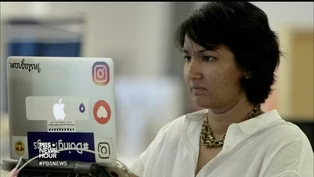
JUDY WOODRUFF: One of the first things that greets you inside Instagram is, no surprise, a place to take pictures.
The free photo-sharing mobile app was born in 2010 with its first post, a foot in a flip-flop alongside a stray dog.
Turns out it was taken in Mexico by co-founder Kevin Systrom.
KEVIN SYSTROM, Co-Founder, Instagram: It's a mixture of teams.
So, we have got design teams, we have got partnership teams, we have got a community team, and then a bunch of engineers.
We don't really have an organization.
JUDY WOODRUFF: Systrom showed us around Instagram's new offices in Menlo Park, California, designed to accommodate an ever-expanding staff.
You moved here six months ago; is that right?
KEVIN SYSTROM: Yes, six months ago, we moved from the original campus.
And we designed this entire experience inside here to be cleaner, and a little bit more Instagrammy.
So we have got the hip wood walls, and the polished concrete floors.
It's very start-uppy, but it's in an Instagram way.
JUDY WOODRUFF: A start-up no longer, Instagram was acquired by Facebook in 2012 for a cool billion dollars.
Then, the company had 13 employees.
Now it has more than 600 to keep up with a rapidly growing user base, 700 million monthly active users and counting, 80 percent of them outside the United States.
How do you explain the phenomenal, rapid growth of this?
KEVIN SYSTROM: On Instagram, very early on, you would post an image, and anyone anywhere in the world could see that image, and understand what you were trying to say without speaking your language.
So, we like to say that Instagram was one of the first truly international networks in the world.
And I think that's what's allowed it to scale to the hundreds of millions of people that use it every day today.
JUDY WOODRUFF: It still is a pretty extraordinary growth rate, isn't it?
KEVIN SYSTROM: Yes.
JUDY WOODRUFF: I mean, even with that rational explanation, it's hard for people to understand how it happened.
KEVIN SYSTROM: Yes.
You know, back in the day, if you started a company, you would have to rent a warehouse, you would have to hire a bunch of employees.
But, you know, with very, very few people sitting here in this building today, we're able to scale it to hundreds of millions of people around the world, because of the innovations that we are built up upon.
And that's the cool thing about running a company today, is how many people you can touch how quickly.
JUDY WOODRUFF: For a company founded on images, the walls here are adorned with some of the best, culled from Instagram users around the world.
KEVIN SYSTROM: Well, not to invoke the common saying, but a picture is worth 1,000 words.
And that's kind of like the phrase that this company is built on.
It's just something that's unlike traditional texts and traditional media.
And I think it allows you to see a different side of people, maybe a more raw and human emotional side of people.
JUDY WOODRUFF: Celebrities have embraced the app.
Singer Selena Gomez has the most followers, more than 118 million.
And Beyonce has the distinction of having the most-liked image in the history of Instagram, 10.9 million and climbing, for this photo that announced she's pregnant with twins.
For teens, the quest for more and more likes and followers, plus the pressure for perfection as portrayed by some mega-popular users, is raising concerns among parents.
Not only body image, but also bullying have become issues for some younger users.
And Instagram is grappling with how to foster a safe community, free from abusive behavior.
So, when you started Instagram seven years ago in 2010, did you have any idea you were going to be spending time, a lot of time now, thinking about protecting the people who use it?
KEVIN SYSTROM: No, I would say, every day at Instagram is not only the most complicated day of my career, but also the most interesting.
JUDY WOODRUFF: How do you prepare yourself for this kind of responsibility?
I mean, what are you, 32 years old?
KEVIN SYSTROM: Thirty-three.
JUDY WOODRUFF: Thirty-three.
KEVIN SYSTROM: Yes.
JUDY WOODRUFF: All of 33.
That's a lot of responsibility, isn't it?
KEVIN SYSTROM: Yes.
And there are a lot of parents here at Instagram who think deeply about a world in which their children are going to grow up online, and what kind of product they want to create, and what kind of legacy they want to leave.
I don't yet have kids, but in a world where I do have kids, I want to make sure that the world they grow up in is one that is safe online, and that Instagram led the way to create that world.
JUDY WOODRUFF: But with 95 million uploads a day, monitoring is a tall order.
New guidelines are aimed at blurring out questionable material before the user even sees it, with a screen labeled "sensitive content."
There's also a reporting function for content about self-harm or suicide.
Systrom says the company's work is far from over.
KEVIN SYSTROM: This is a constant process.
This is about making sure that we continue to evolve the way we attack the problem.
This isn't about getting to an eventual future where it is absolutely gone.
That being said, it doesn't mean that we can't make real progress on it, and, more importantly, show the leadership that I think our company can and should, so that other tech companies do as well.
JUDY WOODRUFF: The pressure in Silicon Valley to lead, innovate and stay relevant is intense.
And Instagram has come under criticism for its outright and successful copying of rival Snapchat's video stories feature Instagram Stories, you have openly said was copied, in effect, from Snapchat.
Is that what happened?
KEVIN SYSTROM: The way things work in Silicon Valley is that companies will think up ideas, and, if they're good, they will stick.
And, often, they spread to other companies.
And if we can learn from other companies that do it really well, we're going to continue to do that.
JUDY WOODRUFF: Advertising on the app is also growing and reaping rewards.
There are one million active advertisers, a 400 percent increase from last year.
How have you changed your advertising philosophy over time?
KEVIN SYSTROM: Yes, there were two major changes, I think, to our advertising philosophy over time.
The first was just to have advertising at all.
JUDY WOODRUFF: Period.
KEVIN SYSTROM: That was a big one.
But we always knew we were going to be a business, and that's how we were going to be a business, was advertising.
The second shift was going from a world where we had a small number of advertisers doing very refined ads to now, where we have many, many millions of advertisers on Facebook able to buy Instagram ads.
JUDY WOODRUFF: We ended where we began, in front of Instagram's wall of photo-ops, where Systrom shares credit for how far the company has come.
KEVIN SYSTROM: It was the right time, it was the right idea, and then it was the right team.
You need a lot of things to go well to get to this point.
So I feel very lucky.
WILLIAM BRANGHAM: The business practices and decisions made by Instagram and, much more broadly, by Facebook are increasingly under scrutiny.
We will have a closer look at that issue later this week.
Now to our "NewsHour" Shares, something that caught our eye that may be of interest to you, too.
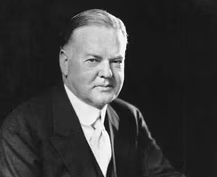
Herbert Hoover may be best remembered as a rigid Republican whose presidency saw the start of the Great Depression.
But newly discovered reels of film reveal a softer, more human side of the man and his family.
The "NewsHour"'s Julia Griffin explains.
JULIA GRIFFIN: Herbert Clark Hoover, engineer, humanitarian, and 31st president of the United States, he's forever imprinted in our history books in Depression-era black and white -- or maybe not.
Seven recently unveiled home movies now place his White House in a colorful new light.
LYNN SMITH, Herbert Hoover Presidential Library-Museum: You get used to seeing the '20 and '30s in black and white only, so, to see them in color is kind of like going through a time machine.
JULIA GRIFFIN: Lynn Smith is the audio-visual archivist at Herbert Hoover Presidential Library-Museum.
In 2014, she discovered the films weren't black and white, but rather Kodacolor, a short-lived product that requires a special projection lens to reveal colored hues.
LYNN SMITH: It's nice to have old color film, but White House color films, there's only one first, and I think we may have it.
JULIA GRIFFIN: The camera belonged to Hoover's wife, Lou, an early home movie technophile.
Now restored, the films show unguarded moments of first family life, a 1929 fishing trip, in which then president-elect Hoover catches a barracuda, or a game of fetch on the White House lawn between first lady Lou and first dogs Pat and Weejie.
One even features Alonzo Fields, who served 20 years as the chief White House butler.
Here, he stands in the 1930 Rose Garden.
But the longest clip offers a rare glimpse of the president's favorite physical activity: a morning match of catch the press dubbed Hoover Ball.
LYNN SMITH: It was a 6-pound leather ball that was filled with stuffing, and they'd have Cabinet members, some members of the Supreme Court out every morning, six days a week.
And they would toss and catch thing.
They would score it similar to volleyball or something like that.
JULIA GRIFFIN: The videos show the Hoover family's lighter side.
LYNN SMITH: He wasn't just the dour, stone-faced man that was president during the Depression.
He did have a heart and soul.
JULIA GRIFFIN: Smith is busy scouring the museum's archives for more shots like this.
For the "PBS NewsHour," I'm Julia Griffin.
WILLIAM BRANGHAM: Tune in later this evening.
"Independent Lens" presents a film that looks at the secret U.S. drone program through the eyes of three veterans who are now whistle-blowers.
"National Bird" explores the difficult circumstances faced by military personnel in that program.
It airs tonight on most PBS stationso~.
And that's the "NewsHour" for tonight.
I'm William Brangham.
Join us online and again here tomorrow evening.
For all of us at the "PBS NewsHour," thank you, and we will see you soon.
For all of us at the "PBS NewsHour," thank you, and we will see you soon.
Early home movies capture White House life in color
Clip: 5/1/2017 | 2m 34s | Early home movies capture White House life in color (2m 34s)
How Congress compromised to prevent a shutdown
Clip: 5/1/2017 | 7m 9s | How Congress compromised to prevent a shutdown (7m 9s)
How Instagram pictures the world
Clip: 5/1/2017 | 7m 32s | Photos translate in every language. 80% of Instagram's users are outside of the U.S. (7m 32s)
South Sudan's civil war spirals into genocide
Clip: 5/1/2017 | 9m 12s | South Sudan's civil war spirals into genocide (9m 12s)

Student sexual assault more common than we thought
Clip: 5/1/2017 | 5m 35s | Student sexual assault more common than we thought (5m 35s)
Providing Support for PBS.org
Learn Moreabout PBS online sponsorship
- News and Public Affairs

FRONTLINE is investigative journalism that questions, explains and changes our world.

- News and Public Affairs

Amanpour and Company features conversations with leaders and decision makers.












Support for PBS provided by:
Major corporate funding for the PBS News Hour is provided by BDO, BNSF, Consumer Cellular, American Cruise Lines, and Raymond James. Funding for the PBS NewsHour Weekend is provided by...