
PBS NewsHour full episode May 2, 2018
5/2/2018 | 53m 25sVideo has Closed Captions
PBS NewsHour full episode May 2, 2018
PBS NewsHour full episode May 2, 2018
Problems playing video? | Closed Captioning Feedback
Problems playing video? | Closed Captioning Feedback
Major corporate funding for the PBS News Hour is provided by BDO, BNSF, Consumer Cellular, American Cruise Lines, and Raymond James. Funding for the PBS NewsHour Weekend is provided by...
PBS NewsHour full episode May 2, 2018
5/2/2018 | 53m 25sVideo has Closed Captions
PBS NewsHour full episode May 2, 2018
Problems playing video? | Closed Captioning Feedback
How to Watch PBS News Hour
PBS News Hour is available to stream on pbs.org and the free PBS App, available on iPhone, Apple TV, Android TV, Android smartphones, Amazon Fire TV, Amazon Fire Tablet, Roku, Samsung Smart TV, and Vizio.
Providing Support for PBS.org
Learn Moreabout PBS online sponsorshipJUDY WOODRUFF: Good evening.
I'm Judy Woodruff.
On the "NewsHour" tonight: President Trump's lead lawyer handling the Russia investigation is stepping down, the latest shakeup in a defense team grappling with a possible interview of Mr. Trump by the special counsel.
Then: the uncertain fate of the Iran nuclear deal.
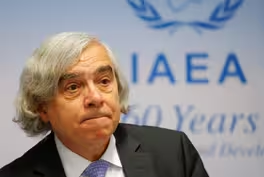
I sit down with former U.S. Secretary of Energy Ernest Moniz to discuss what could happen if the U.S. drops out of the agreement.
Then: defending Missouri -- why the state's public defender system is failing both lawyers and their clients.
Plus, we continue our series inside the world of junk news -- tonight, how one media publisher uses Facebook to build viral hyperpartisan content.
CYRUS MASSOUMI, TruthExaminer.com: My goal at one point was to deliver to them what they like, and, unfortunately, the reality of that is just that people are prone to go for the lowest common denominator.
JUDY WOODRUFF: All that and more on tonight's "PBS NewsHour."
(BREAK) JUDY WOODRUFF: The new U.S. secretary of state says it's time to solve the North Korea nuclear problem once and for all.
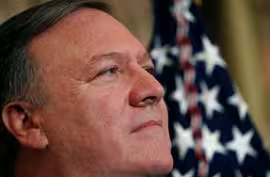
Mike Pompeo spoke this morning after his ceremonial formal swearing-in by Vice President Pence, with President Trump watching, at the State Department.
MIKE POMPEO, U.S. Secretary of State: Right now, we have an unprecedented opportunity to change the course of history on the Korean Peninsula.
I underscore the word opportunity.
We're in the beginning stages of the work and the outcome is certainly yet unknown.
The American people are counting on us to get this right.
We are committed to the permanent, verifiable, irreversible dismantling of North Korea's weapons of mass destructions program and to do so without delay.
JUDY WOODRUFF: Meanwhile, China's Foreign Minister Wang Yi arrived in North Korea for possible talks with its leader, Kim Jong-un.
He's expected to press for a larger role for Beijing in the new round of nuclear diplomacy.
In Libya, two suicide bombers killed at least 14 people at the National Election Commission in Tripoli.
The Islamic State group claimed responsibility, saying it was trying to prevent a nationwide vote later this year.
Video posted online by Libyan television stations showed smoke rising from the building.
The Election Commission said that its electoral database was undamaged.
The U.S. has transferred a prisoner out of Guantanamo Bay for the first time under President Trump.
Ahmed al-Darbi was sent to a rehabilitation program in his native Saudi Arabia.
He pleaded guilty in a 2002 attack on a French oil tanker; 40 detainees are left now at Guantanamo.
Protesters were out in full force across Armenia today, after Parliament rejected the opposition leader serving as prime minister.
His supporters blocked major roads and ministry buildings in a national strike, this on the heels of weeks of protests against corruption.
Later, the opposition leader called off the protests after the ruling party said that Parliament will vote again next Tuesday.
Palestinian president Mahmoud Abbas is under fire after suggesting that European Jews have brought persecution on themselves.
In a Monday speech, Abbas said hatred of Jews was -- quote -- "not because of their religion; it was because of their role in usury and banks."
Today, Israeli Prime Minister Benjamin Netanyahu called Abbas a Holocaust denier and his Foreign Ministry joined in.
EMMANUEL NAHSHON, Israeli Foreign Ministry Spokesman: What we have heard from Mr. Abbas is a series of anti-Semitic accusations of an ugly nature.
Mr. Abbas accuses actually the Jewish people for being responsible for its own tragedy.
Those are things that we cannot accept.
JUDY WOODRUFF: The U.S., the U.N. and the European Union offered their own criticism.
Abbas' spokesman declined comment.
The Palestinian leader has previously questioned how many Jews died in the Holocaust.
Back in this country, the state of Iowa may implement the nation's strictest abortion law.
Overnight, the Republican-majority legislature approved a ban on abortions after a fetal heartbeat is detected.
That's around six weeks, and often before a woman knows she is pregnant.
Republican Governor Kim Reynolds opposes abortion, but has not said whether she will sign the measure.
In Philadelphia, two black men arrested in a Starbucks last month have settled with the city government for $1 each.
City officials also promised $200,000 for an entrepreneurs program in high schools.
Images of Rashon Nelson and Donte Robinson being led away in handcuffs sparked a renewed debate over racial profiling.
Starbucks said that it has reached a separate settlement with the men.
The British data firm embroiled in the Facebook privacy scandal is shutting down.
Cambridge Analytica declared bankruptcy today.
It said it has been unfairly vilified for collecting Facebook user information to build voter profiles.
A British lawmaker warned the company not to delete its data history, as investigations are continuing.
The Federal Reserve Board announced today that it's leaving a benchmark interest rate unchanged.
But it said again that further increases are expected.
On Wall Street, the news contributed to a late-day sell-off.
The Dow Jones industrial average lost 174 points to close below 23925.
The Nasdaq fell 29 points, and the S&P 500 slipped 19.
And the Boy Scouts are changing their name to Scouts BSA, because starting next year, they're also accepting girls.
Today's announcement said the parent organization will remain the Boy Scouts of America.
Cub Scouts, for younger children, will still be known as Cub Scouts.
Still to come on the "NewsHour": a former energy secretary on what could happen if the U.S. exits the Iran nuclear deal; Missouri public defenders overwhelmed with clients now in a catch-22; and much more.
President Trump today tapped a veteran Washington lawyer to join his legal team.
Emmet Flood, who represented President Bill Clinton during his impeachment proceedings, will replace Ty Cobb as the lead White House lawyer in the special counsel investigation.
Here to walk us through the latest developments is Robert Costa, reporter of The Washington Post -- anchor of Washington Post and reporter for -- of "Washington Week" and reporter for The Washington Post.
Bob Costa, I will get it right eventually.
ROBERT COSTA: I'm wearing many hats.
(LAUGHTER) JUDY WOODRUFF: Yes, you are.
So, why is this happening?
Why is Ty Cobb leaving?
ROBERT COSTA: It comes down to President Trump.
This is a major shift, Judy, in the president's legal strategy.
He wants to be more combative.
Talking to White House advisers tonight, he wants to have a team around him that counters Robert Mueller and the special counsel investigation that moves away from Ty Cobb and his strategy of cooperation.
Now, with Rudy Giuliani, the former New York mayor, in there, Emmet Flood, a veteran lawyer known for taking a tough line on impeachment proceedings in federal investigations, that just shows you where the president wants to go.
JUDY WOODRUFF: So, there's been a fair amount of shuffling.
I think I have lost count of how many attorneys have come and gone on the president's various legal teams.
Does this reflect a change or a different moment in this investigation?
Because, up until now, it seemed the president was content to follow this cooperation strategy, but something changed.
ROBERT COSTA: Something did change.
My colleagues and I reported yesterday that, in early March, Mueller threatened a subpoena to President Trump if he decided to decline a voluntary interview.
And ever since then, you have had the raid of Michael Cohen, the president's longtime pressure lawyer, and that has really pushed the president away from cooperating with Robert Mueller.
And now he has a big decision to make.
Will he sit for that interview or not?
And today I talked to Giuliani at length.
And he said, if the president sit -- and that's a big if -- it would only be for two or three hours max, and it would be about a narrow set of questions.
You see a lot of questions being negotiated through the press and privately.
JUDY WOODRUFF: So, you're right, Robert.
There's been a lot of reporting about to what extent the Mueller team has telegraphed to the president's lawyers or told them what he wants from them, what questions he will ask or not.
Do we now have a good sense of what Mueller wants to know from the president?
ROBERT COSTA: We do.
Mueller's team has informed the president's team that they'd like to know about key decisions he has made as president, including the firing of former FBI Director James Comey.
And what they really want to learn from the president and why it's so important, the federal investigators say, for the president to sit down before them is, they want to know his intent.
Did he have corrupt intent when it came to certain decisions, like Comey, to get rid of Comey because of bad management in his eyes as president of the FBI, or was in corrupt intent to rupture the investigations into Russian interference?
That's what the special counsel is trying to figure out, and they feel they need the president to speak directly to them about that.
JUDY WOODRUFF: So among -- so it sounds as, if the White House, especially for the president, the antennae are up and on alert, worried about what this could lead to.
ROBERT COSTA: They very much are on alert, red flags going up.
Giuliani, Emmet Flood -- Emmet Flood, most Washington lawyers will tell you, is not the kind of lawyer who would encourage a president to sit down for an interview.
Ty Cobb was that kind of lawyer.
And these kind of disagreements have consumed the president's inner circle for months now.
That's what led to the resignation of John Dowd, then the president's lead attorney on Russia, in late March.
JUDY WOODRUFF: And, Robert, just quickly, again, what is it about Flood that you think was appealing to the president?
ROBERT COSTA: Flood is close to White House counsel Don McGahn.
Flood is wary of cooperating too much with federal investigators, of opening up the White House to scrutiny.
You have McGahn seeing Flood as someone who understands that it's perhaps the White House's prerogative to exert executive privilege, protect itself in these investigations, at least more than it has been in the eyes of some insiders.
JUDY WOODRUFF: So, separately, Robert Costa, you are reporting just in the last few minutes on what is going on with regard to the president getting more and more concerned about the failure of the Justice Department, or specifically Deputy Attorney General Rod Rosenstein, to cooperate, to turn over documents that certain Republican members of Congress want from him.
Fill us in quickly on that.
ROBERT COSTA: It's a complicated story.
Very briefly, there's a paper fight between Congress and the Department of Justice over documents related to the Russia investigation and a few other investigations.
But the cloud over all of it, Judy, is that they're trying to go after Rod Rosenstein, the deputy attorney general, who also oversees the Mueller probe.
So, as they fight over documents, it risks putting that Russia probe with Bob Mueller at risk, if Rod Rosenstein is removed as the manager.
There's a lot of political chess going on here, a lot of legal chess, and you have got to read up on all of it, but that's what's happening.
JUDY WOODRUFF: So, Rosenstein spoke before a group yesterday.
We saw clips of it on television.
It was reported that he essentially is saying I'm going to do what I think the Justice Department should be doing, let this investigation go forward.
He didn't sound as if he is prepared to turn those documents over.
ROBERT COSTA: He's not.
The Department of Justice said today -- this is a big story -- that they're not going to give Congress the document that shows the scope of the Mueller investigation, something that's come up in the Paul Manafort trial, that they're not going to give it over.
And that has alarmed Trump-allied Republicans on Capitol Hill, like Mark Meadows, the North Carolina Republican House member who speaks regularly to President Trump.
And they're warning of impeachment proceedings against Rosenstein if he doesn't comply.
So we're at this tense moment between the DOJ and House GOP.
JUDY WOODRUFF: And what is the thinking, Bob Costa, if Rosenstein were removed?
ROBERT COSTA: It's a long way from there, Judy.
Speaker Ryan, a Republican, could stop that kind of thing from happening on the House floor.
Meadows still may try to do it through different House rules.
But it would be an unprecedented moment to have a federal official who wasn't being accused of bribery, the usual kind of impeachment proceedings for a judge or someone like that, for a document fight to lead to impeachment.
It would be, to say the least, historic.
JUDY WOODRUFF: Robert Costa of both "Washington Week" and The Washington Post, so much to follow.
Thank you very much.
ROBERT COSTA: Thank you.
JUDY WOODRUFF: Another deadline looms for the president, this one on May 12.
He must decide whether to continue waiving sanctions that had been imposed on Iran, but were lifted as part of the 2015 nuclear deal.
If they are put back in place, that would be a violation of the Obama administration era agreement which froze Iran's nuclear program.
On Monday, one of the deal's harshest critics, Israel's Prime Minister Benjamin Netanyahu, alleged that documents stolen by Israel from Tehran show that Iran retains the blueprints for restarting its program.
So where do we stand 10 days from the deadline?
For some answers, we turn to former U.S. Secretary of Energy Ernest Moniz.
He was a key member of the American negotiating team that struck that deal.
He is now CEO of the nonprofit Nuclear Threat Initiative.
Ernest Moniz, welcome to the program.
ERNEST MONIZ, Former U.S. Energy Secretary: Thank you.
JUDY WOODRUFF: So, you heard, you're very familiar with what the Israeli prime minister, Benjamin Netanyahu, had to say, how he described all these documents, these computer disks that were taken from Iran.
What do you make of all that?
ERNEST MONIZ: Well, first of all, of course, we all knew that Iran had a weapons program.
Our intelligence agencies declared that in 2007.
The IAEA, the international inspectors, said they had a structured program.
So there was no deception here, in the sense of their having a program.
And I might say just up front that we went into the negotiation, of course, knowing that.
And, last week, Secretary Mattis said: I read the agreement and it sounds like an agreement made for a cheater.
So this is not on trust.
Now, what the prime minister put forward, of course, may have some additional information on people, on places, et cetera, and all of those must be run to the ground, and the JCPOA, the Iran agreement... JUDY WOODRUFF: Which is the agreement.
ERNEST MONIZ: The agreement puts in place the process to do that.
So, indeed, in my view, the prime minister's presentation provides more reason why we need, in fact, to stay in the Iran agreement.
JUDY WOODRUFF: So when the prime minister says this is just proof that the Iranians are going to be able to make a bomb once this deal expires, is he not accurate about that?
ERNEST MONIZ: No, he is not, for a couple of reasons.
First of all, you don't make bombs with papers and C.D.s.
You make them with nuclear material.
And the agreement didn't, I might just say, didn't just freeze the Iranian program, it rolled it back dramatically, to the point where, even if they went full out, no subterfuge whatsoever, it would take them at least a year just to assemble the nuclear material for a bomb.
That's the first point.
The second point may be even more consequential.
After -- 15 years after the agreement, restrictions on Iran's peaceful nuclear activities go away, but we are not back to where we are before.
Now we have the world's most intrusive verification regime, and that's really central.
If you think about it, if Iran wanted a nuclear weapon, they're not going to do it in the open.
They're going to do it covertly.
The agreement is what gives the international inspectors the tools to go anywhere in Iran and have access.
JUDY WOODRUFF: And that's -- and I wanted to ask you about this so-called sunset clause, which is what happens after the deal expires, in effect, because the argument is by the critics that all bets are off and Iran can go right back to doing what it was doing before.
Your point is that they won't be able to do this.
ERNEST MONIZ: Correct.
There is no sunset in the agreement.
What does phase out in various steps, 10 years, 15 years, 20, 25 years, are various specific elements of what they can do.
But what remains in place forever is their - - first of all, their commitment to not have a nuclear weapon, secondly, their forswearing weaponization activities.
But, most important, they must follow something called the additional protocol.
Basically, what that means is, the international inspectors can go to undeclared nuclear sites.
And, uniquely, Iran must provide access in a fixed time period.
JUDY WOODRUFF: Let me cite a comment that has been made in the last day or so by the former deputy head of the International Atomic Energy Agency.
You know him very well, the IAEA.
His name is Ali Hainoun (ph) -- Hainoun -- Hainoun.
I think that's correct.
ERNEST MONIZ: I do.
JUDY WOODRUFF: He says some of the images the Israelis have show pieces of equipment directly related to nuclear weapons work that had not been previously disclosed.
Is that your understanding?
ERNEST MONIZ: So, actually, the same gentleman also said, upon seeing the presentation, that he just saw a lot of pictures that he had seen before.
So, again, as I said, the full cache of information may certainly contain information on individuals, on equipment, on places that maybe we didn't know about before.
But, again, we knew they had a weapons program, number one.
Number two, we need to run all of those elements he refers to into the ground.
Iran is -- frankly, is in a tough spot.
They have got to explain all of this, and that's why we need the process that the agreement put in place with the IAEA, with something called the Joint Commission of the Negotiating Countries, and, ultimately, the U.N. Security Council.
JUDY WOODRUFF: Right.
Well, another point that Ali Hainoun is making, he said, what you're looking at here, he said, this is much more extensive than what was known before.
He said now it's clear that Iran has new locations that the IAEA definitely has not visited before.
And he's going to on to say, a country party to this Nuclear Non-Proliferation Treaty should maintain all this because it violates the spirit of the treaty.
In other words, he's saying there are just some very troubling pieces of information that come from what the Israelis turned up.
ERNEST MONIZ: Again, I think the Iranians have to be put on the spot to explain why these archives were maintained after they, in the agreement and the supreme leader said, we will never have a nuclear weapon.
JUDY WOODRUFF: What will the consequences be if President Trump goes ahead and the U.S. is withdrawing from that nuclear deal?
ERNEST MONIZ: I think it would be, frankly, tragic for a couple of reasons.
One, it will take away the process that we need right now, in fact, to explore these - - the information in the Israeli information.
Two, it will drive a wedge between the United States and our allies in Europe.
And it will be very, very messy, because, on the one hand the European governments, U.K., France, Germany, have all made it clear, while Iran is in compliance, we should be working with them to keep them in compliance.
At the same time, their own companies will be subject to sanctions from the United States, and this is a very, very poor... JUDY WOODRUFF: These are private companies doing business in Iran.
ERNEST MONIZ: Private companies doing business in Iran, exactly.
JUDY WOODRUFF: So I'm asking you, because we just saw in Washington last week President Macron of France, Chancellor Merkel of Germany were here both talking to the president,.
It seems that they are -- it's been reported they are working on some sort of fallback plan if the U.S. does pull out.
So that's a possibility.
ERNEST MONIZ: I think the president put forward a bunch of desires in terms of the European actions with the United States.
Most of them, the Europeans, I think, are quite prepared to go with us on.
And, very importantly -- and I think it was shown in the joint strikes in Syria with the U.K. and France, that they want to work with us in pushing back on Iran.
But they don't want to violate the agreement.
JUDY WOODRUFF: Very, very quickly, totally different subject -- similar subject, but a different part of the world, North Korea.
You follow these nuclear developments around the world.
Is it your -- do you believe that the North Koreans may be ready to denuclearize, as they are suggesting to some negotiators?
ERNEST MONIZ: They may.
They have made statements about having the deterrent complete and now focusing on the economy.
I think we have to play it out.
But it's the same as Iran.
Don't trust and verify, verify, verify.
And for North Korea, that will be, I might say, even a greater challenge, the verification, than it is with Iran.
JUDY WOODRUFF: Ernest Moniz, former U.S. secretary of energy, thank you very much.
ERNEST MONIZ: Thank you, Judy.
JUDY WOODRUFF: Stay with us.
Coming up on the "NewsHour": new revelations about the EPA administrator's questionable dealing with lobbyists; and an inside look at a Web site that churns out hyperpartisan content picked up on social media.
But first: When someone is charged with a crime, but can't afford an attorney, the court is required to provide one.
In most cases, that person is a so-called public defender.
But what if that public defender already has too many clients to serve as competent representation?
That's a situation playing out in many states, including Missouri, where public defenders have started refusing cases, throwing a wrench into the machinery of the criminal justice system.
John Yang has that story, produced by Frank Carlson and with support from the Pulitzer Center on Crisis Reporting, and it's part of our continuing coverage of Broken Justice.
JOHN YANG: In December, Rayshod Ashton was arrested in Platte County, Missouri, charged with resisting arrest and assaulting a police officer.
Unable to make bond, he'd already spent four months in jail when his public defender told him that his caseload was so heavy, he wouldn't have time to take his case to trial for another six months.
RAYSHOD ASHTON, Defendant: Like in six months from now, I could totally repair all the damage that's been done from the four months that I have already been -- you know, this is my life right here.
JOHN YANG: Ashton spoke to us from jail.
RAYSHOD ASHTON: We shouldn't even be here.
I mean, there's a room full of 40 guys right now who haven't been sentenced.
They're all just waiting on the next thing to happen.
It's just a waiting game.
I'm just sitting here waiting.
JOHN YANG: The Sixth Amendment of the U.S. Constitution guarantees every American facing trial the right to a lawyer, even if they cannot afford one.
The Supreme Court enshrined that right into law with its landmark 1963 ruling in the case Gideon vs. Wainwright.
One way society meets that responsibility is with public defenders.
But across the country, that system is being stretched to the breaking point, underfunded and overworked.
MAN: We have created a counterfeit defense, and it's only the illusion of fairness.
MAN: The public defender's office says it's at a tipping point and the outlook is not good.
WOMAN: We want the state to give them public defenders or to give money to appoint lawyers who can represent them in the way that the Constitution demands.
MAN: We are dealing with a crisis.
JOHN YANG: Missouri may well be ground zero, the state's public defender system widely seen as nearly broken.
The state ranks 49th in per capita spending on indigent defense.
Last year, its 320 public defenders handled 80,000 cases, on average more than 240 cases each.
Listen to these lawyers in the public defender's office in Jackson County, the state's biggest district, which includes Kansas City.
MAN: Most days, it's overwhelming.
WOMAN: Over the next six weeks, I have some very, very serious trials.
MAN: They deserve a lot more attention than I give them.
MAN: Mostly all the time.
MAN: I think I have six murder cases right now.
WOMAN: Too many for me to be prepared for.
MAN: Pretty much, if you ask any lawyer in this office, they would say the same thing.
JOHN YANG: Do you feel you're able to give them all the time they deserve?
(LAUGHTER) DAVID WIEGERT, Public Defender: I don't know if -- this is a long answer that you're asking for here.
No is the simple answer.
JOHN YANG: Michael Barrett is head of Missouri's Public Defender System.
MICHAEL BARRETT, Director, Missouri Public Defender System: Defendants routinely sit in jail for weeks just before they meet their attorney.
And we tell them that we are very eager to work on your case, but it's going to be a while, because there's an awful lot of people in front of you.
JOHN YANG: In 2016, Barrett convinced the Republican-controlled legislature to spend more money for his office.
And when then-Governor Jay Nixon, a Democrat, slashed that increase, Barrett took a bold step.
MICHAEL BARRETT: I wanted to bring attention to this matter because so many people were being incarcerated without competent representation.
But before I appointed a private lawyer who didn't cause this problem, I thought I would start with the one person with a law license in the state who could do something to fix it.
WOMAN: A bitter budget battle in Missouri going to a new level last week.
MAN: Missouri Governor Jay Nixon has just been recruited to be a state public defender.
WOMAN: And Missouri's lead public defender has ordered Missouri Governor Jay Nixon to represent a poor defendant in court later this month.
JOHN YANG: The courts said Barrett didn't have to power to do that, but he had made his point.
Now the courts are considering a $20 million class-action suit the American Civil Liberties Union filed against the state.
The five plaintiffs, all represented in criminal court by public defenders, say their constitutional rights were violated by long delays.
Barrett acknowledges that when defenders are handling as many as 200 cases at a time, there's no way they can fulfill their professional and ethical duties to their clients.
MICHAEL BARRETT: You have to go visit with your client.
You have to look at the charges that your client faces.
You have to investigate the case.
You have to meet with witnesses.
You have to talk to the police officer.
You have to file motions.
You have to receive the evidence that the prosecution has and then discus the evidence with your client.
To think that you can do each one of those steps in 150 cases is absolutely ridiculous.
JOHN YANG: As a result, defendants like Rayshod Ashton often end up pleading to crimes they say they didn't commit just to get out of jail.
It's called pleading to daylight.
RAYSHOD ASHTON: I was in jail four months already, and by the time they came with a deal, that was probation, I just took it, pretty much knowing I wasn't guilty of the charges that were being brought about.
JOHN YANG: After resolving those charges with his probation plea, Ashton remains detained, waiting for his public defender to help him address other charges.
The issue with overworked public defenders in Missouri has been building for years.
Now it's come to a head.
Last summer, the Missouri Supreme Court sent shockwaves through the system by sanctioning a public defender for neglecting clients.
David Wiegert has been a public defender in Jackson County for six years.
DAVID WIEGERT: This whole thing is a ticking time bomb for all of us.
It is probably due to our clients' inexperience with the system that they don't know how to file proper bar complaints against us.
That allows us to keep going with the system in which we don't give them proper service.
But if they were ever made aware of the ways in which they can file formal ethical complaints against us, I think that the gates are open at that point, and I think we drop like flies.
JOHN YANG: On the day we visited, 16-year defender Laura O'Sullivan was heading to court to tell a judge that, given her workload and ethical responsibilities, she couldn't take on another client.
What is the judge's reaction?
How do they react to that?
LAURA O'SULLIVAN, Public Defender: Most of the time, they're denying our request to decline the cases.
I think they don't know what to do.
JOHN YANG: That's because judges themselves are graded on how quickly they move cases, putting public defenders and sitting judges at odds.
Some judges and prosecutors say the problem with Missouri public defender offices isn't too little money or too few people.
They say it's too much mismanagement.
DWIGHT SCROGGINS, Buchanan County Prosecutor Attorney: You have to do more with less.
JOHN YANG: Dwight Scroggins served as a public defender before becoming the prosecuting attorney in Buchanan County, north of Kansas City, 28 years ago.
He puts the blame for delays on the defenders themselves.
DWIGHT SCROGGINS: The public defender's thinking is limited to, we have a lot of cases.
We need more money.
We need more attorneys.
And guess what?
They have gotten over the years more money and more attorneys and what are they saying?
You have to start looking somewhere along the line at efficiencies.
JOHN YANG: While it's true that, since 1994, funding for the state public defenders office has continued to grow, so has the number of cases the office handles, which leads to the question, how many cases are too many?
STEPHEN HANLON, National Association for Public Defense: Missouri is the epicenter of this whole movement to end this abandonment of the rule of law.
JOHN YANG: Stephen Hanlon is a longtime pro bono attorney who serves as counsel to the National Association for Public Defense.
Its members includes 16,000 public defenders.
By auditing the work of both public and private defense attorneys in Missouri and three other states, he's developed a standard for how many hours should be spent on a case.
The results are striking.
STEPHEN HANLON: They're handling three to five times as many cases as they can handle competently.
If an obstetrician has three to five times as many cases as he or she can handle competently, terrible things happen.
If a public defender, with people's liberty at stake, has three to five times as many cases as he or she can handle competently, terrible things will happen.
JOHN YANG: He hopes his data will eventually lead to reforms in what he sees as the systematic, unconstitutional and racist underfunding of indigent defense across the nation.
STEPHEN HANLON: You cannot do mass incarceration unless the whole justice system rolls over and plays dead.
JOHN YANG: In the meantime, defendants like Rayshod Ashton wait for their day in court.
RAYSHOD ASHTON: We're your sons and we are your cousins.
And there's a whole bunch of pods over there that are your daughters and moms.
I don't understand how this is continuing to be the case, like, over and over again.
JOHN YANG: An all-too-common refrain for those who must rely on public defenders to represent them in court.
For the "PBS NewsHour," I'm John Yang in Kansas City.
JUDY WOODRUFF: The administrator of the Environmental Protection Agency, Scott Pruitt, has been under heavy scrutiny for the way he has spent money on travel, security and pay raises for his staff.
He's now facing at least 11 investigations related to a variety of such matters.
Now, as William Brangham tells us, Pruitt's in the spotlight yet again, this time over a trip to Morocco.
WILLIAM BRANGHAM: The Washington Post and others reported that Pruitt's trip to North Africa last December was arranged in part by his longtime friend former Comcast lobbyist Richard Smotkin.
A few months after the trip, according to The Post, Smotkin was awarded a one-year $40,000-a-month contract with the Moroccan government.
Federal laws prohibit public officials from using government resources to financially benefit their friends.
But the EPA has insisted this trip was proper and that Smotkin didn't attend any official meetings and that Administrator Pruitt did not fully know about Smotkin's ties to the Moroccan government.
The purpose of the trip has also been publicly questioned by some lawmakers, and so was its cost, which reportedly topped $100,000.
Juliet Eilperin of The Washington Post helped break this most recent story about Scott Pruitt.
And she joins me once again.
Welcome.
JULIET EILPERIN, The Washington Post: Hello.
WILLIAM BRANGHAM: What else can you tell us about this trip to Morocco and the questions about it?
JULIET EILPERIN: So, there are a lot of interesting aspects of this trip, but I would start with the fact that, first of all, many people, as you noted, questioned why the administrator was going there.
It is true that he did spend part of his time working on a bilateral environmental chapter of a trade agreement between Morocco and the U.S.
However, according to the reporting that we have done, he was very focused on the issue of natural gas exports from the United States to Morocco That's what he focused on in the run-up to the trip and also while he was there.
And, again, much of this trip was arranged by Richard Smotkin.
So, this is a friend of his who has worked as a lobbyist in different capacities.
And both some of the information we got today as well as yesterday shows that he was intimately involved in essentially serving as a liaison between the Moroccan government and Pruitt's top aides, both as they were trying to decide what he would do and once they arrived in Morocco.
He joined them.
He was a constant presence, whether it was in social events, as well as some of the official meetings on the itinerary.
WILLIAM BRANGHAM: So, the question about this, I guess, would be that Smotkin helps arrange the trip and in some way helps Pruitt get to Morocco, and then a few months later Smotkin gets this very lucrative contract.
That seems to be the ethical question here?
JULIET EILPERIN: Yes, that's the most pressing ethical question that is raised on this.
Interestingly, he registered as a foreign agent last month.
And that's when the contract was signed.
But it was retroactive to January 1, so two weeks after they returned to the United States.
And the liaison that he worked with in the run-up to the trip, who is on there is the person who ultimately gave him the contract.
WILLIAM BRANGHAM: Shifting gears a little bit, two of Scott Pruitt's top aides recently resigned.
Tell us about who those men were and the timing of this.
JULIET EILPERIN: Yes.
Just this week, two of Pruitt's top aides are formally leaving the EPA.
That includes Albert Kelly, who was one of his top aides who oversaw the Superfund program and the initiative that Mr. Pruitt has been pursuing, which he has been very focused on, and Pasquale "Nino" Perrotta, who is the head of Mr. Pruitt's security detail.
Both of them were top advisers to the administrator who weighed in on both on the issues which they were in charge of, as well as other issues, hiring issues, strategy and things like that.
And so what we're seeing is that Mr. Perrotta today was scheduled to meet with House investigators and has come under great scrutiny for some of the recommendations he made which led to, say, Mr. Pruitt's first-class travel and other activities.
And then Mr. Kelly, who by all accounts had taken a serious role and policy-oriented role at the department, is under scrutiny for some of his financial dealings back in Oklahoma.
WILLIAM BRANGHAM: As we said initially, Scott Pruitt is under 11 different investigations, and many have wondered why he is still in this job, but obviously the president still has full faith in him.
And many have pointed out that this is probably because he has been so tenacious in undoing President Obama's environmental regulations.
One of them has been lowering, apparently, the fuel emission standards for automobiles.
This was a big part of the Obama legacy and something that Scott Pruitt has been rolling back on.
Just this week, California and 16 other states have said that they are going to file suit to try to block the EPA from lowering those national standards.
From an automaker perspective, if you are wondering, you're looking at California and these states arguing this, and the EPA arguing something else, that is going to cause a lot of confusion for the industry.
JULIET EILPERIN: Absolutely.
It's a difficult time for automakers who are trying to decide what sort of cars should they manufacture just a few years from now.
We're talking about model year 2022, which obviously goes on sale in 2021.
So what is happening is that they are -- on one level, they didn't initially ask the Trump administration to potentially roll back these standards.
But now, given that California and the states allied with it compose roughly a third of the nation's auto market, they're trying to figure out what kind of cars they will be producing and for whom.
And that certainly makes these decisions difficult.
WILLIAM BRANGHAM: Juliet Eilperin, thanks so much, as always, to help us wade through all this.
JULIET EILPERIN: You're welcome.
JUDY WOODRUFF: Now to our deep dive on the continuing problem of false or misleading news, or what you might call junk news.
Much of the attention recently has centered on Facebook.
And, yesterday, the company's founder and CEO, Mark Zuckerberg, told "Wired" magazine that it may take up to three years to fully prevent all kinds of harmful content from affecting people's news feeds.
Tonight, Miles O'Brien's latest report profiles a man who's been a leading purveyor of junk news, and how he has been exploiting Facebook to reach an audience.
It's part of our weekly series on the Leading Edge of technology.
MAN: There has been a shooting at a high school in Parkland.
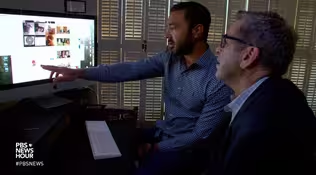
CYRUS MASSOUMI, TruthExaminer.com: Right now, we have about 5,300 people and change on the Web site.
MILES O'BRIEN: It was a busy day at the office when we met one of the Internet's most prolific distributors of hyperpartisan fare.
CYRUS MASSOUMI: Actually, in a story like this, we do actually beat the mainstream media for these sorts of breaking new events.
MILES O'BRIEN: It was the day of the high school shootings in Parkland, Florida, and as the horrific events unfolded, Cyrus Massoumi was spinning facts reported by others to fit the world view of his audience.
CYRUS MASSOUMI: You can see that, like, he is wearing a "Make America Great Again" hat.
MILES O'BRIEN: Right.
CYRUS MASSOUMI: And he has lots of photos of guns, so, obviously, this is going to be a very controversial issue.
MILES O'BRIEN: His site is called Truth Examiner.
And it caters to liberals, with headlines like this designed to entice clicks on stories with little substance.
His writers are among the five most successful at luring those clicks on Facebook.
People want to read those lines to reaffirm their beliefs, right?
CYRUS MASSOUMI: Correct.
MILES O'BRIEN: And that is not rocket science, is it?
CYRUS MASSOUMI: It's not rocket science, but doing it faster and better than your competitors is an art.
MILES O'BRIEN: Lately, Truth Examiner has added something else to the formula, a steady stream of conspiracy theories, ironically, accusing the Trump administration of peddling fake news.
Massoumi has thrived in this murky world for eight years, hedging his bets, serving up grist for liberals and conservatives through various Facebook pages.
CYRUS MASSOUMI: They want like 250-word, like little hit them and go.
It's like -- basically like a coke addict.
Every hour, he just needs to get that little dopamine rush.
Like, a fan on the conservative side or the liberal side needs to take out their phone, look at it, oh, Trump sucks.
Trump sucks, so bad.
All right, all right, I'm done, I'm done, and then, right?
Like, that's it.
That's it.
MILES O'BRIEN: People don't care about the facts.
CYRUS MASSOUMI: Yes, of course.
People don't care about facts.
Take it to the bank.
MILES O'BRIEN: He estimates he has spent over a million dollars in ads, reaching over 100 million people, and has made several million dollars by selling that audience to advertisers on his own site and on Facebook.
Do you create fake news?
CYRUS MASSOUMI: No.
No, I don't.
MILES O'BRIEN: Tell me what it is then.
CYRUS MASSOUMI: Always inflammatory, like excluding facts from the other side, but never fake.
My team, they don't cover news angles which are favorable to opposition, in the same way that CNN would never cover a favorable angle to Trump or MSNBC.
MILES O'BRIEN: He lives in the home where he grew up, on a nine-acre vineyard in Napa, California.
CYRUS MASSOUMI: We grow a brand of cabernet which is, I'm told, very nice although I'm not a wine person.
MILES O'BRIEN: He is a self-described cultural libertarian, free thinker and lover of politics.
For him, it all started in high school.
He was selling anti-Obama T-shirts and decided Facebook was a good way to reach more customers.
It worked.
He learned how to build an audience on Facebook, dropped the T-shirts and created Mr. Conservative, his first hyperpartisan site.
CYRUS MASSOUMI: So, I'm a marketer with a love of politics.
And, you know, I contend that marketers will be the king of the future of media.
I think that the danger is not the Russians or the Macedonians, but that the actual danger is when you have a marketer who doesn't love politics.
MILES O'BRIEN: Producer Cameron Hickey found Cyrus Massoumi during our 16 month investigation of hyperpartisan misinformation on Facebook.
Cameron's key reporting tool?
Software that he wrote that analyzes social media, looking for the sources of what we call junk news.
CAMERON HICKEY: It's clear that a lot of the publishers are domestic, and I think we have given a lot of attention to Russian disinformation or Macedonian teenage profiteers, but both of those groups, I think, learned it from these guys.
They have learned it from Americans, who have been long profiting on partisan information or other kinds of junk.
MILES O'BRIEN: Social networking allows us all to bypass the traditional arbiters of truth that evolved in the 20th century.
DANAH BOYD, President and Founder, Data & Society: Historically, our information landscape has been tribal.
We turn to the people that are like us, the people that we know, the people around us to make sense of what is real and what we believe in.
MILES O'BRIEN: Computer scientist Danah Boyd is president and founder of Data & Society.
DANAH BOYD: And what we're seeing now with the network media landscape is the ability to move back towards extreme tribalism.
And there are whole variety of actors, state actors, non-state actors, who are happy to move along a path where people are actually not putting their faith in institutions or information intermediaries, and are instead turning to their tribes, to their communities.
MILES O'BRIEN: Cyrus Massoumi's first big jackpot exploiting this trend toward tribalism was linked to yet another mass shooting at a school, this one in Sandy Hook, Connecticut, in 2012.
In the midst of that horror, he bought a Facebook ad that asked a question, do you stand against the assault weapons ban?
If so, click like.
Those who did became subscribers to his page, insuring his content would rise to the top of their news feeds.
He had bought thousands of fans at a very low price.
CYRUS MASSOUMI: I felt subsequently that I built my first business, sort of if you want to call it, on the graves of young children who were killed.
MILES O'BRIEN: Well, how do you feel about that?
CYRUS MASSOUMI: I don't know.
How do people feel about things that they do badly?
I feel bad about it, but, I mean, we do what we do to pay the mortgage, right?
MILES O'BRIEN: The strategy Massoumi helped pioneer spread like virtual wildfire.
By 2016, marketers, political operatives and state actors were all using the same playbook of hyped headlines, political propaganda and outright falsehoods.
DANAH BOYD: They were all in an environment together, a melting pot, if you will, and with a whole set of really powerful skills, when they saw a reality TV star start to run for president.
And that's pretty funny.
That's pretty interesting.
And so it was fun to create spectacle.
MILES O'BRIEN: The stage was set for the 2016 presidential election and an unprecedented misinformation campaign waged on several fronts.
Back in Napa, Cyrus Massoumi was doing well, running a conservative page called Truth Monitor, along with the liberal Truth Examiner.
Massoumi says anger is what generates likes, and conservative stories were more lucrative.
CYRUS MASSOUMI: Conservatives are angrier people.
MILES O'BRIEN: Tell me about that.
CYRUS MASSOUMI: You ever seen a Trump rally on TV?
MILES O'BRIEN: Yes.
CYRUS MASSOUMI: Yes?
It's gold.
MILES O'BRIEN: But, since the election, the conservative side of Massoumi's business has dried up.
His site that used to offer that content has moved into feel-good stories.
He says competition among conservative hyperpartisan sites created a junk news arms race, making the content too extreme to be ranked favorably by the Facebook news feed algorithm.
CYRUS MASSOUMI: On the conservative side, I think that we were at one point publishing low-quality clickbait.
That's what the conservative devolved into.
MILES O'BRIEN: Is it unpatriotic to do it?
CYRUS MASSOUMI: To publish low-quality clickbait?
I think that people like what they like.
And my goal at one point was to deliver to them what they like.
And, unfortunately, the reality of that is, is that people are prone to go for the lowest common denominator.
MILES O'BRIEN: But, for Cyrus Massoumi, the target really doesn't matter, so long as he hits the mark.
Stirring up anger, no matter on which side, is very good for business.
Ahead as we continue our series, you will meet two of the fans bought by Cyrus Massoumi, a deep blue liberal from Brooklyn and a Christian conservative from Indianapolis.
For the "PBS NewsHour," I'm Miles O'Brien in Napa, California.
JUDY WOODRUFF: Miles' series on Facebook and junk news continues next week.
You can watch part one and find more reporting on our Web site, PBS.org/NewsHour.
Now to our "NewsHour" Shares, something that caught our eye that might be of interest to you.
Workers at a construction site just miles from the nation's capital recently unearthed some long-forgotten treasures dating back to our nation's founding.
Our Julia Griffin explains.
JULIA GRIFFIN: In Old Town, Alexandria, these days, the pulse of progress means helmets, backhoes, and 18th century ships?
ELEANOR BREEN, Acting Historic Alexandria Archaeologist: Behind us is construction in progress, but also archaeology in progress.
JULIA GRIFFIN: Eleanor Breen is acting city archaeologist for historic Alexandria.
When developers want to dig on culturally significant land in the city, her team ensures archaeologists are on hand to identify and help preserve any discovered historical artifacts.
ELEANOR BREEN: With a lot of scrapes of the trowel and scoops of the shovel, there's history on unearthed.
But what's being found here is really particularly remarkable.
JULIA GRIFFIN: Remarkable because, in addition to old building foundations and paved alleyways, the archaeologists at this site discovered not one, but three ships from the 1700s hidden in the dirt.
But the 12-to-25-foot wide hulls are not long-forgotten shipwrecks.
ELEANOR BREEN: It was actually a fairly common practice going back centuries to take derelict ships and chop them up and actually use large fragments of the hull as part of a framework to fill in ground and make new land that didn't exist before.
JULIA GRIFFIN: This map, drawn by a young George Washington, shows Alexandria's natural shoreline with its shallow mudflats in 1748.
By the early 1800s, Alexandrians added 10 new city blocks to the waterfront that continue to exist today.
ELEANOR BREEN: To be a premier port city, they need to get more land closer to that deeper channel of the Potomac River.
It was much easier to get the cargo off of the ships if you can bring the land to the ship, as opposed to smaller ships to the land.
JULIA GRIFFIN: Today, the trio of unearthed ships, likely cargo vessels, sit just south of what had been Point Lumley.
Now exposed, their once-waterlogged timbers must be kept moist at all times to prevent warping and degradation.
Archaeologists are now removing the hulls piece-by-piece and storing them in tanks of water, just as they did with another Revolutionary War era ship found a block away in 2015.
That ship is now at Texas A&M undergoing a years-long conservation process to prepare the fragile beams for study and display.
Where the new ships end up has yet to be determined.
But, for Breen, the painstaking measures to preserve them are well worth the effort.
ELEANOR BREEN: I think there's something in our culture about this seafaring days of discovery that captures people's attention when they see such large fragments of vessels in the ground.
JULIA GRIFFIN: City officials hope all the ships could one day be put on exhibit for modern-day Alexandrians to enjoy.
For the "PBS NewsHour," I'm Julia Griffin in Alexandria, Virginia.
JUDY WOODRUFF: History everywhere we look.
And on the "NewsHour" online right now: A "NewsHour" reporter spends a week only consuming media from Radio Sputnik.
That's a Russian government-funded outlet widely seen by experts as a vehicle to disseminate disinformation for the Kremlin.
That and more is on our Web site, PBS.org/NewsHour.
And that's the "NewsHour" for tonight.
On Thursday: the assault on intelligence.
We talk with former CIA Director Michael Hayden about the agency under the Trump presidency.
I'm Judy Woodruff.
Join us online and again here tomorrow evening.
For all of us at the "PBS NewsHour," thank you, and we'll see you soon.
Moniz: U.S. leaving Iran nuclear deal would be ‘tragic’
Video has Closed Captions
Clip: 5/2/2018 | 8m 56s | President Trump has a deadline for the Iran nuclear agreement looming just 10 days away. (8m 56s)
News Wrap: Pompeo sworn in as secretary of state
Video has Closed Captions
Clip: 5/2/2018 | 5m 27s | News Wrap: ‘Time to solve’ North Korea nuclear threat, says Pompeo (5m 27s)

Old buried ships unearth this city’s seafaring past
Video has Closed Captions
Clip: 5/2/2018 | 3m 33s | A team of archaeologists is on hand to help preserve a particularly remarkable discovery. (3m 33s)
Online anger is gold to this junk-news pioneer
Video has Closed Captions
Clip: 5/2/2018 | 9m 52s | Meet one of the Internet's most prolific distributors of hyper-partisan fare. (9m 52s)

Public defender case overload is ‘ticking time bomb’ in Mo.
Video has Closed Captions
Clip: 5/2/2018 | 10m | Missouri public defenders are overloaded with hundreds of cases as defendants wait in jail (10m)
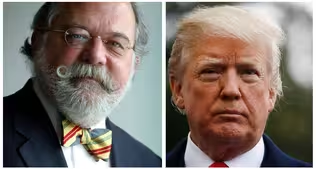
Trump legal team shuffle signals more combative strategy.
Video has Closed Captions
Clip: 5/2/2018 | 6m 38s | President Trump on Wednesday tapped Emmet Flood to join his legal team. (6m 38s)
Providing Support for PBS.org
Learn Moreabout PBS online sponsorship
- News and Public Affairs

FRONTLINE is investigative journalism that questions, explains and changes our world.

- News and Public Affairs

Amanpour and Company features conversations with leaders and decision makers.












Support for PBS provided by:
Major corporate funding for the PBS News Hour is provided by BDO, BNSF, Consumer Cellular, American Cruise Lines, and Raymond James. Funding for the PBS NewsHour Weekend is provided by...