
PBS NewsHour full episode May 7, 2018
5/7/2018 | 53m 35sVideo has Closed Captions
PBS NewsHour full episode May 7, 2018
PBS NewsHour full episode May 7, 2018
Problems playing video? | Closed Captioning Feedback
Problems playing video? | Closed Captioning Feedback
Major corporate funding for the PBS News Hour is provided by BDO, BNSF, Consumer Cellular, American Cruise Lines, and Raymond James. Funding for the PBS NewsHour Weekend is provided by...
Support provided by:

PBS NewsHour full episode May 7, 2018
5/7/2018 | 53m 35sVideo has Closed Captions
PBS NewsHour full episode May 7, 2018
Problems playing video? | Closed Captioning Feedback
How to Watch PBS News Hour
PBS News Hour is available to stream on pbs.org and the free PBS App, available on iPhone, Apple TV, Android TV, Android smartphones, Amazon Fire TV, Amazon Fire Tablet, Roku, Samsung Smart TV, and Vizio.
Providing Support for PBS.org
Learn Moreabout PBS online sponsorshipAMNA NAWAZ: Good evening.
I'm Amna Nawaz.
Judy Woodruff is on vacation.
On the "NewsHour" tonight: Rudy Giuliani says President Trump could defy the Mueller investigation while trying to set the record straight after a whirlwind first week.
Then: undermining the deal -- an Israeli private intelligence firm tries to dig up dirt on the Obama administration's Iran deal negotiations.
And stumbling towards peace.
Nearly 20 years after wartime atrocities in Kosovo, reconciliation remains a fragile process.
CHRISTIANA QUNI, Student: Maybe the only solution is that the young people from Kosovo could get together and first talk.
But I think it's the only thing that we don't do that often.
AMNA NAWAZ: All that and more on tonight's "PBS NewsHour."
(BREAK) AMNA NAWAZ: Our lead story tonight is the ongoing legal drama that surrounds President Trump.
In the last few days, one of President Trump's personal attorneys, Rudy Giuliani, has been doing the media rounds.
Giuliani has confronted questions about special counsel Robert Mueller's Russia probe, but also about a $130,000 hush payment from one of Mr. Trump's longtime associates to an adult film star.
With me here is our White House correspondent, Yamiche Alcindor, to sort out what we have learned about what could become a legal battle on multiple fronts.
Yamiche, let's try the break this down now.
The Giuliani media blitz left a lot of people kind of scratching their heads, trying to figure out what's happening with this legal strategy from the White House.
It's been evolving, right, as the special counsel's investigation has evolved.
What do we know about that strategy now?
YAMICHE ALCINDOR: The strategy appears to be to be as aggressive as possible and to really be on the offensive.
This is a strategy where you have someone like Rudy Giuliani, who is really an attack dog, going out after people, going out on different media rounds, laying out all sorts of strategies.
There's not one legal strategy.
What he's doing is saying -- floating kind of ideas.
He has one thing that he said, that the president might plead the Fifth if asked to justify with the special counsel investigation.
He has said that the president might assert executive privilege.
He's also said that they might negotiate.
There were the questions that were leaked to The New York Times, where we saw all these different questions that the president might answer.
So there's a lot of different things that Rudy Giuliani is saying, but nothing in particular that they're saying they're going to do.
AMNA NAWAZ: There are a lot of things he's saying.
There's a lot more questions that seem to have been raised from the interviews he gave, rather than questions answered in those interviews.
There are things like whether or not the president would comply with a subpoena, whether or not there have been other payments made.
It seemed confusing at times.
Could confusion have been the point?
YAMICHE ALCINDOR: Confusion seems to be the point.
I'm going to read to you something to you that Rudy Giuliani said to The Washington Post.
He said -- quote -- "Everyone is reacting to us now, and I feel good about that, because that's what I came in to do."
So, that really gets to the heart of the legal strategy here.
Rudy Giuliani is telling people, look, you're talking about me, you're saying what I want to say, you're asking me all these questions.
I'm now the story.
And, remember, a couple of weeks ago, we were talking about Michael Cohen and raids on his office, what was going to happen with Stormy Daniels.
Now it's basically been Rudy Giuliani week turning into Rudy Giuliani week number two.
AMNA NAWAZ: Well, the president has pushed back on some of Rudy Giuliani week, right?
He was clarifying some of his comments, saying he's still getting up to speed, he's new to the team.
What do we know about how this president views Mr. Giuliani?
YAMICHE ALCINDOR: Well, I have questioned several White House officials asking this question, saying, is the president really happy with what Rudy Giuliani is doing?
Because if you listen to a lot of experts, this should not be the way that your legal expert, your lawyer is acting.
But everyone tells me that the president is happy with him.
And I'm going to play for you a little bit of what Sarah Sanders said today when she was asked about this.
And she struggled to answer the question.
But let's see what she said.
QUESTION: Is the president pleased with the appearances of Rudy Giuliani over the last few days?
SARAH HUCKABEE SANDERS, White House Press Secretary: I didn't speak with him specifically about his feelings about it, but certainly feels that he's an added member -- added valued member to his outside special counsel.
YAMICHE ALCINDOR: So, there you have it, Sarah Sanders really trying to -- she is someone who really is usually on it.
She has her answers prepared.
She's usually reading from a piece of paper.
In this case, you saw her kind of stumbling, trying to explain how the president feels about Rudy Giuliani.
AMNA NAWAZ: Real quick, before we let you go, Giuliani has joined after a number of shakeups on the legal team.
Is the kind of thing normal?
Can you put this context for us with what we have seen from past presidents?
YAMICHE ALCINDOR: I spoke with an expert today who studied special counsel and special investigations.
And that person said, we should really look at President Clinton and how he handled all the different legal scandals that he had to deal with as president, with the Monica Lewinsky, but also with the sexual harassment lawsuit by Paula Jones.
And he told -- that expert told me, President Clinton made it a point to have a very solid team together.
This was not a rotating cast.
This is core people who understood the cases, understood what was going on.
But he said that there was a face man there.
There was a man named Robert Bennett whose job it was to talk to the media, to try to make the case for President Clinton, because they didn't want President Clinton to be obsessing about this case.
In this case, it's not really like that.
You have someone like Rudy Giuliani who is out there talking about all this.
But you also have the president himself tweeting about it, kind of talking about it all the time, which is not what President Clinton was doing.
So, this is think -- the word gets used a lot, but it's pretty unprecedented for this president.
AMNA NAWAZ: A word we use a lot these days.
Yamiche Alcindor, good to talk to you.
YAMICHE ALCINDOR: Thanks.
AMNA NAWAZ: In the day's other news: President Trump put out the word that he will announce his decision on the Iran nuclear deal tomorrow afternoon.
He tweeted the news today, ahead of his self-imposed May 12 deadline.
Mr. Trump has threatened to withdraw the U.S. from the agreement, unless it is revised.
European allies have urged against that step.
The president and the White House mounted a defense today of Gina Haspel, the nominee for CIA director.
She's under fire over her role in harsh interrogation of terror suspects, including water-boarding.
White House Press Secretary Sarah Sanders said Haspel is 100 percent committed to the nomination, despite reports that she'd offered to withdraw.
SARAH HUCKABEE SANDERS: She wants to do everything she can to make sure the integrity of the CIA remains intact, isn't unnecessarily attacked.
And if she felt that her nomination would have been a problem for that and for the agency then she wanted to do everything she could to protect the agency.
AMNA NAWAZ: The president tweeted today that Democrats oppose Haspel because she was -- quote - - "tough too on terrorists."
Her Senate confirmation hearing is set for Wednesday.
In Russia today, Vladimir Putin took the oath of office to begin his fourth term as president, promising to boost living standards.
The ceremony took place at an ornate Kremlin hall.
On stage, Putin placed his hand on Russia's constitution, and swore to serve the people and country.
On Sunday, hundreds in Moscow protested the inauguration, chanting, "Putin is not our czar."
The city of New Orleans swore in a woman as mayor today, for the first time since its founding 300 years ago.
LaToya Cantrell rose to prominence as an activist after Hurricane Katrina.
She was elected to city council in 2012.
After taking her oath of office, Cantrell and supporters strolled out of the Mahalia Jackson Theater in a traditional New Orleans Second Line parade.
First lady Melania Trump unveiled what will be her signature initiative, the well-being of children.
The Be Best campaign will focus on emotional and physical health, social media use and opioid abuse.
The first lady made the announcement in the White House Rose Garden, with the president looking on.
MELANIA TRUMP, First Lady: If we truly listen to what our kids have to say, whether it is be their concerns or ideas, adults can provide them the support and tools they need to grow up to be happy and productive adults who contribute positively to society and their global communities.
AMNA NAWAZ: The first lady says one of her concerns is cyber-bullying.
The White House today rejected any suggestion that the president's own tweets might legitimize such attacks.
It's been another unseasonably hot day in Phoenix, Arizona, with a forecast high of 102 degrees.
Sunday's heat hit 106 and broke the record for May 6 that had stood for 70 years.
Triple-digit heat is expected in Phoenix for the rest of the week.
And on Wall Street, the Dow Jones industrial average gained 94 points to close at 24357.
The Nasdaq rose 55 points.
The S&P 500 added nine.
and the price of oil closed above $70 a barrel for the first time since November of 2014.
Still to come on the "NewsHour": an Israeli security firm tries to dig up dirt about Obama officials who negotiated the Iran deal; efforts to bring together ethnic factions in the Balkans suffers some setbacks; the science behind the erupting Hawaiian volcano that's destroyed dozens of homes; and much more.
President Trump has been weighing whether or not to remain part of the 2015 Iran deal, a decision he says he will announce tomorrow.
But John Yang now has the strange tale of how and why two Obama administration staffers who helped to shape the pact are suddenly back in focus.
JOHN YANG: Amna, it's been nearly three years since the Iran deal was sealed.
But this weekend, the British newspaper The Guardian reported that last year, two top Obama White House national security officials who helped negotiate the agreement, Ben Rhodes and Colin Kahl, were the targets of elaborate efforts to delegitimize it.
The newspaper said an Israeli private intelligence firm tried to dig up information that might discredit the two men.
With us now to explain this story is The Guardian's world affairs editor, Julian Borger, who helped break the story.
Julian, thanks for being here.
First off, I know that you have got a new story that was posted on The Guardian's Web site this afternoon our time.
What's the latest?
JULIAN BORGER, The Guardian: Well, this is about Trita Parsi, who is the head of the National Iranian American Council, who is a very fierce advocate of the Iran nuclear deal.
And during the transition in late 2016, he was approached through an intermediary with a message from U.S. intelligence, someone in -- high up in U.S. intelligence, warning him to look out because the Trump crowd were coming after him and would seek to discredit him as a means of discrediting the deal.
And several months later, he was approached by someone he believed to be a journalist who turned out to be working for this Israeli private security firm who was asking him, after asking general questions, asked him about whether these two these two officials, Ben Rhodes and Colin Kahl, had in some way maybe profited or benefited from the deal.
He didn't think anything more about it other than to think it was a bit odd, until we read from the transcript of that conversation that we got ahold of from sources close to that firm.
JOHN YANG: So that was what they were looking for.
They were looking -- they were trying to say, according to your reporting, that these two officials who negotiated the deal were profiting from it?
JULIAN BORGER: Yes, they were, I think, looking for two areas, one in ways they were benefiting from the deal, and the other the possibility that they may have shared classified information with supporters of the deal or journalists during the negotiation or in the defense and the attempt to promote the deal afterwards.
JOHN YANG: And, from your reporting, who was behind this?
Who asked this or who hired this Israeli security firm to do this?
JULIAN BORGER: Our understanding is that this was political -- had a political intention behind it, from and was commissioned by people close to Donald Trump, with the intention of discrediting people connected to the Iran nuclear deal, so, when the deal was torpedoed, there would be less backlash against it, it would help discredit the deal itself.
JOHN YANG: You say people close to Trump.
Were you able to take this inside the White House in your reporting?
JULIAN BORGER: We -- I'm not sure in terms of whether this is people who were in the White House or business associates.
But our sourcing who are close to this private security firm said it was clear that, when the tasking for this went out, that the ultimate customer was the Trump team, the Trump camp.
JOHN YANG: And you did reach out the to the White House.
What did they say?
JULIAN BORGER: They said they refused to comment on it.
JOHN YANG: And this Israeli security firm called Black Cube, tell us about this.
JULIAN BORGER: Well, this is a security firm made up of former Israeli intelligence officers.
They have been involved in Nigeria.
They have been involved in Central Europe.
And they have been involved in the scandal around Harvey Weinstein, one of his lawyers, New Yorker, hired Black Cube to go after the accusers of Harvey Weinstein, see if they could get anything on them to -- as a way of stopping the claims of sexual misconduct against him.
Some of the same fake firms that were used to approach Harvey Weinstein's accusers were used to approach the wives of Ben Rhodes and Colin Kahl.
And so, to some extent, it is somewhat sloppy of them, using the same cut-out firms, using the same photographs of people who are acting under aliases, to approach people both in the Harvey Weinstein case and in the Iran nuclear deal case.
JOHN YANG: This is an intriguing story, and I'm sure there's going to be more.
Julian Borger, thanks so much.
JULIAN BORGER: Thank you.
AMNA NAWAZ: Now to part two of our look at the state of affairs in the Balkans.
Nearly 20 years after the war in Kosovo, efforts to achieve reconciliation between Serbs and ethnic Albanians have suffered one of their worst setbacks in recent years, after a controversial arrest.
Kosovo, with its majority ethnic Albanian population, used to be an autonomous region of the former Yugoslavia.
But, in 1999, after a series of Serb atrocities, NATO intervened on the side of the Albanians to help Kosovo become an independent nation.
With the support of the Pulitzer Center on Crisis Reporting, special correspondent Malcolm Brabant found that overcoming ethnic hatred and suspicion is one of the biggest obstacles to consolidating peace in the fledgling nation.
MALCOLM BRABANT: After 20 years of painfully slow progress towards reconciliation, there was widespread dismay at the way in which Kosovar Albanian riot police arrested this man, Marko Djuric, the chief peace negotiator of the Serbian government in Belgrade.
The arrest took place in Mitrovica, Kosovo's most volatile town, where the country's ethnic tensions are accentuated.
What happens here frequently influences the rest of the country.
DALIBOR JEVTIC, Serbian Politician: Police used force without reason.
And I cannot understand using force on those people, people that gathered there to talk about peace.
MALCOLM BRABANT: Dalibor Jevtic leads a Serb party in Kosovo's Parliament, which left the government to protest the arrest.
DALIBOR JEVTIC: They arrest the person who is the main negotiator of Serbia.
And they treat him as a dog.
When you have forced on a legitimate representative of Serbs, what ordinary people can expect then?
MALCOLM BRABANT: The Serbs have come a long way since 1999, when their tanks roamed Kosovo, forcing Albanians to flee from their villages.
The Serbs' campaign of so called ethnic cleansing provoked NATO airstrikes.
After a 10-week bombing campaign, the Serbs accepted NATO's peace terms.
The Albanians of Kosovo, the majority population, were the beneficiaries.
In February, Kosovo celebrated 10 years of independence.
But the country remains widely unrecognized.
Its membership of the United Nations is blocked.
The biggest problem in the peace process is trying to convince Serbia, the old wartime enemy, to formally recognize Kosovo.
So why would the Kosovar Albanian led-government in Pristina reignite Serb resentment when it needs cooperation?
Kosovo's Prime Minister Ramush Haradinaj, a former wartime guerrilla leader, defended the arrest, saying the Serb negotiator entered the country illegally, despite being told not to come.
That does not send a good sign to the Serbian people, does it, that that is the way that they're going to be treated?
RAMUSH HARADINAJ, Prime Minister of Kosovo: No.
No, sir, this is not oriented towards Kosovar Serbs, any elected official, leader, Serb officials.
That was mainly towards two persons that illegally passed the borders.
MALCOLM BRABANT: Some Balkan experts believe that the arrest in Mitrovica was potentially dangerous, because it's exacerbated ethnic tensions and it will also make it more difficult for there to be normalization of relations between the former warring factions.
They also fear it could lead to a hardening of attitudes by the governments here in Pristina and also in the Serbian capital, Belgrade.
In return for recognition of Kosovo, the carrot of European Union membership for Serbia is being dangled in front of its president, Aleksandar Vucic.
In February, Vucic told Germany's Chancellor Merkel he was prepared to reach a deal in which both Serbs and Albanians lost something.
But in recent days, he has retrenched.
So, will a conclusive peace agreement ever happen?
Regional analyst Luzlim Peci.
LUZLIM PECI, Regional Analyst: I think that final agreement is possible.
It will depend a lot on the engagement of the United States of America and European Union.
If they are not strongly engaged in the region, then Russia enters with its influence, and then the situation becomes more complicated.
MALCOLM BRABANT: Russia aligns with the Serbs and it's in Moscow's interest for Kosovo's current state of stagnation to continue.
Most Serbs have a deep emotional attachment to Kosovo and are reluctant to set it free as a nation.
They regard Kosovo as the cradle of Serbian culture, because it's home to orthodox monasteries like Decani.
FATHER SAVA JANJIC, Visoki Decani Abbot: The opening of this metal coffin is not something very attractive, I must say.
MALCOLM BRABANT: The abbot, Sava Janjic, opens up the coffin of the monastery's 14th century founder, King Stefan, a saint, whose hand is as well preserved as any Egyptian mummy.
This and other treasures underpin the religious and historical significance of Kosovo for the Serbs.
In the past few months, some Serb politicians have suggested redrawing the map so Northern Kosovo becomes an integral part of Serbia again.
But only 35 percent of Kosovo's Serbs live in the north.
The rest live amongst Albanians in the south.
FATHER SAVA JANJIC: These ideas are absolutely unrealistic, and they are also, I must say, immoral in a way.
MALCOLM BRABANT: Father Sava has been a long time opponent of Serbian nationalism, and his is an influential voice with visiting international politicians.
He argues that the Serbs living in southern Kosovo have no intention of leaving willingly.
FATHER SAVA JANJIC: We will all be forced out of here just because certain people need to have clearly ethnically cut territories.
This is exactly what was the reason for the Balkans wars in the '90s, and we must never allow that to happen again.
MALCOLM BRABANT: Kosovo's unsettled present is deterring foreign investment, and the absence of prosperity is particularly felt in Mitrovica, a town that is a microcosm of the nation's ethnic tensions.
Igor Simic represents Mitrovica's Serbs in Kosovo's Parliament, and he's optimistic about reaching a deal with the former enemy.
IGOR SIMIC, Parliament Member: Right now, 19 years after the war, and we are still talking about the same stories from the past.
So we have to find a way how to go further.
The new generation doesn't want to wait, doesn't want to be on the same spot as their fathers were.
MALCOLM BRABANT: The young Kosovars who grew up after the war have little experience of the hatred and fear that motivated their parents.
Christiana Quni is the daughter of a prominent Kosovar guerrilla fighter and member of Parliament.
She is studying in Austria, but wants to return to help her nation recover.
CHRISTIANA QUNI, Student: Maybe the only solution is that the young people from Kosovo to get together and first talk.
But I think it's the only thing that we don't do that often.
MALCOLM BRABANT: This small pork processing cooperative in western Kosovo provides a glimpse of what is possible when former enemies reach across the ethnic divide.
It's shared between Albanian women and Serbs who returned to the area after the war.
WOMAN (through translator): Throughout Kosovo, it's hard to find an enterprise like this one where we coexist together.
It would be great if other people would follow suit.
WOMAN (through translator): It also shows that we are the same people.
Everybody has her own problems, her own worries, so we know each other and open our hearts to each other.
MALCOLM BRABANT: But old wounds are likely to be reopened soon once a special court in the Netherlands indicts former Albanian members of the Kosovo Liberation Army for war crimes against Serbs, other minorities and political opponents.
Kosovars tried to stop the court being established, but America and its Ambassador Greg Delawie insisted it was essential.
GREG DELAWIE, U.S.
Ambassador to Kosovo: Justice is vital for reconciliation.
We support the Kosovo Special Court.
We feel it's essential to true to provide justice for all victims, and we think the court will make an important contribution to that.
MALCOLM BRABANT: But Nysrete Kumnova and her husband, Muharrem, want more Serbs to be held accountable.
They are heading to the empty grave of their son Albiyon.
He was 19 when, along with other men of fighting age, he was abducted by Serbian forces who overran the western town of Gjakova in march 1999; 750 bodies have been recovered; 720 are still missing.
NYSRETE KUMNOVA, Mother (through translator): There won't be any reconciliation while we are still alive.
And all politicians shouldn't dare to forgive Serbia until Serbia returns all the remains of the bodies of those killed, and all the perpetrators should be put on trial, and until Serbia apologizes to us and to the world for the crimes committed in this country.
MALCOLM BRABANT: If the Kumnovas are to attain peace, they need a Serb to examine his conscience and reveal their son's secret grave.
For many Kosovars, the conflict is simply frozen and far from over.
For the "PBS NewsHour," I'm Malcolm Brabant in Kosovo.
AMNA NAWAZ: Stay with us.
Coming up on the "NewsHour": the Republicans' West Virginia primary coming down to the wire; and what being educated means to someone who grew up with no formal schooling.
Emergency crews continued to battle lava flow and hazardous fumes today, four days after the Kilauea volcano erupted on Hawaii's Big Island.
Roadblocks are set up miles away from where lava is spilling out from fissures on the street.
The eruptions have been followed by a series of small earthquakes.
The ground split open near the Leilani Estates subdivision; 35 structures, including at least 26 homes, have been destroyed so far, with nearly 2,000 people forced to evacuate and unsure of how long they will be displaced.
While the lava can be slow-moving, this time-lapse footage shows just how devastating it can be as it makes it way across streets.
WOODY NELSON, Hawaii: It kept me up weeks on weeks knowing that the volcano is there.
And this nightmare finally came true today, the whole House up in flames.
CHERYL GRIFFIN, Hawaii: Living here, you -- that's the gamble that you take, is to have all this beauty.
And it's the volcanoes.
You have got to just know that you live on an active volcano.
AMNA NAWAZ: Some residents have been allowed back into safe spots briefly to collect pets and belongings, all the while, sulfur dioxide, a toxic gas, is being released through volcanic vents in the ground, prompting a cell phone alert from local officials to avoid it at high levels.
No fatalities have been reported, but authorities are asking all tourists and sightseers to avoid the Leilani Estates area.
And for more about the volcano, the eruption and the risks in the days to come, let's talk to a volcanologist who studies Kilauea and others regularly.
Michael Garcia of the University of Hawaii joins us via Skype.
Professor Garcia, thanks for your time.
Welcome to the "NewsHour."
Let me ask you about Kilauea.
It's the youngest and the most active volcano on Hawaii.
What do we know about the latest activity we're seeing now?
MICHAEL GARCIA, University of Hawaii: Well, the activity seems to be waning somewhat.
The active fissure, fissure number eight, has diminished overnight and so we're hopeful this eruption might stop soon.
However, the earthquakes are continuing, so there's every sign that perhaps activity might restart.
AMNA NAWAZ: You mentioned those fissures.
People have been describing seeing those, basically the ground opening up and the lava below bubbling up or shooting up in some cases.
Help us understand, what prompted those fissures in the first place?
MICHAEL GARCIA: So, the fissures are in response to the injection of new magma from the summit of the volcano.
So magma works its way down the so-called rift zone of the volcano, and as it does this, it cracks the earth, because the injection of magma is causing the ground to swell, so the swelling leads to the cracking.
And as the magma gets close to the surface, you begin to see those cracks get wider and wider.
So, for a while, the scientists were measuring the opening of these cracks as a way to try and understand when it might actually erupt.
AMNA NAWAZ: You mentioned measuring those cracks.
There's also a lot of other monitoring that goes on around Kilauea.
Tell me a little bit about how you keep an eye on the volcano, and if we had any sign that this was coming.
MICHAEL GARCIA: Well, many different techniques are utilized, particularly ground deformation, earthquakes, and even the gas that are being released from the volcano.
So a variety of different kinds of techniques are utilized to try and understand what's going on at depth.
And sometimes we're caught off-guard in terms of, like in this case, that the eruption would leave the locations where you had two active vents.
You had a lava lake the last 10 years at the summit of the volcano.
You had an active vent for 35 years on the middle of the east rift zone.
Both of those things have lost their magma flow.
And instead the lava is drained down the rift zone and then popped up 20 kilometers away from where it was erupting previously.
AMNA NAWAZ: A lot of the focus, as people pay attention to this, has been on the lava flow.
Right?
There have been some mesmerizing videos on social media and elsewhere, but you mentioned the gas.
I want to ask you about that.
A lot of people are pointing to that sulfur dioxide as something that is much more of a threat.
Tell me about that.
MICHAEL GARCIA: Well, it's a threat if you get caught off-guard.
Normally, like yesterday, in particular, we had strong trade winds.
So as long as you're aware of where the vents are and which way the wind is blowing, you should be able to avoid that gas.
But there are times when the trade winds drop down and the gas lingers in the forest or along the highways, and you could be caught off-guard and get gassed.
I have had that happen to me several times.
It's a very unpleasant experience.
AMNA NAWAZ: There's been a number of homes destroyed, right, dozens and dozens, hundreds of people forced to evacuate as well.
What can you tell us about this subdivision, this Leilani Estates subdivision, that's been particularly harmed by this latest activity?
MICHAEL GARCIA: Well, over 1,700 people live in the subdivision.
But it has got the highest ranking of a hazard zone on the island, so it's hazard zone one.
So people were aware, I think, that they have some risk.
But the last eruption in this area was in 1955.
So I think people were under the impression that nothing may happen for a while.
AMNA NAWAZ: Professor Michael Garcia, thank you for your time.
MICHAEL GARCIA: You're very welcome.
AMNA NAWAZ: Now to West Virginia, where, tomorrow, Republican voters will choose their candidate to run against Democratic Senator Joe Manchin in November.
It's one of the GOP's best chances to pick up a U.S. Senate seat.
It is also a test of the Trump factor, with a controversial candidate aiming for the president's outsider momentum, even though two other top candidates have Mr. Trump's support.
Lisa Desjardins reports.
LISA DESJARDINS: In the Mountain State, a wild primary race and a Republican family feud.
WOMAN: It's gotten a little mean-spirited at times.
WOMAN: Silly.
MAN: Ugly.
MAN: Chaos.
LISA DESJARDINS: The top two candidates in past polls, Congressman Evan Jenkins and Attorney General Patrick Morrisey, are fighting off a headline-grabbing insurgent.
JUDY WOODRUFF: Former coal executive Don Blankenship was sentenced today to a year in federal prison.
LISA DESJARDINS: Sentenced for conspiring to violate mining safety laws, Blankenship was released from prison last May.
DON BLANKENSHIP (R), West Virginia Senatorial Candidate: I think that they like somebody who'll keep fighting even when they're the underdog.
LISA DESJARDINS: The once-feared CEO now presents himself as a gentle listener, an outsider who wants to rattle Congress.
DON BLANKENSHIP: You can't change Washington or change the culture of a company or anything without controversy.
LISA DESJARDINS: But he is also one of the most hated men in the state.
In 2010, 29 miners died in an explosion at one of his mines, Upper Big Branch, or UBB.
Federal investigators concluded Blankenship's company, Massey Energy, was reckless at the mine.
He was convicted of general conspiracy.
Blankenship blames the actions of federal mining inspectors for the explosion.
You know, I was at UBB, and I talked to the miners in that mine, and they told me that they did feel the mine was unsafe.
And they felt -- some of them told me they thought Massey was unsafe.
Did you ever consider that your company was unsafe?
DON BLANKENSHIP: That mine didn't blow up because of anything Massey did.
It blew up because of what the government did.
PATRICK MORRISEY, West Virginia Attorney General: Time after time after time, we sued Obama, and we won for West Virginia.
LISA DESJARDINS: Attorney General Morrisey uses a more traditional playbook, with endorsements like that of Kentucky Senator Rand Paul.
He points to his lawsuits on behalf of the West Virginia to end Obama era regulation.
PATRICK MORRISEY: I believe strongly we have to talk about my conservative record of success.
EVAN JENKINS (R), West Virginia Senatorial Candidate: People don't understand rural West Virginia.
LISA DESJARDINS: Congressman Evan Jenkins, a former Democrat, is working to prove he too is conservative here at a gun store outside Morgantown.
He argues he is the most likely to defeat Democratic Senator Joe Manchin, helping Republicans increase their Senate margin.
EVAN JENKINS: We are in ground zero of the best of the best opportunities.
So what's at risk for Republicans nationally?
This is about control of the United States Senate.
LISA DESJARDINS: The three-man battle is a national nail-biter.
Some groups have launched anti-Blankenship ads, including a $750,000 buy from a super PAC linked to Senate Majority Leader Mitch McConnell, petrified a Blankenship election could doom the GOP in the fall.
NARRATOR: Who will clean up Washington?
Not convicted criminal Don Blankenship.
LISA DESJARDINS: Blankenship has waged war back, controversially saying Leader McConnell is pro-China because his wife, Transportation Secretary Elaine Chao, is of Chinese descent and her father is a shipping tycoon.
DON BLANKENSHIP: Swamp captain Mitch McConnell has created millions of jobs for China people.
LISA DESJARDINS: Like most primaries, this one will be decided by a relatively small group of voters, the most ardent conservatives in one of the most conservative states.
And they seem to have two things in common, love of President Trump and hatred of Washington, both themes in last week's debate.
EVAN JENKINS: You know, I proudly endorsed President Trump in the May primary of 2016.
PATRICK MORRISEY: I'm the only candidate on the stage who not only has voted for Donald Trump at the convention and in the Electoral College.
DON BLANKENSHIP: You can't drain the swamp being like the swamp.
LISA DESJARDINS: But today, in another sign that Blankenship is a real contender, President Trump rang in, tweeting; "Don Blankenship cant win the general election in your state.
No way."
At an annual shrimp feast in Bluefield, we found undecided voters Larry and Brenda Bowman (ph).
MAN: We will pray about it.
Let's put it that way.. LISA DESJARDINS: Thinking less about which candidate they like, and more about which is the most like President Trump.
WOMAN: I will be voting... MAN: Yes, we will be there voting.
WOMAN: ... Republican, so that President Trump will have someone to work with.
MAN: Yes, we need somebody here that is going to back up Trump, because I think Trump is doing the right thing.
And we need somebody here who is going to back Trump up.
LISA DESJARDINS: How voters decide here will impact Republicans' national landscape and show what voters think it needs to support President Trump.
Traveling across West Virginia, for the "PBS NewsHour," I'm Lisa Desjardins.
AMNA NAWAZ: And it's not just West Virginia voters that head to the polls tomorrow.
There are also primary races in Indiana, Ohio, and North Carolina.
So, it's a good time for Politics Monday.
I'm joined by Amy Walter of The Cook Political Report and the newly announced Friday host of Public Radio International's "The Takeaway," and Shawna Thomas of VICE News.
Amy and Shawna, welcome.
Amy, let's talk about some of these primaries.
Now, we have talked a lot about the future of the Republican Party, right, what we can tell from some of these races and how they have gone.
What can we learn from the primaries we're seeing right now?
AMY WALTER, The Cook Political Report: Yes, especially Indiana and West Virginia.
And I think Lisa did an excellent job of sort of setting the stage here and two big themes going on in both of those states.
The first is, Democratic incumbents sit in both of those states.
They are top targets, because these are deep red states that Donald Trump carried.
The second is the embrace of Donald Trump, both his message and as well as his policies.
There's a lot of talk about draining the swamp and building the wall.
And, finally, what we're seeing in these primaries looks very familiar what we saw in 2016, all the candidates running against Washington, but many of them are part of Washington.
They're either are a member of Congress.
As we have seen in Indiana, there are two.
In West Virginia, there's one.
Or part of the so-called establishment.
One of those folks running in West Virginia is the sitting attorney general.
Sort of ironic, too, that they are running against Washington, when the Republicans are in charge of Washington.
Usually, when you're in charge, you say let's send more people there to help build our majority.
Instead, the focus is on they need to go there to help the president, not to help Republicans in Congress.
AMNA NAWAZ: You have talked before about whether or not there is room in the party for Republicans who oppose the president as well.
Does that mean that has gone away?
AMY WALTER: You're not hearing anything about a candidate who is trying to run against the Trump portfolio.
In fact, I looked at all the ads that have been run since the beginning of January until now in all races across the country.
Republicans have run almost three times as many ads that are supportive of Trump as Democrats have run ads against Trump.
So Democrats are not running as much as an anti-Trump party as Republicans are running as the pro-Trump candidate.
AMNA NAWAZ: Shawna, let me ask you about the president's involvement in these primaries, because he's tweeted about them before.
He has weighed in.
He is weighing in on the West Virginia primary, too.
Does it make a difference anymore?
SHAWNA THOMAS, VICE News: I think it seems to -- I think he thinks it makes a difference.
And especially with the West Virginia primary, the two more, let's say, establishment Republicans, his tweet was actually very interesting, because he named both of them.
And it was basically like, don't vote for Blankenship, vote for one of these.
But the interesting thing about that is that those two guys may split the vote, which just allows Blankenship to go ahead and raise up.
But it is clear that Republicans in general, whether it's someone running far right or someone trying to like thread the needle of D.C., they think they need to keep President Trump on their side.
And Blankenship's thing is that he keeps saying he's Trumpier than Trump.
AMY WALTER: Right.
And the other irony is, that's exactly what Republicans said about Trump.
If he wins the primary, he can't win a general election .
And now you have the president saying, if this guy wins, who's running basically the same sort of campaign and he has a lot of baggage, he can't win a general election.
SHAWNA THOMAS: I also think he doesn't want to be caught -- the president doesn't want to be caught in a Roy Moore situation out of Alabama, where he did actually endorse the more traditional candidate, then had to sort of backtrack and kind of endorse Roy Moore, even after saying Roy Moore couldn't win, which he couldn't in that case.
This race is a little bit different, but I think they're trying to figure out how do they read the tea leaves a little bit.
AMNA NAWAZ: And he's been tweeting about that connection to the Alabama special election as well.
He is also tweeting about the Iran deal.
There was a self-imposed May 12 deadline.
He now says we will have a decision tomorrow.
He's been threatening and threatening to take the U.S. out of it.
So, what do you think?
Are we in or out?
SHAWNA THOMAS: It seems like everything he has been telegraphing and everything that sort of the Europeans are saying about what they have done to try to convince him to stay in the deal has not worked.
So I think we're all just sort of sitting in D.C. and assuming that he's going to say he's going to pull out.
Now, what does that actually mean?
It sort of means like that that deadline, Saturday, I believe, May 12, is about whether we're going to slap our sanctions back on Iran for certain things that we lifted them for in the nuclear deal.
And that, snapping those sanctions back on, doesn't just affect Iran and it doesn't just affect the United States.
It affects some of our dealings with European countries, which is also part of it.
So it's a much larger kind of economic problem, too.
But it seems like he's going to pull us out.
We can't know until he tells us.
But no one -- I haven't talk to anyone, and no European person who knows about this has said they that have convinced him.
And he's been talking about this since the campaign.
And he follows through on... (CROSSTALK) AMY WALTER: He does follow through, absolutely.
AMNA NAWAZ: Can he afford to not do it now, after talking about it for so long?
AMY WALTER: Right.
I think he does it.
Now, the question is always how far he goes, right?
AMNA NAWAZ: Right.
SHAWNA THOMAS: Yes.
AMY WALTER: I'm going to pull out of NAFTA.
Well, we didn't really pull out of NAFTA.
But we're renegotiating.
I'm going to slap tariffs and sanctions -- or I'm going to slap tariffs on China.
I'm going to call them the currency manipulator.
Well, didn't call them a currency manipulator.
There are some tariffs.
It's unclear the tariffs, where they're going for other countries.
But Shawna is exactly right.
Everything we saw from -- it wasn't just when Macron came to the U.S., his body language.
He also basically said, I wasn't able to convince him.
And then Rudy Giuliani went on TV, I guess it was this weekend or earlier in the week, saying, well, yes, no, he's definitely going to -- he's going to tear... (CROSSTALK) SHAWNA THOMAS: I don't know why that's Rudy Giuliani's problem.
But... AMNA NAWAZ: We will see tomorrow.
We expect that announcement tomorrow from the president.
Another big story we're watching this week, Gina Haspel has her confirmation hearing on Wednesday.
She's the president's nominee for CIA director.
If you look back to some of the more recent nominees, look back to Ronny Jackson, for example, when he got into some trouble, when there was some heavy scrutiny and you knew it was going to be a tough confirmation hearing, the president kind of backed away a little bit.
We're not seeing that with Gina Haspel.
Is this different?
SHAWNA THOMAS: I think it is a little different.
I think one thing is that Gina Haspel is probably qualified for the job.
And it was unclear if Dr. Ronny Jackson was qualified for that particular position.
She has that going for her.
And you have to remember, she is the acting director of the CIA right now.
I think the issue that comes up is about the word torture and her involvement in the destruction of certain videotapes that purport to actually show what the CIA did, water-boarding, and how much responsibility she needs to take for that in an open forum.
AMNA NAWAZ: What about the votes here, Amy?
We saw her on the Hill today.
We know she was meeting with senators.
Joe Manchin came out, shook hands, smiled, said it was great to meet her, we're looking forward to the hearing.
Who are some of her problem votes?
AMY WALTER: Well, Rand Paul, the Republican senator from Kentucky, always on issues like this has been on the other side from where more traditional Republicans have been.
He was on the other side of the Bush administration.
And, in fact, this debate we're having right now about Gina Haspel feels much more like the kinds of debates we had in Congress about pre-Trump.
Right?
This isn't about, is she qualified for the job?
I think she's had six former CIA directors saying she's absolutely qualified.
You hear people in the Intelligence Committee saying, this woman is absolutely right for the job.
SHAWNA THOMAS: Her former staff has said that.
(CROSSTALK) AMY WALTER: Her former staff.
The debate is about the issue of torture, how to deal with terrorism suspects.
That was an issue when Bush was president.
It was an issue when Obama was present about closing Guantanamo.
Obviously, this president now wanting to keep it open or keeping it open.
And so this is much more about policy than it is about personality.
AMNA NAWAZ: Sure to be a tough hearing either way on Wednesday.
Amy Walter, Shawna Thomas, thanks for your time.
SHAWNA THOMAS: Thanks.
AMY WALTER: You're welcome.
AMNA NAWAZ: Now a fictional look at McCarthy-era Washington from one of Washington's most well-known journalists.
Yamiche Alcindor is back with this latest edition to the "NewsHour" Bookshelf.
YAMICHE ALCINDOR: The book is a political thriller focusing on a fictional congressman navigating 1950s Washington, D.C.
It's a story set in the era of Eisenhower and Kennedy, but also in the shadow of Joseph McCarthy's Red Scare.
The author who penned the story also happens to have a day job, news anchor.
He is Jake Tapper, and he book is "The Hellfire Club," his first novel.
It opens in 1954.
The main character wakes up drunk in Rock Creek Park, and he's somewhat, I guess, rescued.
But I won't spoil the whole book.
But why did you open up this way?
And tell me why you thought readers should have this scene as an introduction to Washington, D.C. JAKE TAPPER, Author, "The Hellfire Club": I -- actually, I had originally written the book more linearly.
And that scene was in the middle of the book, or the -- actually more like the third -- first third.
And then a friend of mine read it, and suggested, why don't you open the book with that scene, because it's so compelling, and you're just thrown into the situation?
He wakes up.
He's face down in the mud.
He doesn't remember getting there.
A car has crashed behind him.
It turns out that there's a dead body nearby.
And you're just thrust into this world.
And it just seemed a good way to grab people.
I wish I could take credit for the brilliant idea, but it was a friend of mine, Jeff (ph), who came up with it.
YAMICHE ALCINDOR: The Hellfire Club was a real place in Britain, and, apparently, in Ireland, it was the name of some exclusive clubs.
Why did you want to write about secret societies?
JAKE TAPPER: Well, actually, the genesis for this book occurred when I first heard about the Hellfire Club, which, you're absolutely right, it was in England in the 1700s.
And all sorts of nobility and politicians and rich people, men, would come together on this one estate and have these horrifically debaucherous and sacrilegious adventures.
And the more I read about it, the more I thought, what an intriguing world, not only because of the secretness of it and people living these double lives, but also the fact that it forced them all to have these alliances.
YAMICHE ALCINDOR: I want to ask you about Senator Joseph McCarthy and his role in this book.
I will read just a small passage from the book.
It says: "He's impossible to ignore.
He becomes this planet blocking the sun.
And whatever points he makes that have validity are blotted out by his indecency and his lies and his predilection to smear."
You started writing this book in the middle of the Obama administration.
But how does your depiction of McCarthy at all connect to present day, and in particular to President Donald Trump?
JAKE TAPPER: They say history doesn't repeat itself, but it rhymes.
And McCarthy was in the book.
And Roy Cohn was in the book before Donald Trump became a candidate for president.
But, certainly, parts of McCarthy and qualities that McCarthy has that are resonant today, I may have underlined a bit here and there, because not only did McCarthy do the same kind of thing that we see with President Trump, which is saying things that are demonstrably false and smearing people who don't deserve to be smeared, but the world that McCarthy was in, Republican politicians, Democratic politicians, the media, didn't really know how to respond to this.
So a lot of the mistakes that we saw in the 1950s with McCarthy are being repeated today.
YAMICHE ALCINDOR: When you talk about kind of the connections to present day Washington, one thing that I was struck by was the main character, he comes to Washington, D.C. and you kind of feel like, OK, this guy, he has a good heart.
He's here to really make a difference.
And then he starts doing some questionable things.
How does that -- really, that thinking connect to present day Washington and to maybe the response that we're having to -- that we see, especially in Congress and Republican lawmakers, to President Trump?
JAKE TAPPER: It makes me so happy that that was your response to Charlie, because that's exactly what I want to capture.
I have seen -- I have lived in this town now for several decades, and I have seen good people come here to try to do good works for the American people.
And the system is designed to force them to compromise.
Now, sometimes, it might just be a small compromise, and they can live with it: I'm a Republican, so I'm not going to attack any fellow Republicans, et cetera.
Sometimes, the compromises might be bigger and deeper.
And I have seen people have their principles chipped away and their souls sold off piece by piece.
And that's kind of one of the things I wanted to illustrate with this book, was, how does it happen somebody good who wants to come to Washington to do good is forced into a situation where, all of a sudden, the system is just dragging him down into the swamp that you hear President Trump talk about?
And so I think it's very resonant, different kinds of compromises.
Mine are fictitious.
But it's the same exact problem that a lot of good people who come to Washington to do good face every day.
YAMICHE ALCINDOR: As I was reading this book, I thought, this is Jake Tapper, the person who I see six times a week, who has a family.
What's next for you?
Do you want to write another book?
I kind of want to learn more about Charlie's wife, because she's one of my favorite characters.
Or do you think you will go back to writing nonfiction, or maybe you will just go to sleep?
(LAUGHTER) JAKE TAPPER: Well, first of all, Margaret is probably actually the hero of the book.
I mean, I have had lots of women who read the book tell me, you know what?
Margaret is the hero of the book.
And she's definitely stronger than Charlie.
I have an idea for a sequel that would take place in 1962, when John F. Kennedy, President Kennedy, is about to go to Los Angeles, and Frank Sinatra desperately wants him to stay at the Sinatra compound.
But Attorney General Robert Kennedy is wary of Sinatra because of his mafia connections.
I thought that might be a fun thing to write about.
And you can play with Hollywood, as well as politics.
But the nap thing you suggested sounds good too.
I mean, maybe I could do that first.
YAMICHE ALCINDOR: Thanks for joining me, Jake Tapper, a CNN anchor and also author of the latest novel "The Hellfire Club."
JAKE TAPPER: It's been so fun.
Thank you so much, Yamiche.
YAMICHE ALCINDOR: Thanks.
AMNA NAWAZ: It's graduation season, and the memoir "Educated" is the may pick for the "NewsHour" Book Club, in collaboration with The New York Times, Now Read This.
Its author, Tara Westover, had no formal education until she attended college.
The unlikely path that led her there was entirely self-made.
Tonight, she shares her Humble Opinion on how an education has very little to do with the schools you attend.
TARA WESTOVER, Author, "Educated": During my first semester of college, I raised my hand in a class and asked the professor to define a word I didn't know.
The word was holocaust, and I had to ask, because, until that moment, I had never heard of it.
I had been raised in the mountains of Idaho by a father who distrusted many of the institutions that people take for granted: public education, doctors and hospitals, and the government.
The result was, I was never put in school to taken to the doctor.
I didn't even have a birth certificate until I was 9 years old, which meant that, according to the state of Idaho, I just didn't exist.
My older brother bought textbooks and was able to teach himself enough to go to college.
When I was 16, he returned and told me to do the same thing.
I taught myself algebra and a little grammar, and somehow I scraped a high enough score on the ACT to be admitted to Brigham Young University, even though I had no formal education.
That is how I came to be in that lecture hall, asking aloud, what is a holocaust?
Because I had never been allowed to go to school, the only history I had learned was the history my father taught me.
His perspective was my perspective.
He said pharmaceuticals would permanently damage my body, so I had never taken so much as a Tylenol.
He said the government had been corrupted by the illuminati, so I said that, too.
His ideas had become my ideas.
His fears had become my fears also.
Once I discovered education, I studied for 10 years.
I sought out as many ideas and perspectives as I could find, and I used that body of knowledge to try to construct my own mind.
This pursuit would take me to some of the most respected universities in the world, to Cambridge, to Harvard.
But it would also take me away from my family.
I would become a different person, and that person could no longer go home.
What I would come to understand from this journey is that an education is not the same thing as a school.
A school is merely the institution through which an education is offered.
An education is something you take for yourself.
It's a process of becoming.
That is the power of it, and that is the danger of it.
For some, the word educated has come to mean institutionalized, but it doesn't have to mean that.
An education is the remaking of a person.
You can submit to that remaking passively, or you can take an active part.
To choose the second is to remake yourself.
To choose the first is to be made by others.
AMNA NAWAZ: To hear more from Westover, you can join our book club through our Facebook group, Now Read This.
And right now, online, Westover shares insight into how she writes, what she reads and why - - quote -- "Inspiration is a myth."
That's at PBS.org/NewsHour.
Tune in later tonight.
"Independent Lens" presents "No Man's Land."
It is an inside look at the deadly standoff in 2016 between federal agents and armed protesters occupying an Oregon national wildlife refuge.
That's tonight on most PBS stations.
And that's the "NewsHour" for tonight.
I'm Amna Nawaz.
Join us online and again here tomorrow evening.
For all of us at "PBS NewsHour," thank you, and good night.
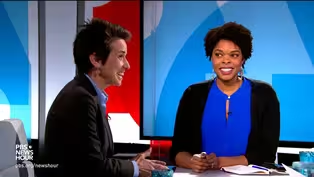
Amy Walter and Shawna Thomas on the West Virginia primary
Video has Closed Captions
Clip: 5/7/2018 | 7m 45s | West Virginia voters head to the polls on Tuesday, but they’re not alone. (7m 45s)
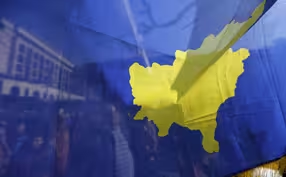
Controversial arrest upsets fragile Kosovo reconciliation
Video has Closed Captions
Clip: 5/7/2018 | 9m 31s | Special correspondent Malcolm Brabant reports in part two of our series. (9m 31s)
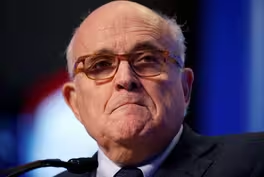
Giuliani’s legal strategy for Trump marked by confusion
Video has Closed Captions
Clip: 5/7/2018 | 4m 35s | Yamiche Alcindor joins Amna Nawaz to sort out what we've learned. (4m 35s)
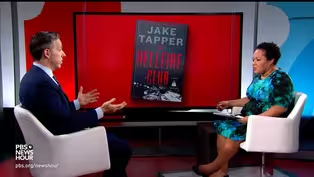
Jake Tapper’s new novel explores McCarthy-era Washington
Video has Closed Captions
Clip: 5/7/2018 | 6m 17s | In Tapper's book a congressman navigates Washington in the era of McCarthy. (6m 17s)
News Wrap: White House defends CIA pick Haspel
Video has Closed Captions
Clip: 5/7/2018 | 4m | Also, Vladimir Putin began his fourth term as Russian president (4m)

Report: Israeli security firm tried to discredit Iran deal
Video has Closed Captions
Clip: 5/7/2018 | 5m 17s | John Yang learns more from Julian Borger of The Guardian. (5m 17s)
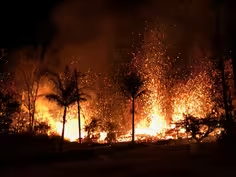
The science behind Hawaii's bubbling lava
Video has Closed Captions
Clip: 5/7/2018 | 5m 52s | The slow-moving lava has destroyed 35 structures so far, including at least 26 homes. (5m 52s)
West Virginia primary is a national nail-biter for the GOP
Video has Closed Captions
Clip: 5/7/2018 | 4m 57s | The top two candidates in past polls are fighting off a headline-grabbing insurgent. (4m 57s)
What makes education different from school
Video has Closed Captions
Clip: 5/7/2018 | 3m 23s | Author Tara Westover shares her humble opinion on remaking yourself. (3m 23s)
Providing Support for PBS.org
Learn Moreabout PBS online sponsorship
- News and Public Affairs

FRONTLINE is investigative journalism that questions, explains and changes our world.

- News and Public Affairs

Amanpour and Company features conversations with leaders and decision makers.











Support for PBS provided by:
Major corporate funding for the PBS News Hour is provided by BDO, BNSF, Consumer Cellular, American Cruise Lines, and Raymond James. Funding for the PBS NewsHour Weekend is provided by...