
PBS NewsHour full episode Oct. 26, 2017
10/26/2017 | 54m 9sVideo has Closed Captions
PBS NewsHour full episode October 26, 2017
PBS NewsHour full episode October 26, 2017
Problems playing video? | Closed Captioning Feedback
Problems playing video? | Closed Captioning Feedback
Major corporate funding for the PBS News Hour is provided by BDO, BNSF, Consumer Cellular, American Cruise Lines, and Raymond James. Funding for the PBS NewsHour Weekend is provided by...
Support provided by:

PBS NewsHour full episode Oct. 26, 2017
10/26/2017 | 54m 9sVideo has Closed Captions
PBS NewsHour full episode October 26, 2017
Problems playing video? | Closed Captioning Feedback
How to Watch PBS News Hour
PBS News Hour is available to stream on pbs.org and the free PBS App, available on iPhone, Apple TV, Android TV, Android smartphones, Amazon Fire TV, Amazon Fire Tablet, Roku, Samsung Smart TV, and Vizio.
Providing Support for PBS.org
Learn Moreabout PBS online sponsorshipJUDY WOODRUFF: Good evening.
I'm Judy Woodruff.
On the "NewsHour" tonight: DONALD TRUMP, President of the United States: We can be the generation that ends the opioid epidemic.
We can do it.
JUDY WOODRUFF: President Trump declares a public health emergency to combat the opioid crisis -- what this means for America's deadly epidemic.
Then: Where you grow up may determine your future -- why hometowns make all the difference for younger generations in an unequal economy.
And we travel to Pakistan, one of the few countries where polio still exists, to examine the challenges of eradicating the disease.
SALMAN AHMAD, Polio Activist: When I arrived here, there was a lot of confusion, there was a lot of chaos because of the Taliban spreading this disinformation that there's something in the polio vaccine which is un-Islamic.
JUDY WOODRUFF: All that and more on tonight's "PBS NewsHour."
(BREAK) JUDY WOODRUFF: From President Trump today, a summons to battle opioid addiction.
He called for new action, but not necessarily for new money.
William Brangham begins our coverage.
DONALD TRUMP, President of the United States: As you all know from personal experience, families, communities and citizens across our country are currently dealing with the worst drug crisis in American history and even, if you really think about it, world history.
WILLIAM BRANGHAM: President Trump, flanked by survivors, first-responders and family members impacted by opioids, declared a public health emergency.
DONALD TRUMP: This epidemic is national health emergency.
Unlike many of us, we have seen and we have seen in our lifetimes, nobody has seen anybody like what is going on now.
As Americans, we cannot allow this to continue.
It is time to liberate our communities from the scourge of drug addiction.
Never been this way.
We can be the generation that ends the opioid epidemic.
We can do it.
WILLIAM BRANGHAM: The president spoke at length of the severity of this crisis, which claimed the lives of at least 64,000 people last year, has stretched the ability of first-responders and filled treatment centers to capacity nationwide.
But the president also told a more personal story, about his own brother Fred, who died after his struggle with alcoholism.
DONALD TRUMP: But he really helped me.
I had somebody that guided me.
And he had a very, very, very tough life because of alcohol, believe me, very, very tough, tough life.
He was a strong guy.
But it was a tough, tough thing that he was going through, but I learned because of Fred.
I learned.
WILLIAM BRANGHAM: The administration today announced several initiatives.
The prescription drug Opana will be removed from the market because it's considered too dangerous.
A key regulation will be changed to expand access to treatment facilities.
They will allow grants from the Labor Department and money for HIV/AIDS care to be used in this fight.
And officials will be able to tap the Public Health Emergency Fund, even though that fund has less than $60,000 in it.
No new money has been allotted by today's action.
Many say the president's declaration of a public health emergency is important, but they note that it falls short of a more sweeping state of national emergency, which would give the government far more flexibility to respond to the epidemic.
The president's own commission on this crisis, chaired by New Jersey Governor Chris Christie, had urged that more comprehensive declaration earlier this year.
Christie today was still very supportive of the president's action.
GOV.
CHRIS CHRISTIE (R), New Jersey: What the president did today was historic and it is an extraordinary beginning set of steps to dealing with this problem.
WILLIAM BRANGHAM: Minority Leader Nancy Pelosi said that without more robust funding, today's action is simply not enough.
REP. NANCY PELOSI (D-CA), House Minority Leader: Declaring an emergency means he can have access to some funds, but the funds in that account are like $57,000, $58,000, so show me the money.
WILLIAM BRANGHAM: Today's declaration lasts for just 90 days, but can be renewed indefinitely by the president.
For the "PBS NewsHour," I'm William Brangham.
JUDY WOODRUFF: The state of Rhode Island has been especially hard hit by this epidemic and has one of the highest overdose fatality rates in the country.
Gina Raimondo is the governor and a Democrat.
And she joins me now from Providence.
Governor, welcome to the program.
Thank you.
What does it mean to you that the president has declared this a public health emergency?
®MD+I®MD-IGOV.
GINA RAIMONDO (D), Rhode Island: Well, good afternoon, Judy.
Good to talk to you.
This is a public health emergency.
It's a public health emergency here in Rhode Island.
Since I have been governor, I have done two executive orders on the matter.
And it is certainly probably the biggest public health crisis we face in America.
So, we can't do enough.
People are dying every day because of overdose deaths.
I'm sick and tired of going to funerals in my state of my friends' kids, family members of people who I know.
Every day almost, I hear a story of this.
And we have to do more.
JUDY WOODRUFF: What is your understanding of what can happen now as a result of this being declared a public health emergency that couldn't be done before?
GOV.
GINA RAIMONDO: You know, this has just come out, so it's little too soon to say.
What I will say, though, is to me it seems like too little too late.
This has been an emergency for some time.
What we really need is resources, Judy.
We know what works.
We have to do prevention and we have to get folks into treatment.
And so what the president should be doing if he really did care about these lives is sending finances and funding to us on a local level so that we can get folks into treatment.
We know what works.
Like, here in Rhode Island, for example, we have been using our Medicaid expansion dollars to provide medical assisted treatment to folks in prison, so they don't overdose and die when they come out.
It works.
It's saving lives.
But if the president were serious about treating this like a crisis that it is, he would have acted sooner, and at this point he would be providing some budget behind this priority, because that's what we need.
JUDY WOODRUFF: Well, at the White House, officials are telling reporters that this is going to put them in a position to urge the Congress to put more fun into this so-called Public Health Emergency Fund, which they would point out has not been funded by the Congress for years.
GOV.
GINA RAIMONDO: And that would be a good step.
That would be a good step, although, again, I would say we're past baby steps on this.
I mean, in a small state of Rhode Island, hundreds of people die every year because of overdose.
And these are people in every zip code, of every socioeconomic status in every neighborhood.
Young people, kids in their 20s, are dying, and it could be prevented.
So I would say we need more money for prevention, more money for mental health.
We don't have nearly enough mental health facilities.
And more money for medical-assisted treatment.
And I don't think we can wait.
It's time for action.
People deserve action.
In the past two weeks, I have gone to three funerals related to this.
Enough is enough.
We're doing everything we can, and the president needs to do everything he knows how to do to save lives.
JUDY WOODRUFF: Well, the president, I think, went out of his way today to say that this is something that matters deeply to him personally.
He spoke about his own brother who died of - - having been diagnosed with alcoholism.
The president sounded like he's very determined to keep the focus on this.
GOV.
GINA RAIMONDO: Well, talk is one thing, but let's see action.
You know, as I said, people are still unable to get access to mental health services, either because they can't afford it, they don't have insurance, or there's not enough capacity in the system.
He mentioned today, for example, going after cheap fentanyl coming in from China.
Take action on that.
Fentanyl is killing our kids every day.
It's coming in from China and Mexico.
So, let's see some real enforcement.
And, again, just -- I'm just imploring him, put politics aside, imploring the Congress, put politics aside, do the right thing, give the states not just flexibility.
Give us the finances that this country has, so we can save lives.
JUDY WOODRUFF: And time matters here?
GOV.
GINA RAIMONDO: Time absolutely matters.
Every day we wait, people lose their lives.
That is about the size of it.
So let's get to work.
JUDY WOODRUFF: Governor Gina Raimondo of the state of Rhode Island, thank you very much.
GOV.
GINA RAIMONDO: Thank you.
JUDY WOODRUFF: And in the day's other news: The House of Representatives narrowly passed a Republican budget, paving the way for tax cuts of up to $1.5 trillion.
Twenty Republican conservatives joined Democrats opposing the budget.
They complained that the tax cuts could balloon deficit spending and eliminate state and local tax deductions.
House Speaker Paul Ryan acknowledged the complaints, and promised the conservatives will be heard.
REP. PAUL RYAN (R-WI), Speaker of the House: The Ways and Means Committee will be putting out a specific plan very shortly and they are going to work with all of our members to look at and consider and address their concerns.
I believe that the Ways and Means Committee will be working with these members in particular to find a solution.
JUDY WOODRUFF: On a separate note, Ryan played down the biting criticism of President Trump by Republican Senator Jeff Flake this week.
He told reporters -- quote -- "I don't think the American people care about that."
The Trump administration imposed new economic sanctions today on North Korea's military and government leaders.
It cited human rights abuses.
And a State Department report showed satellite images of brutal prison camps in the North, and spoke of systematic killings and forced labor.
In Indonesia, at least 47 people died in a massive explosion at a fireworks factory near Jakarta.
The blast and inferno of flames collapsed the roof, as thick smoke billowed out.
Most of the victims were female workers apparently locked inside.
Kenya held a re-run of its presidential election today, but only part of the country voted.
The rest was in turmoil, as opposition supporters battled police and boycotted the polls.
John Ray of Independent Television News reports from Kenya.
JOHN RAY: The day Kenya went to vote, some places looked like they would go to war.
At least three reported dead, and many more injured.
A protester takes a beating from the police.
No surprise if democracy is another casualty.
Security forces fire tear gas into crowds of demonstrators, who hurl stones in return.
In this opposition area, there is no question of voting today.
Instead, all day, there have been these skirmishes between protesters and police.
Kenya's election will settle nothing.
In fact, it is only increasing tensions.
The opposition claims the election is rigged.
Why is nobody here voting?
MAN: There's no democracy.
No democracy.
JOHN RAY: Do you think the election is being stolen?
MAN: Already, it has been stolen.
JOHN RAY: In the absence of a challenger, President Uhuru Kenyatta would seem guaranteed victory, though tarnished by a low turnout.
UHURU KENYATTA, Kenyan President: All we're asking is that Kenyans turn out.
We are requesting them humbly that they should turn out in large numbers, cast their vote.
JOHN RAY: And in the capital, government loyalists did as they were asked by their president, though here they queued not in their many thousands, but by the few dozen.
With just one contender, we know who will win the election, but not when the chaos will end.
JUDY WOODRUFF: That's John Ray of Independent Television News.
Spain's Catalonia region moved closer to the brink of seceding today.
The regional president declared he will not call new elections, as the central government in Madrid wanted.
The political developments came as thousands of pro-independence protesters marched in the Catalan capital of Barcelona.
Back in this country, there's word that a computer server involved in a lawsuit over election security in Georgia has been wiped clean.
The Associated Press reports that it happened in July, just after the suit was filed.
The main defendant is the Republican secretary of state.
His office denies any role in the erasure.
MSNBC today suspended political journalist Mark Halperin over allegations of sexual harassment.
At least five women say Halperin propositioned and groped them in the 1990s and early 2000s when he was political director at ABC News.
They say that he -- that they didn't report the actions, for fear of retribution or embarrassment.
Halperin has apologized for what he called - - quote -- "inappropriate behavior."
And on Wall Street, the Dow Jones industrial average gained 71 points to close at 23400.
The Nasdaq fell seven, and the S&P 500 added three.
Still to come on the "NewsHour": what's next now that the opioid epidemic has been declared a public health emergency; a pattern of neglect from hospice caretakers; parents forced to pick up and move to give their kids a better future; and much more.
We return now to our lead story, President Trump's declaration of a public health emergency over the opioid epidemic.
William Brangham is back with a look at what it could mean.
WILLIAM BRANGHAM: And for that, we're joined by two people who've studied this epidemic for a very long time.
Dr. Bertha Madras sits on President Trump's opioid commission.
She's a professor of psychobiology at Harvard Medical School.
And Dr. Andrew Kolodny, he's co-director of opioid policy research at Brandeis University's Heller School and is executive director of Physicians for Responsible Opioid Prescribing, a group dedicated to reducing the overprescription of painkillers.
Welcome to you both to the "NewsHour."
DR. ANDREW KOLODNY, Brandeis University: Thank you.
DR. BERTHA MADRAS, Harvard Medical School: Thank you.
Delighted to be here.
WILLIAM BRANGHAM: Andrew Kolodny, I would like to start with you.
I wonder if you could just give me your reaction to the president's initiatives today?
DR. ANDREW KOLODNY: I'm disappointed.
We heard from the president last August that he considered the opioid crisis to be an emergency.
Back in August, I would have expected the president to announce what he was going to do about the problem and to begin taking action.
If you call a problem an emergency, you expect to see immediate action to address it.
And then months went by, and, today, we heard again that he considers this an emergency.
He's giving it an official designation as a public health emergency, but we're still not really receiving a detailed plan about the actions that will be taken.
And I'm especially disappointed that the president isn't announcing that he is seeking an appropriation from Congress.
I believe we need billions of dollars invested in building out a treatment system that doesn't exist yet if we're going to see overdose deaths start to come down.
WILLIAM BRANGHAM: Dr. Madras, what do you make of this?
This is a criticism that a lot of people have said, that it is obviously hugely symbolic for the president to talk about it as personally and as movingly as he did today, but that, absent money behind it, it may not be enough.
DR. BERTHA MADRAS: Well, I -- my lovely colleague Dr. Kolodny and I disagree on the take on this.
First of all, this opioid crisis has festered for almost a decade.
The upsurge was in 2010.
And I think to expect the president to solve the problem within a few weeks or months of declaring it a national emergency is unrealistic, especially since the report of the commission is coming up next week.
That report is going to have far greater detail in terms of areas that need funding, areas that need dramatic reform, and areas, of course, that need prevention.
My take on the president's speech today is that it was one of the finest presentations on the overview of what drugs do to people, what the consequences are, and it presents a national philosophy on drugs that we haven't heard in recent times.
WILLIAM BRANGHAM: Dr. Kolodny, let's say that next week the president does come forward with the billions of dollars you would like to see put towards this epidemic.
What are we to do with that money?
What are the big challenges that need funding and need attention?
DR. ANDREW KOLODNY: Yes, if we want to see overdose deaths begin to come down, what will have to happen is, we need to be in a place where someone who is opioid-addicted, when they wake up in the morning -- and if you are opioid-addicted, when you wake up in the morning, you are going to need to use opioids pretty quickly, or you are going to be feeling very sick.
That individual needs to be able to access effective outpatient treatment more easily than they can access pain pills, heroin or fentanyl.
If that person is going to be feeling sick soon, and they have got $20 in their pocket, they are going to go out and they are going to use heroin.
We need that person to be able to walk into a treatment center, and get treated that same day, regardless of their ability to pay for it.
WILLIAM BRANGHAM: Wouldn't you agree that that is really the central issue here, that people who want treatment oftentimes don't have access to it?
DR. BERTHA MADRAS: Treatment on demand.
And, Andrew, if you could wait until the report comes out, there is clearly a recognition of the need for people who are motivated.
The biggest problem that I see in dealing with people who have an opioid use disorder is that a large proportion of them do not come forward.
And I'm more concerned that these are the people who are moving into an overdose crisis, as much as the people who are people who are motivated.
People who are motivated should be able to access high-quality treatment.
That's another issue.
What is high-quality treatment?
There is no national consensus.
We talk about addiction as a brain disease, and yet we don't treat it as a medical problem.
We have treatment centers that are completely divorced from the medical community.
We have medications-assisted treatment in one part of a community and then methadone in another part.
Nothing is converging into a holistic approach to an individual with an opioid use disorder.
WILLIAM BRANGHAM: Dr. Kolodny, some others have pointed out that, even if the money were to come and the guide lines were crystal-clear on a plan of action, that there are still many officials within the government themselves - - we don't have a head of HHS, we don't have a drug czar right now.
Are those impediments, in your mind, to tackling this crisis?
DR. ANDREW KOLODNY: I believe that's the reason we don't have a plan.
I think for the president to give an address with vague information about what he is going to do to tackle a problem might be OK if the administration had a detailed plan ready to release to the public.
But there is no plan.
I don't believe that the administration agencies that should be tackling this problem, that should be putting out a detailed proposal, I don't believe that they're doing it.
And although there is a commission that President Trump has put together to make recommendations, it's not the commission's job to come up with the plan for tackling the crisis.
It should be coming from the agencies.
And with all respect to Dr. Madras, we have waited a very long time for a response from the federal government for tackling this problem.
We haven't seen it.
And it is true that this problem began before - - began a while ago.
And it's true that the Obama administration neglected the opioid addiction epidemic.
It really wasn't until President Obama's last year in office that he began speaking about the problem or seeking funding from Congress to address it.
What we need to do to tackle this problem has been pretty clear for a while.
And it isn't something that the federal government can solve on its own.
But we have counties doing everything they can to tackle the problem, and there has yet to be real help from the federal government.
WILLIAM BRANGHAM: Dr. Andrew Kolodny, Dr. Bertha Madras, thank you both very much.
DR. ANDREW KOLODNY: Thank you for having us.
DR. BERTHA MADRAS: Thank you.
WILLIAM BRANGHAM: You can find all of our coverage of the opioids crisis, America Addicted, on our Web site, PBS.org/NewsHour.
JUDY WOODRUFF: Now: There are 4,000 hospice agencies around the country.
And a new report has some disturbing findings showing neglect for too many patients and their families.
John Yang has the story.
JOHN YANG: In-home hospice care promises 24/7 support for a dying patient's physical, emotional and spiritual needs, allowing them to spend their final days at home.
But a new investigation has found that calls for help in times of crisis have sometimes been met by delays, no-shows and unanswered calls.
Here to talk about this is one of the reporters who conducted the investigation, JoNel Aleccia, a reporter for Kaiser Health News, which is an independent service not associated with Kaiser Permanente.
JoNel, thanks so much for joining us.
You worked on this with your colleague Melissa Bailey.
Tell us what you found, sort of the magnitude of what you found.
JONEL ALECCIA, Kaiser Health News: Yes, we did.
You know, we took a look at about 20,000 hospice inspection record from Medicare, and those included about 3,200 complaints.
And of those, more than 700 were confirmed and found to have problems.
We looked at those, and more than half of the inspection reports and the complaints with problems were from people who had missed visits, no-shows and other kinds of services that they were promised that were missed.
JOHN YANG: And an example of this, we have got -- you folks at Kaiser Health News produced a video part of this report.
This is Patricia Martin of Wasilla, Alaska, talking about her struggle to get pain medication for her husband as he died of cancer.
PATRICIA MARTIN, Alaska: So, I called them.
And I said, we didn't get the pain medication.
And they said, oh, well, we can't get ahold of the doctor, because he is sleeping because he works at night at the hospital on Saturday.
He said to me, "I thought I was going to get pain relief" when we got into hospice.
JOHN YANG: The Alaska Department of Health and Social Services concluded in that case that the hospice failed to properly coordinate services for the Martins.
How typical was that -- is this example?
JONEL ALECCIA: You know, Pat Martin's situation was, sadly, really typical of the situations that we found in those complaint records.
We combed through them and were able to track down people through death records and other public records.
But Pat's case was, sadly, very common.
We had other people where they delivered boxes of medication without telling them how to use it.
They had nurses that they would call in the middle of the night.
One nurse that we reported about, her cell phone was on silent, and she missed 16 calls for help as this woman's husband was dying.
JOHN YANG: What was the industry response to what you found?
JONEL ALECCIA: You know, what the industry said is, no situation like that is tolerable or appropriate.
But they emphasize that most people who enroll in hospice are happy with the experience.
And they said that these cases are a small minority of the typical cases that you will find in hospice.
JOHN YANG: In your report, you pointed out that a lot of this was paid for by Medicare and that hospice gets -- the hospice services are paid for by about $16 billion a year in Medicare funds.
These are taxpayer funds.
What sort of oversight does Medicare have over these services?
JONEL ALECCIA: Well, Medicare -- you know, Medicare is responsible for oversight of the hospices.
But, you know, what is not often known is that these hospices aren't inspected as frequently as nursing homes are, for instance.
They don't have to be inspected every year.
You know, they just changed the rules, and starting in 2018, they will have to be inspected every three years.
So, Medicare is responsible for oversight of these hospices, but it doesn't appear to be enough.
JOHN YANG: In -- we have got less than a minute to go.
What can families do to try to avoid these problems?
JONEL ALECCIA: Families can ask questions about how people respond to patients in emergencies.
If they have time, they can ask their local state -- the state health department for the inspection records at the hospice that they plan to use.
But, mostly, they need to ask questions about what happens late in the night and when patients are at their worst.
JOHN YANG: JoNel Aleccia Kaiser Health News, thank you so much for telling us about this really startling report.
JONEL ALECCIA: Thanks for having me.
JOHN YANG: And you can read the full Kaiser Health News report on our Web site, PBS.org/NewsHour.
JUDY WOODRUFF: Stay with us.
Coming up on the "NewsHour": Pakistan's goal to eradicate polio; and a Brief But Spectacular take from Gold Star father Khizr Khan.
Paul Solman But first: Our economics correspondent, Paul Solman, is continuing to chronicle some of the problems with inequality across the country.
Tonight, he looks at the possibility of moving up the economic ladder by moving out to other communities.
It's part of his weekly series, Making Sense.
KRISTEN HOPPER, Mother: I want better for my family.
PAUL SOLMAN: Kristen Hopper expressing the economic motto of America even before the states united.
So, you want your kids to do better than you have done?
KRISTEN HOPPER: A hundred percent.
PAUL SOLMAN: The 35-year-old mother of four has gone the extra miles to make that happen.
With help from the Interfaith Council for Action, a housing nonprofit, she's uprooted her family from hardscrabble Yonkers, New York, where she herself grew up, and has in effect emigrated a mere 20 miles north, but in some respects a world away, to Ossining, New York.
Ossining may be home to Sing Sing Prison, where criminals are still sent up the river from New York City, but this is suburbia, a place with far better prospects for 2-year-old twins Robert and Juliet (ph), 10-year-old Josie, 14-year-old Gio.
KRISTEN HOPPER: The last place that I lived, it wasn't safe for my kids to walk around in.
There was a shoot-out.
They have all kinds of gangs.
I know that, if I stayed there, my kids would be in the streets too.
PAUL SOLMAN: But instead of the streets, Gio is in after-school clubs, pre-law, pre-business and The Ossining High School Current.
GIOVANNI ROSADO, Student: I want to become a lawyer.
And I'm trying to work on that.
PAUL SOLMAN: So that you can do better economically?
GIOVANNI ROSADO: Yes.
Yes.
PAUL SOLMAN: How much better is it for you and for the kids... ROBERT BRUNNER, Fiance of Kristen Hopper: Oh my God.
PAUL SOLMAN: ... to be living... ROBERT BRUNNER: It's amazing.
PAUL SOLMAN: Hopper's fiance, Robert Brunner.
ROBERT BRUNNER: The safety is 1,000 times different than it is in a hood area.
And to fit in, in those places, you have to be rough and tough, and it's a totally different child.
It changes the child.
PAUL SOLMAN: As it changed Brunner, who did and dealt drugs, like the hallucinogen PCP, angel dust.
ROBERT BRUNNER: It's embalming fluid and jet propellant.
That's the mix of it.
I used to sell it.
I used to do all that crap.
Craziness.
PAUL SOLMAN: The craziness climaxed when he crashed his car while high, was in a coma for 18 months.
ROBERT BRUNNER: My father -- like, when the doctor say, you know, your son has no brain activity, he's -- he won't even be able to function, so then they pull the plug on me.
They basically pull it out to see if you can breath on your own.
And then, if you do, you're good.
And if you don't, you're done.
PAUL SOLMAN: Do you think that a kid as smart as Gio is, would he have been vulnerable to taking angel dust?
ROBERT BRUNNER: I think, if the crowd is doing it, I think he would do it.
Peer pressure isn't easy, you know?
PAUL SOLMAN: And thus the move upriver, different peers, different pressures.
Just ask Gio and Josie.
GIOVANNI ROSADO: The people down in Yonkers, they are very mean, in a way.
PAUL SOLMAN: Mean?
GIOVANNI ROSADO: Yes.
They, like, get angry a lot and they like to pick on kids, and I didn't really enjoy that.
JOSEPHINA GRAVENESE, Student: And, in Ossining, there's like kids who are like so nice to you.
When it was my first day, the kids were asking me like, do you want to play and stuff?
It's just not like Yonkers at all.
PAUL SOLMAN: But it could be that the people in Yonkers are as mean as they are, to use your word, because they don't see much of a future for themselves there.
GIOVANNI ROSADO: That's true.
PAUL SOLMAN: Where people here do see a future for themselves.
GIOVANNI ROSADO: Yes.
PAUL SOLMAN: Which is their mom's whole point.
KRISTEN HOPPER: I want to show them that in order to be able to live well, and not live paycheck to paycheck, not have to be on social services, not that it's a bad thing -- and I'm grateful for all the help that I have, but I definitely want them to do better than me.
PAUL SOLMAN: Now, some might say that shouldn't be hard in this case, but here's the stark fact that prompted our trip to Westchester: The odds no longer favor American kids doing better than their parents.
RAJ CHETTY, Stanford University: It's basically a coin flip at this point.
NATHANIEL HENDREN, Harvard University: Yes, it's just a remarkable decline in our country in terms of the fraction of our kids earning more than their parents.
PAUL SOLMAN: Economists Raj Chetty and Nat Hendren study economic inequality, growing in America for decades, as you have so often heard.
But inequality itself might not be so bad if we all had a fair shot at the platinum ring.
Problem is: NATHANIEL HENDREN: The fraction of kids earning more than their parents has fallen from above 90 percent four decades ago to about 50 percent today.
PAUL SOLMAN: And so people who are worried about this for their kids are right to worry.
NATHANIEL HENDREN: Absolutely.
It used to be that everybody could count on this, that your kids were going to grow up to earn more than you.
And, today, it's not just something that's a feature of the American economy.
PAUL SOLMAN: So what can a poor family with an American dream do to increase the odds of the kids moving up?
Move out.
NATHANIEL HENDREN: We see that in places where kids of different economic backgrounds are mixing in the same environment, those tend to be places where kids from low-income backgrounds rise up further in the income distribution.
PAUL SOLMAN: Kind of like Ossining, where a plaque commemorates Alexis de Tocqueville's visit almost 200 years ago.
He wrote: "When inequality is the general rule in society, the greatest inequalities attract no attention."
KRISTEN HOPPER: You have some really wealthy people.
You have some people in poverty.
It's kind of balanced.
PAUL SOLMAN: And that helps your kids?
KRISTEN HOPPER: Yes, I want them to understand that there is hard life, that there's good life.
PAUL SOLMAN: So they can see the good life, and they see it's attainable you mean?
KRISTEN HOPPER: Yes.
Of course.
Of course, because the reverse is also true.
RAJ CHETTY: Places that are more segregated by race or by income tend to have lower levels of upward mobility.
PAUL SOLMAN: Consider inner-city Baltimore, which we visited two years ago, when violence erupted following the death of Freddie Gray in police custody.
According to these young ministers-in-training, the near-absence of upward mobility fueled the protesters' anger.
MAN: People aren't feeling like they can succeed in life or get above.
MAN: It's like we're all living in this dump or this war zone.
MAN: Living in the dilapidated areas which they live in, they feel like they're not loved.
They feel like they're not cared for.
RAJ CHETTY: If you think about what's gone on in Baltimore, it's a place of tremendous concentrated poverty.
PAUL SOLMAN: Chetty and Hendren have looked closely at Baltimore, reanalyzing data from a mid-1990s experiment in which the federal government gave poor families housing vouchers to move to better neighborhoods.
Twenty years later: RAJ CHETTY: The kids who moved at young ages are dramatically better as adults.
They're earning 30 percent more.
They're 27 percent more likely to go to college, something like 30 percent less likely to have a teenage pregnancy, relative to the kids who stayed in the high-poverty public housing projects.
And so there's clear scientific evidence that you can dramatically change kids' outcomes just based on where they grow up.
PAUL SOLMAN: What does it say on your arm?
DESTINY TURTURIELLO, 17 Years Old: "Only the strong survive," in Chinese.
PAUL SOLMAN: But back in Yonkers, 17-year-old Destiny Turturiello, a family friend of Kristen Hopper's from the old neighborhood, can't get out.
A minor with no legal guardian, she's even having trouble getting back into school, having dropped out when kids bullied her for doing her homework during lunch.
She used to give as good as she got.
DESTINY TURTURIELLO: If you look at me, just like how you're looking at me now... PAUL SOLMAN: Yes?
DESTINY TURTURIELLO: ...
I might just fight you two years ago.
PAUL SOLMAN: You would fight me?
What do you mean?
DESTINY TURTURIELLO: I would just be like, what are you staring at?
Is there a problem?
And then I would have hit you.
And then I would have went about my day, because I feel like I just took my anger out on you.
PAUL SOLMAN: She's learned to manage her anger, but she's still in Yonkers, which has deep pockets of poverty not far from upscale, affluent areas.
DESTINY TURTURIELLO: What am I doing with my life?
I'm not doing anything productive.
What am I going to be later on in life?
Am I going to be something?
If I could change on living in Yonkers, I would do it 100 percent.
PAUL SOLMAN: But Turturiello, like millions of other Americans, can't afford to move to a better community.
Kristen Hopper only managed with help from benefactors.
But finances weren't the only factor.
KRISTEN HOPPER: It was hard for me to disconnect from friends.
Like, what am I going to do if I have nobody you know?
And when I actually did it, many people were shocked.
PAUL SOLMAN: Shocked, she says, and resentful.
Is the resentment similar to the resentment that so many Americans feel towards people who are just doing much better that they're doing in this economy?
KRISTEN HOPPER: I have felt that resentment hard.
PAUL SOLMAN: The status distinction.
KRISTEN HOPPER: Yes.
I did.
I did.
PAUL SOLMAN: Location, location, location, an old saw in real estate, but one with poignant new pertinence in today's increasingly immobile economy.
For the "PBS NewsHour," this is economics correspondent Paul Solman, reporting from Westchester, New York.
JUDY WOODRUFF: Now: the first of two-part series looking at Pakistan.
Tonight, we focus on the country's campaign to eradicate the polio virus, which remains endemic in regions of just three countries, Nigeria, Afghanistan and Pakistan.
In cooperation with the Associated Press, special correspondent Fred de Sam Lazaro reports.
It's part of his series Agents for Change.
FRED DE SAM LAZARO: Salman Ahmad is one of Pakistan's most recognizable public figures, a rock musician whose group, Junoon, has sold millions of albums and filled large stadiums in recent decades.
Today, Ahmad has become known as the Bono of Pakistan.
His cause?
Raising public awareness for the country's campaign to eradicate polio, which he reminded these students is very close to its goal.
Ahmad appears in TV spots and restricts his public appearances to small groups, illustrating a key challenge for the polio campaign.
SALMAN AHMAD, Polio Activist: We used to do concerts here where 100,000 people could come in these stadiums, like the Karachi -- national stadium in Karachi.
Now everything has gone underground.
We can't go and do public concerts, just because of the threat of violence and threat -- the extremist threat.
FRED DE SAM LAZARO: That threat is the main reason Pakistan is one of only three countries in the world where the crippling viral disease remains endemic.
The violence has specifically targeted polio campaigners.
Several dozen vaccinators and security personnel have been killed by Taliban gunmen.
SALMAN AHMAD: When I arrived here, there was a lot of confusion, there was a lot of chaos because of the Taliban spreading this disinformation that there's something in the polio vaccine which is un-Islamic.
FRED DE SAM LAZARO: Not helping the cause, the CIA conducted a fake vaccination campaign in the area where it suspected Osama bin Laden was hiding, trying to collect DNA matches from family members.
That severely damaged public trust.
Despite all the challenges, Pakistan has seen an impressive drop in new cases, from more than 300 cases in 2014 to just five in 2017.
DR. ZULFIQAR A. BHUTTA, Polio Activist: We hope we are really at an advanced stage of the polio end game.
FRED DE SAM LAZARO: Dr. Zulfiqar Bhutta is a leading expert on the country's polio campaign.
He says there's been a concerted effort to plug the gaps, led by Rotary International and a number of partners, including Pakistan's religious leaders and army.
DR. ZULFIQAR BHUTTA: Pakistan, particularly in the conflict-affected insecure areas of the country, has made tremendous inroads.
FRED DE SAM LAZARO: Violence and extremism have made many parts of Pakistan inaccessible to the polio campaign, so vaccinators have fanned out to places where people are coming and going from these regions, looking for small children in places like Karachi's main railway station.
SALMAN AHMAD: The real hero is the polio health worker, mostly the women, who are out on the front lines going and immunizing the kids.
FRED DE SAM LAZARO: They are campaign veterans, like Saeeda Banu.
Banu and her colleagues look out for young children, coaxing the three drops of oral vaccine into sometimes reluctant customers.
For Banu, the job is personal.
SAEEDA BANU, Polio Vaccinator (through translator): I had two sons.
Both developed polio, and the older one died.
This happened to my children, and so I want to make sure that it doesn't happen to other children.
FRED DE SAM LAZARO: She worries about her surviving son, Abdul Wajid, who is 16 and severely disabled.
SAEEDA BANU (through translator): He was completely normal at birth, then started to show some symptoms at eight months.
His feet got twisted, he stopped playing.
We have taken him for some operations, and that's helped him to sit upright.
Before, he couldn't even do that.
FRED DE SAM LAZARO: Her husband is on a small pension, and with her own meager salary, things like physical therapy or a wheelchair for Abdul Wajid are beyond reach.
Many people live in far worse poverty.
And they are the prime target of the polio campaign's foot soldiers, most of them women.
The vaccinators are trained to anticipate resistance from parents.
WOMAN (through translator): Our vaccines comes from Indonesia.
And Indonesia is a Muslim country.
FRED DE SAM LAZARO: Accompanied by a policeman, the vaccinators, many from the same neighborhoods in which they work, go door to door.
Security is only one concern that can hinder their progress.
Conditions on the ground are often ripe for polio, waste of all kinds, and flooding when it rains.
And tests this year detected the prevalence of the polio virus in this Karachi slum.
Only a small proportion of people exposed to the polio virus develop the disease, and small children are most vulnerable.
The workers try to get as many as they can, but families here are mostly transient, moving as they look for daily labor jobs to survive.
Their mobility increases the likelihood their children won't get the oral vaccine, or at least a full course, ideally at least three doses.
Another challenge, polio is simply not a priority, says Dr Bhutta.
DR. ZULFIQAR BHUTTA: I think, to an average person who's lost his child due to diarrhea or has lost his daughter-in-law due to hemorrhage after childbirth, there is more to life and misery and hell than polio.
They have got to place polio in the context of everything else.
FRED DE SAM LAZARO: New infections are at an all-time low, but the virus is still active and able to spread, and Bhutta's biggest fear is a combination of complacency and exhaustion, especially in certain regions.
DR. ZULFIQAR BHUTTA: The job isn't done until the job is done.
With polio, you can't afford to even have one or two cases.
FRED DE SAM LAZARO: As long as there's a single case, he says, polio remains a global threat, not just a localized one.
So the campaign, with Salman Ahmad and other celebrities, continues and hopes to keep polio front and center in public consciousness, in pursuit of the big zero.
For the "PBS NewsHour," this is Fred de Sam Lazaro in Karachi.
JUDY WOODRUFF: Fred's reporting is a partnership with the Under-Told Stories Project at the University of St. Thomas in Minnesota.
Staying in Asia, we found an organization that is helping young women in Afghanistan participate in new outdoor sports for that country, hiking and rock climbing.
Independent filmmaker Atia Musazay (ph) brings us the story of Ascend Athletics, an American organization that is training what has become the first climbing team of its kind in the war-stricken country.
The "NewsHour"'s Julia Griffin has details.
JULIA GRIFFIN: Afghanistan is not known for its hiking or climbing.
It's not safe.
But this team of young women is hoping to change that.
Freshta is part of this team.
FRESHTA, Program Coordinator, Ascend Athletics (through translator): The wind that hits my face and the view that I see from the top of the mountain, not everyone has the opportunity to see that.
We take pictures and breathe freely.
I think most Afghan girls will never have this experience.
JULIA GRIFFIN: Ascend Athletics, a nonprofit of American professional climbers, is training the team of young Afghan girls.
Their goal is to help women find peace in the midst of war.
Afghanistan is the eighth most mountainous country in the world.
Nearly 75 percent of the country is covered by rugged mountains, and few are brave enough to climb them.
The organization trains about 20 girls each year.
Freshta works for Ascend Athletics as a program coordinator.
FRESHTA (through translator): When I heard about this position, I really liked it.
What was interesting to me was that women were doing this for other women.
It's a new sport in Afghanistan, and I knew I had to be a part of this.
JULIA GRIFFIN: Today, they are practicing rock climbing in a mountain at a location they cannot disclose for safety reasons.
Women in Afghanistan frequently participate in indoor sports, but the country's conservative culture makes outdoor sports more difficult to practice.
Harassment and even threats of violence from the Taliban and other extremists mean the group must travel to climb sites in secret.
WOMAN (through translator): Somebody shot at us.
They are trying to scare us.
JULIA GRIFFIN: While ascending over a sharp ridge, a gunshot rang out from the distance.
The team holds position to make sure the coast is clear.
WOMAN (through translator): How dare they do it so close to us?
It hit this rock near us.
GAWHAR, Mountain Climber (through translator): Even here in the mountains where there is no one, we are not safe.
But I'm still happy we can rock-climb even in these conditions.
JULIA GRIFFIN: Eighteen-year-old Gawhar recently joined the team.
GAWHAR (through translator): When I'm exercising, I feel healthy.
I feel like I'm really living.
JULIA GRIFFIN: The Ascend Athletics team also addresses issues of trauma and mental health that can come with living in an unstable country.
Freshta was a student at the American University of Afghanistan in 2016 when the Taliban attacked the school and killed 13 people.
FRESHTA (through translator): When us girls get together, we talk about happiness and our dreams.
But we also talk about the bombings.
We ask each other if we're OK. JULIA GRIFFIN: The United Nations reports that the conflict in the country have been affecting women at record levels.
The rate of female casualties has increased 23 percent since 2016.
Many victims were civil servants working for government institutions.
Freshta says she is frequently reminded of the attacks.
FRESHTA (through translator): I worry about the day a bomb goes off, and I get a call that I lost a loved one.
JULIA GRIFFIN: Rayhana is 18 and wants to be a construction engineer.
She's in the second year of her studies and the only woman in her program.
RAYHANA, Mountain Climber (through translator): This society thinks mountain climbing is not for women and that a woman cannot make it to the top.
I really like mountaineering, especially because can I prove to men that women can do anything.
FRESHTA (through translator): There have been times we have had rocks hurled at us.
We have been yelled at.
We try not to think about these things.
If I want to be a mountaineer, if I want to conquer heights, I will do it.
I want that pride in myself.
JULIA GRIFFIN: In 2018, the team plans to ascend mountain Mount Noshaq At nearly 25,000 feet, it's the highest peak in Afghanistan.
For the "PBS NewsHour," I'm Julia Griffin.
JUDY WOODRUFF: Finally, in another of our Brief But Spectacular series, we hear from Khizr Khan.
He's the Gold Star father who gave a speech at the 2016 Democratic National Convention, later called out for criticism by then candidate Donald Trump.
Mr. Khan has more recently been fund-raising for the Democratic Party.
Tonight, he tells us a about his son, Captain Humayun Khan, and the legacy he left behind.
Khizr Khan's book, "An American Family: A Memoir of Hope and Sacrifice," was released this week.
KHIZR KHAN, Author, "An American Family: A Memoir of Hope and Sacrifice": I would take my kids with our guests sometimes to Jefferson Memorial in Washington, D.C., and I would ask them to read the inscription on the wall.
And they would be amazed to see what is written.
Sometimes, these kids would roll their eyes because I have taken them 20 times already.
And they would complain that, why you keep bringing us here?
But patriotism begins to take root.
When Captain Humayun Khan arrived at University of Virginia, Thomas Jefferson's university, in Charlottesville, he became avid reader of Jefferson.
And public service, the emphasis on public service, serving others, became his motto.
And you see from his life how far that took him, service of others.
The person that he became by the training that the Army provided him turned him into a patriot.
He was protecting those who were under his responsibility.
On June 8, 2004, in was in Baqubah, Iraq.
He realized that this car is moving too fast towards the doors.
He told his men and women at the gate to hit the ground.
He had the option to hit the ground.
That would have meant that this car would hit the gate and harm the people at the gate and beyond on the other side of the wall.
He took 10 steps, those 10 made-in-America bravery steps, towards the car.
His hand extended trying to stop it.
He did stop the car, causing it to prematurely detonate.
He lost his life instantly there.
That has become symbol of Captain Humayun Khan, that there comes time in every person's life when you have to stand up, even if it means risking your life, for the values that you cherish so very much.
He granted us 27 years of his presence.
Only parents know this.
It is said that, when you lose a child, it creates a hole in your heart, and that is never filled.
You learn to live with that.
Guess who said that to me?
I was at Union Station checking in to travel the train.
The person who was issuing the ticket looked at me.
He recognized me.
He came.
There was a line of people waiting.
He came behind the counter, gave me a hug, and whispered in my ear, "Mr. Khan, I want to you know that I have lost a son too."
When I go to Arlington Cemetery, I not only stand at Captain Humayun Khan's grave and pray for his soul.
I pray for all of my sons and daughters that are buried there.
It means so very much to me.
My name is Khizr Khan.
This is my Brief But Spectacular take on dignity and patriotism.
JUDY WOODRUFF: And thank you, Mr. Khan, for sharing that with all of us.
You can watch more of our Brief But Spectacular videos online at PBS.org/NewsHour/Brief.
On the "NewsHour" online right now: Redheads are rumored to feel more pain and need more painkillers than their blonde and brown-haired cousins.
So, what do genetics say about that?
We separate fact from fiction on our Web site, PBS.org/NewsHour.
And that's the "NewsHour" for tonight.
On Friday, National Book Award winner Jesmyn Ward looks at love, class and race in her new novel, "Sing, Unburied, Sing."
I'm Judy Woodruff.
Join us online and again here tomorrow evening.
For all of us at the "PBS NewsHour," thank you, and we'll see you soon.
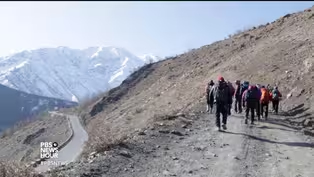
How hiking gives Afghan girls a chance to breathe free
Video has Closed Captions
Clip: 10/26/2017 | 4m 43s | A new organization is helping women find peace living in the war-stricken country. (4m 43s)

Investigation reveals neglect by hospice caretakers
Video has Closed Captions
Clip: 10/26/2017 | 5m 19s | An investigation found that calls for help in times of crisis were often met with delays. (5m 19s)
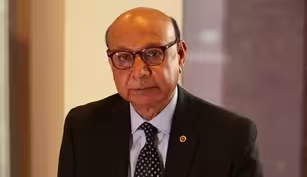
Khizr Khan on why public service is the root of patriotism
Video has Closed Captions
Clip: 10/26/2017 | 3m 58s | Khizr Khan on why public service is the root of patriotism (3m 58s)
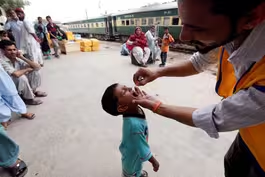
Pakistan makes inroads toward polio eradication
Video has Closed Captions
Clip: 10/26/2017 | 7m 1s | A campaign to dispense vaccinations has helped relieve the polio crisis in Pakistan. (7m 1s)
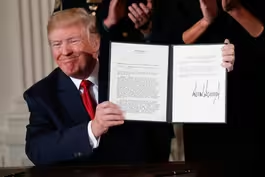
Trump calls for new action, not new money, to tackle opioids
Video has Closed Captions
Clip: 10/26/2017 | 7m 51s | Will President Trump’s emergency declaration on opioids do enough to help states? (7m 51s)
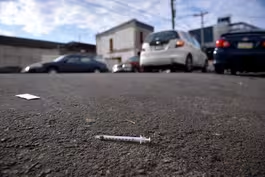
What does the emergency declaration mean for opioid crisis?
Video has Closed Captions
Clip: 10/26/2017 | 7m 34s | Trump has officially designated the opioid epidemic as a public health emergency. (7m 34s)

Where you grow up matters in an unequal economy. Here’s how.
Video has Closed Captions
Clip: 10/26/2017 | 9m 12s | Is geographic mobility the key to moving up the economic ladder? (9m 12s)
Providing Support for PBS.org
Learn Moreabout PBS online sponsorship
- News and Public Affairs

FRONTLINE is investigative journalism that questions, explains and changes our world.

- News and Public Affairs

Amanpour and Company features conversations with leaders and decision makers.












Support for PBS provided by:
Major corporate funding for the PBS News Hour is provided by BDO, BNSF, Consumer Cellular, American Cruise Lines, and Raymond James. Funding for the PBS NewsHour Weekend is provided by...