One-on-One
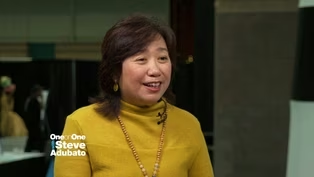
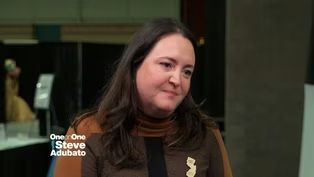
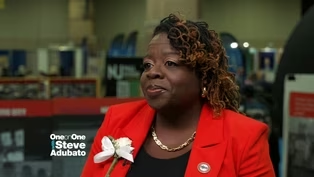
Petal Robertson; Gillian Ober; Shihong Zhang
Season 2026 Episode 2935 | 27m 58sVideo has Closed Captions
Petal Robertson; Gillian Ober; Shihong Zhang
Petal Robertson, VP of the NJEA, talks about the intersection of labor unions and politics. Gillian Ober, 2025-2026 NJ State Teacher of the Year & ESL Teacher at Freehold Borough School District, discusses advocating for students who go unheard. Shihong Zhang, Founder & Board Chair of the NJ Chinese Teachers Association, discusses building community and collaboration among Chinese educators.
Problems playing video? | Closed Captioning Feedback
Problems playing video? | Closed Captioning Feedback
One-on-One is a local public television program presented by NJ PBS
One-on-One
Petal Robertson; Gillian Ober; Shihong Zhang
Season 2026 Episode 2935 | 27m 58sVideo has Closed Captions
Petal Robertson, VP of the NJEA, talks about the intersection of labor unions and politics. Gillian Ober, 2025-2026 NJ State Teacher of the Year & ESL Teacher at Freehold Borough School District, discusses advocating for students who go unheard. Shihong Zhang, Founder & Board Chair of the NJ Chinese Teachers Association, discusses building community and collaboration among Chinese educators.
Problems playing video? | Closed Captioning Feedback
How to Watch One-on-One
One-on-One is available to stream on pbs.org and the free PBS App, available on iPhone, Apple TV, Android TV, Android smartphones, Amazon Fire TV, Amazon Fire Tablet, Roku, Samsung Smart TV, LG TV, and Vizio.
Providing Support for PBS.org
Learn Moreabout PBS online sponsorship- [Narrator] Funding for this edition of One-On-One with Steve Adubato has been provided by NJ Best, New Jersey’s five-two-nine college savings plan.
NJM Insurance Group.
Serving New Jersey’s drivers, homeowners and business owners for more than 100 years.
Stockton University.
The Russell Berrie Foundation.
Making a difference.
PSE&G.
Powering progress.
Valley Bank.
EJI, Excellence in Medicine Awards.
A New Jersey health foundation program.
The Turrell Fund, a foundation serving children.
And by Englewood Health.
Promotional support provided by NJ.Com.
Keeping communities informed and connected.
And by NJBIA.
We put business at the center.
- This is One-On-One.
- I'm an equal American just like you are.
- The way we change Presidents in this country is by voting.
- A quartet is already a jawn, it’s just The New Jawn.
- January 6th was not some sort of violent, crazy outlier.
- I don't care how good you are or how good you think you are, there is always something to learn.
- I mean what other country sends comedians over to embedded military to make them feel better.
- People call me 'cause they feel nobody's paying attention.
_ It’s not all about memorizing and getting information, it’s what you do with that information.
- (slowly) Start talking right now.
- That's a good question, high five.
(upbeat music) - Hey, everyone, Steve Adubato with my colleague, the senior correspondent for "One-on-One," Jacqui Tricarico.
Hey, Jacqui, we are celebrating teachers all this week.
This is National Teacher Appreciation Week on "One-on-One."
We celebrate our teachers because?
- Well, we should be celebrating our teachers every single day.
Let's face it, Steve, our kids are with our teachers more than they are at home with us, and they're just such an important role.
They play such an important role in our kids' lives every single day, and there are so many amazing teachers across our state doing great work, not just in the classroom, but outside the classroom.
And this whole week just really pays tribute to that, to the great teachers across our state doing things for our students, for our kids that are going to shape the rest of their lives.
- So, Jacqui and I down at Atlantic City toward the end of 2025, the NJEA, New Jersey Education Association, to disclose one of our long-time supporters of public broadcasting.
Jacqui and I talked to all sorts of leaders in the world of education, all sorts of educators who are making a difference.
This is Teacher Appreciation Week right here on "One-on-One."
Let's check it out.
(upbeat music) - Hey, everyone.
Steve Adubato in Atlantic City.
Why?
Because it's the 2025 New Jersey Education Association Convention.
We are here, with the Vice President of the NJEA, Petal Robertson.
By the way, the reason you're looking at people is 'cause you got people (Petal laughs) all around here waving to you, - I do.
- giving you high-fives.
- I do.
It's the best time of the year.
- Tell us why this convention.
By the way, you've been to a few?
- I have been to a few.
- Why is this one with over 10,000 people so exciting for you?
- So for me, because we're coming off a really big NJEA win, our endorsed candidate for governor just won the gubernatorial seat.
- Governor Mikie Sherrill.
- So congratulations to Governor-elect, Mikie Sherrill.
So our members organized, and they rallied.
So them coming in and being able to celebrate that big win together.
And it's always a great time at convention.
So this is just my favorite time of year.
- So let's talk about that.
Because I was talking to Steve Beatty, to your president about that as well, about the NJEA involved.
And I'll disclose again, the NJEA, a longtime supporter of public broadcasting and of our programming as well.
Why is it so important for those who go, "Why are you involved in politics?
Why are you involved in campaigns?"
It's important that people understand that.
- Well, I think that everyone- - By the way, we're at a convention.
That's how you know stuff's going on around here.
(Petal laughing) Go ahead.
- Well, I think everyone should be involved in politics.
Everyone should be a participant in politics.
And we know that politics is heavily involved in education.
So educators, that is just a natural place for us to fit.
And as a union, we wanna make sure that we're empowering our members so that they can also get involved in politics and the communities around them.
- Along those lines, it's not so much politics, but it's government decisions, which, political.
The "Break in Service" law.
- Oh, this makes me happy.
- What the heck is it?
I talked to Steve about this as well.
- Yes.
- Explain to folks what it is and why it matters.
- So I'll give you a really, a simple breakdown of it.
So in 2011, the law changed, and it made it so that people who took more than two years out of the classroom got bumped out of their original retirement tier and bumped into tier five.
- So hold on.
Teacher takes a break.
- Teacher takes a break.
- Two years, you're out?
- Yeah.
I can give you a perfect example.
We had a teacher go on maternity leave, and on their maternity leave they found out that their child had special needs.
- Mm.
- So they decided to extend that maternity leave, and it extended past two years.
They go back to work thinking, "I'm still in tier one, I can still retire."
- Tier one means... - Means that I can retire at 55 with a good retirement savings.
And they think everything's good, and "I'm coming back to this classroom that I love, and I'll be able to retire."
But because of the law that changed in 2011, they were bumped out of their tier, and they were put into tier five, which means you can't retire until you're 65 years old for significantly less money than you originally planned.
And this we found, disproportionately affected women in our organization who had left to take care of children, themselves, some recovering from cancers, all of those things.
So we really rallied, we pushed hard, and we're so grateful to Governor Murphy for signing this bill into law because this now will restore the proper retirement for so many of our members.
- Petal, thank you.
First, thank you for laying that out.
But I'm curious about this.
- How many years teaching?
- Oh my goodness.
I have been teaching since 2001.
- Okay.
- So I'm, I'm over two decades in, but I've been wanting to teach since I was five years old.
- Because... - Because I come from a line of teachers.
My mother was a teacher in Guyana, my family's from South America.
My grandfather opened a school in Guyana.
They actually just named a street after him.
- After your grandfather?
- After my grandfather.
That's awesome.
- Frederick Robertson.
Yes.
And so education has always been so important to us, and it's just been such a key to unlock so many doors for myself and my family, and for so many immigrant communities.
So I just feel very passionately about ensuring that every child has an equitable education.
- That's personal for you?
- Yes, very.
Very much so.
- Is it also personal on some level beyond the professional satisfaction of being the vice president- - Yeah.
- of the organization?
How much of that is personal for you?
You didn't go into this to become a leader?
- Oh no.
- And an officer in the organization.
- I tell people all the time, someone said, "Oh, did you, you know, when you were a kid, did you know that you would be the vice president of the union?"
And I said, "What kid dreams about being in a union?"
(Steve laughing) I was worried about quicksand.
But- - Wait, hold on.
(Petal laughing) You just can't say that.
Quicksand where you grew up?
- I thought quick... No, I just as a kid, I thought quicksand would be something that I would have to figure out how to maneuver out of.
I've never seen quicksand, Steve.
- Okay.
I just wanna clarify that.
But being a union leader- - But being a union leader- - not on the bingo card.
- Not, not on the bingo card at all.
But I realized that I am a big mouth, I am an activist, and I really love fighting for marginalized people and marginalized voices.
So it sort of naturally placed me in this position.
And I'm honored because I get to be the first black woman to ever serve as vice president of the NJEA.
And I hold that with pride.
- It is our honor and pleasure- - Thank you.
- to be here at the NJEA convention.
It's, again, you could hear what's going on around us.
- Yes.
- But the vibe here, before I let you go, I gotta tell you, the vibe here is awesome.
- Isn't it?
- And the keynote speaker, was it Malala?
- Yes.
- Malala... Yousafzai.
- Oh.
- Malala.
Tell everyone, one of the two keynote speakers.
- Yes.
- "She was awesome because..." - She was awesome because she gave the room hope.
And she let the room know that activism isn't about age, it's about passion, about your beliefs.
- But she's young.
But by her background, - Yes.
- Let folks know.
- She, so Malala started her activism for young girls, fighting for young girls to get an education.
And she was shot at 11 years old by the Taliban.
And she, and she never let it deter her.
As a matter of fact, it's forced her to push harder.
And she is now working in several countries ensuring that young girls are, are enabled an opportunity to receive an education.
And so her story, her humor, her warmth, all of those things were the reminder that we still have really great people in this world, and that we can be those really great people that we need.
- Inspiring.
- Oh, she was amazing.
She was amazing.
- This is Petal Robertson.
She's the vice president of the NJEA.
She knows how to navigate quicksand, apparently.
(Petal laughing) - I'm a pro.
- You're a pro.
I cannot thank you enough.
- Thank you so much, Steve.
- We appreciate you and your colleagues.
- I always enjoy it.
- And again, - Thank you.
- let me disclose again, the NJEA, a long time supporter of our programming and public broadcasting.
You may have heard of it.
(Petal laughing) Still pretty important.
I'm Steve Adubato.
We're in Atlantic City for the NJEA convention.
Stay with us.
We'll be right back.
- [Narrator] To watch more One on One with Steve Adubato find us online and follow us on Social media.
- I'm so pleased to be joined now by Gillian Ober, who is a ESL teacher in Freehold Borough and the 2026 New Jersey State Teacher of the Year.
Congratulations.
- Thank you.
I'm still letting that sink in.
- Still absorbing the information.
Well, it's funny because I know the NJEA is notorious for surprising their state teachers of the year.
So bring us back to that day.
It was just a few months ago.
- Yeah.
- Even last month.
What was that like finding out that you were selected?
- It was incredible.
I was just like teaching a lesson in my classroom and my superintendent, she has a really good sense of humor, she comes in, she's like, "Excuse me, you know, I heard, so there's something happening in here.
There's loud noises.
Like, is everything okay?"
And I'm like, "Oh no, we're good, we're good."
And then all of a sudden the commissioner walks in, everyone from the DOE.
- Did you know right away when you saw those faces or were you still confused?
- I like had the moment of like, what's happening?
And then I was like, "Oh my God, this is it.
It's happening."
- Oh my goodness.
Okay, so you find out and then what do you realize right after that?
What is your next steps as New Jersey State Teacher of the Year?
I know you're gonna be, go on a sabbatical.
- Yeah.
- I know you don't know what that looks like quite yet, but what are the next steps?
What does it really mean to be the state teacher of the year?
- I think it's just, like in that moment it dawned on me like the opportunity that I'm gonna have this year.
And like, I think what's so important about this role is that I got chosen, but like, I'm gonna be the voice for all of these teachers in New Jersey that I know are doing amazing things.
And that's really like, that's the responsibility I feel.
I feel like I have to represent everyone and my students because a lot of my students don't have a voice and they need it to be amplified, or they have voices, but I want to make them heard.
So I'm just so excited.
I have no idea what opportunities are gonna present themself, but to be the one to be able to kind of catapult things for multilingual learners, for immigrants, I'm just really lucky to get to have that microphone.
- Talk about that, talk about your students.
You're in seventh grade now teaching seventh year classroom.
Talk about the students that you're seeing every day.
What kind of challenges are they facing?
- So I work with a lot of our newcomers, so those are students that just came to the United States.
- First generation.
- Yeah.
And a lot of my students have interrupted, like formal education are, you know, they're navigating a new language, a new culture.
So I always, what I say about my students who I'm always just like in awe of them, is they have to be so brave every day.
Like all of our students in New Jersey are amazing, but these kids have to come to school every day and have that bravery to try to learn a new language.
Like that takes a lot, it's scary.
And they're navigating things outside of school that a lot of adults haven't gone through in their life and they're 12, 13 years old.
So they just really, they inspire me.
They're amazing.
- And New Jersey is such a melting pot.
How are you able to really like take each student individually, because like you said, they're coming from all different walks of life and really make sure that you're able to connect with them individually to help with their specific needs?
- Well, what I say is, you know, like I think when you're working with multilingual learners, the biggest thing you can do is you have to build like, relationships with your students.
Because if I don't have their trust, the learning's just not gonna happen.
In multilingual education, we talk about the effective filter, and it's essentially if your anxiety is high, it's impossible to learn a new language.
That language acquisition, it's not gonna stick.
So getting your students to trust you and just feel safe, like if I've done that, I'm like, okay, the academics can come, it's important, but for my students that they feel a connection, that they feel that they have a place they can come to and be themselves, then, I feel like I've done my job.
- Give us one of the biggest challenges you've had to face as an educator and how you were able to overcome it.
- I think the past few years, what's been really tough for a lot of my students is just the immigration experiences that they're facing outside of school.
I've had a lot of families that are in our extremely complicated court system, you know, trying to get residency or green cards, and that's a lot for a kid to be navigating while also just trying to be a kid.
So I try to advocate for my students.
I try to help with that outside of school, if I can help families in any way, you know, during their experience with immigration court.
You know, I always, I'm not a lawyer, but I've done a lot of work to try and help families know their rights and just feel like they're supported and they're not alone in it, 'cause that can be a very isolating experience.
It can be scary to ask for help.
It's scary to navigate a system that's very complicated and that oftentimes families feel like the world is working against them.
- You have done a lot with the STEM fields too.
I know that's been a passion of yours.
And Fort Dix especially, there was a program that you did at Fort Dix.
Describe that program because I found it really interesting.
- Yeah, so my superintendent, one of her very lifelong friends is actually the director of STARBASE.
And it's a lab that they have on the military base.
It's basically a STEM lab for fifth graders and they come and do a series of field trips.
So I was our fifth grade team leader.
So Asia Michael, my superintendent came to me, and she's like, "Let's make this happen."
And it was actually, it ended up being 40 field trips throughout the school year because each of our fifth grade classes got to go five times.
- Wow, what were the takeaways for those students being able to see something like that hands on?
- Well, I think something that, like, what I noticed was it gave the opportunity to some of my students that might not have traditional success in the classroom.
My students that are struggling readers, my students that might have interrupted formal education, they could do the hands-on experiments and labs.
Like we were doing coding, we were doing robotics, and it was a really great opportunity for those kids that might not always shine in the academic sense.
They were rock stars when we were there.
Like it was so cool seeing them have that moment of like, they were the ones getting the coding and then explaining it to their classmates.
It was really amazing.
And the director also worked with us.
We had some engineers come in and some of them were multilingual learners, so it was really cool for my students to see people that looked like them, people that sounded like them, that spoke another language in this job where they're, you know, helping defend our country and doing all of these crazy engineering projects.
That was like a powerful thing to see.
- Opening their eyes to so much more outside of the classroom.
That's wonderful.
Lastly, your, some of your colleagues have said things like, "You're fun loving.
You recognize the various types of learners and really are able to hone in on that and you build strong relationships with your students."
What has it felt like for you to have this recognition, the spotlight on you and your work and you as an individual?
- I think I'm still getting used to it a little bit.
I'm not used to the spotlight, but I think it's been really humbling to have that support around me and it just kind of validates what I've been doing.
I'm just gonna keep doing what I'm doing and making those connections.
But I think that's what's been really beautiful about this whole experience is people commenting on, like, it's the connection that I make with the kids because that's what matters the most to me.
So the fact that other people are seeing that and it got me here to state teacher of the year.
- Yeah.
- I'm like, you know what?
The universe has a plan for me and I'm just gonna keep being me and being my authentic self, because I think that's what makes me, when I come as me to my students, it gives them the freedom to also be themselves.
- Well, you're doing incredible work representing so many great teachers across our state.
Thank you for joining us and good luck on this next journey, this sabbatical for you.
- I know it's gonna be great.
- It really is.
We can't wait to catch up with you afterwards.
We'll be right back after this.
- [Narrator] To watch more One on One with Steve Adubato find us online and follow us on Social media.
- Hi, I am Jacqui Tricarico on location at the NJEA Convention here in Atlantic City.
And so pleased to be joined by Shihong Zhang, who's the founder and board chair of New Jersey Chinese Teachers Association.
And you're also here as a design team ambassador for the NJEA consortium.
So great to have you with us.
- Thank you, I'm glad to be here.
- Well, tell us first about your own personal journey to becoming an educator.
Because you came here from China about 30 years ago.
Why did you know teaching was your calling?
- Teaching is my whole life.
So when I was a student, I admire my teachers.
So when I graduate from a college in China, I immediately become the teacher.
Then after I work four years and go to the education as a Master degree to further study education, then I come to America.
And I never thought about having second career.
So that's why, you know, being the education for years almost in my whole life.
- Yeah, yeah, you were born with it, it feels like.
- I think so, I made up for that, I think.
- Yes, yes.
So tell, I wanna go back to 2021 because that was at the height of the pandemic.
What we were seeing across our state and across the nation were a rise in hate crimes against Asian Americans because of the pandemic.
But you took that time to look at it as an opportunity and you wanted to create the New Jersey Chinese Teacher Association.
Why did you feel that was so important?
- I don't think I wanted to create it, it's just a call.
So we need it because Chinese actually, in every school is a kind of a small program, you know, so Spanish, French is much bigger than Chinese, but during the pandemic, like people saying the Chinese virus, then some, you know, kind of hate.
So most of school only have one Chinese teacher.
They're afraid, they feel like helpless.
Nobody help them, they just no friends.
So we get together, should we support each other, right?
So we start doing that.
Now we say, why we not gonna have our own organization to support our ourself?
That's how the idea was started.
And actually it's very interesting, it started in Bell Lab.
- Oh, Bell Labs, yes.
- Yeah, I think that's a place for innovation.
- Yes it is.
- We have the discussion there.
We have the idea we applied, that's how the New Jersey Chinese Association, NJCTA was born.
- How many members now and what has been the reaction from your colleagues?
- At 2021, so we have three people, you know, have that conversation.
Then we have like 17, almost 20 people have a further discussion about that.
Then by September we registered, we have 28 people, but right now we have general group have 200 people, but almost 100 paid members.
- Okay, and what kind of ideas are you bouncing off each other?
How are you using this association to really lean on each other?
- I want this association for us, for the teachers initially.
You know, we want have a platform to exchange ideas, you know, teaching materials and get to know each other.
And later we also find out, you know, it's our responsibility to reach out the community, let the community understand better.
So we know each other, we will, you know, be better to connected.
And later we expanded it to, you know, students learning the language.
So we must include students.
So we also provide a platform for students, have a competition, have a exchange program.
So now we are fully expanded with professional development, the student youth leadership and you know, other connections in the state-wise and nation-wise.
- That's great, now, like you said, often you hear students and when I was growing up it was, you had either Spanish or French to learn as a second language in high school or middle school.
How prevalent now is the Chinese language being offered in our schools across the state?
I mean, do we need to offer it more?
(people laughing) - You know, I think during the 2010, something like this year, the Chinese really, because Chinese economy really soared then a lot of people want to learn Chinese.
So no matter college or community or public schools, a lot of schools started to offer Chinese.
I think that really helped to bridge between the two great countries then get to know each other culture, understand, then exchange a lot of stuff going on.
But after the pandemic, actually the Chinese program, it's getting shrink a lot because of the, you know, political, economic issues.
And right now actually facing some challenges because everything, the budget cut and the Chinese is a smaller program and also due to the political issues and stuff.
So actually, some schools are facing the problem and as association, we are trying to support them.
Try to help them.
- Yeah, yeah.
- Definitely for the community.
I think diversity is the key for America, right?
So that's a country, like everybody seek the freedom, come here, you know, want to be respectful to each other.
So there's nowhere in the world, any other country like American and really tolerated for all kind of the cultures and appreciate each other.
I know there are some, hey, some thing it's not perfect, but it's better than anywhere else.
So I do think Chinese is needed and China's culture have 5,000 years culture, it be 5,000 years, must something great then can last a lot long, right?
Should we have that curiosity to find out what that is, what we can learn from.
- Yeah, yeah, and I love what you're doing with the association to make sure that's happening.
- And lastly, I know AI, you're passionate about that.
There's a lot of controversy around, is AI beneficial for our students?
How is it hurting them?
How have you seen into and how can we integrate it into classrooms effectively and making sure that we're also keeping our students safe?
- You know what?
That's a really good question.
AI is a such hot topic in the world right now.
So actually, I'm doing my EDD at Penn State University on AI and instructional design.
I think AI is a change the world as we know, you know, for school curriculum, we involve a school subject matter teachers, students, AI change all four common places.
You know, the school, all schools starting to develop AI policies and if any textbook without AI, that's not modern, you know, curriculum.
And for teachers, I have a conversation with some teachers say, oh, I'm gonna retire.
I cannot deal with this technology.
I said, no, you not gonna retire now because with AI, will make your life so much easier.
Think about that teacher before, when we make the worksheet, we spend so much time, right, to format it, to do the PowerPoint, to add the picture, decide the font.
Now you just tell the AI, they do for you, right?
- Yeah, it's helping save a lot of time 'cause we know teachers spend a lot more time outside of the classroom than they do in the classroom preparing and all this.
- So that's really can release a lot of burden for teacher preparation time and for students, we know the student always want personalized learning.
We never can do that because with one teacher for 20 students, now you have AI, AI can be the personal student, like a personal individual practice partner, right?
So then your teacher, you just guided the student, you know, how to do it.
Your life is much enjoyable, why you retired?
No, no retired.
(person laughing) - Telling all teachers don't retire.
Use the resources to your benefit.
- Yeah, this is the golden age of a educator.
- Yeah.
- So I'm very excited.
So my research topic is that use AI to improve world language teaching and learning with the instructional design.
- Well, look forward to hearing more about what you learned during that court, during that schooling that you're doing at Penn State.
Good luck with all of that.
And thank you for taking the time to speak with us.
- Thank you.
Yes, they have the workshop.
A lot of people was there, it's very interesting, yeah.
- Wonderful, well thank you for joining us here at the convention, we appreciate it.
- Thank you.
- For Steve Adubato and myself, Thanks for watching, we'll see you next time.
- [Narrator] One-On-One with Steve Adubato is a production of the Caucus Educational Corporation.
Funding has been provided by NJ Best, New Jersey’s five-two-nine college savings plan.
NJM Insurance Group.
Stockton University.
The Russell Berrie Foundation.
PSE&G.
Valley Bank.
EJI, Excellence in Medicine Awards.
A New Jersey health foundation program.
The Turrell Fund, a foundation serving children.
And by Englewood Health.
Promotional support provided by NJ.Com.
And by NJBIA.
- The EJI Excellence in Medicine Awards was established in 1939, shining a light on New Jersey's health care leaders.
Current awards include the Excellence in Medicine, Research, Medical, Education and Community Service.
EJI also funds annual scholarships to medical, dental, pharmaceutical and physician assistant students throughout the state.
Learn more at EJIAwards.org.
 New
NewBuilding community & collaboration among Chinese educators
Video has Closed Captions
Clip: S2026 Ep2935 | 11m 32s | Building community & collaboration among Chinese educators (11m 32s)
 New
NewNJ Teacher of the Year highlights trust in the classroom
Video has Closed Captions
Clip: S2026 Ep2935 | 10m 15s | 2025-2026 NJ Teacher of the Year highlights creating trust in the classroom (10m 15s)
 New
NewVP of NJEA discusses labor unions, politics & retirement
Video has Closed Captions
Clip: S2026 Ep2935 | 9m 4s | VP of the NJEA discusses the intersection of labor unions and politics (9m 4s)
Providing Support for PBS.org
Learn Moreabout PBS online sponsorship
- News and Public Affairs

Top journalists deliver compelling original analysis of the hour's headlines.

- News and Public Affairs

Today's top journalists discuss Washington's current political events and public affairs.











Support for PBS provided by:
One-on-One is a local public television program presented by NJ PBS