State of Affairs with Steve Adubato
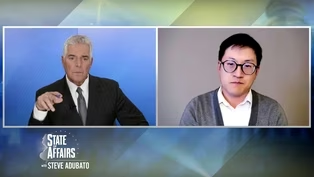
Peter Chen; Cathy Rowe, DrPH; Chris Daggett
Season 9 Episode 32 | 27m 55sVideo has Closed Captions
Peter Chen; Cathy Rowe, DrPH; Chris Daggett
Peter Chen, Senior Policy Analyst at New Jersey Policy Perspective, examines the importance of addressing childhood poverty. Cathy Rowe, DrPH, Executive Director of NJ Advocates for Aging Well, explores the economic and societal challenges associated with aging. Chris Daggett, Board Chair of the New Jersey Civic Information Consortium, discusses the ramifications of news deserts on democracy.
Problems playing video? | Closed Captioning Feedback
Problems playing video? | Closed Captioning Feedback
State of Affairs with Steve Adubato is a local public television program presented by NJ PBS
State of Affairs with Steve Adubato
Peter Chen; Cathy Rowe, DrPH; Chris Daggett
Season 9 Episode 32 | 27m 55sVideo has Closed Captions
Peter Chen, Senior Policy Analyst at New Jersey Policy Perspective, examines the importance of addressing childhood poverty. Cathy Rowe, DrPH, Executive Director of NJ Advocates for Aging Well, explores the economic and societal challenges associated with aging. Chris Daggett, Board Chair of the New Jersey Civic Information Consortium, discusses the ramifications of news deserts on democracy.
Problems playing video? | Closed Captioning Feedback
How to Watch State of Affairs with Steve Adubato
State of Affairs with Steve Adubato is available to stream on pbs.org and the free PBS App, available on iPhone, Apple TV, Android TV, Android smartphones, Amazon Fire TV, Amazon Fire Tablet, Roku, Samsung Smart TV, and Vizio.
Providing Support for PBS.org
Learn Moreabout PBS online sponsorship- [Narrator] Funding for this edition of State of Affairs with Steve Adubato has been provided by The Fund for New Jersey.
The Turrell Fund, a foundation serving children.
Garden State Initiative New Jersey Board of Public Utilities.
Providing New Jersey residents tools to save money on energy costs.
PSEG Foundation.
Holy Name.
The Adubado Center for Media Leadership.
Because media matters more than ever.
Seton Hall University.
Inspiring great minds to greater purpose since 1856.
And by Robert Wood Johnson Foundation.
Working to create a future where health is no longer a privilege, but a right.
Promotional support provided by Insider NJ.
And by NJBIA.
We put business at the center.
[INSPRATIONAL MUSIC] - Hi, everyone, Steve Adubato.
We kick off the program with Peter Chen, Senior Policy Analyst at New Jersey Policy Perspective.
Peter will put up the website for New Jersey Policy Perspective, let everyone know what it is?
- Sure, New Jersey Policy Perspective is think tank.
We're dedicated to advancing social, economic and racial justice in the State of New Jersey through database analysis and research.
- Let's talk about childhood poverty first.
How do we define it?
How serious is the problem?
What do we need to do, please?
- Sure, so, child poverty in New Jersey is a serious problem.
One in eight New Jersey kids live in poverty.
And just to give some context for what that means, if we're talking about a family of four, we're talking about less than $30,000 a year.
And when you think that the median income in New Jersey is around $100,000 a year, that's a very small amount of money to be raising kids.
And the kinds of experiences that they can have would be, can be hampered by their life in poverty.
- What does a new governor, Mikie Sherrill need to do to address along with the legislature and her cabinet, what does she need to do to address the issue?
- Addressing child poverty requires thinking big.
This is not an issue that can be solved by nibbling around the edges.
We saw with the expanded federal Child Tax Credit during the pandemic that this, you know, a substantial investment in children and families can cut child poverty by 40%, 50%.
But that requires real commitment on the part of lawmakers.
And that federal expanded Child Tax Credit went away, and many of the benefits went away as well.
And so what we need to see is some real focus on poverty as a serious issue rather than, as, you know, a nice to have kind of issue.
When we talk about affordability, we've heard over and over, affordability this and affordability that, affordability for children living in poverty is going to be the toughest, right?
The cost of rent, the cost of food.
- That's right.
- Those costs are higher for people living in poverty because they take up a bigger chunk of their income than they do for higher-income folks.
- But, Peter, lemme follow up on this because there's federal policy that impacts childhood poverty, SNAP, right?
Otherwise known as food stamps previously.
Medicaid funding being cut, whole range of federal programs.
What exactly can a state government do with federal government policies impacting in some ways, by the opinion of many in a negative way, children suffering of poverty?
Where's the state?
Where are the feds?
- I think one thing that we've seen is that it's important for states to have their own programs in order to help children and families.
And that relying on the feds is not necessarily a long-term solution where there is so much volatility and dysfunction in D.C.
And so for example, when the federal Child Tax Credit, the expanded version expired, New Jersey created its own Child Tax Credit, right?
Which now provides up to $1,000 for families with kids younger than age six.
So, you know, there are ways that states can try to reduce or eliminate poverty for their own residents.
Certainly New Jersey has a long history of this with its own state-Earned Income Tax Credit, which dates back to I think the Whitman administration.
- You've said that one of the ways to address childhood poverty is to give childhood allowance of $5,000 per child.
What's it now?
- Well, right now no state has a child allowance of the type that we're describing in the- - What would the 5,000 do in your opinion?
- Well, so we looked at some research from our national partners at the Institute on Taxation and Economic Policy as well as work that was done in the wake of the federal expanded Child Tax Credit.
And there were some estimates done to try to see what would take to reduce child poverty by half by state?
And in New Jersey, that number was in the 4 to $5,000 range.
And you know, it seems like an appropriate figure given that the cost of living in New Jersey is higher than in most other states.
- Let's shift gears.
The folks at The Fund for New Jersey.
We've had conversations with Brandon McKoy, the other leaders there about the importance of the census.
There's a 2030 census coming up.
The federal government has the responsibility to count the number of people living in a state, correct?
- That's right.
Yep, it's in the Constitution.
- It's in the Constitution, but how it gets done, exactly when it gets done is now being discussed and debated by some.
But let folks know why the 2030 census is so critically important to the 9.5 million people in the State of New Jersey, particularly the most vulnerable.
- So, there are three main ways that the census is really critical for states and for people in general.
The first is redistricting.
The reason why we have a census, the reason why it's in the constitution is to divide up the districts for legislative and Congressional districts to determine how many Congressional Representatives we have.
New Jersey did not lose a Congressional Representative in the most recent census, which is good for us 'cause it means one more voice in D.C.
speaking- - Well, hold on, lemme clarify something.
There's a set number of members of House of Representatives.
There's 435 members in the House of Representatives.
Doesn't go up, doesn't go down, it apparently, not apparently, the fact is New Jersey has lost House seats in the past because of a loss of population.
Or even if the population that stays the same in other states, Texas, California and others gain population, they have more representation.
That's where it starts.
The legislature has a set number of members in the House, the lower house and the Senate.
But it moves, you don't lose representation in the legislature, but districts get moved around?
- That's right, the borders of districts get moved around, because each district needs to have a roughly even number of people.
But in New Jersey, those State legislative district lines can't go across town boundaries other than Jersey City and Newark.
So, when the census happens, they have to redraw those district lines.
And some districts may shift who their representative is.
Some districts, some towns that may have had an outsize influence on one district may find themselves in a new district.
And so that can definitely affect how political power is divided up across the state.
- If it shifts power around, that's one thing, but we're a policy-centric media series.
How does that potentially impact policy?
- Well, I mean, every time there's a shift in the borders of political boundaries, there's going to be a shift in what political leaders are going to focus on.
We have, for example, you know, real assaults going on on the Voting Rights Act and on the way that legislative districts are drawn to protect Black and Hispanic populations.
And that's, you know, all going into the next cycle and having an accurate account of where people actually live and, you know, who they are is critical to ensure that, you know, those boundaries represent the voice of the people of New Jersey.
- And by the way, team, let's make sure we put up a website so that people can find out more about what the census is, how it works, and why it matters.
Have about minute left.
Let me ask you this, Peter, for the new governor in the State of New Jersey, Christie Whitman, excuse me, Christie Whitman.
We were just doing another segment on the last female governor in the State of New Jersey who was in fact Christie Whitman, the first Democrat, the first woman to be a Democrat and be elected is in fact Mikie Sherrill.
What would you say the number one or two issues she will face as governor when she takes office in January?
What do you believe they are, Peter?
- I think one huge issue is the fiscal state of the state budget.
There are serious landmines waiting for the next governor in the upcoming budget.
Whether it's the traumatic cost increase in State New Jersey, increasing healthcare costs, increasing school funding costs, and a structural deficit that is going to continue to eat away at the state's cash reserves.
And that's gonna make it very challenging to take on new projects, to make the kind of ambitious investments that the state needs.
And for that, the new governor is going to need new revenue.
And finding new revenue in New Jersey is always a challenging topic, but there are ways to ensure that more revenue can be raised without affecting most of the majority of people who live here.
But the second thing that I think is going to be facing the new governor is something that both candidates mentioned on the campaign, which is affordability.
- That's right.
- The costs of living in New Jersey particularly housing, are extremely high and they make it incredibly difficult for raising a family.
Even for folks who do wanna live here, who wanna stay here, who wanna raise a family they can't afford to, because they're getting priced out with rents, you know, skyrocketing and house prices skyrocketing as well.
So, I think addressing affordability with the kind of investments directly in families that can help alleviate those costs is going to be extremely important moving forward.
- And we look forward to an in-depth one-on-one interview with Governor Sherrill around a whole range of issues that Peter is discussing and others.
And make sure you go to the New Jersey Policy Perspective website to find out more.
Peter, thank you so much for joining us.
We'll talk in the future.
- Thanks, Steve.
- You got it, stay with us, we'll be right back.
(grand music) - [Announcer] To see more State of Affairs with Steve Adubato programs, find us online and follow us on social media.
- We're now joined by Dr.
Cathy Rowe, who's Chair of the Lifelong Strong New Jersey Steering Committee.
Cathy, great to have you with us.
- Thank you for having me.
- Let everyone know what Lifelong Strong is.
- So, Lifelong Strong New Jersey, it's a collaborative campaign of advocates, thought leaders, philanthropists, academics who are urging our next governor to prioritize aging in policy, in all forms of policy, so that we can ensure that older adults can age and thrive in the Garden State.
- And you're also Executive Director of the New Jersey Advocates for Aging Well.
So, you have a great compelling op-ed piece, if you will.
- Thank you.
- Opinion editorial piece and spotlight.
This is a quote, "The next governor, Governor Sherrill, has 1.6 million reasons to prioritize aging."
Make the case.
- Well, it is true, 1.6 million New Jerseyans are age 65 and older, and that number is growing.
Proportionately, as a state, like many states, we are aging and it is time for us to prepare for that.
So during the first term of Governor Elect Sherrill, New Jerseyans are going to outnumber the students sitting in our classrooms.
It's time to strategically make change in how we do things, how we prioritize, and how we share our resources.
By 2034, adults aged 60 and older are gonna be 25% of New Jersey's population, and already 40% of our older residents can't meet their basic needs, so our state is aging, the proportion of older adults is aging, and we need to prepare for it now before it becomes a crisis.
We can get ahead of this curve.
- Cathy, I'm sorry for interrupting.
What does that agenda look like?
Top two or three items.
- Well, as Mikie Sherrill campaigned, affordability is a top issue in New Jersey, and that is the same for aging, so housing affordability, property tax relief, healthcare affordability.
- Energy costs.
- Energy costs too.
But we have many programs in New Jersey that help older adults or assist them with these challenges, but we can't keep putting a bandaid on this and fixing problems one-on-one, and we also need to look at helping all of our older residents, not only the most vulnerable, but all of our older adults.
- Cathy, why have you said, it's interesting you said that ageism is the only ism, racism, sexism, a lot isms.
- Yeah.
- You've said that it's sort of acceptable.
- I think it's more than sort of.
I think for some reason, it is still acceptable.
And ageism is discrimination against our future selves.
I mean, unless we all picture ourselves being put on the shelf somewhere, well, we're talking about ourselves, we're talking about our own futures, not just our grandparents or our aging parents.
What do we want as we age?
So if we continue to keep our ageism tendencies, we're just, we're not preparing for ourselves.
We're treating, we're othering ourselves, we're treating ourselves differently, and then we're not part of the conversation about what we want and need in our futures.
- Well, let me push back a little bit.
Some of us who are aging, are in the category you just talked about, we try to deny it.
Some of us lie about our age, others just deny it to ourselves.
That's not actually a strategy, is it?
If that makes any sense.
- No, I can- - In that world, it's not gonna happen.
It's not happening.
It's happening as we speak, so avoiding it, cosmetic surgery, whatever, all those things, you can't avoid it, so are you saying lean into it?
- Exactly, lean in and prepare, and you know, yeah, we do cosmetic surgery, change the way we look, the color of our hair, we can do that, that's all topical.
We're talking about the substance behind it.
What do we need?
Let's expect to age well into our 80s, into our 90s, and think about what we need.
We need housing, we need transportation, we need economic security.
We need social connections and actually things to do.
We're not gonna sit around in a rocking chair.
Let's blow up that ageism stereotype.
So let's lean in and think strategically about what we want and what we need to get there.
- You know, as I talk to my mom, who I know watches on a regular basis, who is 90, Ma, you can't lie about your age 'cause I've said it before on the air.
So my mom often will say to me, and because she loves going out and being around people, that one of the worst things for her, because she's so sharp, so smart, so engaged, so aware, is sometimes feeling isolated.
That's not uncommon, Cathy, is it?
- You are absolutely correct, it's not, and you know, for some reason we are rightfully focused on social isolation among our younger population, how social media has impacted that.
- That's right.
- That conversation about older adults who are socially isolated because their partner may have died or might not be this same person they've lived with all the years, their family has moved away, their friends are no longer mobile or nearby, so I think it's age, we know that this has a huge mental health impact on younger people.
It affects all of us at every stage of our life.
It's not that anything gets magically better when we turn 60 or 65.
All of the same issues are there, some are more pronounced, and we know now, from our previous surgeon general, that social connection and fighting loneliness is the equivalent of giving up smoking a pack of cigarettes a day.
This isn't just something nice, this is something necessary.
It affects our mental, physical, and social wellbeing.
- Hey Cathy, let's make sure we continue talking about issues impacting older New Jerseyans and Americans' ageism, and last time I checked, even though some of us tried to deny it by doing all sorts of things, and working out is great, and all those things are terrific, but in the end, I don't think any one of us can avoid getting older.
Let's do it together and let's lean in as Cathy said.
Hey, thank you, Cathy, appreciate it.
- Thank you for having me.
- We'll continue the conversation.
Stay with us.
We'll be right back.
(grand music) - [Announcer] To see more State of Affairs with Steve Adubato programs, find us online and follow us on social media.
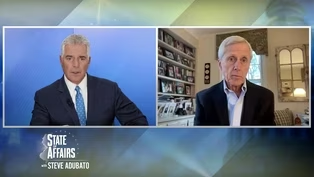
- We're joined once again by Chris Daggett, who is the chairman of the board, the board chair of the New Jersey Civic Information Consortium.
Good to see you, Chris.
- Good to see you, Steve.
- We have the website up right now for the consortium.
Tell everyone what it is and why it matters more than ever.
The graphic will also come up for Media Matters, which is our media series, please.
- So the consortium was formed in 2018 by a bipartisan effort in the legislature, led by a group called Free Press out of Washington, who came and helped get people interested in response to the collapse of local news sites all around New Jersey.
The legislature passed a law that created an independent, nonprofit organization called this consortium, and so we've been in operation since 2018.
- And also, press forward, Dale Anglin, who is the CEO there, checkout our website.
It'll be up right now, SteveAdubato.org.
We did an in-depth interview with Dale, and she provides important perspective here.
So help us on this.
There are a couple of facts that are shocking to me, but not to you because you live this every day.
New Jersey ranks 50th outta 51 states, that includes DC, with only 5.1 local journalists per 100,000 people.
That's horrific.
It creates all these news deserts.
Why is that so bad for the state and our people, Chris?
- Bad because when people aren't informed, they're not engaged in their community.
When civic life is such that people don't participate in what's going on in the activities around them, democracy suffers and the communities are not nearly as successful as they would be with that kind of participation.
- And the consortium provides grants to largely local media organizations.
- Correct, nonprofit and for-profit online, local news organizations, and our focus has been on marginalized communities and so-called news deserts where people have little to no local news whatsoever other than what they might find on Facebook feeds from friends or TikTok or some other social media sites.
- Yeah, talk about that, Chris.
I often pick up my phone and go, "Hey, listen, "somebody on the algorithm team knows what I look for."
Why, Chris, without being overly philosophical or theoretical, if someone said, someone watching right now goes, "Adubato, there's all this stuff Media Matters "and he's got Chris Daggett on, "so many other people, talking about this."
I've got my phone.
I'm on TikTok.
I'm on Facebook.
I'm on Instagram.
They know what I want.
Why is that not, quote, "news," Chris?
- Well, it is a form of news.
I mean, it provides them with some information.
That information has been fact checked or whether it is about the kinds of events in their local communities that may matter to the community and may result in civic engagement, whether it be a new development or something about entertainment in the area or a school board meeting or a planning board or zoning or a town council meeting.
All those are very important, and there's little to nothing on Facebook sites or TikTok sites about those meetings that you would say is news in the sense that it's been curated in some fashion, it's been fact checked, and people are doing anything more than expressing their opinion.
- Chris, you have served in state government in the past, correct?
- Right.
- You understand state government better than most.
New governor, Mikie Sherrill, what, if you were advising her and her administration as to what the state's role should be as it relates to media, public media in the state, but at the same time, not going back to having the state run a public media operation, which was the previous entity, New Jersey Network, who did a great job, but it was a state agency.
Talk about this, Chris.
What should the role of state government be to promote and protect free media in the state?
- So the advertising model, which historically has supported news throughout the state, whether it be broadcast, journalism, or whether it be paper, or whatever it happens to be, collapsed with the rise of the internet, and with that collapse is the collapse of journalism, if you will, and the collapse of local news sites who are supported by that advertising.
So, in my view, public support is necessary, at least until such time as a new financial model to replace the advertising model is developed.
People have been at this for 15 years now.
No one's really come up with anything that's sustainable over time.
They use grants from foundations.
They use membership models.
They use advertising to the degree that they can on the internet.
It doesn't generate that much revenue.
And when you combine all of it, it's still inadequate to support a thriving local news ecosystem.
So I think public support is necessary at least for the probably, not just the near term, but maybe five or 10 years minimum and possibly longer.
And so what does that look like?
New Jersey needs to set up independent entities like the consortium that can provide grants to online local news outlets or other outlets and provide that kind of support that gives them the base to be able to do this important part of civic life, which is letting people understand what's going on in their communities.
- But not control.
See, this is where it gets really tricky, because, and I'm not gonna get political about this, but President Trump has also often called those of us in the media, "the enemy of the people."
And he'll often say, and again, people can like who they like and that's their right, but when the president says he will engage with media organizations that quote, "are nice to him and agree with him," this isn't political, that's not our job to be nice or to like Governor Sherrill or President Trump.
It is our job to be independent arbiters of what we think truth is and facts and have people with different points of view.
Are we supposed to be rooting for the home team here, Chris?
- So, no, we're not supposed to be rooting for the home team, we're supposed to be reporting on what the home team is doing on a day-to-day.
- Last time I checked, yeah.
- And we have this unique opportunity in New Jersey now that virtually no other state has.
We have no commercial television station based in New Jersey.
We have radio stations that are owned mostly by either New York or Philadelphia entities.
- That's right.
- And we have a collapse of local journalism.
But we have an opportunity in this to figure out, because of the fact that the New Jersey public television license that NET held for 15 years has- - WNET, our long time, sorry for interrupting.
WNET, 15 years ago, 2011, with the Caucus Educational Corporation as a key player in that.
The state owns the license.
WNET operated the station, then known as NJTV, then NJPBS, that license, excuse me, that agreement ends on the last day of June, 2026.
The opportunity is what, Chris?
Got a minute left.
- The opportunity is what comes next.
How do you build a public media ecosystem that includes not only the public television, but public radio, local news, how do you put all that together?
And the opportunity is, this is the first time we really have the chance to be shaping New Jersey news as New Jerseyans.
We're not under the shadow of New York with WNET, or the shadow of Philadelphia with its commercial and public television stations, we have an opportunity to do something here for New Jersey, that could be a model for the rest of the country, particularly given the cuts in federal funding for public broadcasting around the United States.
So, the question is how we do that, and that's what's at issue right now, and that's the opportunity that faces, I mean, Governor-Elect Sherrill as she comes into office, - Chris Daggett is the board chair of the New Jersey Civic Information Consortium.
Go on the website, find out more.
And the one commitment I'll make to everyone watching, I've said this many times.
We will, State of Affairs, Think Tank, One-on-One, We will be part of whatever that universe looks like to try to make a difference.
That's our agenda, and I know it's Chris's as well.
Chris, thanks for joining us.
We'll see you next time.
- Thank you.
- We'll continue the conversation.
I'm Steve Adubato.
That's Chris Daggett.
See you next time.
- [Narrator] State of Affairs with Steve Adubato is a production of the Caucus Educational Corporation.
Funding has been provided by The Fund for New Jersey.
The Turrell Fund, a foundation serving children.
Garden State Initiative New Jersey Board of Public Utilities.
PSEG Foundation.
Holy Name.
The Adubado Center for Media Leadership.
Seton Hall University.
And by Robert Wood Johnson Foundation.
Promotional support provided by Insider NJ.
And by NJBIA.
- At the New Jersey Board of Public Utilities, affordability is always top of mind.
We offer a variety of energy assistance and other programs to help New Jersey residents reduce their energy use and save money.
The Community Solar Energy Program delivers immediate electric bill savings to all subscribers regardless of income, and our free Comfort Partners program helps qualified residents save money and make energy efficient upgrades.
We work to put affordability within reach for New Jersey residents.
Addressing the prevalence of childhood poverty
Video has Closed Captions
Clip: S9 Ep32 | 11m 6s | Addressing the prevalence of childhood poverty (11m 6s)

Exploring the societal challenges associated with aging
Video has Closed Captions
Clip: S9 Ep32 | 7m 39s | Exploring the societal challenges associated with aging (7m 39s)
The impact of news deserts on democracy & local communities
Video has Closed Captions
Clip: S9 Ep32 | 9m 56s | The impact of news deserts on democracy & local communities (9m 56s)
Providing Support for PBS.org
Learn Moreabout PBS online sponsorship
- News and Public Affairs

Top journalists deliver compelling original analysis of the hour's headlines.

- News and Public Affairs

FRONTLINE is investigative journalism that questions, explains and changes our world.












Support for PBS provided by:
State of Affairs with Steve Adubato is a local public television program presented by NJ PBS